Tuesday, April 2, 2019

Expanding School Choice: Making Education More Accessible or Bureaucratic Boondoggle?

Expanding School Choice: Making Education More Accessible or Bureaucratic Boondoggle?

Expanding School Choice: Making Education More Accessible or Bureaucratic Boondoggle?
The Trump administration’s proposal would make Catholic schooling more accessible, but it raises concerns about federal overreach.


WASHINGTON — Education Secretary Betsy DeVos introduced a proposal last month, aimed at expanding school choice, that would provide “a $5-billion annual federal tax credit for voluntary donations to state-based scholarship programs.”

While some groups welcome the proposal as a way to help make Catholic and private schools more accessible to lower-income families, others have raised questions about its long-term effects on the federal government’s influence on education.

The “Education Freedom Scholarships” plan has been introduced in both the House and Senate by Rep. Bradley Byrne, R-Ala., and Sen. Ted Cruz, R-Texas. The Department of Education (DOE) explained that these scholarships “will be funded through taxpayers’ voluntary contributions to state‐identified Scholarship-Granting Organizations (SGOs),” and the taxpayers who contribute will get a “non‐refundable, dollar‐for‐dollar federal tax credit.”

They emphasized that the scholarship program “will not create a new federal education program” but “instead will allow states to decide whether to participate and how to select eligible students, education providers and allowable education expenses.”

“The key element of the proposal is freedom for all involved,” DeVos said in a statement announcing the program. “Students, families, teachers, schools, states — all can participate, if they choose, and do so in the ways that work best for them. The major shift is that a student’s needs and preferences, not their address or family income, will determine the type and quality of education they can pursue.”

According to the DOE, states could put the program funding toward an array of educational opportunities for students, including private and home education, special-education services and therapies, summer and after-school education programs, and tutoring for students in low-performing schools.

However, several prominent organizations that advocate for school choice have come out in opposition to the proposal, raising concerns over the consequences of this kind of federal involvement in state school-choice programs.


Constitutional and State Concerns

Lindsey Burke, the director of the Center for Education Policy at the Heritage Foundation, told the Register that, while the Trump administration’s support for school choice is welcome, “establishing a nationwide federal tax credit scholarship program goes in the wrong direction: It would grow, rather than shrink, federal intervention in K-12 education.”

Burke explained that the tax credit could incentivize a certain kind of giving that could hurt state programs.

“A dollar-for-dollar tax credit at the federal level could also mean donors give first to the more generous federal program (most state programs are not dollar-for-dollar),” she said, “and then, if they still have funding available, contribute to their state program. That CONTINUE READING: Expanding School Choice: Making Education More Accessible or Bureaucratic Boondoggle?


Ed Notes Online: NYSAPE Final Press Release - NYS Education Commissioner Mary Ellen Elia Creates a Culture of Fear, Intimidation, and Misinformation in our Schools

Ed Notes Online: NYSAPE Final Press Release - NYS Education Commissioner Mary Ellen Elia Creates a Culture of Fear, Intimidation, and Misinformation in our Schools

NYSAPE Final Press Release - NYS Education Commissioner Mary Ellen Elia Creates a Culture of Fear, Intimidation, and Misinformation in our Schools


Today's straw man:
Old UFT/AFT buddy Mary Ellen Elia under attack. Anti-Opt- out is a UFT signature- and a vote for Unity is a vote for supporting Elia and high stakes testing.


It's Monday, April 1st and it is no April fool’s joke of what’s going on around the state. Please share widely, here’s the link to share all over social media:

FOR IMMEDIATE RELEASE: April 1, 2019
More information contact
Jeanette Deutermann  
nys.allies@gmail.com
Kemala Karmen  nys.allies@gmail.com
NYS Allies for Public Education - 
NYSAPE


NYS Education Commissioner Mary Ellen Elia Creates a Culture of Fear, Intimidation, and Misinformation in our Schools

The Every Student Succeeds Act (the federal law known as ESSA) gives states authority to design their own unique accountability plan regarding the state tests. Unfortunately, Commissioner Elia has used that authority to misinterpret ESSA, and has used ESSA as an opportunity to impose a culture of fear on our administrators and teachers, and our children.  Under Commissioner Elia’s direction, the State Education Department (SED) at best turns a blind eye to, and at worst encourages, school districts to bribe, coerce, manipulate, and threaten students and parents into complying with a broken assessment system.
As we head into the first round of 2019 grades 3-8 state testing, NYSAPE is receiving an unprecedented number of reports from parents statewide about morally objectionable, educationally unsound, and in some cases, illegal policies and tactics that local schools and districts are using in attempts to suppress test refusal. Parents are reporting bribery with prizes, parties, and exemptions from district course finals. Students CONTINUE READING: Ed Notes Online: NYSAPE Final Press Release - NYS Education Commissioner Mary Ellen Elia Creates a Culture of Fear, Intimidation, and Misinformation in our Schools


CHARTERS: NJ press–finally–smells rot, but proposes reforms that continue racist policy |

CHARTERS: NJ press–finally–smells rot, but proposes reforms that continue racist policy |

CHARTERS: NJ press–finally–smells rot, but proposes reforms that continue racist policy


Deseret Segura, 16, comforts her grandmother, Deseret Richardson, 83. The older woman was weeping her granddaughter would be transferred to a school far from home they shared because of the so-called “One Newark” enrollment plan. It was designed by Christie administration to ensure charter school enrollment growth. It continues today despite promises by Mayor Ras Baraka to end it. ( 2014 Photo by Bob Braun)

A recent series of articles in The Record of North Jersey described how the “flawed experiment” of charter schools cost the state millions in public dollars. While it is gratifying that—finally— a major mainstream news outlet in New Jersey noticed the corruption inherent in publicly-funded but privately-operated  charter schools,  this eureka moment  not only comes late—about five years after it was originally exposed in these pages—but it also skips over the human casualties caused by the corrupt and racist spread of charter schools in New Jersey’s cities.
And, in the end, the series teaches the absolutely wrong lesson and promotes the absolutely wrong solution—that, if only the Legislature can change the laws governing the construction of privatized schools, everything will be fine. The series, far from calling for an end to the theft of public school funds to finance charter expansion, calls for so-called “reforms” that would make it easier for charters to expand—and further degrade  public schools.  
“Just introduce legislation,” The series quotes former Assembly Speaker Joseph Doria, a long-time champion of charter schools, someone frequently mentioned in the series. The articles also frequently cite the vies of wother charter proponents.
No. No. No. No. That’s wrong.
Wrong because, the basic, irrefutable truth about charter schools is this:
They take away money from public schools—especially in New Jersey’s largest cities where resources are scarce. They are replacing public schools with money that should be used to repair public schools.
They are replacing regular public schools and that was never the intent.
Following the series’ suggestions would mean more charter schools, less money for public schools, and a continuation–even enhancement–of the racism that propels public education policy in New Jersey’s cities.
 The truth about privately operated charters and how they are built and operated with public funds  has been glaringly obvious for years—but few in the CONTINUE READING: CHARTERS: NJ press–finally–smells rot, but proposes reforms that continue racist policy |

New Jersey Expose, Part 4: Cashing in on Real Estate Deals in the Charter Market | Diane Ravitch's blog

New Jersey Expose, Part 4: Cashing in on Real Estate Deals in the Charter Market | Diane Ravitch's blog

New Jersey Expose, Part 4: Cashing in on Real Estate Deals in the Charter Market


This post is part 4 of a series published by northjersey.com and USA Today New Jersey. Written by Jean Rimbach and Abbott Koloff, it is called “Cashing in on Charter Schools.” It explores the many ways that charter operators exploit taxpayers.
“Interest-only mortgages with rates that grow each year. Multimillion dollar fees for paying off loans early. Property that quickly doubles in price. And buildings sold with markups as high as 70 percent.
“Deals like these inked by New Jersey charter schools — or the private groups that support them — highlight how tax dollars meant for public education can reap profits for investors.
“But they also illustrate the lack of options some charter schools face when trying to find and finance facilities — and an absence of state oversight in the process.
“State education officials say they have no authority to review financing or lease agreements struck by charter schools before they are signed. And they don’t police the private organizations, often called “Friends of” groups, that are created to support charter schools by owning or financing their real estate and, in many cases, enter into contracts on a school’s behalf.
“That includes groups like the Friends of Marion P. Thomas Charter School, which agreed to buy two former Newark public school buildings and paid a deposit but said they couldn’t get financing to complete the purchase. So the group struck a deal with a developer who bought CONTINUE READING: New Jersey Expose, Part 4: Cashing in on Real Estate Deals in the Charter Market | Diane Ravitch's blog


Garn Press Publishes a Collection of My Most Important Essays | Diane Ravitch's blog

Garn Press Publishes a Collection of My Most Important Essays | Diane Ravitch's blog

Garn Press Publishes a Collection of My Most Important Essays


Garn Press, one of the nation’s valuable independent publishers, has compiled a collection of my most important essays. I am grateful for their hard work and dedication in bringing the book to fruition.
The book is titled “The Wisdom and Wit of Diane Ravitch.”
It contains essays published on this blog, the New York Review of Books, Huffington Post, and the Education Week blog that I shared for five years with Deborah Meier.
I am grateful for the prodigious research that went into this effort by publisher and literary scholar Denny Taylor and her team, as well as the elegant design.
Yohuru Williams, the great scholar of African-American history and my colleague on the board of the Network for Public Educatuon, wrote the introduction.
Should there be any royalties, I have asked that they be given to the Network for Public Education.

To learn more about the book, open any of these links:

Charter Chains Pay Out Salaries Like… Corporations, Even While Enrollment Erodes – redqueeninla

Charter Chains Pay Out Salaries Like… Corporations, Even While Enrollment Erodes – redqueeninla

Charter Chains Pay Out Salaries Like… Corporations, Even While Enrollment Erodes


Education Privatizers have made a private market out of the public sector.
In tax year 2016, the top-10 salaries from among LAUSD’s 37 Charter Management Organizations/Groups (CMO/Gs) totaled $3.4 million dollars:

Private-industry salaries are generated for top execs, which are justified by branding the remade sector as now “business”. From nowhere these usurpers have constituted a whole new economy, transforming what was formerly the people’s prerogative educating human beings and citizens, into a private dynamo generating paper-profit simply by transferring public tax dollars to private coffers.
The exercise enriches an elite few, even while being justified by metrics selected to illuminate precisely the subpopulation cherry-picked. Nice work if you can get it; a lucrative sector to bolster.
Elsewhere it was noted that LAUSD has chartered 275 schools, nearly 2/3 of which (61%) are run by the following 37 CMO/Gs:
The names and salaries (where existent) of Charter CMO/G board members were abstracted from each of their most recent IRS 990 Form for Non-profits. Most postings were late of 2016, but some dated to 2015.
It is interesting to note the names of board members not on salary too, and these follow at the bottom. Often though not always, these individuals come with deep bank accounts and broad ideologies linked to privatization generally or this CONTINUE READING: Charter Chains Pay Out Salaries Like… Corporations, Even While Enrollment Erodes – redqueeninla

Badass Teachers Association Blog: Don’t Treat Schools Like Competitive Businesses by David Negaard

Badass Teachers Association Blog: Don’t Treat Schools Like Competitive Businesses by David Negaard

Don’t Treat Schools Like Competitive Businesses by David Negaard


Originally posted at: https://www.civilbeat.org/2019/03/dont-treat-schools-like-competitive-businesses/?fbclid=IwAR0COMqiueZzgJf8UNZBdYU5WpcYnS24UzhunPQxoIRIUpJYBWxLtUMf2MU

Once more for the people in the back: Schools aren’t businesses, kids aren’t product, employers aren’t schools’ customers or clients, and standardized tests aren’t quality control. It is not schools’ primary function to produce (compliant, obedient) employees for the titans of industry, but rather self-actualized citizens who think critically and effectively and can create a better future for themselves and for all of us.
NOTE: pick the correct link
The purpose of public schools is to elevate all students. All public schools have the same basic goal and do not and should not compete with one another for resources, for students, for anything. Neither should public school students compete with one another for opportunities or status.
Whether schools or students, when they compete, there are winners and losers, and that is contrary to the premise of public education. Neither schools nor students should be subject to Darwinian “survival of the fittest”  pressures. Competition (fostered by so-called “school choice” and “accountability” initiatives) pits would-be allies — schools, principals, teachers, even students — against one another and “may the odds be ever in your favor.”
Recently, HawaiiKidsCAN, a branch of venture capital-funded “50CAN: The 50-State Campaign for Achievement Now,” published a critique (“analysis”) of Hawaii public schools based on 50CAN’s “four dimensions of a healthy and dynamic learning system.” Among the “lenses” they use CONTINUE READING: Badass Teachers Association Blog: Don’t Treat Schools Like Competitive Businesses by David Negaard

Choosing Democracy: Sacramento Teachers Uprising ? #Unite4SACKids #WeAreSCTA #WeAreCTA #strikeready #REDFORED #SCTA #CTA

Choosing Democracy: Sacramento Teachers Uprising ?

Sacramento Teachers Uprising ?


The #RedForEd Wave has already swept through Los Angeles and Oakland this year, with thousands of brave educators going on strike and leading massive movements to fight for the soul of public schools. Is Sacramento the next big fight of the Educator Uprising?
Frustrated and fed-up by continued deceit, disrespect and outright violation of their contract, Sacramento City Teachers Association (SCTA) voted to authorize a strike over egregious unfair labor practices and unlawful activity by Sacramento City Unified School District’s superintendent and school board. With 70 percent of SCTA members voting, 92 percent approved a strike to stop the district’s unfair practices and unlawful behavior, SCTA leaders announced Friday.
The SCTA bargaining team offered to meet with SCUSD at the end of the month to give the district an opportunity to correct its ongoing unlawful behavior. If SCUSD’s conduct and unfair practices continue, the executive board is authorized to set a strike date, likely in the next month.
“It’s truly unfortunate that teachers may be forced to strike to get Superintendent Jorge Aguilar, Board President Jessie Ryan and other district leaders to obey the law, including things as simple as agreeing to meet with us and honoring agreements they signed 15 months ago,” said Sacramento City Teachers Association President David Fisher. “What kind of example are they setting for the 40,000 students in our district?”
If 2,800 Sacramento City educators do indeed go on strike, it would be the first #RedForEd-era strike in the country over unfair labor practices and a school district reneging on a contractual agreement. SCTA says SCUSD’s continued unlawful activity is giving them no choice but to take direct action. These transgressions include:
  • Refusing to honor the collective bargaining agreement approved by both sides in December 2017, which included class-size reduction and increased numbers of school nurses and psychologists, violating the contract;
  • Refusing to meet at reasonable times and places with representatives the educators have elected to have represent them, and attempting to dictate who the teachers have represent them at the bargaining table;
  • Making unilateral and unlawful changes to the wages and working conditions of teachers without bargaining;
  • Failing to send district representatives to the bargaining table who have the authority to negotiate on behalf of the district, rendering bargaining meaningless.
SCTA has also challenged the legality of recent school board actions to lay off 400 educators in light of alleged violations of the Brown Act’s open meeting requirements (detailed here and here). Additionally, SCTA has questioned SCUSD’s gross fiscal mismanagement—the district stands on the brink of state takeover due to insolvency, particularly in the aftermath of a scathing audit by the State of California’s Fiscal Crisis Management Assistance Team. If all that wasn’t enough, there are also serious unanswered questions about potential conflicts of interest by Superintendent Aguilar and other top district administrators. Recently, the California Joint Legislative Audit Committee directed the state auditor to conduct a forensic audit of SCUSD due to growing concerns of fiscal mismanagement.
Follow SCTA on Facebook and Twitter for the latest news on this fight.
Choosing Democracy: Sacramento Teachers Uprising ?


CURMUDGUCATION: Accountability Beyond the Bubble

CURMUDGUCATION: Accountability Beyond the Bubble

Accountability Beyond the Bubble


Accountability has always been an educational buzzword, and the modern reformy era has put accountability on a high, if somewhat cockeyed pedestal. Testing? Not testing? Running test scores through models soaked in magic VAM sauce? Regular school visits, inspections and audits? Administrators and school boards that actually pay attention? A big fat stack of state and federal regulations and reports thereon? So many fun things are on the table these days.

But as with many reformy subjects, what's really being discussed is accountability for large, urban districts. Those districts face a unique set of challenges, all of which boil down to these districts just being too damn big.

That gets us models like "Filling out a bunch of paperwork that may or may not have any connection to reality" (spoiler alert-- it's "not") or "Creating and administering instruments that purport to measure something that is alleged to be a proxy for the thing we really want to measure" (spoiler alert-- it doesn't). This gets us highly politicized grandstanding as well as representative bodies that may or may not truly represent poor and powerless neighborhoods-- the very neighborhoods that need schools that have strong and responsive support.

There's a good accountability model you can find out here in rural spaces and small towns. It's the living in the community you serve model.

I taught in a small town for almost forty years; in fact, I taught at the same school from which I graduated. I live in the town, a smallish place with a steady drain on our population, but not many new folks moving into town. I cannot take a step without encountering a former classmate, student, student's parent, or student's offspring.

This has always meant a special level of accountability. If I assigned something that folks disagreed CONTINUE READING: 
CURMUDGUCATION: Accountability Beyond the Bubble


Charter Moratorium on Tap: Update on Legislative Effort in California | Cloaking Inequity

Charter Moratorium on Tap: Update on Legislative Effort in California | Cloaking Inequity

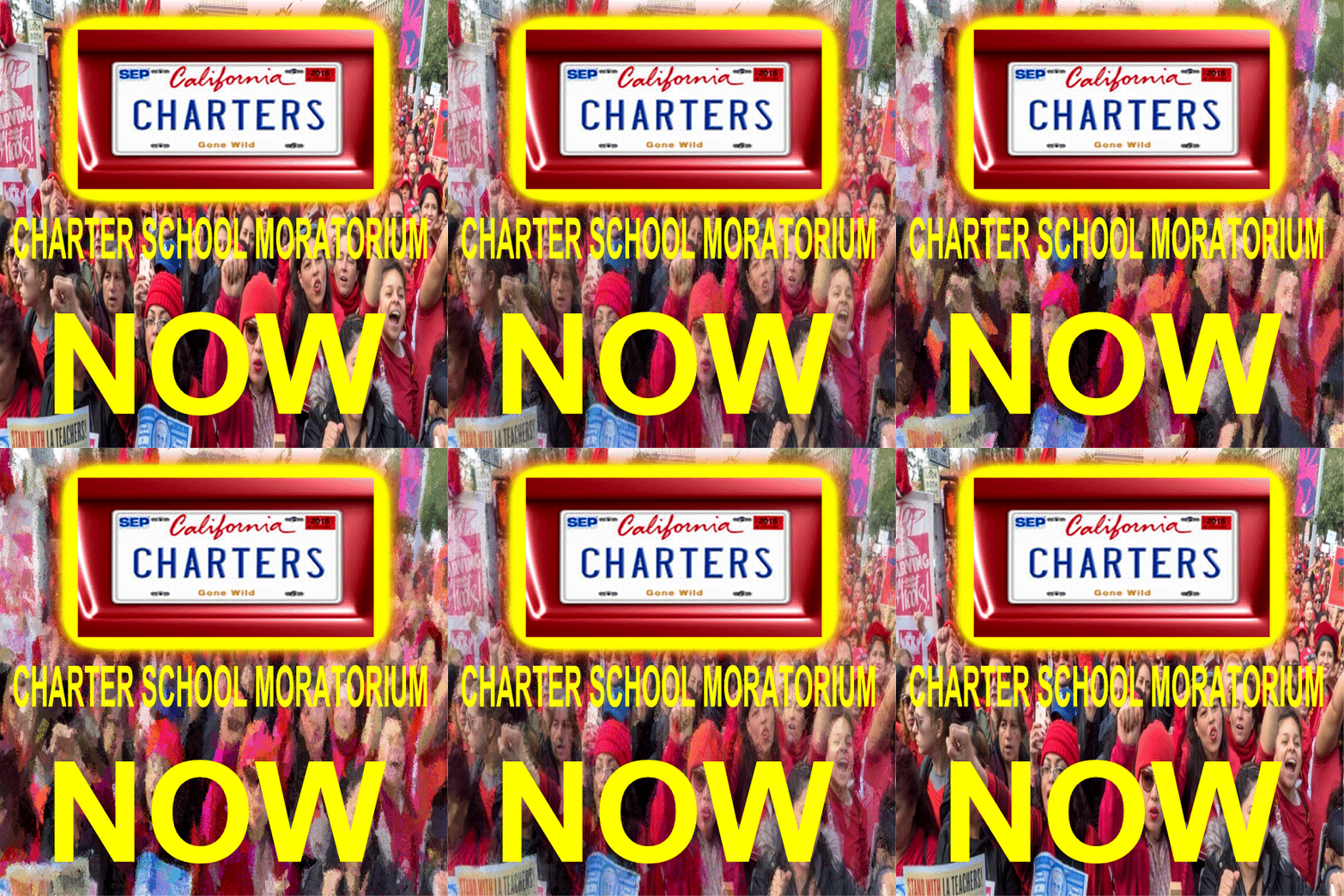
CHARTER MORATORIUM ON TAP: UPDATE ON LEGISLATIVE EFFORT IN CALIFORNIA


First, a charter moratorium bill was filed this morning in California SB 756. I knew the spot bill would be a moratorium, but of course I couldn’t say that publicly before it happened. Here is how it reads now.
The Charter Schools Act of 1992 authorizes the establishment and operation of charter schools. Existing law generally requires a petition to establish a charter school to be submitted to the governing board of a school district, and, under specified circumstances, authorizes a petition to be submitted to and approved by a county board of education or the State Board of Education. Existing law prohibits the governing board of a school district from denying a petition to establish a charter school unless it makes written factual findings in support of one or more specific findings.
This bill would express the intent of the Legislature to enact legislation containing specified policies relating to charter schools on or before January 1, 2020, and would prohibit, notwithstanding any other law, the approval of a petition for the establishment of a new charter school until June 30, 2024, unless those specified policies are enacted. The bill would require, during the 2023–24 school year, the Legislative Analyst’s Office to publicly issue a report that answers specified questions relating to charter schools and the effects of the moratorium, or, if applicable, the specified policies enacted by the Legislature.
This is HUGE. The NAACP’s call for a charter moratorium could become law in California!
Legislative staff also provided the following update on other charter legislation.
Assemblymembers O’Donnell and Bonta are pleased to announce that they have decided to combine their separate charter school reform bills into one joint bill.  In light of the many recent questions trying to distinguish the difference between the bills as they relate to fiscal impact, it seems the most strategic thing is to combine the bills so there can be one bill on the fiscal impact of charter schools on school districts.
AB 1505 will be amended tomorrow to include the elements from AB 1508. Assemblymember Bonta will also be added to AB 1505 as a joint author.  AB 1508 will be amended to be a different topic in education and heard at a later date.
The amendments to AB 1505 will go across the desk tomorrow.
  • Allows school districts to consider fiscal, academic and facilities impact of charter school petitions on the neighborhood schools and the district.
  • Authorizes countywide charter schools to be approved by counties if school district approval is obtained first.
  • Require charter petitions to provide a clear explanation of why proposed model cannot be accomplished within the school district structure of neighborhood public schools.
  • Requires charter school teachers to hold the CTC credential required for their assignment.
  • Changes the petition approval timeline from 30 to 60 days and 60 to 90 days.
  • Require charter petitions to include a description of how the school will achieve a balance of special education students and English learners.
The bills will be heard on April 10th during a special order of business at 1:30pm.
Will California pass legislation this year that will be a model for the rest of the nation? I think so.
If you’d like to file support letters for AB 1505, AB 1506 and AB 1507 they are due Tuesday by 5pm, in order to be reflected in the analysis.
p.s. I know what 1508 will be too and it’s even better than a moratorium. ๐Ÿ˜‰
Please Facebook Like, Tweet, etc below and/or reblog to share this discussion with others.
For all of Cloaking Inequity’s posts on charters click here.
Check out and follow my YouTube channel here.
Twitter: @ProfessorJVH
Click here for Vitae.