Latest News and Comment from Education

Tuesday, June 27, 2017

Michigan: State Takeover Effort Collapses, Schools Will Return to Detroit Public School District | Diane Ravitch's blog

Michigan: State Takeover Effort Collapses, Schools Will Return to Detroit Public School District | Diane Ravitch's blog:

Michigan: State Takeover Effort Collapses, Schools Will Return to Detroit Public School District


Michigan’s Education Achievement Authority is closing down, and the low-performing schools put into the state-controlled district will be returned to the Detroit public schools.
The EAA was a disaster from the beginning. Its leaders had total control, and they used it to run experiments on the children, using technology. They ran up the bills and produced no academic improvements. The first leader was Robert Bobb, with Barbara Byrd-Bennett as chief academic officer (BBB is now sentenced to jail time for taking bribes in her role as superintendent of the Chicago public schools). Then there was Broad-trained John Covington, who increased the deficit, then moved on. At all times, Eli Broad was deeply involved in creating and staffing the EAA. This Friday is the last day for the EAA.
The EAA’s 15 schools will stay open, but they’ll be absorbed back into the Detroit Public Schools Community District. Sonya Mays, treasurer for the DPSCD school board, says the district is working with the EAA to make it a smooth transition for students.
The two districts are coordinating on transferring school records, communicating with families, and hiring administrators and teachers, among other things.
“And so it’s our hope, and we’ve tried to be very intentional about this, that students themselves will see very little disruption,” Mays said.
Big Education Ape: CURMUDGUCATION: The Takeover Lie - http://bigeducationape.blogspot.com/2017/05/curmudgucation-takeover-lie.html
 
Big Education Ape: STATE TAKEOVER: An Achievement School District Primer - Mitchell Robinson: Reforming Reform - http://bigeducationape.blogspot.com/2015/07/state-takeover-achievement-school.html

Big Education Ape: Experts warn of murky results from State Takeover charter schools - http://bigeducationape.blogspot.com/2016/06/experts-warn-of-murky-results-from.html

We have become too Permissive, not Progressive. | DCGEducator: Doing The Right Thing

We have become too Permissive, not Progressive. | DCGEducator: Doing The Right Thing:

We have become too Permissive, not Progressive.

images

Defined as granting or inclined to grant permission as in permissive parents; characterized by freedom of personal behavior or a disregard of social mores, the term was heavily used to describe the parenting practices of my generation of baby boomers. It was sparked by the changes of the 1960s and a revolt against the practices of their far stricter parents. As in every decision in life, there were intended and unintended consequences to this generational decision. Were the consequences of the acceptability of permissiveness the far-reaching social, economic, and political issues we face today in our wild and wacky society?
I am a proud independent, anti-authoritarian, libertarian, liberal and moderate progressive. (If you know me, pick your own label.) But folks, somehow we got things totally screwed up. I know what I am about to go on record saying may piss off a bunch of you but tough shit. See, I already did, but made George Carlin Proud.
Speaking of my comic hero, why is it that the most anti-authoritarian, independent, libertarian, liberal, progressives in our country today are comics We have become too Permissive, not Progressive. | DCGEducator: Doing The Right Thing:

John Thompson: North Highland Elementary an important history lesson - NonDoc

North Highland Elementary an important history lesson - NonDoc:

North Highland Elementary an important history lesson

North Highland


It would have been a mistake to follow through with an initial plan to abruptly close North Highland Elementary School without taking time to consult with the community or to make plans. To her credit, Superintendent Aurora Lora has backed off from that approach.
Also to its credit, the current OKCPS administration now acknowledges the need for wraparound services. In announcing a change to its plans after the school was burglarized and vandalized Friday night, the administration explained,
… district teams will work to staff the building with additional supports including an extra assistant principal, full-time counselor, and two social workers, all of which were allocated to North Highland prior to the consideration of a temporary closure.
 North Highland vandalism

Classrooms, hallways and offices were vandalized at North Highland Elementary School following news it would be temporarily closed. The school will now remain open. (OKCPS)

North Highland problems in 2012 led to brief closure

In 2012, then-Oklahoman reporter (and current school board member) Carrie Coppernoll covered the brief closure of the school to discuss its rampant disorder. OKCPS said that half of the faculty was new, but turnover was a long-standing problem. It admitted, “Sometimes we may Band-Aid something when really we need a full 9-1-1 effort,”
The district pledged to get to the roots of the situation. Instead, it focused on the easy “areas of teacher training, including behavior, [and] classroom management.”

Segregation by any other name …

Many of the problems facing today’s North Highland neighborhood can be traced to the way the Oklahoma Industries Authority conducted urban renewal, wrecking a proud African-American community and the way that families were relocated to the Highland.
For unnerving accounts of how urban renewal created the same destruction across the North Highland Elementary an important history lesson - NonDoc:

LILY ESKELSEN GARCÍA: The Supreme Court just let a church use public funds to fix its playground. Will this shift public education’s terrain? - The Hechinger Report

OPINION: The Supreme Court just let a church use public funds to fix its playground. Will this shift public education’s terrain? - The Hechinger Report:

OPINION: The Supreme Court just let a church use public funds to fix its playground. Will this shift public education’s terrain?
Here’s why the ruling in favor of Trinity Lutheran may not be a green light for vouchers


hen the U.S. Supreme Court agreed in 2016 to hear arguments in Trinity Lutheran Church of Columbia, Inc. v. Comer, school voucher advocates saw an opportunity.
The case actually revolved around the specific question of whether the state of Missouri could refuse a grant to resurface a playground to a church solely due to the fact that the church is a religious institution.
But a broad enough ruling in favor of the church could dismantle so-called “no aid” provisions that states have enacted to ensure that state resources for public schools were not diverted to private religious institutions. This was the invitation voucher proponents made to the nine justices.
On Monday, the court turned down the offer.
In a 7-2 ruling, the justices ruled that while Missouri could not refuse a playground grant to a church solely due to the fact that the church is a religious institution, the court was not “address[ing] religious uses of funding or other forms of discrimination.” In other words, the ruling was not a green light for school vouchers.
Educators and parents across the country should applaud the court’s refusal to place in doubt decades of precedents enforcing state constitutional protections of our public schools.
It doesn’t matter how their backers try to disguise them — “education savings accounts,” “tuition tax credits,” “opportunity scholarships” — vouchers are a destructive and misguided program that take scarce funding away from public schools, where 90 percent of America’s students attend, and give it to private schools that are unaccountable to the public.
Unlike public schools, private schools have almost complete autonomy with regard to how they operate: who they teach, what they teach, how they teach, how — if at all — they measure student achievement, OPINION: The Supreme Court just let a church use public funds to fix its playground. Will this shift public education’s terrain? - The Hechinger Report:

2016 BackPack Index : Communities In Schools

2016 BackPack Index : Communities In Schools:

2016 BackPack Index


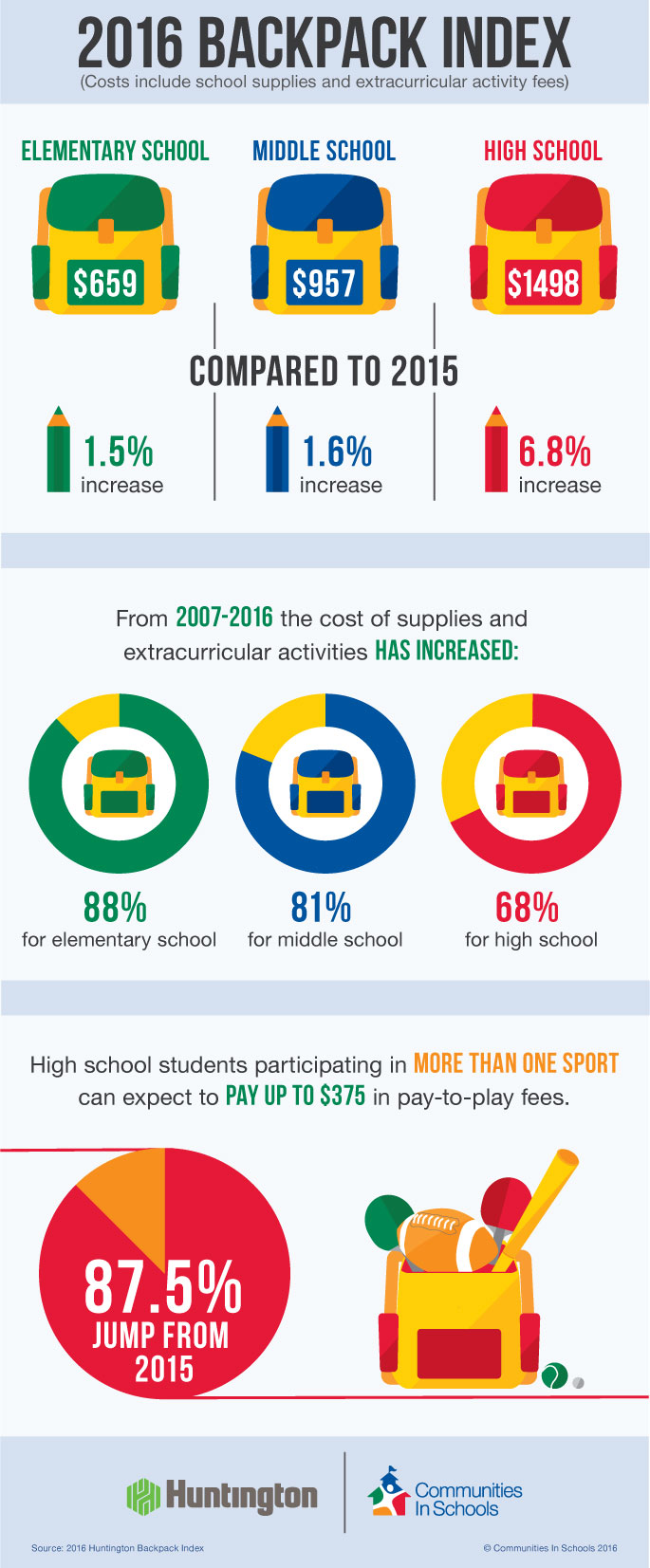
 At the 10-year mark for the Huntington Backpack Index, the cost of supplies and extracurricular activities has increased from 2007-2016 by 88 percent for elementary school students, 81 percent for middle school students and 68 percent for high school students.
For the 2016-2017 school year, according to the Backpack Index parents can expect to pay per child:
  • $659 for elementary school children, a 1.5 percent increase compared to 2015.
  • $957 for middle school children, a 1.6 percent increase compared to 2015.
  • $1,498 for high school students, a 6.8 percent increase compared to 2015.


Devos: School Choice Vouchers Don't Improve Performance | Time.com

Devos: School Choice Vouchers Don't Improve Performance | Time.com:

Betsy DeVos Wants to Spend Millions on School Vouchers. Two New Studies Say They Don't Actually Work


President Donald Trump's proposed 2018 budget includes $250 million for voucher initiatives, state-funded programs that pay for students to go to private school. Another $1 billion is set aside for encouraging schools to adopt school choice-friendly policies. Betsy DeVos, Trump's education secretary, is an outspoken advocate for such programs, which she has argued would lead to better educational outcomes for students.
But a pair of new studies released Monday provide evidence that voucher programs don't improve students' performance on standardized tests, one quantifiable method of testing educational outcomes.
"There may be some places where vouchers are working for some students, but generally we need to understand a lot more about the conditions under which vouchers are effective or not," Mark Berends, co-author of the Indiana study, told TIME.
The first study, a joint project from Tulane University's Education Research Alliance and the University of Arkansas' School Choice Demonstration Project, found that voucher programs did not produce improvement on students' test scores.
The researchers used standardized test scores spanning from 2012 to 2015 to analyze students' outcomes from the Louisiana Scholarship Program, an initiative that paid for 7,000 children from low- and moderate-income families to attend private schools. They found that students in the Louisiana voucher program initially had lower test scores, but after three years, their scores matched those of students who stayed in public schools.
A second study, meanwhile, examined the statewide school voucher program in Indiana, one of the largest initiatives of its kind in the U.S. The unpublished study from the University of Notre Dame and the University of Kentucky, which is pending peer review, found that Indiana's 34,000-student program had a Devos: School Choice Vouchers Don't Improve Performance | Time.com:


School choice programs pay off for donors - Longform Story

School choice programs pay off for donors - Longform Story:

School choice programs pay off for donors
Are tax benefits too generous?


Dibye Bass’ 12-year-old son, like thousands of children, has benefitted from a school choice program championed by the Trump administration that offers big-money donors tax breaks which critics say are too generous.

Bass’ son was bullied in a Virginia public school and a scholarship tax credit program was his way out and into a private school that the single mother said has made a difference in her son’s life. Regardless of questions raised about the way the programs are financed, she said she is grateful.

“I see it as something that encourages you to give more. Not just for a tax break but because you’re doing something good,” she said.

 But here’s what’s unusual, if not controversial, about the scholarship programs: Wealthy donors can potentially “profit” from their contributions through extensive tax benefits that can drain money from state treasuries which fund public services — including public schools.


The programs are available in 17 states and are being considered by legislators in several others. They are praised by Secretary of Education Betsy DeVos — a longtime school choice advocate — and are the focus of two congressional bills that seek to create a federal version of the program.

All the programs basically work this way: Individuals and businesses make cash or stock donations to scholarship granting organizations. The organizations award scholarships to qualifying families with K-12 students, primarily children in failing public schools or whose families' income meets the state’s poverty threshold. Students can then attend a private or religious school of their choice. What makes these programs unique is that donors get a full or partial credit toward their state taxes, which they are not allowed when donating to most other charities, and this allows them to realize a sizable tax advantage when combined with a federal deduction on the same gift. Plus, in some states, donors also get a state deduction.

“What these scholarship tax credits do is they super charge that incentive up to 100 percent of the amount donated,” Carl Davis, senior tax expert with the Institute on Taxation and Economic Policy, said. “And in the right set of circumstances, they’re receiving more back in tax breaks than they ever donated in the first place. … They’re able to claim a state tax credit and a federal deduction on a single donation and this is often profitable for them to do so.”

Davis’ organization released a report last month in conjunction with the School choice programs pay off for donors - Longform Story:

Have You Heard

Have You Heard:

Have You Heard


Putting the ‘i’ in School
Tweet Have You Heard Episode #20: Personalized Learning and the Disruption of Public Education Fantastic news, listener. The cure for what ails our long failing public schools has finally been found and it’s personalized learning! Except that as our special guest, Bill Fitzgerald, breaks down for us, a more accurate term for this miracle cure-all is *algorithmically-mediated learning, which is ab
No Clean Hands
Tweet I’m responsible for the appointment of Betsy DeVos as Secretary of Education. Are you? By Alicia 18 th century political and moral philosopher Joseph de Maistre said every country gets the leader it deserves. More recently, professor and public intellectual Tressie McMillan Cottom pointed out there are no innocent parties in the expansion of market-based education. That’s over two centuries
Labor Pains
Tweet I talk to veteran union critic Mike Antonucci about what’s next for unions, whether charter school teacher organizing is *a thing,* and whether he has any advice for teacher union heads Randi Weingarten and Lily Eskelsen Garcia… Jennifer Berkshire : You’ve been predicting that it’s only a matter of time until the Supreme Court delivers a crushing blow vs. public sector unions. This intervie

JUN 06

Buying Influence
Tweet Have You Heard Episode #19: Big Money and School Board Elections Today’s $17 million question: how did school boards become the must-have accessory for the donor who has everything? That’s the question that Jack Schneider and I put to researcher Rebecca Jacobsen, who has been studying the role of big donors in school board races across the country. Jacobsen walks us through the emergence of

MAY 26

Screw U
Tweet Betsy DeVos’ top advisor led a for-profit university that defrauded students and hoovered up federal student aid. Now Robert Eitel is tasked with *right-sizing* the Department of Education. What could possibly go wrong? Jennifer Berkshire : This week Betsy DeVos announced that she was tasking one of her top advisors, Robert Eitel , formerly of Bridgepoint Education, Inc., with overseeing th
DNA Test: The Ancestry of Charter Schools
Tweet Did you hear the one about how charter schools were the brainchild of Albert Shanker, the legendary teachers union head? Writer Rachel Cohen did, but when she began tracing the tale back to its origins, she found that the real 
 Have You Heard:

CURMUDGUCATION: PA: Charter Transparency Fail

CURMUDGUCATION: PA: Charter Transparency Fail:

PA: Charter Transparency Fail


Last night, my district's school board voted to raise taxes. 

They did it at a public meeting. I could have attended it easily (they meet just across the street from my home) as could any member of the public. I could also have commented on the budget situation, and I could have based my comments on having looked at the proposed budget, a document that has been available for at least a month. And if I attend all meetings regularly, I know the whole process that has gone into the board decisions, because it's illegal for board members to get together and do board work outside of meetings, and it's illegal for them to hold a meeting without giving public notice (PA law allows them to hold private sidebars on personnel matters).

That's transparency in the function of a public school district. 


Meanwhile, in another part of Pennsylvania, one more charter is demonstrating how the opposite of transparency works.

Down Catasauqua way, Innovative Arts charter school has been a source for some concerns. Two teachers from the charter went before the Catasauqua public school board with their concerns. 

Special education teacher Ann Tarafas and Spanish teacher Elizabeth Fox, herself hired as a paraprofessional and lacking an emergency permit to teach a foreign language, rehashed their non-compliance stories now accompanied with a total lack of inclusion...

Referring to inadequate special education department staffing (down from five to three), [Special Ed teacher Ann] Tarafas declared, "We're not in compliance with state standards nor are we holding up to the contracts we signed with parents of special ed students on behalf of the school. There is 
CURMUDGUCATION: PA: Charter Transparency Fail:

The Supreme Court Made Trinity v. Comer More Important Than It Was - The Atlantic

The Supreme Court Made Trinity v. Comer More Important Than It Was - The Atlantic:

A Major Church-State Ruling That Shouldn't Have Happened

In Trinity v. Comer, there was no remaining dispute between the actual parties—and both the majority opinion and the leading dissent got the issue wrong.

Image result for wrong judge animated gif


Trinity Lutheran Church v. Comerthe church-state case decided by the Supreme Court Monday, is a truly hard case. I can think of good arguments for either side, and even better arguments why—since there was no remaining dispute between the actual parties—the court should have stayed out altogether.
The court waded in, alas. And the majority opinion, by Chief Justice John Roberts, and the dissent, by Justice Sonia Sotomayor, got the issue wrong.

In Trinity Lutheran, a church challenged the state of Missouri’s refusal to fund safety improvements at its daycare playground. In April 2017, however, the newly elected governor of Missouri ordered the state to grant the funding and not to enforce its no-churches funding rule. The church won what it wanted because the state decided to give it—this being, for any judges unclear on the concept, what is wistfully called “the political process” courts are supposed to support, not supplant.

Even after the fight ended, however, the Supreme Court insisted on deciding the no-longer-existent dispute. The resulting opinions illustrate the old adage that “if you don’t know where you’re going, when you get there, you’ll be lost.”
The issue in Trinity Lutheran is whether the Constitution requires that the church, located in Columbia, Missouri, be eligible for a state grant program that pays for non-profit organizations to put down recycled-rubber-tire surfaces that prevent playground injuries. The church operates a daycare center. Its application for a state grant was strong; the state rejected it solely because the daycare is run by the church itself. That meant a grant would violate a provision of the Missouri state constitution that provides, “no money shall ever be taken from the public treasury… in aid of any church, sect, or denomination of religion…”

As someone who has spent nearly two decades studying church-state cases, I am frankly torn about this one. Denying playground surfacing to children based on the formalities of their daycare seems harsh; but constitutional micromanagement of state church-state relations has its own hazards.

To be clear: The rejection was not because the daycare was religious. Had it been operated by a separate religious non-profit with its own board (as it originally was) rather than directly being controlled by the church itself, it would almost The Supreme Court Made Trinity v. Comer More Important Than It Was - The Atlantic:

Seattle Schools Community Forum: Blanford Slams the Board and the District at TFA Event

Seattle Schools Community Forum: Blanford Slams the Board and the District at TFA Event:

Blanford Slams the Board and the District at TFA Event


Dear Directors,

I am tracking the school board elections and I attended two events last night.

One was at the NAACP where they hosted the national education director who was speaking on ESSA and how states will be enacting those regulations.  I was unable to stay for the full program as I had planned to go to another event and the NAACP program started late.

The other program was at a group called General Assembly and it was sponsored by Teach for America.  They allegedly invited all the candidates (but I heard from at least one who only got the reminder, not the invite) but only two came and, of course, were both former TFA members.  That would be Oscar Vasquez in the 5th and Chelsea Byers in the 7th.  

The moderator for the evening was Director Blanford who had been asked - at the last minute - to come and fill in the group (of about 40 people) about the Seattle School Board.  What he said about the Board and the district, I found appalling.  Keep in mind, he knew I was there and taking notes.  I'm only going to speak to what he said about the Board and district and not all his speaking points about running for school board.

Oddly, he started by saying that "hopefully, I can speak without being negative" and then proceeded to do exactly that. 

He also noted - and this is the first time I have heard any Board member say this in public - that the next Board "will likely be engaged in a superintendent search."  I'm not sure that was appropriate to say but he said that.

He then said that he had traveled a lot to conferences, both in state and nationally, and such and that Seattle's school district and board does not have a good reputation "it's not positive."  He said that the the reputation of the Board is that it "frequently oversteps its bounds" and "is not appropriate in its 
Seattle Schools Community Forum: Blanford Slams the Board and the District at TFA Event: