Latest News and Comment from Education

Friday, May 12, 2017

Friendly Friday Diane Ravitch's blog | A site to discuss better education for all

Diane Ravitch's blog | A site to discuss better education for all:

Friendly Friday Diane Ravitch's blog
 A site to discuss better education for all
Image result for big education ape Diane animated gif


Jeff Murray of Fordham Institute: Do English Teachers Have a Responsibility for Students’ Vocational Training?

Jeff Murray is the Ohio operations manager of the Thomas B. Fordham Institute’s offices in Columbus. He read an essay by a high school English teacher who was offended by Governor John Kasich’s proposal that teachers should be required to 

Andy Borowitz: An Impeachment Shocker (SATIRE)

Andy Borowitz has the latest news about the prospects for Trump’s impeachment.

L.A. Times Endorses Trump-DeVos Ticket for School Board

I was curious to see whether the L.A. Times editorial board would stand up for public education or would join the chorus of privatization and greed. Would the editorial board be offended that billionaires are swamping the district with 

Los Angeles: Outside Money Continues to Pour in to Buy Control of LA School Board for Charter Industry

If you live in Los Angeles in one of the districts where there is a run-off, please vote for Steve Zimmer or Imelda Padilla. Don’t let the billionaires buy control of the public schools. They don’t want to improve them. They want to turn them 

Gary Rubinstein: Rick Hess is the Reformer Who Thinks

Gary Rubinstein read Rick Hess’s latest book, “Letters to a Young Education Reformer” and found much to admire, even though Gary is one of the most perceptive critics of what is now called “reform.” He writes: “I was eager to receive Rick Hess’s latest book ‘letters to a young education reformer.’ Hess is the director of education policy studies at the American Enterprise Institute (AEI), a conse
Sue M. Legg: Charters Bomb in Florida

The Florida Department of Education, firmly in the hands of the Jeb Bush team, tried to spin the “success” of the charter industry, but Sue M. Legg of the League of Women Voters in Florida says, “Not so fast.” In this post, she explains that charter schools enroll a lower percentage of students who qualify for free and reduced lunch, of English language learners, and of students with disabilities
Andrea Gabor: Why Are the Few Veteran Teachers of New Orleans Demoralized?

Andrea Gabor reviews research produced by the Education Research Alliance of New Orleans about veteran teachers, those who taught before Hurricane Katrina and returned. “ERA’s analysis provides an important before-and-after-the-storm glimpse of the city’s schools from a unique perspective—the small group of pre-Katrina teachers who returned to teaching following the storm, and who have remained i

YESTERDAY

Trump’s Amazing Interview with “The Economist”

I promise you, I am really trying not to post about Trump. Some articles, however, are too compelling to pass up. This is one of them. The latest Trump interview once again reveals appalling ignorance and dishonesty – Vox https://apple.news/Ak-YKQ5ZJR6OLq0yvVV_LDw
Politico: DeVos Makes Some Political Appointments

Politico reports: Ed Department has made about three dozen political hires By Caitlin Emma 05/11/2017 12:45 PM EDT The Trump administration has made about three dozen political appointments to the Education Department, according to a list obtained by POLITICO through a Freedom of Information Act request. That’s about a quarter of the agency’s 150 political vacancies. Some of the job titles on the
Rev. Barber Plans to Lead National Movement

The inspirational leader Rev. William Barber 11 is stepping down from his post as chair of the North Carolina NAACP to launch a national movement. http://nypost.com/2017/05/11/naacp-leader-who-led-north-carolina-protest-movement-to-step-down/ His strong voice for moral strength, equal rights, dignity, courage in the face of adversity, and love is needed more than ever today.
Bret Wooten Asks Some Important Questions about Our National Investment in Education

Bret Wooten, a businessman in a small town in Texas, sent this letter to newspaper in the state. He asks whether we really care about our future if we neglect our most important investment: Our children. He previously posted his reaction to visiting his wife’s classroom. Are you concerned about the future of this country? Me too, but not in the way most people seem to be. We as a nation are willi
Sue M. Legg: Florida’s Budget Bill is a Train Wreck for Public Schools, a Boon for Charter Operators

Here we go with the Great Money Heist in Florida. HB7069 passed both houses of the legislature and will go to Governor Rick Scott for his signature. In two posts , Sue M. Legg of the League of Women Voters analyzes the devastating impact of this budget bill for public schools. She hopes that Governor Scott will veto the bill. As she explains, money is being shifted to charter organizations and ta
Bianca Tanis: A Teacher Visits a Montessori Classroom and Loves It

Bianca Tanis teaches a combined kindergarten-first grade special education class in the Hudson Valley in New York. She is on the board of New York State Allies for Public Education, the group leading the campaign against high-stakes testing and privatization in the state. She writes: I had the opportunity to spend the day visiting a public Montessori school in Kingston yesterday. I have been cons
The Best Shout-Out to the Graduates of Bethune-Cookman, Class of 2017

Blogger Luvvie Ajayi salutes Bethune-Cookman’s graduates for standing up against Secretary of Education Betsy DeVos , a woman with zero understanding of their lives or the life of Mary McLeod Bethune. She writes, “Thank You for Telling Betsy DeVos ‘Nah.'” She writes: “Y’all are the real MVPs. Really and truly. I am applauding you with the fervor I’d use during praise and worship right now. You kn
Georgia: Governor Deal Vetoes Legislation to Allow Opt Out from Testing

Rightwing corporate reformers like to go on and on about parental choice. Choice. Choice. Choice. The one choice they will not tolerate is parents who want their children to refuse the state tests. No choice! Governor Nathan Deal of Georgia vetoed a bill that would make it easier to parents to opt their children out of state standardized tests. He also blocked the possibility of students taking t
Audrey Amrein-Beardsley: The Top Ten Research-Based Reasons Why Standardized Tests Should NOT Be Used to Evaluate Teachers

The value-added assessment model that was forced on states by Arne Duncan’s Race to the Top is starting to fall apart, in the courts and in the experience of every state compelled to use it. In this post, evaluation expert Audrey Amrein-Beardsley explains the top ten reasons why large scale, standardized tests should not be used to evaluate teachers. She faced off against the rightwing National C
Alan Singer: How New Are New York’s New Standards?

Alan Singer writes that the real test of the state’s new standard s will happen in the classroom. The proof of the pudding, he writes, is in the eating, not in what is said or written about it. He warns that the whole process may be tainted if the current testing regime remains in place. And he worries that the state aims to quash the opt out movement, which is the only public voice and which com
As New York Rebrands Its Common Core Standards, What’s in a Name?

Newsday offers an amusing reflection on the change in the name of the Common Core state standards, which became toxic and set off the powerful opt out movement across the state, and especially on Long Island (which Newsday serves). In the last round of state testing, 50% of the eligible students on Long Island opted out of the English Language Arts state test, and 54% on Long Island opted out of


New York: Common Core Standards Get a New Name!

In response to years of protests against the Common Core standards, the State Education Department has tweaked them, massaged them, tickled them, and given them a new name. The New York state standards are now “the Next 

Torlakson Announces Peak of Annual CAASPP Testing - Year 2017 (CA Dept of Education)

Torlakson Announces Peak of Annual CAASPP Testing - Year 2017 (CA Dept of Education):

State Schools Chief Tom Torlakson Announces Peak of Annual CAASPP Testing

Image result for big education ape opt out Tom Torlakson


SACRAMENTO—State Superintendent of Public Instruction Tom Torlakson announced that nearly 500,000 California students took California Assessment of Student Performance and Progress (CAASPP) tests on Tuesday May 9, the highest number of students testing simultaneously during the 2017 spring testing season.
“We are in the third year of administering these state-of-the-art assessments, and the capacity of our system and our schools to efficiently administer these tests increases every year,” Torlakson said. “Our students and families are the ultimate winners here. The information from these tests will help our schools refine their teaching, improve learning, and better prepare our students for success.”
The CAASPP assessments in English language arts/literacy and mathematics are given each spring to students in grades three through eight and grade eleven. More than two-thirds of the 3.3 million eligible California students have begun testing. As of Wednesday, May 10, more than 2.7 million students statewide have started a summative assessment in English language arts/literacy or mathematics. Participation peaked on May 9 with 495,463 students testing at one time.  
The online tests are computer-adaptive, which means the tests change in real time depending on how students are performing. A student doing well will see increasingly challenging and more difficult questions; a struggling test taker will see easier questions in an attempt to more precisely measure the student’s knowledge. The tests are aligned with California’s more rigorous classroom standards and test critical thinking and problem solving skills students will need for college and the 21st century job market.           
# # # #
Tom Torlakson — State Superintendent of Public Instruction
Communications Division, Room 5602, 916-319-0818, Fax 916-319-0100

Know-It-All School Reformers | Larry Cuban on School Reform and Classroom Practice

Know-It-All School Reformers | Larry Cuban on School Reform and Classroom Practice:

Know-It-All School Reformers

Image result for big education ape billionaire Know-It-All School Reformers

Listen to Michael Mann, a climatolgist at Penn State University who talked about the science behind global warming and rising sea levels.
Any honest assessment of the science is going to recognize that there are things we understand pretty darn well and things that we sort of know. But there are things that are uncertain and there are things we just have no idea about whatsoever. (Nate Silver, The Signal and the Noise, 2012, p. 409).
Ah, if only federal and state policymakers, researchers, and reform-minded educators would see the “science” of school reform in K-12 and higher education in similar terms. “Science” is in quote marks because there is no reliable, much less valid, theory of school reform that can predict events or improvements in schools and classroom instruction.
Still, for K-12 children and youth there are “things we understand pretty darn well.”
*We understand that socioeconomic status of children’s families has a major influence on students’ academic achievement.
*We understand that a knowledgeable and skilled teacher is the most important in-school factor in student learning.
*We understand the wide variability in student interests, abilities, and motivation.
*We understand that children and youth develop at different speeds as they move through the age-graded school.
Then there are “things that we sort of know.” Such as some schools with largely low-income, minority enrollments out-perform not only similarly-situated schools but schools that serve families from middle- and upper-middle income schools.
Or that the more educational credentials graduates collect over time, chances are they will earn more in their lifetime than those who fail to finish school and college.
Or that curriculum standards can outline what students have to learn but the tests–and the rewards and penalties tied to those tests–measuring whether Know-It-All School Reformers | Larry Cuban on School Reform and Classroom Practice:
Image result for big education ape billionaire Know-It-All School Reformers

Image result for big education ape billionaires

2 Celerity charter schools shut down by California board of education | 89.3 KPCC

2 Celerity charter schools shut down by California board of education | 89.3 KPCC:

2 Celerity charter schools shut down by California board of education

Image result for the party never ends


Two schools run by Celerity Educational Group — the Los Angeles charter school operator under federal investigation — are shutting down.


 The California State Board of Education voted unanimously Thursday to let the charters for the campuses expire. The state board was the schools' last chance. L.A. Unified school board members had already voted to deny renewal petitions for the schools.

In January, federal agents raided Celerity's home offices in South L.A. Their warrant is under seal, so it's not clear what investigators were looking for, but LAUSD officials had previously expressed concerns about ties between Celerity Educational Group and a separate, related entity: Celerity Global Development.
There are four other Celerity schools in L.A. and one in Compton. Two more are set to open next year2 Celerity charter schools shut down by California board of education | 89.3 KPCC:
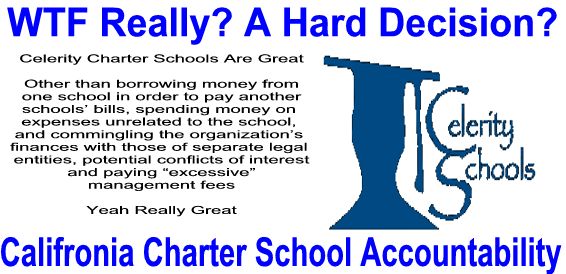
California’s State Board of Education voted unanimously Thursday to shutter two Los Angeles charter schools run by a nonprofit that is under investigation by the U.S. Department of Education and the inspector general for the Los Angeles Unified School District.
Some parents and teachers at the schools cried through their testimony at an emotional hearing, which ended with the board declining to renew the charter petitions for the Celerity Dyad Charter School in South Los Angeles and the Celerity Troika Charter School in Eagle Rock. Explaining their vote, board members said they had lost confidence in the Celerity Educational Group, the organization that manages the schools, and expressed growing concerns about its governance structure and finances, as well as the potential for conflicts of interest.
“This seems to be a very troubling failure on the part of the adults who manage these organizations, rather than on the adults in the classrooms,” said board member Ilene Straus.
The board’s vote comes at a time when charter school advocates are determined to increase the number of such schools in L.A., and it highlights the growing difficulty of regulating them. The state’s teachers union, which has fought against the growth in charter schools, has argued that all control over which charter schools are approved or rejected should rest with local school districts, rather than county or state boards.
With more charter schools than any other district in the country, L.A. Unified is considered one of the main battlegrounds for charter advocates and opponents.
The state board’s vote Thursday was a stunning departure from its thinking last fall, when it approved two new charter schools operated by the Celerity group. At the time, most board members brushed aside questions about the group’s operations and did not dwell on the fact that it was under investigation by L.A. Unified’s inspector general. They endorsed Celerity’s expansion, citing its academic record and comparatively high test scores.
Since then, the board’s opinion of Celerity has changed dramatically.
In late January, federal agents from the Department of Homeland Security, the FBI and California's State Board of Education votes to close 2 Celerity charter schools
Image result for big education ape  Celerity

CURMUDGUCATION: NC: Millions More for Vouchers

CURMUDGUCATION: NC: Millions More for Vouchers:

NC: Millions More for Vouchers

Image result for big education ape north carolina


Jeff Jackson is a Democratic senator in North Carolina whose fifteen minutes came in 2015 when he was the only legislator to show up for work on a snow day. 


What he "just found" was not really a secret. Back in February, reporters were noting that the GOP legislature was planning to triple voucher money (NC calls them "opportunity scholarships" as in "the opportunity for people to make a ton of money pretending to educate students") from $45 million to $145 million.

The proposed increase is just one more point of contention between the new Democratic governor and the GOP's straight-out-of-the-19th-century legislature. Debate has highlighted some of the standard pro-voucher arguments that we can all expect to be hearing.

Expect, for instance, to hear about the 2002 Supreme Court ruling on Zelman v. Simmons-Harris, the case that found that voucher money going to private religious schools could be okee-dokee. That's good news in North Carolina, where over 90% of voucher money goes to private religious schools. 

Expect, also, to hear voucher fans find new and fun ways to wiggle around the accountability issue. North Carolina charters are completely unaccountable to anyone. You'll be glad to now their students 
CURMUDGUCATION: NC: Millions More for Vouchers:

Image result for big education ape north carolina
Image result for rev barber


Ohio’s Notorious E-Charters Evade Regulation: ECOT Saga Drags On and On and On | janresseger

Ohio’s Notorious E-Charters Evade Regulation: ECOT Saga Drags On and On and On | janresseger:

Ohio’s Notorious E-Charters Evade Regulation: ECOT Saga Drags On and On and On

Image result for big education ape ecot


Ohio’s biggest charter school, the notorious e-school, the Electronic Classroom of Tomorrow (ECOT), held a big rally in Columbus early this week. Rick Teeters, ECOT’s superintendent, told all the school’s teachers and students to show up, even though the rally happened in the middle of the school day. Maybe everybody was expected to go home afterwards and study online until midnight.
ECOT’s founder, William Lager, made an emotional speech bragging that his school has provided more choices for those who have few. Lager didn’t mention, of course, the hundreds of millions of tax dollars the school has been receiving year after year from the state on a per-student basis. Neither did he say anything about the $60 million from last year alone that the Ohio Department of Education says ECOT fraudulently charged the state for students who did not really attend school at ECOT last year. ECOT is trying to avoid paying back the money.
In Ohio, pretty much everybody knows that ECOT is a huge scam, but because Ohio is an all-Republican state without any checks and balances at all, and because William Lager keeps on contributing to the campaign coffers of members of the legislature, no strong law has been passed to stop the ripoff.  And now, in the biennial budget bill the House passed on May 2, nobody will even claim the language that mysteriously appeared to undermine oversight of Ohio’s charter school sector.
Under enormous pressure from the press last year, the legislature did tighten the regulatory process to demand that the online academies must now provide documentation that students are at their computers doing 20 hours per week of work in order to be counted.  ECOT has continued to maintain that it has, as the law has specified for years, been providing 920 hours of curriculum for its students each year. But, says ECOT, the state never asked for attendance Ohio’s Notorious E-Charters Evade Regulation: ECOT Saga Drags On and On and On | janresseger:
Image result for big education ape ecot

Thursday, May 11, 2017

Jersey Jazzman: Attrition in Denver Charter Schools

Jersey Jazzman: Attrition in Denver Charter Schools:

Attrition in Denver Charter Schools

Related image

Earlier this month David Leonhardt of the New York Times wrote yet another column extolling the virtues of charter schools. I feel like a broken record when I say, once again, that education policy dilettantes like Leonhardt don't seem to understand that it requires more than a few studies showing a few charters in a few cities in a few select networks get marginally better outcomes on test scores to justify large-scale charter expansion.

There are serious cautions when it comes to the proliferation "successful" charters, starting with the fiscal impact on hosting districts as charters expand. We should also be concerned about the abrogation of student and family rights, the lack of transparency in charter school governance, the narrowing of the curriculum in test-focused charters, the racially disparate disciplinary practices in "no excuses" charters, and the incentives in the current system that encourage bad behaviors.

But let's set all that aside and look at the evidence Leonhardt presents to justify his push for more charters:

Unlike most voucher programs, many charter-school systems are subject to rigorous evaluation and oversight. Local officials decide which charters can open and expand. Officials don’t get every decision right, but they are able to evaluate schools based on student progress and surveys of teachers and families. 
As a result, many charters have flourished, especially in places where traditional schools have struggled. This evidence comes from top academic researchers, studying a variety of places, including WashingtonBostonDenverNew OrleansNew YorkFlorida and Texas. The anecdotes about failed charters are real, but they’re not the norm.
You'll notice that Leonhardt picks cities and states that uphold his argument while excluding others like Detroit, Philadelphia, and Ohio. In addition: I spent a lot of time last year explaining why the vaunted Boston charter sector isn't all it's cracked up to be. I've also documented the mess that is Florida's charter sector. I'll try to get to some of Jersey Jazzman: Attrition in Denver Charter Schools:


Torlakson Opposes Potential Federal Medicaid Cuts - Year 2017 (CA Dept of Education)

Torlakson Opposes Potential Federal Medicaid Cuts - Year 2017 (CA Dept of Education):

State Schools Chief Tom Torlakson Opposes Potential Federal Medicaid Cuts for School-based Health Services


SACRAMENTO—State Superintendent of Public Instruction Tom Torlakson today said he sent two U.S. Senators a letter announcing his opposition to changes that could endanger funding for school-based health services.
The bill, called the American Health Care Act, includes a per-state cap on spending for Medicaid, the federal program that funds health care for low-income people and families, and is referred to as Medi-Cal in California The new funding limits mean states will have to choose what benefits and services to offer, including assistance for Medicaid-eligible children who receive health care at schools.
School-based services include medical supplies such as feeding tubes for disabled children, vision and hearing screenings, and funding for school health aides.
“It is highly likely that schools and districts would bear an increased responsibility for covering the costs of these services, placing additional pressure on already-strained budgets,” Torlakson said in a letter to U.S. Senators Lamar Alexander (R-Tennessee) and Patty Murray (D-Washington), the Chair and Ranking Member of the Senate Committee on Health, Education, Labor, and Pensions. “Removing Medicaid funding for such services and equipment would present a significant hardship for many schools and students.”
Torlakson, a former science teacher and track and cross-country coach, has put a top priority on ensuring that students come to school ready to learn, which means they are healthy, eat nutritious food, and engage in regular exercise. This legislation could undermine those efforts.
“Students need to have access to health care so they can come to school healthy, and ready to learn and succeed,” he said. “This legislation may reduce access to health care for our students.”
The U.S. House of Representatives passed the American Health Care Act in early May, and the legislation is currently in the Senate.
The federal Individuals with Disabilities Education Act (IDEA) to assist special education students has already been historically underfunded, and the American Health Care Act could jeopardize services even more, Torlakson said.
A lack of preventive care and screenings could create long-term costs for states. For example, vision and hearing screenings can identify students who need eyeglasses or hearing assistance so they can pay attention and succeed in class. Reducing screening will hurt those students and require expensive remediation later in the students’ school years.
“Taking away any of these services could be devastating to individual students as well as to classrooms and schools as a whole,” Torlakson said.
Torlakson urged the Senators to preserve the current Medicaid funding structure and maintain services to eligible children.
# # # #
Tom Torlakson — State Superintendent of Public Instruction
Communications Division, Room 5602, 916-319-0818, Fax 916-319-0100


 Torlakson Opposes Potential Federal Medicaid Cuts - Year 2017 (CA Dept of Education):

Brown’s May budget adds more money for schools and child care, but mixed bag for higher ed | EdSource

Brown’s May budget adds more money for schools and child care, but mixed bag for higher ed | EdSource:

Brown's May budget adds more money for schools and child care, but mixed bag for higher ed

Image result for big education ape jerry brown

Rosier-than-expected budget revenues have prompted Gov. Jerry Brown to restore some cuts projected in January – most notably to child care – and to send over $1 billion in additional funding to schools than anticipated.
“California has spent enormous sums of money, particularly in education,” Brown said during a Thursday press conference announcing the May revision of his $183.4 billion budget. “The increase is phenomenal.”
Under the May revision, a $5.8 billion shortfall in revenues was reduced to $3.3 billion, which allowed for the $1.4 billion allocation in 2017-18 to the Local Control Funding Formula that pays for K-12 public schools. With this increase, the formula – which was slated to grow annually over several years – is now at 97 percent of the promised final funding levels, or up about $4,058 per student over 2011-12 levels.
State data show that the Proposition 98 minimum guarantee of funding for K‑14 schools has fluctuated over the years, dropping to a low of $47.3 billion in 2011‑12. The May revise proposes $74.6 billion in 2017-18 — an increase of $1.1 billion since the proposed budget was released in January. 
The extra revenues in the May revise also eliminated the need to defer some school funding, a delay included in January’s proposal. 
According to the state’s Local Control Funding Formula, districts receive additional money to serve low-income students, English learners and foster youth. It is up to school boards to approve Local Control and Accountability Plans that reflect these spending priorities.
But Brown said individual communities should ensure that their school boards spend the money in ways that will best benefit local students.
“We want the activists, we want the parents and the teachers to go to their local boards and put the pressure on them, using the transparent accountability plan,” he said, explaining that advocates no longer need to go to Sacramento to lobby for specific expenditures.
Also, a one-year delay in increases for child care funding projected last Brown’s May budget adds more money for schools and child care, but mixed bag for higher ed | EdSource: