Latest News and Comment from Education

Sunday, April 30, 2017

Schools superintendent: Students are harming themselves and citing ’13 Reasons Why’ - The Washington Post

Schools superintendent: Students are harming themselves and citing ’13 Reasons Why’ - The Washington Post:

Schools superintendent: Students are harming themselves and citing ’13 Reasons Why’

Dylan Minnette as Clay Jensen in Netflix’s “13 Reasons Why.” (Beth Dubber/Netflix)

A Florida schools superintendent told parents in a letter that his district has seen a rapid rise in at-risk behavior at elementary and middle schools — including self-harming and suicide threats —  in the wake of a graphic Netflix series about a 17-year-old girl’s suicide called “13 Reasons Why.”
The series, which debuted March 31, is based on a 2007 young adult novel and includes detailed scenes of young people harming themselves, including that of a teen who cuts her wrists with a razor in a bathtub and her blood is seen pouring out as she struggles to breathe. With the first episode released about a month ago, the series has sparked warnings from mental health counselors and others expressing concern about copycat behavior and the glorification of suicide by vulnerable young people. The National Association of School Psychologists released guidance to parents on how to lead the discussions along with other resources.
Palm Beach County Schools Superintendent Robert M. Avossa wrote in the letter sent April 28 (which you can read in full below):
As a father of a teenager and tween, I am very concerned about a dangerous trend we have observed in our schools in recent days. School District personnel have observed an increase in youth at-risk behavior at the elementary and middle school levels to include self-mutilation, threats of suicide, and multiple Baker Act incidents. Students involved in the recent incidents have articulated associations of their at­-risk behavior to the “13 Reasons Why” Netflix series. The Netflix website tagline summarizes the series theme as follows: “After a teenage girl’s perplexing suicide, a classmate receives a series of tapes that unravel the mystery of her tragic choice.”
Asked about the superintendent’s letter, a Netflix spokesperson sent an email with the following statement from the company:
We’ve heard from our members that 13 Reasons Why has opened up a dialogue among parents, teens, schools and mental health advocates around the intense themes and difficult topics depicted in the show. We knew the material covered sensitive topics, as the book did when it was published in 2007, and we worked with mental health experts to show how these issues impact teens in real and dramatic ways. With this in mind, we gave the series a TV-MA rating, added explicit warnings on the three most graphic episodes, produced an after show, “Beyond the Reasons,”  that delves deeper Schools superintendent: Students are harming themselves and citing ’13 Reasons Why’ - The Washington Post:

NO "FULL DISCLOSURE" IN KPPC LAUSD PENSION REPORTING - Perdaily.com

NO "FULL DISCLOSURE" IN KPPC LAUSD PENSION REPORTING - Perdaily.com:

NO "FULL DISCLOSURE" IN KPPC LAUSD PENSION REPORTING

Image result for big education ape media

One of the most disturbing and regrettable trends in today's news reporting is the systematic and often premeditated failure to even mention often highly relevant facts that if merely addressed would most assuredly cause the reader to come up with a completely different interpretation or conclusion after reading the article.

One recent case in point can be found in a KPCC 89.3 FM reporter Kyle Stokes' article: What should LAUSD do about its ballooning benefits costs? While Stokes approaches this issue through the respective positions of incumbent LAUSD Board Member Steve Zimmer and his challenger and charter schools backed opponent Nick Melvoin, in how they each would deal prospectively with what now amounts to a looming $13.6 billion unfunded health and other benefits package, nowhere in the article is the easily verifiable fact mentioned that for the last 8 years LAUSD has already been "dealing" with this problem by systematically and illegally targeting and removing with clearly fabricated charges, teachers at the top of the salary scale and/or others about to vest in expensive lifetime health or other retirement benefits.

Approximately 93% of the literally thousands of teachers who have and continue to be targeted for removal from their more expensive senior teaching positions at LAUSD find it difficult to get others to believe them that they did nothing wrong and that this kind of heinous and clearly illegal behavior is going on, because people just don't want to think LAUSD administration would have any motive for so acting.

If nothing else, the magnitude of just how far in the red LAUSD is with its health and other benefits programs now offers that clear and unequivocal motivation for LAUSD targeting its more senior and expensive employees. To quote the late Vito Corleone, "It's just business."

And why hasn't the State of California gone after LAUSD to defend senior teachers and other targeted certificated and classified employees? Because if, and more likely when LAUSD goes bankrupt, it is the State of California that will be left holding the bag in having to bail out LAUSD. This clearly gives the State a conflict of interest, when it comes to defending wrongfully charged teachers, whose greatest actual "crime" is that they are too expensive.

But if LAUSD can save $60,000 a year in salary and benefits by getting rid of high seniority teachers in its attempt to balance an LAUSD benefits budget that is billions of dollars in the red and stands a very good chance of bankrupting LAUSD in the next two years, all of a sudden the NO "FULL DISCLOSURE" IN KPPC LAUSD PENSION REPORTING - Perdaily.com:

Can Technology Change How Teachers Teach? (Part 1) | Larry Cuban on School Reform and Classroom Practice

Can Technology Change How Teachers Teach? (Part 1) | Larry Cuban on School Reform and Classroom Practice:

Can Technology Change How Teachers Teach? (Part 1)

Image result for Can Technology Change How Teachers Teach

Have the 41 exemplary teachers in integrating technology into daily lessons that I observed and interviewed in Silicon Valley in 2016 changed their practice as a result of using new devices and software?
Straightforward as the question sounds, it is tricky to answer. Why?
In a society geared to constant change as America is, the word has far more positive than negative connotations. Fashions in clothes, car models, gadgets, and hairstyles change every year trumpeting the next new thing to acquire. Both Presidential campaigners Barack Obama in 2008 and Donald Trump in 2016, for example, promised their supporters that America will change for the better. Change is “good.” Embracing the new is progress. It is a norm that Americans revel in.
Especially when it comes to taking on new technologies in the past (e.g., household appliances, radio, television) and present (e.g., desktop computers, laptops, and smart phones). So for teachers, doctors, lawyers, CEOs, and elected officials not accepting the next new electronic device and changing their daily practice is often seen as resistance, a fondness for the “old” that is out of step with American values and the future. Reform-driven policymakers, deep pocket donors, entrepreneurs and vendors believe a lack of change or very slow adoption of new digital tools to be a detriment to student learning, patients, clients, customers, and voters. So a social and individual bias toward change, particularly technological change, is built into American society, history, institutions and professional behavior.
Acknowledging a historical bias toward change hints at the trickiness of the question I ask. Judging whether teachers have actually altered their daily classroom practice is surprisingly hard to do. Teachers, imbued with the culture’s values, often say that they have changed their lessons from week to week, year to year due to new district curricula, tests, and programs. Yet policymakers and researchers are less certain of such changes.[i]
Consider that researchers ordinarily find out whether teachers have changed their practices through direct observation before and after change occurred, interviews, surveying faculty opinions, sampling principal evaluations, and soliciting student views. Few researchers, however, have the access, time, or funds to tap all of these sources so they use short cuts and depend upon one or two sources at best and snapshots of one moment in time. Occasional teacher interviews, drop-in classroom observations, and faculty surveys are often what researchers end up using to answer to the question.
Yet even when researchers or other inquirers believe they have sufficient Can Technology Change How Teachers Teach? (Part 1) | Larry Cuban on School Reform and Classroom Practice:

Jersey Jazzman: Desperately Searching For the Merit Pay Fairy

Jersey Jazzman: Desperately Searching For the Merit Pay Fairy:

Desperately Searching For the Merit Pay Fairy

It's been a while since we've talked about the Merit Pay Fairy.


Yo, it's me -- da Merit Pay Fairy, makin' all your reformy dreams come true!

The Merit Pay Fairy lives in the dreams and desires of a great many reform-types, who desperately want to believe that "performance incentives" for teachers will somehow magically improve efforts and, consequently, results in America's classrooms. Because, as we all know, too many teachers are just phoning it in -- which explains why a system of schooling that ranks and orders students continually fails to make all kids perform above average...

One of the arguments you'll hear from believers in the Merit Pay Fairy is that teaching needs to be made more like other jobs in the "real world." But pay tied directly to performance measures is actually quite rare in the private sector (p. 6). It's even more rare in professions where you are judged by the performance of others -- in this case, students, whose test scores vary widely based on factors having nothing to do with their teachers

But that doesn't matter if you believe in the Merit Pay Fairy; all that counts is that some quick, cheap fix be brought in to show that we're doing all we can to improve public education without actually spending more money. And, yes, merit pay as conceived by many (if not most) in the "reform" world, is cheap -- because it involves not raising the overall compensation of the teaching corps, but taking money away from some teachers and giving it to others, using a noisy evaluation system incapable of making fine distinctions in teacher effectiveness.

Which brings us to the latest merit pay study, which has been getting a lot of press:
Student test scores have a modest but statistically significant improvement when an incentive pay plan is in place for their teachers, say researchers who analyzed findings from 44 primary studies between 1997 and 2016.
“Approximately 74 percent of the effect sizes recorded in our review were positive. The influence was relatively similar across the two subject areas, mathematics and English language arts,” said Matthew Springer, assistant professor of public policy and education at Jersey Jazzman: Desperately Searching For the Merit Pay Fairy:

Sunday times. | Fred Klonsky

Sunday times. | Fred Klonsky:

Sunday times.

C-mr49tXYAA_fzh (1)
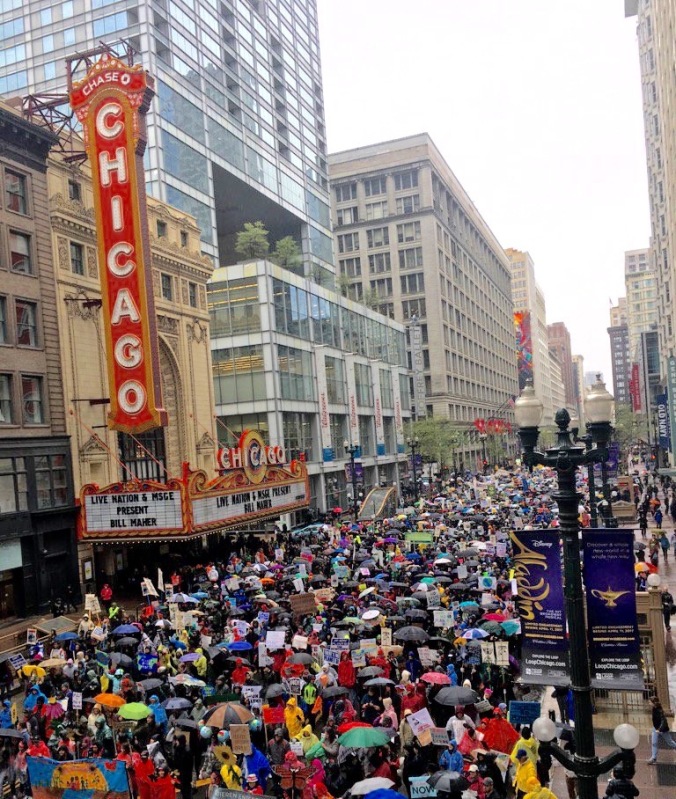
Saturday’s climate march in Chicago.

Trump and Pence may crow about bringing back coal, but the truth is more natural. The future, which they will deny and turn away from coal and fossil fuels, and instead turn to renewables.  The cost of solar and wind will become more and more economical and scientifically worthy – two areas in which neither have any faith or comprehension.
We are jolted from one crisis to another – North Korea, Syrian blasted under Tomahawk missiles, a fence and no fence, a China enemy and then friend – we are subjects now to whims, many determined in the wee hours of the morning by a sorry child-man wandering alone in the hallways of an historical building, his children hired to help prevent his emotional outbursts from throwing us all into some disaster or, worse, a nuclear Armageddon. RESIST! John Dillon, Pension Vocabulary
C-l-NLZWsAAumTh

When you go home, I hope you all say that your trip to the White House was something very special.  I know Melania has been working with you now for quite a while.  She is a tremendous fan of wonderful teachers. But she’s worked very hard and we’re having some special times here. This is Melania’s birthday and you were very nice to sing happy birthday, even though we’re celebrating you.

So thank you all very much and God bless you all.  And you go back and keep teaching those students because, like I said — oh, look, and you’re crying —

PARTICIPANT:  Sorry, I’m always crying!  (Laughter.)

THE PRESIDENT:  I know, the Oval Office can do that.  I have had some of the biggest executives in the world and they’ve been here many times.  I said, have you ever been to the Oval Office, and they said no.  I mean, I once had here like the biggest, from the biggest companies. And they walk into the Oval Office and they start crying.  I said, I promise I won’t say to your various stockholders that you cried.  (Laughter.)   But I have seen people cry Sunday times. | Fred Klonsky:

AFT president Randi Weingarten Outs Education Secretary Betsy DeVos as a “Public Education Denier.” – twitchy.com

Teachers union president wants you to check out these totally point signs by educators in the resistance – twitchy.com:

Teachers union president wants you to check out these totally point signs by educators in the resistance

Image result for big education ape randi

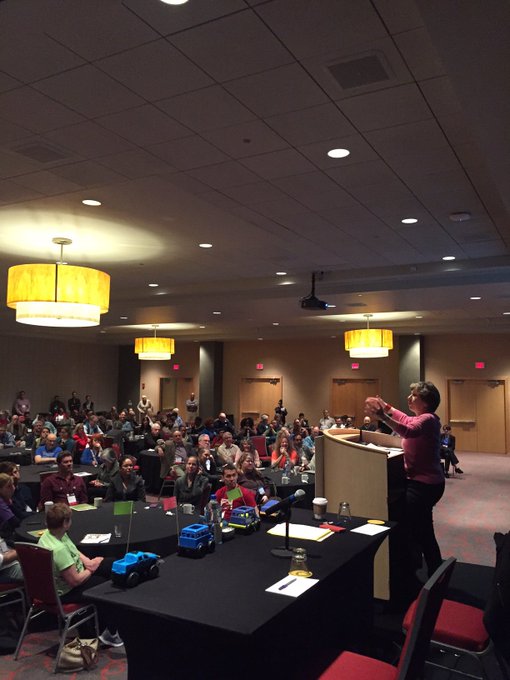
Maybe the protest groups at the NRA’s annual meetings in Atlanta this weekend would have enjoyed a bigger turnout if many of the nation’s educators weren’t tied up at the American Federation of Teachers Higher Education Organizing Conference in Detroit this weekend.
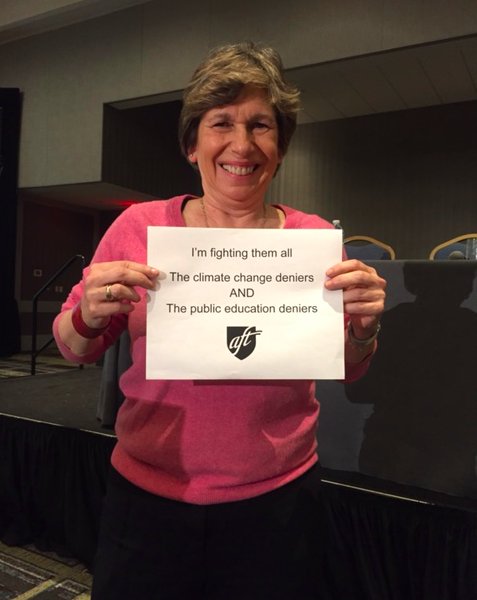
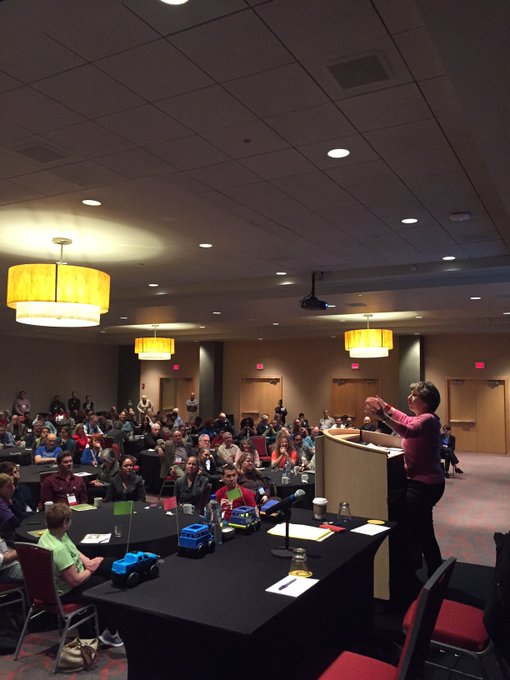
Did we say many? Just look at this big audience agreeing with AFT president Randi Weingarten as she outs Education Secretary Betsy DeVos as a “public education denier.”

Whether they’re denying climate change or the role of public schools, @rweingarten fights them all 

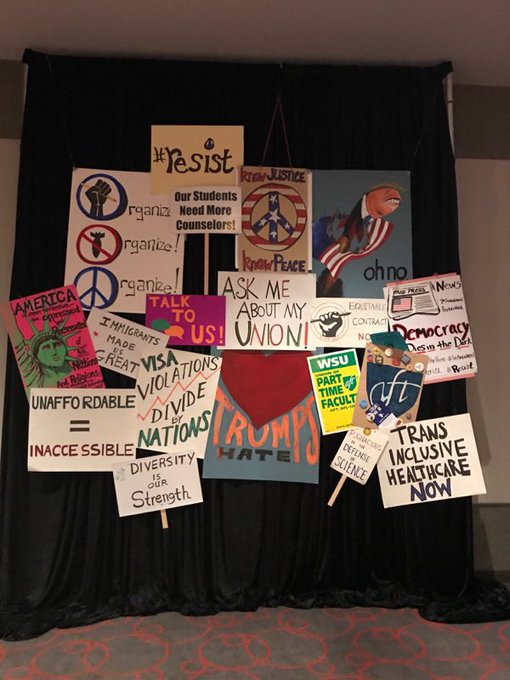
The real story of the conference, which included sessions on organizing a sanctuary campus, organizing for free college, and nonviolent bystander intervention training, was told in this collection of totally point signs.
Look at these totally point signs at ! Fighting for rights on campus and beyond.
Are they totally point or are they totally point?
In case it wasn’t clear already, the American Federation of Teachers once again spelled out its platform: public education for everyone, followed by free college. Oh, and ending hate. It wouldn’t hurt if higher ed faculty made more money and had full health coverage, either, while they teach to rooms full of students attending college for free.
Our values: pub ed 4 all w/ free college, health care, economic prosperity, democracy, ending hate. This is the frame 4 our fight. 
Thrilled to welcome Frances Fox Piven join us for  on the critical role educators play in the . w/ @rweingarten
Again, just in case it wasn’t clear, there you have it: educators play a “critical role” in the resistance.