Latest News and Comment from Education

Monday, April 17, 2017

Monday Monday Diane Ravitch's blog | A site to discuss better education for all

Diane Ravitch's blog | A site to discuss better education for all:

Monday Monday Diane Ravitch's blog 
A site to discuss better education for all


More Florida Mischief
When the Florida House of Representatives passed the legislation to award $200 million to charter operators who opened in competition with low-performing schools, they also passed two other bills that are ugly. One would require districts to share their property taxes with charter schools. The other would make adjustments to the state’s idiotic “Best and Brightest” bonus plan for new teachers, wh
Florida: “Schools of Hope” Designed to Attract No-Excuses Charter Schools
The Florida Speaker of the House said that the legislation recently passed was designed to attract national charter chains to take over low-performing public schools, such no-excuses charter schools as KIPP, SEED, and Uncommon Schools. But according to this article in Politico, the chains thus far are not 

Florida: Jeb’s Corporate Raiders Attack Public Schools Again
Florida has more than 600 charter schools. They open and close like day-lilies. Many operate for profit. The charter industry cannot rest so long as a public school remains undisturbed by the forces of disruption and greed. A new law has 

Gary Rubinstein: “College or Die”
Gary Rubinstein has become a master at unmasking “miracle” claims, you know, the schools where 100% of the students in a poor neighborhood (formerly served by a public school) graduate or 100% go to college or some equally implausible miracle. None of these claims ever turned out to be true. The miracle was attrition of the kids who were not on track to graduate. He recently discovered a charter
Washington State: Where Billionaires Get Richer, and Schools Get Shafted
This is an astonishing article about the battle for fair funding of public education in Washington State, where billionaires pay a lower tax rate than working stiffs. The article appeared almost two years ago, but it remains relevant today. “Despite its image as the cutting-edge land of Microsoft, Boeing, Amazon, Starbucks, and many other corporate icons, the state ranks near last place nationall
David Greene: The Erosion of American Education Has Turned into a DeVostating Mudslide
David Greene is a teacher, mentor, coach, the whole 100 yards. He also blogs about education, and in this post he describes what great teaching is, and gives us hope that it may survive even the current tsunami of bad ideas. David reluctantly saw a video about High Tech High, which he was floored by, because so many “reformers” love it but never replicate it. It is a project-based school of the k
How School Choice Segregated the Public Schools of Michigan, Home of the DeVos Family
School choice produces segregation: racial segregation, religious segregation, socioeconomic segregation. That is why the idea of school choice originated with Southern governors in the wake of the Brown V. Board of Education decision. They were determined to defend racially separate public schools. Their strategy was school choice. They knew that if students could choose their schools, they coul

YESTERDAY


An Easter and Passover Joke
Happy Easter! Here’s a smile for your holidays. I think you should spend today reading something other than this blog. If you are Christian, go to church or do whatever you usually do. If you are Jewish or Muslim or atheist or anything else, 

Democrats link party rivals to DeVos as 2018 fights emerge - POLITICO

Democrats link party rivals to DeVos as 2018 fights emerge - POLITICO:

Democrats link party rivals to DeVos as 2018 fights emerge
Teachers unions and others are attacking charter supporters in California, New York and New Jersey for doing the administration's 'dirty work.'

LOS ANGELES — It’s rare that Democrats are cast as puppets of the Trump administration. But on the issue of education, many Democrats who have long supported school choice are newly on the defensive within their party, forced to distance themselves from President Donald Trump and his education secretary, Betsy DeVos.

The unusual dynamic started soon after Trump’s inauguration, when a teachers union in Los Angeles sent voters mail depicting two charter-school-friendly school board contenders, both Democrats, as “the candidates who will implement the Trump/DeVos education agenda in LA.”

The message was repeated in New York, where the Alliance for Quality Education, an advocacy group partially funded by teachers unions, likened Democratic Gov. Andrew Cuomo’s education policies to Trump’s. The group urged online audiences to “stop Cuomo from doing Betsy DeVos’s dirty work.” In New Jersey, Sen. Cory Booker opposed DeVos’ appointment but came in for criticism for working with DeVos on school choice initiatives when he was mayor of Newark.

Though Democrats across the country widely repudiated DeVos, publicity surrounding her controversial appointment has allowed a new line of attack on members of the party who, while resisting school vouchers and certain teacher performance measures, have embraced charter school expansion and other education policies opposed by unions and traditional public school advocates.

Labor-backed Democrats are seizing on the DeVos issue as an opportunity ahead of the 2018 primary elections. In the race for California governor, Lt. Gov. Gavin Newsom invoked DeVos’ appointment last month, telling a crowd in Hollister, California, that education would be the “wedge issue” in the 2018 campaign.

“The opportunity to brand a reformer as a Trump/DeVos Republican is a real risk for a Democrat,” said Mattis Goldman, a political consultant advising charter school ally Marshall Tuck in his campaign for California state superintendent of public instruction. “It’s important for candidates who disagree with that to make sure that doesn’t happen.”

Tuck opposed DeVos’ appointment. But Goldman noted that “the winds of the situation are a little bit perilous for [reform] Democrats these days because you Democrats link party rivals to DeVos as 2018 fights emerge - POLITICO:


Education Reform That Works | tultican

Education Reform That Works | tultican:

Education Reform That Works


The Teacher Powered Schools (TPS) movement has a history of success and is now in more than 100 schools. It won’t make anyone rich but it just might bring a new area of positive growth in the teaching and learning process.
It could be argued that TPS has been around since Socrates. More recently, Debra Meier’s efforts to democratize schools in New York and Boston along with her friend Ted Sizer’s thinking has set a foundation for today’s movement. The modern TPS movement stemming from the 1990’s accelerated in 2012 with the publication of Trusting Teachers with School Success by Kim Farris-Berg and Edward Dirkswager with Amy Junge.
By 1997, Debra Meier could open one of the first TPS schools, Mission Hill k-8 in Boston. Her glowing reputation led school officials who would normally have been quite skeptical to embrace her concept. A case study describes the school’s governance:
“A governing board, consisting of a council that represents parents, faculty, students and other community members, oversees the school to ensure the teacher team continues to meet the needs of students effectively but delegates decision-making authority to the teacher team. The teachers and the principal they selected collaborate on all decisions, including curriculum, staffing, and the school’s schedule. They involve all local education stakeholders in decisions regarding principal selection, determining the school’s mission, and approving staff-developed budget and human resources plans.”
Following 20 years of experience, a local New England news outlet reports,
“According to the Boston Public School District, 32% of students in the district will attend one of four types of teacher-powered or autonomous schools, like Mission Hill next year.”
In 2014 the Teacher Powered Schools initiative was launched. Their reported vision is:
“While the initiative recognizes the many other important efforts focused on Education Reform That Works | tultican:


School Choice, Neoliberalism Hurt Public Goods and Education - The Atlantic

School Choice, Neoliberalism Hurt Public Goods and Education - The Atlantic:

How School Choice Turns Education Into a Commodity
Schools are a public good that extreme market proliferation would eventually destroy.


Buoyed by Donald Trump’s championing of a voucher system—and cheered on by his education secretary Betsy DeVos—Arizona just passed one of the country's most thoroughgoing policies in favor of so-called “school of choice.” The legislation signed by Governor Doug Ducey allows students who withdraw from the public system to use their share of state funding for private school, homeschooling, or online education.

Making educational funding “portable” is part of a much wider political movement that began in the 1970s—known to scholars as neoliberalism—which views the creation of markets as necessary for the existence of individual liberty. In the neoliberal view, if your public institutions and spaces don’t resemble markets, with a range of consumer options, then you aren’t really free. The goal of neoliberalism is thereby to rollback the state, privatize public services, or (as in the case of vouchers) engineer forms of consumer choice and market discipline in the public sector.

DeVos is a fervent believer in neoliberalizing education—spending millions of dollars on and devoting herself to political activism for the spread of voucher-system schooling. In a speech on educational reform from 2015, DeVos expressed her long-held view that the public-school system needs to be reengineered by the government to mimic a market. The failure to do so, she warned, would be the stagnation of an education system run monopolistically by the government:
We are the beneficiaries of start-ups, ventures, and innovation in every other area of life, but we don’t have that in education because it’s a closed system, a closed industry, a closed market. It’s a monopoly, a dead end. And the best and brightest innovators and risk-takers steer way clear of it. As long as education remains a closed system, we will never see the education equivalents of Google, Facebook, Amazon, PayPal, Wikipedia, or Uber. We won’t see any real innovation that benefits more than a handful of students.

Many Americans now find DeVos’s neoliberal way of thinking commonsensical. After all, people have the daily experience of being able to choose competing consumer products on a market. Likewise, many Americans rightly admire entrepreneurial pluck. Shouldn’t the intelligence and creativity of Silicon Valley’s markets be allowed to cascade down over public education, washing the system clean of its School Choice, Neoliberalism Hurt Public Goods and Education - The Atlantic:

Corporate childcare looks like an Arby’s. Put in the middle of the worst traffic arteries. But it’s all about the money. | Fred Klonsky

Corporate childcare looks like an Arby’s. Put in the middle of the worst traffic arteries. But it’s all about the money. | Fred Klonsky:

Corporate childcare looks like an Arby’s. Put in the middle of the worst traffic arteries. But it’s all about the money.

larger

It will be a Learning Experience, for sure.
Now that it is almost summer I will bring my old Schwinn up from the basement and start riding it to the gym.
It is a nice ride along the boulevards until I get to the intersection of Western and Logan. Then it is holy shit! I ride under the expressway were there is no bike lane. With the roar of highway traffic above me, I go up on the little strip of sidewalk, covered in pigeon dung, doing a slalom around the highway pillars until I arrive at one of the busiest, most dangerous  intersections on the north side of Chicago.
Rob Horton of Red Cedar Partners LLC, said his team is aiming to finish construction by July and open the facility shortly thereafter.
The two-story, 10,900-square-foot facility, catering to children six-weeks to six-years old, will offer a fenced-in rooftop playground, which is mostly the result of limited space.
“Having an onsite playground was a requirement of The Leaning Experience so you have to make due with the space you have when your developing in an urban environment,” Horton said in an email.
Image result for drive thru

Beware the “Miracle” School Claim | radical eyes for equity

Beware the “Miracle” School Claim | radical eyes for equity:

Beware the “Miracle” School Claim

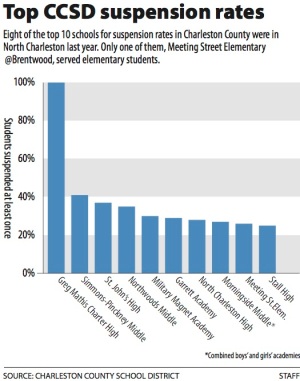
Published on Easter Sunday 2017 in the Post and CourierPaul Bowers offered what I suspect will be a slow and painful series of unfortunate evidence that will discredit claims of educational miracles at Meeting Street Elementary @Brentwood; in this case, the public/private partnership elementary school has a unique and extreme suspension problem:
Meeting St suspensions copy
As a public/private venture, as a school choice and reform mechanism, Meeting Street Elementary @Brentwood is trapped in the need to advocate, sell its process. And since South Carolina has not held this experiment to the traditional school report card transparency, we are left only with the claims of school leaders.
However, we have well over a decade of “miracle” school bluster, all of which has been dismantled—suggesting that, I am sorry to say during this holiday season, there are no miracles.
While the school report card based mostly on high-stakes testing data is a significant failure of education reform, South Carolina’s report card system has included a key way to know if schools are in fact outperforming other schools, using the “Schools with Students Like Ours” metric (which I have Beware the “Miracle” School Claim | radical eyes for equity:

Using busing to combat kindergarten truancy | 89.3 KPCC

Using busing to combat kindergarten truancy | 89.3 KPCC:

Using busing to combat kindergarten truancy

Image result for busing

A study released last week reveals an unexpected approach to help schools reduce chronic student absenteeism: making sure kids ride the school bus.


“A lot of the work done that’s been done in absenteeism focuses on looking at characteristics of the child or the family,” such as poverty or student disengagement from school said U.C. Santa Barbara education researcher Michael Gottfried.
But Gottfried found that decisions made by the school system around transportation can also help solve the problem.
His nationwide study of 14,370 kindergarteners in the 2010-2011 school year asked whether kindergarteners taking the school bus have fewer absences than children who get to school by walking, car, or any other way.
He found that 12 percent of the children who took the school bus were chronically absent, two percent lower than kindergarteners who didn’t take the bus.
That percentage is small, but because he studied chronic absences – children absent ten or more days out of the school year – the cumulative effect could be large. By increasing the number of kindergartners taking the bus schools nationwide, schools could cut the number of lost instructional days by 1.04 million, he said.
According to California officials, 210,000 students missed 10 percent or more of the school year in 2016 because of unexcused absences. And researchers have found that chronic truancy in kindergarten leads to lower test scores in third grade.
Gottfried joined an effort by the state attorney general’s office to shed light on the effects of chronic truancy on students and schools. Most school districts have taken steps in the last few years to cut chronic truancy and Gottfried wanted to give schools a concrete step that’s been shown by research to have an impact.
“Kindergarteners have the highest absenteeism rates,” because the transition into kindergarten is tough, Gottfried said.
There’s a deeper takeaway from the results, he said, beyond adding bus routes that could test already tight budgets. He calls it the “school bus effect.”
“Yes, the bus is important but [we should also ask] what is the bus symbolizing, what is the bus doing for kids and families and how can we still do that in the Using busing to combat kindergarten truancy | 89.3 KPCC:

Connecticut has spent upwards to $1 Billion on corporate welfare programs with limited oversight - Wait What?

Connecticut has spent upwards to $1 Billion on corporate welfare programs with limited oversight - Wait What?:

Connecticut has spent upwards to $1 Billion on corporate welfare programs with limited oversight


Since taking office, Governor Dannel Malloy and his administration have shoveled hundreds of millions of dollars in “corporate aid” to dozens of companies as part of their ongoing efforts to “persuade” business to stay or grow in Connecticut.
As CT Voices for Children, a non-profit, non-partisan research group explains,
These incentives come in the form of direct aid, such as discounted loans and grants, and business tax breaks, such as tax credits, which reduce the tax liability for investors, industries, and individual firms.”
Other than some limited review by the very agency that hands out the money, there has been little public oversight of this massive outlay of public funds.
Last year legislation passed the Connecticut General Assembly to require greater oversight but Governor Malloy vetoed the bill and his allies in the legislature choose not to try and override the veto even though there was broad, bi-partisan support for the law.
However, a new bill before the legislature could finally require proper oversight of the state’s economic development programs.
Just last week the General Assembly’s Finance Committee held a public hearing on House Bill 7316, An Act Concerning Evaluation of Business Assistance and Incentive Programs.  The legislation would dramatically expand the level of oversight and transfer some of the duties to monitor and report on the corporate welfare programs to the Office of State Auditors, an independent agency.
State Comptroller Kevin Lembo has been one of the most outspoken proponents for the need for more oversight of the public funds being spent on business incentives.  His legislative testimony can be found – here.
Speaking in favor of the bill CT Voices noted,
A more efficient, transparent, and fair budget process would include regular reviews of all economic development incentives to ensure that tax expenditures are yielding the 
Connecticut has spent upwards to $1 Billion on corporate welfare programs with limited oversight - Wait What?:

More Comments on Personalization Continuum (Tom Hatch) | Larry Cuban on School Reform and Classroom Practice

More Comments on Personalization Continuum (Tom Hatch) | Larry Cuban on School Reform and Classroom Practice:

More Comments on Personalization Continuum (Tom Hatch)

Tom Hatch is an Associate Professor at Teachers College, Columbia University. I met Tom at Stanford University when his wife, Karen Hammerness, was a graduate student and took one of my classes. Hatch had worked closely with Ted Sizer, Howard Gardner, and James Comer–leaders of whole-school reform movement in the 1980s and 1990s. He subsequently wrote thoughtfully about theories of action. I used an article he wrote in my seminars for many years (“The Difference in Theory That Matters in the Practice of School Improvement,” 1998 in American Educational Research Journal).
He posted this letter to me April 7, 2017. In it, he offers comments on the  Personalization Continuum that I had drafted, weaving together readers’ comments with his own research and experiences. 
Dear Larry
Your recent post describing the many versions of “personalization” you’ve seen in your visits to schools seems particularly relevant these days for a number of reasons:
Ironically, it’s probably worth noting that this surge in interest in personalization coincides with the closing of the national organization of the Coalition of Essential Schools – founded by Ted Sizer who put personalization on the map in the 1980’s and 90’s.
Your post prompted me to reflect on some of these developments and what I have been seeing in my own research on improvement efforts and “innovation” in several developing and developed countries.  In particular, I think your draft of More Comments on Personalization Continuum (Tom Hatch) | Larry Cuban on School Reform and Classroom Practice:

NaughtyBots Part 3: Advocacy and Marginalization | Truth in American Education

NaughtyBots Part 3: Advocacy and Marginalization | Truth in American Education:

NaughtyBots Part 3: Advocacy and Marginalization


This is the third part in a four-part NaughtyBots series about the #commoncore Project: How Social Media is Changing the Politics of Education.
Advocacy
The BotNet, or naught, issue was addressed in the previous installment so there is no need to address it again. This section will have a focus on the advocacy of Common Core opponents.
On page 32 of the project’s pdf report it says:
“As the data show, in many ways, Prasek and the PJNET Team accomplished what they set out to do. Not only did they dominate the Common Core conversation
on Twitter, but they also achieved their stated goal of promoting a set of “conservative topics, causes, and legislation.” What is even more intriguing is that the group is apparently unaffiliated with any registered political action committee. They are instead a homegrown grassroots social media movement intent on promoting their social and political agendas, cleverly aided by BotNets and hashtag rallies.”

file0001949378562That team is portrayed as a grassroots social media movement. Since the Project looked at the use of Twitter, this limited view is understandable. The team, or advocates, is more than a social media movement. Many are very involved in opposing the Common Core outside of social media. That outside social media involvement includes writing articles, writing letters to the editor, calling and working with legislators, attending school board meetings, testifying, and giving presentations.
It is fair to portray this as a homegrown grassroots effort. The on-Twitter and off-Twitter opposition to Common Core has been grassroots for years. Michelle Moore Earle of NY Parents Involved in Education (NYPIE) has been involved in this effort and says it well in this statement:
“We’ve been grassroots for years now. Our Twitter rallies gave us experience and provided insights into how do we make it more user friendly for people new to Twitter. We urged more grassroots parents to join Twitter to help in our campaigns against NaughtyBots Part 3: Advocacy and Marginalization | Truth in American Education:

College Or Die | Gary Rubinstein's Blog

College Or Die | Gary Rubinstein's Blog:

College Or Die

Chalkbeat Tennessee recently reported that the new director of charter schools in Memphis is the former principal of the Charles A. Tindley Accelerated charter school in Indiana.  I went to the school’s website and found that the school’s motto, which they have painted in large letters on the walls of one of their hallways is, “College Or Die.”
Image result for College Or Die
Students are reminded of this motto each time they go to the ‘Student Life’ section of the website, as it is the first item on it.
They have actually produced a video explaining this.  In the description for the video they say:
Located in one of Indianapolis’s roughest neighborhoods, the Charles A. Tindley Accelerated School is promising students not only that they’ll graduate from high school, but that they’ll be accepted into prestigious colleges and universities. The amazing thing is, they’re succeeding with a combination of tough love and academic inspiration.

Over the years I’ve heard so many variations, mostly with charter schools implying that 100% of their cohort were admitted to college when, in fact, it was just 100% of the senior class, ignoring the large percent of students who had started as ninth graders three years earlier.  Arne Duncan used Urban Prep’s 100% college rate in a speech at TFA’s 20 year alumni summit.  Michael Johnston used it in claiming that the school he was principal of had a 100% college rate.  YES prep got a million dollars from Oprah based on the 100% college rate.  Now Rahm Emanuel is saying that in Chicago, students should not be permitted to graduate without an acceptance to college or some other kind of post high school education.
Indiana has a pretty good public data site, so I went to check the numbers for this school.  I was not so surprised to see that this school had 93 9th graders in 2013-2014.  Three years College Or Die | Gary Rubinstein's Blog:


Why Are You Looking For The Living Among The Dead? | The Jose Vilson

Why Are You Looking For The Living Among The Dead? | The Jose Vilson:

Why Are You Looking For The Living Among The Dead?

Image result for sunrise

“While they were puzzling over this, suddenly two men in radiant apparel stood beside them. As the women bowed their faces to the ground in terror, the two men asked them, “Why do you look for the living among the dead? He is not here; He has risen!” – The Gospel According to Luke, 24:5
Double down on living.
I was always curious about the idea of a man dying on a cross and, three days later, rolling right out a cement bed. I was baptized, did my communion and confirmation over four years at Saturday school, and went to Catholic school for six consecutive years. In that time, I attended plenty of Easter Masses, each with different priests, homilies, and interpretations of the passage above. As a teenager, I watched The Undertaker do a mock resurrection a billion times over in wrestling matches, but that was mere resuscitation. The difference is that, with resuscitation, you expect complete death at some point in the future. Resurrection, on the other hand, promised life after having lived forever and a day.
For believers and non-believers alike, it also holds important lessons about the way we live.
Too many of us are asked to live in order to die. Our work often becomes a job, and not a passion. Our chores become ticks on a scoreboard, counting down to an eternal darkness. Nas once said “Sleep is the cousin of death,” a sure sign that our nervousness to close our eyes means we’re one day closer to involuntary shut-eye. It’s scary, too, because we seek the meaning of life from templates that have already lived. We mistake living for survival and vice versa.
Then, if and when we get to retire, we tell ourselves we’ve lived long enough to live our lives.
The resurrection suggested to so many of us that, when we look towards life, we can reorient ourselves in living to live, not living to die. So many of our worries and fears are death adjacent. People who haven’t seen real love in themselves and with others in a substantive way kill us in increments with mandates, insults, threats, and obfuscation. They thrust their hurt Why Are You Looking For The Living Among The Dead? | The Jose Vilson:

Badass Teachers Association: Rahm Suspends Teacher For Fighting Injustice by Jake Jacobs

Badass Teachers Association: Rahm Suspends Teacher For Fighting Injustice by Jake Jacobs:

Rahm Suspends Teacher For Fighting Injustice by Jake Jacobs


A day before spring break, Chicago teacher Sarah Chambers was fired without being given an explanation.
An email from the Chicago Board of Education said she was being suspended and due for a hearing without a date given.
Sarah has spent all eight years of her special education teaching career at The Saucedo Academy, a magnet school serving low-income students. 
Searching for answers, Sarah found out from the city’s Labor Relations Chief Joe Moriarty that her firing was related to the current PARCC tests (Partnership for Assessment of Readiness for College and Careers), essentially the Illinois name for Common Core. But she still doesn’t know what the supposed infraction is.
Described as “high achieving”, Saucedo has a tradition of student and teacher activism, including a 2014 boycott of the phasing-out, “pointless” ISAT exams which most teachers and about 50% of students refused to take part in.

This made the school a target of Mayor Rahm Emanuel who appoints all Chicago Public School (CPS) school board members through “mayoral control”. CPS sent in interrogators who threatened the jobs and licenses of those teachers who refused to administer the ISAT test. But because of press coverage and major public scrutiny, the teachers were ultimately not sanctioned.

The upcoming dismissal hearing for Sarah seems to be a renewed attack in the ongoing campaign against Chicago teachers by administration officials. 

“This attack isn’t about PARCC, it’s a witch hunt to try to silence 
Badass Teachers Association: Rahm Suspends Teacher For Fighting Injustice by Jake Jacobs: