Latest News and Comment from Education

Saturday, June 4, 2016

Gulen Charter School ruling reignites Lancaster's surreal charter school drama | PennLive.com

Court ruling reignites Lancaster's surreal charter school drama | PennLive.com:

Court ruling reignites Lancaster's surreal charter school drama

Killing Ed | Charter Schools, Corruption, and the Gülen Movement in America - http://killinged.com/


Clarification: The headline of this article, originally containing a quote from Candace Roper of the School District of Lancaster, has been updated to ensure no confusion with the content of a court ruling in this case. 
The latest round in the School District of Lancaster's epic 3-year, $450,000 legal battle against a proposed charter school — one reportedly tied to both a convicted drug dealer and secretive Sunni Imam — has gone to the District.
Lancaster County Judge Joseph Madenspacher recently shot down an appeal filed by backers of the Academy of Business and Entrepreneurship Charter School (ABECS), finding they lacked "sufficient valid signatures" to challenge an earlier rejection of the project by the School District of Lancaster, the home district in which the charter school would be located.  
Charter schools are independent public schools established and operated under a charter from the local school board.
In this case, the School District of Lancaster's board decided not to grant that permission, citing concerns with the charter school's curriculum and administration. 
The district spent heavily defending that decision in the ensuing years, to the tune of almost half-a-million dollars to date.
"Our decision to spend the money needed for a legal fight has saved the district millions of dollars and has sent a clear message to predatory would-be schools that this is not a district that falls for charlatans posing as educators and seeking to profit at the expense of our students," board member Candace Roper said in a statement Thursday.
There are no limits to the number of times ABECS can file new applications for a charter, however, and ABECS board president Indrit Hoxha, an economics professor at Penn State Harrisburg, said they are currently considering their options.
In challenging the school board's previous rejection of their plan, ABECS backers reportedly gathered more than 2,000 petition signatures in support, or as part of an appeal. 
Judge Madenspacher weighed in last week, citing "forged, illegible and improperly gathered signatures" in deciding ABECS's appeal would not go forward, LancasterOnline reports.
School District of Lancaster officials initially challenged the signatures saying some had been collected by a convicted local drug dealer, and possibly outside of the school district's boundaries in a clear violation of the rules. It argued that others belonged to clients of a city homeless shelter whose official residency was unclear, and said at one point pages of signatures had been lost before being recovered by police and returned, raising concerns about the chain of custody and their validity.
Those questions and more have haunted the charter school ever since.
And in his ruling handed down last week, judge Madenspacher found only 580 of the 2,000-plus submitted signatures were valid, well short of the 1,000 minimum needed to carry an appeal forward to the state.  
Hoxha said this marked the reversal of an earlier court decision which found 1,066 of the signatures to be valid.
Hoxha said ABECS backers were "disappointed" in the decision.
School District of Lancaster administrators, however, were not.
Harvey Miller, school district of Lancaster board president issued the following statement: "The Board and I are grateful that Judge Madenspacher has carefully reviewed the information placed before him. We share Judge Madenspacher's conclusion that there were substantial flaws in the petition that ABECS presented to the Court."
Candace Roper called the saga "a painfully clear example of how badly we need to reform charter laws in PA," adding "That is what people need to be outraged over — the fact that a poor urban school district's only defense against these predators is going to court and draining our own precious resources."
The district has previously approved one charter for La Academia Charter School of Lancaster on North Ann Street, and has paid as much as one-million dollars a year to the school as required by the state.   
"Despite the fact that we spent a sizable sum of money on the ABECS proposal and petition fight, it was our only option to head off opening a 'school' that would have cost millions for the first year alone and would not have provided any of our district students with a high — or even mediocre — quality education," Roper added. 
Chief Financial Operating Officer with the district, Matt Przywara, agreed, saying in this case the district had to spend money to save money.
"Anytime we can invest dollars back into the classroom instead of legal defense claims, it would be better served; however, in this case the dollars spent on the defense will hopefully save local and PA taxpayers millions of dollars in the long run," Przywara explained.
The controversy surrounding the case is nothing new to the charter school industry or the ABECS brand.
Diane Ravitch, assistant secretary of education under President George H.W. Bush and a charter school supporter-turned-critic, identified the ABECS charter school proposed for Lancaster as being under the umbrella of the "Gulen Charter School" movement, once the largest charter chain in the nation, according to Ravitch's blog, and one headed by Fethullah Gülen, a "reclusive Turkish imam who lives in the Poconos but has a powerful political movement in Turkey."
Those behind the ABECS charter proposal in Lancaster have denied any connection to Gulen, but critics insist otherwise.
According to Ravitch's blog, Sait Onal, a name linked to the ABECS charter proposal in Lancaster and other failed charter bids in the midstate and Harrisburg, claimed no connection to the Gulen movement, but has written for The Fountain, "a magazine produced and published by the Gulen Movement."
Supporters of ABECS call this evidence circumstantial at best, while Hoxha describes something of a smear campaign orchestrated by opponents within the Court ruling reignites Lancaster's surreal charter school drama | PennLive.com:

Big Education Ape: Update: Gulen Harmony charter school network accused of bias and self-dealing Dallas Morning News - http://go.shr.lc/1qV85Hm
Big Education Ape: Turkey Links Texas Charter Schools to Dissident - WSJ - http://go.shr.lc/1OW1ZfV


UVA Professor’s New Book Wary of Top-Down School Reform | UVA Today

UVA Professor’s New Book Wary of Top-Down School Reform | UVA Today:

UVA Professor’s New Book Wary of Top-Down School Reform

“The Children Left Behind: America’s Struggle to Improve Its Lowest-Performing Schools,” by UVA Professor Daniel Duke, analyzes the successes and failures of the No Child Left Behind Act under both the Bush and Obama administrations.

As a classroom teacher in a low-performing school on the outskirts of Philadelphia, Daniel Duke, now a professor at the University of Virginia Curry School of Education, experienced first-hand the struggles of the public school system.
At the conclusion of the first semester of his ninth-grade classes in African-American and American history, Duke was prepared to award his students their final grades, many of which were A’s.
“They earned them,” Duke said.
But a school administrator didn’t approve, stating that such a move would result in Duke’s students, who weren’t considered college-bound, shaking up the school’s student rankings by knocking down students who were.
Duke couldn’t fathom the idea of not rewarding students with the grades that they had earned and deserved, and took that as his cue to create change.
“That convinced me that there was a need for a different kind of leadership,” Duke said.
The experience propelled Duke to earn his doctorate in educational leadership from the University of New York at Albany, arming him with the tools to become a school administrator in upstate New York. Still, Duke knew there was more he could do to address the problems he had witnessed.
So Duke entered the world of academia when he was hired by Stanford University to direct its Instructional Leadership Program, focusing his attention on guiding and shaping America’s future educational leaders and administrators.
Now at UVA, Duke researches America’s low-performing schools. An internationally known specialist on school improvement, Duke has conducted numerous studies on the school-turnaround process and has designed training programs on improving struggling schools. Duke was also instrumental in establishing the Darden/Curry Partnership for Leaders in Education, a joint venture of UVA’s Darden School of Business and the Curry School that strives to help leaders in education operate school systems effectively and efficiently.
In Duke’s newest book, “The Children Left Behind: America’s Struggle to Improve Its Lowest-Performing Schools” (Rowman & Littlefield, 2016), he discusses the issues facing the public education system as the No Child Left Behind Act gives way to the Every Student Succeeds Act.
Q. What problems did the No Child Left Behind Act intend to address?
A. The No Child Left Behind Act received bipartisan support. At the time, the intent was to focus attention on the very lowest-performing schools. Never before had the federal government zeroed in on the lowest 5 percent.
Also for the first time, there was an actual prescription for what these schools could do. Those four prescribed strategies reflected a range of opinions about what needed to be done, including closing the schools; converting them to charter schools; firing the principal and making changes to the curriculum and in how time was allocated; and firing the principal and half of the teachers.
Q. In what ways did NCLB succeed and in what ways did it fail?
A. While some states have done reasonably well in assisting their lowest-performing schools, others have really struggled.
The Recovery School District in Louisiana has been a reasonable success. Out of over 100 schools in the district, only three or four of the highest-performing schools were kept and the others were converted to charter schools. The average performance on state tests of the African-American students in the charter schools has exceeded the performance of African-American students elsewhere in Louisiana.
Cincinnati, Ohio is the poster child for a successful district turnaround. UVA worked with Cincinnati during the early years of the Darden/Curry program.
Unfortunately, while there have been successes, they haven’t been nearly as plentiful as folks had hoped. One of the strong beliefs in our political system is that of local control, which is probably as much myth as it is reality. People cling to that belief in terms of low-performing schools. Some of the greatest successes I’ve seen have been at local level, but so have the greatest failures.
Q. What do you think the reasoning is behind some of NCLB’s failures?
A. Trying to understand the reasons why some states did better than others is a major part of the book. What comes out of the analysis is predictable: The states that have done poorly allowed the mission of
- See more at:UVA Professor’s New Book Wary of Top-Down School Reform | UVA Today:

Friday, June 3, 2016

FedED Threatens Opt Out Movement: New Dog, Same Old Tricks

FedED Threatens Opt Out Movement: New Dog, Same Old Tricks:

FedED Threatens Opt Out Movement: New Dog, Same Old Tricks


Just when the current crop of presidential candidates was making Barack Obama look good, John King, the new “dog” at the federal Department of Education(FedED), pulls an Arne Duncan and attacks the opt-out movement with the same old set of tricks.
FedED claims the purpose of the proposals is to give states “the clarity they need” to implement the new Every Student Succeeds Act (ESSA). But in the proposals, King and FedED aim right at the heart of the opt-out movement. They list punitive steps states must take to ensure 95% of their students take the tests or else face a cut-off of federal funds. States must assign a “comprehensive, summative rating for each school to provide a clear picture of its overall standing,” report on an individual school’s performance on each indicator, and take “robust action” against schools that do not test 95% of their students.
A summary of the proposed regulations is online.
My support for the opt-out movement and opposition to ESSACommon Core, and Common Core aligned high-stakes testing is laid-out in a number of my Huffington Post blogs.
Ironically, the real educational issues are totally ignored by ESSA, FedED, and King.
ESSA left most educational policymaking power with the states. As long as states drill and test 95% of their students, they can use whatever tests they want, grade them as they wish, provide inadequate curriculum, systematically underfund education, and bankrupt public school systems to support cronies operating for-profit charter school networks. States are supposed to intervene to improve consistently underperforming schools, but there are no guidelines or requirements for action. The only thing FedED and King seem committed to ensuring is the end of the opt-out movement.
Randi Weingarten, president of the American Federation of Teachers, after reviewing the proposals, issued a statement that she was disappointed with key parts of the regulations. According to Weingarten, “Rather than listen to the outcry by parents and educators over hypertesting, the department offers specific punitive consequences for when fewer than 95 percent of students participate in tests. This doesn’t solve the issue of the misuse of testing. It simply inflames the problem by suggesting punitive consequences for those who are so frustrated by the misuse and high-stakes nature of standardized testing that they want to opt their kids out.”
Bob Schaeffer, the public education director for the National Center for Fair and Open Testing, or FairTest, accused Secretary of Education King of continuing to “promote the kind of federal overreach that led to widespread rejection of No Child Left Behind.’”
According to FedED, they are “interested in hearing even more from stakeholders” and there will be a sixty-day “public comment period” starting May 31 and ending July 31, 2016. King et al claim, “We are taking these comments very seriously, understanding that our final regulations will be stronger because of that input.” As FedED Threatens Opt Out Movement: New Dog, Same Old Tricks:


Jersey Jazzman: Who's Responsible For Misusing Washington DC's Test Scores?

Jersey Jazzman: Who's Responsible For Misusing Washington DC's Test Scores?:

Who's Responsible For Misusing Washington DC's Test Scores? 


Recently, Matthew Chingos and Kristin Blagg of the Urban Institute published a blog post about the rise in national test scores for schools in Washington, DC. The post has been republished elsewhere and, consequently, cited frequently in the edu-bloggosphere and press.

I have four specific objections to their post, which I'll lay out below (from least to most technical). But let me start by saying I don't think Chingos or Blagg are hacks; far from it. I want to engage on what they wrote because I think it's important and I think they are serious. My tweeting yesterday could easily be interpreted as my saying otherwise, and for that, I apologize.

However...

We now live in an atmosphere where, far too often, education research is being willfully misrepresented by people with ideological, personal, or other agendas. As I've said many times here, I don't pretend that I don't have a point of view. But I also work hard to keep the evidence I cite in proper context.

Others, like Michelle Rhee and Jonathan Chait, have no such qualms. It is, therefore, far past time for public intellectuals and researchers to start asking themselves what responsibilities they bear for the willful misuse of their work. For example...

Objection #1: The framing of the research. I realize this was just a blog post, and that the standards of a peer-reviewed article don't apply here. But I also understand that Urban is an influential think tank with an extensive communications shop, so anything they put out is going to get traction. Which I why I have a problem with starting the post with this paragraph:


Student performance in the nation’s capital has increased so dramatically that it has attracted significant attention and prompted many to ask whether gentrificationrather than an improvement in school quality, is behind the higher scores. Our new analysis shows that demographic change explains some, but by no means all, of the increase in scores.
Chingos and Blagg have got two big, big assumptions laid out right at the top of their post - See more at: Jersey Jazzman: Who's Responsible For Misusing Washington DC's Test Scores?:

Don’t confuse tax credits with school vouchers | The Star-Telegram

| The Star-Telegram:

Don’t confuse tax credits with school vouchers

Once again, the Texas Legislature is looking for ways to expand educational opportunity to all children.
While wealthy families can afford to live in districts with high-performing public schools or pay for private school tuition, low-income families often have no financially viable options besides their assigned district school.
One way to address this inequity would be for Texas to grant school vouchers that parents could redeem at the school of their choice.
Eleven of 12 random-assignment studies — the gold standard of social science research — found that school choice programs produce modest but statistically significant positive outcomes, including increased academic performance and higher rates of high school graduation and college enrollment.
However, in a recent series of op-eds, the group Pastors for Texas Children has raised valid concerns about vouchers.
First, they argue government funding generally comes with government regulations. Though there is always the possibility the government could impose harmful regulations even without corresponding funding, it is true that voucher programs often entail significant regulations on private schools.
Second, the pastors contend the use of public funds is coercive. Though the U.S. Supreme Court ruled that school vouchers are constitutional, vouchers nevertheless force all citizens to pay for the teaching of ideas that some citizens might find objectionable.
Of course, this is also true of the public school system, but vouchers would nevertheless constitute an expansion of that coercion.
Fortunately, there’s a way to expand educational choice without using public funds.
Tax-credit scholarship laws, like Senate Bill 4 in the current legislative session, encourage private donations to nonprofit scholarship organizations that help low- and middle-income families send their children to the schools that work best for them.
Last year, nearly 200,000 students in 13 states used tax-credit scholarships to attend their school of choice, and two more states passed similar laws so far this year.
The Pastors for Texas Children claim that these scholarships “are plainly private school vouchers,” but they are not. Two programs may share the same ends but employ very different means.
For example, food banks and food stamps are both programs that aim to feed the hungry, but they are plainly not the same. Food stamps are government-funded and administered; food banks are privately funded and administered.
Likewise, vouchers and tax-credit scholarships share the same goal — expanding educational opportunity — but the differences are significant.
Vouchers are government funds granted to low-income families by the government. By contrast, tax-credit scholarships rely on voluntary contributions to nonprofit scholarship organizations, which is why the tax credit laws do not impose the same regulatory burden as vouchers.
The pastors argue that the tax credits constitute government funding, but the U.S. Supreme Court ruled otherwise.
In ACSTO v. Winn (2011), the court ruled that private funds do not become “government property” until they have “come into the tax collector’s hands.” Rather, when “taxpayers choose to contribute to [scholarship organizations], they spend their own money, not money the State has collected.”
Constitutionally, this is no different than other forms of tax deductions or exemptions.
Do Pastors for Texas Children believe that their churches are “government funded” because their donors receive tax deductions or because their churches receive 100-percent property-tax exemptions? Do they believe that other citizens are coerced into supporting their churches because of these tax deductions and exemptions?
We should all admire the pastors’ passion for education and seriously consider their concerns about vouchers. The pastors should also consider the facts about tax-credit scholarships.
The scholarships would expand educational opportunity to low-income families without coercing other citizens or imposing harmful regulations on private schools. That’s a goal we should all embrace.
JASON BEDRICK IS A POLICY ANALYST AT THE CATO INSTITUTE’S CENTER FOR EDUCATIONAL 
FREEDOM. 


Read more here: http://www.star-telegram.com/opinion/opn-columns-blogs/other-voices/article21619608.html#storylink=cpy

Walmarted Superintendent faces wary civic advisory panel at group's final meeting | Arkansas Blog

New LRSD superintendent faces wary civic advisory panel at group's final meeting | Arkansas Blog | Arkansas news, politics, opinion, restaurants, music, movies and art:
New LRSD superintendent faces wary civic advisory panel at group's final meeting


Mike Poore, the incoming superintendent of the Little Rock School District, fielded questions from the district's Civic Advisory Committee this evening at the panel's final meeting. After Poore outlined his "entry plan" for public outreach in the weeks ahead, members of the CAC asked him pointed questions about charter schools and more — but were also careful to make it clear that their current discontent is directed towards the state rather than Poore himself.

Poore, for his part, mostly hedged; as in the past, he wouldn't explicitly commit to opposing charter expansions. To be fair, that's only to be expected from an incoming school leader in a fraught political environment. Only time will tell where the new superintendent really stands.

The CAC is — or, after tonight, was — an entity created by the state Board of Educationafter it assumed control of the LRSD in January 2015. Although the advisory committee was tasked with soliciting community input on Little Rock schools when the district's elected local school board was dissolved upon takeover, it never had any real decision-making power. It did, however, take a symbolic stand against the decision to fire current LRSD Superintendent Baker Kurrus in April, including a unanimous call for the replacement of state Education Commissioner Johnny Key. It's widely assumed that Key declined to renew Kurrus' contract because of the superintendent's vocal position against charter school expansions in the city, which Key supports. 

Kurrus addressed the panel briefly, but left early to attend a principal's retirement ceremony. He thanked the CAC for its service and welcomed Poore before declaring "I want what’s best for our school district"; much of the audience gave him a standing New LRSD superintendent faces wary civic advisory panel at group's final meeting | Arkansas Blog | Arkansas news, politics, opinion, restaurants, music, movies and art:


California Legislators and Governor Brown: No Accountability for Charters | Diane Ravitch's blog

California Legislators and Governor Brown: No Accountability for Charters | Diane Ravitch's blog:

California Legislators and Governor Brown: No Accountability for Charters


Jessica Calefati of the San Jose Mercury-News wrote a shocking seriesabout the online charter schools of K12 Inc., which have the lowest graduation rate in the state, and which counts students “present” if they log on for only one minute.
Millions of public dollars fund the California Virtual Academies (CAVA), which operates for profit and is listed on the New York Stock Exchange. The company, founded by Michael and Lowell Milken, delivers a substandard education. It should be closely supervised or shut down.
Unfortunately, as Calefati discovered, the legislature is moving at a snail’s pace to authorize an audit of CAVA. Nothing seems to be happening. Much clucking of tongues, but no action.
CAVA is the lowest performing school in the state. Why hasn’t it been shut down long ago? If you recall, K12’s online charter in Tennessee was the lowest performing school in the state, and not even the State Commissioner Kevin Huffman was able to get it closed. Why?
Governor Brown likes charters. When he was mayor of Oakland, he opened two charters. The legislature has been unwilling to stand up to the rich and powerful California Charter Schools Association. CCSA should be demanding close scrutiny of CAVA, whose tactics embarrasses all charter schools. Their silence is deafening.
When the legislature dared to pass a bill banning for-profit charters, Governor Brown vetoed it. He also vetoed a bill to require charter schools to ban conflicts of interest.
So California has a greedy, rapacious charter industry, whose growth will continue unchecked until public schools enroll only students the charters don’t want. Fraud, waste, and abuse in the charter industry will grow without oversight. Conflicts of interest and nepotism will proliferate. Charters will continue to be run by entrepreneurs and speculators.
Does anyone think these developments are “reform”? From a distance, they look like graft and corruption.California Legislators and Governor Brown: No Accountability for Charters | Diane Ravitch's blog:


After 25 Years, a Course Correction on Charter Schools?

After 25 Years, a Course Correction on Charter Schools?:

After 25 Years, a Course Correction on Charter Schools?

Charter Schools - Dividing Communities since 1991

On June 4, 1991, Minnesota passed the nation’s first charter school law, leading to the opening of City Academy in St. Paul one year later. Within a decade, more than 40 states would have their own laws authorizing charters to set up shop in school districts. And now, 25 years later, 7 percent of all U.S. students – almost 3 million total – are now attending charter schools.
Often considered the crown jewel of the education reform movement, charters have faced heightened scrutiny in recent years, and it’s fair to say that the brand has taken a bit of a beating. Whether it’s extreme financial mismanagement, punitive and unfair disciplinary policiesquestionable enrollment practices, or exaggerated reports of academic success, the charter sector’s record is (finally) on display.
But will new calls for greater accountability steer us away from the unfettered expansion of the last 25 years, or will charter schools continue to grab larger chunks of market share in school districts across the country?  That was one of the questions adressed at a recent panel discussion held at the Center for American Progress (CAP)to mark the 25th anniversary of Minnesota’s landmark charter school law.
Moderated by Catherine Brown, CAP vice president of education policy, the panel featured Leo Casey, executive director of the Albert Shanker Institute, Shantelle Wright, founder and CEO of Achievement Prep, a charter school in Washington D.C., Richard Kahlenberg, senior fellow of the Century Foundation, and David Osborne, director of the Reinventing America’s Schools Project at the Progressive Policy Institute.
Casey began by reminding the audience that the original vision for charter schools – first articulated by Albert Shanker in the late 1980s –  is now more or less non-existent in the sector today. The two pillars of that vision were, one, charters should be a place for innovation that could be shared with traditional public schools, and, secondly, teachers, parents and community members would be empowered to try out new ideas and actually play an active role in school decisionmaking.
“But 25 years later, the reality is that this has happened in only a minority of charter schools,” Casey said. “Most use a very traditional curriculum, a very traditional pedagogy, rely upon stringent discipline policies. And most charters don’t have avenues for parent voice. Being a “consumer” is not real voice. And there are no avenues for teacher voice either.”
The successful charter schools that are innovative and do empower educators and parents “represent the exception, not the rule,” he added.

Misinterpreting Results

David Osborne, a longtime charter school advocate, disagreed with Casey’s assessment and held up KIPP schools – the leader of the “No Excuses” movement – as models of innovation. As an example, Osbourne pointed to the practice of After 25 Years, a Course Correction on Charter Schools?:


A backlash against L.A. schools as high-security fortresses - CSMonitor.com

A backlash against L.A. schools as high-security fortresses - CSMonitor.com:

A backlash against L.A. schools as high-security fortresses

SEARCH FOR SOLUTIONS An L.A. school policy of mandatory bag checks and random metal detector scans fits a nationwide trend of schools beefing up security. But a coalition of educators says that the trend has gone too far.


Students (from l.) Zahnki Woods, Jimmy Escobar, Carlos Fructuoso, Gissell Gomez, and Jesse Vargas stand with their teacher, Vitaly (2nd r.), outside their classroom at Central High School, a Los Angeles Unified School District continuation school in Culver City, Calif., on Thursday.
Vitaly refuses to use a metal detector on his students.
The educator runs the Culver City site for Central High School, a Los Angeles Unified School District continuation school for students at risk of dropping out. To engage his class of ninth- through 12th-graders – all of whom identify as people of color and working class or low-income – Vitaly says he has to earn their trust.
Complying with the district policy to conduct random searches with a metal detector wand, he says, would do just the opposite.
“On my campus, there has never been a violent incident,” says Vitaly, who goes by one name. “Here they are, supposedly high school dropouts, and they’re learning, bettering themselves. They’re doing what the system hasn’t been able to make them do in traditional schools. They relax and let their guard down.”
“And I’m supposed to search them with metal detectors?” he asks. “That’s the most counterintuitive, counterproductive thing I could dream up. I would be like all the other adults in their lives that have traumatized them.”
Vitaly is one educator in a coalition of teacher’s unions, charter schools, civil rights groups, and educational organizations across Los Angeles that is urging the district to revise its school security policy, which calls for daily, random metal detector and locker searches at all L.A. Unified secondary and co-located charter schools.
The request, school safety analysts say, is part of an ongoing debate over how to protect students in an era of violence without turning campuses into fortresses. The question is central to a broader nationwide struggle to reconcile zero-tolerance policies in the juvenile and criminal justice systems with those that focus on community engagement and relationship-building, they say.
“There’s an inherent tension between beefed-up security on one end of the rope and maintaining a welcoming, supportive school climate on the other,” says Kenneth Trump, a school security consultant who runs National School Safety and Security Services, a private consulting firm based in Cleveland.
In the wake of high-profile mass shootings like the 2012 tragedy at Sandy A backlash against L.A. schools as high-security fortresses - CSMonitor.com:

With A Brooklyn Accent: Why Jim Horn's New Book Should Be Required Reading in Every School District in the Nation

With A Brooklyn Accent: Why Jim Horn's New Book Should Be Required Reading in Every School District in the Nation:

Why Jim Horn's New Book Should Be Required Reading in Every School District in the Nation


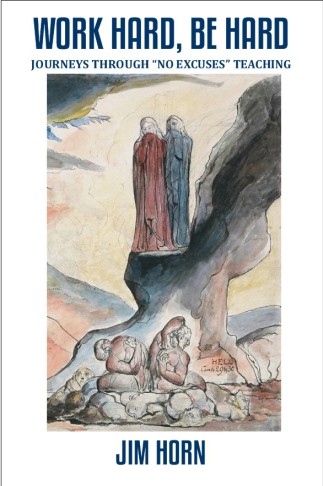
Jim Horn's new book "Work Hard,Be Hard: Journeys Through 'No Excuses' Teaching" should be required reading in every school district in the nation. Horn provides a devastating portrait of how what is essentially a Sweatshop model of schooling for children of color attracted huge support from philanthropists-many of whose own companies profited from Sweatshop labor- along with elected officials in both parties. That a model that depends so heavily on intimidation and behavior modification, for teachers as well as students, has become a model, not only for charter schools, but public schools, reflects a society where the prerogatives of great wealth have overpowered humanity, common sense and our best understanding of child development. 


Those who romanticize this "results driven" model need to come to grips not only with Horn's portrait of what it means to teach and learn in such a school, but his analysis of the antecedents of this model in post civil war industrial education. That we as a society have invested so heavily in institutionalized educational abuse for the children of the poor is damning enough; that we now want to spread it to all public school children suggest what a grim future is in store for most of our population if current economic trends continue! 


Every school board, superintendent, and principal who extoll the "No Excuses" model or promotes a pedagogy that sees test results as the sole criteria of achievement and learning a should be required to read this book. We are heading down a path that is crushing joy and creativity among more and more of our young people, and driving the best teachers out of the profession With A Brooklyn Accent: Why Jim Horn's New Book Should Be Required Reading in Every School District in the Nation:


CURMUDGUCATION: Moskowitz Schadenfreude

CURMUDGUCATION: Moskowitz Schadenfreude:
Moskowitz Schadenfreude


Eva Moskowitz, the super-well-paid queen (almost a cool half million) of Success Academy, finally had more than just a lousy day. She flat out lost one. I know it's not nice, but let's share a little schadenfreude over the defeat of a woman whose defiant hubris has been a bamboo shoot under the fingernails of educators all across Ne York.

The plan has been to expand the SA empire by adding Pre-K. But in an unexpected twist, the city of New York, rather than simply handing Moskowitz a pile of money and saying "Have a nice day," actually insisted that she sign a contract and agree to use the money in particular ways. 


You might think that this does not sound terribly unreasonable, that virtually all vendors who want a chunk of public money have to enter some sort of contract in which they agree to do certain things in certain ways according to certain rules. Even the long-existent military-industrial complex does not work by having contractors say, "We'd like a million dollars to just do some stuff. Heck, plenty of charter advocates propose a system in which charters contract to hit certain marks and have their success or failure measured accordingly. 

But we're talking Eva Moskowitrz here. Moskowitz who successfully told the state of New York that they had no right to audit her. Moskowitz who simply went over the head of the mayor of New York City and had the legislature overrule him so that she could have more schools. 

Not only did Moskowitz want her pile of Pre-K money without conditions, but she offered the argument that it was illegal to require anything contractually of her when the money was handed over. The contract may have been okay for every other provider of Pre-K services in the city, but Moskowitz answers to no one. Check out her op-ed here, where among other things, she says that 
CURMUDGUCATION: Moskowitz Schadenfreude:


Election Year Politics - Congressional delegation to cut ribbon for Vo-Tech schools that Malloy/Wyman are destroying - Wait What?

Election Year Politics - Congressional delegation to cut ribbon for Vo-Tech schools that Malloy/Wyman are destroying - Wait What?:

Election Year Politics – Congressional delegation to cut ribbon for Vo-Tech schools that Malloy/Wyman are destroying


 Welcome to the sad state of Connecticut politics in 2016.

The headline in of the press release screams out;
COURTNEY, BLUMENTHAL, MURPHY TO HIGHLIGHT ‘MANUFACTURING PIPELINE’ DURING ROUNDTABLE DISCUSSION AND JOIN RIBBON CUTTING FOR GRASSO TECH WELDING SHOP
The news advisory goes on explain that “Welcoming remarks” will be provided by Lieutenant Governor Nancy Wyman.
The event, which is taking place this morning at the Grasso Vo-Tech High School, will include a roundtable discussion, followed by a celebratory “ribbon cutting” for the Connecticut Vocational Technical High School’s expanded manufacturing program that seeks to, “train or retrain employees for high-tech manufacturing careers.”
Discussing the importance of job retraining in the 21st Century economy, Congressman Courtney, along with Senators Blumenthal and Murphy, will be basking in the glory of having helped the Connecticut Vo-Tech High School’s Workforce Training Program get a $6 million federal grant last year.
But of course, the problem – which is nicely overlooked in the media announcement- is that Governor Dannel Malloy and his policy partner, Lt. Governor Nancy Wyman, were successful in their effort to persuade the Democratic-controlled State Senate and State House of Representatives to adopt Malloy’s strategy of instituting the deepest cuts to Connecticut’s Vo-Tech high schools in state history .
The state budget was finally passed and signed into law by Governor Malloy who slashed another $7.8 million from Connecticut’s Vocational-Technical High School system.  In Election Year Politics - Congressional delegation to cut ribbon for Vo-Tech schools that Malloy/Wyman are destroying - Wait What?: