Latest News and Comment from Education

Wednesday, June 1, 2016

Gates Says It Still Supports CCSS, But No New CCSS Grants Yet in 2016 | deutsch29

Gates Says It Still Supports CCSS, But No New CCSS Grants Yet in 2016 | deutsch29:

Gates Says It Still Supports CCSS, But No New CCSS Grants Yet in 2016


On May 23, 2016, Gates Foundation CEO Susan Desmond-Hellman broadcast the Gates intention of pushing onward with trying to implement the Common Core State Standards (CCSS).
Pennsylvania teacher and blogger Peter Greene offers some insightful and entertaining commentary on Desmond-Hellman’s Gates-behalf declaration of fidelity toward pushing CCSS down the throat of the American public school classroom.
One stat that Desmond-Hellman cites is as follows:
For too many students today, the bridge to a prosperous and fulfilling life is obstructed and uncertain. In 2015, the ACT Condition of Career and College Readiness study revealed that only 40 percent of students met three of the four college-readiness standards across English, reading, math, and science. And performance was much lower for students of color.
The problems with narrowing educational (human?) value into “college readiness” aside, even ACT is clear that it has not scrapped its own definitions of “college and career readiness” in order to unquestioningly align with CCSS:
The finding that ACT Aspire assessments adequately assess many but not all of the priority content reflected in the Common Core standards is not surprising. Unlike other assessments included in the study, ACT Aspire is not and was never intended to measure all of the CCSS. Rather, ACT Aspire is designed to measure the skills and knowledge most important in preparing students for college and career readiness. This is a significant philosophical and design difference between ACT Aspire and other next generation assessments. ACT has made the choices we have to align with college and career readiness standards, rather than specifically to the Common Core, and we intend to keep it that way. [Emphasis added.]
Desmond-Hellman’s tossing out the “40 percent” ACT stat only shows that as CEO ofthe major CCSS funding source, she did not do her homework on ACT and just assumed that ACT’s usage of the term “college and career ready” must mean that ACT is lock-step, CCSS aligned–which really shows that the term “college and career ready” has lost its usefulness and should be scrapped.
But here is a more important and amazing issue in light of Desmond-Hellman’s Gates Says It Still Supports CCSS, But No New CCSS Grants Yet in 2016 | deutsch29:
 

Ed Reform Propaganda Machine Goes into Overdrive – Save Maine Schools

Ed Reform Propaganda Machine Goes into Overdrive – Save Maine Schools:

Ed Reform Propaganda Machine Goes into Overdrive

url.jpg
Well now this is just plain creepy.
In 2012, the Vermont based, Nellie Mae Education Foundation-funded  Partnership for Change  developed a one-year, 125k dollar communications plan for the Winooski-Burlington School Districts in Vermont to sell an idea for which there is no sound supporting research.
Using tactics developed by FrameWorks Institute (also with funding from Nellie Mae), the communications plan  uses strategic messaging – including sample talking points, opinion editorials, a speech/PowerPoint presentations, letters to the editor, and even a template sermon for the faith community –  to generate public buy-in for the corporate-driven theory of education  known as “personalized,” “competency-based,” or “student-centered” learning.
“Over time, we will put flesh on this narrative, adapt it for various audiences and time frames, and spread it across the community such that it eventually becomes second nature to the citizens of Winooski-Burlington,” the document states.
According to the plan: “Designated messengers, including superintendents, will give PowerPoint presentations to various groups (e.g., Kiwanis, Rotary, Chamber of Commerce) about the Partnership for Change and its implementation.”
The plan even includes a master calendar of local school and community events to help “the team” to help “identify potential opportunities for carrying the message and building public Ed Reform Propaganda Machine Goes into Overdrive – Save Maine Schools:

Maintaining the Charter Mirage: Progressive Racism – the becoming radical

Maintaining the Charter Mirage: Progressive Racism – the becoming radical:

Maintaining the Charter Mirage: Progressive Racism


As a former (and humbled) recipient of the National Council of Teachers of English’s George Orwell Award, and devoted reader of Franz Kafka, a Twitter debate can often seem surreal—and yesterday’s pushed me to suspect I was a victim of a satire account (but I wasn’t).
Spurred by my posts confronting the Post and Courier (Charleston, SC) embracing both takeovers of traditional public schools and “miracle” claims from a privatized charter chain, I foolishly waded into a charter debate with a self-professed “libertarian” edujournalist who writes for a publication that advocates for school choice and is a research fellow for The Friedman Foundation for Educational Choice as well as the superintendent of South Carolina’s Charter School District (if charter schools are public schools why do we have a separate school district for them?).
My Orwellian/Kafkan moments included the edujournalist calling me an “ideologue” and the superintendent bristling at my questioning the value of one year of data on the “miracle” charter school—seems there is no time for accountability for those knee-deep in the pet projects of the accountability movement.
But it became even more ridiculous (the feeling of a satire account even more intense) when the edujournalist began to Tweet horror stories about public schools, suggesting (“come on” was his refrain) that these cherry pickings somehow justified continuing to support the charter school mirage. (You see, the charter/school choice crowd cannot maintain multiple facts in mind at once—that we can challenge the very real failures of traditional public schoolsand recognize that the charter school alternative has been an equally negative failure.)
Because charter schools are without a single controversy—students of color walking out due to a lack of diversity and lack of racial sensitivity, children wetting their pants under the intense focus on testing.
Nope. Nothing to see here in the rosy land of the charter mirage.
The charter mirage is a scam, similar to the entire buffet of education policies embraced during the past thirty years of accountability.
This political scam can be traced to two facts: (1) politically and socially in the U.S. we refuse to identify and confront directly the race, class, and gender inequities that scar our nation and all our public and private institutions, and (2) education policy is driven by ideology and not Maintaining the Charter Mirage: Progressive Racism – the becoming radical:

UPDATE: Failing the Test: A New Series Examines Charter Schools - CAPITAL & MAIN

Failing the Test: A New Series Examines Charter Schools - CAPITAL & MAIN:

Failing the Test: A New Series Examines Charter Schools

Failing the Test
Illustration by Manoel Magalhaes
When the Great Public Schools Now Initiative, the $490 million blueprint to turn half of Los Angeles’ public school system into charter schools, was first leaked to Los Angeles Times reporter Howard Blume, it triggered an uproar among the city’s education community. The Los Angeles Unified School District already has more charter seats than any school system in the country, though at a lower percentage (about 16 percent) of total enrollment than Oakland’s — which, at roughly 25 percent, is proportionally the state leader. And like Oakland, and many other urban school systems in the U.S., LAUSD is teetering on the brink of bankruptcy.

See More Stories in Capital & Main’s Charter School Series

This comes at a time when charter-supporting philanthropists, led by the Broad, Walton Family and the Bill and Melinda Gates foundations, have been aggressively pushing charter schools across the country under the banner of “parent choice.” The initiative, which originally surfaced with a cover letter signed by Eli Broad and is often referred to as the Broad Plan, argues its case by charging that the country’s “urban school districts are not serving students. This failure is particularly acute for low-income and minority students who are in the greatest need of a quality education.” But contrary to the plan’s claims, the charters’ overall report card has not been so stellar.
According to University of Colorado, Boulder professor Kevin G. Welner and others, charters have been shown to offer no tangible academic advantages over traditional public schools. Welner, who is director of the National Education Policy Center, told Capital & Main, “If we’re talking about test scores, we’re not seeing any real meaningful differences between charter schools as a whole and noncharter public schools.”

(Photo by Pandora Young)
Photo by Pandora Young
Today there are about 1,230 charter schools statewide (or seven percent of the state’s K-12 enrollment), with 80 new schools opening in the 2015-16 school year alone, 21 of which were in Northern California. The 27 that opened in Los Angeles put it first in the state for growth. The Great Public Schools Now Initiative calls for 260 more charters to be created in the city by 2023. Capital & Main has since learned that charter groups have also been quietly pushing a similar plan to make Oakland’s school district half charter schools and half traditional schools.
If you are talking about going to one-third [or] one-half of enrollment in a place like Oakland or L.A., there are two big worries,” says Bruce Fuller, a professor of education and public policy at the University of California, Berkeley. “One is [that] you start to siphon off the most motivated families out of the traditional system and into the charter system. [Then] the charter system starts to look more and more like a network of private schools. So that kind of creaming process is very worrisome. The second thing is their fragile financial situations — especially Oakland’s. As you drain the dollars out of the mainstream system, the traditional system starts to shrink and implode as it tries to compete.”
Kevin Welner, Director, National Education Policy Center: “If we’re talking about test scores, we’re not seeing any real meaningful differences between charter schools as a whole and noncharter public schools.”
These caveats have led some critics to question not only if charter schools represent a viable or effective solution to improving learning opportunities for the state’s most disadvantaged children, but whether reforming public education is the only driver of charter expansion in the state.
Steve Zimmer, the LAUSD school board president, has his doubts. Zimmer, who has been one of the harshest critics of the Broad Plan, points to the charter industry’s pattern of existing expansion in Southern California. The LAUSD’s 130,000 charter-student population already would make it roughly the 20th largest school district in the country. It also, Zimmer says, represents an overpopulated charter school oasis surrounded by a veritable charter-free desert of even more desperate, high-needs districts like Lancaster, Palmdale, Santa Ana, Pasadena, Lynwood and Compton.
Even if you accepted the argument that choice is the most important lever for change and that charter schools were providing extraordinary opportunity,” he pointed out in an interview, “how could you possibly justify opening a hundred more charter schools — or 10 more charter schools even — in L.A. Unified, when there are districts with lower student outcomes all around L.A. Unified, places where there are no charter schools? The only answer is that it’s not about kids and it’s not about kids who need choice the most. And it’s not even about choice. It’s about what is in LAUSD that’s not in any of these other districts.”
What makes LAUSD a priority target, Zimmer maintained, is its board of education, which has been staunchly supportive of effecting reform within the public school system rather than through privatization, and the influential, 31,000-member United Teachers Los Angeles (UTLA), the second largest teachers union local in the nation.
Zimmer may have a point. In a section on political strategy titled “Improving Conditions for Los Angeles Charters,” the Broad Plan emphasizes its goal of winning a pro-charter majority on the LAUSD school board, and it spells out the effectiveness — and importance — of lobbying by the California Charter School Association to “improve the political and regulatory landscape.”Failing the Test: A New Series Examines Charter Schools - CAPITAL & MAIN:

Big Education Ape: How California's Charter Schools Are Failing The Test - http://go.shr.lc/283bJkr


Coming:

Wednesday
Failing the Test: Charter Schools’ Winners and Losers - CAPITAL & MAIN - http://go.shr.lc/24j3Fr0

Charter Schools’ Winners and Losers, by Capital & Main Staff (with video)
Yardsticks and Rulers: Measuring Charter School Performance, by Julian Vasquez Heilig
ThursdayThe Charter School Movement’s Powerbrokers, by Capital & Main Staff
Who’s Accountable? Searching for Charter School Transparency, by Bobbi Murray
FridaySchool Solutions and Turnarounds, by Bobbi Murray and Bill Raden
Solutions for Struggling Schools: Nine Takeaways, by Julian Vasquez Heilig
Plus video interviews with John Rogers, Director, UCLA Institute for Democracy, Education and Access.

Q&A With Monique W. Morris: How K-12 Schools Push Out Black Girls - Education Week

Q&A With Monique W. Morris: How K-12 Schools Push Out Black Girls - Education Week:

Q&A With Monique W. Morris: How K-12 Schools Push Out Black Girls


As a researcher and author working at the intersection of education, civil rights, and juvenile and social justice, Monique W. Morris has long studied the issues women of color face in the United States. She is co-founder and president of the National Black Women's Justice Institute—a Berkeley, Calif.-based nonprofit organization that works to improve racial and gender disparities in the criminal justice system for black women. Morris previously served as a vice president for economic programs, advocacy, and research at the NAACP. She and Rebecca Epstein, executive director of the Georgetown Law Center on Poverty and Inequality, are currently partnering in a two-year project to improve the relationships between girls of color and school resource officers.
Her latest research sheds a light on the treatment of black girls in K-12 schools. In her fourth book, Pushout: The Criminalization of Black Girls in Schools (New Press, 2016), Morris takes a closer look at the educational policies, practices, and conditions in U.S. schools that marginalize black girls both academically and socially as early, she argues, as pre-K. In the book, Morris unpacks the racial and gendered stereotypes that affect how schools respond to black girls on a daily basis.
—Positive Images
Recent studies from the U.S. Department of Education's office for civil rights show that many current disciplinary measures end up barring these young students from schools at higher rates than those for any other female student group and most male groups, which puts them at greater risk of entering the juvenile justice system. Morris frames this research around the stories of girls she spoke with across the country who experienced "pushout"—defined as the practices that foster criminalization in schools and how this criminalization leads to imprisonment—to expose what she says are the untold stories of the conditions that remain a barrier to black girls' education and well-being.
Commentary Associate Kate Stoltzfus interviewed Monique W. Morris by phone to discuss why young black girls are disproportionately pushed out of schools and how educators and policymakers can join forces with their communities to create school environments that allow all black girls to thrive in the classroom.
EW: Black girls are 16 percent of the female student population in public schools in the United States but more than one-third of all female school-based arrests, according to 2011-12 data from the U.S. Department of Education's office for civil rights. The disparities between how schools discipline black female students and all other female student groups, as well as many male groups, start as early as preschool. How do we begin to make sense of this polarizing gap?
MORRIS: One of the things I've been sharing in this conversation about school pushout Q&A With Monique W. Morris: How K-12 Schools Push Out Black Girls - Education Week:

CURMUDGUCATION: The New Teach for America-- Now With Less "Teach"

CURMUDGUCATION: The New Teach for America-- Now With Less "Teach":

The New Teach for America-- Now With Less "Teach"


Teach For America likes to reinvent itself from time to time, searching for whatever is currently the sweet spot in the market. And as Emma Brown explains in yesterday's Washington Post, TFA has stepped into the transmogrifier once again, and has emerged with a bit of mission creep.


The latest shift is prompted by a notable drop in TFA's recruiting juice. As Brown reports, applications are down 35% over the last three years, plummeting from 57,000 in 2013 to 37,000 this year. There are a variety of explanations for this including the general drop of everyone going into teaching through traditional paths or made-up paths like TFA; there's an irony in that TFA has itself been part of the movement denigrating and deprofessionalizing the teaching profession. TFA itself is no longer as shiny as it once was, partly because of bad press, but also, I'd bet, because after twenty-five years, TFA is part of the status quo and not some Hot New Thing.

But TFA, always looking to keep itself a viable business, has a plan for combating the lag in applicants and selling the program to a new generation. Part of it is a tactical tweak-- recruit students while they are underclassmen and no longer wait until they are seniors and know betterand have a different focus. But that's just procedure and not the heart of the new sales pitch.

The secret? Emphasize how Teach for America really isn't about teaching at all.

Here's a TFA rep talking at a recruitment event:

“We believe that this is far bigger than teaching,” Kimberly Diaz, of the organization’s D.C. regional office, told a group of prospective applicants from Georgetown and George Washington universities in April. They had just visited an elementary school in suburban Maryland and heard 
CURMUDGUCATION: The New Teach for America-- Now With Less "Teach":


Egregious Mismanagement of Charters in Ohio Drags On and On | janresseger

Egregious Mismanagement of Charters in Ohio Drags On and On | janresseger:

Egregious Mismanagement of Charters in Ohio Drags On and On


Knowyourcharter.com, a collaboration of Innovation Ohio and the Ohio Education Association, released a scathing report last week about the waste of millions of dollars in federal Charter School Program grants for Ohio charter schools that soon closed, or worse, never opened in the first place.
Belly Up: A Review of Federal Charter School Program Grants explains that in Ohio, “At least 108 of the 292 charter schools that have received federal CSP (Charter School Program) funding (37 percent) have either closed or never opened, totaling nearly $30 million.” “Of those that failed, at least 26 Ohio charter schools that received nearly $4 million in federal CSP funding apparently never even opened and there are no available records to indicate that these public funds were returned.”  Charter School Program grants are to support the development  of new charter schools, and Ohio has been a big recipient over the years, receiving CSP grants of $99.6 million since the 2006-2007 school year.
According to the new report, federal demands for oversight of Charter School Program grants has been minimal: “Since the grant program started in 1995, the U.S. Department of Education apparently has conducted exactly one examination of Ohio’s grant awards—and that review was contracted out seven years ago to a private education consulting firm called WestEd, which has written many pro-charter school reports.  Not surprisingly though, this 2009 assessment found some serious problems in Ohio. ‘The State needs to strengthen its subgrant application and verification process to ensure compliance with Section 501(c)3 eligibility requirements….’  WestEd was particularly concerned about the for-profit operators acting as the de facto school, even choosing the members of its charter schools’ boards.”  Last week’sBelly Up report adds, however, that in the years since WestEd’s report, “several new charter school laws (most significantly House Bill 2 which passed last year) have remedied some of these concerns. However, Ohio’s history of not allowing the state’s oversight agency—the Ohio Department of Education—to exercise any real, meaningful oversight of the state’s charter Egregious Mismanagement of Charters in Ohio Drags On and On | janresseger:

Who Are The Rest of Y'all? (On Dr. Emdin's For White Folks ...) | The Jose Vilson

Who Are The Rest of Y'all? (On Dr. Emdin's For White Folks ...) | The Jose Vilson:

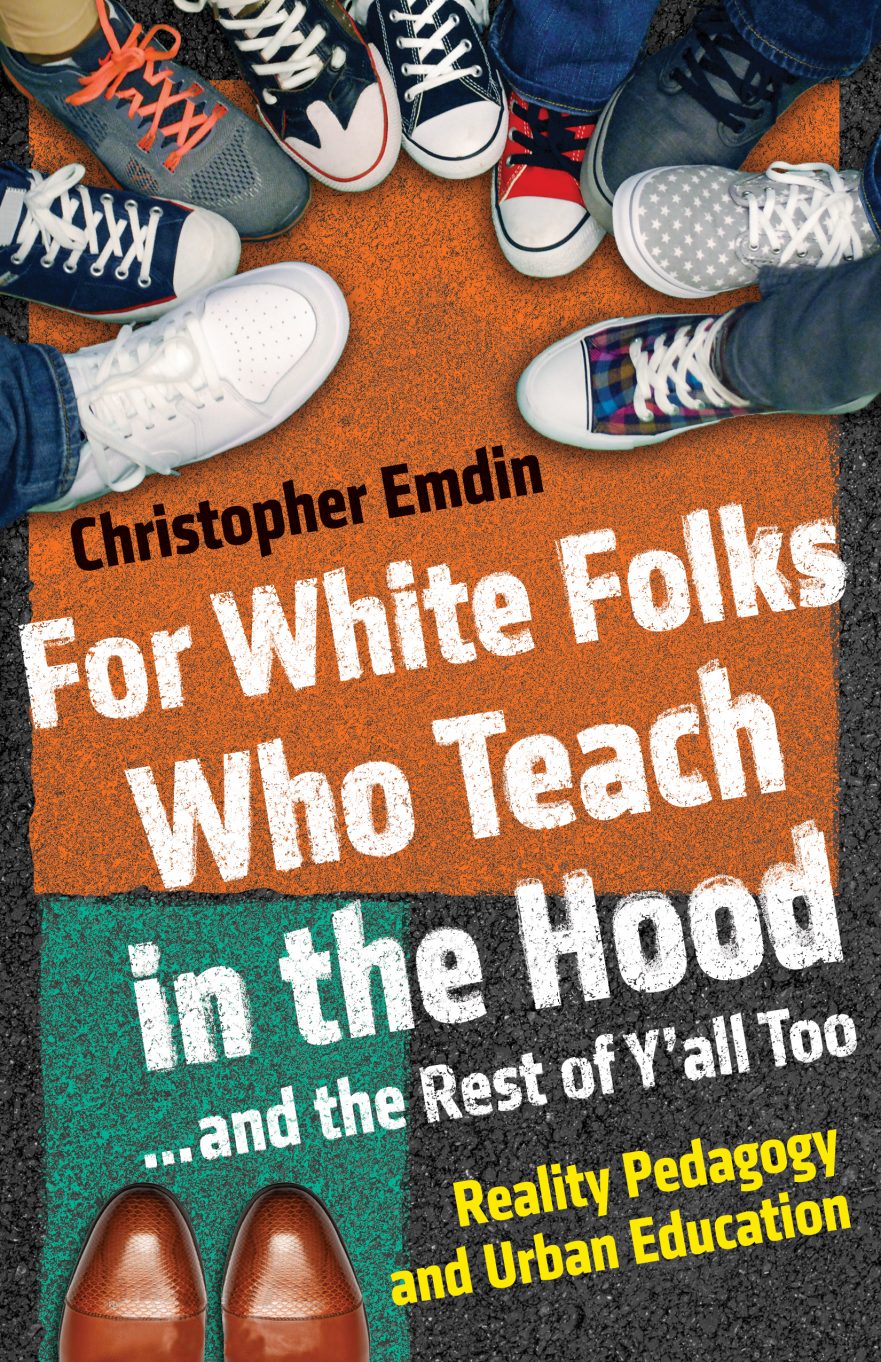
Who Are The Rest of Y’all? (On Dr. Emdin’s For White Folks …)

Emdin-ForWhiteFolksWhoTeachintheHood (1)


First, it’s important to note that I’ve been following Dr. Christopher Emdin’s ascent into superstar academic. From the hip-hop pedagogy classes he organized at Columbia University’s Teachers College and the collaborations with Wu-Tang Clan elder statesman GZA to conferences in South America and rendezvous with Kendrick Lamar, the dapper dandy reppin’ the Bronx has made this “work” look easy. (Note: it’s not.) What’s most captured me is that, despite the plethora of praise he’s received from Harvard University and the American Education Research Association to the Department of Energy and the White House, he has found time to wage war with both ideas and the figures who espouse said ideas. He doesn’t simply resort to calling them haters, but uses the academic language he inherited on the way to his doctorate to address and redress.
Which is why Dr. Christopher Emdin’s For White Folk Who Teach In The Hood … and the Rest of Y’all Too was so fascinating, not because he names names, but because he avoids names and focuses intently on ideas. For all of y’all: past, present, and future.
For those who’s been “doing the work” for some time, this book is a conglomerate of influences like Gloria Ladson-Billings (culturally responsive teaching), Lisa Delpit (analogizing the struggles of a people outside of his personal experiences to explicate his people more directly), Paulo Freire (bringing in students’ knowledge to make them the teachers and thus activating their knowledge), and, yes, John Dewey. But, as we know, John Dewey didn’t truly believe that progressive pedagogy rested in the hands of people of color, so the boulder that other academics like the aforementioned as well as Pedro Noguera, Sonia Nieto, Antonia Darder, and Angela Valenzuela keeps rolling with Emdin and the up-and-comers he stands to usher in. If you’re in this category, reading the book feels conversational, familiar, and will either affirm what you already believe and / or help Who Are The Rest of Y'all? (On Dr. Emdin's For White Folks ...) | The Jose Vilson:

Gates Foundation Apologizes Once Again for “Learning Organization” Missteps

Gates Foundation Apologizes Once Again for “Learning Organization” Missteps | Non Profit News For Nonprofit Organizations | Nonprofit Quarterly:
Gates Foundation Apologizes Once Again for “Learning Organization” Missteps


Sue Desmond-Hellmann, marking two years as the CEO of the Bill and Melinda Gates Foundation (BMGF), recently posted her vision of the kind of organization its founders wished the Foundation to become: “From the beginning, Bill and Melinda wanted their foundation to be a learning organization; one that evolves and course corrects based on evidence. We want to get continually smarter.” In one of their areas of major interest and investment, education, they seem to be widely missing this mark.
Desmond-Hellman asks, “What if all children—especially the poorest—had an equal opportunity to reach their full potential?” The Gates Foundation’s answer to this important question lies in in the failures of public education; for them, it’s the root cause of our growing societal inequity.
The Gates Foundation’s leadership believes firmly “that education is a bridge to opportunity in America.” In 2009, Bill Gates wrote:
Within the United States, there is a big gap between people who get the chance to make the most of their talents and those who don’t. Melinda and I believe that providing everyone with a great education is the key to closing this gap. If your parents are poor, you need a good education in order to have the equal opportunity that our founders promoted for every citizen.
The huge resources of the BMGF have been marshaled in support of a series of initiatives that ignore other possible reasons for our societal inequity as they seek to radically change how we teach our children and provide public education. Billions of dollars later, their results are marginal.
After more than five years of foundation support, in 2009, Bill Gates reported on the failure of their investment in “small schools”: “Many of the small schools that we invested in did not improve students’ achievement in any significant way.” The foundation’s lessons learned from this experience did not result in any questioning of their core belief that the answer to building a more equitable society would be found within our public schools. They just shifted their focus to increasing the number of charter schools, creating test-based teacher evaluation systems, improving school and student data management, and setting universal standards through the common core curriculum. Each has struggled, and none appear to have been effective.
In 2014, the BMGF supported InBloom, an effort to create a national educational data management system, shut down after parents protested the collection and storage in the cloud of data on their children. Various states withdrew their support, and NPQ reported last September on the failure of one of these Gates-funded initiatives, Empowering Effective Teachers.
Desmond-Hellman has led the foundation as it has invested heavily in the effort to create a national set of learning standards, the Common Core Curriculum. Despite over $300 million in foundation funding, alliances with other large foundations, and strong support from the U.S. Department of Education, the effort has drawn bitter opposition and decreasing support. The strong push that the DoE gave states to implement the Common Core was seen as an unwanted intrusion of federal power into local schools. The use of Gates Foundation Apologizes Once Again for “Learning Organization” Missteps | Non Profit News For Nonprofit Organizations | Nonprofit Quarterly:


"Power Couple" Are Out To Make A Killing On Charters & Privatization of California Education.

"Doing Good" In California After Helping To Blow Up The World Economy? Beller & Moses : Indybay:

"Doing Good" In California After Helping To Blow Up The World Economy? 

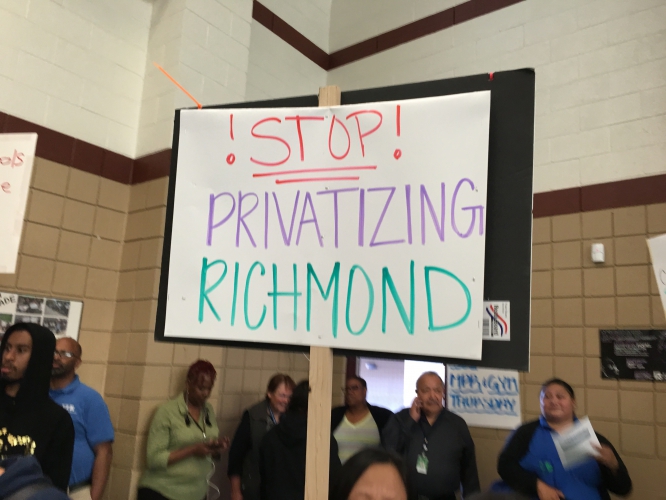
sm_utr_stop_privatizing.jpg original image (4032x3024)


"Power Couple" Beller and Moses Who Helped Bust The World Economy In 2008 Are Out To Make A Killing On Charters & Privatization of California Education. Their Caliber Charter Chain wants land in Richmond to build a non-union school and stick the taxpayers with the costs of privatization


"Doing Good" In California After Helping To Blow Up The World Economy? 
"Power Couple" Beller and Moses Who Helped Bust The World Economy In 2008 Are Out To Make A Killing On Charters & Privatization of California Education 
by Steve Zeltzer 
KPFA WorkWeek Radio 
5/31/16 

Some of the same people who helped wreck the world economy in 2008 are now in California using the deregulation of education, charters and testing scams to make a killing in California public education. 

They are also running up against angry parents, teachers and advocates of public education in Richmond, California 

Ron E Beller, his wife Jennifer Moses and Scott Mead were leading stars as speculative traders at Goldman Sachs in London in the 1980's before the collapse. They left Goldman Sachs in 2001 to set up their own hedge fund which was called Peloton and a it was run by Beller , Moses and Scott Mead 

Peloton initially made huge profits from the subprime mortgage debacle in the US. Peloton's top manager described proudly how it had gambled on a "'world coming to an end' trade that debt linked to subprime loans would tumble and higher quality securities would rise". 
As a result the firm's ABS investment fund rose 87 percent in 2007. EuroHedge magazine awarded the fund best new fixed-income fund. Now, despite investing in high quality mortgages, it's worthless. 

Beller and Moses early claim to notoriety in the UK was a secretary at Peloton who stole millions of dollars that he and his wife did not know was missing. "Not all Goldmanites avoid the headlines. An abiding tale of the boom years is how three London executives, Jennifer Moses and her husband, Ron Beller, and Scott Mead, had so much cash they did not notice when an assistant, Joyti De-Laurey, stole more than £4m from their accounts." 

In the case it also came out that Ron and Jennifer had spent £500,000 on her 40th birthday weekend in Italy. According to trial records, Mrs. Moses took trips with personal shoppers around Bergdorf Goodman, a high end exclusive department store in New York. Two house keepers and a firm of landscape gardeners looked after their home outside New York as they spent most of their time in London. 

Political Aspirations 

Jennifer Moses also had big political aspirations. She had become an education advisor to UK Labor Party Prime Minister Gordon Brown. Her job was to “fix” the crisis in the British school system with US capitalist enterprise schemes and enterprise social policies. She was one of the US Clintonite neo-liberals who wanted to give “tough love” to the poor and children. According to reports she was even so hardliner in cutting benefits that even labor party leader Tony Blair was put off according to reports. According to one of her supporters, Moses took a “strictly pragmatic view of education supporting city academies and private money in the state education” which was opposed by many Labour MPs. "Her view is very American," says one leading Lib-Dem who knows her. "It is that if you can solve a problem with private money, just get on with it. It would have shaken up the brethren around Gordonif she had joined the team." As an American with, according to colleagues, a "formidable intellect", it is understood the Prime Minister was convinced Moses, a libertarian with a social conscience, was the woman to help "get things done" and show that he was not relying on a what new rightwing Labour party officials called “old” labour. 
She and her husband were also supporters of the private charter school in the UK called the ARK schools. ARK advertises itself as an American and British educational charity sponsored and run by a group of millionaire merchant bankers and currency speculators. According to the UK National Teachers of Union NUT although it adverstises itself as an operator of ‘non-selective inner city schools.' it is not. 
“ARK,advertises itss a specialism in maths. It has been revealed that one proposal considered by ARK is to develop a maths curriculum and sell it "Doing Good" In California After Helping To Blow Up The World Economy? Beller & Moses : Indybay:

4 Better Ways to Allocate Federal Funding for Poor Children | US News

4 Better Ways to Allocate Federal Funding for Poor Children | US News:

Is There a Better Way to Allocate Federal Funding for Poor Children?

The Title I formula has proven near impossible to change.


After a monthslong investigation into federal education funding, U.S. News concluded that much of the $14.5 billion meant to provide poor children with an education comparable to rich children's is in fact flowing to school districts with lower-than-average poverty rates.
The why has to do with a complicated formula based on sometimes outdated data that inflates money going to school districts in small states, large school districts and localities that can devote more money to K-12 education. Read more in our investigation: Rich School Districts Get Millions in Federal Money Meant for Poor Kids.
In education policy circles, the formula's shortcomings are common knowledge, and have been the subject of much discussion.


The Alliance for Excellent Education has explored how to better address the needs of high school students with Title I (funds are often prioritized for elementary or middle school instead). The Brookings Institution has looked at how funds are spent, saying simply that the program "doesn't work."
Some have also proposed new formulas. The Center of American Progress has run analyses of a formula it says "is much better than the current formulas at targeting Title I dollars to settings of concentrations of poverty." An analysis from Nora Gordon published by The Hamilton Project called for Congress to remove state-level spending per pupil from the formula, to eliminate two of the four sub-formulas used to calculate a school's funding, and to raise the minimum requirement to receive funds from a 2 percent poverty rate (or 10 poor children) to a 5 percent poverty rate. Gordon, an associate professor at the McCourt School of Public Policy at Georgetown University, has provided her data to U.S. News.
Despite the clear problems with the formula and the available options for change, Congress has dragged its feet on an overhaul. This won't come as a surprise given recent criticisms of the "do-nothing" Congress that suffered from low productivity rates and low approval ratings. But the problem actually spans decades.
While the fight for forumla change has founds some advocates, they've found it impossible4 Better Ways to Allocate Federal Funding for Poor Children | US News: 

Tuesday, May 31, 2016

'Everyone's Job to Help': Addressing Student Poverty Beyond the Schoolhouse

'Everyone's Job to Help': Addressing Student Poverty Beyond the Schoolhouse:

‘Everyone’s Job to Help’: Addressing Student Poverty Beyond the Schoolhouse

student poverty

Conversations around student poverty took center stage last week in Washington, D.C. when leading experts gathered at a symposium, hosted by the National Education Association, to examine poverty’s effects on child development, promising practices, and policy recommendations beyond the schoolhouse.
The statistics on child poverty are alarming: 15.5 million U.S. children live in poverty, one in five children receive food stamp assistance, and more than 50 percent of public school students qualify for free or reduced-price lunches.
“Poverty is a tragedy,” said NEA President Lily Eskelsen García during her keynote, “…and their only hope is what they find in that public school,” referring to schools that integrate academics with community services, such as health and social services, youth and community development, and community engagement.
“Why aren’t we making every public school like our best public school?” Why aren’t we improving the community as we improve our public schools? Make the case that every public school should look like the best public school,” Eskelsen García said.

Policies Working Together

Three different panels led the day’s conversation, which ranged from poverty’s effect on brain development and how some early returns have found structural differences in the brains of children to dispelling the myths and negative perceptions of poor people. The narrative of “black and brown kids don’t care about their education” must change, said Zakiyah Ansari, advocacy director of the New York State Alliance for Quality Education. “It’s a narrative we’re pushing back on.”
While educators were on hand to discuss the disconnect between policy and 'Everyone's Job to Help': Addressing Student Poverty Beyond the Schoolhouse: