Latest News and Comment from Education

Sunday, March 6, 2016

CURMUDGUCATION: The Obligations of Wealth + KY: Charter Salvation? + Involving Introverts + ICYMI: In like a lamb

CURMUDGUCATION: The Obligations of Wealth:

The Obligations of Wealth


This is not the blog piece you think it's going to be.

I am not going to write about how the Waltons or the Gates or the Kochs or the Rich Folks Whose Names I Don't Know should live their lives, spend their money, and generally behave themselves. It's not, mind you, that I don't have some thoughts about it. But those are not the wealthy people I'm going to write about today.

I'm going to write about me.

It's fun to focus righteous rage on Those People and condemn the profligate wealthy and their terrible use of their privilege and power and money. But years ago I needed to face up to something. I live in a rural/small town area, one that once upon a time has a decent industrial base, but has lost much of that over the past fifty years. We're not destitute. But we live among the residual pieces of an earlier wealth, the churches and homes and other fine buildings erected 150 years ago by oil barons and captains of industry. Want a beautiful Victorian home dirt cheap? We've got the places for you-- but you need to bring your own job.

As a teacher with thirty years in, I'm pretty well off. I make above the median pay for the county. Hugely above the per capita income for the county. I own my own home, and while it's neither large or without issues, it's also right up against the river and close to the center of town. I have reliable transportation (no small thing-- in the country homelessness isn't nearly as problematic as transportationlessness), and I'm only six minutes from work. I'm not rich in any absolute sense, and I have plenty of bills to pay with a paycheck that doesn't always stretch as far as would be handy. There are things I'd like to have that I can't afford, a level of security and insulation I'd love to provide my family, but can't. 

So, to be clear, I am not arguing that I am overpaid and that our next teacher contract should roll our pay back. Because it shouldn't. But that's not what I'm talking about.

It is not easy for me to talk about this. It's not easy to talk about possessing privilege. I don't
CURMUDGUCATION: The Obligations of Wealth: 


KY: Charter Salvation?


Kentucky is one of the few states without a charter law. But what they do have is a new governor, and Matt Bevin would love to bring Kentucky into the loving embrace of the charter industry.

Kentucky residents are getting a crash course in the charter biz. That includes all of the usual arguments, including Education Secretary Hal Heiner's call to put adult interests aside and Do It For The Children. Heiner is a long-standing charter booster and real estate developer who actually ran against Bevin in the governor's race; after defeating him, Bevin appointed him ed secretary.

Heiner and Bevin believe that the children of Kentucky need more choices, but Dr. Donna Hargens, superintendent of Jefferson County Public Schools, points out that the district offers 18 magnet schools and 52 magnet and optional programs.

Charter proponents have been pitching Indiana as a success story, including the Tindley schools of Indianapolis, and that turns out to underline the problem-- Tindley schools have just turned out to be in the middle of a financial mess, and their visionary leader will step down at the end of the year with some of his personal spending under attack. The school has been accused of having a high suspension rate, and there's also a case to be made that some Tindley charters have been the point of the spear for gentrification of neighborhoods.

But most of all, Indiana is one more place where it's becoming evident that you can't have a charter system without hitting the taxpayers up for more money. Tindley's charter company was itself begging just a few years ago when it took over Arlington High and found the finances insufficient for the job. Indiana is a bigger charter mess than we can get into here, but one thing they have 
KY: Charter Salvation?


I'm never a fan of embracing technology for technology's sake, but I do love a good technological solution to a teaching problem, and I have found some technology is an absolute boon to engaging introverts.

It helps, of course, to understand what the heck an introvert is. Introverts aren't necessarily shy, and don't hate all human contact. But interaction is work. The classic distinguisher for extroverts and introverts-- two people go to a party, where both mingle and talk and have a good time with all the folks in the room, but the extrovert comes out pumped up and ready to go do something else, and the introvert emerges wrung out and ready to settle into his own chair in his own room in his own home by his own self.

Some extroverts really don't get introversion and suffer from the notion that introversion is a problem that needs to be solved. This can be problematic in a classroom; many introverts can tell you a story of some extroverted teacher who decided to force the introvert to come out of her shell, or to get more engaged with the other students in the room.

When I take a test like, say, the Myers-Briggs inventory, I peg the introvert-o-meter. But I've been a performing amateur musician my whole life, and I was a union president. Your introvert students can do everything that your extroverts can; they just may approach it a bit differently.

Years ago I discovered Moodle, an open-source learning platform. One of its features was a discussion board that allowed threaded conversations. It was handy for any number of classroom 
Involving Introverts


Let's kick of March with some good readings, both new and old.

Why I'm Not Impressed with Effective Teachers

Timothy Shanahan makes an important distinction between effective teachers and effective teaching.

Shut Up and Sit Down

Joshua Rothman in the New Yorker looks at our dangerous leadership obsession, tracing it up through the current leadership industry which assumes that leadership and power can be decoupled.

21st Century Learning, Inc

From a couple of years ago, here's Tara Ehrcke's look at the business of 21st century learning, and why it is a bunch of hooey and a marketeer's drea.

Marc Tucker and Common Core Fuel Injection

You probably read this, and you definitely should have. Mercedes Schneider hoists Marc Tucker by his own badly constructed metaphorical fuel injector.

The ESSA Negotiated Rulemaking Committee

A breakdown of who, exactly, is on that committee to flesh out the details of ESSA.

A Bill of Rights for School Children

Russ Walsh has a book coming out soon. I've already read it, and I recommend it not just for your own reading, but as a gift for the civilian in your life who hasn't been paying close attention to what's going on in education. This short piece is a sort of preamble to the book. Check it out. 

NEWSLETTER | A Message From Diane - NPE Action

NEWSLETTER | A Message From Diane - NPE Action:

NEWSLETTER | A Message From Diane


 Only the light can vanquish darkness. In this last election cycle wealthy individuals poured unprecedented amounts of dark money into state and local school board races, in towns small and large, to elect candidates intent on undermining and privatizing our public schools. Network for Public Education Action brings together those of us who are determined to counter the big money that is working to privatize and destroy public education.

We do not have their deep pockets, but we have something better – we have you. And together, we have created a national movement of teachers, parents, and citizens who are working to strengthen public education and push back against the privatizers.
Our public schools have paid a heavy price for the test and punish privatization agendas of the last two presidents. ESSA takes much of that power away from Washington, and puts it back in the hands of each state. So while we will work to ensure the next president makes public education a priority and turns his or her back on privatization, we must also work at the state and local level to support candidates who understand sound education policy.
If you want to change toxic policies and laws, expose the dark money behind the privatization movement, and support candidates who champion public education, then please consider donating to NPE Action.
Your financial support will allow NPE Action to inform public opinion, advocate and support policies and legislation that strengthen our public schools.
Thank you for helping to keep the light shining, as we work together to defend and strengthen the guarantee of public education for all American children.
Thank you,
Diane Ravitch
President, Network for Public Education Action  NEWSLETTER | A Message From Diane - NPE Action:

NPE Action Virtual Launch Party

NPE Action is thrilled to invite you to join Diane and Robin for a Virtual Launch Party on Thursday, March 10th.
Stay tuned in the coming days for more details, but don’t miss this chance to chat with Diane and Robin about the launch of NPE Action, the 501c4 of Network for Public Education, and their vision for the coming year.NEWSLETTER | A Message From Diane - NPE Action:

Russ on Reading: A Bill of Rights for School Children

Russ on Reading: A Bill of Rights for School Children:

A Bill of Rights for School Children


 My new book, A Parent's Guide to Public Education in the 21st Century, is due to be released in about a week from Garn Press. The book is aimed at helping parents make informed decisions from the perspective of a public education advocate and corporate education reform critic. This Bill of Rights for School Children serves as a sort of preamble to the book.


It is clear that in the near future public education faces tremendous disruption and change. How this great American institution emerges from this change is of critical importance to every parent and child in the country. In the city of New Orleans, the system of public education as we have known it has been almost entirely replaced by a system of privately run, publicly funded charter schools. In other cities, like Philadelphia and Detroit, where adequate resources have long been denied to the public schools and where the public schools have been struggling for decades, more and more of the responsibility for educating the children has fallen to charter schools, both brick and mortar schools and cyber schools.

The current crop of education reformers argue that these changes are necessary, that the situation in many inner-city schools demands that we try something new. There is no question that something must be done to improve the quality of the learning experiences that children get in the inner cities. What the education reformers miss is that the public school system, any public school system, is both a reflection of and a product of the community where it resides. Reform cannot be focused on one element of that community, like the schools, and be successful.

We have seen that in the United States public schools in affluent areas consistently perform at a very high level. We see this in community after community, county after county, state after state, all across the country. Parent income is the single best predictor of student readiness for college and career. It is notable that in many of these affluent communities, teacher unions are strong and vocal, charter schools are virtually non-existent and test scores and every other measure of student learning are off the charts. Every one of these communities has both been able to and willing to make a financial commitment to quality public schools. Strong unions have not stood in the way of strong student learning. Teachers perform at a high level. Principals and other administrators are both qualified and highly engaged in producing quality learning.

It seems obvious that if we are going to improve public education in the economically struggling inner cities, we must take a holistic view. We must attack poverty with as much vigor and energy as the education reformers bring to their lobbying efforts in support of opening more charter schools. We must provide children in the inner cities with more services than schools in affluent areas because these children need more help to become proficient learners. This means wrap around services like medical and dental screenings, increased availability of counselors to help children navigate the trauma of their daily lives, home-school counselors that assist struggling families in providing experiences for their young children that will help them when they get to school, and professionally run and developmentally appropriate pre-school programs. All of these things will help and they will help much more than sending a child across town to a new charter school that has promised to raise student test scores.

Education reformers have it wrong. We cannot end poverty by improving educational opportunity. Education has proven a way out of poverty for a select few of course, but for most children, the debilitating impact of poverty cannot be overcome in the classroom. To truly serve these children we must first concentrate on ending income inequity. If we can make significant strides in improving the economic outlook of the 24% of American children living in poverty, improved educational opportunity will be the joyous and very predictable outcome.

As we look to future, it may be useful to consider some principles about public education that, for me at least, seem immutable. A Bill of Rights for the school child if you will.

1.      Every child has a right to a free, high quality, public education.
2.      Every child has a right to attend a well-staffed, well-resourced, clean and safe local neighborhood school.
3.      Every child has the right to be taught by well-informed, fully certified, fully engaged teachers who care about the child as a learner and as a person.
4.      Every child has the right to a school that provides a rich and varied curriculum that includes the visual and performing arts, integrated technology, and physical education.
5.      Every child has a right to a school that provides a rich and varied extra-curricular program including athletics, clubs, and service learning opportunities.
6.      Every child has a right to instruction that is well-planned, engaging, and collaborative.
7.      Every child has a right to instruction that is developmentally appropriate.
8.      Every elementary school child has a right to daily recess.
9.      Every child has the right to go to a school with adequate support personnel including librarians, nurses, guidance counselors, and learning support specialists.
10.  Every child has a right to an element of choice in the educational program, including the right to choose to take advanced level courses.
As parents it is of course in our interest to see that all of these things are available to our own child, but it is also in every parent’s interest to make sure that every child has this opportunity. The world that our children will inhabit in the future will be populated by an increasingly diverse citizenry. If we want the best that this country has to offer for our own children, we must work to ensure that every child in this country has similar opportunities. For our own children to reap the benefits of the American Dream, to live happily, freely and securely in the challenging world of the future, we must make sure that everyone’s children have access to that same American Dream.Russ on Reading: A Bill of Rights for School Children:

Seattle Schools Community Forum: About Highly Capable - Dear Directors

Seattle Schools Community Forum: About Highly Capable - Dear Directors:

About Highly Capable - Dear Directors


 My e-mail to the Board (via the schoolboard@seattleschools.org which means I sent it to senior management as well):


Dear Directors,

The situation with AL/HCC is getting out of hand and someone must step in.  I would ask that it be you because clearly, it's not happening in senior management.

I'll be upfront with you; there has never been a champion for HC in Seattle Schools.  I'm NOT saying no one cares about gifted students. I'm saying that year after year HC drifts along in an incoherent manner.  There is NO one in SPS - and I'd love to do a pop quiz with the Superintendent - who can clearly explain this program.

So let's review what has happened in the last couple of years (not to mention months.)

- multiple apologies over student data being accidentally sent out to other parents
- confusion over testing dates (and more apologies)
- with the current issue - letters sent to parents saying their students did qualify for HC and then a follow-up letter saying they didn't - here's the response from senior staff (partial but the full extent of the "how" it happened):

"To date, review of how this happened relates to human error."

And slowly, slowly EVERY single Spectrum program is going away.  The parents at Lafayette just got their notification (and they are the last school.)

With no discussion, no input, no public notification, an entire section of the HC program is gone/fundamentally changed.  

I will note at the Seattle Schools Community Forum blog that we often have heated discussions about who is in the program, namely that it's largely white and Asian.  We ALL know there are bright kids of all races in all corners of our district.  

Why aren't we finding them? I can give you a laundry list:
- testing instrument that may not be culturally competent
- principals who do not encourage parents of their students of colors to apply (and, when your school's scores are important, why would you?)
- low, low numbers of Pacific-Islander, Native American, Latino and African-American students.  It becomes a chicken and egg dilemma; parents don't want Seattle Schools Community Forum: About Highly Capable - Dear Directors:

Extending school days and year will continue flux in DCPS – @ THE CHALKFACE

Extending school days and year will continue flux in DCPS – @ THE CHALKFACE:

Extending school days and year will continue flux in DCPS


 The Chancellor of DC Public Schools is hell bent on transitioning the entire District, mainly vis a vis most beleaguered schools, to an extended day and school year. The Mayor and Chancellor recently announced a list of roughly ten schools who will be implementing an extended school year of 20 days. These schools are all in blighted Wards 7 and 8, so it will be obvious to all residents of DC that only the poor kids go to school for longer days and years. Their presence in school uniforms longer than their same age peers across the city will further underscore their entrapment.

The assumption is that more time equals better outcomes, and we know from research that the results are so mixed that no significant investments in increasing school time should be made. But as a cosmetic political change, increasing school minutes and school days are easy metrics to gauge the seriousness of education reform efforts.
The Washington Teachers’ Union has made it clear to members that any extension of the day or calendar is a violation of the pre-existing contract. Any school that implements an extended day or year is operating outside the boundaries of the Collective Bargaining Agreement. Teachers are technically within their rights to refuse to participate in either proposition, and technically without fear of reprobation. But any DCPS teacher knows that, within the current evaluation regime, there are ways administration can punish teachers who do not comply, even though non-compliance is non-punishable in certain instances.
For instance, a teacher, in many schools, can refuse to participate in extended day activities. They will not receive additional pay at a prescribed hourly rate, but they will not technically experience any blowback from that decision. However, the current IMPACT evaluation system uses something called “Commitment to School Culture”, or CSC, to evaluate teachers. Principals possess great leverage to define what Commitment means. In some cases, Commitment can mean participation in after school activities. So, if a teacher refuses, they can be dinged on their CSC score. Or, principals can and do find ways to under rate teaching as a form of punishment for unrelated acts of defiance.
When implementing extended school day and year by fiat, specifically in low-income schools in Wards 7 and 8, the District is once again contributing to the churn of teachers in these schools. In February of the current school year, teachers and the public were notified that certain schools were going to extended school year. This adjustment of the school calendar is only legally negotiable at the union and District level, not Extending school days and year will continue flux in DCPS – @ THE CHALKFACE:

Glen Ford: The Black “Mis-Leadership” Class | Seattle Education

Glen Ford: The Black “Mis-Leadership” Class | Seattle Education:

Glen Ford: The Black “Mis-Leadership” Class


About Cory Booker:
From Seattle Education:

Cory Booker and the $100M gift to Newark Public Schools

This goes into the OMG category because that is what I kept saying to myself as I read this article.
From FireDogLake:
By: DSWright, posted on Wednesday December 26, 2012
bookerzuk
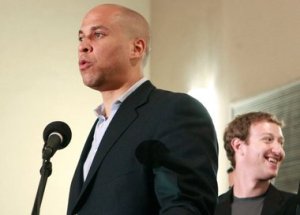
Cory Booker (left) and Mark Zuckerberg
It started on Oprah.
Facebook founder and Winklevii nemesis Mark Zuckerberg announced a $100 million donation to Newark schools to blunt PR damage from the release of The Social Network to help school children. The money would not be going into the struggling city’s budget but would be privately controlled with Newark Mayor Cory Booker providing guidance.
Yes, money used to transform Newark public schools would be administered privately and, until recently, in secret from the people of Newark.
Privatizing schools in Newark was already a tough task this year after the crown jewel of charter schools in the city was caught up in a cheating scandal. Apparently telling teachers they get paid more/remain employed if their students do better on tests leads to gaming the test system – who knew monetary incentives lead to the pursuit of self-interest? The strategy was clear, use the private money to launch attacks on public Glen Ford: The Black “Mis-Leadership” Class | Seattle Education:
 Charter schools: “There’s gold in them thar schools!” | Seattle Education http://bit.ly/1LJI3kk

BlackLivesMatter work in Milwaukee Public Schools advancing | Educate All Students: Larry Miller's Blog

BlackLivesMatter work in Milwaukee Public Schools advancing | Educate All Students: Larry Miller's Blog:

BlackLivesMatter work in Milwaukee Public Schools advancing


 In 2015 the MPS school board adopted a BlackLivesMatter resolution proposed by Dr. Robert Smith and myself.

Since its adoption, a group of community educators, parents, MPS teachers, principals and administrators have been meeting and preparing to implement the work, starting this summer. While the resolution calls for a broad reach in implementing the lessons of the Black Lives Matter movement, the working group is focusing on teaching and learning, along with restorative practices. Professional development training is being planned to be carried out this summer to prepare for implementing in classrooms and schools for this Fall.
I am very encouraged by the participation and the level of discussion taking place.
Following is the full resolution.
Black Lives Matter, Milwaukee Public Schools Resolution 1516R-001 April 28, 2015
WHEREAS, The United Nations Declaration of Human Rights (1948) boldly declared that, “Education shall be directed to the full development of the human personality and to the strengthening of respect for human rights and fundamental freedoms. It shall promote understanding, tolerance and friendship…”; and
WHEREAS, As a public school district, we are facilitators of the limitless growth potential of human beings. Our charge is to pour every ounce of creativity and energy that we have into the task of helping young people find and achieve their purpose. Our purpose must be guided by the belief that every human being deserves to live with dignity and that each of our students can leave his or her communities better than he or she found them; and
WHEREAS, The killing of unarmed Black men and women has left young people searching for answers to incredibly complicated and infuriating questions; and
WHEREAS, The extrajudicial killing of Black people in this country has deep roots in the dehumanizing system of white supremacy that once defined Black bodies as property and persisted in the form of lynchings during the 100 years of Jim Crow. The mob and the whip have been replaced by government sponsored “programs” like COINTELPRO, the war on drugs, mass incarceration, unjust policing, and structural policies that maintain racial segregation (redlining, urban renewal, and more) that exploit and oppress poor communities. Because these tragedies are not new and have lasting negative consequences for our communities, cities, and nation, we need to assert, over and over again, that the lives of Black people matter; and
WHEREAS, As WEB Du Bois stated, “The teachers of Black youth must believe in them. They must have faith in them and their community. They must trust them and encourage them and defend them.” Right now that means affirming that we are committed to the emotional and physical safety of Black students. It means that our schools and classrooms must be safe spaces for dialogue and support on the issues raised by the Black Lives Matter movement and the efforts to reverse the school-to-prison pipeline; and
WHEREAS, We believe deeply that the lives of all people matter. As a school district and as educators our lives are constructed around this fact. Shouting loudly that “Black Lives Matter” BlackLivesMatter work in Milwaukee Public Schools advancing | Educate All Students: Larry Miller's Blog:

Now some schools are testing kids for their ‘grit’ and ‘joy’ levels. Really. - The Washington Post

Now some schools are testing kids for their ‘grit’ and ‘joy’ levels. Really. - The Washington Post:

Now some schools are testing kids for their ‘grit’ and ‘joy’ levels. Really.

Tony Roddy talks to members of the Joliet Boys and Girls Club about his walk across the United States during a presentation in Joliet, Ill. (Lathan Goumas/The Herald-News via AP)


 In 2012, I published a post with this headline, “Sick of grit already.” Here it is 2016, and not only has “grit” become one of the watchwords in the education reform debate, but now some powers that be think they can teach it, measure it and test it.

Despite the fact that there is no consensus definition on how to do any of those things, the U.S. government, in 2017, is going to start collecting collecting data from students about their individual “grit” levels by asking those who take the National Assessment of Educational Progress to rate their own level of grit. Also their “desire for learning.”
And now, as this New York Times story says, schools are trying to find ways to measure and test grit, joy and other non-academic attributes. It says in part:
 …starting this year, several California school districts will test students on how well they have learned the kind of skills like self-control and conscientiousness that the games aim to cultivate — ones that might be described as everything you should have learned in kindergarten but are still reading self-help books to master in middle age.
A recent update to federal education law requires states to include at least one nonacademic measure in judging school performance. So other states are watching these districts as a potential model. But the race to test for so-called social-emotional skills has 
Now some schools are testing kids for their ‘grit’ and ‘joy’ levels. Really. - The Washington Post:

Educators update anti-bullying messages to protect Muslims - Yahoo News

Educators update anti-bullying messages to protect Muslims - Yahoo News:

Educators update anti-bullying messages to protect Muslims


 MERIDEN, Conn. (AP) — In response to a surge in reports of anti-Muslim bullying — students being called terrorists, having their head scarves ripped off and facing bias even from teachers — schools are expanding on efforts deployed in the past to help protect gays, racial minorities and other marginalized groups.

Civil rights organizations and other advocates have been working more closely with schools since the attacks in Paris and San Bernardino, California, stirred a new backlash that led the U.S. Justice Department and U.S. Education Department to urge vigilance on the bullying of Muslims.
While stressing that students have rights under the law, and that offenses should be reported, speakers at schools and mosques have also discussed how to create an inclusive culture, how Muslims are scapegoated for attacks and how non-Muslims can be allies to their peers.
"Muslim kids get bulled, gay kids get bullied because other kids are uncomfortable with them, and they show it," said Bill Howe, a multicultural education specialist who spoke at an anti-bullying forum in December for children at Meriden's Baitul Aman mosque. "That causes Muslim students to retreat, to be more isolated. They need to develop critical social skills so they can build relationships."
One mother who attended the forum, put on by the office of the U.S. attorney for Connecticut, said she was relieved to learn help is available.
Shazia Choudry's 13-year-old daughter, Maria, transferred recently from a public school after students repeatedly grabbed away her head scarf, but became frightened one day in January at her private Roman Catholic school when seventh-grade classmates peppered her, the only Muslim student, with questions about the Paris attacks.
"They were saying 'Did you hear about this before the terror attack?' And I was like, 'No I didn't,'" Maria said.
Saleha Qureshi, a member of the mosque, said that in the past several months, her son has been called a racial slur and a "terrorist" by his eighth-grade classmates at a public middle school.
Her son has grown anxious, she said, but does not want her to take matters to the principal. She checks up on him daily, letting him vent to her, but she's not sure what more she ought to do.
"I'm just hoping things will change for him," Qureshi said.
The Anti-Defamation League updated its anti-bias training activities after the Paris attacks to incorporate Islam.
One lesson plan tailored for junior and senior high school students has them discuss ways in which Muslims and Syrian refugees are being scapegoated as a result of the attacks. Another encourages students to discuss connections between stereotypes about Muslim people and acts of bigotry, as well as ways they can support Muslims.
Education officials in most of the ADL's 27 U.S. regional offices have been reporting anti-Muslim incidents, and schools have been requesting materials to help deal with the bullying, said Jinnie Spiegler, the organization's curriculum director. Among other efforts, the agency participated in a town hall meeting at Montgomery Blair High School in Silver Spring, Maryland, where officials said some Muslim students were being called names.
The town hall followed others at the school on topics such as Black Lives Matter, said Andrea Lamphier, a sponsor for the school's Muslim students club. Afterward, she said, a petition drive gathered signatures from more than a third of the student body on a letter criticizing Gov. Larry Hogan for saying the state would not welcome Syrian refugees.
While schools generally do not keep statistics on motivations for bullying, a survey of 600 Muslim students in California by the Council on American-Islamic Relations found in October, even before the latest attacks, that 55 percent reported facing religion-based bullying — a rate twice as high as the national average of students who report being bullied at school. Officials with the group say bullying reports spiked in recent months.
Parents say that incidents often go unreported, particularly among older students, and that many families address the problem by changing schools or home-schooling.
Left unchecked, advocates warn, bullying and harassment can make students feel disconnected from school and hurt their academic performance.
Donna Clark Love, a bullying prevention trainer in Houston, said schools traditionally brought her in for issues affecting students who or gay or have distinguishing physical traits, such as obesity. More recently, anti-Muslim bullying has emerged as another top concern. All result from a lack of acceptance, she said, and she addresses them the same way, by teaching children to have respectful conversations.
In some cases, teachers have taken it on themselves to hold discussions on anti-Muslim bias. Kate Sundeen, a chemistry teacher at the Academy at Palumbo magnet school in Philadelphia, helped to set up a discussion in January that was modeled on a town hall on the Black Lives Matter movement. A panel of a dozen students spoke about their experiences after the Paris attacks, including being accosted by adults in public and harassed over headscarves.
"It was heartbreaking but important and really brave of them to share these experiences," Sundeen said.
___
This story has been corrected to show the name of the bullying prevention trainer in Houston is Donna Clark Love, not Donna Clarke Love.Educators update anti-bullying messages to protect Muslims - Yahoo News:

Saturday, March 5, 2016

BlackLivesMatter/CampaignZero Activist Brittney Packnett (Almost) Tries to Defend the Indefensible, Teach for America

From the Black Agenda Report: BlackLivesMatter/CampaignZero Activist Brittney Packnett (Almost) Tries to Defend the Indefensible, Teach for America | Seattle Education:

From the Black Agenda Report: BlackLivesMatter/CampaignZero Activist Brittney Packnett (Almost) Tries to Defend the Indefensible, Teach for America


Originally posted on the Black Agenda Report:

TFA/BlackLivesMatter/CampaignZero Activist Brittney Packnett (Almost) Tries to Defend the Indefensible

brittney-packnett-deray
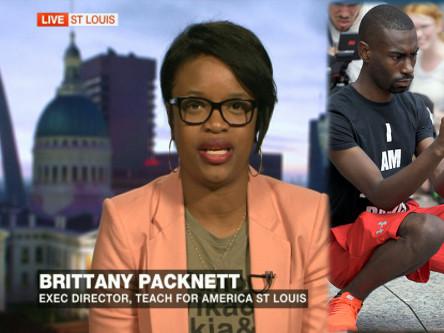
Brittney Packnett, Executive Director for Teach for America St. Louis
Packnett’s problem however, and Teach For America’s too, is that their mission so clearly indefensible that they can’t really talk about what Teach For America actually does, and why it does those things.
Stung by growing public recognition of Teach For America’s heinous role in destabilizing communities and destroying public education, CampaignZero/BlackLivesMatter activist & TFA’s Brittney Packnett took to Huffington Post last week to defend herself and TFA’s mission. But school privatization is so unpopular she had to resort to misdirection and mumbling about her St. Louis origins and supposed conspiracy theories against her instead.
By Bruce A. Dixon
As the pivotal role of Teach For America in the elite bipartisan drive to privatize public education comes more sharply into public view, it’s natural that TFA operatives and apologists will try to defend their missions and careers. That’s what Brittney Packnett’s sad and disingenuous “Let’s Get Back To Work” piece in Huffington Post last week was about.
Packnett’s problem however, and Teach For America’s too is that their mission so clearly indefensible that they can’t really talk about what Teach For America actually does, and why it does those things.
TFA, whose St. Louis director is Ms. Packnett, cannot just come out and say they spend hundreds of millions a year in corporate and government funds replacing experienced, qualified, mostly black public school teachers with undertrained and mostly white temps to facilitate the policy goal of their corporate funders, which is the privatization of public education.


CORE: The Movement to Privatize California's Public Schools

CORE — Transforming Education:


The CORE districts are spread out geographically and represent 1.1 million California students. More than half of those students are from two southern California districts, Los Angeles Unified and Long Beach Unified. Clovis Unified, which is included in the charts, withdrew its application late in the process.


Follow This Link for the Real Story Big Education Ape: CORE Waivers: The Movement to Privatize California's Public Schools http://bit.ly/1p7MeN2


TransformEd serves as the strategic advisor to the CORE Districts on the design and rollout of the social-emotional component of their School Quality Improvement System (SQIS). Together, the CORE Districts and TransformEd have validated a common set of social-emotional measures with nearly half a million students. We are committed to making these measures available as a free, open-source tool for other schools and districts to use.


Overview

Research shows that success in school and in life depends on more than academic ability alone. Rigorous longitudinal research has demonstrated that specific social-emotional competencies have a significant impact on students’ academic performance and persistence in school, as well as their health, wealth, and well-being outcomes throughout life. Based on this compelling research, six CORE Districts have chosen to incorporate measures of students’ social-emotional skills alongside academic and school culture/climate indicators into a more holistic and more formative system of accountability and continuous improvement called the School Quality Improvement System (SQIS). LEAs participating in this effort include Fresno, Long Beach, Los Angeles, Oakland, San Francisco, and Santa Ana Unified School Districts, which collectively serve more than one million students.


The School Quality Improvement Index (SQII) 

Fully implemented during the 2015-16 school year, the School Quality Improvement Index (the measure at the heart of the SQIS) assesses school performance as a balanced function of students’ academic outcomes (60%) as well as students’ social-emotional competencies and school climate/culture (40%).

SQII (1).jpg
The social-emotional and climate/culture component of the index includes both administrative measures that serve as rough proxies for students' social-emotional skills (e.g. chronic absenteeism and suspensions), as well as explicit measures of four social-emotional prioritized by the CORE Districts: growth mindset, self-efficacy, self-management, and social awareness.


A Unique Approach 


The CORE Districts were the first in the country to include measures of students' social-emotional competencies in a school accountability system, setting the precedent for a new, more holistic definition of student and school success. Additionally, the CORE Districts are fundamentally changing the accountability paradigm: rather than penalizing schools that perform poorly on the new accountability measure, they will pair low-performing schools with higher-performing schools that can provide support and mentorship. This is a significant shift away from a compliance-based, high-stakes accountability system to one driven by collective responsibility to support schools in helping all students succeed.CORE — Transforming Education: