Latest News and Comment from Education

Thursday, March 3, 2016

The Testing Resistance and Reform Movement • Monthly Review

Home • Monthly Review:

March 2016 (Volume 67, Number 10)


Ellen Meiksins Wood, who died on January 14, was coeditor of Monthly Review with Harry Magdoff and Paul M. Sweezy from 1997 to 2000, and a major contributor to historical materialist thought in the late twentieth and early twenty-first century. Her parents were socialist refugees, members of the Jewish Labor Bund who came to the United States in 1941, after fleeing Latvia in the 1930s, when indigenous fascists came to power. Her mother worked for the Jewish Labor Committee in New York and her father for the United Nations. Ellen obtained her B.A. in Slavic languages at the University of California at Berkeley and went on to do graduate studies in political science at Berkeley, where she met and married Neal Wood, a professor in the department. From the late 1960s to the late 1990s, she taught political theory in the political science department at York University in Toronto.

NEW THIS WEEK!


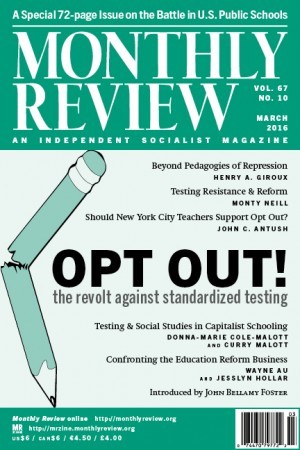
The Opt Out Revolt

Democracy and Education

In the United States today, the age of monopoly-finance capital and neoliberal politics, all aspects of social life are being financialized at breakneck speed, while the economy as a whole and employment remain lackluster. Financial flows of whatever kind are converted into “securitized” assets to be leveraged by Wall Street speculators. The data of private communications are mined. Health care is converted into a realm of super profits. Public water and electric facilities are sold to the highest bidder. The political system is turned into an open-air auction. Even pollution is treated as a market.… At the center of this juggernaut is elementary and secondary education, which receives over $550 billion in annual public spending, equal to the GDP of Belgium, ranked twenty-fifth worldwide in national income. The new copyrighted Common Core State Standards, and the accompanying standardized tests run by two multi-state consortia in conjunction with testing companies, are “high stakes” not merely for schools, teachers, and students, but also for the vested interests of capital.

The Testing Resistance and Reform Movement

This article will be published on March 7th.
In the spring of 2015, more than 620,000 students refused to take state standardized exams. The numbers were stunning in some places: 240,000 in New York; 110,000 in New Jersey; 100,000 in Colorado; 50,000 in Washington; 44,000 in Illinois; 20,000 in Oregon and Florida; 10,000 each in New Mexico and Rhode Island. Statewide, the New York opt-out rate reached 20 percent, topping 70 percent in some districts. Washington’s numbers represented half the grade eleven class. In several other states, high school refusals reached 15 percent.… These numbers are a huge leap over 2014, when the Opt Out movement first began to have an impact.… Leaders predict the numbers will escalate again in the March to May 2016 testing season.

Opting Out of the Education Reform Industry

This article will be published on March 14th.
Big business has long been enamored of public education. Whether shaping systems of schooling along the lines of factory production, dictating what children should learn, or cultivating private-public partnerships to gain access to government monies, corporations and their owners have insisted on being key players in the formation of education policy and practice in the United States. Analysts estimate the value of the K-12 education market at more than $700 billion dollars. Beyond their calls for students and workers to adapt to the global capitalist economy through increased competition and “accountability” in public schools, business leaders crave access to a publicly funded, potentially lucrative market—one of the last strongholds of the commons to be penetrated by neoliberalism.… In an education industry dependent on market competition to increase profitability, there is no better tool to turn teaching and learning into products—ready to measure, compare, and sell—than the high-stakes standardized tests championed by the contemporary education reform movement.

Should New York City Teachers Support Opt Out?

Two Views in the UFT

This article will be published on March 21st.
New York State’s Opt Out movement was described by the New York Times as “the vanguard of an anti-testing fervor that has spread across the country.” The movement consists primarily of parents and students who fought against high-stakes Common Core State Standard (CCSS) tests by “opting out” of taking the exams.… [However,] this article is not about the massive parent and student-led “Opt Out Spring” of 2015. It is about how Opt Out threw into relief two different ways of thinking about unionism within New York City’s UFT [United Federation of Teachers].… The leadership of…[the UFT,] the largest union local of any kind in the United States…. supported the CCSS and standardized testing, including the use of student test scores as part of teacher evaluations, and refused to support Opt Out.… Meanwhile, rank-and-file UFTers in the MORE-UFT (Movement of Rank and File Educators) caucus and other groups joined the city’s Opt Out movement as part of the struggle against “ed deform.”

Testing and Social Studies in Capitalist Schooling

This article will be published on March 21st.
In a New York Times editorial on August 15, 2015, the editors, following the NAACP, cautioned that the movement for students to opt out of high-stakes standardized exams was detrimental to minority students and their communities. The rigorous accountability measures of high-stakes exams, it was claimed, compelled teachers and schools to do a better job educating traditionally oppressed students.… Such views ignore the history of high-stakes testing, which has served to perpetuate class inequality and advance white supremacy since intelligence testing was developed during the First World War. More than anything else, standardized testing measures students’ access to resources and proximity to dominant cultures, rather than innate ability or quality of teaching. The accountability movement has successfully exploited the existing inequalities of a white-supremacist, capitalist society to argue that high-stakes testing, one of its primary tools, is helping to overcome those same inequalities.

Beyond Pedagogies of Repression

This article will be published on March 28th.
At a time when the public good is under attack and there seems to be a growing apathy toward the social contract or any other civic-minded investment in public values and the larger common good, education has to be seen as more than a credential or a pathway to a job, and pedagogy as more than teaching to the test. Against pedagogies of repression such as high-stakes testing, which largely serve as neoliberal forms of discipline to promote conformity and limit the imagination, critical pedagogy must be viewed as crucial to understanding and overcoming the current crises of agency, politics, and historical memory faced by many young people today. One of the challenges facing the current generation of educators and students is the need to reclaim the role that education has historically played in developing critical literacies and civic capacities. Education must mobilize students to be critically engaged agents, attentive to important social issues and alert to the responsibility of deepening and expanding the meaning and practices of a vibrant democracy.… At the heart of such a challenge is the question of what education should accomplish in a democracy.… In a world that has largely abandoned egalitarian and democratic impulses, what will it take to educate young people to challenge authority, resist the notion that education is only training, and redefine public and higher education as democratic public spheres?
To access this content, you must purchase a subscription to Monthly Review. If you are already a subscriber pleaseplease login here. If you are having trouble logging in, please read this announcement about changes to the MRweb site.
 Home • Monthly Review:

Vouchers aiding resegregation | Opinion columns | www.journalgazette.net

Vouchers aiding resegregation | Opinion columns | www.journalgazette.net:

Vouchers aiding resegregation

Surest way to keep public schools strong is to keep them diverse

Kristina Frey is president of the Washington Township Schools Parent Council in Marion County. She holds an MBA from Northwestern University and is working toward a degree from the Robert H. McKinney Indiana University School of Law. She is a parent to a 7-year-old daughter. 


As a proud public school parent, I recently testified before the Indiana House Education Committee to share a parent’s perspective on vouchers. I was asked derisively by an incredulous representative, “Why (are you) so against taxpaying parents having a choice in their taxpayer-funded education?” As a taxpaying parent myself, it is because I have seen personally how this so-called “choice” plays out in my own neighborhood.
I am a white, upper-middle-class parent of a second-grader, and I do something that has become quite rare in our state, to the detriment of our collective future.
I send my precious daughter to a public school that is majority-black, with a free and reduced lunch rate of more than 75 percent. I love our neighborhood school, and my daughter is getting a fantastic education there.
Yet I find myself constantly defending my daughter’s wonderful school and school district. The perpetuation of the myth of failing public schools, combined with the always-expanding availability of charter schools and vouchers, has caused my neighbors to hesitate to send their children to our absolutely amazing, high-quality neighborhood school.
I know that schools are stronger when they are supported by their community, and that communities are stronger when they support their schools, and that is the kind of community I want to live in. I also know that one of the very best ways to improve test scores is to have socioeconomic and racial diversity in schools, and because of that, it rips me apart when I see my middle-class neighbors opting out of our neighborhood school.
I am also concerned with educational stability, which is an important factor in student success. Charter schools and voucher schools, with the encouragement of our legislature, have pushed a culture of endless “school-shopping” in our community.
This session, a bill is on the verge of passing that will even encourage changing of schools in the middle of the school year. I know so many stories of parents who have pulled their children out of their public school to send them to a voucher school, sure that a private school must be better. In some cases, they end up sorely disappointed. Which leads them to pull their child out again, and start over yet again. What is that doing to our children?
When I’m not happy with something at my daughter’s school, I get involved, I talk to the teachers and administrators, and I work through it. I don’t run away. Don’t we teach our children that they should work through challenges, to use critical thinking to solve problems? We don’t teach them to run away to the other side where the grass looks greener.
And this “run away” attitude brings me to the biggest reason I oppose school “choice” and passionately support my local public schools. The reality of our society is that middle-class white families are using the guise of school “choice” to run away from people who don’t look like them. Washington Township is a diverse place, and hardly a bastion of conservatism. Yet even here, I have had neighbors tell me that they chose a private school over our neighborhood school because they were uncomfortable with their child being one of only a few white children in a class.
I have had neighbors tell me that if they aren’t permitted by administration to go to one of the whiter, wealthier schools in the district, that they might move to a different county rather than send their child to the same school that I happily send my child to each day (which is in the same district and only 2 miles from their preferred school).
Multiple studies have shown that school vouchers actually increase segregation. Data from our own state show that as qualifications for vouchers have expanded, the biggest growth has come from white, middle-class families. The sad reality is that, as a society, we still tend toward segregation, and everyone should oppose any policy that further re-segregates our schools.
My neighborhood school is doing an excellent job. Imagine if all the middle-class children who should, by geography, be attending our school actually did attend, rather than fleeing for richer, whiter, pastures. Socioeconomic diversity is proven to increase test scores – it pulls up the scores of the poorest children, while not hurting the scores of the wealthiest children.
The very best way for all of the schools in our state to improve, is to encourage them to reflect accurately the diversity of their communities. Vouchers and charter schools are creating just the opposite of that result. It’s time for middle-class parents, especially white ones, to strongly support our public schools. Vouchers aiding resegregation | Opinion columns | www.journalgazette.net:

The Opt Out Revolt by John Bellamy Foster • Monthly Review

The Opt Out Revolt by John Bellamy Foster • Monthly Review:

The Opt Out Revolt

Democracy and Education


In the United States today, the age of monopoly-finance capital and neoliberal politics, all aspects of social life are being financialized at breakneck speed, while the economy as a whole and employment remain lackluster. Financial flows of whatever kind are converted into “securitized” assets to be leveraged by Wall Street speculators. The data of private communications are mined. Health care is converted into a realm of super profits. Public water and electric facilities are sold to the highest bidder. The political system is turned into an open-air auction. Even pollution is treated as a market.
At the center of this juggernaut is elementary and secondary education, which receives over $550 billion in annual public spending, equal to the GDP of Belgium, ranked twenty-fifth worldwide in national income.1 The new copyrighted Common Core State Standards, and the accompanying standardized tests run by two multi-state consortia in conjunction with testing companies, are “high stakes” not merely for schools, teachers, and students, but also for the vested interests of capital. The latter seek by these means to: (1) form a labor force of cheerful robots; (2) eliminate critical thinking from schools; (3) generate immense profits for the education industry and information firms; (4) end teacher tenure, seize control of classrooms from professional educators, and break teachers’ unions; (5) privatize public education through charter schools and other means; (6) facilitate private profits and financial speculation through control of government education funding; (7) merge education for large sections of the poor and racial minorities with the military and penal systems; (8) decrease the role of democracy in education while increasing the corporate role; (9) create databases with detailed biometrics on almost everyone, to be exploited by corporations; and (10) manage the population in what is a potentially fractious society divided by race and class.
Such unstated systemic aims—even more than the stated goals of closing the achievement gap associated with racial and ethnic inequality, or increasing international competitiveness—serve to explain the vast restructuring of U.S. education pushed forward during the last decade and a half, from the Bush administration’s No Child Left Behind Act to the Obama administration’s Race to the Top.
The entire educational reform movement, as it is called, has been spearheaded by a number of big “venture philanthropic” or “philanthrocapitalist” foundations, including the Gates Foundation, the Broad Foundation, the Walton Foundation, and others, which have sought to promote the Common Core State Standards, high-stakes standardized tests, and charter schools. These foundations have poured billions into educational restructuring, with the cooperation of large corporations and the government at every level.2
However, what could be called the national command center of this corporate-based education reform movement is located in the quasi-governmental agencies of the Council of Chief State Officers (CCSO) and the National Governors Association (NGA), both consisting of governmental officials but functioning outside political jurisdictions as private, non-governmental organizations, unaccountable to the populace. The CCSO and the NGA have copyrighted the Common Core State Standards, which were paid for primarily by the Gates Foundation and designed in conjunction with educational services companies like Pearson and McGraw-Hill—and without the significant involvement of teachers. As a result neither the federal government nor the states nor the teaching profession itself have control of the Common Core, which is nonetheless imposed on states and local school districts, forming the foundation of the entire system of high-stakes standardized testing.3 The performance of students on the high-stakes standardized tests is currently being used in thirty-five states to The Opt Out Revolt by John Bellamy Foster • Monthly Review:
 

Why teachers should stop trying to hide their emotions in school - The Washington Post

Why teachers should stop trying to hide their emotions in school - The Washington Post:

Why teachers should stop trying to hide their emotions in school


 There is a great deal of talk about how schools need to address the social and emotional needs of students, and that is indisputably true. But this post isn’t about that. It’s about  teachers, and the hidden emotional toll that their job takes on them. In this unusual post, Ruben Brosbe, a third-grade teacher in the Hamilton Heights neighborhood of New York City, writes about the difficulty teachers have in talking about their feelings about their job — and how gender plays a role in that dynamic.

Brosbe likes hands-on learning and talking about social justice, and he says that he loves the different challenges that every day brings nin his class. When he’s not teaching he likes to cook or explore new parts of New York City. This post was originally posted on The Educator’s Room here, and I am republishing it with permission.

By Ruben Brosbe
I was recently called into a meeting unexpectedly and given the news that one of my students would probably not be returning to school this year. The news and the surrounding circumstances hit me with a wave of emotions.
After discussing logistics such as how to mark her attendance and what to tell her classmates, I was dismissed. I made it about halfway down the hallway before I realized I was not ready to go back into my classroom. I asked a colleague to cover my classroom for a minute. I walked to the bathroom and cried. I felt a profound sense of loss and sadness.
Teachers —  especially those of us who spend all day with the same students — forge deep relationships with the young people in our classrooms. Along the way of teaching them how to read, write and enumerate, we are also getting to know them as human beings. Even when these relationships are fraught with conflict, we care for these students as if they are family.
We don’t often talk about it, but at the end of the year, along with the sweet relief of summer vacation, there’s a pang of sadness. The end of the year is a goodbye. In the course of a school year I have spent roughly 1,000 hours with my students. In addition to lessons, tests and field trips, these hours have included birthdays, team builders and difficult conversations. Meanwhile, these hours have been filled with countless little interactions where I provide Why teachers should stop trying to hide their emotions in school - The Washington Post:

Seattle Schools Community Forum: Washington State Charter School Update

Seattle Schools Community Forum: Washington State Charter School Update:

Washington State Charter School Update

It's March 3rd and there is now just one more week until the end of the session on March 10th.  A new bill - 6670 - a so-called "title-only" bill that is a placeholder (along with HB 3000, also a placeholder) for something to come.  Here's 6670 - in its entirety -

Sec. 1. This act may be known and cited as the public schools that are not common schools act.

This Hemingway-length legislation is brought to us by the usual suspects in the form of Senators Fain, Mullet, Litzow and Hobbs. 

A little backstory on what this is and how it is happening comes to us via theTri-City Herald which seems to take a dim view of this type of legislation (bold mine). 


The Washington Constitution includes a provision to prevent legislators from considering bills introduced at the last minute. The provision is designed to make sure the public has a chance to learn about the legislation and provide comment.

Article 2, Section 36 of the constitution says “No bill shall be considered in either house unless the time of its introduction shall have been at least ten days before the final adjournment of the legislature, unless the legislature shall otherwise direct by a vote of two-thirds of all the members elected to each house.”

But the crafters of that language underestimated the cleverness of the members of our state legislators and their proclivity for finding ways to avoid public 
Seattle Schools Community Forum: Washington State Charter School Update:
 

Teachers Who Staged ‘Sick-Outs’ Declare Victory | PopularResistance.Org

Teachers Who Staged ‘Sick-Outs’ Declare Victory | PopularResistance.Org:

Teachers Who Staged ‘Sick-Outs’ Declare Victory

Against Detroit Schools’ Unelected Emergency Manager

Education activists cheered today as Darnell Earley officially stepped down from his position as emergency manager of Detroit Public Schools (DPS). His departure came after thousands of teachers staged rolling “sick-outs” to protest his role as the unelected head of the school system.
Strikes by teachers and other municipal employees are illegal under Michigan law, but more than a dozen times this winter, groups of teachers called in sick to protest frozen wages, ballooning class sizes, decaying buildings and other conditions they say are the result of state-imposed austerity. The largest such action on January 20 forced the temporary closure of 88 of the district’s 104 schools. Photos shared by teachers of the hazardous conditions inside their classrooms—black mold, rodents and no heat—went viral.
Earley has an ignominious resume: Before he began managing DPS in January 2015, he was the emergency manager of Flint, Michigan when the city infamously switched water supplies, eventually exposing its residents to lead-contaminated water. Teachers say that Earley’s reign in Detroit, likewise, made a bad situation worse. The Detroit Federation of Teachers  (DTF), which did not coordinate the sickouts but filed suit against Earley and DPS in February, accused him of allowing the schools to “deteriorate to the point of crisis.” Earley’s departure is a victory for the union and rank-and-file activists who organized the sickouts, but some are adamant that the work is not done until local control is returned to Detroit’s schools.
Sick with ‘Snyder Flu’
The larger problem, many teachers say, is the string of unelected emergency managers that have presided over Detroit schools for the past seven years. Following decades of structural disinvestment, the city’s school system is in an estimated $30 billion in debt. The teacher’s union says that a series of four emergency managers have only dug that hole deeper, running up $515 million in debt while implementing mass layoffs and cuts on the backs of educators and students. Governor Rick Snyder has relied heavily on emergency managers to fix the state’s fiscal woes, but critics say that the system effectively disenfranchises the majority-black communities that have ended up under the thumb of appointed leaders.
Under emergency management, Detroit’s elected school board is effectively powerless. Teachers say this situation forced them to take dramatic action. “Having none of the usual forms of democracy, like having no school board meetings to go to where we can voice our 
 

As Malloy calls for record cuts to minority teacher programs – Robert Cotto Jr. asks - Where did Black & Latin teachers in Hartford go? - Wait What?

As Malloy calls for record cuts to minority teacher programs – Robert Cotto Jr. asks - Where did Black & Latin teachers in Hartford go? - Wait What?:
As Malloy calls for record cuts to minority teacher programs – Robert Cotto Jr. asks – Where did Black & Latin teachers in Hartford go?


 Governor Dannel Malloy, Lt. Governor Nancy Wyman and their administration are proposing record budget cuts to Connecticut’s Minority Teacher Incentive Program, as well as, to the state’s institutions of higher education – which include Connecticut’s teacher preparation programs.

As Connecticut faces the need for additional talented, dedicated and prepared public school teachers, Malloy and his advisers are cutting vital teacher training programs while promoting the use of inexperienced, unprepared and transient Teacher For America recruits.
Meanwhile, Robert Cotto, Jr, the Director of Urban Educational Initiatives at Trinity College and a Lecturer in the Educational Studies department highlights the very real problem facing Connecticut’s school districts as he investigates the disturbing failure to recruit and retain Latino and African-American teachers in Hartford.
Several months ago, former Hartford school board member Dr. Shelley Best posted a photo of herself with a handful of white teachers and an administrator in the background. Dr. Best, a Black woman, took the “selfie” photo at a district workshop about the “achievement gap”. In the caption of her Facebook post with the photo, she commented, “In a room full of folks talking about us (and the educational achievement gap) that don’t look like us … hmmmm …”
The Hartford Courant wrote a story months after the event and focused on one of the white teacher’s hurt feelings about being captured in the photo 
As Malloy calls for record cuts to minority teacher programs – Robert Cotto Jr. asks - Where did Black & Latin teachers in Hartford go? - Wait What?:

Flint Educators Ask: ‘How Dare You Poison Our Children?' - NEA Today

Flint Educators Ask: ‘How Dare You Poison Our Children?' - NEA Today:

Flint Educators Ask: ‘How Dare You Poison Our Children?’

Image result for big education ape flint


When teacher Michelle Gushen celebrated Martin Luther King, Jr.’s “I Have a Dream” speech in her Flint, Mich., high school classroom this year, every one of her students said they have a dream, too. And it’s about clean water.
“Who would ever think a child would have to ask for clean water in the United States?” Gushen asked NEA President Lily Eskelsen García during her February visit to the area. “And [we] don’t really have an answer for them,” Gushen said.
But NEA does have an answer for Flint students who have been asking their teachers if they’ll die from drinking the lead-poisoned water that poured from their faucets last year. The Association also has a message for lawmakers: Not for one more second will NEA stand idly by in the midst of the institutional and environmental racism that enabled the water crisis in Flint.
“My brave colleagues are worried and heartsick, but they are determined that justice will be done and their union makes them strong,” wrote Eskelsen García in a post to her blog, Lily’s Blackboard.
In the short term, this means NEA members will fight to hold accountable those who are responsible for poisoning some 8,000 Flint children, and press Congress to make critical investments in nurses, counselors, nutritional programs, and special education supports in every Flint school, says United Teachers of Flint President Karen Christian. Because the very best strategy to countering lead exposure in children, says Dr. Helen Binns, director of the lead evaluation clinic at Chicago Children’s Hospital, is to provide them with excellent educational experiences—at school and at home.
In the long term, it also means tackling the institutional racism that causes the excessive exposure of Black and Brown Americans to toxic air and water.
“How dare you poison our children?” demands Flint teacher Darlene McClendon.

Not an Act of God

The Flint water crisis is entirely man made. At its headwaters are men who would sacrifice the health of poor, Black children to save some dollars.
The actions that would enable Flint to poison its own children kicked off in 2011, when Michigan Gov. Rick Snyder pushed through a far-reaching law that expanded his ability to seize power from the elected leaders of this majority Black city and hand it to an “emergency manager”—a person whose primary duties appear to be cutting costs.
The emergency manager law “rests on the premise that democracy in predominantly African-American cities is unnecessary and that the state knows best,” wrote Louise Seamster and Jessica Welburn in The Root. Indeed, 52 percent of Michigan’s African-American residents—compared to 2 percent of White residents—live in areas that are governed by emergency managers, report Detroit NAACP leaders.
In 2014, Flint’s profit-motivated managers made a decision: They would stop buying water from Detroit, ending 50 years of service, and instead get it from the Flint River—a graveyard for abandoned appliances and auto parts. The city figured to save about $8.5 million.
Soon after, Flint residents noticed changes in their water. A pastor told the New Yorker it got so stinky he stopped using it for baptisms. General Motors complained the water was rusting their auto parts. And yet, when Flint residents protested the smell, color, and taste of the water flowing from their taps, state officials told them to “relax.”
Eventually, a local pediatrician determined that the percentage of Flint children with lead poisoning doubled after Flint switched to the river, and even tripled in some neighborhoods. At the same time, Virginia Tech researchers found that at least a quarter of Flint households had water that exceeded regulatory limits for lead. In some homes, the drinking water actually met the definition of toxic waste.
Everyone was being poisoned,” says Eskelsen García.

‘Are We Going to Die?’

These days, the fifth- and sixth-graders in McClendon’s classroom play distractedly with plastic water bottles. This year’s students are less attentive than previous groups and “when you ask them a question, it’s gone like you didn’t teach them Flint Educators Ask: ‘How Dare You Poison Our Children?' - NEA Today:

How Useful Is 'Academia'? - Bridging Differences - Education Week

How Useful Is 'Academia'? - Bridging Differences - Education Week:
How Useful Is 'Academia'?

Deborah Meier continues her conversation with Harry Boyte. To read their full exchange, please visit here.
Dear Harry and friends,
I gave up, sort of, on universities when the young lefties of the 1960s went into them and started vying for who could be most obtuse and "academic"—rather than using their positions to speak to the public in our shared language. A lost opportunity!
But, of course, one never gives up. But I've a real peeve over what the word "academic" has come to mean (or did it always?). A meaning that we insist even 4-year-olds must be introduced to. It's not, alas, a compliment to say someone speaks or writes "academically," and in common parlance the phrase "it's academic" means irrelevant.
But it could be otherwise, and probably is in some places. My friend Jay Featherstone wrote a book about what schools of education might be like, for example, if they wanted to truly influence the schooling of American children. It was a truly inspiring concept and worth reading (Transforming Teacher Education, Harvard University Press). It proposed an approach that married theory and practice—academics in the real world—that could truly transform K-12 schools into places for intergenerational learning by doing.
My latest fascination is with community colleges, and I'm enjoying reading Mike Rose's blog (partsone and two) on what they could be—and sometimes are. It fits with my pre-K-12 scenario. They should be the two places in each community—plus the library—where rigorous (but not rigid) discussion—sometimes probably noisy and maybe even, on occasion, rude—conversation takes place across generations. Places where adults and young people listen to each other and, sometimes, take each other seriously. I've always hated it when visitors to kindergartens ooh and aah over what "cute" things the students say. They ignore, in this way, the children's genuine insights. In fact, these 5-year-olds are genuinely expressing interesting ideas, not trying to be cute at all. And if we listened with respect we'd realize that democracy is not a utopian idea—that virtually all 5-year-olds are capable of tackling important ideas and expressing them well until we discourage their intellectual curiosity with "academics."
Taking our neighbors and our families seriously—with some humor—is where it starts. Unfortunately, school is too often where it stops.
How to both end the segregation of future citizens by race, gender, native language, so-called academic ability, et al., is part of this task. We separate children not only into different schools, but even then within schools. There is no surer way to insure the limited ability to understand others at ever younger ages. How we can undo this in a society in which we reside physically in different spaces is a dilemma. Because it's also vital to maintain, nourish, and, if necessary, create a sense of community as a place of pride and political and social strength. I'm still struggling over how best, in an imperfect world, to accomplish both. I believe democracy's future depends on finding a way to build overlapping lives with those whose traditions and "habits" are different than ours.
Democracy assumes "politics"—and that, in turn, assumes differences of opinion based on the different stories and experiences we were raised with. The earlier we can acknowledge these alternate stories and find ways to confront them with the best of those habits of heart and mind I described earlier, the better. 
Ted Sizer and I went to see the president of Harvard shortly after NCLB was passed to suggest he lead a college-wide discussion on the meaning of being well-educated. He said he agreed that it was a good idea but that it should start at the school of education. That was, alas, a killer idea, since the school of education had neither the prestige nor the power to convince other departments that this was a topic vital to all our attention, and that didn't belong to any single academic department.
I wonder how much agreement there is in schools, K-12 as well as beyond, about democracy as a vital concern to the well-being of the "academic" disciplines in general. How critical to democracy's future is a "liberal arts" education, one that is as critical for cosmologists as cosmeticians, to plumbers and to plutocrats?

THE STAR-LEDGER’S ENDORSEMENT OF CHRIS CHRISTIE |

THE STAR-LEDGER’S ENDORSEMENT OF CHRIS CHRISTIE |:
THE STAR-LEDGER’S ENDORSEMENT OF CHRIS CHRISTIE


Gov. Chris Christie is the most remarkable political talent America has seen since Bill Clinton. If you haven’t witnessed his performance at a town hall meeting yet, make a point of it. You will come away convinced there is a sensible middle ground in America after all.
Equally impressive is his skill at playing Trenton’s inside game. Faced with Democrats in solid control of the Legislature, he’s managed to split them down the middle by seducing a handful of pliant party bosses whose self-interest compelled them to hitch their wagons to his.
The surprise is that his achievements have been only modest. He signed an important reform to contain pension and health costs, but it was mostly done before he arrived. He signed a useful tenure reform last year, but it is a weak version that still protects bad teachers with seniority. His reorganization of the higher education system is promising, but untested.
Balance that against his measurable failures, and you have to conclude he is much better at politics than he is at governing.
The property tax burden has grown sharply on his watch. He is hostile to low-income families, raising their tax burden and sabotaging efforts to build affordable housing. He’s been a catastrophe on the environment, draining $1 billion from clean THE STAR-LEDGER’S ENDORSEMENT OF CHRIS CHRISTIE |:

Charter Schools: Publicly Funded but Accountable Neither to the Public nor to Parents | janresseger

Charter Schools: Publicly Funded but Accountable Neither to the Public nor to Parents | janresseger:
Charter Schools: Publicly Funded but Accountable Neither to the Public nor to Parents


In the Public Interest supports public education.  It’s website describes the organization as “a comprehensive research and policy center committed to promoting the values, vision, and agenda for the common good and democratic control of public goods and services.”  It is the co-sponsor of Cashing In On Kids, a national campaign to confront the privatization of public education:  “We believe the American public school system should serve all students and prepare them to be good, productive citizens. Our public schools are the essential foundation of a functioning democracy and a healthy economy and require public control and vigilance to protect the common good and advance our broad public interests.”
Last Sunday in an important commentary, Donald Cohen, In the Public Interest’s executive director, wondered: Are Publicly Funded Charter Schools Accountable to Parents and Taxpayers?  Cohen responds to the important NY Times story of Nadya Miranda, the mother whose child was reprimanded by her first-grade teacher at one of Eva Moskowitz’s Success Academy Charter schools, a situation that was captured in a cellphone video by an assistant teacher and posted in the NY Times.  Personnel at the school showed the video to the mother of the child who was berated by her teacher just prior to its appearance in the newspaper, despite that the event happened well over a year ago.  The mother, who lives with her children in a NYC homeless shelter and who had proudly won a space for her child by winning the school’s lottery, was devastated to learn about the school’s punitive learning policy and angered to discover that the school worried more about its own reputation than the well being of her daughter.
In his recent commentary, Donald Cohen describes the mother’s experience as she tried to hold someone accountable for what the she felt was the betrayal of her child by the school: “The student’s parent went to the NY Department of Education to file a complaint.  She was told that Success was independent from the school district and that she needed to contact the school’s board of trustees.  But the board, chaired by hedge fund CEO Dan Loeb, that gets to Charter Schools: Publicly Funded but Accountable Neither to the Public nor to Parents | janresseger: