Latest News and Comment from Education

Tuesday, February 2, 2016

The Latest: Teachers' Union Wants Local Control for District - ABC News

The Latest: Teachers' Union Wants Local Control for District - ABC News:
The Latest: Teachers' Union Wants Local Control for District


The Latest on the state-appointed emergency manager for the Detroit Public Schools stepping down (all times local):
1:50 p.m.
The Detroit teachers' union president says emergency manager Darnell Earley's decision to step down is a step in returning the district to local control.
Ivy Bailey said Tuesday that "appointing another emergency manager won't fix Detroit's education crisis."
Earley told Snyder in a letter that he would leave his post Feb. 29, about 4½ months early.
He was appointed in 2014 to continue the work of two previous managers in trying to turn around the troubled district, and previously oversaw Flint's finances when the city switched its water supply, resulting in lead leaching from old pipes into some homes.
Legislation before the Michigan Senate calls for the state to pay off the district's more than $500 million debt load.
A number of teacher sick-outs were held in January, including one that closed more than 85 schools. Teachers have complained about a number of issues including low pay and poor building conditions.
———
1:20 p.m.
Detroit Public Schools' emergency manager Darnell Earley has told Michigan Gov. Rick Snyderthat legislation aimed at eliminating the district's debt has effectively ended his role over the district's finances.
He informed Snyder on Tuesday that he will step down at the end of February — 4½ months early.
Earley has been criticized by teachers over low pay, poor school conditions and other issues. He also oversaw Flint's finances when the city switched its water supply, resulting in lead leaching from old pipes into some homes.
Earley says that "in anticipation of" Snyder's plan before the state Senate to rid the school district of more than $500 million in debt, the focus now can be teaching students.
Earley was appointed in 2014. He is the third manager over the district since 2009.
———
10:45 a.m.
The state-appointed emergency manager for Detroit's troubled school district is leaving the job about 4½ months early.
Darnell Earley also was the emergency manager for Flint when its water source was switched.
He notified Gov. Rick Snyder of his decision Tuesday and says he completed work ahead of his 18-month schedule.
Snyder says Earley "has done a very good job The Latest: Teachers' Union Wants Local Control for District - ABC News:


CT Regional School District #7 succumbs to Common Core testing frenzy, throws their children under the bus. - Wait What?

CT Regional School District #7 succumbs to Common Core testing frenzy, throws their children under the bus. - Wait What?:

CT Regional School District #7 succumbs to Common Core testing frenzy, throws their children under the bus.


Based on utter ignorance or stunning arrogance, the elected members of the Regional School District #7 Board of Education (Barkhamsted, Colebrook, New Hartford and Norfolk) voted last week – January 27, 2016 – to adopt an official policy “banning” parents from opting their children out of the unfair, inappropriate and discriminatory Common Core testing scheme.
By a unanimous vote, Board Chair Molly Sexton Read, Vice-Chair Robert Jerram, Secretary/Treasurer Don Torrant and members Mary Duran, Noel Gauthier, Deborah Bell, Theresa Kenneson and Dennis Spector adopted an anti-opt-out policy stating;
“Both federal and state statutes are clear in their language. All students enrolled in public schools must take the yearly state assessment. Until such legislation changes, the Department of Education and each school district must comply with federal and state mandates.”
In an apparent effort to rationalize their decision to undermine their district’s students, parents, teachers and citizens, the board of education’s statement opined;
Some students and parents may be confused by the term “opt out.” While it 
CT Regional School District #7 succumbs to Common Core testing frenzy, throws their children under the bus. - Wait What?:


A charter school principal relieved of his duties

UPDATE: Principal cites 'irregularities':

UPDATE: Principal cites 'irregularities'


A charter school principal relieved of his duties claims that there may be “irregularities and issues involving certain members” of the school board that suspended him.
In another development, parents in support of Millennium Charter High School Principal Peter Gray plan to address the Monterey County Board of Education on Wednesday about Gray's abrupt removal from the job. The county board oversees the school's charter.
Also, an interim school administrator for Millennium High has been appointed. Faris Sabbah, an assistant superintendent with the Monterey County Office of Education, will serve as head of the school for now, according to Spencer Critchley, a Millennium trustee.
On Friday, before a packed room of parents and students, the Millennium Charter High School board voted 7 to 1 to place Gray on paid administrative leave. The disciplinary action was made over the objections of many parents and students demanding to know the reasons for Gray’s suspension. They got no explanation from school board members. Personnel issues are not open to the public.
The closest thing they got to any insights into Gray's suspension came from Gray himself. On Sunday, he sent an email to parents stating he was grateful for the outpouring of support from parents, students and staff in the effort to keep his job. “I myself am left with many questions … from this unfortunate event," he wrote.
Gray stated that he “discovered some irregularities and issues involving certain members of the board of governors. While I am not able to share any details, I can say that the current impasse between the board and myself is about my discovery of those issues and how they should be addressed.”
Gray’s email continues: “My intention is to bring the irregularities … to light to protect the community of learning you and I have worked so hard to build and sustain.”
Gray said before being placed on leave Friday that a conflict between him and the board arose about six months ago and peaked in December. Gray has been principal at Millennium – the only charter high school in the county – since it opened in August 2013. The school is focused on digital media arts, theater and technology with hands-on training in state-of-the-art video, radio and television broadcasting. Its main campus is The Media Center for Art, Education, and Technology, a department of The Monterey County Office of Education.
Earlier on Friday, between 70 to 80 students walked out of school in protest of the imminent loss of their principal. They picketed the entire school day in front of the UPDATE: Principal cites 'irregularities':

CURMUDGUCATION: NC: TeachStrong Solves The Mystery of Teaching

CURMUDGUCATION: NC: TeachStrong Solves The Mystery of Teaching:

NC: TeachStrong Solves The Mystery of Teaching


Remember TeachStrong? It was launched by the folks at CAP to create some tasty PR about fixing teachers, complete with a not-very-impressive list of Ways To Make Teachers Swell. They rounded up most of the usual Faux-Lefty Reformster Suspects, including virulently anti-teacher and anti-teacher-union groups like DFER, and despite all this, the initiative also suckered in NEA and AFT into joining, a decision so...um, let's say "counter-intuitive" that Randi Weingarten had to write a whole post explaining WTF she was thinking. (Plus, I stand by my theory that this group is about covering Hilary Clinton's education flank).

Well, TeacherStrong is up to things. Specifically, they are going to host a moderated discussion in North Carolina on February 17th (roughly a month before the primary election) to discuss "the importance of modernizing and elevating the teaching profession." They will even follow it up with some local educators (including the 2014 Teacher of the Year, and an association president) who will wax poetic about "the impact that TeachStrong's principles would have on their career and the entire teaching profession." Moderators include a director from Project LIFT, a "pubic-private" turnaround biz, and CAP. 

TeachStrong's message that we must work to modernize and elevate the teaching profession is especially relevant in North Carolina. The Charlotte area alone had nearly 1,000 teachers resign before the 2015 school year, and the state has experienced a 20 percent drop in enrollment in teacher preparation programs over the last 3 years. 

Yes, the exodus of teachers from North Carolina and the reluctance of new recruits to join up-- that is a real puzzler, that is. Regular readers of this space know that I have a few theories. North 
CURMUDGUCATION: NC: TeachStrong Solves The Mystery of Teaching:

#TFA25FactCheck: Examining TFA’s Facade Cracks in Real Time | deutsch29

#TFA25FactCheck: Examining TFA’s Facade Cracks in Real Time | deutsch29:

#TFA25FactCheck: Examining TFA’s Facade Cracks in Real Time


 On February 5-7, 2016, Teach for America (TFA) will host its 25th Anniversary Summit in Washington, DC.

Former TFAer Gary Rubinstein wants to fact-check TFA’s marketing of itself at said celebration.
To this end, he has created the blog, TFA25FactCheck, as a headquarters for monitoring the TFA glories spouting from its summit– an effort directed toward summit attendees who are also finding themselves with raised eyebrows when hearing about the alleged wonders of TFA.
To date, the blog has three posts. The first, entitled, “Why TFA25FactCheck?“, briefly offers his rationale:
I attended the 20 year TFA alumni summit five years ago, and was surprised by the number of wild claims I was hearing from the featured speakers and panelists.
After that conference I spent the next five years examining these sorts of claims and found that they were always untrue or extremely exaggerated.
This time around, I want there to be some kind of place where these claims can be shared and I, and others, can research them and post our finding here.
For now, I’m thinking that the ‘comments’ will be a good place to have a 
#TFA25FactCheck: Examining TFA’s Facade Cracks in Real Time | deutsch29:

New Progressive Education Podcast Gets to the Heart of Philadelphia's Opt-Out Movement | The Progressive

New Progressive Education Podcast Gets to the Heart of Philadelphia's Opt-Out Movement | The Progressive:
Education Podcast Gets to the Heart of Philadelphia's Opt-Out Movement
We're excited to introduce a new podcast by Progressive Education Fellow Jennifer Berkshire and Aaron French.
Have you noticed that the debate over the future of our public schools either seems to go down like a screaming match OR like an echo chamber? We have, which is why we've launched a podcast series that aims to go in, well, a different direction. Our podcast brings you voices and perspectives missing from the debate over the future of public schools.
In Have You Heard's first episode “These Tests Will Go,” The Opt-Out Movement in Urban Philadelphia we head to Philadelphia to talk to African American parents who are opting their kids out of standardized tests. It's a bit different than you might think.
Listen in as they share their perspectives about a movement that’s been characterized as wealthy, white and suburban.
Jennifer Berkshire is the creator and editor of the popular blog EduShyster.com, where she chronicles the end of public education with a wry eye, and is also the Northeast Regional Progressive Education FellowAaron French is the creator and former host of EDUCATION ON TAP, a podcast produced by Teach For America.
- See more at: http://www.progressive.org/pss/new-progressive-education-podcast-gets-heart-philadelphias-opt-out-movement#sthash.myxX4y81.dpuf

How do states support their public schools? Badly, a new 50-state report card shows. - The Washington Post

How do states support their public schools? Badly, a new 50-state report card shows. - The Washington Post:

How do states support their public schools? Badly, a new 50-state report card shows.


How do the 50 U.S. states and the District of Columbia support their public schools? Badly, according to a new report card (see in full below) which evaluates their performance on six key criteria and finds all of them wanting. The best overall grade is a C, with most states earning D’s or F’s.
The report card is being issued Tuesday by the Network for Public Education (NPE), a nonprofit group co-founded several years ago by education historian and activist Diane Ravitch to advocate for America’s public school system. The authors evaluated states on criteria they see as promoting a professional teaching force, equitable and sufficient funding and equal opportunities for all students to succeed — all critical to the health of public schools.
Specifically, the reports looks at how states approach high-stakes standardized testing and school finance as well as how much they resist the privatization of public education and promote the professionalization of teachers. How states spend taxpayer money is another criterion, as is whether states promote policies that affect the income, living conditions and governmental support for students to give them all a chance to succeed in school. Some states earned A’s in a category or two but none earned higher than an overall C.  You can see the breakdown below.
This list of criteria is very different than would be one coming from How do states support their public schools? Badly, a new 50-state report card shows. - The Washington Post:

NPE publishes Valuing Public Education: A 50 State Report Card – Cloaking Inequity

NPE publishes Valuing Public Education: A 50 State Report Card – Cloaking Inequity:

NPE publishes Valuing Public Education: A 50 State Report Card


The Network for Public Education is pleased to publish today a new national report card that analyses how each state values public education. The following is from Carol Burris, Executive Director of Network for Public Education:
We want to give you a first look at a very important NPE project that Diane is unveiling at the National Press Club today. Valuing Public Education: a 50 State Record Card, is an evaluation of how well our states and the District of Columbia support public schools.
It’s the first in-depth, nonpartisan report card to grade states according to whether their current policies and laws make public schools vibrant and strong or undermine them. It stands in stark contrast to report cards released from conservative political organizations like The American Legislative Exchange Council (ALEC) and StudentsFirst that wrongly rank states based on their willingness to privatize public education and weaken the status of the teaching profession.
Our report card is different. Our grades reflect the values that we believe in—stability in the teaching force, a rejection of high stakes testing, small class sizes, integrated schools, pre-school education, a recognition that poverty matters and of course a sound rejection of charters, vouchers and other forms of privatization.
You may not always agree with our grades—some you may think are too high and others too low. But we hope you will agree with the goals they represent. The point after all is to ignite the kind of public debate we have all been longing for, and to spread a message about what we must do to truly improve our public schools.
You can find our report card along with an interactive map on our website at www.networkforpubliceducation.org. Share it with friends and policymakers. By week’s end we will also post individual state report cards on the site for you to check out.
Here is how you can help:
Bring the report card to the attention of your local media;
Encourage local media to contact the Network for Public Education;
Share it with friends and colleagues;
Write an letter to your local media and talk about the report card;
If you are a blogger—write a blog about its content;
Give us feedback so we can make it even better next year;
Support NPE and persuade at least five new members to join. Our strength is in our numbers, and your support helps make efforts like this happen.
Thank you for all that you do,
Carol Burris, Executive Director of Network for Public Education
Find the report here.
I am honored to serve as a founding board member of the Network for Public Education.
Please Facebook Like, Tweet, etc below and/or reblog to share this discussion with others.
Want to know about Cloaking Inequity’s freshly pressed conversations about educational policy? Click the “Follow blog by email” button on the home page.
Twitter: @ProfessorJVH


Click here for Vitae.
NPE publishes Valuing Public Education: A 50 State Report Card – Cloaking Inequity:

Valuing Public Education: A 50 State Report Card - Network for Public Education

Education Map:
Valuing Public Education: A 50 State Report Card - Network for Public Education


NPE State Report Card 2016

The Network for Public Education created this report card to inform the public about each state’s commitment to public education. 

See what your state is doing to provide opportunity for its public school students. Click the criteria in the table below, to view state results for each. You can also click on any state to see all of its grades.


Education Map:


Fighting for public education: It’s on us | United Teachers Los Angeles

Fighting for public education: It’s on us | United Teachers Los Angeles:

Fighting for public education: It’s on us

Alex Caputo-Pearl Fairfax Senior HS
UTLA President Alex Caputo-Pearl with UTLA members at Fairfax Senior High School.

The Promise of Teaching  ....

One of the dependable pleasures of being an educator is running into former students. Over the holiday break, I ran into a former student of mine, Walther Perez, from my 10th-grade World History class at the Crenshaw High School Social Justice Academy, where I was lead teacher.
In that class we studied philosophers like John Locke and Jean-Jacques Rousseau as well as those not in the standards but who were fundamental to developing ideas around social movements (Mary Wollstonecraft, Sojourner Truth, Toussaint L’Ouverture, Simon Bolivar, Tecumseh). Walther was one of the quieter students, mostly low-key. But he told me during our conversation at a Starbucks on Pico that it was my class that sparked a curiosity that shaped his life and his choices.
Walther is now a student at Santa Monica College, where he is majoring in philosophy and political science and playing for the SMC soccer team while getting ready to transfer into the UC system. He is also the head of a student club that mentors high school students, and he is leading an effort to expand this mentoring program beyond Santa Monica and into South L.A. He is driven to give back to the community he came from. This gets to the heart of our profession: to inspire and instill curiosity and a thirst for knowledge, things that only a robust education can bring them. And, well, we love igniting that spark.
Everything Walther said crystallizes for me the purpose of teaching, the promise of teaching. It also drives home the responsibility we have on our shoulders as a teachers’ union. Everything Walther’s experience involves—educators having some autonomy over curriculum, making authentic connections to parents and community, teaching the value of community service and social justice activism—is under attack with the Broad-Walmart scheme and other like-minded market-driven reforms. Now more than ever, as educators, we must fight to preserve that spark.

Broad-Walmart’s shape-shifting

We have landed some blows in the battle against the billionaires, including the unanimous passage on January 12 of a School Board motion — sponsored by member Scott Schmerelson — that opposes the Broad-Walmart scheme (read more on page 4 of the January United Teacher).
Be prepared for a dirty fight. The Broad-Walmart plan is slick and will continue to morph because their beliefs are not rooted in genuine connections with students, but in undermining the promise of a public education system in Los Angeles. They are scrambling because, through our organizing and outreach, we have shaped the narrative by exposing the fundamental problems at the heart of their scheme, relating to lack of accountability, transparency, and equity.
The Broad-Walmart response to our organizing has been noticed — including by the L.A. Times, as reflected in their January 17 op-ed that says the plan has been “shape-shifting ever since an early draft was leaked” after the scheme was widely criticized by educators and the community.
Although the Broad-Walmart public message has changed, their goal to defund, deregulate, and dismantle public schools has not. You only have to look at the team they hired to lead the disingenuously named Great Public Schools Now.
If they were truly backing off their plan to push a massive expansion of unregulated charter schools across LAUSD, would they have put investment banker Bill Siart in charge? Siart is a founder of ExEd, a company that specializes in (and profits from) supporting new charters. Would they have hired Myrna Castrejon, a former lobbyist for California Charter Schools Association, as executive director? And if this effort was not truly about breaking the union, would they have hired Mercury Public Affairs? Mercury handles PR for Walmart and Alliance Charters—two entities with aggressively anti-union managements. Now Mercury Public Affairs has been hired by the Michigan government to do PR spin for the city of Flint, where institutional racism and a privatization-driven lack of funding for infrastructure and public services have led to a shameful health crisis.
New LAUSD superintendent Michelle King told the L.A. Times this month that she doesn’t “agree or support any initiative that says we’re going to take over or take part of L.A. Unified kids”—a positive sign, but as UTLA members we know that no matter who the superintendent is, it is up to us to build a strong union that can advocate for our students and our profession. During the search process, UTLA repeatedly called for three criteria in a new superintendent: That the person be a career educator who understands public schools, who does not have a connection to Eli Broad or the Broad superintendent training academy, and who has a history of collaboration with stakeholders. King unquestionably meets the first two criteria; as for the third criteria, while she has worked well with stakeholders in key instances in the past, time will tell if King continues to deepen that commitment to collaboration as LAUSD superintendent.

UTLA’s Roadmap for 2016

We should be encouraged by our early successes against the Broad-Walmart plan, but we know that the fight is far from over. UTLA has a roadmap for the year that will keep the fight going against privatization and the billionaire agenda while also taking action on issues deeply connected to our campaign for the Schools L.A. Students Deserve. The passage of the Build the Future, Fund the Fight campaign is central to future wins. Think of UTLA’s financial restructuring as the fuel we need to power our work. Without that fuel, we won’t get far down the road. Your support for a stronger UTLA will not count if you don’t mark your ballot and mail it in. If you haven’t already, make sure you mark your ballot and mail it in or vote online before the February 10 deadline.
The front of this UNITED TEACHER lays out our 2016 roadmap, and I want to cover some of the key actions on our timeline.
February 17 National Walk-In: I am truly excited about the February 17 National Walk-In to Reclaim Public Education. Look at the numbers: More than 30 cities across the U.S. participating, and more than 120 schools in Los Angeles (and counting) taking part. This is how we build a national movement against the privatization of public education and for greater investment in neighborhood schools.
UTLA held a productive all-day planning session on January 14, where representatives from more than 70 schools worked together in small groups to develop a vision for the day (read more on page 5 — there’s also still time for your school to sign up). With the session’s focus on parents and community and positive messaging, Harry Bridges Span School teacher Michael Gearin told me it was one of the most exciting meetings he’s ever been involved in at UTLA.
Out of that meeting came some key tenets for February 17: We believe in working with parents, students, and the community to build Sustainable Neighborhood Community Schools, and we call for the investment and resources to do it. We believe in fully funded public schools, and we reject Broad-Walmart’s plan to undermine LAUSD. Billionaires like Eli Broad shouldn’t be trying to undermine public education — instead, they should be paying their fair share through progressive taxation. 
Contract bargaining: On February 9UTLA formally will initiate “reopener” bargaining with LAUSD on the vitally important issues of class size, student services staffing, and educator development and support. As with the past contract cycle, the key to making progress in bargaining rests in the member organizing and the parent-community outreach we do to support our demands. Read more on contract reopeners on page 8.
Taking on standardized testing: It’s been a slow process, but the national dialogue about overtesting is moving in a positive direction. A growing number of parents and community members are taking a stand against the abuse of standardized testing and the way it distorts classroom learning. As confirmed by UTLA testing survey results, the vast majority of our members who give standardized tests have concerns about lost instructional time and the impact on students’ learning experiences. A majority of members also reported that most of the tests provide little or no useful data. We submitted a demand to consult with the District on educational objectives — our right under state bargaining law. UTLA, through our Testing Task Force, also made extensive document requests in an attempt to create an inventory of local, state, and national assessments being used in LAUSD. Our first meetings with the District are January 27 and February 12. Read more about our testing fight and a free screening on February 11 of a great movie on the issue on page 5.
Charter educator representation and organizing: This month, UTLA members at Birmingham Community Charter School and El Camino Charter High School scored strong contract agreements (read about Birmingham’s agreement on page 8). Their agreements underscore the power in collective bargaining and in united action to support that bargaining. Educators at the Accelerated School are still in the middle of tough negotiations. I met early this month with the Accelerated educators (thanks to Juliana Xochimitl for setting it up) and was inspired by their commitment to escalate their actions to get a fair agreement. These campaigns are critical to raising standards around salary, health benefits, and working and learning conditions across all schools, LAUSD and charter. Raising standards is why the educators at Alliance College-Ready Schools are organizing and keeping up the fight to unionize. They are still waiting, by the way, for Alliance CEO Dan Katzir — who is under a court injunction — to meet with his own educators and UTLA officers to create a labor neutrality agreement.
Organizing for school and social services funding: Governor Jerry Brown’s proposed state budget provides us with some decent news on school funding, including a 5.4% increase in Local Control Funding Formula money and $1.2 billion in one-time discretionary funds (equating to roughly $200 per student for every district). The picture might get even better after tax revenue is updated and after public education advocates have a chance to press for more investment in schools and social services. But this still puts us nowhere near where we need to be for fully funded schools. UTLA will be pushing for the absolutely crucial extension of the Prop. 30 funding measures (scheduled to sunset in 2018-2019) and exploring additional means to raise revenue.
Our roadmap is an ambitious plan, but we know this work needs to be done. Weaving through our work together in the coming year will be the important discussions we had during the Build the Future, Fund the Fight campaign. Our national affiliates are using our deep, months-long dialogue on our financial restructuring drive as a model for member engagement, a model for helping folks understand the importance of the union in fighting for educational justice and against the billionaires and their anti-public education schemes and their anti-union court cases, like Friedrichs v. CTA.
During phone banking for the Build the Future campaign, amidst having great conversations with hundreds of our members, I talked to a few teachers who work at Westwood Charter with Kelly Oschack, whose son played baseball with my son. One of those teachers was a student in Kelly’s class many years ago, and she has returned to Westwood Charter to teach alongside her as a colleague. That is more evidence of the impact of teaching — what we know in our bones about the importance of what we do. That’s why we harness the power of our union — our collective voice — to stand up for public education. Our fight is righteous, and we are ready.
Fighting for public education: It’s on us | United Teachers Los Angeles:

Schools, Black Children, And Corporal Punishment | PopularResistance.Org

Schools, Black Children, And Corporal Punishment | PopularResistance.Org:
Schools, Black Children, And Corporal Punishment

A rally was organized on Rainier Avenue S. in response to the death of Freddie Gray, an unarmed black man who died in police custody in Baltimore. (Photo by Celia Berk for the South Seattle Emerald)
Above Photo: By Celia Berk for the South Seattle Emerald

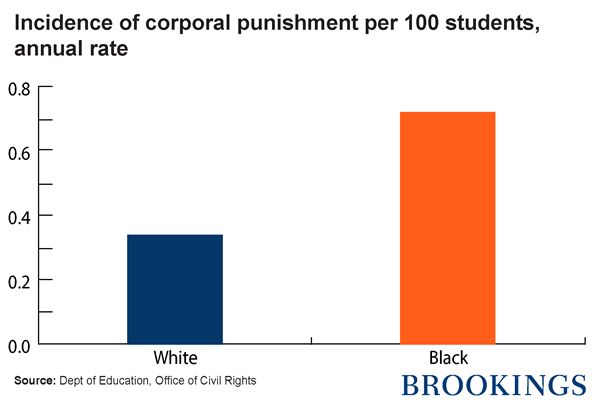
As we recently celebrated Dr. King’s life, it is worth examining the difference in how our schools discipline black and white children. In public schools in the United States, black children are twice as likely as white children to be subject to corporal punishment.
Figure 1 shows the comparison, derived from nationwide data reported by schools to the Office of Civil Rights, Department of Education. (All data is for the 2011-2012 school year, the latest year available.) The continuing disproportionate corporal punishment of black children is a reminder that some aspects of the “bad old days” are not fully behind us.

BROOKINGS INSTITUTION
Figure 1

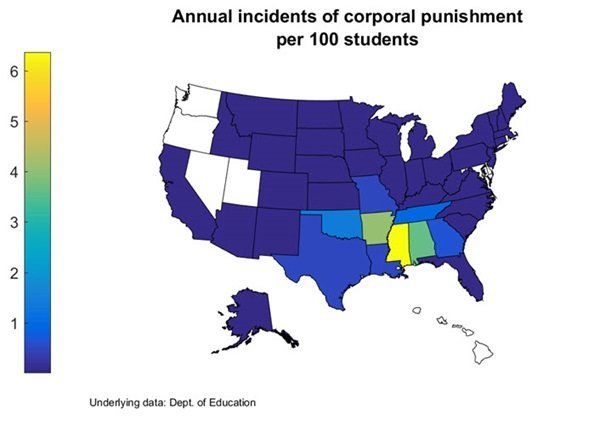
The 42,000 reported incidents of black boys being beaten, and 15,000 incidents for black girls, by educators in their school reflects two facts. First, black students are more likely to be located in states that use corporal punishment extensively. Second, in many states black students are disproportionately likely to be singled out for corporal punishment. Figure 2 shows the annual incidence of corporal punishment by state, with states where the incidence is less than once per ten thousand students greyed out.

BROOKINGS INSTITUTION
Figure 2

While corporal punishment is used in almost every state, seven states account for 80 percent of school corporal punishment in the United States: Mississippi, Texas, Alabama, Arkansas, Georgia, Tennessee, and Oklahoma. For black students, six of these states (Mississippi, Alabama, Georgia, Arkansas, Texas, and Tennessee) plus Louisiana account for 90 percent of corporal punishment. One reason that black students are subject to more corporal punishment is that they live in those states responsible for most of the corporal punishment of all children.
Where is corporal punishment racially disproportionate? Essentially, and sadly unsurprisingly, the first answer is that black students are disproportionately beaten in parts of the Deep South. Black students are twice as likely to be struck as white students in North Schools, Black Children, And Corporal Punishment | PopularResistance.Org:

What the Promoters of School Choice Week Forgot to Mention Last Week | janresseger

What the Promoters of School Choice Week Forgot to Mention Last Week | janresseger:

What the Promoters of School Choice Week Forgot to Mention Last Week


 School Choice Week was celebrated all over the country last week. Such staged “events” are always congratulatory, which is why it is a good idea to think about what the supporters of school choice forgot to mention.

School choice is the term we use to define an education marketplace in which parents no longer must send their children to the assigned public school but can instead choose a publicly funded charter school or receive a tax-generated voucher to pay tuition at a parochial or private school. So, how’s school choice really going?
In December, Bruce Baker of Rutgers University and Gary Miron of Western Michigan University released a policy brief that warned: “A substantial share of public expenditure intended for the delivery of direct educational services to children is being extracted inadvertently or intentionally for personal or business financial gain…. Public assets are being unnecessarily transferred to private hands, at public expense, risking the future provision of ‘public’ education.  Charter school operators are growing… self-serving private entities built on funds derived from lucrative management fees and rent extraction… Current disclosure requirements make it unlikely that any related legal violations… are not realized until clever investigative reporting, whistleblowers or litigation brings them to light.”  Professors Baker and Miron conclude that the charter marketplace is enriching charter operators at public expense and that inadequate regulation makes it hard to identify and prosecute violations of the public interest.
Here is what the Center for Media and Democracy (CMD) described in an October report,Charter School Black Hole: “The system insulates each element from accountability for what actually happens….”  The federal government has relinquished oversight to the states, which have then turned over regulation to charter school authorizers in what CMD calls, “a classic What the Promoters of School Choice Week Forgot to Mention Last Week | janresseger:

Louisiana Educator: Our School Rating and Grading System Is a Failure!

Louisiana Educator: Our School Rating and Grading System Is a Failure!:

Our School Rating and Grading System Is a Failure!


 Click here to view a new white paper produced by Superintendent Kelli Joseph of the St. Helena Parish public school system. It describes how the present school performance score system and the school and district letter grades derived from it are unfair and unproductive for rating public schools in Louisiana. This Advocate story summarizes the reports' findings.  It emphasizes the unfairness of the system in rating small, rural and highly impoverished school districts relative to larger, richer districts. The white paper also suggests basic changes that should improve the school rating system.


My opinion is that while the changes proposed by St. Helena are helpful, the entire premise behind the school rating system which by BESE policy must be based primarily on student test results is inherently flawed. If its purpose was to inform the public about the level of educational services provided to students in schools and school districts, then the rating system fails miserably. The rating system does not tell parents or taxpayers anything about the quality of educational services provided to students, it is simply a reflection of the relative wealth of the school or school system. This is of no use in telling us what and how to improve services to students.

Here is a letter to The Advocate by a school activist in East Baton Rouge Parish that describes the unfairness and ultimate futility of the state school rating system from the point of view of a citizen that simply wants to tackle the real problems affecting our schools.

The following is the most concise and accurate summary I can 
Louisiana Educator: Our School Rating and Grading System Is a Failure!:

GOP-led states increasingly taking control from local school boards - The Washington Post

GOP-led states increasingly taking control from local school boards - The Washington Post:
GOP-led states increasingly taking control from local school boards


Republican lawmakers in Illinois last month pitched a bold plan for the state to seize control of the Chicago public schools, becoming one of a growing number of states that are moving to sideline local officials — even dissolve locally elected school boards — and take over struggling urban schools.
Governors in Michigan, Arkansas, Nevada, Wisconsin, Georgia, Ohio and elsewhere — mostly Republican leaders who otherwise champion local control in their fights with the federal government — say they are intervening in cases of chronic academic or financial failure. They say they have a moral obligation to act when it is clear that local efforts haven’t led to improvement.
“I want to protect the schoolchildren and their parents; that’s my first duty,” Illinois Gov. Bruce Rauner (R) said about his plan, which would wrest control of the nation’s third-largest school district from elected city leaders and was immediately opposed “100 percent” by Chicago Mayor Rahm Emanuel (D).
After Ohio Gov. John Kasich, a Republican presidential hopeful, seized the struggling schools in Youngstown last July, he described it as an 11th-hour attempt to save young lives. “If you’re a school district that’s failed year after year after year, someone’s going to come riding to the rescue of kids,” Kasich said, describing the Youngstown school system, which has regularly received GOP-led states increasingly taking control from local school boards - The Washington Post: