Latest News and Comment from Education

Wednesday, October 28, 2015

California High School Seniors Can Add a New Line to Their Résumé: Guinea Pig

High School Seniors Adjusting to Spate of New Systems:

High School Seniors Can Add a New Line to Their Résumé: Guinea Pig


You’re going to hear a lot this week about students who aren’t on track to graduate.
Data released by San Diego Unified on Friday reveals that there are a lot of them: A quarter of the current senior class is not on track to meet new graduation requirements in place for the class of 2016.
Indeed, the district has its hands full helping students adjust to those requirements and a spate of other new stuff: On top of the new so-called A-G requirements, students are working with new Common Core curriculum and tests. A new SAT test is looming, too.
I talked with a handful of students and teachers at University City High about all the new requirements. Those conversations revealed that the new system has taken a toll even on those who are on track.
The new requirements include four years of English, three years of math, history/social science and science, including a higher level of math than what was required before, and two years of the same foreign language.
University City High School senior Alison White said the new graduation requirements have squeezed most of the fun out of her schedule. She’d like to take more electives, but felt pressure to take Advanced Placement classes instead, which carry weighted grades and can help boost grade point averages.
“It’s so competitive to get into colleges,” she said. She and several classmates said they’re not getting enough sleep between all of their homework, completing college applications, plus work and community service obligations.
Pressure to take AP classes isn’t new, of course, but the new requirements can put additional pressure on students who aren’t as strong in math or science. If they are forced to re-take one of those classes to meet the new bar, that’s one fewer opportunity to explore something like music or journalism that they might actually be interested in. Taking AP classes, which are weighted, can make up for a lower grade in a math or science.
White said schools are “really pushing math and science and I have a more creative and artistic mind. Having to take more of those classes puts more stress on me.”
This year’s seniors were also the first to take the new Common Core-aligned assessment, called theSmarter Balanced test. Student results were mailed home last week after much delay by the state and included a letter from Superintendent Cindy Marten admonishing parents to remember that the test is only one indicator of a child’s progress.
Student reviews of the test, given last spring, aren’t encouraging.
“It was not user-friendly or intuitive,” White said. Students had complaints about taking the test on a computer, which not only had glitches, but was a big adjustment for students who have always been tested on paper. Taylor McCabe, a University City High School senior, said the features that were supposed to be available to help students complete the test didn’t function properly, like the embedded highlighter and calculator. “Taking it on a computer was horrific,” said Cameron Doyle, also a UCHS senior.
The students I talked with gave varying reviews of the Common Core-aligned curriculum. That appears to depend largely on teachers. Susan Bristol, a University City High School English teacher, has been teaching critical thinking skills all along, and there are explanations all over her classroom about the Common Core State Standards. The changes are almost unnoticeable for her students.
But it’s been a rocky transition elsewhere. “They’re still working out the kinks” in math classes in particular, White said. “They’re trying to make math into more than it is. Math is pretty black and white, but they’re making it gray, which is more confusing.”
For students who want to make up a grade by retaking a class, it means less room in their schedule High School Seniors Adjusting to Spate of New Systems:

Heartbreak on NAEP | The Thomas B. Fordham Institute

Heartbreak on NAEP | The Thomas B. Fordham Institute:

Heartbreak on NAEP


“It’s obviously bad news,” said Michael J. Petrilli, the president of theThomas B. Fordham Institute, a right-leaning education policy group in Washington. “We don’t want to see scores going in this direction.”Big Education Ape: Nationwide Test Shows Dip in Students’ Math Abilities - The New York Times http://bit.ly/1k8BvyG


Unfortunately, the rumors, predictions, and surmises were correct: scores on the National Assessment of Educational Progress (NAEP) are mostly down or flat, with the worst news in eighth grade math, where twenty-two states saw declines. One of the only bright spots is fourth grade reading, where ten states plus D.C., Boston, Chicago, and Cleveland posted gains.
Why this happened will be combed over and argued. So far, it feels like anyone’s guess (more on that below). But there’s no denying that it’s bad news. It had come to seem like NAEP scores would always go up, at least over the long term, just like it had come to seem like murder rates would always go down. Now the real world has intervened to remind us that social progress is not inevitable. Let’s not sugarcoat it: this is deeply disheartening for our country, our K–12 system, and especially our children.
As our friends in the research community like to remind us, it’s impossible to draw causal connections from changes in NAEP data; doing so is “misNAEPery.” Yet we can’t help but search for explanations. And we can certainly float hypotheses about the trends—educated guesses that can then be tested using more rigorous methods (like these).
What might be going on? It could certainly be something happening inside our schools. Maybe the transition to the Common Core is causing disruption and growing pains (or worse), and that’s reflected in these data. Maybe the political debate over standards, testing, and teacher evaluations has caused uncertainty in the classroom or somehow discouraged kids from trying as hard. Maybe Arne Duncan’s waivers relieved the pressure on schools to boost achievement, and they took their feet off the gas of improvement efforts. Some states will explain that they altered the portions of students with special needs and English-language learners who were excused from NAEP testing. All plausible.
But it’s also plausible that these trends reflect something going on outside of schools—namely the economic condition of our country and our communities. As I argued the other day, the Great Recession and its aftermath could have acted as a stiff headwind. As schools face morechallenging demographics—partly because of the decades-long surge in immigration, but also because of the economic dislocation facing many students and their families—they have to work harder just to stand still.
Do the data bear this out? Looking at state-level differences, my read is…not really. Perhaps Nevada, Rhode Island, Florida, North Carolina, Ohio, and Kentucky can blame the recession. But it’s fair to ask why the bad economy didn’t knock Georgia, Michigan, Indiana, Alabama, or Arizona off course. And North Dakota and Texas had better find another excuse for their test score drops.
Trends in Median Family Income versus Eighth Grade Mathematics Scores
(Change in family median income in parentheses)

* Data are from Kids Count; I then used the Bureau of Labor Statistics’ inflation adjuster calculator to determine inflation-adjusted income. I considered between -2% and +2% to be flat.
***
To be sure, some will use these results to attack education reforms, including Common Core, charter schools, vouchers, teacher evaluations, and anything else they don’t like. And in fairness, some reformers would have committed misNAEPery to bolster their arguments had the trends gone in the other direction. The most intellectually honest approach today is to urge patience—to wait for more sophisticated analyses to emerge, and to wait until 2017 to see if these numbers are a one-time blip or the beginning of a disturbing trend. We certainly don’t have enough information now to justify a major change of course. But that day may yet come.Heartbreak on NAEP | The Thomas B. Fordham Institute:


Break budget impasse with charter school reform | Opinion | CentreDaily.com

Their view | Break budget impasse with charter school reform | Opinion | CentreDaily.com:

 Break budget impasse with charter school reform


You wouldn’t pay $10 for an apple or a loaf of bread. So why should you overpay for tax-funded, privately run charter schools?
The urgency of passing strong charter school reform in Pennsylvania has only grown in recent weeks, due to two major news stories:
•  the state budget impasse and
•  revelations that charter schools in Philadelphia alone have racked up nearly $500 million in debt, all of which could ultimately be the responsibility of taxpayers.
I recently issued my third annual report on charter schools, outlining the problems and potential solutions. You can read it at http://is.gd/2015CharterReport.
The good news is that the $160 million or more in potential savings from passing strong charter school reform could help fill the gap that has left Pennsylvania without a budget for more than three months. It would be a sizable step toward closing the structural deficit and restoring school funding. It would also amount to at least six times more than the savings from a Republican bill (H.B. 530) the House passed on party lines in March.
Gov. Tom Wolf has proposed $160 million in savings from reforming cyber charter school payments. We should build on that by making strong reforms to brick-and-mortar charter schools as well.
For example, reforming special education funding that goes to charter schools was left out of a 2014 law that only implemented some recommendations of a bipartisan commission. As noted in an Education Law Center study, 2012-13, Pennsylvania charter schools received more than $350 million in special education revenue from school districts, but spent just $156 million on services for special needs students.
I have introduced a bipartisan bill (H.B. 1328) to reform charter schools. As House Democratic Leader Frank Dermody, D-Allegheny, has said: “Every dollar freed up this way is a dollar that can restore education cuts; every dollar freed up this way is a dollar that doesn’t have to come from taxes.”
Some charter schools are high-performing, but we shouldn’t be overpaying, even for those. And we need openness to help make sure we don’t overpay.
I believe that well-run charter schools have nothing to fear from the strong reform and openness that H.B. 1328 would provide. In fact, they would benefit from the contrast with other schools.
Requiring more transparency could have prevented many of the problems spotlighted in my recent annual charter school report and by news stories in recent years. The previous director of the state Office of Open Records called charter schools “a cancer on the otherwise healthy right-to-know law,” and the Open Records Office reported receiving 239 appeals in cases in which charter schools either rejected or failed to answer taxpayer right-to-know requests.
Strong charter school reform would benefit students and taxpayers, and provide a sustainable way to help bridge the state budget impasse. It’s time to pass H.B. 1328.
James Roebuck represents the 188th Legislative District in Pennsylvania. He is the Democratic chairman of the House Education Committee.Their view | Break budget impasse with charter school reform | Opinion | CentreDaily.com:


Read more here: http://www.centredaily.com/2015/10/28/4987937/their-view-break-budget-impasse.html#storylink=cpy

Mayor: Dissolve the School Reform Commission | Philadelphia Public School Notebook

Mayor: Dissolve the School Reform Commission | Philadelphia Public School Notebook:

Mayor: Dissolve the School Reform Commission


Photo: Emma Lee/WHYY
Mayor Nutter calls for the dissolution of the School Reform Commission. The governing power would be transferred in 2018.


Updated, 5:40 p.m. with additional quotes and reaction
In a major education policy speech this morning, Mayor Nutter called for the dissolution of the School Reform Commission and the return of a local board of education.
"Of all the policy recommendations I make today, none will have a bigger impact on Philadelphia than a return to local control," he told an audience of invited guests at WHYY.
After 15 years, Nutter said, "it's time for the experiment to end."
In addition to shifting power to a mayorally appointed board, Nutter called for School Advisory Councils at every neighborhood school.
"While I believe that the SRC and its many members have functioned to the best of their abilities and with good intentions, we Philadelphians deserve to govern our own schools," Nutter said. "A return to local control would give us real authority over the education of our children."
He laid out a plan that would complete the transfer of power in September 2018. Conditions for the changeover would include "full funding for public education" by the state and a "student-weighted" education funding formula. This would allow the District, he said, to "adhere to its five-year financial-stability planning process that demonstrates the District's structural balance."
Then there would be a year of "public hearings on governance, debates, and forums on how best to improve education," said Nutter. "Only then will we be in the right place to govern our schools locally." 
By 2017, he said, the District would put in place "new accountability practices" and begin the legal process for the transfer of power together with the governor, secretary of education, and the SRC. The changeover would occur the following September.
In Nutter's vision, the new Board of Education, like the one the SRC displaced, would have nine members: five appointed outright by the mayor, four chosen from 12 recommended by City Council.
The SRC can only be dissolved if the members vote the commission out of existence or if the state legislature changes the law that created it.
In his speech, Nutter said that though some school councils exist now and do important work, "many exist only on paper."
The councils he wants would have more authority and promote the important function of helping school staffs get to know community members. They would be made up of parents, community members, teachers, administrators, and older students, would fundraise and volunteer, but also "help inform the decision-making process about afterschool programs, class offerings and school staffing."
"The councils would benefit all schools, especially those schools with staff members who differ greatly from their students in terms of race, ethnicity, and income," he said. "To succeed, the councils need to be real instruments of change."
The new District governing body would create a strategic plan to judge success of the councils, he said.

Education accomplishments 

Despite facing a recession as soon as he took office and a political change in Harrisburg that resulted in the slashing of education spending, Nutter said there was real progress in education during his administration.
Most prominent has been an increase in the high school graduation rate, especially for students that had been mostly written off before. For instance, the graduation rate for youth involved in the juvenile justice system more than doubled from 16 percent to 36 percent; for those in the foster care system, the rate rose from 28 percent to 44 percent.
Still, he said, "our current system is failing too many of our young people, leaving a Mayor: Dissolve the School Reform Commission | Philadelphia Public School Notebook:

What the national drop in 2015 NAEP test scores really means - The Washington Post

What the national drop in 2015 NAEP test scores really means - The Washington Post:

What the national drop in 2015 NAEP test scores really means


2015 Math results on the National Assessment of Educational Progress
The 2015 scores for the National Assessment of Educational Progress (NAEP) are out, and the news isn’t good for those who think standardized test scores tell us something significant about student achievement.
NAEP is often called the nation’s report card because it is the only measure of student achievement given periodically to a sampling of students around the nation. It is seen by many as a high-quality test though it has many critics, too, some of whom say that the NAEP definition of “proficiency” is unnaturally high, and that the test cannot measure many of the qualities students must develop to be successful.
My Post colleague Emma Brown reports in this story that math scores for fourth-graders and eighth-graders across the United States dropped this year, the first time since the federal government began administering the exams in 1990. Reading scores weren’t much better; eighth-grade scores dropped while fourth-grade performance was stagnant compared with 2013, the last time the test was administered. Since 1990, scores had generally edged up with each administration, though achievement gaps between white and minority students have remained large.
School reformers who have touted NAEP score increases in the past as evidence of their success are now trying to spin the newest results as anything but their the failure of their reforms. Education Secretary Arne Duncan, in 2013 for example, credited Common Core implementation for higher NAEP scores in some states. He said:
“In 2013, reading and math scores edged up nationally to new highs for fourth and eighth graders. It is particularly heartening that reading scores for eighth graders are up, after remaining relatively flat for the last decade. Achievement among the largest 
What the national drop in 2015 NAEP test scores really means - The Washington Post:

Obama Responds to Testing Fatique, Widespread Opt-Outs, the Accountability-Driven Reform Movement - The Atlantic

Obama Responds to Testing Fatique, Widespread Opt-Outs, the Accountability-Driven Reform Movement - The Atlantic:

Testing, So Much Testing

A search for the meaning behind the rampant assessments in America’s schools


On Saturday, President Obama posted a high-profile video message to Facebook in which he called on schools to reduce the amount of standardized testing taking place in classrooms. Critics of overtesting generally support the proposal, which reinforces what seems to have been the U.S. education system’s gradual, uneven, and often tacit withdrawal from aggressive, assessment-based accountability. In many ways, the plan amounts to the White House’s long-anticipated, albeit anti-climactic, response to what’s become a particularly fraught era in public education. The past few years have been characterized by mass opt-outs, a patchwork of state legislation to rein in rampant testing on their home turfs, and all kinds of assessment-related technological glitches and logistical snafus (one of which is currently playing out across Florida).
But Obama’s announcement of the so-called “Testing Action Plan”  wasn’t the only piece of news to hit the anti-testing world this past weekend. It coincided,not uncoincidentally, with the release of a compelling report by Council of the Great City Schools—an influential Washington-based group that has generally supported testing—which offers the latest piece of evidence that government-driven school reform has taken things too far. The report identifies significant redundancy in the exams being administered in 66 urban U.S. school districts, finding that, between prekindergarten (yes, pre-k) and 12th grade, U.S. public-school students each take roughly eight mandatory standardized tests annually, many of them stipulated by No Child Left Behind.


Adding to that news twofer, a number of recent reports help confirm critics’ doubts about the integrity of test scores as a tool for measuring student achievement. American Institutes for Research published a study on Monday highlighting inconsistencies between the Common Core standards, which are adopted at the state level, and the separate National Assessment of Educational Progress (NAEP), a set of federally sponsored exams that’s administered consistently across all 50 states. The Urban Institute’s Matt Chingos has just authored a somewhat similar report outlining the “promises and pitfalls” of the NAEP scores, too. “NAEP scores,” he wrote, “have been misused as long as the test has been given.”


As it happens, the newest NAEP report was published Wednesday, and it shows a decrease in fourth- and eighth-graders’ math scores—the first decline since 1990. (Eighth-graders’ reading scores also took a dip, while those for fourth-graders remained stagnant.) In response to the results, Randi Weingarten, president of the American Federation of Teachers, said: “Not only is there plenty Obama Responds to Testing Fatique, Widespread Opt-Outs, the Accountability-Driven Reform Movement - The Atlantic:


Tuesday, October 27, 2015

Naep Scores Stagnant: Duncan Says Wait a Decade - DR - NAEP dashboards - report_card

NAEP dashboards - report_card:

Naep Scores Stagnant: Duncan Says Wait a Decade Diane Ravitch's blog

NEW RELEASE         NAEP dashboards - report_card:

2015 Mathematics and Reading Results              NAEP dashboards - report_card:

National average scores were lower than 2013 for eighth-grade students participating in the NAEP mathematics and reading assessments, and scores were higher than the first assessments in the early 1990s at both grades 4 and 8.​​

NAEP dashboards - report_card:


California districts moving to new ‘integrated’ high school math pathway | EdSource

California districts moving to new ‘integrated’ high school math pathway | EdSource:

California districts moving to new ‘integrated’ high school math pathway


This fall 9th-grade students in virtually all California high schools are taking math classes aligned with the Common Core standards. But for many of them there is an additional twist: they are embarking on a sequence of courses that represents a significant departure from how high school math has traditionally been taught in California and the nation.
Every district has had to decide whether to stick with a “traditional” sequence of courses in grades 9-11 (Algebra 1, followed by geometry, then Algebra 2, with some probability and statistics in each course) or adopt a new “integrated pathway” that combines and re-orders content from those courses in a three-year sequence.
That sequence is typically simply called Math I, Math II and Math III. Each course includes algebra, geometry, probability and statistics that are “integrated” with each other.
Regardless of which one they embrace, many teachers, schools and districts have been scrambling to find appropriate textbooks and supplemental materials, develop lesson plans, and provide professional development to teachers aligned with the new standards.
The state does not keep track of which approach districts are adopting. But an EdSource review of the state’s 30 districts with the largest high school enrollments shows that the traditional approach – Algebra 1, geometry, Algebra 2 – is still used in 15 of them. The remaining 15 have embraced the integrated Math I, II and III pathway.

(See end of this article for a list of which approach the surveyed districts adopted.)

Of the six public school districts and the Aspire charter school network EdSource has been closely tracking as they implement the Common Core, four districts (San Jose Unified, Fresno Unified, Santa Ana Unified and Garden Grove Unified) and Aspire have opted to continue teaching using the traditional pathway. The remaining two (Elk Grove Unified and Visalia Unified) are committed to the integrated pathway.
Which sequence a district adopts has implications for both students and teachers.
Proponents of the integrated pathway argue that it is academically more effective, and in line with how secondary California districts moving to new ‘integrated’ high school math pathway | EdSource:

Nationwide Test Shows Dip in Students’ Math Abilities - The New York Times

Nationwide Test Shows Dip in Students’ Math Abilities - The New York Times:

Nationwide Test Shows Dip in Students’ Math Abilities


For the first time since 1990, the mathematical skills of American students have dropped, according to results of a nationwide test released by theEducation Department on Wednesday.
The decline appeared in both Grades 4 and 8 in an exam administered every two years as the National Assessment of Educational Progress and sometimes called “the nation’s report card.”
The dip in scores comes as the country’s employers demand workers with ever-stronger skills in mathematics to compete in a global economy. It also comes as states grapple with the new Common Core academic standards and a rebellion against them.
Progress in reading, which has been generally more muted than in math for decades, also stalled this year as scores among fourth graders flat-lined and eighth-grade scores decreased. The exams assess a representative sampling of students on math and reading skills in public and private schools.
“It’s obviously bad news,” said Michael J. Petrilli, the president of theThomas B. Fordham Institute, a right-leaning education policy group in Washington. “We don’t want to see scores going in this direction.”
“That doesn’t mean we should completely freak out,” he added. “This could be a one-time variation, and maybe we’ll see things come back next time. But if it were the beginning of a new trend, it would be quite disappointing and disturbing.”
Education officials said that the first-time decline in math scores was unexpected, but that it could be related to changes ushered in by the Common Core standards, which have been adopted by more than 40 states. For example, some of the fourth-grade math questions on data analysis, statistics and geometry are not part of that grade’s guidelines under the Common Core and so might not have been covered in class. The largest score drops on the fourth-grade math exams were on questions related to those topics.
The stagnating performance could also reflect the demographic changes sweeping America’s schools and the persistent achievement gap between white students and minorities, as well as between students from poor families and their more affluent peers.
“It’s not unusual when you see lots of different things happening in classrooms to first see a slight decline before you see improvement,” said William J. Bushaw, the executive director of the National Assessment Governing Board, which sets policies and achievement levels for the tests.
About a quarter of public school students are Hispanic, compared with fewer than 10 percent in 1990. As a group, the scores of Hispanic students trail those of white students; this year, for example, 21 percent of Hispanic fourth graders scored at a level deemed proficient or above on reading tests, compared with 46 percent of white students.
The proportion of African-American students in public schools has remained fairly stable, but an achievement gap with white students remains. On the fourth-grade reading tests this year, just 18 percent of black students were deemed proficient.
America’s schoolchildren are also increasingly poor. Students from poor families often arrive at school with smaller vocabularies than students from middle-class or more affluent households, and are faced with challenges like hunger, homelessness and parents working several jobs, all of which can interfere with their learning in school and the academic support they receive at home — and ultimately their test scores.
Arne Duncan, the departing secretary of education, said schools should embrace the challenges of growing diversity. A study this week showed that student demographics can affect test scores. “We should be learning from each other and schools who are doing the best job with students with disabilities and English language learners and students living below the poverty line,” Mr. Duncan said.
The average fourth-grade math score this year was 240 on a scale of 500, down from 242 in 2013, the last time the federal assessment results were released. The average eighth-grade math score was 282, down from 285 two years ago.
In reading, the average fourth-grade score of 223, compared with 222 in 2013, was not a statistically significant difference. The average eighth-grade score fell to 265 from 268.
No state or any of the 21 urban school districts that participated in the tests raised scores in both subjects and grade levels. But the District of Columbia repeated some of the strength it showed in 2013 by raising fourth-grade Nationwide Test Shows Dip in Students’ Math Abilities - The New York Times:

The Revolution Will Not Be Funded: Testing and the Problem With Grant-Driven Educational Projects | Rick Ayers

The Revolution Will Not Be Funded: Testing and the Problem With Grant-Driven Educational Projects | Rick Ayers:

The Revolution Will Not Be Funded: Testing and the Problem With Grant-Driven Educational Projects


President Obama has finally declared that the educational establishment's obsession with high-stakes testing has gone too far. It reminded me of a disagreement that broke out recently in a teacher professional development planning meeting. 
"The problem is," I ventured, "there is very little you can tell from a standardized test of students and then to tie evaluation of that teacher to performance of those students becomes even less valid, and finally trying to compare our professional development graduates to other teachers is just a fool's errand." That was my intervention in the discussion, a big dissension blurted out.
It was a meeting of a collaboration group for an innovative summer professional development teaching project -- I was a visiting professor in a medium-sized California city, Charles was from the professional development nonprofit and Greg was from the school district. We were discussing evaluation data to send to the granting agencies and Charles had suggested that we collect "Smarter Balance" test scores from our graduates and compare to other teachers. I was immediately doubtful -- not only that this measure would distort and narrow the teaching practices of our graduates, but that it would provide support and validation for the advocates of value added evaluation across the state.
Greg, the district guy, showed no interest in my comment. He did not even raise himself to disagree or debate me. He simply declared, "The superintendent wants these numbers (on the test) and we are collecting them so they can be used as data." The look in his eyes, the subtext of his dismissal, was essentially, "What is this pinhead talking about? It's irrelevant."
Charles actually agreed with me. He is a progressive educator who knows the debates and the game. Why, then, had he made this proposal? It was, of course, the pressure of the grant. Both foundation and federal grants for the professional development The Revolution Will Not Be Funded: Testing and the Problem With Grant-Driven Educational Projects | Rick Ayers:

“Fund for Louisiana’s Future” is a DC Super PAC Devoted to David Vitter | deutsch29

“Fund for Louisiana’s Future” is a DC Super PAC Devoted to David Vitter | deutsch29:

“Fund for Louisiana’s Future” is a DC Super PAC Devoted to David Vitter

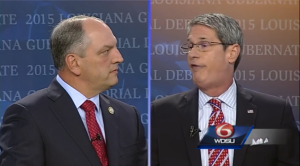
edwards-vitter
Edwards, Vitter.  WDSU-TV , 10-01-15


Somehow, I have ended up on the email list for “Fund for Louisiana’s Future” (FFLF).
It is a Washington, DC-based Super PAC that supports David Vitter by bashing his opponents.
This PAC apparently produces no ads telling voters why they should vote for Vitter, only ads trying to damage the reputations of anyone running against him.
For the October 24, 2015, Louisiana governor’s race, FFLF paid for ads against Vitter’s Republican competition, Scott Angelle and Jay Dardenne. (For excellent background on FFLF and its ads against Angelle and Dardenne, see this September 14, 2015, post by Louisiana blogger, Cenlamar.)
As might be expected, since Vitter is in a runoff against Democrat John Bel Edwards, FFLF has started running attack ads against Edwards.
That was the purpose of the email that FFLF sent to me today: Nothing to justify voting for Vitter.
However, the great advantage of having FFLF pay for these ads is that FFLF can say that it is “not authorized by any candidate or candidate’s committee.” Thus, FFLF has “Fund for Louisiana’s Future” is a DC Super PAC Devoted to David Vitter | deutsch29:

Why Educators Need To Reflect On Spring Valley High

Why Educators Need To Reflect On Spring Valley High:

We’re Wrong [Reflecting on Spring Valley High]

face-painted-on-hands-e1361470447697-620x364


One more thing about the teachers of color panel went awry from a couple of weeks ago: we too embody white supremacy as agents of the state.
Yesterday, a cop assaulted a black girl in the middle of class for refusing to leave the class when a teacher, an administrator, then the school resource officer told her to step out. The easy part for my colleagues is to say that, if the student just complied, then none of this would have happened. If the student had simply gotten up on her own accord and done exactly as the overseers had told her, Spring Valley High School would not be a trending topic in all the worst ways.
But that’s not how students work. They’re not 100% complaint. Neither are adults. Our laws and their executors thrive on this.
That’s what shocked me most as the videos pan to who was in the room watching the incident take place. Unlike the plethora of videos on WorldStar or YouTube with black kids walloping each other Why Educators Need To Reflect On Spring Valley High:

Peg with Pen: Opt Out Revolution: The Next Wave

Peg with Pen: Opt Out Revolution: The Next Wave:

Opt Out Revolution: The Next Wave


I keep getting texts, phone messages and emails telling me how happy folks are that Obama is now listening to us - and that Opt Out has been heard. This is heartbreaking for me - because this tells me that mainstream media has done a stellar job of co-opting Opt Out. We saw it happening. We warned that it was happening - and it indeed did.

Now, the country embraces Opt Out and folks are listening to Obama's words and thinking that we have a clear victory here. We do not. We are on a very slippery slope - one in which Opt Out can continue to drain them of their precious data but also one in which Opt Out must be ready for the next wave of this revolution. It will be a hard fought win - and it will require stamina like never before.

The next wave involves the U.S. Dept. of Ed's recommendations for testing reduction which also comes with funds to support states in getting there. And the scariest part is this - the GROUNDWORK IS COMPLETE. The feds/corporations did exactly what they came to do - they dangled carrots. They got high stakes testing systems in place with longitudinal data bases to carry the seamless productivity of the data. They loosened privacy regulations.  They got common standards out there which are essential for easy data tagging. They pushed and pushed and pushed to support charters and alternative teacher certification. They set the groundwork for the STATES to now lead the way - and they (feds/corporations) have their people in place on school boards, schools of education, depts. of ed., district 
Peg with Pen: Opt Out Revolution: The Next Wave:


Dominant Education Policies

Dominant Education Policies:

How Dominant Education Policies Help Shrink Middle Class

Dominant Education Policies


The erosion of the American middle class and the relentless attack on the standard of living of the American work force is dramatized by two dominant tendencies in education policy:
  • The dependence on low wage adjunct instructors—many of whom are as qualified as tenured faculty—to do the bulk of the teaching in the nation’s colleges and universities.
  • The privatization of public education and the use of test based teacher evaluation, invasive management and charter school promotion to create a teacher work force which is unstable, non-unionized and not around long enough to collect pensions.
The net result is that our most talented college graduates can no longer realistically view university or public school teaching as careers which can provide stability, security, autonomy and high levels of job satisfaction.
Ironically, both of these trends in education policy and management are promoted and implemented by administrators who, following the CEO model in the private sector, compensate themselves extravagantly.Dominant Education Policies:
mak-naison-175This is not only our future, it is for all to many teachers and teachers in the making, our present.
If I were graduating from college today, there is no way someone with my personality and skills could imagine becoming a teacher, much less a professor. I could not accept the humiliating conditions of employment that most people entering the profession, at every level, are forced to accept.