Latest News and Comment from Education

Thursday, September 17, 2015

NPE Endorses Lee Barrios for BESE – The Network For Public Education

NPE Endorses Lee Barrios for BESE – The Network For Public Education:

NPE Endorses Lee Barrios for BESE


Lee Barrios Endorsement Graphic


The Network for Public Education is proud to endorse Lee Barrios for the District 1 seat on the Louisiana Board of Elementary and Secondary Education (BESE). “Lee Barrios has been a steadfast champion of better education for all children in Louisiana,” NPE President Diane Ravitch said. “I am so happy that we can endorse her, and we do so enthusiastically!”
Barrios retired from teaching in 2010 and became a full-time advocate, working to protect public education in her home state. Barrios has a long list of qualifications for a seat on BESE. She is a retired National Board Certified Teacher with a Masters Degree in Secondary Education; a founding member of the Coalition for Louisiana Public Education, which represents classroom teachers; the Information Coordinator for Save Our Schools – LA; and she was a founding member of the Parent Coalition for Student Privacy, which worked to expose inBloom around the country.
Her opponent is James Garvey, who is running for his third term on BESE. He is a part of the board majority that supports charter schools, high stakes testing, vouchers, Common Core, VAM, and controversial Louisiana state superintendent John White. Garvey has well over $200,000 in his campaign coffers. Garvey entered the race with almost $160,000 left over from his previous campaign, and another $40,000 has been donated to his current campaign by four Political Action Committees (PACs) formed by the Louisiana Association of Business and Industry. Seehereherehere, and here.
Barrios is well aware that she is up against powerful, moneyed interests, and has a clear sense of how dangerous market-based education reform is to the cause of public education.
“The market-based model that is driving reform since the 2001 federal No Child Left Behind Act has not contributed to meaningful, lasting improvements in education. Privatization of our public school system will only diminish the education opportunities to which every Louisiana child is constitutionally guaranteed. Market-based reforms remove the community-based system and its democratic foundation. Privatization is profit driven.”
She has made a name for herself in Louisiana by attending countless BESE meetings, and speaking out against policies adopted by the state board that are detrimental to children and to public education. Her advocacy has won her the respect and endorsement of educators and education advocates, such as teacher, researcher, author, and blogger Mercedes Schneider.
“Over the last several years, retired teacher Lee Barrios has been relentless in her efforts to hold Louisiana state superintendent John White and the state board accountable to the public. She regularly attends BESE meetings and speaks at those meetings, knowledgeably questioning a board chiefly bent on privatizing the very public education system it is supposed to represent.
It is beyond time for Lee Barrios to become a BESE member and to increase her leverage in advocating for Louisiana public education. I can think of no one more qualified to represent the BESE district in which I live, and I will most certainly be casting my vote for her.”
Barrios has also earned the endorsement of New Orleans parent advocate Karran Harper Royal.
“I absolutely endorse Lee Barrios. She has been a consistent and committed educatorfocused on what is best for our children. Lee has been an excellent watchdog as legislation pertaining to education is debated in our state. She gives excellent analyses of various policies and laws, always with a focus on what is in the best interests of our children. We need Lee Barrios on the BESE now.”
Barrios has developed pointed platform positions, including returning local control to districts; replacing Common Core standards with Louisiana standards created by educators; appointing a qualified, experience educator as Superintendent; and removing high-stakes from state assessments.
These no nonsense positions resonate with educators, and those actively engaged in the day-to-day work of serving children in Louisiana’s public schools. Neal Hennegan, a school board member in St. Tammany Parish, said, “I know Lee Barrios to be an outstanding and highly effective educator. She is a staunch supporter of high quality public education and I believe she will serve the families of BESE District 1 exceptionally well.”
Louisiana lawmakers engaged in the struggle to preserve and protect public education have also taken note of Barrios’ advocacy work. Louisiana Representative Brett Geymann said:
“Lee has been instrumental in providing expertise and information about standards and testing as we fought the Common Core battle. Her willingness to be engaged in the process and provide assistance to the parents in their fight to take back control of the education of their children has been very valuable. The progress we have made in the battle to return local control of education could have never been accomplished without her help.”
NPE believes that Lee Barrios has clearly demonstrated her commitment to Louisiana’s public schools, and we hope you will do what you can to support her grassroots campaign. Previous campaigns from coast to coast have proven that pro-public education candidates can defeat connected, well-funded reformsters. Please visit Lee’s website and Facebook page, and donate, volunteer, or just help spread the word about her campaign for the District 1 seat on BESE.NPE Endorses Lee Barrios for BESE – The Network For Public Education:


LAUSD Board Pres Steve Zimmer on the winner-take-all attitudes that are hurting public schools

Interview: Schoolyard Scuffles | The Argonaut Newspaper:

LAUSD Board of Education President Steve Zimmer on the winner-take-all attitudes that are hurting public schools

Steve Zimmer, who represents the Westside on the LAUSD board  and is now its president, says the California Charter Schools  Association has taken “a combat approach” to occupying space  on public school campuses


The new Common Core state standardized test results are in, and they don’t look great for LAUSD.
Nearly a year after the departure of Supt. John Deasy, the school district still awaits new permanent executive leadership.
Traditional public school enrollment is declining as charter schools pick up more students and move into empty LAUSD classrooms, while specialized education programs designed to keep families from leaving the district are encountering resistance from neighborhood schools.
Steve Zimmer, the longtime Westside LAUSD board member who became president of the board in July, has a lot on his plate.
A former high school teacher and counselor, Zimmer says he hopes to chart a different course than past LAUSD board presidents — one less-defined by political friction and internal division. But he does not mince words about his dislike of the California Charter Schools Association, whose independent expenditure committee spent heavily against him during his 2013 reelection bid, a race that drew national attention due to the involvement of billionaire Eli Broad and former New York Mayor Michael Bloomberg.
Zimmer takes personal responsibility for the failure in June of his plan to transfer the popular Mandarin Chinese dual language immersion program from Broadway Elementary School in Venice to a new, $30-million facility on the Mark Twain Middle School campus in Mar Vista. Believing that most stakeholders would accept the program as part of a larger vision for a Westside language education pipeline was a critical mistake, he says.
“I was broadcasting a perspective that was shared by a very few,” Zimmer says. “I vastly overestimated the reservoir of goodwill, which is completely dry on the Westside. And there is not a first assumption of goodwill.”
— Gary Walker
What went wrong with your plan to move the Mandarin immersion students to Mark Twain?
Change is very hard for people. I don’t think, theoretically, that it was the wrong strategy, and three years ago it had a lot of support at many levels. What I should have understood was how difficult the fight would be to support a program but ensure the support for that program did not cause collateral damage to children in other programs.
I don’t think there will be a revisiting of a large construction project at Mark Twain, at least not in the immediate future. The pain is just too extreme, and without a willingness to do the kind of work that would be necessary to use this space in a different way and not create a major disruption in people’s lives, it cannot work. You have to have an absolute commitment to it at every level. And to force it down people’s throats at this point would have very negative reverberations.
Does this jeopardize your plans for the dual-language immersion pipeline?
I don’t think it will because I think it’s too strong. The challenge for LAUSD is to balance all of these things and approach our role as a district that can embrace, build and promote programs that will grow enrollment. The multi-language future of Venice is not just about Mandarin immersion. We have excellent programs in Spanish immersion at Grand View [Boulevard Elementary School] and an emerging program at Broadway that are also integral components.
Given that they’re back to sharing space at Broadway, what’s the future for the Mandarin program?
It is an outstanding instructional program and it is capable of adjusting. I have mad respect for the families who have endured the struggle with the Mandarin immersion program and who continue to believe that this can be done through the public school system. To say that we would lose the program if it was divided Interview: Schoolyard Scuffles | The Argonaut Newspaper:

It’s Constitution Day: A quiz to see how much you know - The Washington Post

It’s Constitution Day: A quiz to see how much you know - The Washington Post:

It’s Constitution Day: A quiz to see how much you know


U.S. Constitution (National Archives)


Here, again, is our annual quiz on Constitution Day, which occurs every year on Sept. 17 and which could be called the U.S. government’s birthday.
Constitution Day was created by Congress in 2004 to require that all schools which receive federal funding offer some type of “educational program” on the U.S. Constitution, but it doesn’t define what that should be.  Sept. 17 was chosen because it was the last session of the 1787 Constitutional Convention in Philadelphia, during which the final version  of the newly written U.S. Constitution was signed by 39 delegates.
Schools — pre-K through college — have taken different approaches to teaching the Constitution on this day, some with holding school fairs where information is shared, some with formal lessons on the Constitution. There are numerous online lessons available for teachers and students, including some by the National Archives,which suggest ways to teach six big ideas about the Constitution.
Take this quiz to see how much you know about the Constitution.
1
Who is considered the father of the Constitution?
Benjamin Franklin
George Washington
James Monroe
James Madison

2
Who was unanimously elected to preside over the 1787 Constitutional Convention in Philadelphia?
Benjamin Franklin
George Washington
James Monroe
James Madison

This Week In Education: Thompson: Hess & Jennings Cast Doubt on NCLB

This Week In Education: Thompson: Hess & Jennings Cast Doubt on NCLB:

Thompson: Hess & Jennings Cast Doubt on NCLB


The conservative spawn of the devil, Rick Hess, writes: "The acid test, I'd think, is whether they [test score increases] carry over to what matters: success in high school, college, and beyond. A decade of stagnant high school metrics is not reassuring, and it's possible that NCLB's command-and-control effort to improve schooling could be delivering up a false sense of progress."
 
Our liberal pragmatist hero, Jack Jennings, writes that "the lack of congruence between state test and NAEP results throws into doubt the ability of NCLB's accountability provisions to raise general students achievement." Jennings concludes, "The recent stalling of progress on NAEP since 2008 ... suggests  problems with the NCLB accountability approach." 
 
Is there a dimes worth of difference between the American Enterprise Institute scholar's and the consummate insider/scholar's conclusion?
 
Seriously, there is a difference between Hess's "musing" in Of Head Start and SAT and Jennings's thorough analysis of what worked and didn't work in accountability-driven reform. Hess starts with an old-fashioned conservative argument, raising the question of whether Head Start's gains are lasting. He then offers a specific critique of conservatives who keep whistling in the dark when bad news is announced. In this case, it is the decade-long decline of average SAT scores from 1514 for the class of 2006 to 1490 for the class of 2015 that reformers (who are now the new status quo) are scrambling to explain away.
 
Jennings, in Presidents, Congress, and the Public Schools, documents the long-term increase in student performance since 1970s, explaining why pre-NCLB improvement efforts were more successful than commonly assumed, and documenting the negative, unintended effects of NCLB's test-driven accountability system. 
 
Both the conservative and the liberal are refreshingly grounded in reality. Hess gets to the heart of the This Week In Education: Thompson: Hess & Jennings Cast Doubt on NCLB:

Opt Out Philly to take part in National Parent Strike on Sept. 17 - Working Educators

Opt Out Philly to take part in National Parent Strike on Sept. 17 - Working Educators:

Opt Out Philly to take part in National Parent Strike on Sept. 17

good.jpg


Opt Out Philly will be a part of the National Parent’s Strike. It’s not just a day it’s a national movement for parents to take back public education one test score at a time!

On Thursday, September 17, Opt Out Philly is participating in the National Parents Strike by asking parents, teachers and community members to do the following:
  • Wear Red
  • Submit your Refusal letters to your child’s school
  • Change your profile pic to that of your children or an Opt Out image
  • Use the following hashtags when you Tweet or share on social media: #optoutphilly #phillyparentstrike #welovephillyteachers #weloveourteachers #weloveourchildren and #nationalparentstrike
A press conference will be held in front of the School District of Philadelphia at 440 North Broad Street between 4:45 pm and 5:30 pm.
Last year, parents opted out at nearly twenty schools in the Philadelphia School District, in suburban districts like Quakertown, Lower Merion, Abington, and Lower Moreland, and in several of the state’s cyber charter schools.
"There is a strong correlation between standardized test scores and household income. It is simply unethical for Pennsylvania to spend $58.3 million annually on high-stakes tests that punish students living in poverty, English Language Learners, and special needs students. We want joy and curiosity, not compliance and discipline." Alison McDowell, parent of a Philadelphia School District 8th grader.
Parents are especially alarmed by how these tests affect English Language Learners and children with IEPs. Further, parents are heeding the warning of educators and researchers that the obsession with standardized testing is simply being used to label kids, teachers, and schools as failures.
“I am opposed to these tests being used simply to sort and separate students, rather than help them learn,” said Robin Roberts, School District of Philadelphia parent. “My child is more than a score.”
Parent leader Tonya Bah who has children at Wagner Middle School and Widener Memorial School says, “We, as parents and students, deserve to know our rights. We are here to break the code of silence surrounding standardized testing in Philadelphia. Every parent has a right to opt their child out of the test. Every student has a right to refuse the test.”

For more information, please visit the Opt Out Philly BlogFacebook, or call 267-283-8273 (Tamara Anderson).Opt Out Philly to take part in National Parent Strike on Sept. 17 - Working Educators:

The Republican Debate: Did YOU Hear Education Mentioned?

The Republican Debate: Did YOU Hear Education Mentioned?:

The Republican Debate: Did YOU Hear Education Mentioned?


Kids Children Diversity Happiness Group Concept


I did not remain glued to the screen when the debate was on last night, so when I stepped away, maybe it was then that they mentioned education and public schools.
I must have missed it.
Yes. I’m sure that was it. My guess is that they thoroughly discussed, at some point, the backbone of this nation—the preparation of our young people, our next generation, and the current state of how we are forming our country’s future.
I’m sure I just happened to miss when they delved into the following serious topics:
Common Core. I did hear Donald Trump briefly snipe at Gov. Jeb Bush about Common Core. But I must have missed when they delved into this topic more completely…whether or not Common Core State Standards are national standards usurping the power of the state and local governments. Little stuff like that.
High-Stakes Testing. Testing is such a serious issue with many parents in both parties. Surely the candidates touched upon it at least for a few minutes out of the three hours.
Vouchers. Jeb Bush did mention a Christian voucher school, but I missed any in-depth discussion about vouchers. Many Republicans likely support vouchers, but surely they discussed what their strategy is to replace public schools with them. I’m sure they The Republican Debate: Did YOU Hear Education Mentioned?:

How To Make The Most Of Your 10 Minutes With The Teacher : NPR Ed : NPR

How To Make The Most Of Your 10 Minutes With The Teacher : NPR Ed : NPR:

How To Make The Most Of Your 10 Minutes With The Teacher


So you finally get the chance to meet one-on-one with your child's teacher — now what?
Like a good Boy Scout, be prepared: Educators agree that doing your homework before a parent-teacher conference can make a big difference.
The Harvard Family Research Project's Tip Sheet for Parents suggests reviewing your child's work, grades and past teacher feedback. Ask your child about his experience at school and make a list of questions ahead of time to ask during the conference.Care.com — a website that matches parents with child caregivers — created a list of questions to print out and take with you.
A good parent-teacher conference, experts say, should cover three major topics: the child, the classroom and the future.
The Child
Most experts suggest telling the teacher about your child. Describe what they're like at home, what interests and excites them, and explain any issues at home that may be affecting your child at school.
"Often times we don't have any understanding of what happens when a child leaves school," says Amanda Wirene, a reading specialist at the Montessori School of Englewood in Chicago. "Often parents are our only way to know what's going on at home."
Be thorough, but do be aware of the time.
"You always get that one parent who wants to stay forever and tells you in great detail all about their child," says Colleen Holmes, assistant principal at Lincoln Elementary School in Erie, Pa. Share information, she says, and if you need to talk more, schedule another time.
The Classroom
Ask about what's happening in the classroom — both academically and socially.
"Parents have more access to student information than ever before," says Scot Graden, superintendent of Saline Area Schools in Saline, Mich. "Chances are, anything that's going to come up at parent-teacher conferences, the student will already know about it."
By talking to your child in advance, you can ask more specific questions about grades or behaviors, says Graden.
Don't be afraid to ask the teacher to clarify what assessment or grades actually mean.
"Teachers can sometimes use educational jargon that may seem alien to you," Karen Mira writes in The Asian Parent, a parenting magazine in Singapore. "Don't be shy to ask your child's teacher to explain what a certain educational word means."
If teachers bring up areas for improvement, don't get defensive, says Holmes, the elementary school assistant principal.
And don't let the meetings be a dumping ground for pent-up concerns or frustrations.
"We don't want parents to load up on things they've wanted to discuss and are looking to have a sort of 'gotcha' moment," says Graden.
The same holds true for teachers: Lindsay Rollin, a second-grade teacher at Teachers College Community School in New York, says conferences should never be the first time parents are hearing about problems their child is having.
"I am not dropping bombs on anybody," she says.
Before the meeting is over, you should be sure you're clear on the teacher's How To Make The Most Of Your 10 Minutes With The Teacher : NPR Ed : NPR:

CURMUDGUCATION: The Public Education Dream

CURMUDGUCATION: The Public Education Dream:

The Public Education Dream


As much time as I spend writing about what I think people get wrong, it's important to keep some focus on what I want to see done right. So let's look at the major issues in education these days and consider what the positive outcome would be in a perfect world, and what would be a hopeful outcome in the real world.

SCHOOL CHOICE

Turning schools into a competitive marketplace is toxic for education. It does not drive improvement and, as currently practiced, it does not empower parents, but instead more commonly disempowers them.

In a Perfect World...

Choice pushers like to say that no child should be trapped in a failing school just because of her zip code. I say that no child should have to leave her neighborhood just to find a decent school. People don't want choice; they want good schools.

So in my perfect world, every child is able to attend a great school in his own neighborhood, with his neighbors, near where his family lives. Every school receives the funding and support it needs to be excellent.

In this world...

No more building a well-funded, well-supported school as an excuse to abandon the school alreadyexisting school. If we must have choice, let it be between excellent schools with, perhaps different focuses, or with the goal of improving a city and community through creating a diverse learning community.

But all schools must be fully funded and fully supported. No more "Well, a thousand students are trapped in this failing school, so we're going to invest millions of dollars in creating a great school for 100 of them."

CHARTERS

I have written a ton about this, so I'll be brief (ish).

In a perfect world...

If you want to set up a charter school, it must be fully funded, but not by stripping funds from public 
CURMUDGUCATION: The Public Education Dream:

Bronin Wins Hartford Democratic Primary for Mayor declaring – “We Did It.” - Wait What?

Bronin Wins Hartford Democratic Primary for Mayor declaring – “We Did It.” - Wait What?:

Bronin Wins Hartford Democratic Primary for Mayor declaring – “We Did It.


Promising to plow all the snow off Hartford’s streets, cut taxes, expand city services, create jobs, properly fund the public schools and provide corporate welfare to any company that is thinking of leaving or coming to Hartford, Greenwich native and Golden Boy Luke Bronin has defeated Harford Mayor Pedro Segarra in Hartford’s Democratic Primary.
Thanks to Democrat Governor Dannel and the financial advantage that comes with the most expensive mayoral campaign in Connecticut history, Bronin and Malloy can now brag that they successfully took down the only Puerto Rican mayor of a major city in the fifty states.
A look back on Bronin’s path to victory reveals;
Bronin violated Connecticut campaign finance law by accepting illegal corporate contributions, a violation that should result in a fine from the Connecticut State Elections Commission.
Bronin’s wife Sarah Bronin not only violated Connecticut’s campaign finance law, but Connecticut’s State Ethics Laws, an action that should lead to her being suspended without pay from her job as a professor at the UConn School of Law.
Bronin lied to Hartford voters and the media about how long he had lived in the city, claiming that he was in Hartford from 2006-2009 when, in fact, he was living in India and Washington DC for almost half of that time.
Bronin claimed he would be Hartford’s “Education Mayor” and was ready to take control of the Hartford Board of Education, while deciding to send his two school-aged children to a private school in West Hartford.
Bronin attacked Mayor Pedro Segarra for raising taxes, going so far as to blame Segarra for the fact that city tax assessments “keep going up,” as if it was Segarra’s fault that property values were finally improving after the Great Recession.   This attack from a candidate who purchased a Hartford Brownstone for $400,000 in 2012, added hundreds of thousands of dollars in renovations and yet is still paying taxes in 2015-2016 on a house that is assessed at a value of $110,000
As for Bronin’s claim that Segarra raised taxes, Bronin failed to admit that the 2.5 Mill rate Bronin Wins Hartford Democratic Primary for Mayor declaring – “We Did It.” - Wait What?:

FERC Fasters In Solidarity With Dyett12 | PopularResistance.Org #FightForDyett

FERC Fasters In Solidarity With Dyett12 | PopularResistance.Org:

FERC Fasters In Solidarity With Dyett12


Dyett photo


Washington, DC –  Beyond Extreme Energy (BXE) fasted in solidarity with organizers and hunger strikers working to reopen the Dyett highschool with a green energy curriculum. This was the 9th day of the BXE fast and the 30th day of the Dyett hunger strike. BXE is fasting at the Federal Energy Regulatory Commission (FERC) demanding an end to all new fossil fuel infrastructure permits. FERC’s continued permitting of fossil fuel projects disproportionately impacts poor folks and people of color due to project placement (like many LNG terminals in the Gulf South that need FERC approval) and climate change (like super-storms Katrina & Sandy).
The Dyett hunger strikers are demanding that their high school, in a mostly black area of Chicago, be reopened with a green energy curriculum. After years of organizing and numerous days without eating, their school will be reopened, but not with the requested curriculum—thus, their hunger strike continues. The courage of the Dyett hunger strikers, including Cathy Dale and Jeanette Taylor-Ramann who had to end their strike due to health concerns, has inspired BXE fasters to keep going, despite weakness, dizziness, hunger, and other pains.
BXE sees the fight for climate justice at FERC as inextricably tied to the fight of poor, black, and brown communities against the school to prison pipeline and the privatization of education. They are both symptoms of the same system that prioritizes private profit at the expense of people and the earth. Furthermore, many FERC approved projects are placed right next to threatened schools.
BXE sent this letter to the Dyett organizers and hunger strikers:
Dear Dyett 12 and all working to Save Dyett School,
Twelve people from Beyond Extreme Energy (BXE), ages 19-72, are undertaking an 18 day water only fast/hunger strike from September 8-25at the Federal Energy Regulatory Commission (FERC). We would like to express our deepest gratitude for the work that you are doing to SaveDyett Highschool and take back power in the south side of Chicago. We support all of your demands including a green technology curriculum, an important piece of addressing climate justice. Your hunger strike, long term organizing, and all of your actions are an inspiration to our group and many others across the country.
More about Our Fast at FERC:
In addition to the 12 full time fasters, others are undertaking shorter fasts in their communities or at FERC. The FERC is a powerful regulatory agency that is causing irreparable damage to the nation, and especially those living next to fracking wells and fracking infrastructure (like pipelines, compressor stations, gas refineries, and export terminals).We have written letters, lobbied, gone to meetings, talked to Congress, and FERC Fasters In Solidarity With Dyett12 | PopularResistance.Org:

The Proxy Wars That Constrain African Americans - The Atlantic

The Proxy Wars That Constrain African Americans - The Atlantic:

Race Is Always the Issue

Blackness has been relentlessly disparaged in American discourse—both covertly and overtly.


Every conversation about resources in the United States is also about race and racism. Like parents choosing a neighborhood for its “good schools,” Americans talk about prison and crime as a means of discussing race and racism in polite company.
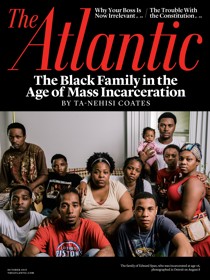
One needn’t hate Hispanics to choose a school system with no Hispanics. One need not say that black people are violent apes to call the police when an injured human being who happens to be black knocks on your door for help. Freedom—from being stopped and frisked; from predatory criminal justice fines; from cells—is arguably the resource from which every other resource flows: education, marriage, income, wealth, happiness, actualization. In “The Black Family in the Age of Mass Incarceration,” Ta-Nehisi Coates offers a decoder ring for the language of criminality, revealing that it rests on the idea that America can only be great so long as America is fundamentally white.
The articulation of America’s greatness is rarely as strong as when the country is preparing to elect its next leader. If nothing else, the political class generates tons of text and ideas for ordinary readers to parse. Coates parses the ideology of white racism in crime policy and rhetoric from the Fugitive Slave Clause through Richard Nixon, Bill Clinton and on to Bernie Sanders. The occasion is the 50th anniversary of Daniel Patrick Moynihan’s report, “The Negro Family: The Case for National Action.”

During my doctoral training, Moynihan was offered as a cautionary tale to young academics. Moynihan, they said, dared to tell the truth about the culture of poverty in black communities. As a result, the liberal elite and angry black-activist oligarchy ran him out of society’s good graces, if not exactly out of town. We were warned against dabbling in social prescriptions: “Look what they did to Moynihan!”
We should all be so lucky as to be punished the way Moynihan was punished. Moynihan was a sociologist and a junior government official when he wrote his now-infamous treatise on the moral and economic decay of the black family. By the time he died in 2003, Moynihan was more than just a sociologist. He entered the rarified world of power. He worked with presidents. He commanded audiences within the cognitive elite. He had, I was once told by someone at a conference who’d had a bit too much to drink, a fantastic office at Harvard. Moynihan made it.

That he made it despite being “made into a racist,” as he put it, refutes the idea that being labeled a racist is some scarlet letter. It also raises questions about the renewed interest in revitalizing Moynihan’s reputation. Orlando Patterson and Ethan Fosse wrote in a new book that “history has been kind to Moynihan.” I agree. History has been kind to Moynihan. But it is not that empirical evidence of a deep culture of poverty among blacks has proven Moynihan’s case. Instead, the rapid acceleration and ruthless efficiencies of incarceration have made Moynihan’s theses seem prescient by intensifying every structural condition of race, poverty, and criminality in the United States. Moynihan is prescient only if one ignores that Moynihan went on to participate in the kind of policies and ideology that perpetuated the conditions he was originally critiquing. That kind of prescience is called winning by owning the rules of the game.
As voters prepare to turn the board over to a new gamemaster, Coates argues that the rules are still the same. Bill Clinton signed a crime bill in 1994 that effectively paid states to build prisons and reduce parole so that those prisons might stay full. In 2015, activists are circulating clips of Hillary Clinton online. In one, she can be heard calling kids “super predators” as an argument in support of her husband’s crime policies. Hillary likely borrowed the “super predators” language from a 1996 book that predicted a new crime wave unless these hyped up, extra-terrestrial, mostly poor, and almost always dark young people were locked away.

As fortune (or power) would have it, the narrative of a crime wave is reemerging. In the wake of Black Lives Matter protests all across the country, standing against The Proxy Wars That Constrain African Americans - The Atlantic:

New Report Decries Theft of Democracy in State School Takeovers | janresseger

New Report Decries Theft of Democracy in State School Takeovers | janresseger:

New Report Decries Theft of Democracy in State School Takeovers


The Alliance to Reclaim Our Schools is pushing back against the rush by state legislatures to take over the poorest schools in America’s big cities—in many cases to seize entire school districts—and run them without the oversight of an elected local school board.  Examples of such state takeovers abound these days from New Orleans to Little Rock to Philadelphia to Detroit to Newark, and recently, after the Alliance’s report went to press, Youngstown, Ohio. The new report from the Alliance declares, “(T)here is a different attack on minority  enfranchisement not addressed in the Voting Rights Act.  Instead of barriers to the ballot box, local elected governance is being dissolved altogether.”  State takeovers cluster in low-income, black and brown communities, the report explains, while across the United States 95 percent of school districts continue to be run by locally elected school boards.
In Out of Control: The Systematic Disenfranchisement of African American and Latino Communities Through State Takeovers, the Alliance proclaims: “This fall, tens of thousands of students are returning to schools that have been placed under state authority.  Elected school boards have been dissolved or stripped of their power and voters have been denied the right to local governance of their public schools. These state takeovers are happening almost exclusively in African American and Latino schools and districts—in many of the same communities that have experienced decades of underinvestment in their public schools and consistent attacks on their property, agency and self-determination. In the past decade, these takeovers have not only removed schools from local authorities, they are increasingly being used to facilitate the permanent transfer of the schools from public to private management.” State departments of education, ill-equipped to run schools and school districts, are increasingly bringing in enormous charter management companies to operate the schools now under state takeover.  While school choice is said by its proponents to empower families, parents in these now privately-run, state-held school districts find themselves disenfranchised and without leverage to shape their children’s schooling.
The new report traces the history of under-investment in these districts dominated by racial segregation and rapidly intensifying poverty: “Despite the Supreme Court’s decision in Brown v. Board of Education in 1954, despite the Civil Rights Act of 1964, the Elementary and Secondary Education Act and the Voting Rights Act (both passed in 1965), public schools have never fully served low-income students of color. Our antiquated school funding system that relies on local property taxes to support public schools embeds inequities based on race and class. When the rise of manufacturing in northern cities attracted large numbers of African American families looking for jobs, they were met with housing discrimination and redlining that led to segregated neighborhoods and segregated schools. When manufacturing left these same cities, they were thrown into decline. The loss of jobs, and later, resistance to integration led to massive white flight, further concentrating poverty in urban centers and communities New Report Decries Theft of Democracy in State School Takeovers | janresseger:

California Democrats Starve Public Education

California Democrats Starve Public Education:

California Democrats Starve Public Education


We are often told that the right wing is acting to destroy public education with people like Wisconsin’s Governor Republican Scott Walker and the Koch brothers being properly vilified. For example, American Federation of Teacher’s President Randi Weingarten has written that, “We need to tell Govs. Tom Corbett in Pennsylvania (now defeated), Scott Walker in Wisconsin, Rick Snyder in Michigan and others that their chronic disinvestment in higher education is a one-way ticket out of the governor’s mansion.” (AFT on Campus Fall 2014 pg. 3)
Weingarten, who recently was involved in the American Federation of Teacher’s endorsement of Hillary Clinton for president, is suggesting that if we have any hope for higher education, we need to place Democrats in power. The same logic would apply to protecting all forms of public education.
However, in many ways, the Republicans are providing cover so that when the Democrats enact programs that starve public education of proper funding, their actions often go unreported and unnoticed.
Democrats are constantly expressing support for education. The policies they enact often do not match their rhetoric.
Many Democrats share a huge responsibility for the degradation of public education. They have overseen cuts in public educational funding. They have also supported anti-union policies demanding more work for less pay while attacking job protection, high stakes testing, and privatization leading to more charter schools and to contracting out much work that had been done previously in-house by a public school.
A prime example of Democrats overseeing the short changing of public education is California under Governor Jerry Brown. During the time he has been in office, starting in 2011, the Democrats have dominated the state government with huge majorities in both houses of the legislature while also holding all executive offices. However, funding for education in real dollar amounts has been lacking even as revenue has increased and despite a reformed budget process in place during the time Brown has been governor. Now, a simple majority of each house of the state legislature is sufficient to pass a budget. Previously, a two-thirds majority had been necessary.
Here is the recent record of spending on education in California.
Screen Shot 2015-09-16 at 3.01.02 PM
The above numbers are striking.
In the budget approved for fiscal year 2008-2009, when Schwarzenegger was still governor and a two-thirds majority in each house of the legislature was necessary to pass a budget, spending for K-12 was $46.2 billion and for higher education stood at $13.6 billion. Both amounts of educational spending are higher for every subsequent year until 2015-2016, even after total state funds were higher than they were in 2008-2009.
Partly in response to the recession that began in 2008, spending on education for all of the years thereafter reached the lowest point in 2011-2012 which is after Brown became governor. Total spending for California Democrats Starve Public Education: