Latest News and Comment from Education

Monday, August 31, 2015

Mike Klonsky's SmallTalk Blog: #FightForDyett CLERGY CALL FOR EMERGENCY HEARING ON DYETT

Mike Klonsky's SmallTalk Blog: CTU PRESS RELEASE: CLERGY CALL FOR EMERGENCY HEARING ON DYETT:

CTU PRESS RELEASE: CLERGY CALL FOR EMERGENCY HEARING ON DYETT

CLERGY TO APPEAL TO MAYOR EMANUEL TO END TO THE DYETT HUNGER STRIKE NOW IN 14th DAY


Parents, educators, activists continue to refuse food untiBronzeville receives a neighborhood high school

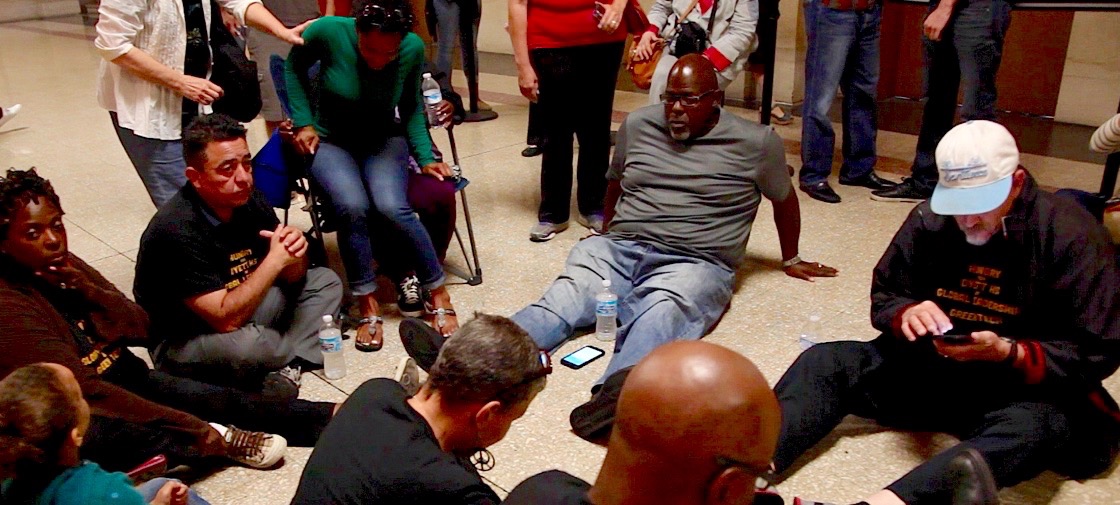
CHICAGOAs activists enter the 14th day of dangerous hunger strike, a group of clergy, representing varioufaiths, will hold press conference Monday, August 31st to call on Mayor Rahm Emanuel and Board of Education President Frank Clark to end this dangerous non-violent protest by immediately calling for an emergency hearing on Dyett High School. 
Three strikers have already required medical attention and many fear that more will succumb. The school district moved its Dyett vote to the end of September,which places these parents, grandparents, community activists, teachers and clergy refusing solid foods in serious health danger, according tmedical professionals. Theprotesters have vowed to continue the hunger strike until their community receives neighborhood high school.

WHO:             Rev. Robert Jones, currently in the 14th day of hunger strike, will be joined by varioufaith leaders, including Rabbi Brant Rosen, Rev. CJHawking, and others in direct moral appeal for fairness, democracy and education justice. The clergy will represent varioufaiths and represent a cross-section of Chicago.


WHAT:           Clergy will conduct press conference to call thmoral question about Mayor Emanuel’s refusal to entertain the Dyett proposals ashe previously promised; and to call on city leaders to help end this hunger strike as 12 protesters move into a critical phase of protest. The clergyintend to deliver plea to the mayor in hope that he will act quickly, hold an emergency hearing on the matter, and end the hunger strike.

Chicago PEACE (Parents, Educators and Community for Education), a CTU faith-based group, will also participate in the news conference.


WHEN:           Monday, August 31, 2015
10:00 a.m.

WHERE:         CITY HALL, 5th FLOOR
121 N. LaSalle Street


On the 14th day, religious leaders make their appeal and Claypool does what we predicted he would do. | Fred Klonsky

On the 14th day, religious leaders make their appeal and Claypool does what we predicted he would do. | Fred Klonsky:

On the 14th day, religious leaders make their appeal and Claypool does what we predicted he would do.


7555688_G


This morning many of Chicago’s religious leaders will make an appeal to the Mayor on behalf the #FightForDyett hunger strikers.
Mayor Rahm, who often tries to portray himself as God, will not be impressed.
Rev. Robert Jones, currently in the 14th day of a hunger strike, will be joined by various faith leaders, including Rabbi Brant Rosen, Rev. CJ Hawking and others in a direct moral appeal for fairness, democracy and education justice. The clergy will represent various faiths.
If you have not done so, read brother Mike’s post from Friday where he discusses the lies and “let-them-eat-cake” attitude of this morally corrupt administration.
While the courageous hunger strikers continue their action, and men and women of faith make their appeal to the morally bankrupt leader of the city,his newly appointed CEO of the public schools does exactly what we all said he would do two weeks ago.
He painted the office.
First thing: Kudos to my bro for his prognostication.
Two weeks ago he predicted that the new CEO at CPS, Forrest Claypool, would hand out banker boxes to the Byrd-Bennett crew and show them the door.
Some cynics might claim that this was an easy prediction since the 
On the 14th day, religious leaders make their appeal and Claypool does what we predicted he would do. | Fred Klonsky:

Recognizing Progress on Student Data Privacy - Data Quality Campaign

Credit where It’s Due: Recognizing Progress on Student Data Privacy - Data Quality Campaign:

Credit where It’s Due: Recognizing Progress on Student Data Privacy


My oldest son turns eleven this month and he is getting his first smartphone. I know that this means grappling with the intimidating responsibilities that come with parenting through these advances in technology. I don’t understand all that I am agreeing to in those Terms of Service agreements and, quite frankly, I don’t understand ALL the ways in which his smartphone data can be used to help or harm him.
However, I’m not just any parent. I work for the Data Quality Campaign (DQC). Because of that I’m in a unique position to get smart on these issues, hear about emerging concerns, and know first-hand what protections either exist or are being developed. I have access to privacy and data experts and advocates across many fields and they have been generous with their time and expertise to equip me with the knowledge I need to feel good about this birthday gift.
One such advocate is Jim Steyer, CEO of Common Sense Media. We appreciate that an organization dedicated to providing parents with the knowledge to make informed decisions is taking action in the important arena of student data. DQC has appreciated this fresh voice out there explaining that existing student privacy laws are outdated and don’t reflect the current realities schools, students, and parents face while using technology in classrooms. We’ve highlighted California’s groundbreaking 2014 privacy legislation, SOPIPA, and noted where other states have adopted versions of this bill that Common Sense Media helped shape. Steyer has also highlighted the work of Governor Jack Markell, who is most definitely a leader to be learned from in this field. He recently signed strong privacy legislation to safeguard Delaware students.
However, we also recognize that while not all states have introduced or passed bills exactly like California’s, most states have dug in and begun the tough conversations with schools and families about how state law can be best address their concerns. Just this year, we’ve seen 46 states introduce 182 bills resulting in 15 states with 28 new laws to protect students. By our analysis, 25 states have introduced legislation modeled on SOPIPA though several made changes to the bill’s language to address local concerns or add additional protections (e.g.,Georgia’s bill includes SOPIPA-like provisions within a larger more comprehensive bill that governs schools in addition to education technology providers). It is heartening to see so many states paying attention to this critical issue.
In any student data privacy conversation, it is important to note that federal protections do exist. The Family Education Rights and Privacy Act (FERPA) has done what it was designed to do—prohibit schools from releasing students’ personal information except under limited and defined circumstances. While this 40-year-old law needs to be updated, schools take their responsibilities under FERPA quite seriously. We also have the Children’s Online Privacy Protection Act (COPPA) passed by Congress in the late 90s. While this law currently only protects the privacy of students under the age of 13, it is an important safeguard for elementary and middle school aged children who are just beginning to engage with apps and online learning opportunities in schools.
States, and Congress now too, have recognized how complex and new this issue really is. They are learning and borrowing from each other, and they’re also breaking new ground and forging new pathways to protection. We’re pleased that legislatures have continually sought to strike the balance between the promise of personalized learning through effective data use and the moral and legal imperative to safeguard privacy. As a parent who is continually struggling with and learning all that comes with these technologies in my own house, I can truly appreciate how difficult it must be to legislate in this area. As DQC staff, I want them to get this right. As a parent, I need them to get this right.


State Privacy Legislation


Credit where It’s Due: Recognizing Progress on Student Data Privacy - Data Quality Campaign:

Is this any way to run a school district? - The Washington Post

Is this any way to run a school district? - The Washington Post:

Is this any way to run a school district?


Back in 2012, the long-beleaguered Chester Upland School District in Pennsylvania ran out of money — literally — and the unionized teachers and staff agreed to work without pay. (When it made national news, first lady Michelle Obama invited a Chester Upland teacher to sit with her at the State of the Union speech that year.) Well, it’s happened again — at least the part about the district being out of cash and all of the teachers, support staff, bus drivers and other adults in the system agreeing to work for free when the 2015-16 academic year starts on Wednesday.
“We knew we had to do it, again,” said John Shelton, who has been an educator in the district for 23 years and now is dean of students at a district middle school. “With great pain, we agreed to work as long as our families allow us to.”
Why does this keep happening?
About 20 miles west of Philadelphia, Chester Upland is one of the poorest districts  in the state and has been in financial distress for many years.  Under state control for most of the last two decades, it now enrolls about 3,300 students, fewer than the total number of students who attend charter schools in the district.
As teacher Stephen Singer explained on the Badass Teachers Association blog, Pennsylvania lawmakers failed for years to adequately fund Chester Upland (and other poor districts in the state) and left the district “to survive on the drip of local property taxes from residents who, themselves, don’t have two pennies to rub together.”
Making matters worse is the funding controversy involving the district’s charter schools, which were encouraged and supported by Pennsylvania lawmakers and the former Republican governor Tom Corbett. The largest charter in Chester Upland, as my Post colleague Lyndsey Layton wrote in this story,  is Chester Community Charter School, a nonprofit institution managed by a for-profit company (headed, incidentally, by one of  Corbett’s largest individual political donors). As Layton noted, Chester Upland pays local charter schools about $64 million in tuition payments ever year — more than the district receives in state school aid.
Lawmakers set up a funding formula in which Chester Upland’s charter Is this any way to run a school district? - The Washington Post:

Broad Foundation spearheads expansion of Los Angeles charter schools - World Socialist Web Site

Broad Foundation spearheads expansion of Los Angeles charter schools - World Socialist Web Site:

Broad Foundation spearheads expansion of Los Angeles charter schools


The Eli and Edythe Broad Foundation has announced plans for a major expansion of charter schools in Los Angeles. The foundation is the brainchild of investment billionaire Eli Broad, a Los Angeles resident with a net worth of $7.1 billion. It is known for its involvement in the charterization of public education, with assets of $2.1 billion.
The effort is being supported by other similar entities: the Keck Foundation and the Walton Family Foundation. The move is part of a broader push by several billionaires to privatize public education through their philanthropic “non-profit” organizations such as the Melinda and Bill Gates Foundation, the William and Flora Hewett Foundation and the Avi Chai Foundation.
Under the guise of raising “student achievement by recruiting, training and supporting leadership talent from across America to transform urban school systems,” especially in so-called “under-performing” schools, the Broad Foundation is presenting its business plan as an alternative to the public system.
Swati Pandey, a spokeswoman for the foundation, declared: “People have been demanding better public schools forever and not getting them.” The foundation attributes the cause to “Bureaucratic systems, policies and practices that have been built up over decades in inner-city school districts” which “have often led to fewer resources that actually reach the classroom.”
But the truth is that the crisis of public education is directly imputable to years of budget cuts, supported by both big business parties, that have inflicted a fatal blow to programs, students’ access to classes and teachers’ living and academic conditions.
In California alone, the onset of the 2008 financial crisis propelled the slashing of tens of billions of dollars in education funds by both Governors Republican Arnold Schwarzenegger and Democrat Jerry Brown. Despite recent surpluses, cuts were never reversed.
Charter schools are a model based on the private management of public funds. The basic conception is that they are to be run as for-profit enterprises like any other business. As such, all “unnecessary” costs must be cut, starting from teachers’ pay and benefits.
Steve, a Los Angeles charter school teacher, told the WSWS: “Charter schools’ leaders all seem missionary in their work. Almost all talk about the ‘calling’ that teachers who work in charter schools have to have, many times adding that teachers did not get into education for the ‘money.’
“No. The charter schools certainly did! They operate only to get money from the government and various organizations that will fund them. It is a disgrace! Charter schools cynically call themselves public schools, but they really are not.”
California has more charter schools that any other US state. The number of charter schools went from 177 in 1998-99 to 1,184 in 2014-2015, with 547,800 students attending. The Los Angeles region has the highest growth in new charter schools in the state.
There is overwhelming evidence pointing to the fraudulent character of charter schools and their financiers. Last April, the Alliance to Reclaim Our Schools and the Center for Popular Democracy published a report titled “The Tip of the Iceberg: Charter School Vulnerabilities To Waste, Fraud, And Abuse.”
The report details more than $200 million in fraud and waste of public funds in the charter school sector, specifying that the total is impossible to know because of lack of oversight and transparency. Last year, a similar report detailed $136 million in fraud and waste and mismanagement in 15 of the 42 states that operate charter schools.
For the current year, California is expected to lose more than $100 million in fraud, waste and abuse by charter operators, according to a report by the Broad Foundation spearheads expansion of Los Angeles charter schools - World Socialist Web Site:

Initial Common Core goals unfulfilled as results trickle in - US News

Initial Common Core goals unfulfilled as results trickle in - US News:

Goal of comparing student performance among states unfulfilled as Common Core results come in


The Associated Press


LOS ANGELES (AP) — Results for some of the states that participated in Common Core-aligned testing for the first time this spring are out, with overall scores higher than expected. But they are still below what many parents may be accustomed to seeing.
Full or preliminary scores have been released for Connecticut, Idaho, Missouri, Oregon, Vermont, Washington and West Virginia. They all participated in the Smarter Balanced Assessment Consortium, one of two groups of states awarded $330 million by the U.S. Department of Education in 2010 to develop exams to test students on the Common Core state standards in math and English language arts.
Scores in four other states that developed their own exams tied to the standards have been released. The second testing group, the Partnership for Assessment of Readiness for College and Careers, is still setting benchmarks for each performance level and has not released any results.
Even when all the results are available, it will not be possible to compare student performance across a majority of states, one of Common Core's fundamental goals.
What began as an effort to increase transparency and allow parents and school leaders to assess performance nationwide has largely unraveled, chiefly because states are dropping out of the two testing groups and creating their own exams.
U.S. Education Secretary Arne Duncan told state leaders in 2010 that the new tests would "help put an end to the insidious practice of establishing 50 different goal posts for educational success."
"In the years ahead, a child in Mississippi will be measured against the same standard of success as a child in Massachusetts," Duncan said.
Massachusetts and Mississippi students did take the PARCC exam this year. But Mississippi's Board of Education has voted to withdraw from the consortium for all future exams.
"The whole idea of Common Core was to bring students and schools under a common definition of what success is," said Tom Loveless, a senior fellow at the Brookings Institution. "And Common Core is not going to have that. One of its fundamental arguments has been knocked out from under it."
No Child Left Behind, President George W. Bush's signature education law, requires states to test students each year in math and reading in grades three to eight and again in high school. Congress Initial Common Core goals unfulfilled as results trickle in - US News:

Waltons and Education Privatizers Thwarted in Little Rock | Alternet

Waltons and Education Privatizers Thwarted in Little Rock | Alternet:

Waltons and Education Privatizers Thwarted in Little Rock

A unique coalition pushes back hard on attempted charter takeover.


The debate over public schools in Arkansas has been, for decades, ongoing and often fraught. In 1957, the Arkansas school year began with white mobs viciously attacking nine black teenagers as they attempted to desegregate Little Rock’s Central High following Brown vs. Board of Education, shining a national spotlight on the state and forcing President Eisenhower to send in the 101st Airborne Division. 
This past January, nearly 60 years after Arkansas’ first desegregation efforts, the state board of education dissolved Little Rock’s democratically elected local school board, the most racially inclusive and representative of its majority-black constituency in nearly a decade. In making the decision, the state overruled widespread public outcry to take control of the largest school district in the state. Two months later, Walton Family Foundation-backed lobbyists launched a brazen legislative push to allow for broader privatization — or put bluntly, “charterization” — of schools across Arkansas. It was a move many believed revealed a carefully orchestrated effort, begun months prior, to undermine the state’s public school system, destroy its teachers unions and turn public funds into private profits. 
Anyone with even a passing interest in public education knows how this story normally ends; one need only look to places like Philadelphia, where Walton dollars have helped launch an explosion of charters, or New Orleans and Detroit, where Walton funds have contributed to a system in which a majority of K-12 students now attend charter schools. Though it is not the only big-money contributor to the education reform movement (the Bill & Melinda Gates Foundation is a key player, as are countless millionaire hedge funders, real estate developers and investment bankers), no single entity has poured more money into the push for “school choice” than the Walton Family Foundation. As a recent report from In the Public Interest and the American Federation of Teachers notes, “the foundation has kick-started more than 1,500 schools, approximately one out of four charters in the country. Over the last five years [WFF] has spent between $63 million and $73 million annually to fuel new charter openings.”
But this March, Arkansas proved the exception to the ubiquity of Walton rule. Following the introduction of House Bill 1733, which would have vastly Waltons and Education Privatizers Thwarted in Little Rock | Alternet:

The LAUSD Superintendent Search Continues Behind Closed Doors - Change The LAUSD

The LAUSD Superintendent Search Continues Behind Closed Doors - Change The LAUSD:

The LAUSD Superintendent Search Continues Behind Closed Doors


-LAUSD
When I ran for the LAUSD District 3 seat in this year’s elections, one of theplanks in my platform was to make Board meetings more accessible to the stakeholders. Since holding some of them on weekends was one suggestion that I put forward, it was very exciting when the District announced early this month its plans to hold a rare weekend meeting. However, any thought that this was done for the convenience of the parents was soon put to rest as the location of the meeting was not even announced until just a couple of days ago. To alleviate any doubt, the agenda released by the district indicated that the Board would adjourn into a closed session right after hearing public comments.
As if to prove the point that the LAUSD is too geographically large, it took me a little over an hour to travel from Northridge to the meeting location at the Point Fermin Outdoor Education Center in San Pedro. That was without hitting any traffic. After passing some beautiful views of the ocean, Siri directed me to turn into an unmarked gate and past some abandoned buildings. While she said that I had reached my destination, the only clue to the location of the meeting was a small sign visible only to those traveling the other direction.
It was quickly clear that the District had succeeded in keeping the stakeholders at bay as the number of school police officers on duty outnumbered the  the people milling about. Scott Schmerelson had arrived early and was getting a tour of the facility. The other members slowly trickled in and greeted each others like students returning from summer vacation. Unlike regular Board The LAUSD Superintendent Search Continues Behind Closed Doors - Change The LAUSD:

Sunday, August 30, 2015

Two Questions Every Presidential Candidate Needs to Answer about Education | VAMboozled!

Two Questions Every Presidential Candidate Needs to Answer about Education | VAMboozled!:

Two Questions Every Presidential Candidate Needs to Answer about Education


In an article released by Truthout, author Paul Thomas recently released an article titled “Five Questions Every Presidential Candidate Needs to Answer About Education.” You can read all five questions framed by Thomas here, but I want to highlight for you all the two (of the five) questions that most closely relate to the issues with which we deal via this blog.
Here are the two questions about education reform in this particular arena that every candidate should have to answer, and a few of Thomas’s words about why these questions matter.
1. While state and national leaders in education have repeatedly noted the importance of teacher quality – while also misrepresenting that importance [emphasis added] – increasing standards-based teaching, high-stakes testing and value-added methods of teacher evaluation, along with the dismantling unions, have de-professionalized teaching and discouraged young people from entering the field. How will you work to return professionalism and autonomy to teachers?
The teacher quality debate is the latest phase of accountability linked to test scores that started with school and student accountability in the 1980s and ’90s. While everyone can agree that teacher quality is important, the real issues are how we measure that impact and how we separate teacher and even school quality effects from the much larger and more powerful impact of out-of-school factors – that account for about 60% to 86% of measurable student learning.
The misguided focus on teacher quality – linking evaluations significantly to test scores – Two Questions Every Presidential Candidate Needs to Answer about Education | VAMboozled!:

#FightForDyett In Chicago: Dyett Hunger Strike Day 14 – Supporting and Defending - Living in Dialogue

In Chicago: Dyett Hunger Strike Day 14 – Supporting and Defending - Living in Dialogue:

In Chicago: Dyett Hunger Strike Day 14 – Supporting and Defending 


By Michelle Gunderson.
A circle of ten people sit outside Mayor Rahm Emanuel’s office demanding a meeting with the mayor. They have not taken solid food for 12 days. The Dyett hunger strikers ask that a decision be made regarding their proposal to keep the only open enrollment high school in the Bronzeville neighborhood of Chicago.
The mayor does not come out.
An aide is sent instead.
As a supporter of the Dyett hunger strikers, as well as a supporter of the concept of public education driven by communities – not contract or charter schools – I sit behind the Dyett hunger strikers on the fifth floor of Chicago’s City Hall and wait.
We might as well be on the opposite site of a moat of a feudal castle. The barrier between Rahm Emanuel and the members of the Bronzeville community is that wide.
Yet, as we support the Dyett hunger strikers, many of us find ourselves defending their actions.
This past week Eric Zorn, a writer for The Chicago Tribune, claimed the hunger strikers were taking the public hostage with their actions that he called a planned suicide. Then Alderman Will Burns stated that he refused to be bullied by the strikers.
Let’s be clear, a hunger strike is a fast, a withholding of solid food. It is an action which is rooted in deep moral resolve.
As Jitu Brown, hunger striker and community organizer, said, “When you haven’t eaten for a while you gain great clarity.”
Playing by the Rules
By every measure, the coalition for Dyett School has followed all the rules. They engaged with the In Chicago: Dyett Hunger Strike Day 14 – Supporting and Defending - Living in Dialogue:

Seattle Schools Community Forum: Public Education in 2015-2016 - What Will Happen?

Seattle Schools Community Forum: Public Education in 2015-2016 - What Will Happen?:

Public Education in 2015-2016 - What Will Happen?


I believe that this year is to be a pivotal one in public education - for our district, our state and nationally.
I'll go in reverse order. 

Nationally, that issue of opting out over Common Core testing/overtesting is not going away.  No amount about saber-rattling, shaming or finger-wagging is going to change that. 

In 2016 we will elect a new president and I can only say if you believe in "choice" via charters and voucher, vote Republican.  Because that is exactlywhat will happen.  There is not a single Republican I would trust on public education issues (and that's a sad thing to say given how many of them there are).  Trump is the only one with no clear views but I'm thinking the first thing he would do for public education is to make mandatory citizenship reviews of every single student in public schools a reality. 

But with a Republican president, along with vouchers and massive charterization of public schools,  we would probably see a big pullback on federal reach into public education.  Common Core might be weakened by this move.  

But Clinton, Sanders and the other Dems are not-so-stellar either on public education issues so I'm (again) likely to be disappointed for public education, no matter who wins.

For Washington State, we will go into Jan. 2016 seeing the Legislature continue to tie itself into knots over school funding and ignoring I-1351 about class size.  It's going to take some real leadership and public will to create a change that will mean a fundamental change in how we fund our STATE andNot just public education.  I said this to the Governor but I'm not sure he's the 
Seattle Schools Community Forum: Public Education in 2015-2016 - What Will Happen?:

Tools for Tailored Learning May Expose Students’ Personal Details - The New York Times

Tools for Tailored Learning May Expose Students’ Personal Details - The New York Times:

Tools for Tailored Learning May Expose Students’ Personal Details


If the efforts by state legislators to restrict the use of student data are any guide, the email addresses and search queries of the nation’s schoolchildren are a hot commodity.
In May, Georgia adopted a law barring online services designed for elementary through high school from selling or sharing students’ names, email addresses, test results, grades or socioeconomic or disability information. It also bars them from using the data to target students with ads.
In August, Delaware enacted a law that forbids online school services from selling students’ personal details — including their political or religious affiliations, food purchases, text messages, photos, videos and web searches — or using the information to market to them.
Those are just two of the 182 bills introduced in 46 states this year intended to bolster protections for student information, according to areport this month from Data Quality Campaign, a nonprofit group that advocates the effective use of student data in education. Fifteen of those states have passed 28 laws, said the group, which is financed in part by the Bill and Melinda Gates Foundation.
The activity stands in stark contrast to legislative interest just two years ago, when Oklahoma was the only state to pass such legislation. It also provides a clear indication of the rapid adoption of learning apps in classrooms — and of concerns that these novel technologies generate a trove of new data about students that could be used in unforeseen ways.
Many of the new tools are designed to tailor learning to each child. To achieve that sort of customization, the software may collect and analyze a Tools for Tailored Learning May Expose Students’ Personal Details - The New York Times: