Latest News and Comment from Education

Tuesday, August 11, 2015

Digital privacy laws raise concern over security of kids' information at school - CBS News

Digital privacy laws raise concern over security of kids' information at school - CBS News:

How safe is your kids' digital data at school?


As summer vacation winds down, new legislation is raising concern over digital privacy at school. Nationwide, only four states prohibit kids' personal information from being shared by schools with third party vendors, like marketers.
Common Sense Media founder and CEO Jim Steyer said until a couple of years ago, many schools weren't even aware this was happening.

"Because there were no laws about it -- school districts aren't that knowledgeable about it -- they were selling it to marketers, etc. so we started passing laws at Common Sense around the country, starting in California, to restrict the use of that data to only educational purposes," Steyer said Monday on "CBS This Morning."
That California law takes effect in January 2016 and prohibits practices including targeting advertising to minor students or their parents based on personal information, amassing students' information and disclosing students' personal information if the student's name is attached to that information.
Delaware is the latest state to have a law protecting the privacy of kindergarten through high school-aged students. Oregon and Delaware have similar laws and nine other states -- Maine, Maryland, Florida, Mississippi, Georgia, Hawaii, Iowa, North Carolina and Illinois -- are considering laws for student privacy.

Just two years ago, Steyer said, there were no states with such laws.
According to Common Sense Media, information at risk includes performance records, family finances, online searches and behavior records.
"What's happening is because everything is going online and because a lot of kids... are getting laptops and iPads in classrooms, people are getting accounts where personal information -- health, behavior, all sorts of personal, family information -- is stored," Steyer said.
Across the country, 95 percent of school districts use cloud services but only 25 percent inform parents of that usage, according to a Fordham University Law School study.
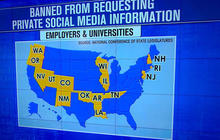
"The one thing I'd say to parents though is tech is here to stay in kids' education, and used properly, it can be great, but we have to protect kids' privacy," Steyer said.
But Steyer said his company, a non-profit organization that advocates for and educates families about technology, faced pushback for their efforts.
"The technology industry spent millions of dollars lobbying against us. They would like to have unfettered access to -- by the way, your (parents') personal information -- as well as your kids' information, so we started passing these laws ... and the momentum is moving in the right direction," Steyer said.Digital privacy laws raise concern over security of kids' information at school - CBS News:

Fixing the No Child Left Behind law: How the House and Senate plans differ - LA Times

Fixing the No Child Left Behind law: How the House and Senate plans differ - LA Times:

Fixing the No Child Left Behind law: How the House and Senate plans differ


Both the House and Senate have passed fixes to the No Child Left Behind law, the signature educational achievement of the George W. Bush administration, which requires schools to meet strict testing requirements.

But as the chambers try to agree on a solution, lawmakers remain sharply divided over key issues.

The House bill, which would curtail federal standards and permit states to impose their own curricula, did not garner a single Democratic vote, and President Obama has threatened to veto it.

Rep. John Kline (R-Minn.), chairman of the House Education and Workforce Committee, emphasized the need to end the current policy "where Washington's priorities have outweighed what parents, teachers and local leaders know what is best for their children." Kline labeled it a "one-size-fits-all approach, which landed many schools in the failing category."

He will head a committee expected to convene in September to reconcile House and Senate bills. Here's a look at questions and answers surrounding the legislation:

What do the House and Senate bills agree on?

Both measures take steps to ease the effect of federal testing and return greater control over education to states. They would also lessen federal say over establishing nationwide achievement standards, like the so-called Common Core, which critics have labeled an attempt to federalize what students are taught.

The bills would repeal what opponents see as the more onerous requirements of the No Child Left Behind law, such as mandating that students make adequate yearly progress or be sanctioned. Lawmakers view these requirements as denying schools the flexibility to deal with the needs of individual students.

Both chambers have made it clear that the Education Department should not be involved in standards assessments and would prohibit the federal government from getting involved in or imposing curricula on states.

"While there are important differences, the consensus supporting the framework for the House and Senate bills is the same: Continue the law's important measurements of academic progress of students but restore to states, school districts, classroom teachers and parents the responsibility for deciding what to do about improving student achievement," said Sen. Lamar Alexander (R-Tenn), chairman of the Senate Health, Education, Labor and Pensions Committee.

Both bills maintain annual assessments in third through eighth grades and once in high school, while aiming to end the era of high-stakes testing. States would still need to publish breakdowns of test results by student groups.

What's in the House bill?

Although the bill requires annual testing, it would let parents and children opt out without repercussions to their schools. The bill repeals many regulations in the No Child Left Behind law to restore control to states and schools. House Republicans see this as eliminating duplicative programs and instead allowing local educators to spend funds where they believe they will have the greatest benefit.

The bill also adds language supporting school choice and stronger charter school programs.

It allows for federal assistance that goes to children in low-income families to be transferred to a new public Fixing the No Child Left Behind law: How the House and Senate plans differ - LA Times:


Two teachers explain why they want to take down their union - The Washington Post

Two teachers explain why they want to take down their union - The Washington Post:

Two teachers explain why they want to take down their union


Ten California teachers and the Christian Educators Association have sued the California Teachers Association in a case that could eliminate public employee unions’ right to collect fees from all workers. Many observersbelieve that the case, to be argued before the Supreme Court this fall, could seriously undermine public sector unions nationwide.
So who are the teachers who want to take down their union?
One of them is Rebecca Friedrichs, the lead plaintiff in the case, Friedrichs v. California Teachers Association. She also is a 28-year veteran of elementary-school classrooms in Orange County. Another is Harlan Elrich, who teaches near Fresno and has been teaching for nearly 30 years.
Both of them say that they decided to become plaintiffs because they don’t want to support a politically powerful union with which they frequently disagree. Current law allows them to opt out of paying for the union’s political activities — about 30 percent to 40 percent of annual dues. But they must continue to pay “agency fees,” which support the union’s collective bargaining activities.
The plaintiffs are asking the Supreme Court to strike down public sector unions’ right in California (and 25 other states) to collect agency fees. Unions say that doing so would create a class of “free riders” who benefit from union representation but don’t pay for it.
“We feel strongly that they should pay their fair share for their representation that they’re receiving and continuing to take advantage of,” said Frank Wells, a spokesman for the California Teachers Association.
Friedrichs and Elrich each agreed to interviews with The Washington Post; they were interviewed separately. Their responses have been edited for length and clarity.
Why did you become a teacher?
Friedrichs: I love imparting knowledge. I love watching little kids get that sparkle in their eye and that smile on their face when they get it. When I was a little kid I always felt like adults didn’t explain things very well and I was always lost.
Elrich: Up until college I never wanted to be a teacher. My father was a teacher and I watched him and said “I never want to do that.” In college I Two teachers explain why they want to take down their union - The Washington Post:

Research on charter schools needs to go beyond test scores // University of Notre Dame

Research on charter schools needs to go beyond test scores // News // Notre Dame News // University of Notre Dame:

Research on charter schools needs to go beyond test scores

A comprehensive review of the research assessing charter schools as the fastest growing area of school choice reforms has uncovered a need for studies that take a different tack, according to University of Notre Dame sociologist Mark Berends.
Charter schools have gained increasing attention in recent years as school choice laws have made them an alternative to traditional public schools. In the past decade, a number of studies have examined the effects of these schools to assess their impact on student achievement.
Researchers are questioning whether the 6,000 charter schools now operating deliver on the promise of school choice laws to shrink achievement gaps. However, the question demands deeper probes of schools’ qualitative conditions, not merely metrics such as test results, Berends wrote in an article, “Sociology and School Choice: What We Know After Two Decades of Charter Schools,” published in mid-August in the journal Annual Review of Sociology.
Mark BerendsMark Berends
Berends, director of Notre Dame’s Center for Research on Educational Opportunity (CREO), notes that the explosive growth of charter schools in the past decade, with total enrollment now exceeding 2.5 million children, has benefited from claims in the public arena that are not thoroughly examined.
“It’s time to go beyond the horse race between charter and traditional public schools based primarily on test scores,” Berends said in summarizing the Annual Reviews article. “More helpful research — how schools and classrooms are organized and an examination of school mission and goals, principal leadership, professional development and parent involvement — will help us understand whether charter schools are truly effective or not.”
Berends is a fellow of the Institute for Educational Initiatives, which advances Notre Dame’s multidisciplinary research of K-12 schools, public and faith-based.Research on charter schools needs to go beyond test scores // News // Notre Dame News // University of Notre Dame:

Pa. standardized test opt-outs tripled in 2015 - LancasterOnline: Local News

Pa. standardized test opt-outs tripled in 2015 - LancasterOnline: Local News:

Pa. standardized test opt-outs tripled in 2015


The number of students opted out of state tests in math and English language arts tripled in 2015, according to data from the Pennsylvania Department of Education.
PSSA math opt-outs rose to 3,270 students from 1,064 in 2014. PSSA English language arts opt-outs rose to 3,245 from 1,068. Those are the largest jumps in the nine years of available data.


(Note: in 2014, students in grades 3 through 8 took reading PSSAs, and students in grade 4 and 8 also took a writing test. Those components were combined in 2015.)


Keystone Exam opt-out numbers were not available.


Lancaster County numbers
If Manheim Township has been the eye of a storm brewing over standardized tests in recent years, the hurricane winds are starting to spread.
The school district was home to some of the first Lancaster County parents to join the growing national opt out movement in 2013. But this year, other districts are catching up.
School-level figures were not available from the state last week, but numbers reported by Lancaster County district administrators in April indicate that opt-outs here more than doubled for the third year in a row. There were 225 students opted out of math or language arts PSSAs.
In 2014, opt outs in Manheim Township were more than double any other district in Lancaster County. This year, the district again had the highest number of 2015 opt-outs: 44 students.
But some districts came closer those figures: Hempfield had 37 opt-outs, Penn Manor had 32 and Warwick had 25.
Warwick also saw the largest jump countywide — up from two opt-outs in 2014. Contacted in May, district officials declined to comment on that spike.
Lampeter-Strasburg, a district that previously had no opt-outs, had the fifth-highest number among 17 districts this year: 19 students. In an email last May, Superintendent Kevin Peart said he was "a bit surprised" by the increase.
"We fully support parents' rights to opt their child out of the assessment, and did not have any further conversation after they submitted their request in writing. It would certainly be a concern if our opt-numbers negatively impacted our SPP results due to student participation rates, but that is not currently the case," he wrote.
The district totals all represent less than 2 percent of the districts' test-eligible populations. If the numbers reach 5 percent, they could negatively affect a school's score on the state's School Performance Profiles.
A parent's view
Lily Frank was one of 10 Manheim Central students opted out of PSSAs this year. Her mom, Lindsay Frank, said her concerns about the tests started with the high level of stress Lily was showing in third grade.
"As I read more and learned more, it really concerned me that so much time is being devoted to this test prep," said Frank.
Students spend several weeks on on PSSAs each spring, and most schools administer related tests throughout the year to track progress. Those are separate from lesson quizzes and unit tests.
After PSSAs finished in April, Frank said she saw a big change in her daughter's classroom, where she volunteered weekly. Students studied subjects other than math and language arts, and they Pa. standardized test opt-outs tripled in 2015 - LancasterOnline: Local News:

GoLocalPDX | Two 1sts for Kindergarteners: Standardized Test & the 1st Day of School

GoLocalPDX | Two 1sts for Kindergarteners: Standardized Test & the 1st Day of School:

Two 1sts for Kindergarteners: Standardized Test & the 1st Day of School


Kindergarten is not what it used to be. For the last two years, Oregon’s kindergarteners have been taking a kindergarten assessment during the first week—sometimes the first day—of school. Education advocates from Oregon Save Our Schools (SOS) say kindergarteners shouldn’t even be taking the test.

“The test itself is not reliable and valid, and it’s an inappropriate test to be giving to kindergarteners,” said Dana Brenner-Kelley, a member of Oregon SOS and a North Portland resident.
Brenner-Kelley is organizing three events this month—Aug. 20, 21 and 23—to make parents aware of the tests and tell them how to opt out. All of the events will have kindergarten teachers available to add perspective. Two of the events will also screen “Education, Inc.”
Two Tests
The Oregon Kindergarten Assessment is different from the Smarter Balanced tests that have received heated debate and perhaps more attention.
For starters, the kindergarten assessment is given at the beginning of the year instead of at the end of the year. And it’s not tied to teacher evaluation, which the Smarter Balanced tests are. “They’re really quite different, which is why it hasn’t been one of the policies we’ve worked on,” said Stand for Children spokesman Kelsey Cardwell.
Stand for Children has been supportive of the Common Core standards and the correlating Smarter Balanced tests.
Ultimately, to Brenner-Kelley, the problem for both tests stems from an increased corporatization of education. The Oregon Education Investment Board, started by former Gov. John Kitzhaber, was “made up of business leaders with corporate interests in guiding education.” Though the board was disbanded by Gov. Kate Brown, the legacy lives on.
“It’s high stakes from a systemic point of view,” Brenner-Kelley said. For her the question is: “How is this data going to be used in a way that affects this child in inappropriate ways?”
While the test results are showing lower scores for low-income students, which could drive more funding toward low-income schools, Brenner-Kelley said that “drilling” academics into children at a younger age will “create much worse performance for these kids.”
The testing is “high stakes” in the sense that it places pressure on programs that are publicly funded to implement more rigorous academics at an earlier age in order to maintain funding.
A former Washington state Head Start Association director, she said what kids need at an early age is play-based GoLocalPDX | Two 1sts for Kindergarteners: Standardized Test & the 1st Day of School:

Pick up the pace on Sacramento’s ethics reform | The Sacramento Bee

Pick up the pace on Sacramento’s ethics reform | The Sacramento Bee:

Pick up the pace on Sacramento’s ethics reform


If good-government reforms get moving at Sacramento City Hall because of the sordid allegations of sexual harassment against two elected officials, one good thing will have emerged from that regrettable episode.
Mayor Kevin Johnson, the subject of one of those claims, declared Thursday night that he wants a City Council committee to wrap up its work on an ethics code soon. “That’s a hot topic for all of us, and we want to make sure we finish what we started,” he said.
He also said that Mayor Pro Tem Angelique Ashby will “take the lead” during the “final stretch.” Johnson didn’t say why she’s taking over from the committee’s chairman, Vice Mayor Allen Warren. But Warren is facing the other harassment claim; it’s clear he’s compromised.
It should be noted that while the Democratic Party of Sacramento County cited these allegations to push for an ethics commission, sexual harassment wouldn’t necessarily fall under its enforcement powers. Such cases already fall under specific state and federal laws.
But the party chairwoman, Kerri Asbury, also mentioned Johnson’s use of city-paid aides to take control of the National Conference of Black Mayors. That could have much more to do with an ethics code.
Eye on Sacramento, a local watchdog group, and the local League of Women Voters also complain that the city has been dragging its feet on an ethics code, sunshine ordinance and other reforms.
They’re right. After voters rejected the November ballot measure to make Sacramento a strong-mayor city, both sides agreed to proceed on the good-government provisions also in the measure.
However, the pace has been slow and the process flawed. To study the reforms, the mayor appointed the committee, but it’s an ad hoc panel, meeting behind closed doors – in obvious conflict with the whole idea of more transparency.
Reform advocates are seeking stricter standards than state law on conflict of interest, use of public resources, financial disclosure and registration of lobbyists. They’re also seeking an independent commission to draw council districts. They point out that Los Angeles, San Diego, San Francisco and other larger California cities already have ethics commissions to hold government officials accountable.
These are all ideas worth pursuing. Council members need to get to it.Pick up the pace on Sacramento’s ethics reform | The Sacramento Bee:
Big Education Ape: Sacramento Integrity Project | Open Governenment Ordinance http://bit.ly/1ItEqtE
Big Education Ape: Sacramento Democratic Party calls for ethics reform in wake of scandals | The Sacramento Bee http://bit.ly/1UoVaYf

Big Education Ape: Marcos Breton - KJ Is It Time For Bromance Relationship Counselling | The Sacramento Beehttp://bit.ly/1IObKNt

Big Education Ape: Sexual harassment claims become the norm at Sacramento City Hall http://bit.ly/1ItsGrd

Big Education Ape: Sexual harassment claims become the norm at Sacramento City Hall http://bit.ly/1ItsGrd

Big Education Ape: Sacramento Democratic Party calls for ethics reform in wake of scandals | The Sacramento Bee http://bit.ly/1UoVaYf


Read more here: http://www.sacbee.com/opinion/editorials/article30641937.html#storylink=cpy

Dreams of a Hip, High-Tech Sacramento Hinge on Kings’ New Home Court - The New York Times

Dreams of a Hip, High-Tech Sacramento Hinge on Kings’ New Home Court - The New York Times:

Dreams of a Hip, High-Tech Sacramento Hinge on Kings’ New Home Court


SACRAMENTO — When it opens for the Sacramento Kings’ first home basketball game, the $477 million Golden 1 Center — which will have the capacity to hold 17,500 fans and is designed with online graphic and social media interfaces — will be more than the newest and most technologically advanced arena in the N.B.A.
It will have aircraft hangar doors on its north side that open onto a public plaza anchored by a luxury hotel. There are also plans for more than one million square feet of retail, recreation, office and housing space.
The four-block, $1 billion development, previously occupied by an underperforming indoor shopping mall built in 1971, is seen by Mayor Kevin Johnson of Sacramento as the catalyst for efforts to convert California’s capital into a hot spot for jobs, housing and entertainment.
“It’s an amazing moment for Sacramento,” said Mr. Johnson during a ceremony in mid-June to announce that Golden 1 Credit Union, the Sacramento-based banking cooperative, had purchased the rights to the arena’s name for $120 million over 20 years. “We’re in a new era called Sacramento 3.0, where we do things differently and where we control our own destiny. It’s bigger than basketball. We’re revitalizing our downtown. It’s about civic pride.”
There have been disagreements among some city residents and economists, though, about the overall benefits of the new arena to all of Sacramento. A small group of residents objected to the use of public funds to subsidize construction of the arena, but they failed in 2014 to gain enough signatures to hold a public referendum, and their arguments against the project in a court case were rejected by a Sacramento Superior Court judge.
Academic studies have found that new arenas built with public financing are not likely to spread the economic benefits much beyond the neighborhoods closest to the venue. “It’s great for the businesses and for developers in area,” said Victor A. Matheson, an economics professor at the College of the Holy Cross who studies the effects of arena development. “Whether it is good for the city — economic studies suggest they don’t add to citywide prosperity by any sort of economic variable we can identify.”
Though it’s a growing city of about 480,000 residents and the hub of a seven-county metropolitan region with 2.4 million residents, civic pride in Sacramento was rarely talked before Mr. Johnson, a three-time N.B.A. All-Star, was elected in 2008. The city’s reputation as a sensible, stable and decidedly unglamorous place to live and work rested largely on the eras and industries it served.
John Sutter (of Gold Rush fame) built a fort here near the confluence of the Sacramento and American Rivers in 1839, which led to the city’s incorporation eleven years later. Gold miners flocked to the nearby Sierra foothills in 1849. Union Pacific established the western terminus of the intercontinental railroad in 1869 in a big rail yard on the perimeter of today’s central business core.
Much of Sacramento’s reputation is pinned to the Legislature’s decision to settle in the city in 1854. By the late 20th century, nearly 70,000 state workers called Sacramento and its neighboring suburbs home. But downtown streets emptied by dark. Just about the only storefront open for business after-hours was Rodney’s Cigar & Liquor Store, a historic newsstand at the corner of 10th and J Streets.
Rodney’s is an afterthought today in Sacramento’s busy central city. The Dreams of a Hip, High-Tech Sacramento Hinge on Kings’ New Home Court - The New York Times:


Big Education Ape: Sacramento Integrity Project | Open Governenment Ordinance http://bit.ly/1ItEqtE
Big Education Ape: Sacramento Democratic Party calls for ethics reform in wake of scandals | The Sacramento Bee http://bit.ly/1UoVaYf

Big Education Ape: Marcos Breton - KJ Is It Time For Bromance Relationship Counselling | The Sacramento Beehttp://bit.ly/1IObKNt

Big Education Ape: Sexual harassment claims become the norm at Sacramento City Hall http://bit.ly/1ItsGrd

Big Education Ape: Sexual harassment claims become the norm at Sacramento City Hall http://bit.ly/1ItsGrd

Big Education Ape: Sacramento Democratic Party calls for ethics reform in wake of scandals | The Sacramento Bee http://bit.ly/1UoVaYf


Years Of Teacher Layoffs Create Shortages In Classrooms « CBS Sacramento

Years Of Teacher Layoffs Create Shortages In Classrooms « CBS Sacramento:

Years Of Teacher Layoffs Create Shortages In Classrooms


By Kelly Ryan
SACRAMENTO (CBS13) — Schools across California are struggling to fill their open positions, mostly in math, science and special education.
After years of layoffs, schools are now trying to fill empty slots, but there aren’t enough teachers to go around.
Mrs. McKinnon is getting ready for a new class of first-graders in Pasadena Avenue elementary school.
“The best thing about being a teacher is that every year is a new experience,” she said.
Throughout the state teachers like Mrs. McKinnon are in great demand. San Juan Unified School District recently hired 175 teachers, and is still looking for a dozen more in the areas of math and special education.
The shortage comes after 82,000 education jobs were lost in California between 2008 and 2012.
“You had several years were all you heard was teachers are being laid off, so those young folks going to college haven’t chose to get your teaching credential,” said Trent Allen with the San Juan district.
It’s tough competition between schools as they vie for the small number of credentialed teachers. School districts like San Juan Unified are already thinking of new ways of recruiting.
“How can we encourage more folks to come into the field and learn what it is to be a teacher and the great joys that it brings,” he said.
San Juan and other districts in the Sacramento region say students will have teachers, so parent need not worry, but vacancies still remain elsewhere.Years Of Teacher Layoffs Create Shortages In Classrooms « CBS Sacramento:

Monday, August 10, 2015

An Open Letter to the Louisiana Standards Review Committee | deutsch29

An Open Letter to the Louisiana Standards Review Committee | deutsch29:

An Open Letter to the Louisiana Standards Review Committee


Dear Louisiana Standards Review Committee Members:
One of my principal concerns with the Common Core State Standards in English language arts (CCSS ELA) is its divorcing of textual understanding from context. (For an excellent explanation of this CCSS quality of isolating texts from their contexts, see this piece written by New York teacher education professor, Daniel Katz.)
The public survey format for CCSS in Louisiana fosters this divorcing of CCSS from context as any commentary on CCSS must be molded to fit the current structure of CCSS ELA and math, and in line-item-response fashion, at that.
No room to step back and consider CCSS context in the survey. And yet, it is beyond time for Louisiana to consider CCSS within some context.
In May 2009, Louisiana Governor Bobby Jindal and then-State Superintendent Paul Pastorek signed a memorandum of understanding (MOU) to commit Louisiana to be “state led” and participate in the Common Core State Standards (CCSS) Initiative.
On June 02, 2010, CCSS was officially completed and released to the public.
Just under one month later, on July 01, 2010, the Louisiana Board of Elementary and Secondary Education (BESE) recorded in its minutes that it had adopted CCSS.
And what would have been sensible– what would have offered context to any consideration of replacing the Louisiana state ELA and math standards with CCSS– never happened:
A deliberate and detailed comparison of the current Louisiana ELA and math standards to CCSS.
It would have been wise for Louisiana to critically weight its adoption of what was An Open Letter to the Louisiana Standards Review Committee | deutsch29:

There's a Teacher Shortage Looming—Is Real Estate to Blame? - Real Estate News and Advice - realtor.com

There's a Teacher Shortage Looming—Is Real Estate to Blame? - Real Estate News and Advice - realtor.com:

There’s a Teacher Shortage Looming—Is Real Estate to Blame?


desperate teacher


We’ve heard about police officers and firefighters priced out of the neighborhoods in which they work. Now a new class of civil servant is facing the same problem:Teachers are having their own housing crisis.
The housing market “hit low-income Americans hardest, but increasingly, it also means middle-income earners who hold key jobs—like teachers—can’t afford to live where they work,” reported Marketplace. “It’s a problem facing all high-cost communities: big cities, wealthy suburbs, and tiny resort towns.”
“Across the country, districts are struggling with shortages of teachers, particularly in math, science and special education—a result of the layoffs of the recession years combined with an improving economy in which fewer people are training to be teachers,” wrote The New York Times.
Bay Area’s KTVU station reported that it was getting harder and harder to find good teachers to fill the open slots. A big reason: “the lack of affordable housing in the city.”
One disabled Sonoma Country teacher was crowned “the face of Healdsburg’s housing crunch,” by a local paper. “After 10 years living there, it looks like a 65 percent jump in rent—from $850 per month to $1,400—is going to force her out,” wrote the Press Democrat.
The average teacher salary hovers around $45,000, though in the Bay Area it’s about $60,000. Not that the jump helps much. As the Press Democrat pointed out, most families pulling in $150,000 a year can’t afford a home in those parts.
The two-fold crisis comes during a larger national debate about education, standardized There's a Teacher Shortage Looming—Is Real Estate to Blame? - Real Estate News and Advice - realtor.com: