Latest News and Comment from Education

Tuesday, May 12, 2015

The State of Preschool 2014: State Profiles | nieer.org

The State of Preschool 2014: State Profiles | nieer.org:

The State of Preschool 2014: State Profiles


Image result for The State of Preschool 2014:


Click a state or region below to view its profile as a PDF document. For assistance with PDF, see the special instructions for viewing the Yearbook PDF.
The Roadmap to State Profile Pages describes the data and terminology used in the profiles.

US MapMontanaNorth DakotaMinnesotaWashingtonOregonCaliforniaNevadaIdahoUtahArizonaNew MexicoColoradoWyomingSouth DakotaNebraskaKansasOklahomaTexasIowaMissouriArkansasLouisianaWisconsinIllinoisTennesseeMississippiAlabamaFloridaMichiganIndianaOhioKentuckyGeorgiaSouth CarolinaNorth CarolinaNew YorkVirginiaPennsylvaniaWest VirginiaMaineMarylandDistrict of ColumbiaDelawareNew JerseyConnecticutMassachusettsRhode IslandVermontNew Hampshire_2014AlaskaHawai'i

Select by State:
 National Press Release
AlabamaProfilePress Release
AlaskaProfilePress Release
ArizonaProfilePress Release
ArkansasProfilePress Release
CaliforniaProfilePress Release
ColoradoProfilePress Release
ConnecticutProfilePress Release
DelawareProfilePress Release
District of ColumbiaProfilePress Release
FloridaProfilePress Release
GeorgiaProfilePress Release
HawaiiProfilePress Release
IdahoProfilePress Release
IllinoisProfilePress Release
IndianaProfilePress Release
IowaProfilePress Release
KansasProfilePress Release
KentuckyProfilePress Release
LouisianaProfilePress Release
MaineProfilePress Release
MarylandProfilePress Release
MassachusettsProfilePress Release
MichiganProfilePress Release
MinnesotaProfilePress Release
MississippiProfilePress Release
MissouriProfilePress Release
MontanaProfilePress Release
NebraskaProfilePress Release
NevadaProfilePress Release
New HampshireProfilePress Release
New JerseyProfilePress Release
New MexicoProfilePress Release
New YorkProfilePress Release
North CarolinaProfilePress Release
North DakotaProfilePress Release
OhioProfilePress Release
OklahomaProfilePress Release
OregonProfilePress Release
PennsylvaniaProfilePress Release
Rhode IslandProfilePress Release
South CarolinaProfilePress Release
South DakotaProfilePress Release
TennesseeProfilePress Release
TexasProfilePress Release
UtahProfilePress Release
VermontProfilePress Release
VirginiaProfilePress Release
WashingtonProfilePress Release
West VirginiaProfilePress Release
WisconsinProfilePress Release
WyomingProfilePress Release
   
   
American SamoaProfilePress Release
GuamProfilePress Release
Northern Mariana IslandsProfilePress Release
PalauProfilePress Release
Puerto RicoProfilePress Release
Virgin IslandsProfilePress Release

New Orleans needs to run its own schools - The Second Line Education Blog

New Orleans needs to run its own schools - The Second Line Education Blog:

New Orleans needs to run its own schools
But what will it take to keep improving education?
It’s time to change the image of education reform as a mere takeover and start bringing NOLA schools back under elected, local control.


Last week, a Louisiana bill that could help enact this change came one step closer to fruition. If made into law, the bill would return schools that were placed in the Recovery School District after Hurricane Katrina to the New Orleans Parish School Board, provided the schools are no longer failing.
The potential return of schools in New Orleans offers other U.S. takeover districts – like Detroit’s Education Achievement Authority and the Achievement School District in Memphis – a blueprint for return. Return is ostensibly something states don’t think through very well. Supporters of state takeover districts nationwide consistently make the mistake of seizing low-performing schools without having a clear end game or exit strategy for schools that recover or fail under state stewardship
Opponents of the Louisiana measure say the board isn’t ready for the transfer of non-failing schools. But if truly recovered, Louisiana charters that would return under the legislation should feel safe going into a system that allows schools to run themselves.
We shouldn’t worry about the board’s ability to “monitor” autonomous schools.
New Orleans Parish School Board has an impressive pre- and post-storm history of letting autonomous schools draft their own attendance zones and set their own academic criteria for entry. (Nine eligible schools choose not to participate in OneApp, the centralized enrollment system.)
I managed four charter schools in the Recovery School District, and I know my counterparts in the Orleans Parish School Board enjoyed freedoms that I simply couldn’t. Different rules between schools create confusion for families and inequities between professionals.
It’s time for a return, but if we want an equitable, transparent and consistent system with real rules then the superintendent and board members need to install them.
First things first: New Orleans schools can and should have greater autonomy, but the board should vigorously set the limits in which those freedoms can exist. In doing so, the board should understand they are a policy driven body, not one that operates schools. What that means in the policy world is that the board must shift much of its attention to becoming a quality authorizer – “the organizations designated to approve, monitor, renew, and, if necessary, close charter schools.”
In addition, the Orleans Parish School Board has the opportunity to create a platform for parents and students across the landscape of self-directed schools to air their concerns with the system(s). Finally, the board can maximize dollars for the classroom by encouraging more schools to share services like transportation.
Improvement should be embedded in the return process. But school leaders shouldn’t be afraid of the board.
Claims that the Orleans Parish School board isn’t ready to take on stable schools fall flat. Give them credit; the board manages successful charter schools and its finances well, and the district is second highest performing in the state.
Pointing to political rumbling and corruption as reasons not to return are also feeble. As a former charter leader and board member, I can tell you that political shenanigans and fiscal mismanagement happen. (Remember the $660,000 stolen by a charter school administrator?)
There are real doubts and questions regarding a return to elected, local control, and they have remained since before the great breaches in the levees: how can a traditional district turn around failing schools and what are the limits of state intervention?
Right now, Republican hypocrisy is becoming a glaring limitation as a Republican dominated House is forced to square its votes against conservative drives of wanting less bureaucracy and more local control.
Individual members of the GOP have to feel the hypocrisy of supporting state takeover in education while running on platforms against government encroachment in health care and taxes. Then again, many Republicans have found it easy to vote against their principles when it comes to a majority black, Democratic New Orleans.
It would have been nice if newly installed Supt. Henderson Lewis worked with the New Orleans delegation to propose the return legislation. Being backed into such a major restructuring isn’t the most strategic way to garner public support for the return. However, based on how the schools were taken from the district after Katrina, forcing a return from the state may be a case of the chickens coming home to roost.
There is a subtle cowardice and clear disingenuousness in saying ‘we’re not ready.’ New Orleans wasn’t ready for the system we have now – we made ourselves so. Saying we’re not ready is really belief in status quo. New Orleans shouldn’t consider bringing schools back to a district as a return to the past. We should boldly make ourselves better for the future.
This story was produced by The Hechinger Report, a nonprofit, independent news website focused on inequality and innovation in education. Read more columns by Andre Perry.New Orleans needs to run its own schools - The Second Line Education Blog:

The Long Haul: ESEA Reauthorization Timeline - Politics K-12 - Education Week

The Long Haul: ESEA Reauthorization Timeline - Politics K-12 - Education Week:

The Long Haul: ESEA Reauthorization Timeline

U.S. Sens. Lamar Alexander, R-Tenn., and Patty Murray, D-Wash., had their fingers crossed that Majority Leader Mitch McConnell, R-Ky., would schedule their bipartisan Elementary and Secondary Education Act reauthorization bill for debate before the May 22 Memorial Day recess. But with McConnell having just teed up a debate on trade instead, that timeline now seems unlikely.
Hopes are still high for the bill to get on the floor in early June, but in the meantime, the bill is stuck in legislative limbo. Meanwhile, Rep. John Kline, R-Minn., is still trying to cobble together enough support from his own party to put his ESEA rewrite back on the floor for a vote. Remember how leadership yanked back in February amid dwindling GOP support?
How does that Tom Petty song go? Oh that's right. The waiting is the hardest part.
Well, while everyone is waiting, it might be helpful to take a look back at the most serious attempt by Congress at overhauling the federal K-12 law since it was last rewritten back in 2001 and branded as the No Child Left Behind Act.
TIMELINE
Jan. 13: Sen. Lamar Alexander, R-Tenn., Chairman of the Senate education committee unveils a draft of a conservative ESEA rewrite. On the same day, Sen. Patty Murray, D-Wash.,outlines her priorities for ESEA overhaul in a speech on the Senate chamber floor.
Jan. 21: Senate education committee convenes its first hearing on how to overhaul the ESEA law and focuses on testing and accountability.
Jan. 27: Senate education committee convenes its second hearing on how to overhaul the ESEA law and focuses on teachers and principals.
Feb. 3: Senate education committee convenes its third hearing on how to overhaul the ESEA law and focuses on how to let states innovate to better meet students' needs.
Feb. 3: Rep. John Kline, chairman of the House education committee, introduces a bill, the Student Success Act (HR 5), which is modeled on the bill that the House passed in 2013. Kline also schedules a committee markup of the bill for Feb. 11, deciding to forego a hearing on the proposed legislation. He reasons that a hearing is unnecessary since the committee has held more than a dozen hearings on the topic in the past couple of years.
Feb. 4: : Democrats cry foul and argue that new members on both sides of the aisle deserve to hear from expert education witnesses about the federal K-12 law in order to better understand Kline's bill and offer well-informed amendments. Kline doesn't budge on his decision to go straight to a markup.
Feb. 5: Democrats hold their own hearing on how best to fix ESEA.
Feb. 6: Sens. Lamar Alexander, R-Tenn., and Patty Murray, D-Wash., the chairman and ranking member of the Senate education committee, agree to start negotiating to produce a bipartisan rewrite of the ESEA law.
Feb. 7: Anti-testing advocates flood the in-boxes of congressional staff, urging lawmakers to put an end to high-stakes testing.
Feb. 10: Democrats introduce their own legislative proposal to overhaul the law and continue to push back against Kline's timeline.
Feb. 11: The education committee clears Kline's bill on a party-line vote, 22-0.
Feb. 13: The White House releases a report slamming Kline's bill for low authorization levels and for including a provision that would allow Title I money for low-income students to follow them to the public schools of their choice, including charter schools.
Feb. 17: The American Federation of Teachers and the National Education Association launchseparate grassroots lobbying efforts in hopes of continuing to push their priorities for the federal K-12 overhaul.
Feb. 19: House leadership schedules floor time for Kline's bill for the week of Feb. 23.
Feb. 23: The committee in charge of setting the rule for how bills are debated is inundated with 125 amendments from House members who wish to add provisions or alter existing ones. In general, Republicans want to make the underlying bill more conservative, while Democrats want to restore protections in the bill for low-income students.
Feb. 25: The White House issues a veto threat against Kline's bill.
Feb. 25: The rules committee approves 44 of the 125 amendments for debate on the chamber floor. Importantly, it does not OK a measure offered by Rep. Luke Messer, R-Ind., that would allow Title I money for low-income students to follow those students to private schools.
Feb. 26: The House begins debating the bill and votes on several amendments before breaking for the evening just before midnight with plans to resume the next morning.
Feb. 27: The House debate is interrupted throughout the day by a mounting intraparty fight over how to continue funding the U.S. Department of Homeland Security, whose coffers were slated to run dry. Support for the ESEA measure begins to wane after the Club for Growth and Heritage Action, two influential conservative lobbying groups, urge GOP lawmakers to vote against Kline's bill because it isn't conservative enough, and after a post on a conservative,anti-Common Core State Standards blog slamming the bill goes viral.
Feb. 27: Without the votes to pass the bill, leadership pulls the measure from the House floor.
March 9: Alexander and Murray release a joint statement saying they are making progress on their negotiations and plan to mark up a bill in the education committee the week of April 13.
March 23: During the Council of Chief State School Officers annual legislative conference, state superintendents lobby members of Congress to overhaul the ESEA ASAP.
March 24: Kline says that he's still struggling to garner support for his NCLB rewrite in the House and isn't sure when leadership will reschedule the vote.
April 4, 2015: Details of the Alexander-Murray compromise begin to trickle in.
April 6, 2015: Education stakeholders, including the NEA and AASA, the School Superintendents Association, put pressure on lawmakers to get the ESEA reauthorization over the finish line.
April 7, 2014: Alexander and Murray officially unveil their bipartisan ESEA reauthorizatio proposal.
April 13, 2015: Stakeholders weigh in on the Alexander-Murray bill.
April 14, 2015: Senate education committee members file amendments before the markup of the Alexander-Murray bill.
April 14, 2015: Senate education committee wrestles with Title I amendments during the first day of the markup.
April 15, 2015: The Senate education committee continues considering amendments during the second day of the markup and spars over how to address bullying.
April 16, 2015: The Senate education committee unanimously approves the Alexander-Murray ESEA reauthorization. 
April 21, 2015: Senate Majority Leader Mitch McConnell, R-Ky., says the Alexander-Murray ESEA reauthorization is one of a handful of bills he plans to consider before Memorial Day.The Long Haul: ESEA Reauthorization Timeline - Politics K-12 - Education Week:


Washington state schools seek waiver from U.S. test-result penalties - Yahoo News

Washington state schools seek waiver from U.S. test-result penalties - Yahoo News:

Washington state schools seek waiver from U.S. test-result penalties


SEATTLE (Reuters) - Washington state, which already lost an exemption from some requirements of U.S. education law, is asking not to be penalized for lower test scores this year as districts switch to a standardized exam tethered to tougher standards, an official said on Monday.
The request comes as school officials face vocal public resistance to the test as they transition to Smarter Balanced exams, which are aligned to the Common Core multi-state education standards in English and math.
It also comes after hundreds of Seattle high school students boycotted the exam.
"The test is more rigorous than previous tests we've had," said Nathan Olson, a spokesman for state Superintendent Randy Dorn. "We shouldn't have to continue with penalties during this transition period."
Washington state public schools are required to give the tests to meet federal education requirements under No Child Left Behind, a law signed in 2002 requiring annual standardized tests in American schools.
If Dorn's March 31 accountability waiver request is granted, the state would still report its test results from the 2014-2015 school year but be free from the federal law's increasingly punitive sanction scheme if students fail to meet yearly performance targets, Olson said.
Last year, Washington lost its exemption from some requirements under the No Child law because its state legislature declined to link student test scores to teacher evaluations.
That cost the state control of how some $40 million in federal funds is spent on supplemental education programs aimed at bringing schools up to par, and forced it to demonstrate adequate yearly progress on federally required state exams, Olson said.
He added that 2014 was the first year all students had to meet a federal benchmark on statewide tests.
It also comes about a month after U.S. Senator Patty Murray of Washington released a bipartisan rewrite of the No Child law that would preserve a mandate for annual tests but let U.S. states decide how to use the results.
The U.S. Department of Education did not immediately respond to a request for more information.
While any state can apply for the temporary accountability waiver, the Department of Education has already awarded No Child Left Behind waivers - the same one Washington state lost - to 43 states and the District of Columbia.
(Reporting by Eric M. Johnson in Seattle; Editing by Eric Walsh)Washington state schools seek waiver from U.S. test-result penalties - Yahoo News:

Gates Foundation pours millions more into Common Core - The Washington Post

Gates Foundation pours millions more into Common Core - The Washington Post:

Gates Foundation pours millions more into Common Core


Bill Gates famously spent hundreds of millions of dollars to develop, implement and promote the now controversial Common Core State Standards. He hasn’t stopped giving.
In the last seven months, the Bill & Melinda Gates Foundation has poured more than $10 million into implementation and parent support for the Core, according to grant details on the foundation website (see below). That includes $3.7 million to the U.S. Chamber of Commerce to support the Core at a time when it has come under increasing attack across the country, for both educational and political reasons.

Gates is the leader of education philanthropy in the United States, spending a few billion dollars over more than a decade to promote school reforms that he championed, including the Common Core, a small-schools initiative in New York City that he abandoned after deciding it wasn’t working, and efforts to create new teacher evaluation systems that in part use a controversial method of assessment that uses student standardized test scores to determine the “effectiveness” of educators.
Such philanthropy has sparked a debate about whether American democracy is well-served by wealthy people who pour part of their fortunes into their pet projects — regardless of whether they are grounded in research — to such a degree that public policy and funding follow.
The Common Core State Standards several years ago were fully adopted by 45 states and the District of Columbia with unusual bipartisan support. But support began to wane when critics from all sides of the political spectrum began to emerge with concerns on a variety of fronts, including problems with the content of the standards and the developmental inappropriateness of those for the earliest grades, the design of the new tests, how the new exams were written and by whom, and the federal government’s funding of new standardized tests aligned to the Core.

Opposition to the Core has grown stronger this year with the rise of the opt-out movement, in which hundreds of thousands of parents around the country are opting their children out of Core-aligned standardized testing.  The attacks on the Core — which include moves by some states to repeal them and create new standards — have alarmed supporters, some of whom have been pushing back against the criticism. That explains a letter that a nonprofit group called Children Now just released,  disseminated via e-mail that had a subject line that says, “At critical juncture 500 California organizations affirm support for Common Core.” Not so incidentally, Children Now has received at least $2  million from the Gates Foundation since 2011.
Even with the growing opposition, however, most states are still implementing the standards or similar standards.
Here are the grants directly related to Common Core from last November through April as shown on the foundation website:
West Ed
Date: April 2015
Purpose: RFP for teacher networks, designed to deepen the implementation of the Common Core by leveraging effective tools and strategies; teacher leaders capable of scaling them to teachers in national and local networks; Gates Foundation pours millions more into Common Core - The Washington Post:

We’re boring our kids in school: This easy reform will actually help them learn - Salon.com

We’re boring our kids in school: This easy reform will actually help them learn - Salon.com:

We’re boring our kids in school: This easy reform will actually help them learn


 Excerpted from "The Game Believes in You"

In 1967, media critic Marshall McLuhan predicted that within two decades, technology would make school unrecognizable. “As it is now, the teacher has a ready-made audience,” he wrote. “He is assured of a full house and a long run. Those students who don’t like the show get flunking grades.” But if students were given the choice to get their information elsewhere, he predicted, “the quality of the experience called education will change drastically. The educator then will naturally have a high stake in generating interest and involvement for his students.”
McLuhan was right about one thing: students can now get much of their information elsewhere. Many young people “are now deeply and permanently technologically enhanced,” said business and education consultant Marc Prensky—his observation will hit home to anyone who has watched teenagers sit in a Starbucks, wait in line at a Walgreens checkout stand, or attend a family function. But in school, those who don’t like the show still get flunking grades. However, these students have a vision of something different. They now have the experience, outside of school, of diving into worlds that are richer and more relevant than anything they get in school. There’s a technical term for this phenomenon, in which someone sees the possibilities that lie just out of reach but must spend time doing lesser things. It’s called boredom, or as theologian Paul Tillich once described it, “rage spread thin.”
In spite of our teachers’ heroic efforts, our schools are fighting a losing battle with boredom. Indiana University’s High School Survey of Student Engagement finds that 65 percent of students report being bored “at least every day in class.” Sixteen percent—nearly one in six students—are bored in every class.
Perhaps school, for all its efforts, simply isn’t challenging enough. In a 2006 study of high school dropouts, eight in ten said they did less than an hour of homework per night. Two-thirds said they would have worked harder if more had been demanded of them. When American journalist Amanda Ripley in 2013 surveyed hundreds of exchange students from around the world, she found that nine out of ten international students who spent time in the United States said classes were easier here; of the American teenagers who had studied abroad, seven out of ten agreed. “School in America was many things, but it was not, generally speaking, all that challenging,” she wrote. “The evidence suggests that we’ve been systematically underestimating what our kids can handle, especially in math and science.”
This is all happening at what is probably the worst time for our fortunes as a nation. Recent high-profile international comparisons show that our kids are falling behind others in places like Finland and Singapore in skills and knowledge. But in the long run, our kids care less about competing with Finland than about having schools that challenge them and engage their interest. While games haven’t yet improved schools in any kind of systematic way, that could soon change. A generation of teachers who learned division with Math Blaster, history with The Oregon Trail, and the principles of urban planning with SimCity now see games as just another tool, like a calculator. Each spring, Baby Boomer teachers are retiring by the thousands. Their young replacements, born in the late 1980s and early 1990s, well after the dawn of the home video-game console, have never known a world without video games. Among students, only 3 percent don’t play games.
The shift has happened quietly, but it has been complete. When she went to college in the fall of 1990, journalist Megan McArdle believed that any freshman who brought his game system with him “would have been essentially announcing that he did not plan to have sex for the next four years. Now the consoles proudly sit in the living rooms of thirtysomething homeowners.”
How different is the present moment? In 2012, the Educational Testing Service, the folks who bring you the SAT, formed a partnership with, among others, the video game giant Electronic Arts, the folks who bring you Madden NFL, Mass Effect, and Battlefield 3. The result is an experimental nonprofit dubbed the Games, Learning and Assessment Lab, or GlassLab, which is creating educational versions of commercial video-game titles with deep learning analytics under the hood. Based at Electronic Arts’ Silicon Valley We’re boring our kids in school: This easy reform will actually help them learn - Salon.com:

When Pearson Talks Profit, American Education Is Surely Discussed | deutsch29

When Pearson Talks Profit, American Education Is Surely Discussed | deutsch29:

When Pearson Talks Profit, American Education Is Surely Discussed


On February 27, 2015, Pearson CEO John Fallon led the company’s quarterly meeting over the state of Pearson earnings for the final quarter of 2014. In such meetings, Fallon and other Pearson executives discuss profitability with a number of analysts.
In this post, I highlight the discussion related to Pearson’s experiences, plans and expectations for one of their largest markets: North American school.
This meeting has been transcribed by a company known as SeekingAlpha. I am allowed to directly quote only 400 words. (The entire transcript goes beyond education and is almost 29,000 words.)
Let’s open with a comment from Pearson chief financial officer (CFO) Robin Freestone:
As you know we still expect market conditions to stabilize in our largest markets in 2015. In North American school although the policy environment remains uncertain in state assessments we expect greater stability in school learning services and growth in Connections.
The “uncertain policy environment” centers on the reauthorization of the Elementary and Secondary Education Act (ESEA). As to the reference about “growth in Connections”: This is a reference to online education company, Connections Education (as in Connections Academy), which Pearson purchased in 2011.
Fallon follows Freestone’s comments with some language that sounds all too familiar in the American atmosphere of test-score-driven, competitive, “education reform”:
And we will achieve that growth by meeting what we think is one of the biggest needs in the world today which is all about equipping more people with the education and training that is increasingly essential to prosper in the global economy that really does value knowledge and skills more than it ever did before.
Fallon then explains his point with two “practical examples” of focusing on “driving” Pearson product “access and outcomes” designed to result in “higher financial returns” for Pearson. One of these examples involves a Pearson product, enVisionMATH, which Fallon touts as follows: “By the end of second year of using the product, students’ math’s capabilities [are] similar to children between 2 and 4 years older.”
Fallon notes that the publicity generated from this miracle of enVisionMATH “helps turn us to scale.”
The goal of Pearson is the same as the goal of billionaire Bill Gates’ education intrusions: To develop “to scale.” Educational sameness for the masses so that When Pearson Talks Profit, American Education Is Surely Discussed | deutsch29:

Monday, May 11, 2015

Teaching While Black: Exposing Institutional Racism at Claremont Middle School | What's Happening Black Oakland?

Teaching While Black: Exposing Institutional Racism at Claremont Middle School | What's Happening Black Oakland?:

Teaching While Black: Exposing Institutional Racism at Claremont Middle School


d833a8a38ddd576d76_pnm6bn3ks


Claremont Middle School is nestled in the affluent and predominantly white neighborhood known as Rockridge, Oakland. It is an open enrollment public institution consisting of a diverse socioeconomic population of students from all over the East Bay. Many parents send their children to Claremont in hopes of a better education, but something is amiss behind its school walls. There are talks of Claremont becoming a neighborhood school-welcome only to students found in the school’s backyard. To achieve this vision, the current administration is actively working to push out black students and teachers. In this year alone, the school has instituted inequitable student tracking, transferred and fired several black teachers, and eliminated a popular  Ethnic Studies program. “The school will be all white in 3-4 years,” states History and former Ethnic Studies teacher Kurt Kaakuahiuu.
It’s becoming increasingly evident that the school administration is feasting off of a culture of exclusion and intimidation to achieve its end goal. Claremont has had a troubled history for many years due to a massive amount of administrative turnover. However this began to change when Reggie and Ronnie Richardson were hired in 2011. The Richardsons were co-principals who were turning the school around; so much so, they received local and nationwide press. However the Richardsons did not return for the 2014-2015 school year, accepting a position instead with a neighboring school district. Once again, Claremont was left in a state of transition. The staff at Claremont prepared to collaborate with new principal Jonathan Mayer and Vice Principal Tonia Coleman. Former Afterschool Site Coordinator Aries Jordan noted, “It was unfortunate when (the Richardsons) left but I stayed because I’m committed to the children… I wanted to support the students through this transition.”
Racially-Based Student Tracking
“This is all about race.”
When asked about the leadership style of the current administration, the consensus is it’s an epic failure, and openly hostile to minority staff and students. Eighth grade History teacher Mirishae McDonald asserts that the current curriculum ”negatively impacts learning outcomes for students of color.” When asked to elaborate, she discussed an eighth grade program called the “Leadership Academy,” in which the lowest performing students are pulled out of the general school population and put into a class for the entire school day. The vast majority of these students are black and they are taught by a white teacher. It’s known among many students as “the dumb class.” The Leadership Academy is a controversial and inequitable practice in the field of education. While the black students are in the “Leadership Academy,” the remaining youth (primarily white) are getting a more enriching education. Mirishae McDonald harshly criticizes it, “It’s another way of tracking, and it’s not good for the development of the students.” Student tracking is a way to fuel institutional racism and there seems to be other ways that racism surfaces in the administration’s practices.
Kurt Kaaekuahiuu witnessed this firsthand during  a teacher meeting in which Principal Mayer stated, “This is all about race. We know that the white kids will go to places like Stanford or Berkeley with or without our help. We would be lucky if black students at best graduated from high school and went to a junior college.” Another tracking program-“Math Intensive”- is happening concurrently in 7th grade. It’s a class designed for the more advanced students. Math teacher Alonna Haulcy teaches both Math Intensive as well as the traditional math class and notes, “I do think there are some (black) kids who are capable of being in Math Intensive. I’ve expressed that to the principal. He said he would have the department head look at their test scores and I never heard back from him.”
Demoralizing Teachers of Color
“They’re not giving me my own voice.”
Another major problem is Principal Mayer’s top-down approach along with an outward hostility towards any staff member who attempts to question his methods. Kaaekuahiuu states, “From the beginning, Claremont was framed from a complete deficit model. They looked at everything that was wrong with the school without prior knowledge or asking teachers.That says a lot about who you are as a manager.” Kurt used to be the Ethnic Studies teacher until he received an email that the school would no longer support the class. A 7th grader at Claremont reflects on the cancelled Ethnic Studies program: “All the students were engaged because he went outside of the book. His whole class was decorated with Ethnic Studies quotes and pictures. They were torn down by the end of the year and I wondered why.” Alonna Haulcy also feels constricted, “They’re not giving me my own voice. She noted that she is the only veteran teacher who is getting five classroom evaluations; something that is only required for new teachers. When she inquired about it Mayor gave no explanation; but she’s the only black teacher on the list.
Aries Jordan also discusses her struggles working with the administration while coordinating the afterschool program which is “99.9 percent black.” Ms. Jordan had a difficult time running the program this year since the cafeteria burned down in February. Instead of the Claremont administration accommodating the program with unused classrooms in the school, they forced students to have their after school program outside despite cold weather conditions. Moreover,  Principal Mayer claimed that he wanted to make technology a priority in the afterschool program however, Jordan’s students weren’t allowed to use the computer lab or the 60 Macbooks and laptops owned by the school. “They recommended this technology program to us and then turned around and denied us access to the abundant resources available.” states Jordan. Finally, the administration conceded by loaning 4 outdated MacBooks to the entire program. Apparently the Claremont administration wants to institute a tuition policy at the after school program next year; yet another barrier to access students will be up against.

'No Pineapple Left Behind' and the politics of American education

'No Pineapple Left Behind' and the politics of American education:

'No Pineapple Left Behind' and the politics of American education


'No Pineapple Left Behind' and the politics of American education


 Seth Alter was a teacher for all of six months before quitting his job and going indie to make video games full-time. No Pineapple Left Behind, his second PC title, is more or less the story of why he left his students at a Boston charter school. As a special educationmath teacher, his sixth graders were expected to meet the same behavioral standards and educational expectations as their mainstreamed counterparts thanks to 2001's controversial No Child Left Behind Act (NCLB), which ties school funding to standardized test scores. Alter says that teacher evaluations are drawn from those scores as well. And because most charter schools are non-union, they can fire teachers for almost any reason, including low test scores from special-needs students who should have been held to modified standards in the first place. It doesn't take a genius to realize just how flawed that logic is: It's a system built to fail.

"A month before I quit, I was talking to a friend about my job and how it was getting me down," Alter says. "I said that the main problem is that the school assumes that all of my [special education] kids are statistics. If I treat them as statistics, everything's fine. But as soon as I start thinking about them as people, all of a sudden there's a problem and I don't have sufficient resources."
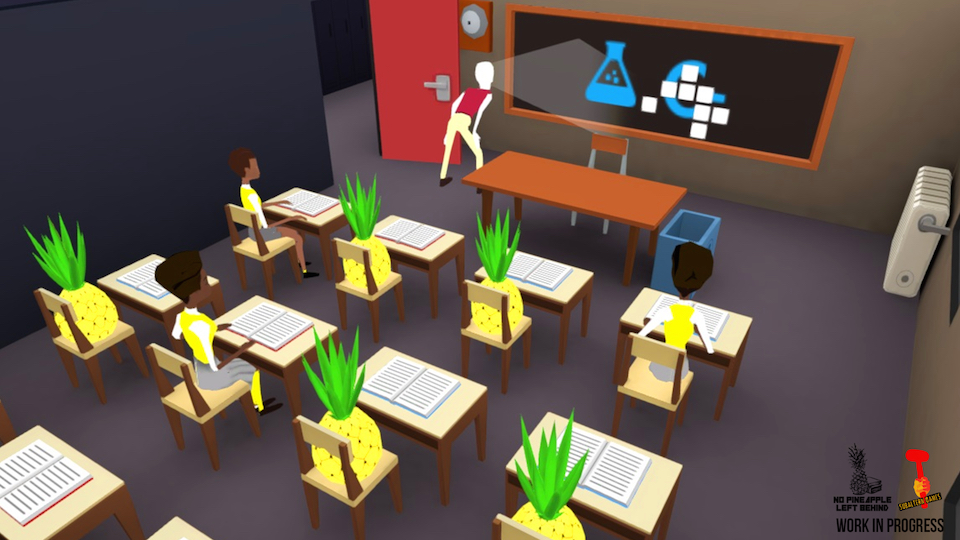
By dehumanizing kids and turning them into pineapples, higher test scores are easier because pineapples excel at testing and nothing else.
In Pineapple, you play the role of a principal in charge of a school and your ultimate goal is to earn as much funding as possible. To do that, you need to ensure it produces the highest standardized test scores throughout a dozen different scenarios. By dehumanizing kids and turning them into pineapples (read: statistics) that makes it easier because "pineapples," as they exist here, excel at testing and nothing else. Children are a bit more complicated: They each have their own individual learning styles and interests.
"There's just no management sims I'm aware of that consider the human implications of treating the workers as moneymaking tools," he says.
Alter says that the biggest message he wants to send is that what he's showing isn't exaggerated or that it isn't how the education system might be in a few years -- it's how it is right now. Each of the game's scenarios draw from situations he's witnessed either firsthand or through stories he's heard from friends and colleagues. The busses are always late; classes are overcrowded -- those sorts of things.
Or consider this scenario that's going to ship with the open alpha this summer: A student named David is wearing makeup, but he can't be bullied for an entire week. Your options as the school administrator are as follows: Establish a comprehensive anti-bullying policy (which Alter describes as doable, but finicky and annoying) or turn him into a pineapple. "Pineapples don't wear makeup and they don't get bullied," Alter reasons.
A video showing off the teachers' spell-casting ability.
If this all sounds very serious, well, it really isn't; Alter's tongue is firmly planted in his cheek. Those aforementioned tardy busses? They travel via hyperspace gates and the local bus drivers union installed hyperspace inhibitor fields to ensure the kid-carriers would be late and so everyone in a class would fail.
Remember, these "statistics" are one of the most delicious fruits available, too. Alter's original plan was to have a much more realistic and allegorical school, but to have one 'No Pineapple Left Behind' and the politics of American education: