Latest News and Comment from Education

Thursday, March 5, 2015

The Status Fallacy: New York State Edition | Shanker Institute

The Status Fallacy: New York State Edition | Shanker Institute:


The Status Fallacy: New York State Edition


A recent New York Times story addresses directly New York Governor Andrew Cuomo’s suggestion, in his annual “State of the State” speech, that New York schools are in a state of crisis and "need dramatic reform." The article’s general conclusion is that the “data suggest otherwise.”
There are a bunch of important points raised in the article, but most of the piece is really just discussing student rather than school performance. Simple statistics about how highly students score on tests – i.e., “status measures” – tell you virtually nothing about the effectiveness of the schools those students attend, since, among other reasons, they don’t account for the fact that many students enter the system at low levels. How much students in a school know in a given year is very different from how much they learned over the course of that year.
I (and many others) have written about this “status fallacy” dozens of times (see our resources page), not because I enjoy repeating myself (I don’t), but rather because I am continually amazed just how insidious it is, and how much of an impact it has on education policy and debate in the U.S. And it feels like every time I see signs that things might be changing for the better, there is an incident, such as Governor Cuomo’s speech, that makes me question how much progress there really has been at the highest levels.
Before discussing the speech, however, I would like quickly to note that virtually none of what I am about to say actually pertains to whether or not Governor Cuomo’s general policy proposals are correct. This is not about the policies. It is about the interpretations of data used to craft and justify those policies.
Let’s start with the governor’s widely-reported reaction to the state’s teacher evaluation results. His “State of the State” speech included the following passage:
Now 38% of high schools students are college ready. 38%. 98.7% of high school teachers are rated effective. How can that be? How can 38% of the students be ready, but 98% of the teachers effective? 31% of third to eight graders are proficient in English, but 99% of the teachers are rated effective. 35% of third to eighth graders are proficient in math but 98% of the math teachers are rated effective. Who are we kidding, my friends? The problem is clear and the solution is clear. We need real, accurate, fair teacher evaluations.
Though not uncommon among advocates and policymakers, this comparison is, at best, highly misleading. In some respects, frankly, it is a little absurd.
For one thing, note that these student performance rates are based on the state’s new tests and higher standards, and that the proficiency rates were 75-85 percent just a few years ago (a point Aaron Pallas made, correctly, in the New York Times article mentioned above). Under the previous standards, theThe Status Fallacy: New York State Edition | Shanker Institute: 

Stack Ranking and Merit Pay: Poor Models for Teacher Evaluation - Living in Dialogue

Stack Ranking and Merit Pay: Poor Models for Teacher Evaluation - Living in Dialogue:


Stack Ranking and Merit Pay: Poor Models for Teacher Evaluation 


 By Vincent Marsala.

Many people think that applying business principles and making educators compete via stack ranking and merit pay will make education better. Even former National Education Association President Dennis Van Roekel said it might work, “The first thing you have to decide on is what you differentiate the pay on? Is it skills and knowledge? Is it responsibility?  And as soon as you decide that answer, you have to say: How will I measure it?”
But Margaret Raymond, the founding director of the Center for Research on Education Outcomes, known as CREDO, has a different opinion, “I’ve studied competitive markets for much of my career. That’s my academic focus for my work. And it’s [education] the only industry/sector where the market mechanism just doesn’t work.”
Raymond is correct. Merit pay and stack ranking teachers as Accomplished, Skilled, Developing, or Ineffective will fail, and Microsoft has already proven it. In Kurt Eichenwald’s August 2012 Vanity Fair article titled, “Microsoft’s Lost Decade,” he said each Microsoft unit had to rank its employees on a bell curve with top, good, average, below average, and poor performers. The rankings led to in-fighting for promotions, bonuses, and/or survival because as a former software developer said, “You walked in the first day knowing that, no matter how good everyone was, two people were going to get a great review, seven were going to get mediocre reviews, and one was going to get a terrible review.” As toxic as it was at Microsoft, stack ranking may be worse within schools.
First, teachers will be forced to compete against each other based on student test scores. Eventually, teachers may resent having a special needs/low performing child in class because a student’s inability to do well on tests will reflect poorly on a teacher. Adding the idea of merit pay based on test scores/evaluations, and teachers may resent these students even more. Next, when teachers work together, kids win, but teachers, just like the workers at Microsoft, are human, too. Teachers competing for the highest test score Stack Ranking and Merit Pay: Poor Models for Teacher Evaluation - Living in Dialogue:

Principal refuses to release child from the school to the mother until police demand. | Reclaim Reform

Principal refuses to release child from the school to the mother until police demand. | Reclaim Reform:


Principal refuses to release child from the school to the mother until police demand.

No parent should have to call the police on the principal who will not release her opt-out child from the building to the mother. No parent should suffer that. No child should endure that.
All parents and children of any race or races have hard earned rights as Americans. No school principal or board of education or superintendent or state education commissioner can deny those rights just because a child has entered a school building.
Susan Mulchrone
Susan Mulchrone, principal of the Brookshire Elementary School in affluent Winter Park, FL, should be slapped with Civil Rights Complaints. She blatantly broke the law.
Emailing parents about “not allowing” parents to take their children out of the building does not release her from the law.
Why wasn’t the principal arrested? Why wasn’t she fired?
Reported by the Orlando Sentinel:
A parent of a fifth grader at Brookshire Elementary School in Winter Park was initially told she could not pick up her daughter, who was opting out of the state’s new writing test, according to another parent who witnessed the incident this morning. That other parent said she called police…
Jacqui Myers of Winter Park — a Brookshire parent active in the local opt-out movement — said the fifth grader’s mother came outside and told her, “They’re not giving me my child, can you help?” —
Myers said the school’s principal, in earlier emails to parents, had said that releasing students during testing would be disruptive and not be allowed.
But the district has no policy that would allow school officials to detain a child under such circumstances, she said.
HOW TO FILE A VALID CIVIL RIGHTS COMPLAINT
Easy step by step directions from United Opt Out National

A Party Divided: Why Education Is A Wedge Issue For Democrats » Harvard Political Review

A Party Divided: Why Education Is A Wedge Issue For Democrats » Harvard Political Review:

A Party Divided: Why Education Is A Wedge Issue For Democrats

By 


California’s two candidates for state superintendent this past November didn’t agree on much when it came to education. Tom Torlakson, a former teacher, wanted to make school funding more equitable and support teachers. Marshall Tuck, a former charter school executive, wanted to increase the number of charter schools and tie teacher evaluations to test scores. Torlakson’s campaign was primarily bankrolled by teachers unions. Tuck’s was funded by out-of-state benefactors like Michael Bloomberg and Alice Walton, the daughter of Wal-Mart founder Sam Walton. These outside parties spent a combined $25 million—three times the amount spent on California’s gubernatorial race—filling the airwaves with attack ads. The race had all the hallmarks of the divisive, partisan competitions that were so common in the 2014 midterms. Except for one thing: Torlakson and Tuck are both Democrats.
The California state superintendent election exemplified a nascent divide among Democrats over education that is poised to play a significant role in the Democratic outlook in 2016 and beyond. Although much has been made of the heated debate between left-wing populists and moderate centrists in the party over economic policy, this educational divide, which pits the Obama administration against grassroots Democratic advocates and self-proclaimed education “reformers” against teachers unions, has been largely overlooked. With Congress set to rewriteNo Child Left Behind, President George W. Bush’s signature education initiative, the increasingly urgent debate over how to address the racial and socioeconomic achievement gaps in schools is becoming a wedge issue for Democrats.
President Obama’s appointment of Secretary of Education Arne Duncan proved divisive within the Democratic Party.
Origins of the Divide

The divisions in the Democratic Party over education policy can be traced back to the late 1980s, when Polly Williams, a black Democrat representing urban Milwaukee in the Wisconsin State Assembly, sponsored legislation creating a school voucher program that allowed low-income Milwaukee students to use state funding to attend private schools. Williams’s embrace of what was originally a conservative idea prompted many other Democrats, concerned with the state of urban public schools, to follow suit.
This was significant, according to Tom Loveless, a senior fellow at the Brookings Institution, because it created a rift between two key Democratic constituencies: urban blacks, who wanted better public schools, and teachers unions, who opposed charter schools and school vouchers. “African-Americans, of course, are a very important constituency in the Democratic Party, and yet so are teachers unions,” Loveless told the HPR. “In that particular case, those two important constituencies were diametrically opposed.”
The true emergence of education as a wedge issue for Democrats came in the 2000s, with the entrance of Wall Street and Silicon Valley billionaires into the education policy debate. Many of them saw education as a business in need of innovation and competition, and they began giving large sums of money to organizations and Democratic candidates that supported charter schools. Some of these donors, like Bill Gates and Eli Broad, had historically given to Democrats, but many were much more conservative, according to Robin Hiller, the executive director of The Network for Public Education, an education advocacy organization.
Hiller explained to the HPR that some of the policies the reform candidates support, like closing schools in low-income areas, may even seem to go against to Democratic principles. “The only thing that makes sense is that there are people giving to candidates in the Democratic Party … that support privatization, that support union-busting, and the attacks on teachers. And so, if you’re getting all your money from those people, you have to go along with what they say.” Loveless disagreed, arguing that the Democratic reformers aren’t beholden to whims of their donors, but are “acting out of moral outrage, and out of what are traditional impulses in the Democratic party, so they don’t see themselves as privatizers.” However, even if these candidates are acting on principle, they still depend on wealthy donors who expect them to pursue specific policies in return for their support.
Loveless said the emergence of these hedge fund billionaires from both sides of the aisle in educational policy prompted a backlash from teachers, who felt “blamed for the failures of urban education.” Left-wing education activists were outraged that wealthy donors who were newcomers to education policy were pushing ideas that were anathema to their policy priorities. Harvard Graduate School of Education professor Susan Johnson told the HPR, “The union reformers, who actually have been at work doing a lot of educational change in some places in very far-reaching ways for the last 15 or 20 years, were very angry that people who had really very little experience in education and few credentials and little training were starting to say, ‘Here are the answers for education.’”
President Versus Party
The Obama administration has used federal funding as an incentive for states to adopt policies, such as encouraging the growth of charter schools and tying teacher evaluations to test scores, that are championed by the new reformers but opposed by public education activists. In urban centers like Chicago, Philadelphia, and Newark, strong grassroots movements, consisting primarily of Democratic constituencies, have emerged to oppose these policies, according to Jeff Bryant, a fellow at the Campaign for America’s Future, a liberal advocacy group. “These A Party Divided: Why Education Is A Wedge Issue For Democrats » Harvard Political Review:

We Have to Stop Ignoring Adverse Childhood Experiences | John Thompson


We Have to Stop Ignoring Adverse Childhood Experiences | John Thompson:


We Have to Stop Ignoring Adverse Childhood Experiences


NPR's Laura Starecheski, in "Can Family Secrets Make You Sick?," describes the medical science which explains how adverse childhood experiences lead to chronic adult illnesses, including heart disease and cancer. Her excellent report was the first of two accounts of adverse childhood experiences (ACE) and the way that the medical profession has failed to grapple with the long term effects of sexual, physical and emotional abuse; child neglect; the loss of a parent due to death, divorce or incarceration; mental illness in a parent; and drug or alcohol abuse by a parent.
Dr. Vincent Felliti argues that inventorying traumatic childhood experiences is one of "the biggest opportunities to prevent disease -- and save billions in health care costs." Sadly, "It's an opportunity ... that American medicine and the health care industry still seem to be missing."
On the other hand, the NPR series gives us hope. Fifteen years after Felitti and Dr. Rob Anda showed why childhood trauma contributes to "pretty much every one of the major public health problems," some scientists "are trying to connect the dots -- to get a clearer picture of what exactly adverse childhood experiences do to the body."
MacArthur Fellow Jeff Brenner, whose work is on treating the most complicated, expensive patients in Camden, N.J., predicts "I can't imagine, 10 or 15 years from now, a health care system that doesn't routinely use the ACE scores."
Virtually every dynamic in the medical profession's delayed adoption of ACE research has a parallel theme in the education sector. As Paul Tough explains, the contemporary reform movement was born of "liberal ptsd" from (supposedly) losing the War on Poverty. Believing that the challenge of overcoming poverty by traditional methods was too great, non-educators imposed a test-driven accountability shortcut. They thus ignored the fundamental challenge in urban education - teaching a class of thirty or so students when 8 to 10 of them have been traumatized to the point where their cognitive processes have been altered.
Even as the study of children's response to trauma pointed to the need to focus on the socio-emotional needs of students, the test-driven school reform movement drew a line in the sand; the mention of adverse childhood experiences was dismissed as an "Excuse." Top-down school reformers imposed an educational version of faith healing on schools, insisting that "High Expectations" by teachers within the four walls of the classroom would trump the ACE dynamics.
After fifteen years of imposing the stress of high-stakes testing to overcome the stress of extreme poverty and trauma, school "reform" has demonstrably failed. Some hold true to the corporate reform mantra that we just need a better test to test to, and to fire teachers who find merit in ACE research. Even the true believers in the Gates Foundation and Arne Duncan's administration, however, seem to be realizing that they cannot test, sort, and punish their way to better schools. They seem to merely assume that their bubble-in campaign was necessary because voters would not embrace a more humane and rational approach to school improvement until they saw liberals taking a prerequisite pound of flesh from teachers, unions, and students.
Reformers still don't seem to understand, however, why their market-driven approach inflicted so much pain on the poor children of color that they sincerely wanted to help. As ACE research shows, children from all races, economic classes, and backgrounds We Have to Stop Ignoring Adverse Childhood Experiences | John Thompson:

Russ on Reading: PARCC Math Test Readability

Russ on Reading: PARCC Math Test Readability:

PARCC Math Test Readability

Two weeks ago I ventured into the world of PARCC testing with several posts on the readability of the reading comprehension passages of the new Common Core aligned PARCC tests, which are being administered right now in many states. You can find those postsherehere and hereSome readers expressed concern about the readability of the PARCC math exams and asked me to take a look at it.

Background: Readability on a math exam matters. While we might assume that a math exam assesses a students ability to perform various mathematical computations, all of the math questions on the PARCC required some literacy skills as well. A study by Abedi and Lord published in Applied Measurement in Education found that linguistic complexity of math word problems can have a significant impact on the test scores of inexperienced problem solvers, English Language Learners and students with disabilities. The question that must be asked is simply, "Does the PARCC measure computation skills or a combination of literacy skills and computation skills?" And we might further ask, "Will students with on grade level reading skills be disadvantaged by the reading required on the math exam?"

Method: I will not rehash all my reservations about readability measures here. You can look at the posts on the reading comprehension part of the PARCC if you would like a fuller explanation. Suffice it to say here that readability measures can only give us an approximation of the difficulty of any one text on any one reader, so all results need to be taken with a grain of salt.

For the purposes of this post, I looked at the PARCC Mathematics Practice Texts. In order to get a sample of 300 hundred words to do a readability 
Russ on Reading: PARCC Math Test Readability:

FUNDING GAPS WIDEN BETWEEN WEALTHY AND POOR NJ SCHOOL DISTRICTS

Education Law Center | FUNDING GAPS WIDEN BETWEEN WEALTHY AND POOR NJ SCHOOL DISTRICTS:


FUNDING GAPS WIDEN BETWEEN WEALTHY AND POOR NJ SCHOOL DISTRICTS

February 23, 2015
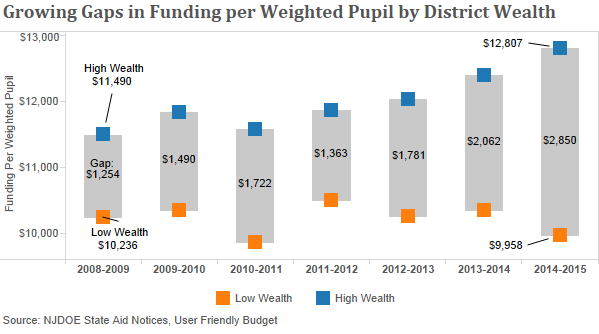
This school year, New Jersey’s highest wealth school districts had access to $2,850 per pupil more than poor districts, when adjusted for student need. Over the six school years from 2008-09 to 2004-15, need adjusted funding increased in the Garden State’s high wealth districts by 11%, while funding in low wealth districts declined by 3%.
Each year, Education Law Center analyzes district funding under New Jersey’s School Funding Reform Act (SFRA), the state’s weighted student formula enacted in 2008, and approved by the NJ Supreme Court in 2009. ELC’s analysis shows that the funding gaps between low and high wealth districts have nearly doubled since 2009-10, as a result of Governor Chris Christie’s refusal to provide the aid increases required by the formula.
As the following graph shows, funding in high wealth districts grew from $11,490 per pupil in 2008-09 to $12,807 per pupil in 2014-15. In sharp contrast, funding in low wealth districts dropped from $10,236 per pupil in 2008-09 to $9,958 per pupil this school year.  
By design, the SFRA formula provides a base level of funding for all students, with additional funding for at-risk (low-income) students, English language learners (ELL), and students with disabilities. An accurate analysis of funding among districts must acknowledge that additional resources are needed to give at-risk, ELL and special education students the opportunity to achieve New Jersey’s core curriculum standards, which now incorporate the Common Core standards in language arts and mathematics.
Under the SFRA, funding is determined by assigning a system of “weights” that represent the additional costs required to augment the base cost allocated for a student with no additional needs. In 2014-15, the base cost is $11,195 per pupil. At-risk students in high poverty districts are funded at 57% above the base cost, or an additional $6,381 per pupil. The funding weights for at-risk students vary according to the district’s overall level of poverty, ranging from 46% to 57%. ELL students are funded at 50% above the base cost, and students who are both at-risk and ELL are funded at the at-risk level plus 12.5% to address the overlap in resources for students who are both at-risk and learning English.
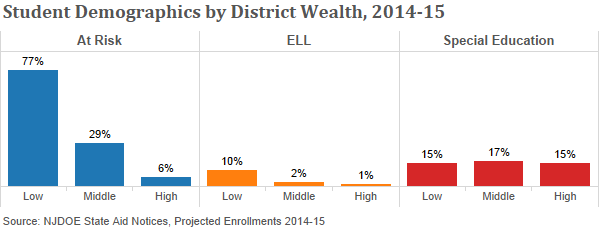
The stark differences in New Jersey’s student populations by district wealth are presented below. In low wealth districts, 77% of students are at-risk, compared to only 6% in high wealth districts. Ten percent of students in low wealth districts are learning English compared to only 1% in wealthy districts. There are only slight differences in special education classification.
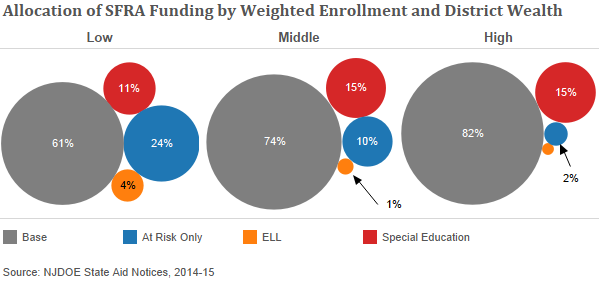
The graph below, based on the SFRA’s weighted student funding, shows that in low wealth districts about 61% of total state and local funding is allocated based on the regular educational needs of all students, 24% is for programs and services for at-risk students, and 4% for ELL students (both at-risk and not). In comparison, 82% of funding for high wealth districts is allocated for general educational purposes, only 2% for programs and services for at-risk students, and 1% for ELLs. Taking these funding comparisons into consideration, this analysis shows that high wealth districts have substantially more funding for the general education program than low wealth districts, and the funding gap is growing.
“It is clear that successive years of flat state aid, limited local taxing ability, and a growing at-risk population is taking its toll on students in our poorest districts,” said Danielle Farrie, ELC Research Director. “These districts have to do more with less, while meeting new mandates such as the Common Core standards and assessments. In contrast, wealthy districts have been raising more in local property tax revenue to boost overall funding.”  [Click here for a more detailed analysis and individual district data.]
“This data shows that the Governor and Legislature are simply failing to provide our students with the funds needed for success in school,” said David Sciarra, ELC Executive Director. “The SFRA was carefully designed to provide the essential resources all students need to achieve New Jersey’s academic standards, including the Common Core. It’s time to get serious about delivering on that promise.”
Related Stories:

Christie and Cami have stolen more than money from Newark | Bob Braun's Ledger

Christie and Cami have stolen more than money from Newark | Bob Braun's Ledger:


Christie and Cami have stolen more than money from Newark

Damage control for Christie and Anderson
 The reappointment of a failing Cami Anderson to a fifth year as Gov. Chris Christie’s superintendent of Newark’s public schools caused anger, of course. Sadness and disappointment, too. But these are not new. What is now taking over the emotions of the city’s residents and leaders is a pervasive and disorienting sense of bafflement. What Christie and his subordinates and allies have imposed on Newark seems like a logical impossibility, a contradiction: A numbing sense of surprise. It’s as if the city’s residents were forced non-stop to watch an absurd play where impossible nonsense regularly happens but is treated as normal. In the rabbit-hole that is Cami Anderson’s and Chris Christie’s Newark, failure is success, illegal is legal, wrong is right. And the more failure and illegality and wrongheadedness the city’s people witness, the less they can do about it–and the more Anderson is praised and rewarded. It is madness as public policy.
    Imagine, if you will, any other community in the state–or in the nation–where a public school superintendent can boycott her elected school board’s meetings for more than a year and yet suffer no professional consequences.  And is praised and rewarded.
    Imagine, too, a superintendent who, after four years of controversial stewardship aimed at improving measurable performance among students, must admit scores are lower—and yet she suffers no embarrassment. And is praised and rewarded.
   Imagine a public school superintendent who, no fewer than three times over the course of a year, defies the demand of the state legislature’s committee that, by law, is charged with monitoring her performance. And, again, no consequences. Except, she is praised and rewarded.
   Imagine a public official who secretly sells public property to a profit-making Christie and Cami have stolen more than money from Newark | Bob Braun's Ledger:

Teachers Deserve Better | Eric Sheninger

Teachers Deserve Better | Eric Sheninger:


Teachers Deserve Better


 In case you haven't noticed the education profession has been under attack as of late. The brunt of these attacks has been aimed at the very professionals who are tasked with positively impacting the lives of children each and every day - our teachers. In my mind education is the noblest of professions. Without education at some level virtually all other professions would be non-existent. This places our teachers at the forefront of molding young minds into the next generation of doers, thinkers, creators, leaders, and entrepreneurs. If there is ever a profession that should be revered as much as that of a doctor who saves lives it is that of a teacher.


Unfortunately there is a growing rhetoric and sentiment that the education system in America is broken and our teachers are to blame for this. New accountability systems have been championed and adopted across the country that reduces teacher effectiveness to a mere number. The algorithm adopted by many states, which quite frankly makes little sense, crunches data sets in an attempt to measure the quality of a teacher against his or her peers. Each state has different factors that go into their value-added measurement (VAM) of a teacher, but the dominant component is standardized test scores. Teachers are the true catalysts of change that can create schools that work for kids. Even though countless studies have debunked this means to truly assess teacher effectiveness states have moved full steam ahead ignoring the research.
With such a focus on standardization in schools many teachers feel compelled to prepare students for a litany of exams, as the data extrapolated from them will be used for high-stakes evaluation. Administrators are also intimately tied to these results as well so as a kneejerk reaction an environment that resembles a test-taking factory is created. The sole focus becomes one that emphasizes performing well on a test as opposed to learning. What results is the proliferation of an industrialized model of education that reformers claim they want to get away from, but the policies they support only help to sustain it. This gloomy depiction of what is happening to schools across the country by people that have no business enacting education policy is forcing teachers to leave the profession at alarming rates.
The structure and function of the majority of schools in this country is the exact opposite of the world that our learners are growing up in. There is an automatic disconnect when students, regardless of their grade level, walk into schools due to the lack of engagement, relevancy, meaning, and authentic learning opportunities. Our education system has become so efficient in sustaining a century old model because it is easy and safe. The resulting conformity has resulted in a learning epidemic among our students as they see so little value in the cookie-cutter learning exercises they are forced to go through each day. The bottom line is that they are bored. It is time that we create schools that work for our students as opposed to ones that have traditionally worked well for the adults.
Creating schools that work for students requires a bold vision for change that not only tackles the status quo inherent in the industrialized model of education, but also current education reform efforts. Even though Common Core is not a curriculum, many schools and districts have become so engrossed with alignment and preparing for the new aligned tests that real learning has fallen by the wayside. We need to realize that this, along with other traditional elements associated with education, no longer prevail. How we go about doing this will vary from school to school, but the process begins with the simple notion of putting students first to allow them to follow their passions, create, tinker, invent, play, and collaborate. Schools that work for students focus less on control and more on trust.
There is a common fallacy that school administrators are the leaders of change. This makes a great sound bite, but the reality is that many individuals in a leadership position are not actually working directly with students. Teachers are the true catalysts of change that can create schools that work for kids. They are the ones, after all, who are tasked with implementing the myriad of directives and mandates that come their way. Leadership is about action, not position. Schools need more teacher Teachers Deserve Better | Eric Sheninger:

Testing ‘disaster’ in Florida prompts call for statewide suspension - The Washington Post

Testing ‘disaster’ in Florida prompts call for statewide suspension - The Washington Post:


Testing ‘disaster’ in Florida prompts call for statewide suspension


 How much of a mess is unfolding this week in Florida as public school students take a new computer-administered standardized test called the Florida Standards Assessment? So far, numerous school districts have been forced to delay testing because of major technological problems, two state senators have called for Gov. Rick Scott to suspend testing across the state, and the superintendent of the largest school district in the state and one of the largest in the country, Alberto  Carvalho of Miami-Dade County Public Schools, is slamming the test on his Facebook page.

Spring standardized testing started on Monday in Florida and computer problems were immediate in numerous districts — including Miami-Dade, Broward, Lee and Volusia — forcing a suspension of the testing. Florida students were going to take a Common Core test known as the PARCC, but the state withdrew from the Core, created its own standards (which are quite similar to the Core) and purchased another standardized test that is to be used for holding schools, students and teachers “accountable” for student achievement. Things in many places were no better Tuesday.
This is where @MDCPS stands concerning FSA assessments. We continue to put our students, parents and teachers first. This message was shared with principals this afternoon.
Although M-DCPS did not administer the computer-based FSA ELA/Writing assessments today in grades 8 – 10, other districts in the state did test and experienced difficulties once again.
In light of the fact that the FLDOE has not yet provided districts with assurances on the stability of the testing environment for the computer-based FSA ELA/Writing assessment, M-DCPS will suspend computer-based testing in grades 8 , 9, and 10 again for tomorrow, Wednesday, March 4, 2015.
You will be notified whether testing may commence on Thursday, March 5th.
On Monday he wrote:
With many questions unanswered and with many doubts looming, state writing assessment begins today. Of particular concern, beyond the reliability and validity issues, is the fact that many students with limited exposure to technology will be assessed on a computer for the first time. Was there consideration given to the real possibility that technical skill will influence content mastery results? Nothing short of a reasonable accountability transition, which must include treating this year as a baseline development year, makes sense. Getting it right must trump getting it done.
The Jackson County Floridan wrote that Pam Stewart, the state education commissioner had said that out of 69,177 tests that were started on Monday, 67,745 were completed, but two state senators took issue with the numbers, noting that tens of thousands of students were not even able to log onto their computers.  Here’s their letter calling the testing “a disaster” Testing ‘disaster’ in Florida prompts call for statewide suspension - The Washington Post:

How Michelle Obama could help make school a reality for millions of girls - Yahoo News

How Michelle Obama could help make school a reality for millions of girls - Yahoo News:


How Michelle Obama could help make school a reality for millions of girls

The first lady is spearheading a new initiative that, in partnership with the Peace Corps, aims to educate adolescent girls around the world.


Tens of millions of girls worldwide are not in school, and first lady Michelle Obama wants to help fix that.
On Tuesday, Mrs. Obama announced a new partnership with the Peace Corps in line with Let Girls Learn, a government-wide initiative to help girls, especially in developing nations, begin and complete their education.
“Peace Corps will be supporting hundreds of new community projects to help girls go to school and stay in school – everything from after-school mentoring to girls’ leadership camps, to entrepreneurial projects… and many more,”  the first lady said at the program’s launch.
The numbers tend to vary depending on which organization is counting, but according to the latest UNICEF data, about 58 million primary-school-age children are out of school today, and 31 million of those are girls. That’s not counting the additional 63 million adolescents aged 12 to 15 who are also not in school, the organization found.
All in all, the Peace Corps estimates that about 62 million girls globally are missing out on an education.
In hotspot countries, the disparity can be much more stark. In Central African Republic, Afghanistan, and Niger, for instance, less than 70 girls for every 100 boys are enrolled in school, according to a Brookings Institute report. In Chad and Somalia, the figure drops to less than 50 for every 100 boys.
This is despite the United Nations' insistence that education has plenty of positive effects on health, nourishment, and livelihood. Maternal mortality drops among educated mothers, who are also more likely to send their own children to school. Incomes go up, unemployment goes down. The gender gap closes.
Yet a variety of reasons exist that keep girls from school.
Poverty is a big one, with millions of parents unable to make enough to put food on the table, much less pay for school fees, supplies, or uniforms. Children in these places – which are often rural, and disproportionately in sub-Saharan Africa and South Asia – often have to spend hours laboring in farms or drawing water from distant wells, leaving no time for formal education.
Families who do have a bit to spare may choose to pay for a son’s education instead of a daughter’s, perpetuating stereotypes about roles for women. Girls in such environments also tend to get married off as soon as a match is found, effectively ending any chance for further study.
“Households typically make decisions about girls’ schooling and marriage jointly, not sequentially, and education tends to lose out,” according to a UNICEF report on child brides.
Violence is another obstacle: Attacks appear to be rising around the world against girls who are in school or seeking access to education, according to a UN Human Rights Council report released earlier this month. The report found strikes against schools in at least 70 countries from 2009 to 2014, with many of the attacks “specifically directed at girls, parents, and teachers advocating for gender equality in education.”
Such a variety of issues in a range of cultures will require at least as many solutions, Obama said during her address. She added that activists in the audience had often advised her against an all-in-one approach.
“Time and again, you have told me that whatever these obstacles these girls face – whether it’s school fees, or violence, or cultural beliefs that girls simply aren’t worthy of an education – you’ve said that these problems will not be fixed from on high, that these are community challenges that call for community solutions,” the first lady said.
With the new partnership, Obama hopes to tap into the nearly 7,000 Peace Corps volunteers already positioned within communities in 60 countries. The Peace Corps will recruit and train new volunteers focused on advancing young girls’ empowerment and education. The volunteers will encourage dialogue that helps locals both figure out what barriers exist that keep girls from school and come up with solutions.
The effort will start in 11 countries, with the goal of eventually going global.
“I see myself in these girls. I see our daughters in these girls,” Obama said. “And like all of you, I just can’t walk away from them. Like you, I can’t just sit back and accept the barriers that keep them from realizing their promise.”
The partnership kicks off with the first lady’s trip to Japan and Cambodia later this month.
Related stories
How Michelle Obama could help make school a reality for millions of girls - Yahoo News: