Latest News and Comment from Education

Thursday, March 5, 2015

FUNDING GAPS WIDEN BETWEEN WEALTHY AND POOR NJ SCHOOL DISTRICTS

Education Law Center | FUNDING GAPS WIDEN BETWEEN WEALTHY AND POOR NJ SCHOOL DISTRICTS:


FUNDING GAPS WIDEN BETWEEN WEALTHY AND POOR NJ SCHOOL DISTRICTS

February 23, 2015
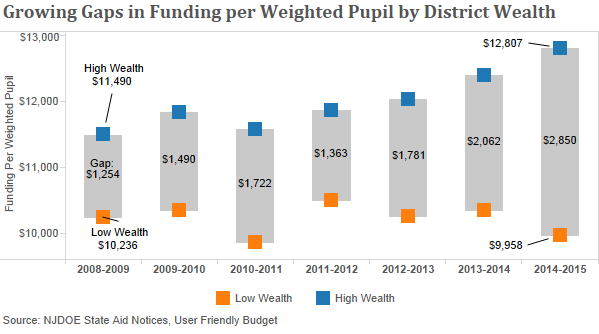
This school year, New Jersey’s highest wealth school districts had access to $2,850 per pupil more than poor districts, when adjusted for student need. Over the six school years from 2008-09 to 2004-15, need adjusted funding increased in the Garden State’s high wealth districts by 11%, while funding in low wealth districts declined by 3%.
Each year, Education Law Center analyzes district funding under New Jersey’s School Funding Reform Act (SFRA), the state’s weighted student formula enacted in 2008, and approved by the NJ Supreme Court in 2009. ELC’s analysis shows that the funding gaps between low and high wealth districts have nearly doubled since 2009-10, as a result of Governor Chris Christie’s refusal to provide the aid increases required by the formula.
As the following graph shows, funding in high wealth districts grew from $11,490 per pupil in 2008-09 to $12,807 per pupil in 2014-15. In sharp contrast, funding in low wealth districts dropped from $10,236 per pupil in 2008-09 to $9,958 per pupil this school year.  
By design, the SFRA formula provides a base level of funding for all students, with additional funding for at-risk (low-income) students, English language learners (ELL), and students with disabilities. An accurate analysis of funding among districts must acknowledge that additional resources are needed to give at-risk, ELL and special education students the opportunity to achieve New Jersey’s core curriculum standards, which now incorporate the Common Core standards in language arts and mathematics.
Under the SFRA, funding is determined by assigning a system of “weights” that represent the additional costs required to augment the base cost allocated for a student with no additional needs. In 2014-15, the base cost is $11,195 per pupil. At-risk students in high poverty districts are funded at 57% above the base cost, or an additional $6,381 per pupil. The funding weights for at-risk students vary according to the district’s overall level of poverty, ranging from 46% to 57%. ELL students are funded at 50% above the base cost, and students who are both at-risk and ELL are funded at the at-risk level plus 12.5% to address the overlap in resources for students who are both at-risk and learning English.
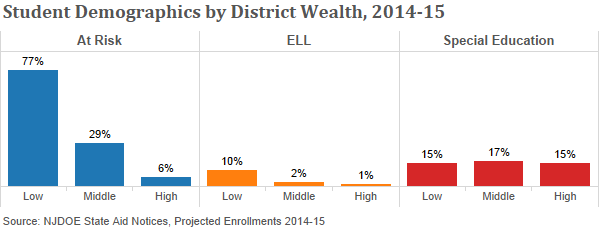
The stark differences in New Jersey’s student populations by district wealth are presented below. In low wealth districts, 77% of students are at-risk, compared to only 6% in high wealth districts. Ten percent of students in low wealth districts are learning English compared to only 1% in wealthy districts. There are only slight differences in special education classification.
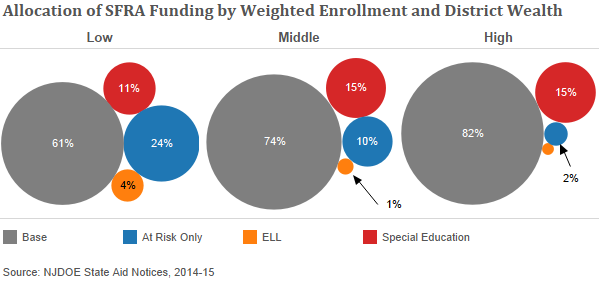
The graph below, based on the SFRA’s weighted student funding, shows that in low wealth districts about 61% of total state and local funding is allocated based on the regular educational needs of all students, 24% is for programs and services for at-risk students, and 4% for ELL students (both at-risk and not). In comparison, 82% of funding for high wealth districts is allocated for general educational purposes, only 2% for programs and services for at-risk students, and 1% for ELLs. Taking these funding comparisons into consideration, this analysis shows that high wealth districts have substantially more funding for the general education program than low wealth districts, and the funding gap is growing.
“It is clear that successive years of flat state aid, limited local taxing ability, and a growing at-risk population is taking its toll on students in our poorest districts,” said Danielle Farrie, ELC Research Director. “These districts have to do more with less, while meeting new mandates such as the Common Core standards and assessments. In contrast, wealthy districts have been raising more in local property tax revenue to boost overall funding.”  [Click here for a more detailed analysis and individual district data.]
“This data shows that the Governor and Legislature are simply failing to provide our students with the funds needed for success in school,” said David Sciarra, ELC Executive Director. “The SFRA was carefully designed to provide the essential resources all students need to achieve New Jersey’s academic standards, including the Common Core. It’s time to get serious about delivering on that promise.”
Related Stories:

Christie and Cami have stolen more than money from Newark | Bob Braun's Ledger

Christie and Cami have stolen more than money from Newark | Bob Braun's Ledger:


Christie and Cami have stolen more than money from Newark

Damage control for Christie and Anderson
 The reappointment of a failing Cami Anderson to a fifth year as Gov. Chris Christie’s superintendent of Newark’s public schools caused anger, of course. Sadness and disappointment, too. But these are not new. What is now taking over the emotions of the city’s residents and leaders is a pervasive and disorienting sense of bafflement. What Christie and his subordinates and allies have imposed on Newark seems like a logical impossibility, a contradiction: A numbing sense of surprise. It’s as if the city’s residents were forced non-stop to watch an absurd play where impossible nonsense regularly happens but is treated as normal. In the rabbit-hole that is Cami Anderson’s and Chris Christie’s Newark, failure is success, illegal is legal, wrong is right. And the more failure and illegality and wrongheadedness the city’s people witness, the less they can do about it–and the more Anderson is praised and rewarded. It is madness as public policy.
    Imagine, if you will, any other community in the state–or in the nation–where a public school superintendent can boycott her elected school board’s meetings for more than a year and yet suffer no professional consequences.  And is praised and rewarded.
    Imagine, too, a superintendent who, after four years of controversial stewardship aimed at improving measurable performance among students, must admit scores are lower—and yet she suffers no embarrassment. And is praised and rewarded.
   Imagine a public school superintendent who, no fewer than three times over the course of a year, defies the demand of the state legislature’s committee that, by law, is charged with monitoring her performance. And, again, no consequences. Except, she is praised and rewarded.
   Imagine a public official who secretly sells public property to a profit-making Christie and Cami have stolen more than money from Newark | Bob Braun's Ledger:

Teachers Deserve Better | Eric Sheninger

Teachers Deserve Better | Eric Sheninger:


Teachers Deserve Better


 In case you haven't noticed the education profession has been under attack as of late. The brunt of these attacks has been aimed at the very professionals who are tasked with positively impacting the lives of children each and every day - our teachers. In my mind education is the noblest of professions. Without education at some level virtually all other professions would be non-existent. This places our teachers at the forefront of molding young minds into the next generation of doers, thinkers, creators, leaders, and entrepreneurs. If there is ever a profession that should be revered as much as that of a doctor who saves lives it is that of a teacher.


Unfortunately there is a growing rhetoric and sentiment that the education system in America is broken and our teachers are to blame for this. New accountability systems have been championed and adopted across the country that reduces teacher effectiveness to a mere number. The algorithm adopted by many states, which quite frankly makes little sense, crunches data sets in an attempt to measure the quality of a teacher against his or her peers. Each state has different factors that go into their value-added measurement (VAM) of a teacher, but the dominant component is standardized test scores. Teachers are the true catalysts of change that can create schools that work for kids. Even though countless studies have debunked this means to truly assess teacher effectiveness states have moved full steam ahead ignoring the research.
With such a focus on standardization in schools many teachers feel compelled to prepare students for a litany of exams, as the data extrapolated from them will be used for high-stakes evaluation. Administrators are also intimately tied to these results as well so as a kneejerk reaction an environment that resembles a test-taking factory is created. The sole focus becomes one that emphasizes performing well on a test as opposed to learning. What results is the proliferation of an industrialized model of education that reformers claim they want to get away from, but the policies they support only help to sustain it. This gloomy depiction of what is happening to schools across the country by people that have no business enacting education policy is forcing teachers to leave the profession at alarming rates.
The structure and function of the majority of schools in this country is the exact opposite of the world that our learners are growing up in. There is an automatic disconnect when students, regardless of their grade level, walk into schools due to the lack of engagement, relevancy, meaning, and authentic learning opportunities. Our education system has become so efficient in sustaining a century old model because it is easy and safe. The resulting conformity has resulted in a learning epidemic among our students as they see so little value in the cookie-cutter learning exercises they are forced to go through each day. The bottom line is that they are bored. It is time that we create schools that work for our students as opposed to ones that have traditionally worked well for the adults.
Creating schools that work for students requires a bold vision for change that not only tackles the status quo inherent in the industrialized model of education, but also current education reform efforts. Even though Common Core is not a curriculum, many schools and districts have become so engrossed with alignment and preparing for the new aligned tests that real learning has fallen by the wayside. We need to realize that this, along with other traditional elements associated with education, no longer prevail. How we go about doing this will vary from school to school, but the process begins with the simple notion of putting students first to allow them to follow their passions, create, tinker, invent, play, and collaborate. Schools that work for students focus less on control and more on trust.
There is a common fallacy that school administrators are the leaders of change. This makes a great sound bite, but the reality is that many individuals in a leadership position are not actually working directly with students. Teachers are the true catalysts of change that can create schools that work for kids. They are the ones, after all, who are tasked with implementing the myriad of directives and mandates that come their way. Leadership is about action, not position. Schools need more teacher Teachers Deserve Better | Eric Sheninger:

Testing ‘disaster’ in Florida prompts call for statewide suspension - The Washington Post

Testing ‘disaster’ in Florida prompts call for statewide suspension - The Washington Post:


Testing ‘disaster’ in Florida prompts call for statewide suspension


 How much of a mess is unfolding this week in Florida as public school students take a new computer-administered standardized test called the Florida Standards Assessment? So far, numerous school districts have been forced to delay testing because of major technological problems, two state senators have called for Gov. Rick Scott to suspend testing across the state, and the superintendent of the largest school district in the state and one of the largest in the country, Alberto  Carvalho of Miami-Dade County Public Schools, is slamming the test on his Facebook page.

Spring standardized testing started on Monday in Florida and computer problems were immediate in numerous districts — including Miami-Dade, Broward, Lee and Volusia — forcing a suspension of the testing. Florida students were going to take a Common Core test known as the PARCC, but the state withdrew from the Core, created its own standards (which are quite similar to the Core) and purchased another standardized test that is to be used for holding schools, students and teachers “accountable” for student achievement. Things in many places were no better Tuesday.
This is where @MDCPS stands concerning FSA assessments. We continue to put our students, parents and teachers first. This message was shared with principals this afternoon.
Although M-DCPS did not administer the computer-based FSA ELA/Writing assessments today in grades 8 – 10, other districts in the state did test and experienced difficulties once again.
In light of the fact that the FLDOE has not yet provided districts with assurances on the stability of the testing environment for the computer-based FSA ELA/Writing assessment, M-DCPS will suspend computer-based testing in grades 8 , 9, and 10 again for tomorrow, Wednesday, March 4, 2015.
You will be notified whether testing may commence on Thursday, March 5th.
On Monday he wrote:
With many questions unanswered and with many doubts looming, state writing assessment begins today. Of particular concern, beyond the reliability and validity issues, is the fact that many students with limited exposure to technology will be assessed on a computer for the first time. Was there consideration given to the real possibility that technical skill will influence content mastery results? Nothing short of a reasonable accountability transition, which must include treating this year as a baseline development year, makes sense. Getting it right must trump getting it done.
The Jackson County Floridan wrote that Pam Stewart, the state education commissioner had said that out of 69,177 tests that were started on Monday, 67,745 were completed, but two state senators took issue with the numbers, noting that tens of thousands of students were not even able to log onto their computers.  Here’s their letter calling the testing “a disaster” Testing ‘disaster’ in Florida prompts call for statewide suspension - The Washington Post:

How Michelle Obama could help make school a reality for millions of girls - Yahoo News

How Michelle Obama could help make school a reality for millions of girls - Yahoo News:


How Michelle Obama could help make school a reality for millions of girls

The first lady is spearheading a new initiative that, in partnership with the Peace Corps, aims to educate adolescent girls around the world.


Tens of millions of girls worldwide are not in school, and first lady Michelle Obama wants to help fix that.
On Tuesday, Mrs. Obama announced a new partnership with the Peace Corps in line with Let Girls Learn, a government-wide initiative to help girls, especially in developing nations, begin and complete their education.
“Peace Corps will be supporting hundreds of new community projects to help girls go to school and stay in school – everything from after-school mentoring to girls’ leadership camps, to entrepreneurial projects… and many more,”  the first lady said at the program’s launch.
The numbers tend to vary depending on which organization is counting, but according to the latest UNICEF data, about 58 million primary-school-age children are out of school today, and 31 million of those are girls. That’s not counting the additional 63 million adolescents aged 12 to 15 who are also not in school, the organization found.
All in all, the Peace Corps estimates that about 62 million girls globally are missing out on an education.
In hotspot countries, the disparity can be much more stark. In Central African Republic, Afghanistan, and Niger, for instance, less than 70 girls for every 100 boys are enrolled in school, according to a Brookings Institute report. In Chad and Somalia, the figure drops to less than 50 for every 100 boys.
This is despite the United Nations' insistence that education has plenty of positive effects on health, nourishment, and livelihood. Maternal mortality drops among educated mothers, who are also more likely to send their own children to school. Incomes go up, unemployment goes down. The gender gap closes.
Yet a variety of reasons exist that keep girls from school.
Poverty is a big one, with millions of parents unable to make enough to put food on the table, much less pay for school fees, supplies, or uniforms. Children in these places – which are often rural, and disproportionately in sub-Saharan Africa and South Asia – often have to spend hours laboring in farms or drawing water from distant wells, leaving no time for formal education.
Families who do have a bit to spare may choose to pay for a son’s education instead of a daughter’s, perpetuating stereotypes about roles for women. Girls in such environments also tend to get married off as soon as a match is found, effectively ending any chance for further study.
“Households typically make decisions about girls’ schooling and marriage jointly, not sequentially, and education tends to lose out,” according to a UNICEF report on child brides.
Violence is another obstacle: Attacks appear to be rising around the world against girls who are in school or seeking access to education, according to a UN Human Rights Council report released earlier this month. The report found strikes against schools in at least 70 countries from 2009 to 2014, with many of the attacks “specifically directed at girls, parents, and teachers advocating for gender equality in education.”
Such a variety of issues in a range of cultures will require at least as many solutions, Obama said during her address. She added that activists in the audience had often advised her against an all-in-one approach.
“Time and again, you have told me that whatever these obstacles these girls face – whether it’s school fees, or violence, or cultural beliefs that girls simply aren’t worthy of an education – you’ve said that these problems will not be fixed from on high, that these are community challenges that call for community solutions,” the first lady said.
With the new partnership, Obama hopes to tap into the nearly 7,000 Peace Corps volunteers already positioned within communities in 60 countries. The Peace Corps will recruit and train new volunteers focused on advancing young girls’ empowerment and education. The volunteers will encourage dialogue that helps locals both figure out what barriers exist that keep girls from school and come up with solutions.
The effort will start in 11 countries, with the goal of eventually going global.
“I see myself in these girls. I see our daughters in these girls,” Obama said. “And like all of you, I just can’t walk away from them. Like you, I can’t just sit back and accept the barriers that keep them from realizing their promise.”
The partnership kicks off with the first lady’s trip to Japan and Cambodia later this month.
Related stories
How Michelle Obama could help make school a reality for millions of girls - Yahoo News:

Independent Reviews of Educational Materials EdReports.org

EdReports.org:


Independent Reviews of Educational Materials


FUNDERS

EdReports.org is funded by Broadcom Corporation, the Bill & Melinda Gates Foundation, the Helmsley Charitable Trust, the William and Flora Hewlett Foundation, the Samueli Foundation, the Charles and Helen Schwab Foundation, and the Stuart Foundation.


Independent Reviews of Educational Materials

EdReports.org is an independent nonprofit designed to improve K-12 education. Our free reviews focus on alignment to the Common Core and other indicators of high quality as recommended by educators.


THE LATEST SERIES REPORT
  • Agile Mind Middle School Mathematics
    Agile Mind
    Subject: Math
    Level: Middle
  • Holt McDougal Mathematics
    Houghton Mifflin Harcourt
    Subject: Math
    Level: Middle
  • Math Expressions
    Houghton Mifflin Harcourt
    Subject: Math
    Level: Elementary

Most Math Curricula Found to Be Out of Sync With Common Core - Education Week

Most Math Curricula Found to Be Out of Sync With Common Core - Education Week:


Most Math Curricula Found to Be Out of Sync With Common Core

Math Programs: How They Rate on Common-Core Alignment


The first round of a Consumer Reports-style review for instructional materials paints a dismal picture of the textbook-publishing industry’s response to new standards: Seventeen of 20 math series reviewed were judged as failing to live up to claims that they are aligned to the common core.
The reviews, released online Wednesday by the nonprofitEdReports.org, were conducted by small groups of teachers and instructional leaders from across the country. They looked at digital and print K-8 mathematics materials from widely used publishers—including Pearson, McGraw-Hill, and Houghton Mifflin Harcourt—as well as from some lesser-known providers whose texts passed state review processes. The results echo previous alignment studies conducted by university-based researchers.
“In general, the results are pretty bad for all the publishers,” said Morgan Polikoff, an assistant professor of education at the University of Southern California, in Los Angeles, who studies common-standards alignment but was not involved in the EdReports.org project. “I think people really will pay attention to this, and I think it will affect [curriculum] adoption processes going forward.”
In all, just one curriculum series stood out from the pack. Eureka Math, published by Great Minds, a small Washington-based nonprofit organization, was found to be aligned to the Common Core State Standards at all grade levels reviewed.
Infographic: See How Math Programs Rated
A McGraw-Hill series, My Math, was deemed aligned to the standards in two of the five grade levels evaluated. All other series reviewed were found to only “partially” or not at all meet the criteria for common-core alignment.
EdReports.org was spearheaded by Maria M. Klawe, the president of Harvey Mudd College, in Claremont, Calif., and was launched in August. Its nine-member boardincludes representatives from the National Board for Professional Teaching Standards, the National Council of La Raza, and the Education Trust.
Infographic
The project is funded primarily by $3 million in grants from the Seattle-based Bill & Melinda Gates Foundation—which also was a major financial backer of the development of the common core—the William and Flora Hewlett Foundation of Menlo Park, Calif., and the Leona M. and Harry B. Helmsley Charitable Trust in New York City. (The Gates and Hewlett foundations also support, respectively, news coverage of college- and career-ready standards and deeper learning in Education Week.)
EdReports.org plans to eventually move on to secondary math and K-12 English/language arts curricula.

Collecting Evidence

The 46 reviewers, half of whom are practicing teachers, worked in teams of four over several months to review the K-5 or 6-8 instructional series. Team members combed through texts independently and then met in a weekly videoconference to discuss their findings.
“There were weeks we could not actually agree, and we would table that discussion until we could find more evidence,” said Kimberly Osbourne, an assistant principal in Murfreesboro, Tenn., who was on a review team. “We worked hard to come to an agreement on the evidence we all collected.”
The curricula were first evaluated on whether they meet the common core’s expectations for focus and coherence—that is, whether they stick to grade-level content and follow a logical sequence for math learning. If a text passed that first threshold, or “gateway”—and a majority did not—the reviewers then moved along to gateway two, which looked at whether the curriculum meets the expectations for rigor. The third and Most Math Curricula Found to Be Out of Sync With Common Core - Education Week:

Frederick Hess: When kids become school-reform props - NY Daily News

Frederick Hess: When kids become school-reform props - NY Daily News:


When kids become school-reform props 


Civic education in our schools is a mess. Survey results routinely show how shockingly little American students know about our history and government. Educators and elected officials rightly worry about low levels of youth engagement.
Some of the nation’s most heralded attempts to cultivate a civic disposition can be found in New York City in schools like Democracy Prep and Success Academies. These charter schools are able to champion a coherent, muscular civic vision that would be much harder in district schools beset by the homogenizing demands of bureaucracy.
They have students diving into public hearings, letter-writing, research and advocacy — in other words, real-world training for citizenship. This is a good thing — but it also raises a complicated question: When are students learning to be empowered citizens and when are they being used to push an adult agenda?
Politically, nothing is more potent or poignant than the picture of a child’s face at a hearing or protest. Which is why adults in the system must wield their influence with great care.
Wednesday, dozens of charters shut their doors for the day in order to bus students, parents and teachers up to Albany so that they could participate in a pro-charter school rally. City Councilman Daniel Dromm condemned the charter schools for “using schoolchildren for political purposes.”
These tensions are hardly unique to charter schools. Opponents of reform-minded Newark Superintendent Cami Anderson have bused students to protests, including to venues as far away as Washington, D.C.
And as reported last month, in upstate New York, a first-grade teacher named Catharine Taylor had her students write letters to Cuomo asking him to give the district more money. Taylor told Syracuse.com: “I would hate for the public to think that I’m using my first-graders.”
This issue has a personal resonance for me. Years ago, I was teaching high school civics in Baton Rouge, La., when white supremacist David Duke ran a nearly successful campaign for governor. I wanted my students to get involved, but I didn’t want them to feel pressured to embrace any particular agenda — especially one as odious as Duke’s.
We want schools to get kids engaged and for kids to be heard. We don’t want minors manipulated by those asked to educate them.
This requires line-drawing. There are three tests that can help ensure real-life civic education is serving children, not adults.
First, there ought to be a clear instructional purpose that connects advocacy with what students are learning in classrooms. If the middle-school curriculum includes learning to communicate concerns to public officials, then having students write to the governor is appropriate. On the other hand, a teacher veering off from the curriculum to have first-graders (!) lobby on state aid is clearly out of bounds.
Second, students should have an opportunity to discuss the issue and to opt out if they disagree. This also means students need to be old enough to grapple with the issue. It’s not OK for a principal or a teacher to say, “Put your T-shirts on now and put on your rally faces.”
After a lively and open discussion, it would be no great surprise to learn that students might want to rally to support their own school. So long as participation was not mandatory, that would be fine.
Third, when schools ask students to get involved as advocates, parents should Frederick Hess: When kids become school-reform props - NY Daily News:

Steve Hansen fights to bring Washington Elementary back to the grid - Sacramento News & Review

Sacramento News & Review - Steve Hansen fights to bring Washington Elementary back to the grid - Bites - Opinions - March 5, 2015:


Steve Hansen fights to bring Washington Elementary back to the grid

A councilman wants services returned to his district


Just when Steve Hansen got elected to the Sacramento City Council, his central-city district was dealt a major blow. In early 2013, the Sacramento City Unified School District decided to close Washington Elementary School, at the corner of 18th and E streets, in order to cut costs.

The savings were minimal, the school district’s process for closing Washington and six other elementary schools was a joke. And Hansen knew then what more people are now beginning to realize.

“Washington Elementary should not have been closed,” he says. “The central city deserves to have an elementary school.”

But, as a brand-new city councilman, he had no say over the actions of the Sacramento City Unified school board, an entirely different set of politicians, with their own turf and their own egos.

The makeup of the school board has since changed, and there’s a new, more collaborative superintendent in place. And predictably enough, state funding for schools has rebounded.

And for the last two years, Hansen has been agitating behind the scenes to re-open Washington Elementary. His efforts are paying off.

If successful, the plan will be a boost for the part of the city that Hansen represents. But it will also show there’s a better way for dealing with falling enrollment and other challenges facing city schools.

Hansen is a cheerleader for grid living—streetcars, housing, arenas, the more amenities the better. While the census tracts around Washington Elementary have about the same population they did when the school was built in 1976, school enrollment has declined for the past 20 years.

“It’s a chicken-and-egg problem,” says Hansen. “We have a hard time attracting families to the central city without good schools. But the school district says we don’t have the families, so we can’t have the school.”

The area is represented on the school board by Jay Hansen, no relation to Steve. Jay voted to close Washington and the other schools, and he still thinks the student population is currently too low to support a neighborhood school at Washington.

Nevertheless, Jay Hansen is now working with Steve Hansen, along with the Sacramento City Teachers Association, to re-open the school.

Partly, that’s because new housing development in and around the core—McKinley Village for example—will eventually boost the school-age population. And nearby schools like William Land Elementary and Theodore Judah are running out of room.

Jay Hansen notes that’s partly because William Land is a “destination school” with a popular Mandarin immersion program that draws students from outside its attendance area. If Washington is to re-open, he says, it ought to be “a neighborhood school with a strand of something special,” like Spanish immersion or an arts program. That might entice some downtown state workers to drop off their kids on the way in to the office.

Hansen and Hansen and company are holding a public meeting at Washington on March 12, starting at 6:30 p.m., to solicit community input about re-opening it. They are billing it as a “Request for Ideas.”

The effort to re-open Washington is a good example of the challenge facing the city’s schools: how to constructively counter falling enrollment, and the flight of families to charter schools and suburban districts.

Until now, the district’s answer has been to slash and burn and shutter schools. There are more creative Sacramento News & Review - Steve Hansen fights to bring Washington Elementary back to the grid - Bites - Opinions - March 5, 2015: