Latest News and Comment from Education

Monday, January 26, 2015

8 Reasons Why School Vouchers Are A Very Bad Idea

8 Reasons Why School Vouchers Are A Very Bad Idea:


8 Reasons Why School Vouchers Are A Very Bad Idea

“School choice” is a common term you hear from corporate privatizers and right-wing politicians. By “choice,” they usually mean taking money out of public schools to fund and send students to schools that are privately run, often by religious groups. This week, Jan. 26 to Feb. 1, is National School Choice Week, sponsored by ALEC, FreedomWorks, the Heritage Foundation, Michelle Rhee’s StudentsFirst and other groups. In honor of this weeklong celebration, here are a few examples of why school vouchers are bad policy:

1. Are voucher schools safe?

8 Reasons Why School Vouchers Are A Very Bad Idea
A federal audit of the Washington, D.C., voucher program found an alarming lack of controls to ensure that the buildings were safe.

2. They teach pretty nutty things

8 Reasons Why School Vouchers Are A Very Bad Idea
The magazine Mother Jones published a shocking list of things children may be learning at voucher schools in Louisiana, including that humans and dinosaurs lived together. That’s off by about 60 million years.

3. Students underperform

8 Reasons Why School Vouchers Are A Very Bad Idea
In both Louisiana and Wisconsin, students who attended schools on vouchers performed below the state average on tests. Why would we drain public schools to send students to schools that perform poorly?

4. Where’s the money?

8 Reasons Why School Vouchers Are A Very Bad Idea
In Milwaukee, a voucher school abruptly closed after collecting $200,000 from taxpayers.

5. Discrimination

8 Reasons Why School Vouchers Are A Very Bad Idea
Some schools that receive public funds through vouchers can discriminate against gay students and fire a teacher for being gay. Not to mention the schools that give pregnancy tests to students.

6. Science is real

8 Reasons Why School Vouchers Are A Very Bad Idea
Via voucherfail.tumblr.com

7. Segregation

Segregation
In Louisiana, the Department of Justice had to sue because the voucher program may have violated desegregation orders.

Vouchers are a bad idea.


To stay updated on vouchers be sure to check out VoucherFail.Tumblr.Com
This post was created by a user and has not been vetted or endorsed by BuzzFeed's editorial staff. It is also not paid advertising. BuzzFeed Community is a place where anyone can post awesome lists and creations. Learn more or post your buzz!

Right-Wing Charter Schools Looking For Toehold In Michigan | Crooks and Liars

Right-Wing Charter Schools Looking For Toehold In Michigan | Crooks and Liars:


Right-Wing Charter Schools Looking For Toehold In Michigan


The John Birch Society or some facsimile thereof is on the move, and they're aiming at charter schools in Michigan.
Chris Savage at Eclectablog has an alarming post about it:
Back in 2011, a man named Pasquale “Pat” Battaglia posted a blog entry on the website of the Lapeer County Tea Party Patriots titled “The God and Country Education Project”. In it, he introduces something he calls “American Christian Academies” and denounces the “progressive” movement who he says have taken “less than 3 generations to completely obliterate our schools”.
Fast forward two years to 2013. The American Christian Academies website no longer exists but Battaglia is still trying to set up a charter school to fight off evil progressives. He published an eerily similar post on the Brighton Tea Party’s website, this time titling it “K-12 Tuition Free Classical Academy for Brighton”. Keeping the ACA acronym, Battaglia rebranded his Christian Academy to be a “Classical” Academy. In the post, he uses much the same language but has snipped out references to religion.
The reason for stripping out the religious references is a simple one. With several notable exceptions, public school funds cannot be used to fund religious schools. Yet.
The term "classical education" is just a euphemism for religious education, particularly when the charter school sponsor is Hillsdale College, noted for its "classical" Christian education standards. Hillsdale has been the beneficiary of millions in right-wing grants from the DeVos family and other anonymous conservative donors via donor-advised funds such as Donors Trust and Vanguard Charitable Fund.
Pasquale Battaglia is the kind of guy who categorically has no business heading up any school, much less a charter school designed to mold young minds and steep them in conservative principles. He uses social media as his personal bullhorn to spew more hate into the universe. Here are but a few examples:


Downstate near Holly, Michigan, lives a man named Pasquale “Pat” Battaglia. Self-labeled as a Christian husband father grandfather, he wants to open Hillsdale College-style charter schools in Southeast Michigan. Currently, he is working on securing a building to open a school in Brighton and another is projected to open in Warren in 2015. These schools according to him are based on the Hillsdale Academy model, which the college publishes reference manuals for $100 a pop so you too can run a for-profit charter school cleverly disguised as a Christian private school that fleeces public tax dollars.
Right-Wing Charter Schools Looking For Toehold In Michigan | Crooks and Liars:

Costs of Teach for America - Substance News

Costs of Teach for America - Substance News:


The true cost of Teach For America... Millions of dollars are being wasted by urban school districts paying TFA its 'finder's fees'


[Editor's introduction. This stunning analysis from The American Prospect should close the book on the two decades of hypocrisy coming from the ruling class and the massive dollars behind Wendy Kopp and "Teach for America." We are reprinting it here as soon as it came to our attention so that our readers can begin to challenge more aggressively the immense costs of TFA not only in Chicago, but wherever TFA is still hustling. George N. Schmidt, Editor, Substance].
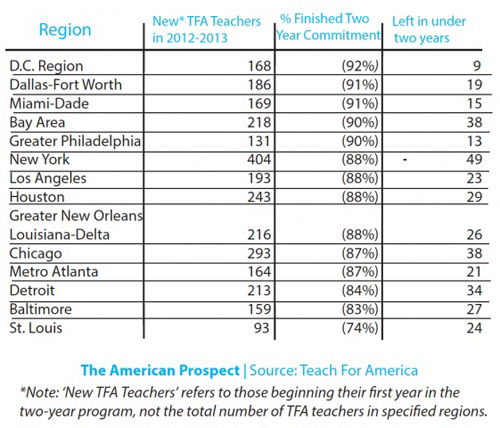
Teach for America is really not providing long-term solutions to the public schools of America's cities, but in fact has become a training ground for the bureaucrats who will staff boards of education and politicians. TFA has been training the cadre of corporate "school reform," not teachers for the children of America's cities. Rachel M. Cohen/The American Prospect from TFA data The True Cost of Teach For America's Impact on Urban Schools
Why are school districts paying millions in "finder's fees" to an organization that places people without education degrees to teach in urban schools—even where applications from veteran teachers abound?
In debates over education policy in urban school districts, few topics are more contentious than the role played by Teach For America, the national organization that recruits elite college graduates to teach in low-income urban and rural schools for two years. It is not uncommon to hear veteran teachers, who majored in education and often have advanced degrees, complain that their profession is diminished by what they see as a preference for TFA recruits who did not study education. Parents are heard to question the qualifications and commitment of TFA’s novice educators, given the assumption that their sign-up for a two-year stint suggests only a fleeting interest in teaching. And both veteran teachers and parents sometimes bemoan the fact that the racial and ethnic make-up of the TFA corps rarely matches that of the students they are assigned to teach. Advocates maintain that Teach For America provides well-educated teachers in areas where recruitment is difficult.
Here Rachel M. Cohen, writing fellow at The American Prospect, explores another area of controversy in the Teach For America program: the start-up costs of hiring a TFA teacher, and the program’s impact on the retention of veteran teachers. -- The Editors
When public school districts hire teachers from Teach For America, they pay a greater upfront cost than if they hire traditional entry-level teachers. This is because TFA charges finder’s fees for every “corps member” they supply. In addition to the salary and benefits school districts pay each teacher, districts also must pay the national organization, typically between $2,000-$5,000 per corps member, per year. Though generally overlooked, these finder’s fees are salient to many of the key issues in the national debate over TFA’s harm and benefit to public education.
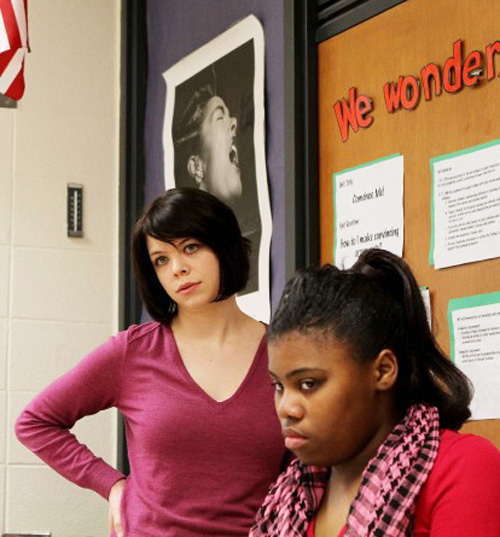
In a 2/4/2011 photo, Erin Gavin, a TFA teacher, listens to students during a group discussion with 7th-graders at a Brooklyn Center School in Brooklyn Center, MN. In 2013, MN Governor Dayton vetoed an item that would have granted $1.5 million to TFA, AP Photo/Andy King,To put the finder’s fees in perspective: If one city’s TFA cohort, consisting of 200 corps members, comes with an annual finder’s fee of $4,250 for each teacher recruited from the organization—then that cohort’s two-year commitment will cost the district an additional $1,700,000 in dues to the organization. This is not a trivial sum for school districts experiencing massive budget shortfalls. The TFA hiring contracts are generally non-refundable, even if a teacher turns out to be a serious problem or quits early. Takirra Winfield, the national spokesperson for TFA, says that while the organization has a “pretty clear” no-refund policy in its contracts, there have been some cases where TFA has made exceptions, such as providing a credit to the district for the upcoming year, or giving regional teams discretion as to whether to invoice districts for teachers who leave early.
Teacher retention
Finding excellent teachers who are willing to stay and work in low-performing schools—typically located in high-poverty areas—has been a challenge for school districts across the nation. As a result, the teachers most frequently sent into high-poverty school districts are young novice instructors who are more likely than more seasoned Costs of Teach for America - Substance News:

Got Choice? Ubetcha! - ALL The RIGHT People Celebrate National School Choice Week

Partners:


Got Choice? Ubetcha! - Celebrating National School Choice Week


National Association of Charter School Authorizers (NACSA) Group: 1 in 5 charter schools not doing well enough to stay open

A group that oversees more than half of the nation's 5,600 charter schools said as many as one in five U.S. charter schools should be shut down because of poor academic performance. 

http://seattletimes.com/html/nationworld/2019784379_charterschools29.html

What happens when the Common Core becomes less ... common? - The Washington Post

What happens when the Common Core becomes less ... common? - The Washington Post:


What happens when the Common Core becomes less ... common?


  January 25 at 5:57 PM  

The Common Core State Standards were envisioned as a way to measure most of the nation’s students against a shared benchmark, but education experts say political upheaval and the messy reality of on-the-ground implementation is threatening that original goal.
“Part of the whole point was you were going to have commonality that would let you compare schools in Chicago to schools in Cleveland,” said Frederick M. Hess, director of education policy at the conservative American Enterprise Institute, who supports the concept of common standards but has been critical of efforts to implement the Core. “We may not see the benefits that folks were hoping to see. . . . The whole notion of commonality, which was so attractive, is more and more a phantasm.”
One of the bipartisan hopes for the Common Core, a set of guidelines for what the nation’s kindergarten-through-12th-grade students should learn and when, was that states would leave behind their patchwork of 50 different sets of standards measured by 50 different tests. It would, for the first time, be easy for parents and policymakers to directly compare student performance in one state to the rest of the nation, and it would be much more difficult for lagging states to game the system in an effort to hide weak performance.
That goal seemed easily within reach in 2011, as 45 states and the District of Columbia adopted the new standards. The Obama administration spent hundreds of millions of dollars to help states develop two new online tests, known as PARCC and Smarter Balanced, that would measure student progress on the Common Core, and most states signed on to administer those tests starting this spring.
But as some states head into their first round of testing, the picture has fragmented amid political blowback from parents and conservative lawmakers who criticize the Core as nationalized education and have found the new course material confounding.
Indiana and Oklahoma have dropped the Core, and four other states are moving to review and potentially replace the standards. Lawmakers in other statehouses are taking up anti-Common Core bills as the legislative What happens when the Common Core becomes less ... common? - The Washington Post:

What the New Senate Education Chair Thinks About No Child Left Behind | TIME

What the New Senate Education Chair Thinks About No Child Left Behind | TIME:

What the New Senate Education Chair Thinks About No Child Left Behind

Lamar Alexander, Patty Murray
Senate Health, Education, Labor and Pensions Committee Chairman Sen. Lamar Alexander, R-Tenn., right, and the committee's ranking member Sen. Patty Murray, D-Wash., arrive on Capitol Hill in Washington, Wednesday, Jan. 21, 2015, for the committee's hearing looking at ways to fix the No Child Left Behind law.Susan Walsh—AP

Sen. Lamar Alexander, the new chairman of the Senate committee on education, walked into Congress this month with guns a-blazin’.

What exactly that makeover will look like is now the subject of hot debate on Capitol Hill.

The primary issue at stake is testing. Under No Child Left Behind, students are required to take a raft of standardized exams, each of which are used to assess whether schools are succeeding or failing, and, increasingly, to hold individual teachers accountable for their performance in the classroom.

Critics of No Child Left Behind—and there are lots and lots of them—generally hate the testing mandate. Conservatives and Tea Party activists decry it as “government overreach,” while liberals, local teachers unions and parents lament the reliance on “high-stakes testing.” Even Secretary of Education Arne Duncan has said that too much testing can “rob school buildings of joy.”
So far, Alexander says that while he sees the benefits of aggregating and breaking down federal testing results, “the jury is still out” on whether an updated No Child Left Behind should require federal standardized tests at all, and if they do, whether the government should be barred from imposing consequences on schools with bad test scores.

How Alexander and the Senate education committee ultimately come down on this issue could fundamentally alter the way that public education works in this country.

In a conversation with TIME last week, Alexander offered a peek into what he thinks might come next.

This interview has been edited for length and clarity.

You’ve said you’re not sure how you stand on the testing issue, but what is your thinking at the moment?

The thing that worked with No Child Left Behind is to take tests results, break them down and aggregate them so that we know that children really aren’t being left behind—so you can’t have an overall average for a school that’s pretty good, but still leave all the Latino kids in a ditch somewhere. But what’s increasingly obvious to me is that the biggest failure of No Child Left Behind has been the federal accountability system—the effort to decide in Washington whether What the New Senate Education Chair Thinks About No Child Left Behind | TIME: