Monday, September 15, 2014

Russ on Reading: The False Promise of School Choice

Russ on Reading: The False Promise of School Choice:


The False Promise of School Choice

Governor Chris Christie was in Camden, New Jersey this week to praise the opening of some new charter schools that he is championing. A great believer in school choice, Christie said that parents should have “more choice, not less.”

I would like to take the Governor at his word on this. If I were a Camden parent and I had real “choice”, I would choose to send my child to a wealthy private school like the one Joe Kennedy, Sr. sent two of his sons to, Choate Rosemary Hall. I think all of us might do the same.

Choate, of course, is one of the go to private schools for the privileged in America. Located in Wallingford, Connecticut, its leafy sprawling 458 acre campus, is home to “one of the leading schools in America.” Its alumni roll reads like a Who’s Who of American politics, industry, arts and letters, and sports. Graduates include a John F. Kennedy, Edward Albee, John Dos Passos, Glenn Close, Michael Douglas, nuclear physicist Katherine Way, Senator Bob Kasten and literally hundreds more prominent folks. They also have one of the top ice hockey programs for boys and girls in all of New England.

Not surprisingly, students at Choate appear to graduate “college and career ready.” Many of them furthering their education at places like Harvard and Yale.

OK, Ok, I know we can’t send all of our Camden students to Choate. After all it costs about 52,000 dollars a year to educate a boarding student there. So, if we can’t send all of our Camden kids to Choate, maybe we can provide them with Choate-like curriculum right in South Jersey.

What does the Choate curriculum look like? Here are a few highlights.

·          There are more than 300 courses in the curriculum
·         Coursework includes community service and global studies
·         A two-year intensive Science Research Program includes mentored laboratory work during the summer at universities in the United States and abroad. 
·         The Capstone Program allows sixth form (senior) students to explore an area of the curriculum in depth. Working under a Russ on Reading: The False Promise of School Choice:

There’s Something Happening Here | janresseger

There’s Something Happening Here | janresseger:


There’s Something Happening Here

Last spring in a profound commentary the editors of Rethinking Schools magazine argued that school accountability based on high-stakes standardized tests merely disguises class and race privilege as merit.  While individual children of all economic and racial groups are likely to score all over the spectrum on standardized tests, in the aggregate scores are likely to be higher among privileged children.   And if schools in our racially and economically segregated society are judged by the students’ test scores, the schools serving wealthier children will appear to be doing a better job just because the children who attend the schools bring their privilege with them to school.
Ohio, like other states, ignores this reality by attaching its rating system for schools and school districts to the standardized test scores of the students. The state credits standardized test scores to the quality of the school district’s teachers and the curriculum and ignores other variables that might be affecting the test scores.
Ohio is currently in transition between a school district rating system that awarded ratings of  “Excellent, Effective, Continuous Improvement, Academic Watch and Academic Emergency” to our new system which will feature school district grades of “A, B, C, D, and F.” Next year districts will receive overall letter grades; late last week the Ohio Department of Education released complicated report cards for school district performance during the 2013-2014 academic year, report cards that award a miasma of letter grades and raw scores.  Most all the grades, however, are for scores on various standardized tests, with the graduation rate and attendance added in, along with a formula-based grade for “value added.”
In the concluding chapter of Public Education Under Siege, Mike Rose and Michael Katz address the trend across the states (including Ohio) to rate school districts on test scores alone: “Perhaps the greatest strength of the current reform movement is its focus on inequality… (but) Because reformers want to keep focus with ‘no excuses’ on the unacceptable performance of poor children, they insist on addressing outcomes (in the form of test scores) rather than on inequality of resources and social conditions.  This is an understandable There’s Something Happening Here | janresseger:

Mike Klonsky's SmallTalk Blog: WEEKEND QUOTABLES

Mike Klonsky's SmallTalk Blog: WEEKEND QUOTABLES:


WEEKEND QUOTABLES

Bethlehem, Pa. NAACP President Esther Lee 
"We could end up with segregation in another form," [Esther Lee] said of charter schools. "It's not 1909, but it's close." -- Express Times
Chicago principal, Troy LaRaviere
The [custodial] cuts mean “residents of Chicago lose out, and the corporations profit from our losses." -- Chicago Public Schools to lay off 476 custodians
Karen Lewis meets Ras Baraka.
Karen Lewis
Lewis, a former chemistry teacher, pointed to Newark as a learning lab for the right formula for political victory. "Money doesn't vote, people do. I believe a lot of hedge fund folks dumped money into [Newark mayoral candidate] Shavar Jeffries' campaign. Baraka was outspent, but he won," Lewis said. "The key is how do you connect with people and the others that are important to them. That's what elections are about, ultimately." -- Chicago teachers union leader and mayoral hopeful comes to Newark to learn from Mayor Mike Klonsky's SmallTalk Blog: WEEKEND QUOTABLES:

Common Core math standards add up to a big money for education companies | The Hechinger Report

Common Core math standards add up to a big money for education companies | The Hechinger Report:


Common Core math standards add up to a big money for education companies

Teachers have to be savvy shoppers as glut of new products enters the marketplace

By
The politically controversial standards curriculum standards known as the Common Core have been in the headlines for months, in Louisiana and across the country. But for most teachers and educators the standards have been quietly transforming classroom instruction for years. And for textbook publishers and other vendors, the new standards add up to new business. Sarah Carr reports on the dizzying array of new education products that claim to be ‘Common Core aligned.’
When thousands of math teachers descended on New Orleans earlier this year, two words proved more seductive than chocolate. Or sex. Or even quadratic equations.
Common Core.
The teachers were in town to attend the National Council of Teachers of Mathematics annual conference. The exhibit hall featured endless booths stocked with Common Core textbooks, Common Core legos, Common Core geometry sets, Common Core MOOCs (which stands for massive open online courses). There were even flying robots that vendors said could help children learn the Common Core.
“We sometimes laugh and say that Staples is going to make a lot of money on a rubber stamp that says ‘100 percent Common Core-aligned,’” said Linda Gojak, the council’s former president.
Greta Anderson, a 5th grade math teacher at New Orleans' Dibert elementary school, has helped her peers adjust to the new Common Core curricular standards. (Photo: FirstLine schools)
Greta Anderson, a 5th grade math teacher at New Orleans’ Dibert elementary school, has helped her peers adjust to the new Common Core curricular standards. (Photo: FirstLine schools)
Gojak chuckles when I ask her if vendors feel pressured to put the Common Core stamp on their products.
“If they want to sell it,” she says.
A few companies are using the Common Core craze as a reason to sell more stuff and make more money. Stacy Monsman, a math coach in an Ohio school district, noticed a glut of products almost immediately.
“When Common Core comes out, literally within a few weeks you saw materials with that sticker on it and there’s no way, the Common Core just came out,” she said. “There’s no way that a good thorough job could have been done to truly incorporate everything into some kind of material.”
But Gojak and others say most vendors really want to align their products with the Common Core — whether they are textbook publishers who are rewriting lesson plans, or the creators of MOOCs aimed at explaining the standards to teachers. But all this change takes time.
So in the short term, at least, teachers need to be cautious consumers, said Greta Anderson, the chair of the math department at New Orleans’ Dibert elementary school.
“Everything is saying right now that they are ‘Common Core-aligned’ and some things are really top notch and others aren’t,” Anderson said. “It takes deeply knowing the standards. It takes looking at Common Core math standards add up to a big money for education companies | The Hechinger Report:

What U.S. schools can learn from Poland
Source: Encyclopaedia Britannica, Inc. (kids.eb.com) By any measure, Poland has made remarkable education progress since the fall of the Berlin Wall. On the most recent 2012 international tests of 15-year-olds, known as PISA tests, Poland ranked 9th in reading and 14th in math among all 65 countries and sub-regions that took the test. It used to be on par with the United States, a mediocre perform

Colorado: Innovation Schools Do Not Mean Less Testing - UNITED OPT OUT: The Movement to End Corporate Education Reform

Colorado: Innovation Schools Do Not Mean Less Testing - UNITED OPT OUT: The Movement to End Corporate Education Reform:


Colorado: Innovation Schools Do Not Mean Less Testing


UOO Banner


Truancy 2014 - Executive Summary | State of California - Department of Justice - Kamala D. Harris Attorney General

Truancy 2014 - Executive Summary | State of California - Department of Justice - Kamala D. Harris Attorney General:


In School + On Track 2014 - Kamala D. Harris California Attorney General


Executive Summary: Every Kid Counts


California’s elementary school truancy crisis is a persistent problem that limits the potential of California’s children and costs school districts and the state billions of dollars each year. High rates of absenteeism interfere with students’ right to an education under the California Constitution. They drive crime and incarceration, and hurt our economy. And most importantly—they put California’s most vulnerable students at a lifelong learning disadvantage.
If every kid in California counts, then we must count every kid. While we can—and should—invest in programs to improve our schools, these benefits will never reach students who do not even make it to class. California must make it a priority to improve elementary school attendance in order to fulfill the promise of the state’s new Local Control Funding Formula (LCFF), to improve educational outcomes for all students, and to help our children compete in California’s global economy.


In School + On Track 2013

Attorney General Kamala D. Harris’s first statewide report on elementary school truancy and chronic absence, In School + On Track 2013, revealed that elementary school students who miss school are more likely to struggle academically1 and eventually to drop out of school altogether.2 Dropouts cost the state more than $46 billion dollars each year,3 including more than $1 billion in juvenile crime costs alone.4 Above all, districts and counties may not realize the true scope of their attendance problems because chronic absence is masked by an insufficient statewide infrastructure for tracking attendance in California.5


In School + On Track 2014

In School + On Track 2013 highlighted the unacceptable rates of elementary school truancy using attendance records from the 2011-2012 school year. This year’s report indicates that those rates were not isolated or unique—truancy rates are persistent in California. In the 2012-2013 school year, the school year immediately preceding last year’s report, 1 in 5 elementary school students were truant, or 744,085 students. This marks an increase of 1.2% from 2011-2012.6 Because California takes an entire year to release its official truancy figures, official truancy rates are only available for years that predate the 2013 report.
This year, due to a partnership with Aeries Student Information System, we have access to new estimated rates of absenteeism for disadvantaged student populations from the 2013-2014 school year.7 The findings from this research are alarming.
According to estimates based on a sample of California school districts, over 250,000 elementary school students were chronically absent in 2013-2014—defined as missing 10% or more of the school year, adding up to roughly 18 or more school days.8 Even more troubling, over 50,000 elementary students were chronically truant, and over 40,000 missed at least 36 days of school in one year.9 Absences are also highest in the earliest years of school most critical for developing foundational skills like reading. As was true in In School + On Track 2013, we can only estimate these more severe indicators of attendance problems because California does not collect information on students’ total absences, chronic absenteeism, or chronic truancy.


Income & Racial Disparities

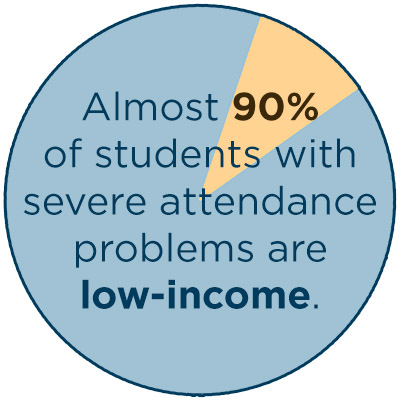
Almost 90% of students with severe attendance problems are low-icome
Almost 90% of the elementary students with the most severe attendance problems—those who miss 36 days or more of school per year—are estimated to be low-income. And 1 in 10 low-income students missed 10% or more of the 2013-2014 school year. These students have rightfully been targeted for increased resources under LCFF, and improving their attendance is an important step to advancing their educational opportunity.
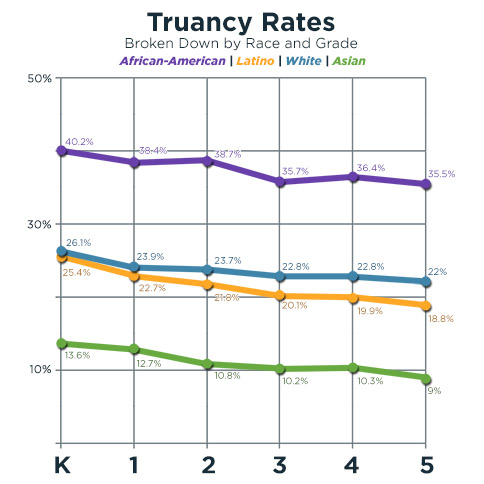
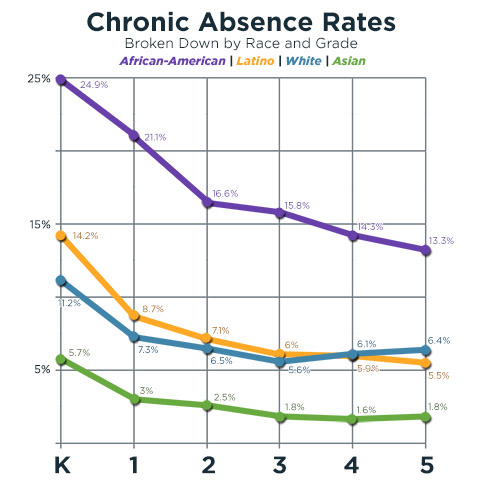
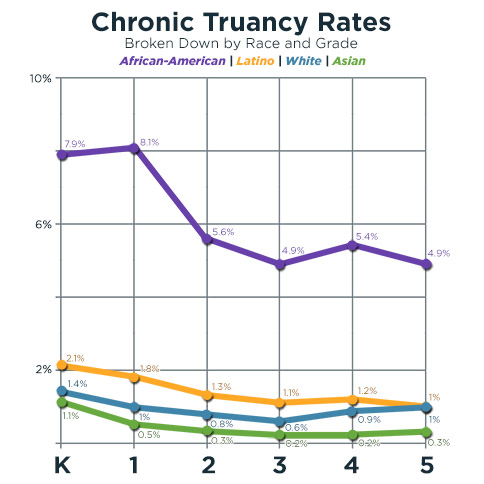
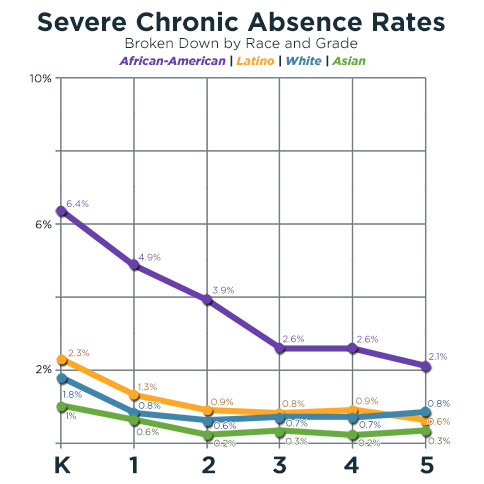
Racial disparities in attendance are particularly troubling. Thirty-seven percent of African American elementary students sampled were truant, the highest of any subgroup (including homeless students) and 15 percentage points higher than the rate for all students. Taken statewide, almost 73,000 African American elementary students are estimated to have been truant in the 2013-2014 school year. Nearly 1 in every 5 African American elementary school students—over 33,000 in total—missed 10% or more of the school year, a rate over two and a half times that of white students in 2013-2014. Most troublingly, African American elementary school students are chronically truant at nearly four times the rate of all students, and are more than three times as likely to miss 36 days of school or more per year. Moreover, absences are highest during the most important years when children learn to read, an important benchmark for long-term academic success and predictor of dropout rates.
Because the state is not collecting this critical information, the attendance crisis among African American children has largely remained hidden. Therefore, we cannot conclusively explain the stark contrast between African American elementary students’ rates of absence and that of nearly every other subgroup. We do know, however, that African American children experience many of the most common barriers to attendance—including health issues, poverty, transportation problems, homelessness, and trauma—in greater concentration than most other populations. We discuss these barriers in more detail in Chapter II.
This attendance disparity must be a wake-up call for local and state policymakers. We need not, and should not, accept these figures as inevitable. This is a solvable problem. If local agencies have the information necessary to illuminate these patterns, they can direct resources to the students and families that need the most. In Chapter II, we highlight innovative models for engaging and empowering communities of color and other disadvantaged populations to resolve barriers to attendance.
Truancy Rate

3+ unexcused absences/tardies
Truancy Rates line graph
Chronic Absence Rate

18+ missed days for any reason
Chronic Absence Rates line graph
Chronic Truancy Rates line graph

Chronic Truancy Rate

18+ unexcused absences
Severe Chronic Absence Rates line graph

Severe Chronic Absence Rate

36+ missed days for any reason
Other at-risk students also display troubling patterns of absenteeism. In grades K-6, 30% of homeless students in the sample were truant in 2013-2014, and approximately 15% missed 18 or more days of school. Finally, truancy and chronic absence rates for American Indian and Alaska Native students are similar to those for African American students, but the smaller sample size for this population has led to less consistency in the rates observed. Latinos are also more likely to be chronically absent than White students, though they suffer from less of a disparity than that observed for African Americans.Truancy 2014 - Executive Summary | State of California - Department of Justice - Kamala D. Harris Attorney General:

Map and Charts: Career Academies in California | EdSource

Map and Charts: Career Academies in California | EdSource:


Map and Charts: Career Academies in California


  •  SHARE THIS ARTICLE

Check out our new interactive map on career academies in California high schools for 2013-2014.
The programs typically combine college-preparatory academics aligned to a specific career field – health care, for example – alongside real-world work experiences, including internships, job shadowing or mentoring opportunities. The map is part of an EdSource initiative focusing on preparing students for college and careers, which is the goal of current reforms such as the Common Core State Standards and the Local Control Funding Formula.
Mouse over the map below to explore schools participating in career academies. Clicking on the numbered marker will expand the markers for individual schools. Scroll down for additional information about the different career academies.

Career Academies by Program

This map shows career academies throughout the state. Check out where different pathway programs have academies by clicking on the layers below.
Leaflet | Map tiles by Stamen Design, under CC BY 3.0. Data by OpenStreetMap, under CC BY SA., Map data from Linked Learning Alliance, Map by John C. Osborn

Types of Career Programs

A number of different programs operate in California schools, depending on the program they were created under and the funding mechanism that supports them:
California Partnership Academies are a network of schools supported by state grants. The programs offer a three-year program for grades 10 through 12 and typically operate as a small learning community inside a larger high school to offer an integrated career and academic curriculum for students. Several different academies may operate at one high school, offering a variety of options for students.
Assembly Bill 790, a 2011 bill by Assemblyman Warren Furutani, D-Gardena, created a statewide linked learning pilot program. Schools following the linked learning model offer courses tied to a specific career field, and that career theme permeates the curriculum. Students on a health care pathway might take human anatomy for their science course, for instance. Twenty districts and educational partners were chosen to participate in the pilot to assess how the linked learning approach can be expanded throughout the state.
The Linked Learning District Initiative was launched in 2009 in nine California districts to expand linked learning models. The initiative is directed by ConnectEd, a Berkeley-based nonprofit, which provides support and coaching to the schools. ConnectEd receives funding for the initiative from The James Irvine Foundation.*
The National Academy Foundation, a New York-based nonprofit, runs a network of career academies across the nation, including several in California. The programs can be standalone high schools or small learning communities within a larger campus. The academies are organized around one of five career themes: finance, hospitality and tourism, information technology, health sciences, or engineering.
Career Academies
Download: PNG

What Career Academies Teach

There were at least 737 career academies in 396 schools in California for the 2013-14 school year. The top three industries of focus within those academies were related to the arts, health and engineering, but there were a total of 15 industry sectors represented in academiesMap and Charts: Career Academies in California | EdSource:

Relying on Half-Truths in Vergara P.R. Push | InterACT

Relying on Half-Truths in Vergara P.R. Push | InterACT:


Relying on Half-Truths in Vergara P.R. Push

SEPTEMBER 15, 2014


Writing in The San Diego Union-Tribune this weekend, San Diego County Superintendent Randy Ward offered lots of rhetoric and insufficient evidence to explain the educational benefits leading to hissupport for the Vergara ruling. At various times over the years, I’ve formed a positive impression of Ward, and even enjoyed a brief chat with him at a California Teachers of the Year event. He has decades of experience as a respected administrator in multiple districts and counties around California. My earliest impression of him came from a panel discussion he did with John Merrow several years ago; when asked the extent to which he would hold unions responsible for certain problems in education, and Ward answered that every contract is signed by two sides, so you can’t hold just one side responsible.
This time around, I have to take issue with his assessment of the state’s current education policy drama. Regarding the Vergara decision, Ward offers plenty of basic observations about the challenges of educating children in high-poverty, high-needs schools, and the maldistribution of highly-qualified teachers among schools. Like the Vergara attorneys, he suggests, without evidence, that the most challenged schools would improve student learning if not for ed. code provisions relating teacher job protections – especially concerning seniority and dismissal proceedings; they want to remove bad teachers more easily, and target less effective teachers for layoffs when necessary. It sounds like I’m arguing against an idea with benefits that are self-evident, but there are some potentially flawed underlying assumptions:
  • Loss of seniority protections won’t have a negative impact on school climate and staff collaboration.
  • Schools are able to evaluate teachers accurately and effectively.
  • The new teachers coming in will be better than those they replace.
  • The ineffective teaching is mainly a result of flaws in the individual rather than in the school system.
Certainly, there are individuals who need to be dismissed. I tend to think that the much larger problem in our field is that over-stressed school systems create a lot of sub-optimal teaching, and unsatisfactory teachers.
Ward concedes that charter schools have the flexibility he wants the Vergara decision to create statewide – and yet don’t, as a sector, have better outcomes. Perhaps he could also have noted that many states are similarly challenged to show better educational outcomes, even though they also lack California’s due Relying on Half-Truths in Vergara P.R. Push | InterACT:

With Tech Taking Over in Schools, Worries Rise - NYTimes.com

With Tech Taking Over in Schools, Worries Rise - NYTimes.com:


With Tech Taking Over in Schools, Worries Rise

Students in Oklahoma City. A patchwork of state laws is taking on concerns over third-party collection and use of student data. CreditSue Ogrocki/Associated Press


 At a New York state elementary school, teachers can use a behavior-monitoring app to compile information on which children have positive attitudes and which act out. In Georgia, some high school cafeterias are using a biometric identification system to let students pay for lunch by scanning the palms of their hands at the checkout line. And across the country, school sports teams are using social media sites for athletes to exchange contact information and game locations.

Technology companies are collecting a vast amount of data about students, touching every corner of their educational lives — with few controls on how those details are used.
Now California is poised to become the first state to comprehensively restrict how such information is exploited by the growing education technology industry.
Legislators in the state passed a law last month prohibiting educational sites, apps and cloud services used by schools from selling or disclosing personal information about students from kindergarten through high school; from using the children’s data to market to them; and from compiling dossiers on them. The law is a response to growing parental concern that sensitive information about children — like data about learning disabilities, disciplinary problems or family trauma — might be disseminated and disclosed, potentially hampering college or career prospects. Although other states have enacted limited restrictions on such data, California’s law is the most wide-ranging.
Photo
State Senator Darrell Steinberg of California, left, has written a wide-ranging bill limiting the use by the education technology industry of the student data it collects. Governor Jerry Brown, right, has not taken a public position on the measure. CreditRich Pedroncelli/Associated Press
“It’s a landmark bill in that it’s the first of its kind in the country to put the onus on Internet companies to do the right thing,” said Senator Darrell Steinberg, a Democrat who wrote the bill.
Gov. Jerry Brown has not taken a public position on the measure, or on a related student privacy bill regulating school contracts with education technology vendors. If he does not act, the bills will become law at the end of this month. Senator Steinberg said the bills had broad bipartisan support and were likely to be enacted.
James P. Steyer, chief executive of Common Sense Media, a children’s advocacy and media ratings group in San Francisco, said the bills were ultimately intended to shore up parents’ trust in online learning.
“You can’t have an education technology revolution without strong privacy protections for students,” said Mr. Steyer, whose group spearheaded the passage of Mr. Steinberg’s bill. “Parents, teachers and kids can now feel confident that students’ personal information can be used only for educational achievement.”
In a sign of the rapid growth of the education technology industry, even Mr. Steyer’s group has partnerships with Google, Apple, Amazon and other companies that distribute the group’s educational materials and its ratings of games and apps for children.
The California effort comes at a pivotal time for the industry. Schools nationwide have been rushing to introduce everything from sophisticated online portals, which allow students to see course assignments and send With Tech Taking Over in Schools, Worries Rise - NYTimes.com:

NYC Educator: On Astorino--Seeing the Forest for the Trees

NYC Educator: On Astorino--Seeing the Forest for the Trees:


On Astorino--Seeing the Forest for the Trees


There's not a whole lot of controversy over the fact that our esteemed Governor, Andrew Cuomo, is pretty much a loathsome reptile. After all, he's maintained a Gap Elimination Adjustment over public schools while concurrently imposing a tax cap that's made it almost impossible to compensate for lost funds. He's called himself a student lobbyist, but supports giving no votes to school budgets more weight than yes votes. And he circumvented NYC mayoral control when it appeared the mayor was no longer going to kowtow to Eva Moskowitz.

Perhaps it should be no surprise that on Twitter I see a few working teachers flocking to Cuomo's GOP opponent, Rob Astorino, because they think he's an improvement. Granted, Astorino opposes Common Core. I watched him speak to a group in Comsewogue about that. But Tea Party stalwarts, like Scott Walker, also oppose it. So if you're going to support Astorino, you have to look a little more deeply before you assume he's supportive of public schools. I mean, if that were the case, why would teacher union public enemy number one (or at least close, as there are so many nowadays) Scott Walker be raising money for him?

For one thing, Astorino opposes the Triborough Amendment. This is very important to NYC teachers, who just went 6 years without a contract, not to mention Buffalo teachers, who are still without one after a decade. The Triborough Amendment mandates that existing contracts remain in force until and unless they are renegotiated. In Astorino's NY Post op-ed, he suggests this gives us no motivation to negotiate. Its repeal would certainly cripple our ability to bargain collectively, and this places Astorino sqaurely in Scott Walker territory. And for those who complain the Post piece is from 2012, here's Astorino challenging Triborough in April 2014. He also supports changing work rules and reducing pension benefits, according to that piece. Could he be alluding to eliminating collective bargaining, like his BFF Scott Walker did in Wisconsin?

It's pretty well-known that Astorino supports charters. I haven't heard quite as much about his support for vouchers and tax incentives for NYC Educator: On Astorino--Seeing the Forest for the Trees:

Teachers Union Heads Get First-Hand Look at NJ School-Reform Hot Spots - NJ Spotlight

Teachers Union Heads Get First-Hand Look at NJ School-Reform Hot Spots - NJ Spotlight:


TEACHERS UNION HEADS GET FIRST-HAND LOOK AT NJ SCHOOL-REFORM HOT SPOTS

Two national leaders visits Camden and Newark districts, tout organized labor’s relevance in local debates over state initiatives


Lily Eskelsen Garcia
Lily Eskelsen Garcia, president of the National Education Association, visiting Pyne Poynt Middle School in Camden.
One was the visit to Camden by the president of the National Education Association, the nation’s largest teachers union. The other was a stop in Newark by the head of the Chicago Teachers Union, the woman who led the nation’s largest teachers strike in decades.
While the visits were not coordinated -- the two unions are not affiliated -- but the timing of the two events on Friday and over the weekend was nonetheless notable for what are inarguably the two hot spots for school reform in New Jersey.
Teachers unions in both state-run districts have been right in the middle of intense debate over reforms being pursued by Gov. Chris Christie. In Camden, the union tried to fight off layoffs last spring. In Newark, the union has fought school closures and consolidations.
But with the influence – or at least strategies -- of those unions sometimes questioned even within their own ranks, the two national union leaders tried to change that conversation this weekend and made a pitch for organized labor’s continued relevance.
“The bottom line is we are at a turning point in this country, and (teachers) are saying they are no longer a respected voice, they are becoming punching bags for governors,” Lily Eskelsen Garcia, president of the NEA, said in an interview this weekend. “We’re saying enough is enough.”
karen lewis
Karen Lewis, president of Chicago Teachers Union, speaks in Newark with Mayor Ras Baraka.
Karen Lewis, president of the Chicago Teachers Union, spoke at a forum at Rutgers- Newark on Saturday alongside Mayor Ras Baraka. She pulled few punches.
“We’ve been following Newark for some time, and nothing has changed,” Lewis said after the forum. “We are seeing the same attacks on publicly-funded public education … and the same top-down mandates that don’t work.
“It’s command and control, something they are not even teaching in business school anymore.”

‘An incredible tale of two schools’

On a cross-country tour of schools that started in Fairbanks, Alaska, Eskelsen Garcia had asked to visit a school in New Jersey that faced the challenges of poverty and also was at the center of the storm over school-reform efforts. She was pointed to Pyne Poynt Middle School in Camden.
That same day, Eskelsen Garcia also had a chance to visit a school that was neither of those things: West Windsor-Plainsboro High School North, an hour’s drive away.
It was a notable contrast, apparent not just in the streets she traveled to and from the schools. At the high school, she reported, she toured orchestra rooms, science labs, art rooms, and “state of the art” track facilities.
“At Pyne Poynt, the principal and faculty followed me around, and they were just so proud that their school had just been painted,” Eskelsen Garcia said. “They had nothing new they could show off.”
She was pleased about one thing the two schools had in common: “After looking at Teachers Union Heads Get First-Hand Look at NJ School-Reform Hot Spots - NJ Spotlight: