Latest News and Comment from Education

Tuesday, September 2, 2014

9-2-14 LA School Report - What's Really Going on Inside LAUSD

LA School Report - What's Really Going on Inside LAUSD (Los Angeles Unified School District):


LAUSD aiming to resolve MiSiS issues as ‘Norm Day’ approaches
LAUSD aiming to resolve MiSiS issues as ‘Norm Day’ approaches While LA Unified says it’s making strides toward solving MiSiS problems, difficulties enrolling students persist and could severely impact school funding levels as a deadline approaches for allocating personnel resources. School administrators are required to report final enrollment numbers to the district by Sept. 12, a date officials


Brown’s Vergara appeal not so hard to understand
Brown’s Vergara appeal not so hard to understand Governor Jerry Brown While editorial boards at most of California’s major newspapers all reacted favorably to Judge Rolf Treu’s ruling in Vergara vs. California, and a USC poll showed that a strong majority of California voters oppose the state’s tenure and layoff policies for public school teachers that the court ruling struck down, Gov. Jerry Brow

Americans are becoming more satisfied with public education
Americans are becoming more satisfied with public education Via Gallup | by Rebecca Riffkin Gallup has asked U.S. adults about their satisfaction with education since 1999, including each August since 2001, as part of its annual Work and Education poll. The high of 53% satisfaction was reached in 2004, the only year more Americans were satisfied with education than dissatisfied. Americans were mos


Morning Read: CA student attendance above national average
Morning Read: CA student attendance above national average Analysis finds California students attend school more than U.S. peers California students attend school more consistently than most of their U.S. peers, and such attendance directly relates to better performance on national math and reading tests, a new analysis has found. LA Times Programs target crucial summer before college Lilie Hau,

8-30-14 This Week in LA - School Report - What's Really Going on Inside LAUSD
LA School Report - What's Really Going on Inside LAUSD (Los Angeles Unified School District):Federal free lunches a lens into proverty that’s blurringFederal free lunches a lens into proverty that’s blurring When it comes to free school meals, it’s increasingly clear that students aren’t always what they eat. The federal free- and reduced-price meals program, launched decades ago by the U.S. Depar


Can We Talk? (I Mean Really…) | EduShyster

Can We Talk? (I Mean Really…) | EduShyster:


Can We Talk? (I Mean Really…)


The 49er says that Education Post can’t start a conversation—because its founders and funders already have all of the answers.
can we talkBy *The 49er*
In a recent offline conversation, EduShyster and I were trying to figure out a name for the group of people that are opposing reformers. You see reformers are easy to place in a camp. Even though there are internal fights on issues such as Common Core and the role of the federal government in education, there is general agreement that there need to be major changes to public education in America. But the camp which is fighting those reformers (and probably most of the people reading this post) isn’t so easy to define. Harvard Professor Jal Mehta defines this camp as  traditionalists(Why do I suspect that EduShyster is bristling at the use of that term?) [Editorial note: she is!]
A Camp Without a Name
Many in this group would advocate for the creation of progressive public schools likeBoston’s Mission Hill School or for Al Shanker’s original vision for charter schools as laboratories of innovation that worked alongside traditional public schools. While many people in this group are union members or union supporters, it’s not just unions that are fighting against reformers. Heck, often times the unions don’t even seem to be fighting against the reformers.
test prep 2Meet the Hollisticrats
The term I’ve been bouncing around in my head for this group is the *Hollisticrats.* OK, OK—I know it’s super wonky, but hear me out. It encompasses the belief that this group shares that education must be adequately Can We Talk? (I Mean Really…) | EduShyster:


9-2-14 Ed Notes Online

Ed Notes Online:


Farina Threat to ATRS Echos Our Opposition to the Contract
Fariña pledged to announce in the next two weeks a big reduction in the number of teachers getting paid despite not having steady classroom jobs. Earlier this month 114 of the roughly 1,100 teachers — known as the Absent Teacher Reserve — accepted $16,000 buyouts. Fariña said the numbers would dwindle further as principals are taught best practices for writing up teachers and beginning the arduous


Eva Moskowitz Success Academy - Changes Locks on Renovated Faculty Restrooms to Shut Public School Teachers Out
My solution? Pee on the outside of the door.A co-located public school teacher in an Eva invaded school. By the way, sources tell me that in this Success School you will find a hell of a lot of white kids, a bunch of them Jewish out of a Hebrew school - not corroborated - yet. Eva used the kids of color as a step to go where she really wants to go --- Inside ColocationThe public school where I've


9-1-14 Ed Notes Online
Ed Notes Online: It's an exhausting enterprise getting rid of a principal, especially when you get NO help from 52 BroadwayMurry Bergtraum has a new principal. MOREista Chapter Leader John Elfrank-Dana helped lead the battle. The principal mis-used the data to target teachers.I know people are impatient and unhappy over the slow pace of replacing the Bloomberg supervisor appointee horror stories.


9-2-14 Hemlock on the Rocks

Hemlock on the Rocks:


Gates and the Teacher Wars: It Matters Where You Stand | Cult of Pedagogy
http://www.cultofpedagogy.com/gates-teacher-wars/ Gates and the Teacher Wars: It Matters Where You StandDoes staying out of the ed reform debate make you out of touch, a peacekeeper, or a self-serving a-hole? There was a time, not long ago, when I was a Bill Gates defender. His foundation has done incredible things to slow the spread of HIV in the third world. They are improving infrastructure a
Why Do Americans Love to Blame Teachers? - The Atlantic
http://www.theatlantic.com/education/archive/2014/09/the-war-on-teachers/379403/ Why Do Americans Love to Blame Teachers? Oleg Golovnev/Shutterstock America hates teachers. That's not exactly the thesis of Dana Goldstein's The Teacher Wars, but her account of 200 years of education policy provides plenty of evidence for it. "The history of education reform," she notes, "show
The Pain and Isolation of an ATR ( ABSENT TEACHER RESERVE )
One of the first people I thought of yesterday when I read the Daily News article with Chancellor Farina's hopes for the upcoming year was blogger Fidgety Teach.Fidgety was a highly regarded and loved pre-K teacher in Brooklyn when she got caught up in the evilness of her principal, Kristine Mustillo. One mistake, forever altered the course of Fidgety's career. One mistake, cost the children of Br
Will rebidding for LAUSD tablets bring more of the same?: Letters to DN Editor on iPad
http://www.dailynews.com/opinion/20140902/will-rebidding-for-lausd-tablets-bring-more-of-the-same-lettersWill rebidding for LAUSD tablets be more of same?Re: "LAUSD rebidding contract for iPads" (Aug. 27):Los Angeles Unified School Superintendent John Deasy acts like a man in the midst of a bank heist who suddenly claims King's X, as in a game of tag, saying, "Hey this one was great
9-1-14 Hemlock on the Rocks
Hemlock on the Rocks: STOP LAUSD From Throwing Good Money After Bad: Investigate/Audit Bad Ed Tech DealsDear Friends, Thank you for signing the petition "Reappoint Architect Stuart Magruder to the LAUSD Bond Oversight Committee" a while back. Together we restored a watchdog with integrity to his rightful role as member of the BOC. Now your powerful voice is needed again in LAUSD to help


California’s 2014-2015 budget attacks education - World Socialist Web Site

California’s 2014-2015 budget attacks education - World Socialist Web Site:


California’s 2014-2015 budget attacks education

By Theo Mclean 
8 August 2014
California’s recently enacted 2014-2015 budget codifies the continuation of the attacks on education by the ruling class. Teachers and students are among those relegated to foot the bill of the economic crisis they did not create.
Over the past three decades, there has been significant disinvestment in California’s education. Funding for higher education has not ever recovered—despite the widely proclaimed economic “recovery” and recent state budgetary surplus—to 2007 levels, which had already represented the lowest level of funding in education for 30 years.
In California’s largest university systems, the California State Universities (CSU) and the Universities of California (UC), state funding in real dollars has fallen by just under 50 percent since 1980. (By contrast, funding for the state Correctional System has risen by approximately 200 percent over the same period.)
In K-12 education, California is the state that consistently has the largest class sizes, while having one of the lowest levels of funding per student.
In the arena of higher education, for example, as funding has decreased, the burden of paying for education has increasingly shifted to students, many of whom come from working class and impoverished backgrounds. Tuition and student fees pay for about 45 percent of the cost of UC and CSU education today, and graduates find themselves with an average of $18,000 of student loan debt. Many youths now consider college too expensive and forgo it altogether.
While tuition has increased sharply at nearly every university across the country, this increase is perhaps even more dramatic at the UC and CSU systems.
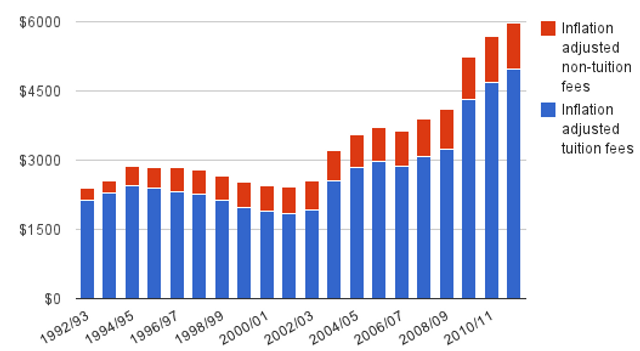
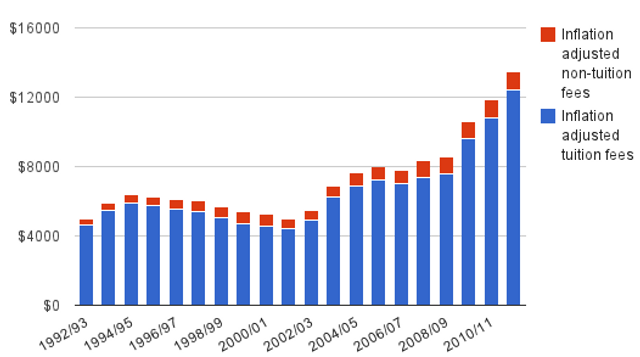
Between 1992 and 2012, inflation-adjusted tuition and fees have more than doubled at the CSU system and nearly tripled at the University of California.
California State University tuition fees. Image courtesy of KQED News.
Highlighting the complete collapse of postwar liberal reform plans, students who attended a UC school in 1965 could expect to pay a maximum of $200 per year on tuition and fees.
University of California tuition fees. Image courtesy of KQED News.
For K-12 education, as state funding has decreased, the burden has increasingly shifted to local governments and teachers, which are ill-equipped to support their own school systems—something historically handled by the state government. Instead, working class taxpayers are being made to foot the bill, most recently in the form of the Proposition 30 state sales tax increase.
Similarly, the state’s solution to keeping pensions funded under the new budget is to put a massive burden on local governments by having them California’s 2014-2015 budget attacks education - World Socialist Web Site:

A Poison Pill for Learning: The Common Core Standards Are Bad for Teachers - US News

The Common Core Standards Are Bad for Teachers - US News:


A Poison Pill for Learning

The Common Core education standards harm students and teachers.

Protesters raise signs during the Hoosiers Against Common Core rally on Monday, April 21, 2014, at the Statehouse in Indianapolis.
No thanks, Common Core.
By  and + More
Most teachers choose the profession because they have a passion for helping children achieve success. To do that, educators have never shied away from academic standards. Well-written academic guidelines, developed with the input of teachers, can provide them and their students with a clear outline of learning objectives.
The Common Core State Standards, first adopted by states in 2010, were developed without sufficiently involving early educators, and initial results and analysis by many experts and educators demonstrate that these guidelines harm both teachers and students.
When the Common Core standards were first offered, we heard promises about how these guidelines and their associated curricula and tests would transform and modernize education. Several years later, those changes don’t appear to be worth celebrating. This spring, New York state had its second round of annual tests based on the Common Core, and for a second time the results were disastrous for students: Only about 31 percent of them achieved proficiency in English language arts. Before the Common Core in New York, there was a 3 percentage point difference between white and Hispanic eighth-graders’ test results in language arts. After the first year of the new standards, that gap grew to 22 points. The gap in math between white and black third-graders also widened significantly.
Tests have become increasingly central to the work of educators and affect their relationships with students. Based on a single exam, students can be told they are “below grade level,” and schools and their teachers might be chastised as “failures.” All this though the overall high school graduation rate has never being higher, and scores have been rising steadily on the National Assessment of Educational Progress.
It is test designers, not teachers, who determine what portion of students will pass or fail a test. Each time a state has used one of the two tests aligned with the Common Core, student scores have dropped dramatically. As in the Empire State, when exams are so difficult that only a third of test-takers pass, students are massively frustrated – and the results have significant implications on the evaluations of their instructors.
A number of experts have also said that the Common Core curricula are not developmentally appropriate, especially for students in first through third grades. Students are asked questions beyond their ability to understand, and they are reduced to guesswork. Moreover, as Karen Lewis, president of the Chicago Teachers Union, has put it, “Common Core eliminates creativity in the classroom and The Common Core Standards Are Bad for Teachers - US News:

Which States' Kids Miss the Most School? | Mother Jones

Which States' Kids Miss the Most School? | Mother Jones:


Which States' Kids Miss the Most School?

Not everyone is going back to class this fall.

| Tue Sep. 2, 2014 6:00 AM EDT


September is upon us, and American kids are filling up their backpacks. But lots of kids won't be going back to school—at least not very much. The map above shows the results of a national report released Tuesday by non-profit Attendance Works, which zooms in on a statistic called "chronic absenteeism," generally defined as the number of kids who miss at least ten percent of school days over the course of a year. The measure has become popular among education reformers over the past few years because unlike other measures like average daily attendance or truancy, chronic absenteeism focuses on the specific kids who are regularly missing instructional time, regardless of the reason why or the overall performance of the school.
If you miss more than ten percent of school days, your odds of scoring well on tests, graduating high school, and attending college are significantly lower.
Several studies have shown that missing ten percent of school seems to be a threshold of sorts: If you miss more than that, your odds of scoring well on tests, graduating high school, and attending college are significantly lower. A statewide study in Utah, for example, found that kids who were chronically absent for a year between eighth and twelfth grades were more than seven times more likely to drop out. The pattern starts early in the year: A 2013 Baltimorestudy found that half of the students who missed two to four days of school in September went on to be chronically absent.
The Attendance Works study, which used missing three days per month as a proxy for the ten percent threshold, categorized students missing school by location, race, and socioeconomic status. Here's what they found:

Oddly enough, the federal government doesn't track absenteeism. Seventeen states do, and, as David Cardinali wrote in the New York Times last week, states have found that school attendance often falls on socioeconomic lines: In Maryland, nearly a third of high school students who receive free or reduced lunch are chronically absent.
In order to work with a national dataset, Attendance Works looked at the results of the National Assessment for Educational Attainment, the nation's largest continuing standardized test, taken by a sample of fourth and eighth graders across the Which States' Kids Miss the Most School? | Mother Jones:

Why Do Americans Love to Blame Teachers? - The Atlantic

Why Do Americans Love to Blame Teachers? - The Atlantic:


Why Do Americans Love to Blame Teachers?


Healthcare has its critics, but few of them are calling for doctors to be replaced. Education is different—and as a new book reveals, it has been throughout U.S. history. 


 America hates teachers.

That's not exactly the thesis of Dana Goldstein's The Teacher Wars, but her account of 200 years of education policy provides plenty of evidence for it. "The history of education reform," she notes, "shows … recurring attacks on veteran educators." In the early 1800s, reformer Caroline Beecher argued that young women with a missionary calling should replace male teachers who were "intemperate … coarse, hard, unfeeling men, too lazy or stupid" to teach; she suggested those men should be sent into the mills instead. Two centuries later, Goldstein notes, programs like Teach for America are promoted as a kind of missionary calling, in which young fresh-faced college graduates replace lazy, stubborn, unionized teachers.
In between those two endpoints, Goldstein recounts the United States' dishonorable McCarthy-era assault on left-wing teachers—and its even more dishonorable record following Brown v. Board of Education, in which black teachers were systematically fired or pushed out of their jobs in order to prevent them from teaching white students. As Goldstein shows, the main result ofBrown was not to integrate schools—which desegregated only haltingly before resegregating more recently—but to force out black educators. Education reform, as so often before, seemed to be less about aiding students than about targeting teachers.
Goldstein argues that discussions of education in the U.S. have repeatedly been framed in terms of moral panics. A moral panic, she says, occurs when "policymakers and the media focus on a single class of people … as emblems of a large, complex social problem." That single class of people is then systematically demonized, as politicians and pundits present "worst of the worst" cases as emblematic of the whole.
In fact, I think you could argue (though Goldstein does not quite) that moral panics do more than demonize a group of people. They serve in part tocreate a group of people—to delimit or describe a particular identity and mark it as deviant. In the ’80s and ’90s, moral panics around poverty created the "welfare mother"—an irresponsible, iconically black inner-city woman who supposedly abused drugs and had multiple children simply to receive hand-outs from the government. Similarly, Arun Kundnani, in his recent book The Muslims Are Coming!argues that before the 9/11 attacks, Muslims were one assimilating ethnic group among many. Afterwards, the state began to view Islam as a dangerous identity and a problem to be studied, controlled, and policed. The control and policing is important. Moral panics create identities in order to regulate them.
That helps to explain the otherwise mystifying path that current school reform has taken. As Goldstein says, there are a couple of school reform strategies that have been successful. For instance, the Children's Literary Initiative, which Why Do Americans Love to Blame Teachers? - The Atlantic:


Yes, Skipping School Correlates With Low Test Scores—Now What?
In a new report, researchers say they found a link between higher rates of student absenteeism and lower scores in reading and mathematics on a nationwide exam. It’s a finding that isn't likely to surprise many people, least of all educators in America’s public schools.  Indeed, a flurry of recent studies confirm what to many observers seems like little more than common sense: Students can’t learn