Latest News and Comment from Education

Monday, June 30, 2014

6-30-14 LA School Report - What's Really Going on Inside LAUSD

LA School Report - What's Really Going on Inside LAUSD (Los Angeles Unified School District):


JUST IN: SEIU Local 99 and LAUSD reach tentative deal
SEIU Local 99, which represents school cafeteria workers, custodians, special education assistants, campus safety monitors and other school service workers, has reached a tentative contract agreement with LA Unified that includes an incremental rise to a minimum wage of $15 an hour. The three-year phase in brings workers up to $11 an hour for the coming school year, $13 an hour the following year


Common Core math stumps parents and students alike
Via New York Times | By Motoko Rich Rebekah and Kevin Nelams moved to their modest brick home in this suburb of Baton Rouge seven years ago because it has one of the top-performing public school districts in the state. But starting this fall, Ms. Nelams plans to home-school the couple’s four elementary-age children. The main reason: the methods that are being used for teaching math under the Commo
LA School Report wins three awards from SoCal Press Club
Upstart LA School Report took first place for Best Blog at the 56th annual SoCal LA Press Club awards ceremony yesterday. The winning entry, Why Teachers Teach, Need You Ask? was written by contributor and teacher Ellie Herman,  who spent the past year chronicling the challenges facing teachers in the classroom. Herman also took third place in the category of online Non-Political Commentary for he
SCOTUS ruling on Illinois union case could impact CA teachers
Justice Samuel Alito A Supreme Court ruling today in a case involving home health care providers in Illinois could have a bearing on a California lawsuit involving teachers who object to paying union dues that are used for political purposes. Split along ideological lines with the conservatives prevailing, 5-4, the Court ruled in Harris v. Quinn that “partial public employees” cannot be compelled
After year of iPads only, laptops are making LAUSD debut
Not too long ago the iPad train barreling toward LA Unified seemed unstoppable. At the beginning of the school year, it was a given that all district students would have an Apple device in their Generation Z hands by the end of 2016. But after a series of very public blunders and intense scrutiny by the Common Core Technology Project Committee, the district is changing tracks. Tomorrow the LA Unif
Morning Read: Deasy, Weingarten debate laws governing teachers
Firing bad teachers: A superintendent and a union official debate Commentary: Dr. John E. Deasy, Superintendent of the Los Angeles Unified School District, supports the California lawsuit against the state’s tenure, layoff and termination rules. He believes that the current system has a disparate impact on the quality of education offered to poor students and minorities, and is therefore unconstit
6-28-14 This Week in LA - School Report - What's Really Going on Inside LAUSD
LA School Report - What's Really Going on Inside LAUSD (Los Angeles Unified School District):Findings of USC poll on teachers at odds with earlier surveyPress conference after Vergara ruling A Washington, D.C. polling firm has expressed disagreement with some of the findings in the PACE/USC Rossier School of Education poll that was released yesterday. The USC poll showed public opinion favored the

6-30-14 Jersey Jazzman Jammin'

Jersey Jazzman:


Are Miami-Dade's Charter Schools Really "Impressive"?
Picking up where I last left off, let's take a look at some test score results from Miami-Dade, FL and see if the charter schools there -- which are, according to the local press, running wild while making their operators boatloads of money -- are really living up to their hype.For this post, we'll keep it simple (for now): let's leave aside the glaring differences in student populations between t


6-29-14 Jersey Jazzman Jammin' All Week
Jersey Jazzman: The REAL Objection to Adequate School FundingEvery once in a while, the school defunders give away the game:[NJ State Senator Mike] Doherty [R- Tea Party] also brought up what he said was another broken promise from Christie. He said the governor had promised to make equal school funding a key theme of the 2013 campaign, in which all 120 seats in the Legislature were up for grabs.

STEM Task Force Report - Year 2014 (CA Dept of Education)

STEM Task Force Report - Year 2014 (CA Dept of Education):


State Schools Chief Tom Torlakson Releases Blueprint to Improve Teaching of Science, Technology, Engineering, and Mathematics in California


SACRAMENTO—For California to maintain its leadership in high-tech innovation, the state must emphasize helping students become literate in science, technology, engineering, and mathematics (STEM), State Superintendent of Public Instruction Tom Torlakson said today as his STEM Task Force issued a report titled INNOVATE: A Blueprint for Science, Technology, Engineering, and Mathematics in California Public Education (PDF).
"California is in a new era of education where getting students ready for college and career means acknowledging the needs of tomorrow's workforce," Torlakson said. "The new Blueprint for STEM will help us chart that course for the future and meet that demand."
The STEM Task Force was charged by Torlakson and Assemblywoman Susan Bonilla (D-Concord) with drafting a new vision and direction for STEM education in the state. The resulting Blueprint for STEM offered recommendations in seven general areas to expand and improve STEM education in California:
  • Public Awareness: Increase public awareness about the importance of STEM education to ensure support for these fields of study.
  • Resources: Increase support for STEM learning from government, business, charities, and communities through partnerships.  
  • Access: Make high-quality STEM experiences and programs accessible to all students in and out of school, before and after school, and to underrepresented youth and girls.
  • Framework: Establish guidance for STEM teaching and learning in all grades that line up with the Common Core State Standards and Next Generation Science Standards.
  • Professional Learning: Adopt policies and standards to train teachers in STEM education.
  • Assessment and Accountability: Consider STEM in the state's testing and accountability systems.
  • Availability of STEM Materials: Ensure that STEM programs can identify and access excellent learning resources.
The Blueprint for STEM noted that California is in a prime position for enhancing STEM education as the state is actively engaged in remodeling the K-12 system through Common Core and Local Control Funding Formula implementation.
STEM jobs are expected to grow 21.4 percent over the next five years, versus a 10.4 percent growth in jobs overall, and business leaders say they do not have enough skilled workers to fill these jobs. Even students who work outside the STEM fields will have to deal with complex issues that require strong science competence. They will also be consumers of increasingly sophisticated technologies.
Torlakson convened the STEM Task Force two years ago, made up of parents, teachers, administrators, and industry leaders. It is led by Herb Brunkhorst, Ph.D., Chair of the Department of Science, Mathematics, and Technology Education at California State University, San Bernardino; and Susan Hackwood, Ph.D., Executive Director of the California Council on Science and Technology. Members examined the status of STEM learning in the state, including curriculum, instructional practices, professional development for teachers, student testing, existing infrastructure, and partnerships with the community and business. For a more detailed look into the Task Force's findings and recommendations, visit the California Department of Education's STEM Task Force Web page.
Torlakson is also inviting educators to attend the Second Annual California STEM Symposium on September 21–23, 2014, in San Diego as part of continuing efforts to enhance STEM education in California. This one-of-a-kind gathering will showcase STEM programs, curriculum, strategies, resources, Common Core, and Next Generation Science Standards. More than 200 presenters will share their best practices with attendees. Registration is now open. Presenters and vendors are invited to apply to showcase their STEM programs, projects, and products. To sign up, visit the Californians Dedicated to Education External link opens in new window or tab.Web page.
# # # #
Tom Torlakson — State Superintendent of Public Instruction
Communications Division, Room 5206, 916-319-0818, Fax 916-319-0100

Marie Corfield: The Year of Living Danielson

Marie Corfield: The Year of Living Danielson:


The Year of Living Danielson


Education professionals across New Jersey just finished their first year under the new evaluation system that was part of the landmark bipartisan TeachNJ law signed by Gov. Christie in 2012. My school district uses the Danielson rubric developed by Charlotte Danielson. It evaluates everything from the way educators greet their students at the door to how well students can actually teach themselves. When I first saw the training videos, my first reaction was that I could be 'highly effective' if I worked in China where total student compliance and obedience is expected. Although I ended the year as 'highly effective' (and no, my students weren't totally compliant and obedient) I still have many doubts. Any evaluation system that outright tells its subjects to 'live in 3 and vacation in 4' (on a scale of 1-4) is demoralizing and contrary to the basic philosophy of learning in the US: shoot for the stars because anything is possible. Educators would never tell their students to do that, so why should we be expected to perform that way? I don't think Ms. Danielson had any intention of her framework being used as part of the high stakes evaluation system we now have where educators can be fired based on student test scores. In this interview she points out the fatal flaw with evaluating teachers in such a manner.

Let’s say I teach 4th grade and my students’ scores on pre-post assessments in reading have increased a lot. I’m happy, my principal’s happy, and the parents are happy.
But it’s hard to know that I was the one who actually caused that gain. It could well be there’s a reading specialist in the building. Or it might be last year’s teacher had some great strategies and students are still using them. 
It might not have much to do with me. So until somebody has figured Marie Corfield: The Year of Living Danielson:

“Why Teachers Teach” wins L.A. Press Club Award! | Gatsby In L.A.

“Why Teachers Teach” wins L.A. Press Club Award! | Gatsby In L.A.:


“Why Teachers Teach” wins L.A. Press Club Award!


 I’m excited to report that my post “Why Teachers Teach” from L.A. School Report won the L.A. Press Club award for best individual blog post!  In case you missed it, here it is:

Why Teachers Teach
We talk about their success stories, the kids who text them from college, invite them to their weddings, grow up and become teachers themselves. We talk about their heartbreaks, the kids who for one reason or another don’t make it, who drop out, who disappear. We talk about their frustrations, the kids with behavior issues, the bureaucracy, the testing. Here’s what we never talk about: money.
I’ve spent the last year talking to teachers across Los Angeles about their jobs. They’ve met with me as they swilled coffee getting ready for an early-morning class, as they spooned up a lunch of peanut butter from a jar while helping a kid study for an exam, as they sipped coffee re-heated in the microwave late in the day over papers they were grading. Not one teacher has ever complained to me about making too little money, which is astonishing especially because, as we all know, teachers do not make anywhere near enough.
The median national salary for a teacher is $52,270, which puts them below almost anyone else with a post-college professional degree: lawyers, doctors, college professors, psychologists, computer systems analysts, nurses, speech pathologists, pharmacists, loan officers and dental hygienists. There are people with a job called “compliance officers” who, whatever frightening thing they do, are making more than teachers.
I have two teacher friends in their thirties who live in the homes of relatives because they are still paying off college loans. I used to carpool with one of my fellow teachers because “Why Teachers Teach” wins L.A. Press Club Award! | Gatsby In L.A.:

What makes for happier teachers, according to international survey | Education By The Numbers

What makes for happier teachers, according to international survey | Education By The Numbers:


What makes for happier teachers, according to international survey

OECD 2013 TALIS Survey
Teachers who say they get included in school decision-making and collaborate often with other teachers are more likely to say that teaching is a valued profession in their society.  In turn, these same teachers report higher levels of job satisfaction and confidence in their ability to teach and to motivate students, according to a 2013 survey of  middle-school teachers in 34 countries and regions around the world conducted by the Organization for Economic Co-operation and Development (OECD) and published on June 25, 2014.
“Those who get to participate and collaborate have a higher feeling of value,” said said Julie Belanger, an education analyst at the OECD and an author of the 2013 Teaching and Learning International Survey (TALIS).
Whether this perception of value directly affects actual student performances is unclear, at least from the survey results.  Analysts did not find a tight correlation between teachers feeling valued by society and students scoring high on the OECD international test known as PISA.*  Teachers in some high performing nations felt valued, teachers in other high performing nations felt undervalued.
In Singapore, for example, where students score very  high on the PISA test, nearly 70 percent of teachers felt that the teaching profession was valued. In Finland, another high performing nation, it was nearly 60 percent. But in Japan, whose students score among the top 10 of the world, only 28 percent of teachers felt their profession was valued. In Poland, another high performing nation, only 18 percent did.
In the United States, which ranked 36th in math and 24th in reading in the most recent (2012) PISA test, only about a third of teachers said they felt part of a valued profession, a sliver above the international average of 31 percent.
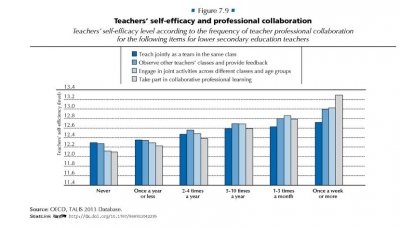
But in every country, the teachers who said their profession is valued in society tended also to report that their schools include them in decisions and that there was a positive collaborative atmosphere with other teachers at their school.  “They have the highest job satisfaction and confidence in their teaching abilities,” said Belanger. “It’s true across the board.”   The graphic on the upper right corner, Figure 7.9 from the TALIS report, shows that the teachers who collaborate more feel more confident about their teaching abilities. Click on it to see a larger version.
The TALIS report highlighted a number of concrete ways that schools can foster collaborative What makes for happier teachers, according to international survey | Education By The Numbers:

California Teachers Pensions Take Another Hit From Politicians

California Teachers Pensions:


California Teachers Take Another Hit From Politicians

California Teachers PensionsWith Democratic Governor Jerry Brown in office since 2011 and the Democratic Party winning a supermajority in the state legislature in 2012, one might think that organized labor was secure and riding high. At least, that is the impression organized labor projects during campaign season. But the Democratic politicians have used their supermajority to serve up a cruel bill of fare to working people, who are still trying to digest it.
There are two public retirement systems in California, and with the drop in the return on investments during the Great Recession both became underfunded. Governor Brown first targeted CalPERS (California Public Employees’ Retirement System) and managed to push through reforms that included raising the age of retirement and raising the amount public workers contribute to the fund. Unions offered no significant opposition to these concessions.
This year Brown has tackled CalSTRS (California State Teachers’ Retirement System), which covers K – 12 and community college teachers. In addition to increasing the amount the state and school districts contribute, he has proposed that teachers pay an additional 2.25 percent of their salary to the retirement fund.
One might think that the California Federation of Teachers (CFT) would have strongly opposed Brown’s proposed concessions from teachers, given that it is one of the more “progressive” unions in the state and many of its members are covered by CalSTRS. Quite the contrary: it wrote Governor Brown, saying it “would like to thank you for proposing a solution to addressing the current unfunded liability of CalSTRS” and merely asked Brown to extend the timeline for the implementation of some of his proposals. CFT explained why it embraced Brown’s proposal in this way: “CFT believes that all stakeholders are responsible for solving the CalSTRS unfunded liability.”
Superficially and at first glance, one might agree with CFT that Brown’s proposal seems fair. All stakeholders should pay. But after taking a step backwards and surveying the entire context, a different conclusion emerges.

Public school teachers’ retirement benefits — at least the part taxpayers pay for — are smaller than those of virtually any other type of public employee, despite frequent claims that teachers’ pensions are excessive and diverting precious dollars from education and other essential government services.

For example, a recent study found that in California “public school teachers’ retirement benefits — at least the part taxpayers pay for — are smaller than those of virtually any other type of public employee, despite frequent claims that teachers’ pensions are excessive and diverting precious dollars from education and other essential government services.”
Given that teachers’ pensions are lower, it is only reasonable that their current salaries should be higher so that they can prepare for this frugal future. Instead, Brown is proposing their salaries bCalifornia Teachers Pensions:

Teachers protest in downtown Seattle, say Bill Gates is ruining education - GeekWire

Teachers protest in downtown Seattle, say Bill Gates is ruining education - GeekWire:


Teachers protest in downtown Seattle, say Bill Gates is ruining education

IMG_8915
Bill Gates has poured millions of dollars into public education reform in the U.S., and some teachers aren’t too thrilled about that.
About 150 instructors from the Badass Teacher Association marched through downtown Seattle toward the Bill & Melinda Gates Foundation on Thursday evening to demonstrate their disdain for the Common Core standards that have been implemented in 45 states, thanks largely to support from the Gates Foundation.
IMG_8917The Foundation has not only put more than $200 million toward the initiative, but also helped organize the political push necessary to implement Common Core, which recommends skills students should learn in each grade but does not set a specific curriculum — that’s up to individual states.
But as detailed in thisWashington Post article from earlier this month, there’s been more and more pushback recently from both teachers and politicians on the standards. Some accuse Gates for supporting Common Core not for the benefit of students, but rather for corporate interest and to help Microsoft’s bottom line because the standards support technology and data.
That sentiment was apparent on the streets of Seattle Thursday.
“We want to get corporations out of teaching,” said Tom O’Kelley, an English teacher at Tacoma’s Oakland High School. “They are trying to turn public schools into a corporate money maker and push out the voice of teachers like we have no idea what we’re doing in Teachers protest in downtown Seattle, say Bill Gates is ruining education - GeekWire:

License to Loot | EduShyster

License to Loot | EduShyster:


License to Loot


 How Michigan charter schools became prime feasting ground for edu-vultures.

turkey vultureBy Tim Fournier
I started teaching in the Detroit Public Schools in 1993, the very year that Michigan approved its first charter schools. Last week The Detroit Free Press published the results of a year-long investigation into the state’s now 20-year old experiment with charters. The series confirms what many of us predicted back then: that freeing these schools from oversight has left them uniquely vulnerable to profiteers, hucksters and charlatans. *Vultures* was the word I used in this letter to the editor I wrote back in 1996.
The wheat from the chaff
When the first charter in Michigan opened its doors, advocates made a pact with state taxpayer: remove the *bureaucratic shackles* and innovation would logically follow, reaping better student outcomes. And as parents exercised choice, the market would respond by separating the wheat of excellence from the subpar chaff.
zebra musselsMeet the Zebra mussels
But as the Detroit Free Press series makes clear, only the choice part of the equation held up. While parents left neighborhood schools and even private schools in droves (an estimated 140,000 Michigan students currently attend License to Loot | EduShyster:

With ‘Harris’ Ruling, Supreme Court Silences Voices of Working Families | NEA Today

With ‘Harris’ Ruling, Supreme Court Silences Voices of Working Families | NEA Today:


With ‘Harris’ Ruling, Supreme Court Silences Voices of Working Families

June 30, 2014 by twalker  
Filed under Featured NewsTop Stories
Share
By Mary Ellen Flannery and Tim Walker
Today, the U.S. Supreme Court, in a narrow 5-4 decision, voted to eliminate fair share, or agency fee, arrangements for Illinois home health care workers. National Education Association President Dennis Van Roekel said the ruling in Harris v. Quinn, in addition to undermining the rights of public workers, creates more uncertainty and instability in the workplace as the nation continues to struggle to overcome the devastating effects of the Great Recession.
“Quality public services, economic stability and prosperity starts with strong unions, but today the Supreme Court of the United States created a roadblock on that path to the American Dream. This ruling jeopardizes a proven method for raising the quality of home health care services—namely, allowing home health care workers to join together in a strong union that can bargain for increased wages, affordable health care and increased training,” Van Roekel said.
The case against the state of Illinois was filed by the National Right to Work Legal Defense Foundation (NRTW), a political group funded by billionaires like the Koch brothers and Walton family. It’s the latest in a decades-long effort to weaken the rights of working people and make it more difficult for them to join together to improve their jobs and the quality of services they provide.
The plaintiff, Pamela Harris, is an Illinois home-care provider who didn’t want to pay her fair share for union representation, as required by Illinois law.  All union members who enjoy the benefits, rights, and protections of a contract should, in fairness, and must, according to Illinois state law, contribute to maintaining that contract. Sometimes called “agency fee,” fair share is a percentage of full union dues, based on the actual cost of collective bargaining, contract maintenance, and other services provided to allunion members.  Fair share dues are not used for political or ideological activities.
Employers and states also have filed in support of fair share arrangements—because they know they work. In Illinois, home-care providers say their collectively bargained contracts have led to more job security, better training and support for workers, and consequently, and most importantly, to much improved care services for their patients.
“Agency fees are a common-sense, straight-forward way to ensure fairness and protect equity and individual rights,” explains Van Roekel. “Every educator who enjoys the benefits and protections of a negotiated contract should, in fairness, contribute to maintaining the contract. And fair share simply makes sure that all educators share the cost of negotiations for benefits that all educators enjoy, regardless of whether they are association members.
NEA, joined by the California Teachers Association and Change to Win, a federation of labor unions, filed anamicus brief with the Supreme Court to expose the truly radical nature of NRTW’s arguments and underscore their audacious claim that public-sector collective bargaining itself is constitutionally suspect.
Van Roekel, although deeply troubled by today’s decision, said public sector workers will continue to organize—in public sector bargaining states and non-bargaining states, in agency fee states and right to work states.
“Public sector workers know that a union is the best way for all of us to ensure good schools, quality public services and economic prosperity.”