Latest News and Comment from Education

Tuesday, June 3, 2014

6-3-14 the becoming radical | A Place for a Pedagogy of Kindness (the public and scholarly writing by P. L. Thomas, Furman University)

the becoming radical | A Place for a Pedagogy of Kindness (the public and scholarly writing by P. L. Thomas, Furman University):


Education in Black and White: Beware the Roadbuilders
Nettie sees the world in a stark black and white once she faces and confronts the missionary zeal being done to the people who are native to Africa. The letters exchanged between Nettie and Celie, which constitute The Color Purple, are literally the lived stories of oppression and the oppressed right there in black and white for readers: The first thing I should tell you about is the road. The roa
Kindness as Antidote to Fatalism of “Grit”
For all the advocates of “grit”—along with the disturbing racism and classism—the world is a horrible place, a fixed horrible place—one requiring children to be treated horribly as practice for that horrible world. (I imagine “grit” advocates see the world in Cormac McCarthy’s The Road when they are planning how to “toughen our children up.”) And thus, it is that fatalism I find nearly as disturbi


6-2-14 the becoming radical | A Place for a Pedagogy of Kindness (the public and scholarly writing by P. L. Thomas, Furman University)
the becoming radical | A Place for a Pedagogy of Kindness (the public and scholarly writing by P. L. Thomas, Furman University): Invoking “Oliver Rule (Expanded)” for Education Reform DebateWhile it is becoming increasingly common and frustrating that the most perceptive views of political and public claims and policies come from satirical programs and their figure-heads (as I have noted recently)


6-3-14 Curmudgucation Week

CURMUDGUCATION:


The Least

I have a friend who posits a simple rule for relationships-- the person who has the least concern has the most power. The person who has less interest has more control.I'm not sure how useful the rule is for understanding romance, but it certainly does deconstruct plenty of other relationships. If dishes in the sink don't bother me, I can let them sit well past the science experimenty point at whi
6-2-14 Curmudgucation Week
CURMUDGUCATION: Cato: Why Are Schools Too Expensive?In 2005, David Salisbury published a paper for the Cato Institute entitled "Saving Money and Improving Education: How School Choice Can Help States Reduce Education Costs." As the title suggests, the paper supports school choice as the solution for a particular problem. I've considered the solution elsewhere, and so today I'm just looki


6-3-14 Perdido Street School

Perdido Street School:


UFT Contract Vote: Predictions And The Roadmap For The Future

Expected to be announced today: The teachers union’s new $9 billion contract with the city is expected to be ratified Tuesday. The secret ballots of more than 100,000 eligible members of the United Federation of Teachers will be scanned by the American Arbitration Association in lower Manhattan. Union officials hope to announce the results by mid-afternoon.Urban Ed thinks the contract passes with
6-2-14 Perdido Street School
Perdido Street School: Education Reformers Should Be Brought Up On Child Abuse ChargesNothing infuriates me more than seeing how the corporate education reform agenda has changed pre-k and kindergarten for children.Gone are the days when children were given the opportunity to learn through play, and experimentation - all of that has been replaced with hours and hours  of "academic" skill

Anthony Cody Reviews A Chronicle of Echoes | deutsch29

Anthony Cody Reviews A Chronicle of Echoes | deutsch29:


Anthony Cody Reviews A Chronicle of Echoes

June 2, 2014
Anthony Cody spent 24 years working in Oakland schools, 18 of them as a science teacher at a high-needs middle school. A National Board- certified teacher, he now leads workshops with teachers on Project Based Learning. He is the co-founder of the Network for Public Education. With education at a crossroads, he invites you to join him in a dialogue on education reform and teaching for change and deep learning.
Follow Anthony Cody on Twitter.

Book Review: Mercedes Schneider’s “A Chronicle of Echoes” Offers Tools for Defense Against Corporate Reform

Fans of Harry Potter will recall the most valuable class at Hogwarts: “Defense Against the Dark Arts.” With her new book, “A Chronicle of Echoes,” Mercedes Schneider has provided those of us working to defend public education with a work that could be called “Defense Against Corporate Reform.”
A short year and a half ago a new blogger appeared, writing from Louisiana, with a flair for following the threads of corporate reform back to their sources. Mercedes Schneider’s Deutsch29 blog  brought us research of everything from the state of New Orleans schools, to the funding of the Common Core standards, has uncovered information not often disclosed voluntarily.
Communities across the country are experiencing similar manifestations of well-funded “reform.” School board and legislative candidates willing to close public schools and expand charters, willing to undermine due process for teachers and impose test-score driven evaluations, receive unprecedented donations from billionaires thousands of miles away. Teachers organized into newly-formed and well-funded “teacher voice” groups show up to testify at legislative hearings, in support of the elimination of due process. Reports issue at regular intervals from supposedly non-partisan “think tanks,” proclaiming the public schools broken, schools of education hopeless, and calling for “disruption” via market forces.
Who are these people and organizations, and where did they come from? This spring, Mercedes has released her first book, A Chronicle of Echoes, which is a sort of handbook for understanding all the players in the corporate reform “movement.” Anthony Cody Reviews A Chronicle of Echoes | deutsch29:

NYC Educator: Pre-K Needs to Be in a Real School, Led by Real Teachers

NYC Educator: Pre-K Needs to Be in a Real School, Led by Real Teachers:


Pre-K Needs to Be in a Real School, Led by Real Teachers

Considering the Daily News expose of conditions in pre-K facilities, Mayor Bill de Blasio ought to reconsider how universal pre-K should be run. In fact, there's little reason why pre-K ought not to have the same controls, if not more, than existing city schools. There ought to be certified teachers--UFT teachers--in every room.

This article is a great argument against the for-profit corporate education mentality that has infected our collective psyche. Around the country, we offer kids all sorts of third-rate options. There are charters where our children are trained like little martinets, and cyber-charters that collect all sorts of money for kids who may or may not avail themselves of the so-called services they provide.

For our youngest and most vulnerable children, we need more than some half-assed plan to overload the already overloaded and substandard services that are now available. We need to find sufficient space to treat these children better than the million-plus children already attending public schools. We need to find better facilities than those described in the News.

If UFT is paying attention, it will serve not only the union but incoming children by insisting on very high standards. If this is to be the new introduction to school for four-year-old children, it behooves us to make them happy and motivated. We won't achieve that via the Common Core crap we've been shoving down the throats of our older children. Let John King eat rigor and grit for breakfast if he so desires. His kids go to Montessori schools where they're treated as individuals, and our kids deserve no less.

On this day when we're dumping one of the crappiest contracts imaginable on not only our members, but likely those of other unions as well, let's take a new direction and try to do something good for someone. Let's insist our children get quality pre-K, and let's be as demanding of de Blasio NYC Educator: Pre-K Needs to Be in a Real School, Led by Real Teachers:

Louisiana Educator: The “Success” of the Louisiana Recovery District is a Great Big Fraud!

Louisiana Educator: The “Success” of the Louisiana Recovery District is a Great Big Fraud!:


The “Success” of the Louisiana Recovery District is a Great Big Fraud!


The Louisiana Department of education has just released the results of the state accountability testing called LEAP and ILEAP. The report includes a percentile ranking of each of the public school systems in the state according to the performance of their students in math, and english language arts. The latest student testing results and these percentile rankings demonstrate the appalling academic performance of the Louisiana Recovery District (The RSD results are given near the bottom of the chart).   After more than eight years of state takeover and conversion of public schools in Louisiana into privately run charter schools, even the most ardent promoters of this radical privatization experiment can no longer hide its spectacular failure.

The latest state testing results in this official LDOE report now ranks the New Orleans Recovery District at the 17th percentile among all Louisiana public school districts in student performance. By the state's own calculations, this means that 83 percent of the state's school districts provide their students a better opportunity for learning than do the schools in New Orleans that were taken over and converted into charter schools. Considering the fact that a special law was passed for New Orleans that allowed the state to take over, not just failing schools, but any school performing below the state average at that time, this 17th percentile ranking places the New Orleans takeover schools just about where they were before the takeover. But in addition, the schools taken over by the Recovery District in Baton Rouge and other areas are now ranked at the 2 percentile and 0 percentile levels respectively, after 6 years of state and charter school control. That means that these two portions of the Louisiana Recovery District are absolutely the poorest performers on the state accountability testing. In two of the schools run by the RSD, the academic Louisiana Educator: The “Success” of the Louisiana Recovery District is a Great Big Fraud!:

Marie Corfield: Note to Cami: 100 excellent ways to create 100 excellent schools

Marie Corfield: Note to Cami: 100 excellent ways to create 100 excellent schools:


Note to Cami: 100 excellent ways to create 100 excellent schools

Jersey Jazzman delivered yet another blistering critique of Cami Anderson's disastrous One Newark plan calling it "illogical, innumerate, secretive, and ill-conceived". Sir Duke once again fills his post with charts, graphs, data, links to studies—you know, actual proof—that this will probably go down as the biggest public policy boondoggle in NJ history. He pointed out that Cami likes to blame the backlash on the 'political season'. (Hmmm... sorta like Christmas? Is there a Black Friday where I get coupons for showing up early and complaining louder and longer?) Then ends with a link to a Bob Braun post which calls out many players on the opposite side of the issue for not taking more aggressive action sooner:

It is now June and no organization—not the Newark Teachers Union,  not the New Jersey Education Association, not the Education Law Center, not the American Civil Liberties Union, no one—has taken aggressive court action to seek a temporary restraining order to stop this flawed plan that will cause real and irreparable damage to children in the city. Soon, within a matter of days, it will be too late to do anything.  And Anderson, despite the optimistic hopes of some in the city, now has repeatedly said she will not resign and she will continue to bury the city under the weight of her “One Newark” plan. 
Hey, guys—get real:  Cami is gaming you and you don’t even know it. Despite what The Star-Ledger editorial board says about her, she is not politically naïve nor tone-deaf.  She knows precisely what she is doing and she is winning.
Read Bob's entire post. He raises some excellent points. Stealing from JJ here, One Newark has all the makings of...
Hat tip to Jersey Jazzman
While the parents and students of Newark are fighting the good fight, they can't do it alone. It's time the major players in this fight started making some real noise. 

In the meantime, I thought I'd offer a little advice to the beleaguered superintendent. Unlike Marie Corfield: Note to Cami: 100 excellent ways to create 100 excellent schools:

Ohio’s “Dropout Recovery” Charters Increase State’s Dropout Rate, Swallow Tax Dollars | janresseger

Ohio’s “Dropout Recovery” Charters Increase State’s Dropout Rate, Swallow Tax Dollars | janresseger:


Ohio’s “Dropout Recovery” Charters Increase State’s Dropout Rate, Swallow Tax Dollars

Doug Livingston, the education writer for the Akron Beacon Journal and Ohio’s top education journalist, recently reported on the financial scam at Ohio’s so-called “dropout recovery” charter schools. These are the on-line charters that say they are serving Ohio’s most vulnerable adolescents while in reality they are, according to Livingston, making enormous profits while driving up Ohio’s dropout rate at the same time other states are significantly increasing the rate of high school completion.
It is, of course, true that these schools cater to students in danger of dropping out, but because of the way the state reimburses such schools, there is massive profit to be made. In  the first of his new series of articles Livingston explains that two-thirds of Ohio’s dropouts are from charter schools, the vast majority on-line academies that require students to sit in a cubicle with a computer for four hours a day.
In a table that accompanies his recent investigation, Livingston lists a dozen dropout-recovery charter schools with a graduation rate below 4 percent, two of them posting a 4-year graduation rate of zero percent. Seven of these schools are part of the Life Skills Academy network owned by politically connected David Brennan as part of his White Hat chain.  In a second piece, Livingston reports: “For 15 years, White Hat and its programs for high school dropouts have cornered an education market saturated with struggling students who often bounce from school to school. White Hat’s model—what founder and owner David Brennan held up as the alternative to government schools’ failing ‘one-size-fits-all’ approach—has spread to every major city in Ohio.”
“Absenteeism tops the reasons why students drop out; charter schools continue to collect tax dollars for more than a month while they are gone.” “Administrators call it churning’ or ‘school hopping’—when student drop out, disappear for months and then return.” “The state counts a dropout as an event, not as a person. If one student drops out three times in one year, that is three dropouts. It happens, a lot.” The state requires that students who are absent or truant for more than 23 days be taken off school rolls, but during that 23 days, the state reimburses the school. Livingston explains: “There were more than 11,000 removals for Ohio’s “Dropout Recovery” Charters Increase State’s Dropout Rate, Swallow Tax Dollars | janresseger:

Stellar History Teaching in Failing Schools (Part 2) | Larry Cuban on School Reform and Classroom Practice

Stellar History Teaching in Failing Schools (Part 2) | Larry Cuban on School Reform and Classroom Practice:


Stellar History Teaching in Failing Schools (Part 2)

Taking pills and sprays to remedy illness is ubiquitous in the U.S.  Ah, if there were only such quick cure-alls for lousy teaching. Say, like aerosol cans that can spray “good” teaching into a classroom.07teachers-art6-articleInline


Or maybe principals can ship cans of breakfast food to certain teachers’ homes.
07teachers-art3-articleInline


Contrary to this magical thinking, first-rate teaching takes a lot of smarts, time, energy, and determination, not sprays or cans. In this post, I will describe one example of what I consider “good” teaching based on my recent observation of the teacher and his class in a history lesson in a minority-dominated high school on the East coast.**
Burt Taylor* is completing his fifth year as a world history teacher at Charlotte Forten High School (CFHS). After graduating college, he served in the U.S. Army for over three years. While serving in Afghanistan, his mother sent him Frank McCourt’s Teacher Man and urged him to consider teaching after he left the service. He did. In 2007, He joined Teach for America. After his five weeks of training in Philadelphia (which he found of little use in his first year as a teacher), he was sent to a large Eastern urban school district. He began teaching world history there in 2009.
While he did not major in history as an undergraduate, he does have (and did enjoy) a “passion for reading and studying history since I was a kid.” The African American and Latino high school students he faces for 80- and 90-minute courses four times a day, while coming to school with “many challenges,” has made teaching at CFHS “rewarding.”
Finishing his fifth year, Taylor remembers well the turmoil in the school since he began teaching. The turmoil, however, came not from students but from the Stellar History Teaching in Failing Schools (Part 2) | Larry Cuban on School Reform and Classroom Practice

Alarming Number Of Urban Teachers Are 'Chronically Absent'

Alarming Number Of Urban Teachers Are 'Chronically Absent':


Alarming Number Of Urban Teachers Are 'Chronically Absent'


Political battles over teaching in the last decade have focused on complexities of pensions, evaluations and standardized testing, often ignoring a basic but critical issue: Attendance.
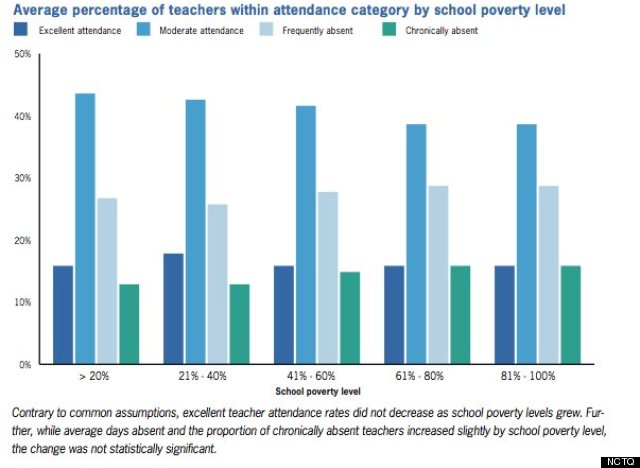
Teachers in the nation's 40 largest school districts came to school 94 percent of the time in the 2012-2013 school year, according to the report released Tuesday by the National Council on Teacher Quality, a think tank that advocates tougher teacher evaluations. "Like clockwork," said Nancy Waymack, the group's managing director of district policy. On average, the urban teachers missed about 11 school days out of 186, and used slightly less than their allotment of short-term leave.
But the National Council on Teacher Quality classifies 16 percent of teachers in those cities as "chronically absent," meaning they missed 18 or more days per school year. Together, chronically absent teachers accounted for one-third of all teacher absences. Districts with formal policies designed to discourage teachers from missing class "do not appear to have better attendance rates than those without such policies," the report concludes.
teacher absences share
The Washington-based National Council on Teacher Quality fueled many of the ongoing teacher evaluation battles, producing reports urging states to include test scores in teacher evaluations. The group, funded by philanthropists backing the so-called education reform movement, has also tried to shake up education schools byranking them and evaluating their curricula.
As the group collected information on teaching quality, it presented findings to individual school districts. Year after year, Waymack said, district officials expressed surprise with teacher attendance numbers -- an area her team initially thought would be familiar to administrators.
"It occurred to us that teacher attendance could be a very easy win to increase teacher quality. Regardless of how effective a teacher is, it doesn't matter if they're not in a classroom," Waymack said. "There's a substantial cost both academic and financial to absences when they're larger than they need to be."
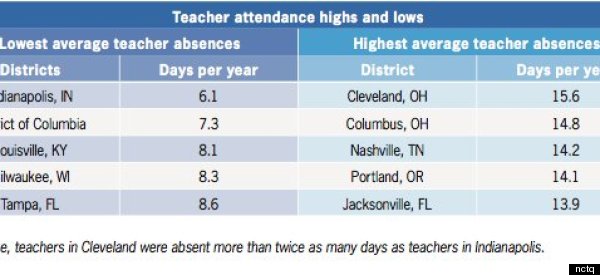
The study found that the 40 urban districts spent about $424 million on substitute teachers in 2012-2013. Of those districts, Cleveland and Columbus in Ohio, and Nashville in Tennessee, had the largest number of average days absent. Louisville, Ky., Washington, D.C., and Indianapolis had the fewest. In 11 districts, teachers had more absences than the number of short-term leave days offered by the district. The study speculates that those teachers took unpaid leave, or used those days for authorized professional development activities.
teacher attendance cities
To minimize absences, the study suggests changing school culture by requiring teachers to call principals to report absences rather than using an online absence Alarming Number Of Urban Teachers Are 'Chronically Absent':

Monday, June 2, 2014

NJEA, AFT: How about a robo-call apology for backing Cory Booker? | Bob Braun's Ledger

NJEA, AFT: How about a robo-call apology for backing Cory Booker? | Bob Braun's Ledger:


NJEA, AFT: How about a robo-call apology for backing Cory Booker?

FacebookTwitterEmailLinkedInGoogle+StumbleUpon
NJEA President Wendell Steinhauer
The New Jersey Education Association (NJEA) spends a fortune of members’ dues money on what loosely could be called “communications”–advertising, promotion, public relations, marketing, and other methods of getting its message out. And, last year, it put a lot of that effort behind the election of Cory Booker as United States senator despite Booker’s embrace of ultra-conservative educational policies, including vouchers. You’d think that, this year, it would use the same approach to correct that awful mistake–but it hasn’t.
Nearly two years ago, Randi Weingarten, the president of the American Federation of Teachers, stopped by Newark long enough to help seal a hare-brained, privately-financed merit pay deal between its Newark Teachers Union and Cami Anderson, the dictator personally selected by Booker to make Newark the “charter school capital” of the country. Anderson has used the pact to weaken the NTU and other unions. You’d think that, this year, the NTU would try to recover lost ground to the union-busters–but it hasn’t.
Both unions have ways of communicating to its members the sense of its leaders on educational issues. In the past, I have received lectures on bureaucratic procedures aimed at explaining why the NJEA, for example, had to make this decision or that about its views.
“We’re a membership organization,” I’ve been told. “We can’t be far ahead of our NJEA, AFT: How about a robo-call apology for backing Cory Booker? | Bob Braun's Ledger:

Do Teachers Need Dress Codes to Know What to Wear at School? | NEA Today

Do Teachers Need Dress Codes to Know What to Wear at School? | NEA Today:


Do Teachers Need Dress Codes to Know What to Wear at School?

June 2, 2014 by twalker  
Filed under Featured NewsTop Stories
Share
By Edward Graham
Although the vast majority of educators dress in professional attire for the classrooms and schools where they work, some schools districts are nonetheless drafting and implementing dress code policies for school employees. Although the push towards standards may seem relatively benign, these efforts bring up renewed questions about teacher professionalism and what constitutes “required educator attire.”
Teachers in West Virginia’s Kanawha County School District are protesting a proposed dress code that’s currently being considered by the local school board.
The dress code would ban facial piercings, visible tattoos (teachers would have to cover them up), flip-flops, and “immodest” dress. Hair and nails are to be clean and neatly groomed, and those who work around moving equipment will be required to maintain shoulder length hair or secure it in place.
One of the more ambiguous inclusions is the prohibition of blue jeans, unless they are “dress jeans.” It’s these kinds of vague policies and stipulations that have teachers, who move from role to role within a school on a moment’s notice, wondering why standards are becoming a hot-button issue when the vast majority of teachers dress in a professional manner that suits their in-school role.
Several right-wing media outlets naturally have seized upon the episode in Kanawha County as a way to portray teachers’ displeasure as privilege and pettiness. The real issue, of course, is respect, says teacher Donna Hanshew.
“It makes you feel like you’re not considered a professional,” Hanshew told the Charlestown Gazette. “It’s just like everything else — you deal with the people who are the problem; you don’t need to punish the majority. It’s just like in school — you don’t punish the whole class for what one student did.”
“When you’ve got schools that are falling down — literally falling down around you — and then you’re making a big deal out of a dress code for teachers, what does that say about your priorities?” Hanshew added.
For Parents As Well?
In April, a school board member in Palm Beach County, Florida, suggested a new dress code – not for students or teachers, but for parents. Karen Brill said she was miffed at the sight of parents picking up or dropping off their children looking unkempt and wearing ill-fitting pants, pajamas or “short shorts.”
The idea however, failed to gain any traction as members said it was important that schools are inviting to parents, regardless of what they may be wearing.
Debra Wilhelm, president of the Palm Beach County Classroom Teachers Association, strongly opposed dress codes for parents, calling them a waste of time and impractical.
“Who’s going to enforce it?” she asked. “Are they going to have school police arrest parents?”
“Our association believes the administration should address inappropriate dress by professionals on an individual basis as opposed to throwing everyone under the bus,” explains Dinah Adkins, president of the Kanawha County Education Association. “The large majority of educators dress professionally and appropriate for daily activities. In our county only one board member actually supported the implementation of a dress code.”
Although many school districts across the country have defined dress codes for students and educators, teachers become peeved when school and local administrators turn to enforcing stricter dress code policies, often for no reason at all. Many educators object, not because they want to look unprofessional, but because they see this as yet another unnecessary and insulting attempt to limit their rights and demean the profession.
“We are professionals, and we don’t need somebody telling us what we need to wear to work,” says Bill Do Teachers Need Dress Codes to Know What to Wear at School? | NEA Today: