Latest News and Comment from Education

Thursday, November 7, 2013

CAUTION: Technology! | the becoming radical

CAUTION: Technology! | the becoming radical:

CAUTION: TECHNOLOGY!


In the myriad debates surrounding implementation of Common Core and the concurrent tests, the sheer costs of this process tends to be ignored. Another issue related to both CC and the related costs is yet another series of commitments to technology as a part of the perpetual education reform process. Here is a reposting of a presentation [see Note below] I gave offering a stern caution about our repeated rush to embrace technology:
Author Kurt Vonnegut quipped, “Novels that leave out technology misrepresent life as badly as Victorians misrepresented life by leaving out sex.” As with novels, so with schools, I believe, but we must take one step beyond “whether schools should address technology” to “how.”
In Walden, Henry David Thoreau offered two warnings that should guide how we approach technology: “We are in great haste to construct a magnetic telegraph from Maine to Texas; but Maine and Texas, it may be, have nothing important to communicate,” and, “We do not ride on the railroad; it rides upon us.”
It’s a Book, Lane Smith
Shifting from seeking technology for technology’s sake to critical technological awareness
• Caution: Inflated costs (market forces) in state-of-the-art technology
• Caution: Pursuing state-of-the-art technology is self-defeating since “state-of-the-art” is a moving target; teaching 

11-7-13 @ THE CHALK FACE

@ THE CHALK FACE:


NAEP? Nope: Why (Almost) Everyone Will Misread (Again) Data on Gaps
NAEP? Nope: Why (Almost) Everyone Will Misread (Again) Data on Gaps. via NAEP? Nope: Why (Almost) Everyone Will Misread (Again) Data on Gaps.


Schools Matter: Union Leadership as Political Sleight of Hand
Schools Matter: Union Leadership as Political Sleight of Hand. via Schools Matter: Union Leadership as Political Sleight of Hand.
  
11-6-13 @ The Chalk Face
@ THE CHALK FACE: The Two Sides of Education Reform in Washington, D.C.Education reform is failing traditional D.C. public middle schools located east of the Anacostia River. Although certain popular education debates, i.e. discussions centered on the merits of school choice, common core, teacher evaluations, etc., may dominate the education policy world; The failures, or shortcomings, of educatio

11-7-13 Perdido Street School

Perdido Street School:


John King: Learning Should Not Be Fun
.@SoniaBasko learning is fun for only Montessori students, the rest can eat Common Core cake. #roc forum— Chris Cerrone (@Stoptesting15) November 7, 2013With the Common Core and NYSED modules, I'd say John King's mission has been accomplished.

Bloomberg Plans To Spend His Post-City Hall Days On Propaganda Touting Himself
I've long said that we will never get a fair and accurate portrait of the Bloomberg Years - especially around the corruption and data manipulation in the various agencies, the DOE, the NYPD and FDNY, etc - because Bloomberg plans a huge post-City Hall propaganda offensive to tout himself as the bestest mayor ever and he owns so many media outlets (with the threat of buying even more) that there ar

Michael Mulgrew And Leo Casey Just Like The Fonz
.@PSulliv yup, wonder if @LeoECasey will apologize to @carolburris now & admit she was right— leonie haimson (@leoniehaimson) November 7, 2013Mikey and Leo now criticizing the teacher evaluation system they helped develop and defend against criticism from Carol Burris and Diane Ravitch.Mikey and Leo are criticizing the system for some of the very reasons Burris and Ravitch criticized it in the

Another Bloomberg Education Failure
From NY1:It's half school, half extracurricular, all hands on. For two years, the city's Summer Quest program has provided extra learning for thousands of struggling students in the South Bronx, nine hours a day, five days a week for five weeks.For the students, the goal is to prevent summer learning loss, a big problem for low-income kids. For the program, the goal is to prove that it works and t
A Strategy For The First Year Of De Blasio's Term As Mayor
Lorenzo St DuBois in a comment here at Perdido Street School:In 2008 I could not believe what I was hearing out of a presidential candidate: thoughtful, intelligent, scornful of soundbites, refreshing rhetorical breaks from tepid democratic compromises. Talking about a more nuanced foreign policy, bringing back constitutional checks, bringing back regulation and a focus on the middle class, skepti

11-6-13 Perdido Street School
Perdido Street School: How De Blasio And His Team Ran A Very, Very Savvy CampaignGood summary in the Daily News on how de Blasio and his team crafted a message of change, stuck with that message, and rode it all the way to Gracie Mansion, with the help of his some affecting ads using his family and the ineptitude of his opponents.Nothing surprising in the article, but it does show how deft a campa

To Lisa Macfarlane and Suzanne Estey: And you thought it was a conspiracy theory? | Seattle Education

To Lisa Macfarlane and Suzanne Estey: And you thought it was a conspiracy theory? | Seattle Education:

To Lisa Macfarlane and Suzanne Estey: And you thought it was a conspiracy theory?

Either your comments have been overly scripted by your moneyed backers or you have been bold face lying but these are the facts:
Chris Christie and Bill Gates
New data proves conservatives and moguls are spending huge sums to turn schools into Wall Street profit centers
It is easy to think of the concept of oligarchy as something distant and fantastical – something that involves exotic destinations like Manhattan, Monaco, Macau and Moscow but not the Middle America locales that you’d never see in, say, a glitzy Jason Bourne flick. I guess the assumption at work is that in a place so often derided as Flyover Country, there’s not much that any true oligarch might covet.
Of course, there’s a good case to be made that oligarchy is actually more of a powerful social, political and cultural force out here than anywhere else. From yesteryear’s Copper Kings in Montana to today’s epic land and water grab all over the Midwest and Rocky Mountain region, the heartland has always been the oligarchs’ playground. It is also their laboratory – the place where the ruling class brutally imposes its hare-brained schemes on the population, as if we are guinea pigs.
You can see what this local version of oligarchy looks like most clearly in education. Indeed, in the last few days, the national media momentarily reported on such oligarchy when the GOP’s prospective 2016 presidential candidate, New Jersey Gov. Chris Christie, publicly berated teachers with the ugly “you people” epithet. The headline-grabbing exchange came after an educator dared to question him about his efforts to turn his state into a laboratory for the destructive ideology of anti-public-school 

States’ testing exec embraces California’s controversial decision for Common Core tests EdSource Today

EdSource Today:

Joe Willhoft discussed the forthcoming Common Core field test before the State Board.
The executive director of Smarter Balanced, a consortium of states developing the new Common Core assessments, said he supports California’s decision to give the field, or practice, test in the new standards to all students next spring, rather than limit the pilot to a small test group as other states are doing.
“The field test is a great opportunity to pressure-test” districts’ capacity to handle computer-based assessments, Joe Willhoft said in comments Wednesday before the State Board of Education. “I applaud California for its decision to expand to as many schools as possible.”
Willhoft’s remarks won’t solve the state’s conflict over the field test with the U.S. Department of Education, which is threatening to withhold an estimated $45 million it gives the state Department of Education to administer federal Title I programs and standardized tests. But Willhoft did support the state’s reasoning, and he said he wished more of the 26 Smarter Balanced states had followed California’s example.
U.S. Secretary of Education Arne Duncan has offered to exempt school districts and states from giving their state standardized tests for grades 3 through 8 and 11 if they give the Common Core 


State board backs off integrated science standards in middle school - by Kathryn Baron
In a surprise move that disappointed California’s top educator but relieved some teachers, the State Board of Education on Wednesday backed away from a proposal that would have radically changed the way middle school students learn science. The State Board had been expecting to vote on a recommendation to teach integrated ... [[ This is a content summary only. Visit the Edsource Today website for

Building school district stability extends beyond the superintendent - by Charles Taylor Kerchner / Special to EdSource
The Los Angeles Unified School District board bought itself a little stability last week when it extended Superintendent John Deasy’s contract for a year by handing him a “satisfactory” rating in his annual evaluation. Buying stability can be a good thing; it’s a key to educational success. “Stability helps move toward continuous improvement,” said ... [[ This is a content summary only. Visit the

What is Wrong with Vouchers? | Deborah Meier on Education

What is Wrong with Vouchers? | Deborah Meier on Education:

What is Wrong with Vouchers?

Nicholas Meier

The rhetoric behind vouchers is that if everyone had vouchers parents could select the best school for their child instead of being forced to go to “government” schools*.
Where does such logic fall apart? There are two main logistical reasons it is really a false promise. One is economic and the other is question of who gets to choose.
The private schools that the elite send their children to cost tens of thousands of dollars a year to attend. I looked up a few progressive private schools and tuition ranged from $20,000 to well over $30,000, more than many private colleges. And the actual amount they spend per pupil is well over the tuition since they raise lots of extra money from alumni. (They also tend to pay their non-unionized teachers significantly less than public schools.)
Since at best the voucher proposals I have seen only pay a small fraction of that, these vouchers will leave the recipients with few real choices without putting out a lot more money. I do not think the public is going to go for vouchers of $20,000+ and have never even heard such figures discussed. If 
Deborah Meier Fan Page
Proud Mom
This is the latest blog of my son, Nicholas.

Jason Carter enters the governor's race and brings a focus on... | Get Schooled | www.ajc.com

Jason Carter enters the governor's race and brings a focus on... | Get Schooled | www.ajc.com:

Jason Carter enters the governor's race and brings a focus on education 

State senator is grandson of former President Jimmy Carter
Sen. Jason Carter, D-Decatur, asks a question about House Bill 487 during Legislative Day 34 in the Senate Chambers at the State Capitol on March 14, 2013.
Jason Carter is running for governor.  Since he was elected a state senator from the Decatur area, the grandson of Jimmy Carter has made education his focus. He has championed changes to HOPE that considered rural students and has traveled the state on a listening tour on school issues.
His entry into the governor’s race will put a new emphasis on education. From the very start, Carter has been talking about education, often sending me notes about issues that he thinks need legislative action. And he reads everything, including all those long, tedious reports that many lawmakers just toss aside.
I am happy to see him enter the race as education deserves more attention in the Georgia State House.
Before we get the kneejerk reaction here on the blog that the younger Carter is running on his grandfather’s coattails, let me 

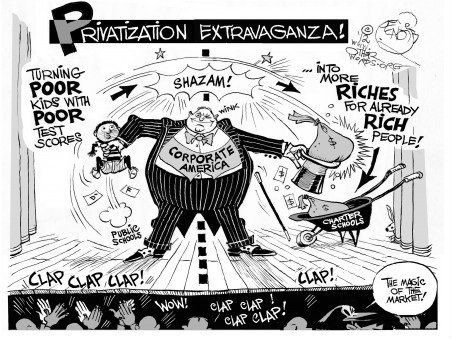
Privatization of Education Won’t Erase Savage Inequalities | janresseger

Privatization of Education Won’t Erase Savage Inequalities | janresseger:

Privatization of Education Won’t Erase Savage Inequalities

For generations our society has committed itself to the provision of public education—publicly funded, universally available, and accountable to the public—as the best institution for balancing the needs of each particular child and family with the need to crate a system that secures the rights and addresses the needs of all children.
New articles published this week trace two specific ways we are veering from these ideals.
In the New York Times, Eduardo Porter reports that In Public Education, Edge Still Goes to Rich.  Porter quotes Andreas Schleicher, who manages international educational assessments for the Organization for Economic Cooperation and Development (O.E.C.D.): “The bottom line is that the vast majority of O.E.C.D. countries either invest equally into every student or disproportionately more into disadvantaged students.  The U.S. is one of the few countries doing the opposite.”  Porter provides stunning numbers that document educational investment disparities reminiscent of the Savage Inequalities Jonathan Kozol reported 22 years ago.  According to Porter, “In New York… in 2011 the value of property in the poorest 10 percent of school districts amounted to some $287,000 per student…. In the richest districts it amounted, on average, to $1.9 million.”  Porter reports that spending per-pupil across the states ranges 

NYC Educator: Does Common Core Align with Danielson?

NYC Educator: Does Common Core Align with Danielson?:

Does Common Core Align with Danielson?

I look at the Danielson Rubric and I see an awful lot about engaging the students. Active, happy kids are a big plus if they're using the Danielson Rubric. You want them to be asking questions on their own, to know there are procedures in place, and to remind one another what they are. You want them in groups, and you want the groups established for some reason or other.

And yet, Common Core is all about rigor. You read how David Coleman, or whatever expert they have this week, says no one wants to know how kids feel. That's not important. The important thing is to get them to read archaic documents with language no one uses anymore, and to have them answer incredibly difficult questions. And just in case they accidentally slip in anything that's fun in any way, you will analyze it so deeply that every last drop of fun will be utterly squeezed out of it.

I always thought how people feel is important. In fact, I thought if you read things that touched your feelings in some way, you'd like them better. I always try to find things like that for kids to read, so that reading becomes a positive experience for them. Yet now, with Common Core telling us that To Kill a Mockingbird