Latest News and Comment from Education

Tuesday, May 14, 2013

Panel to discuss pushback on high-stakes testing | Philadelphia Public School Notebook

Panel to discuss pushback on high-stakes testing | Philadelphia Public School Notebook:


Panel to discuss pushback on high-stakes testing

by Helen Gym on May 14 2013 Posted in Commentary
A panel on high-stakes testing features prominent speakers Michelle Fine and Stan Karp.
High-stakes testing and communities pushing back have been all over the news lately. Just this week, Senate Democratic leaders held a press conference opposing the implementation of Keystone exams, mandatory end-of-course state exams which will go into effect for September's 9th grade class. Amidst a backdrop of unprecedented statewide level cuts under the Corbett administration, Senate leaders said the Keystones would "cost taxpayers dearly" and were being implemented "without a full understanding of the benefits for students, teachers, administrators, and taxpayers.”
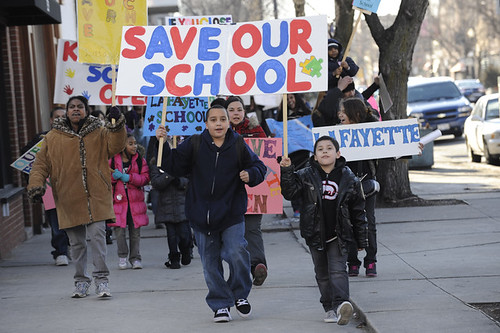
In fact Keystone Exams, which were reported to cost as much as $176 million to develop and will cost districts $31 million per year to implement, are just the latest round in the high-stakes testing battle. The narrative of "failing schools" has been used to justify all manner of intervention: charter schools, union busting, value-added teacher evaluations, and school closures. In the war on public education

Seattle Schools Community Forum: A Good Day for Seattle Education

Seattle Schools Community Forum: A Good Day for Seattle Education:


A Good Day for Seattle Education

I just got back from a news conference where it was announced that the City of Seattle will be investing $500,000 in arts education in Seattle Public Schools.  This will advance the already established partnership between the City and SPS called The Creative Advantage.

The goal is one hour of music and one hour of visual arts per week for every single student in SPS by 2020.

The investment dollars came from something of a surprising source - admission tax revenue from the Great Wheel on the waterfront and the Chihuly Garden and Glass museum was higher than expected.  So thank you tourists for those dollars. 

The $500k will be invested over the next two years to start rolling out the planning done under the $1M Wallace Foundation grant.  The Central district will be the first to see some dollars starting next year.  That area was chosen because of already strong partnerships  with community-based arts organizations.   SPS' Carri Campbell said that they would be building out music for every elementary that feeds into Washington Middle School.  She 

More on Opting Out of SOL Exams in Virginia | PWC Education Reform Blog

More on Opting Out of SOL Exams in Virginia | PWC Education Reform Blog:


More on Opting Out of SOL Exams in Virginia

Torlakson Reacts to May Revise - Year 2013 (CA Dept of Education)

Torlakson Reacts to May Revise - Year 2013 (CA Dept of Education):


State Schools Chief Tom Torlakson Issues Statement on Governor's May Revision


SACRAMENTO—State Superintendent of Public Instruction Tom Torlakson today issued the following statement after Governor Brown released his May Revision of the 2013-14 state budget:
"As a teacher, it's heartening to finally see new resources directed to California's schools after so many years of painful cuts. Californians want our schools back on solid financial ground, and Governor Brown's proposal represents another important step in the right direction.
"I'm particularly pleased to see a substantial share of these new investments devoted to helping our schools prepare, train, and equip themselves to fully implement the Common Core State Standards. These funds will help California's schools prepare children for the challenges of a constantly changing world, and graduate armed with the real-world skills they need to thrive in college and a career.
"In addition, we must continue to work to see that all children, including our youngest and most vulnerable, benefit from California's recovery. We must commit ourselves to rebuilding California's early learning system—which suffered nearly $1 billion in cuts over the past few years—with this budget and in budgets to come."
Related Content
  • Education Budget - Public school funding is the largest program in the state budget, receiving more than 40 percent of the state's General Fund resources. The 2012–13 state budget includes $38 billion for kindergarten through grade twelve (K–12) education.(truncated)
# # # #
Tom Torlakson — State Superintendent of Public Instruction

The Real Truth About CPS School Closings- Substance News

News from James Patrick - Substance News:


The Real Truth About CPS School Closings


Seventy-seven percent of African Americans in Chicago do not approve of CPS's plans to close schools and move children to other schools. CPS a few weeks ago announced 54 school closings, 11 school co-locations (with charter schools), and 6 turnarounds, estimating that approximately 30,000 students would be impacted by these actions.
However, this is not true. These school actions will affect 133 schools and 47,500 students in these proposed school actions. There are three kinds of possible impacts of these school actions:
1. Relocation of students would occur under three circumstances; a. Students from most closing schools are proposed to relocate to a receiving school. b. In 14 of the proposed school actions, students and faulty from the receiving school would relocate to the building of the closing school. c. In the 8 co-locations that do not involve a new school, students would be relocated from one co-location school to the other. Relocating students from 60 schools would be impacted by the loss existing school community; the challenges of adapting to a new school community; having to negotiate new routes to school; and disruptions to relationships, services, and learning processes in place at the current school.
2. Receiving students who have been located from another school who are enrolled in the 65 schools receiving new students would be impacted by the redistribution of school services and resources; disruptions caused by adapting to the influx of new students; and changes to the school community and relationships. Administrators, faculty and staff would be impacted by the workload of programming for, and accommodating, the incoming students and personnel; and revising service provision models in place for students with special needs and response to intervention processes.


Retirement Heist: Illinois Style | Reclaim Reform

Retirement Heist: Illinois Style | Reclaim Reform:


Retirement Heist: Illinois Style

Retirees and active teachers, along with many other public employees, are being scammed, pillage, ripped-off and betrayed. The script of this cruel Kabuki Theater of Absurd Greed has been performed, word-for-word, many times before. The 2011 nonfiction book by Ellen E. Schultz, Retirement Heist, has been plentifully awarded and updated.
Retirement_Heist
Jon Stewart has had Ellen Schultz on as a guest to discuss the book. The New York Times and the Wall Street Journal have run articles and reviews about the book. Politicians and union leaders are aware of this. We, too, need to be aware.
Jon-Stewart_Ellen-SchultzSo the first thing that is important is to realize that the retirement heist has no Illinois style. Pension theft in Illinois simply has puppets with Illinois legislative names and union names mouthing the words and following the steps.
Pages 214-215: “In the public sector, the carnage is being borne by the employees and by 

Victory in Seattle as Teachers Win Battle in Standardized Test Boycott | Common Dreams

Victory in Seattle as Teachers Win Battle in Standardized Test Boycott | Common Dreams:


Victory in Seattle as Teachers Win Battle in Standardized Test Boycott

Controversial test will not be given in high schools next year, but teachers vow to continue until test is removed at all grade levels

- Jon Queally, staff writer
Seattle teachers who took a strong and public stance by refusing to administer a "flawed" but mandatory standardized test earlier this school year are celebrating a victory after an announcement by the school district saying the Measures of Academic Progress (MAP) test will not be given to high school students next year.

"Finally, educators’ voices have been acknowledged,” said teacher Jesse Hagopian, who teaches history at Garfield High School in Seattle where the boycott movement began. “This is a great moment in the movement for quality assessment.”
"The teachers at Garfield are overwhelmed with joy," Hagopian said. “I think this is a real vindication of the movement that was started at Garfield High School by teachers but was quickly joined by parents and students at our school, and around the city, and really around the country.”
The district's decision was announced in a letter sent to school administrations throughout the city on Monday and followed on the recommendations of a review panel that looked at the testing regime and determined it was not "effective for high school-age students."
As local NPR affiliate KUOW reports:
The district requires that students in Seattle Public Schools take the MAP test in reading and math two or three times a year, from kindergarten through ninth 

The most important problem facing American children today

The most important problem facing American children today:


The most important problem facing American children today


poverty chartWhat is the most important problem facing American children today?
According to the Academic Pediatric Association and the American Academy of Pediatrics, it is the effects of poverty on the health and well being of young people. But, they concede, there is no sustained focus on childhood poverty, or a unified pediatric voice speaking on the problem, or a comprehensive approach to solving it.
To try to remedy that, the American Pediatric Association Task Force on Childhood Poverty is beginning a long-term effort to address the problem by looking for solutions that will be effective, sustained and “protected from retrenchment,” according to this brief about the work of the panel.
Children in America are the poorest members of society. One in five children live below the federal poverty line, and almost one in two are poor or near poor, with a 

Breaking the Glass Ceiling of Achievement for Low-Income Students and Students of Color | Education Trust

Breaking the Glass Ceiling of Achievement for Low-Income Students and Students of Color | Education Trust:


Breaking the Glass Ceiling of Achievement for Low-Income Students and Students of Color


Printer-friendly versionPrinter-friendly versionShare this
While gaps between student groups have narrowed over time at the below basic level of performance, gaps at the advanced level have widened. And among higher income groups, gap-widening between white students and students of color is more pronounced. Educators seeking to close gaps must raise the bar for all students.
Publication date: 
 May 14 2013
AttachmentSize
Glass_Ceiling.pdf3.83 MB

Ed Notes Online: NATIONAL TEACHER PETITION: Tell Teachers College to take a stand for REAL teaching and learning! No award for Merryl Tisch!

Ed Notes Online: NATIONAL TEACHER PETITION: Tell Teachers College to take a stand for REAL teaching and learning! No award for Merryl Tisch!:


NATIONAL TEACHER PETITION: Tell Teachers College to take a stand for REAL teaching and learning! No award for Merryl Tisch!

In the field of slime that is corporate deform, I put Merryl Tisch pretty high up on the list. That bastion of so-called progressive education, Teachers College, is giving Tisch an award at their graduation ceremony this month. And TC President Susan Fuhrman is quickly closing in. Many people are not happy. You'll be reading a lot more about this story in the next week. Some people may not prove to be civil. I wonder if there will be apologiesissued.

On May 21, 2013 Teachers College plans to give an award to the Chancellor of the New York State Board of Regents, Merryl Tisch. Given Tisch’s role in promoting the use of high stakes standardized testing in our schools, this award would be an endorsement of Tisch’s record. That’s why I created a petition to Teachers College, which says: 


 “As public school teachers, we, the undersigned, are shocked to learn that one of the premiere institutions of teacher education, Teachers College at Columbia University, will give a “Medal for Distinguished Service” this year to the Chancellor of the New York State Board of Regents, Merryl Tisch. 

As Chancellor, Tisch has committed New York State’s public schools to high stakes testing, and has personally advocated for standardized test scores to be used for promotion, school closures, and teacher bonuses. These policies are devastating our schools and the teaching profession. 

Furthermore, we are extremely concerned that the current president of Teachers College, Susan Fuhrman, serves on the board of directors of Pearson PLC, one of the largest companies responsible for the development of high stakes 

It’s About the Kids | EduShyster

It’s About the Kids | EduShyster:


It’s About the Kids

When a major Wall Street investor and the CEO of a fast growing chain of charter schools get together for a chat, what do you suppose they talk about? Well that’s obvious. They talk about the kids of course, and their shared dream of *crushing* the achievement gap in order to put those kids on a path leading straight to 21st century skills and success. In fact, when an executive from Prudential Financial and the CEO of the UNO Charter Schools in Chicago conversated this spring, the kids were topic #1. Let’s listen in, shall we?
Actual transcript of conversation between Juan Rangel, CEO, UNO Charter Schools and Steven Levy, Vice President, Prudential Financial.***
Rangel: Hello. And thank you for taking the time to speak with me today about the kids.
Levy: While I am very busy, I can always make time to talk about the kids because, as I like to say, it’s all about the kids.
Rangel: Would you like to hear about the various ways that UNO is *crushing* the achievement gap and putting kids on a path to 21st century skills and prosperity?
Levy: Boy, would I! I am investing in the future of minority kids in Chicago because I dream of a day when the financial services sector will not be dominated by the children of prosperous white 

Unified Backlash to Education Mandates Grows, Spreads

Unified Backlash to Education Mandates Grows, Spreads:


Unified Backlash to Education Mandates Grows, Spreads


“It’s always hard to tell for sure exactly when a revolution starts,” wrote John Tierny in The Atlantic  recently. “I’m not an expert on revolutions,” he continued, “but even I can see that a new one is taking shape in American K-12 public education.”
Tierney pointed to a number of signs of the coming “revolution:”
  • Teachers refusing to give standardized tests, parents opting their kids out of tests, and students boycotting tests.
  • Legislators reconsidering testing and expressing concerns about corruption in the testing industry.
  • Voucher and other “choice” proposals being strongly contested and voted down in states that had been friendly to them.
Tierney linked to a blog post by yours truly, “The Inconvenient Truth of Education Reform,” explaining how the movement known as “education reform” has committed severe harm to the populations it professes to serve while spreading corruption and enriching businesses and political figures.
Echoing Tierney, on the pages of SlateThe Nation, and elsewhere, David Kirp, education professor and author of a popular new book casting doubt on competitive driven, market-based school reform, declared that cheating scandals and parent rebellions over high stakes standardized testing were proof that much ballyhooed reform policies championed by New York City Mayor Michael Bloomberg and Education Secretary Arne Duncan are not “a proven – or even a promising – way to make schools better.”
Kirp declared that mounting evidence from school reform efforts in major U.S. metropolitan areas reveals “it’s a terrible time for advocates of market-driven reform in public education. For more than a decade, their strategy – which makes teachers’ careers turn 

Governor to add $1 billion for schools to adopt common core standards | Pass / Fail | 89.3 KPCC

Governor to add $1 billion for schools to adopt common core standards | Pass / Fail | 89.3 KPCC:


Governor to add $1 billion for schools to adopt common core standards

Governor Jerry Brown's revised budget plan being released Tuesday morning will add an extra $1 billion for K-12 schools to fund districts’ adoption of new common core standards — about $170 per student.
The Governor will also propose an extra $240 million for base district funding as part of his  funding overhaul.
Administration officials revealed the details to the Associated Press on the eve of the budget unveiling.  They also explained how the money will get divided among school districts:
  • 80 percent will be carved up among districts, based on the total number of students.
  • 16 percent will be divided based on the districts’ number of students learning English, of low-income, or who are foster children.
  • 4 percent would go to districts where the majority of students are English-learners, low-income or foster children.
Democratic leaders in the state legislature oppose the additional grants for districts with a high concentration of disadvantaged students.
Last week, Assembly Speaker John Perez (D-LA) said a deal could be reached only if the administration made 

UPDATE: MAY REVISE Governor Brown Boosts Investment in Schools California State Budget

California State Budget:


Governor Brown Boosts Investment in Schools, Continues Call for Fiscal Restraint in Revised State Budget


5-14-2013

SACRAMENTO – Governor Edmund G. Brown Jr. released a revised and balanced state budget today that strengthens California’s fiscal integrity by investing in California's schools, chipping away billions from the "Wall of Debt" and maintaining a prudent reserve.

"This budget builds a solid foundation for California's future by investing in our schools, continuing to pay down our debts and establishing a prudent reserve," said Governor Brown. "But California's fiscal stability will be short-lived unless we continue to exercise the discipline that got us out of the mess we inherited."

When Governor Brown took office, the state faced a $26.6 billion budget deficit, estimated annual gaps of roughly $20 billion and a $35 billion “Wall of Debt.” The revised budget plan unveiled today is balanced and on track to lower the state’s debt to $4.7 billion by 2017—a reduction of over 86 percent. This was achieved through billions of dollars in permanent cuts in the 2011-12 and 2012-13 budgets as well as temporary revenues passed by voters last year.

At the center of the May Revision is a significant investment in the state’s public schools. From 2011-12 to 2016-17, the Proposition 98 guarantee will increase more than $19 billion from $47.3 billion to $66.5 billion. The plan provides $1,046 more per K-12 student in 2013-14 than was provided in 2011-12 and funding levels will increase by $2,754 per student through 2016-17.

In addition to the higher ongoing funding, the May Revision proposes to invest $1 billion in one-time revenues to fund professional development, instructional materials and enhancements to technology to support implementation of new national standards for evaluating student achievement in English-language, arts and math (known as Common Core Standards).

The May Revision also adds $240 million in first-year funding for the Governor’s Local Control Funding Formula (LCFF), for a total of $1.9 billion. It gives all districts the chance to improve with new ongoing funding based on the number of students served, directs additional resources to the state’s neediest students and restores local control over how money is spent in schools. 

When fully implemented, it is projected that the formula will spend 80 cents of every dollar on base grants for every district, 16 cents in supplemental funding for every English learner, student from a low income family or foster child in a district and 4 cents for those districts who have a particularly high concentration of these students. While the concentration funds represent only a small portion of the total dollars, they are critically important to those districts with the greatest challenges. Additionally, the May Revision strengthens the proposal’s accountability measures to ensure that the targeted student populations benefit from the funds.

The May Revision also proposes:
• A state-based approach to the optional expansion of subsidized medical care allowed under federal law. This expansion will significantly increase health care coverage and access to new federal dollars.
• A revenue-neutral revamping of the state’s enterprise zone and hiring credit programs to encourage manufacturing investment and increase employment in high-poverty areas.
• An additional $48 million in CalWORKs job training and subsidized employment opportunities.
• To maintain a $500 million increase to the University of California and California State University systems with additional increases in each of the next four years to make higher education more affordable, more efficient and to maintain quality.

While the budget is projected to remain in balance for the foreseeable future, the May Revision also recognizes the risks posed to the budget – including the uncertain economic recovery, court rulings and actions from the federal government – which underscore the need to maintain fiscal discipline.

Further information on the May Revision can be found at www.ebudget.ca.gov.
###


UPDATE: May waiver calendar at SBE includes relief from Open Enrollment SI&A Cabinet Report – News & Resources

SI&A Cabinet Report – News & Resources:


Revised May budget sweetens base grant, adds flexible $1b for common core

Signaling a likely transition to student testing based on the common core standards by spring 2015, Gov. Jerry Brown announced Tuesday a plan to earmark $1 billion of the spring revenue windfall to help schools buy new textbooks, make technology improvements and provide teacher training to implement the new curriculum standards.
Brown’s revised May budget – buoyed by close to $4.5 billion in tax collections above estimates made in January –also moves to tamp down political opposition to his plan to restructure school finance, the Local Control Funding Formula.
He would use some of the additional revenue to increase the per-pupil base grant given to all districts under the formula from an average of $4,920 per average daily attendance to $5,421.
Brown’s May budget would require that the existing deficit factor reduction to revenue limits be restored before the weighted student formula is fully implemented.
The governor has also proposed that the phase-in period for his Local Control Funding Formula increase from five years to seven years.
“This budget builds a solid foundation for California's future by investing in our schools, continuing to pay down our debts and establishing a prudent reserve,” Brown said at a Capitol news conference this morning. “But California's 


May waiver calendar at SBE includes relief from Open Enrollment
By Tom Chorneau
Tuesday, May 14, 2013


Six school districts with test scores at or above the state’s performance benchmark have been granted permission to remove schools otherwise targeted by the 2013-14 Open Enrollment Act’s list of lowest performers.
The California State Board of Education, however, rejected a separate waiver request from a seventh district whose scores on the Academic Performance Index last year fell just short of the 800 mark.
The Open Enrollment Act, adopted in 2009, calls on the state to identify a list of the lowest achieving schools – later renamed ‘open enrollment schools’ – and gives families attending those schools the option of transferring to any other school statewide.
But the criteria used to identify the low-performers also required that no more than 10 percent of schools in a single school district could be placed on the transfer list. As a result, each year the 1,000 “lowest-achieving schools” identified by the state for the purposes of open enrollment also includes a significant number of schools that have achieved API scores well above the 800 mark.
Since the Legislature has since been unable to resolve the issue, the state board’s waiver authority has served as a reasonable alternative. As practiced, the SBE waiver allows districts with API scores of at least 800 to have their schools removed from the Open Enrollment Act’s list of low-performers.
While schools receiving relief are not subject to public labeling as “low-performing,” the waiver comes with the condition that the district honor any request to transfer.
Legislation to eliminate the 1,000-school limit and expand the program to every school in the state was rejected