Latest News and Comment from Education

Monday, January 21, 2013

Ed Notes Online: LEADING EDUCATORS SUPPORT TEACHER TEST BOYCOTT
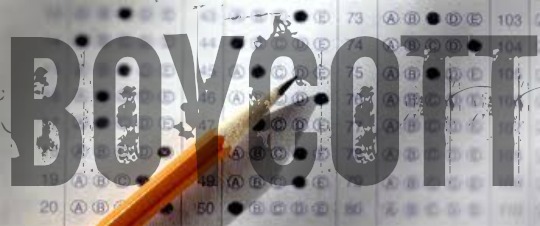
Ed Notes Online: LEADING EDUCATORS SUPPORT TEACHER TEST BOYCOTT:


LEADING EDUCATORS SUPPORT TEACHER TEST BOYCOTT


Date:  January 21, 2013

Contact:  Brian Jones, Teacher and Doctoral Student, 646-554-8592 bjones2@gc.cuny.edu 
Wayne Au, Professor of Education, wayne@rethinkingschools.org


LEADING EDUCATORS SUPPORT TEACHER TEST BOYCOTT

In a public statement released today, more than sixty educators and researchers, including some of the most well-respected figures in the field of education, pledged support for the boycott of the Measures of Academic Progress (MAP) test initiated by the teachers at Garfield High School in Seattle, calling the action a “blow against the overuse and misuse of standardized tests.” Among the signers of the statement are former US Assistant Secretary of Education Diane Ravitch, Chicago Teachers Union President Karen Lewis, author Jonathan Kozol and professor Nancy Carlsson-Paige. While the MAP test is used exclusively for rating teachers, “the test’s developers (the Northwest Evaluation Association) have noted the inappropriateness of using tests for such evaluations” the educators wrote.

“We’ve had more than a decade of standardized testing,” Ravitch said, “and now we need to admit that it’s not helping.” She added: “By signing this statement, I hope to amplify the voices of teachers who are saying ‘enough is enough’.”

“On Martin Luther King Day, we celebrate people who are willing to take personal risks to act according to their conscience,” Lewis said. “The teachers at Garfield High School are taking a stand for all of us.” 

New York City public school teacher and doctoral student Brian Jones drafted the statement last week and received help with revisions and outreach from University of Washington professor Wayne Au. “I’m overwhelmed by the response to this statement,” Jones said, “I feel like this is the beginning of a real movement to challenge high stakes standardized testing.” 

"We contacted leading scholars in the field of education," Au said, "and nearly every single one said 'Yes, I'll sign.' The emerging consensus among researchers is clear: high stakes standardized tests are highly problematic, to say the least."

"When I look at this list of names, I see the people whose work helped to make me the teacher I am today," Jesse Hagopian, a teacher at Garfield High School said. "Their support really means a lot to me, and I know that many teachers at Garfield High School feel the same way."

STATEMENT:

WE SUPPORT THE TEACHERS AT GARFIELD HIGH SCHOOL
HIGH STAKES STANDARDIZED TESTS ARE OVERUSED AND OVERRATED

THE USE OF STANDARDIZED TESTS IS SPREADING
To fulfill the requirements of the No Child Left Behind legislation, schools in all 50 states administer standardized tests to students, often beginning in third grade, in reading and math. Now, in response to the demands of Race to the Top and the trend toward greater “accountability” in education, states are developing even more tests for more subjects. Standardized tests, once used primarily to assess student learning, have now become the main instrument for the high-stakes evaluation of teachers, administrators, and even entire schools and school systems. 

TESTS CONSUME A GREAT DEAL OF TIME AND MONEY
Standardized testing is consuming an ever-growing proportion of education budgets nationwide. The total price tag may be nearly two billion dollars (1). Texas alone spent, last year, $90 million on standardized testing (2). These tests are not a one hour or one day affair, but now can swallow up whole weeks of classroom time (3). In Chicago, some students must complete 13 standardized tests each year (4).

TESTING HURTS STUDENTS
In the name of “raising standards” the growth of high stakes standardized testing has effectively lowered them. As the stakes for standardized tests are raised higher and higher, administrators and teachers have been forced to spend less time on arts, sciences, social studies, and physical education, and more time on tested subjects. The pressure to prepare students for standardized exams forces teachers to narrow instruction to only that material which will be tested (5). With the fate of whole schools and school systems at stake, cheating scandals have flourished, exposing many reform “miracles” in the process (6). Worse, focusing so much energy on testing undermines the intrinsic value of teaching and learning, and makes it more difficult for teachers and students to pursue authentic teaching and learning experiences.

RESEARCH DOES NOT SUPPORT USING TESTS TO EVALUATE TEACHERS 
As a means of assessing student learning, standardized tests are limited. No student’s intellectual process can be reduced to a single number. As a means of assessing teachers, these results are even more problematic. Research suggests that much of the variability in standardized test results is attributable to factors OTHER than the teacher (7). So-called “value-added” models for teacher evaluation have a large margin of error, and are not reliable measures of teacher performance (8).

EDUCATORS ARE TAKING A STAND FOR AUTHENTIC TEACHING AND LEARNING
In a nearly unanimous vote, the staff at Garfield High school in Seattle decided to refuse to administer the district’s Measures of Academic Progress (MAP) test. This test, which research has shown to have no significant impact on reading scores (9), has only one purpose within Seattle Public Schools -- evaluating the teachers, even though the test’s developers (the Northwest Evaluation Association) have noted the inappropriateness of using tests for such evaluations. In taking this action, the educators at Garfield High School have struck a blow against the overuse and misuse of standardized tests, and deserve support. We, the undersigned (10), stand with these brave teachers and against the growing standardized testing industrial complex. 

Signed,

Jean Anyon
The Graduate Center, City University of New York 

Wayne Au
University of Washington, Bothell
Rethinking Schools 

Bill Ayers
University of Illinois, Chicago 

Jeff Bale
Michigan State University

Kenneth Bernstein
Maya Angelou Public Charter Middle School

Bill Bigelow
Rethinking Schools 

Steve Brier
The Graduate Center, City University of New York

Anthony Brown
University of Texas, Austin

Nancy Carlsson-Paige
Lesley University 

Noam Chomsky
Massachusetts Institute of Technology

Linda Christensen
Rethinking Schools

Anthony Cody
Education Week Teacher Magazine

Antonia Darder
Loyola Marymount University

Noah DeLissovoy
University of Texas, Austin

Michelle Fine
The Graduate Center, City University of New York

Nancy Flanagan
Education Week Teacher Magazine

Ofelia Garcia
The Graduate Center, City University of New York

Alice Ginsburg
Author

Gene Glass
University of Colorado, Boulder

Paul Gorski
George Mason University

Rico Gutstein
University of Illinois, Chicago

Helen Gym
Asian American United
Rethinking Schools

Leonie Haimson
Class Size Matters

Brian Jones
The Graduate Center, City University of New York

Stan Karp
Rethinking Schools 

Jonathan Kozol
Author 

Kevin Kumashiro
University of Illinois, Chicago
National Association for Multicultural Education

Zeus Leonardo
California State University, Long Beach

Karen Lewis
Chicago Teachers Union

Pauline Lipman
University of Illinois, Chicago

Barbara Madeloni
University of Massachusetts, Amherst

Nicholas Michelli
The Graduate Center, City University of New York

Alex Molnar
University of Colorado, Boulder
National Education Policy Center

National Association for Multicultural Education

Sonia Nieto
University of Massachusetts, Amherst 

Pedro Noguera
New York University 

Edward Olivos
University of Oregon

Celia Oyler
Teachers College, Columbia University 

Thomas Pedroni
Wayne State University

Emery Petchauer
Oakland University

Bob Peterson
Milwaukee Teachers’ Education Association
Rethinking Schools 

Anthony Picciano
The Graduate Center, City University of New York 

Bree Picower
Montclair State University

Thomas S. Poetter
Miami University

Diane Ravitch
New York University

Kristen A. Renn
Michigan State University

Rethinking Schools

John Rogers
University of California, Los Angeles

Kenneth J. Saltman
DePaul University, Chicago

Nancy Schniedewind
State University of New York, New Paltz

Ira Shor
The Graduate Center, City University of New York

Timothy D. Slekar
Penn State University, Altoona

Christine Sleeter
California State University, Monterey Bay

Jody Sokolower
Rethinking Schools

Joel Spring
Queens College and The Graduate Center, City University of New York

David Stovall
University of Illinois, Chicago

Katy Swalwell
George Mason University

Melissa Bollow Tempel
Milwaukee Public Schools
Rethinking Schools

Paul Thomas
Furman University

Wayne Urban
University of Alabama

Angela Valenzuela
University of Texas, Austin

Stephanie Walters
Rethinking Schools

Kathleen Weiler
Tufts University

Lois Weiner
New Jersey City University

Kevin Welner
University of Colorado, Boulder
National Education Policy Center

Kathy Xiong
Milwaukee Public Schools
Rethinking Schools

Yong Zhao
Author and Scholar

NOTES

1. Chingos, M. M. (2012). Strength in Numbers: State Spending on K-12 Assessment Systems. Brookings Institution.
2. Cargile, E. (May 3, 2012). “Tests’ price tag $90 million this year”. Kxan Investigates, Kxan.com (NBC).
3. Dawer, D. (December 29, 2012) “Standardized Testing is Completely Out of Control”. PolicyMic.com.
4. Vevea, B. (November 26, 2012) “More standardized tests, more Chicago parents looking for ways out”.WBEZ.org.
5. Au, W. (2007). High-stakes testing and curricular control: A qualitative metasynthesis. Educational Researcher, 36(5), 258-267.
6. Pell, M.B. (September 30, 2012). “More cheating scandals inevitable, as states can’t ensure test integrity”. The Atlanta Journal-Constitution.
7. Baker, E. L., Barton, P. E., Darling-Hammond, L., Haertel, E., Ladd, H. F., Linn, R. L., ... & Shepard, L. A. (2010). Problems with the use of student test scores to evaluate teachers. Washington, DC: Economic Policy Institute. See also: DiCarlo, M. (July 14, 2010). “Teachers Matter, But So Do Words”. Shanker Blog, The Voice of the Albert Shanker Institute.
8. Schafer, W. D., Lissitz, R. W., Zhu, X., Zhang, Y., Hou, X., & Li, Y. Evaluating Teachers and Schools Using Student Growth Models. Practical Assessment, Research & Evaluation, 17(17), 2.
9. Cordray, D., Pion, G., Brandt, C., Molefe, A., & Toby, M. (2012). The Impact of the Measures of Academic Progress (MAP) Program on Student Reading Achievement. Final Report. NCEE 2013-4000. National Center for Education Evaluation and Regional Assistance.
10. All signatures represent individual opinions, not institutional endorsements, unless specified. To add your signature to this statement, send an email with your name and affiliation(s) to: GHSstatement@gmail.com.

Do Indiana charter schools measure up, outperform? - southbendtribune.com

Do Indiana charter schools measure up, outperform? - southbendtribune.com:


Do Indiana charter schools measure up, outperform?

Stanford study: It partially depends on when the school opened.

Nadine Grall
Nadine Grall asks social worker Tara Miller a question after the morning assembly at Xavier School of Excellence on Friday morning. From an enrollment standpoint, Xavier is the largest charter school in South Bend. (South Bend Tribune/SANTIAGO FLORES / January 21, 2013)

Elijah Magruder attended three schools before he found one where he finally feels at home.

The seventh-grader loves South Bend Career Academy, the area's newest charter school. It opened in the Blackthorn area last school year.

"It's the first time he's enjoyed school ... where they've paid attention to his strengths and weaknesses," his dad, Jack Magruder, said.

"They make sure you have enrichment and remediation, with a lot of freedom to race ahead without the panic to not get behind," he said.

A new study by Stanford University's Center for Research on Education Outcomes found that from 2004 to 2008, reading and math gains for charter school students in Indiana were significantly better than their peers who attended traditional public schools.

However, the second part of the study, which took place between 2008 and 2009, yielded different 

MORNING UPDATE: LISTEN TO DIANE RAVITCH 1-21-13 Diane Ravitch's blog

Diane Ravitch's blog:

Click on picture to Listen to Diane Ravitch


An Answer to the Question Asked by a Teacher

I earlier posted a letter from a teacher who said that charters give ambitious students a chance to escape their low-performing and disruptive peers. The teacher noted that charters recruit the best students in the poorest neighborhoods. How could anyone blame parents who want their children to be surrounded by others who are equally ambitious?
I invited readers to respond. Here is a thoughtful comment.
This reader comments as follows:
That’s interesting, because I thought one of the major apologies for charters was that they would help close the “achievement gap” by taking our neediest students and making them “competitive” with the most well-performing students.
The apologia in this post basically states as a matter of fact a criticism that charter school advocates have long-

Bobby Jindal’s Campaign to Smash Public Education in Louisiana

This day, set aside to honor the egalitarian message and life of Dr. Martin Luther asking Jr., is an appropriate time to consider the efforts by Governor Bobby Jindal to dismantle public education in Louisiana and replace it with a free market of choices, one with for-profit schools and no unions.
This plan will benefit the haves while harming the have-nots. It is an affront to the legacy of Dr. King. It will be implemented by people elected with the support of economic royalists. It is the work of elitists who shamelessly call themselves reformers as they grind the faces of the neediest into the dirt.
The Jindal plan includes vouchers, charters, for-profit online schools, and for-profit vendors, as well as a teacher 

Jersey Jazzman Answers Another Teacher’s Question

This day on which we mark the life of Martin Luther King, Jr., is an appropriate time to think about our nation’s determination to revive a dual school system in urban districts: one for the “strivers” (the charters, as Mike Petrilliexplained it in a post), and another for the kids unwilling or unable to enroll in a charter school (that is, those who are in public schools).
Yesterday, a teacher asked why parents would keep their children in public schools when charter schools are able to exclude the disruptive kids and provide homogeneous groups of well-behaved students.
Here, Jersey Jazzman adds his thoughts to 

Why You Should Send Your Child to the Local Public School

A reader thought about privatization and offered these thoughts:
“Pride in our School.” The idea behind this comes from the community spirit/commitment necessary to sustain public schools. Call it the social contract. In my small, rural northern California community, two threats to the success (dare I say existence) of traditional public education are: No Child Left Behind (“NCLB”) and charter schools/school choice. Fortunately, NCLB is not long for this world.
My message: send your kids to your local/closest public school, not a charter; second, if you think a charter school or out-of-district school is a good idea, at least try your local public school first. Investigate your local 

In Honor of the Birthday Of Dr. Martin Luther King, Jr.

To commemorate Dr. Martin Luther King, Jr.’s birthday, I am going to quote from one of his famous speeches. The full text of the speech may be found in an anthology titled A Testament of Hope, edited by James M. Washington. I will quote a speech that he delivered to the AFL-CIO on December 11, 1961 called “If the Negro Wins, Labor Wins.”

In this speech, Dr. King shows how closely allied are the labor movement and the movement for civil rights. He 

Diane in the Evening 1-20-13 Diane Ravitch's blog

coopmike48 at Big Education Ape - 3 hours ago
Diane Ravitch's blog: File Under “You Can’t Make This Stuff Up” How Do You Answer This Teacher’s Question? by dianerav I am a strong supporter of the public schools and opposed to the “reform” movement attempting to privatize education. I didn’t find your article divisive. But, I do have a question that keeps coming up for me about some of the reasons why charters gain traction. Charters benefit from the real and perceived impact of heterogeneous grouping upon the achievement of more prepared students. Similarly, they score points because public schools are less able to address... more »

Presidential lessons in education as a civil right | EdSource Today

Presidential lessons in education as a civil right | EdSource Today:


Presidential lessons in education as a civil right - by Kathryn Baron

Daily Kos: Thoughts on an Inaugural Day

Daily Kos: Thoughts on an Inaugural Day:


Thoughts on an Inaugural Day

A new term has officially begun.  The celebrations began even earlier than that.  Today the nation officially celebrates, and we will hear what our President has to offer as his vision for his 2nd four years.
I know there will be times where I will be critical of him and of his administration.  Some of those criticisms will be very strong - on human rights for those denied them, on our increasing use of drones, on the unwillingness to fully protect whistleblowers, on its flawed and damaging educational policy, on an apparent willingness to give too many breaks to certain financial institutions . . . .
And yet I know also how much has been accomplished, starting with the Lily Ledbetter Act leading up to the President's personal commitment to do something about the gun culture that is ruining so many lives and so many communities.
I am 66.  I was born when Truman was President.  I still have some memories of him from my kindergarten days.  Since then I have lived through the presidencies of Eisenhower, Kennedy, Johnson, Nixon, Ford, Carter, Reagan, GHW Bush, Clinton, GW Bush and now Obama.  I lived during the terms of 12 Presidents,  So perhaps what I offer below the fold comes with some depth of perspective, perhaps not.  In any case I invite you to continue reading.

Missouri Education Watchdog: Common Core Standards and Square Watermelons

Missouri Education Watchdog: Common Core Standards and Square Watermelons:


Common Core Standards and Square Watermelons


No, these aren't watermelon designed candles! They are actually fruits ready for shipping. It seems a little crazy but when you put a form around an immature fruit or vegetable it will grow to fit into that form. Apparently these watermelon can be shipped in greater quantities by shaping them. No joke!
From Wikipedia: "In Japan, farmers of the Zentsuji region found a way to grow cubic watermelons by growing the fruits in glass boxes and letting them naturally assume the shape of the receptacle. The square shape supposedly makes the melons easier to stack and store, but the cubic watermelons are often more than double the price of normal ones. Using similar techniques, growers have also created more complex shapes of watermelon, including dice, pyramids, and faces."

A visual representation of common core standards for common students.
Everybody will be the same with the same standards.


No, these aren't watermelon designed candles! They are actually fruits ready for shipping. It seems a little crazy but when you put a form around an immature fruit or vegetable it will grow to fit into that form. Apparently these watermelon can be shipped in greater quantities by shaping them. No joke!


From Wikipedia: "In Japan, farmers of the Zentsuji region found a way to grow cubic 

Mike Klonsky's SmallTalk Blog: The arc of the universe...

Mike Klonsky's SmallTalk Blog: The arc of the universe...:


The arc of the universe...

Dr. King's funeral, 1968. (Don Hogan Charles/NYT)
It's M.L. King Day today. Schools are closed. No b-ball practice. This will be my only post as I'm taking the day off and spending at least some of it contemplating Dr. King's famous statement  -- his conviction that the 

Noam Chomsky: From the Strategic Mind to the Radical Politics of Imagination | Dissident Voice

Noam Chomsky: From the Strategic Mind to the Radical Politics of Imagination | Dissident Voice:


Noam Chomsky: From the Strategic Mind to the Radical Politics of Imagination

This week marks the beginning of Obama’s second term as US President. His inauguration on January 21st coincides with the day that honors civil rights leader Martin Luther King, who delivered his “I Have a Dream” speech 50 years ago at the Lincoln Memorial. At the   dedication of the Martin Luther King Monument in 2011, Obama called to make King’s dream a reality for all. In the last four years, with drone attacks and assassination kill lists, with unprecedented assaults on the Constitution, draconian secrecy and domestic spying, the yawning chasm between Obama’s rhetoric and his actions is becoming crystal clear for anyone willing to see.
Renowned linguist and political dissident, Noam Chomsky was recently interviewed by Aljazeera. When questioned about Obama’s policies and moral stance, he concluded that Obama is “a man without a moral center.” Chomsky elaborated:
“If you look at his policies I think that’s what they reveal. I mean there’s some nice rhetoric here and there but when you look at the actual policies … the drone assassination campaign is a perfectly good example, it’s just a global assassination campaign.”
Popout
Chomsky’s statement made the headlines of several alternative news outlets and circulated on social media. In the same interview, he talked about his own life taking two tracks: political activism and research. Chomsky 

“Remaining awake through a great revolution.” – Rev. Dr. Martin Luther King, Jr « Fred Klonsky

“Remaining awake through a great revolution.” – Rev. Dr. Martin Luther King, Jr « Fred Klonsky:


“Remaining awake through a great revolution.” – Rev. Dr. Martin Luther King, Jr


King
Commencement Address for Oberlin College
By Rev. Dr. Martin Luther King, Jr
June 1965, Oberlin Ohio
“[Oberlin College] President Carr, members of the faculty, and members of the graduating class of this great institution of learning, ladies and gentlemen:
I can never come to this campus without a deep sense of appreciation and gratitude for all that this great institution has done for the cultural, political, and social life of our nation and the world. By all standards of measurement, Oberlin is one of the great colleges, not only of our nation, but of the world. I am also deeply honored to share the platform today with so many distinguished citizens of our nation – particularly our great secretary of state who, through dedicated and brilliant service, has carved for himself a niche in the annals of our nation’s history.
Now to the members of the graduating class: today you bid farewell to the safe security of the academic environment. You prepare to continue your journey on the clamorous highways of life. And I would like to have 

The Enduring Ideals of Dr. King | toteachornototeach

The Enduring Ideals of Dr. King | toteachornototeach:


The Enduring Ideals of Dr. King

The Enduring Ideals of Dr. King

by Daniel R. Porterfield, Ph.D.
mlk-jrOn Jan. 21, we again reflect upon the meaning of the Rev. Dr. Martin Luther King Jr.’s life and legacy. For me, this day has always been especially significant because I have memories of Dr. King from my childhood that inspire me today.
How did I “know” Dr. King? Born in 1961, I grew up in integrated Baltimore City neighborhoods, where, before and after his assassination in 1968, he was a hero for black and white children. In grade school, we learned that he was our Frederick Douglass and our W.E.B. DuBois, teaching the whole country that discrimination is wrong.
Looking back, I now appreciate that many of us felt a distinctly personal connection to Dr. King. We kept pictures of him in our living rooms and 33 rpm album recordings of the “I Have a Dream” speech. My father dro