Latest News and Comment from Education

Wednesday, March 3, 2010

From the ugliness at S. Phila. High, a hero emerges | Philadelphia Inquirer | 03/02/2010

From the ugliness at S. Phila. High, a hero emerges | Philadelphia Inquirer | 03/02/2010

From the ugliness at S. Phila. High, a hero emerges

When Violet Sutton-Lawson saw what was happening in the South Philadelphia High hallway - an Asian student sprawled on the floor, being beaten by a mob - she didn't stop to think. She reacted.
Sutton-Lawson put her hands together like a swimmer on a platform, then dived into the crowd, her momentum propelling her through the mass of bodies and onto the boy on the ground.
She wrapped her arms around him, then glared up at the eight to 10 attackers.
"Get away! Get out!" she shouted. "Ain't none of you going to touch him!"
Sutton-Lawson, 58, looked so fierce that the assailants paused, taken aback.
In that moment, school police and staff arrived, pulling away the attackers and ending the assault. Sutton-Lawson helped the boy search for his glasses, which had been knocked off in the fray.
It was 12:31 p.m. Dec. 3.
Amid a day of terrible violence, Sutton-Lawson insisted on peace.
Two minutes after protecting the boy on the hallway floor, she again risked serious injury by using her body to shield a small group of Asian students from a larger crowd of African American assailants in the lunchroom.
"I can't worry about me when I see some children being torn apart," she said in an interview at her home. "I went right to the problem."
People who know her weren't surprised.
"That's Violet," said Joseph Ritvalsky, the retired

A Gloomy Future For An Entire Jobless Generation | NEWS JUNKIE POST

A Gloomy Future For An Entire Jobless Generation | NEWS JUNKIE POST

Better be thinking about learning an extra trade or getting another college degree because according to employment trends, the job market for working Americans in the future seems pretty dire.
Late last year, Forbes published an opinion piece by former Secretary of Labor Robert B. Reich titled, “Manufacturing Jobs Are Never Coming Back” where he writes about the declining jobs in the manufacturing sector and how these jobs are, well, not coming back.
Blue collar workers and their families have been the worse affected by these disappearing jobs at car assembly and part plants, in the garment and apparel industry, etc. A total of 22 million jobs were gone between 1995 and 2002 and the jobs losses continue to rise.
According to Reich, even manufacturing jobs are disappearing in China. The reason? Higher productivity, more robots taking jobs away from real humans, and an explosion in the high tech industry.
At the turn of the 20th century, the assembly line opened the door to a mass of job opportunities to men and women alike. The two World Wars produced a boom in the manufacturing industry — many Americans reached the middle class and others became quite wealthy due to this. It was a prosperous time in America which led to many of our modern achievements, but that America is now gone.
The impact on seniors
Poverty among the elderly has been rising over the past decade, according to a Census Bureau report released onMarch 2. About 13 percent of the population is made out of people over 65 and, get this: 9.7 percent of them live in poverty. That means that only 3.3 percent of seniors are well-off.
Remember these were seniors that lived through the time period when manufacturing jobs exploded. Sure, many of them didn’t necessarily hold manufacturing jobs, but a good portion of them did. So, if seniors today are not making ends meet even though they lived their younger years during a time of many opportunities, what do you think is going to happen to people today who have lost their jobs and have no savings in let’s say, 30 more years? Will these also be seniors who will be living in poverty? Most likely.

The impact on you
With the rapid decline of manufacturing jobs in states like Ohio, Michigan, California, New York, etc., the job market becomes more saturated — the pool of blue collar workers needing to work becomes gigantic and their opportunities for employment shrink by the day. Most of those are out of work will never be able to work in manufacturing again.

Schwarzenegger calls for immigration reform, but Feds ill equipped | CAIVN

Schwarzenegger calls for immigration reform, but Feds ill equipped | CAIVN

Appearing on Fox News with Greta Van Susteren (Feb. 23), Governor Schwarzenegger briefly emphasized the need for immigration reform in light of California’s economic woes.  “We've got to go and make a decision so that people can come to this country legitimately, rather than having quotas there, because we need the farm workers,” said Gov. Schwarzenegger. “We need the construction workers. We need to have people do certain jobs that maybe that we cannot fill otherwise,” he said.
Another immigrant demographic Schwarzenegger desires to reach is foreign students in California for schooling. Schwarzenegger thinks it's a problem that students spend a few years in California and are sent back upon completing their education.  “I think they should stay here. They should work here. And they should take that knowledge that they have gained in California and put it to good use for California if they're studying here,” he said.  
Portraying himself as a politician tough on illegal immigration, Schwarzenegger said that his state’s strict laws forbid undocumented workers from working in the state.  “Well, as you know, we have strict laws that you can't hire anyone that is here undocumented in the state,” he said.  However, he also acknowledged the current system’s cracks, noting illegal immigration somewhat effects California’s spiraling economy.
“There's people that break the law, and all those kind of things. But the fact of the matter is, yes, it does have -- create an extra burden on our economy and also on our budget situation.”  In California’s recovery efforts and the governor’s claims of illegals breaking the law, the state is dealing with a delicate balancing act and needs to juggle these two issues.
Governor Schwarzenegger's call for immigration reform is problematic in its own right, appearing to hold contradicting stances at times.  As congressional members seek to impose a 

Charter Schools gain momentum in California | News10.net | Sacramento, California | News

Charter Schools gain momentum in California | News10.net | Sacramento, California | News

SACRAMENTO, CA - The 17th annual California Charter Schools Conference opened in Sacramento Tuesday as charter schools are seeing significant growth in California.
"There's a huge momentum in charter schools right now", said Jed Wallace, President and CEO of the CSSA. "The key thing is we're generating higher levels of student achievement."
According to Wallace, nearly 20 percent of charter schools statewide are scoring in the top 10 of all public schools in California, and last year charter schools in the state grew to 809with some 341,000 students attending.
Charter school proponents say the schools offer choice while meeting the demand for education options. The Obama administration is promising to significantly expand the flow of federal aid to charter schools as part of his school reform plan.
Charter schools are public schools funded by the state, but unlike traditional schools they are freed from many regulations in exchange for accountability set forth in each schools charter. Many charter schools are not unionized.
"We have a lot of flexibility in the way we operate our programs," said Casey Taylor, Principal of a K-8 charter school in Paradise, CA. She said teachers in core subjects are fully credentialed, but non-core subjects such as art, music, and foreign language can be taught through independent contractors, which she calls more affordable.
Opponents of charter schools claim they have hijacked the education system and could eventually lead to the death of the public education system by drawing off public funds and good students.
The Charter Schools Association Convention wraps up Thursday at the Sacramento Convention Center with Sacramento Mayor Kevin Johnson and Dr. Don Shalvey of the Gates Foundation as speakers.

Charter Schools To Discuss Segregation - Education News Story - KCRA Sacramento

Charter Schools To Discuss Segregation - Education News Story - KCRA Sacramento:

"SACRAMENTO, Calif. --

Charter school leaders from across California are gathering in Sacramento Tuesday, and one of the hot topics for discussion is a new study that criticizes those schools on allegations of being racially segregated.

When classes let out at Sacramento Charter High School, more than half of the students who leave are all one race.
Before Sac High became a charter school in 2003, four ethnic groups made up roughly equal parts of the student body."

Now, African-Americans account for nearly 56 percent of students at Sac High, while Asians and whites are each less than 6 percent.
The recent study by researchers at UCLA said across the country, charter schools show "high levels of minority segregation."
Funded by tax dollars, but free of many of the rules that govern traditional schools, charter schools are rapidly growing in California.
Charter school leaders meeting in Sacramento this week reject the segregation study.
"In fact, if anything, what I hear is that parents realize that academic achievement is the thing that is most important for their kids," Jed Wallace from the California Charter Schools Association said.
At Sac High, students say if there is de facto segregation at their school they don't mind -- that what counts for them is not what their classmates look like, but the quality of their education.
"I think it's just because of the neighborhood and where Sac High is centered," student Danny Thach said.
The authors of the new study are not calling for a return to the days of forced busing, but say charter schools should spend more on transportation so that they can attract students from further away.
"We are turning back the clock. Since the early 1990s when the Supreme Court authorized dissolution of desegregation plans, we have been becoming more segregated and are now extremely segregated in California," Gary Orfield with the UCLA Civil Rights Project said.

Daily 49er - Students to march for education

Daily 49er - Students to march for education

Published: Tuesday, March 2, 2010
Deliver 100
Michael Chan Yee / Daily 49er
Victoria Rodriguez, a graduate school counseling major, walks past two “Deliver 100” boxes Monday afternoon outside of the Beach Hut. The boxes are part of the upcoming March 4 rally and protests. 10 boxes were placed in the parking structures, dorms and student union. Baktaash Sorkhabi and Spenser Garden, both junior graphic design majors, designed the boxes. The slogan “Deliver 100” stands for the state’s promise to fund 100 percent to education before cutting it by 20 percent, Sorkhabi said.
Of all the rallies and protests held throughout the year, the March 4 protest promises to be different: It will be the first time in recent California history that members from all segments of the public education system will simultaneously protest cuts to education.
According to a California Faculty Association press release, budget cuts have already sliced the California State University budget by more than $1 billion and have eliminated more than 2,000 employees. At the same time, student fees have increased more than 30 percent.
The March 4 protest will give a chance to all those who are upset to express their disappointment.
Claudia Ramirez, student organizer of Students for Quality Education, said in an e-mail that the purpose of the protest is to make noise so that the campus and Long Beach community are aware of how students have been affected by the budget cuts.
“We believe that the budget cuts, fee increases and furloughs are a direct injustice to the lives of students and the future of California,” Ramirez said. “Public education is an essential social service that everyone should be entitled to, regardless of economic situations.”
According to the CFA press release, the protest will be a unified effort of education supporters from all segments of public education in California. Protest organizers will host rallies, demonstrations and other types of events on all 23 CSU campuses and at other locations across the state.
Although Gov. Arnold Schwarzenegger has proposed in his 2010-11 budget a restoration of $305 million to the CSU system, the money will not be enough to fill the hole the budget cuts have made. CSUs are being forced to turn away thousands of new eligible students, while current students suffer because of an increase in student fees and the inability to enroll in necessary classes.

Rallies planned to protest education cuts in Long Beach - Press-Telegram

Rallies planned to protest education cuts in Long Beach - Press-Telegram
Rallies planned to protest education cuts in Long Beach

By Kevin Butler, Staff Writer

LONG BEACH - Rallies are being planned at Cal State Long Beach and in the Long Beach Unified School District on Thursday to protest state funding cuts to education.
LBUSD parents, students, teachers and community members are scheduled to meet about 4:15 p.m. for a protest rally at the Wilson High School gymnasium, 4400 E. 10th St.
"We must stand together and say to our governor and lawmakers, no more cuts, no more compromises," said Michael Day, president of the Teachers Association of Long Beach, in a statement.
David Sanchez, president of the the California Teachers Association, the state's teachers union, is expected to attend. Grammy Award-winning guitarist Tom Morello, a member of the band Rage Against the Machine, is expected to perform, rally organizers said.
The rally sponsors include TALB, the California Faculty Association at CSULB, and the Long Beach City College Community College Association, according to a statement released by TALB, which is the Long Beach Unified School District's teachers union.

Marty Hittelman: The Time to March for California's Future Is Now

Marty Hittelman: The Time to March for California's Future Is Now

Marty Hittelman is the president of the California Federation of Teachers.
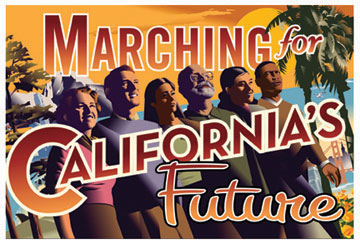
2010-03-02-march_logo.jpgIt is no longer enough to say that "Sacramento politics is dysfunctional," or that the political and legislative processes in the Capitol are stymied by "partisan gridlock." These first impressions have some basis in reality but don't adequately address California's real problems. These impressions only lead to a feeling of inevitability, cynicism, and despair.
What we need in public discussion is a clear picture of the problem and then a plan to fix it. And we all need a sign of hope that change will come. That's why, on March 5, we begin a "March for California's Future." The March will start with a group of public employees who will walk from Bakersfield to Sacramento. By April 21 the March will swell, as it reaches Sacramento, to many thousands. This 250 mile march, sponsored by the California Federation of Teachers and its diverse allies from labor, the faith community, and other civic supporters, is designed to draw attention to the underlying causes of the state's woes as well as gather signatures for a majority budget initiative.
The "March for California's Future" plans to kick start a "reality" discussion on how all Californians can join the fight for a livable California. The three themes of the march are "restore the promise of public education," "a government and economy that works for all," and "fair taxes to fund California's future."
One of the marchers is Irene Gonzalez. She grew up in foster homes throughout the Central Valley. Determined to make something of herself, she worked hard to put herself through school, eventually earning a masters degree. Today she is a probation officer, helping her clients stay out of trouble and on the right track to become productive members of society. In that process she keeps the rest of us safer too.

Answering the attack on teachers | SocialistWorker.org

Answering the attack on teachers | SocialistWorker.org

Answering the attack on teachers

It's open season on the teachers' unions--and President Barack Obama has joined the hunt.
"If a school continues to fail its students year after year after year, if it doesn't show signs of improvement, then there's got to be a sense of accountability," Obama said in praise of the recent decision to fire all teachers at Central Falls High School in Rhode Island.
But while Obama's open endorsement of an effort to bust a teachers' union may seem shocking, his administration has been hammering teachers since he took office. Obama's $4.3 billion Race to the Top (RTTP) initiative doles out grants to states that have laws attacking teacher seniority rights and that tie teachers' pay to student test scores.
With the recession drying up normal funding channels for schools, states are rushing to pass union-bashing laws to get a shot at the federal money--even as they impose layoffs and cutbacks to close huge budget deficits.
The two big teachers' unions--the American Federation of Teachers (AFT) and the National 

Thursday's strike at UCSC: plan for delays - Santa Cruz Sentinel

Thursday's strike at UCSC: plan for delays - Santa Cruz Sentinel


SANTA CRUZ -- Getting around on the Westside could be difficult Thursday, as students at UC Santa Cruz will be protesting budget cuts at the foot of campus during the March 4 Day of Action.
Starting as early as 6 a.m., hundreds of students are expected to attempt to block access to campus at both the intersection of Bay Drive and High Street and at the west campus entrance at Empire Grade Road and Heller Drive.
While the university has met with local enforcement agencies, including Santa Cruz police and the California Highway Patrol who will be on-call, the rallies mostly will be monitored by campus police and university staff, said spokesman Jim Burns.
"The priority will be to try and maintain access to campus and to ensure that the protest, at whatever scale, is safe," he said.
Campus shuttle buses are expected to run, although student throngs may impede their travel, he said. City buses, if need be, will drop students off at the base of campus. University officials have informed both Westlake Elementary School and Waldorf School, which neighbor the university of possible delays because of the protest and have talked to neighborhood associations surrounding campus to help during the day. Events are scheduled until 5 p.m. on campus, and afterward, members of all levels of education and the education community will gather at the Town Clock downtown for another rally.
Santa Cruz police spokesman Zach Friend said officers will be available

Region joins in awareness drive to help schools - The Reporter

Region joins in awareness drive to help schools - The Reporter

Region joins in awareness drive to help schools


A statewide campaign to Start the Day for Students and bring attention to the state's education funding crisis is generating interest locally with events planned for Thursday at many local schools.
With a big push coming from the California Teachers Association, schools will be rallying sites for teachers, parents, students and administrators to speak out about how painful effects budget cuts are having on students, schools and communities. Most schools in the area already have made plans to -- at the very least -- gather a one-half hour before school starts to hand out information about local cuts and how to contact lawmakers.

In the Travis Unified School District, elementary schools intend to participate in a Hands Around the School event in which a human chain, or fence of educators, parents and students, will be formed in front of the schools or on playgrounds as a symbol that more cuts will not be tolerated. These events will take place in the morning and be accompanied by leafleting.

Contact your individual school site for specific Start the Day for Students activities, or log on towww.standupforschools.org.

The Solano County Office of Education has also jumped on board, publishing a brochure for the schools to hand out which outlines, district by district, the effect that budget cuts have had on schools.

For example, Solano County schools, which serve more than 67,000 students, have suffered an
average reduction of 25 percent to their budgets from 2009 through 2011. According to the county office of education, that equates to $96.4 million in reductions to education funding.
These cuts during the last several years have resulted in massive layoffs, larger class sizes, elimination of 

Restore democracy, end two-thirds rule

Restore democracy, end two-thirds rule:


Go to californiansfordemocracy.com
 or ca4d.org, and download an individual petition.


"I celebrate the demonstrations this week to support public education in California, both K-12 and higher education."


But those demonstrations will mean little unless the California Democracy Act gets on the ballot by April 12 and passes in the November election. That is the only way that revenue can be raised to fund California's needs, including education.
The California Democracy Act is simple. It changes just two words in the Constitution: "two-thirds" becomes "a majority" in two places. That's all. The initiative is one sentence long: "All legislative action on revenue and budget must be determined by a majority vote." It's simple democracy. And because it is a ballot initiative, a simple majority can bring democracy by eliminating the two-thirds vote requirements.
The California Legislature is run by a minority of 37 percent - extremist conservatives who think that government should NOT serve public needs. They have taken a pledge not to raise revenue and are happily forcing the budget cuts that are hurting so many Californians and destroying our system of public education.
How can 37 percent run the Legislature? Because it takes a two-thirds vote - 67 percent - in BOTH houses to raise revenue and to pass a budget, one-third plus one can exert control by saying no and creating gridlock until the 63 percent Democratic majority gives in. California is the only minority-rule state in America.
In California, it takes 67 percent to act on virtually anything.
In California, the majority of voters can change this, simply by voting for the California Democracy Act. But first we have to get it on the ballot. Since there is no big money behind this initiative, it has to be a grassroots operation. The voters have got to act.
Luckily, it's not hard. You can do it online (see box). Don't be fooled by similar-sounding

Read more: http://www.sfgate.com/cgi-bin/article.cgi?f=/c/a/2010/03/02/ED6O1C9LQU.DTL#ixzz0h7QHDrgy

Michael Friedman, "All Out March 4 in Defense of Public Education!"

Michael Friedman, "All Out March 4 in Defense of Public Education!"
All Out March 4 in Defense of Public Education!
by Michael Friedman

The U.S. ruling class and its political representatives at all levels have launched an all-out assault on public education.  While disparate elements of this campaign have been in place for the past three or four decades, we are today seeing a confluence and culmination of these trends, orchestrated by President Obama and his Education secretary Arne Duncan, under their "Race to the Top" (previously "No Child Left Behind") program.  Cutbacks, school closings, tuition increases, the "business model," high-stakes testing, school closings, and privatizations/charterizations are all aimed at discrediting, fragmenting, and, ultimately, eliminating public education.
Disingenuous enemies of public education make the claim that charters -- independent schools owned and run by corporations, foundations, or other organizations, and ostensibly regulated by state and municipal governments -- are not private schools.  Charters are housed in public school buildings and provided with tax money that should go to resource-starved public schools.  Make no mistake: the goal of the push for charters is privatization.  In a market economy, fragmented "quasi-private" charter schools will give way to for-profit corporations running chains of schools on economies of scale.  In New York City, for example, several for-profit charter schools are already absorbing public resources, while others have been established with hedge funds which have no other purpose, ultimately, than to guarantee high rates of return for investors.  And, in New York City, at least, the proliferating charter schools largely accept only students that score in the highest percentiles in standardized tests.
Public schools -- particularly urban public schools -- have deteriorated over the past decades as a result of waves of cutbacks, bureaucratic mismanagement, re-segregation, and marginalization of schools serving low-income communities – all of which served to create the self-fulfilling prophecy of failure conducive to the current onslaught.  The response by the public education authorities has been increasingly to label such schools as "under-performing" and close them down, rather than providing the resources and assistance necessary to improve

The State Hornet - Guest Column: Fighting to save higher education in California

The State Hornet - Guest Column: Fighting to save higher education in California
For the first time in California’s history, our state government spent more money on
prisons than higher education.

It’s a shocking figure – but not a surprising one when you consider how much education is
being cut: close to $800 million from the University of California and over $1 billion from
the budgets of Cal State University and California Community College systems combined.
As a result, tuition at our public universities has skyrocketed by over 30% – just as you
and thousands of other students are forced to endure budget cuts, slashed enrollment,
impossible waitlists and reduced course offerings.

My own parents worked as janitors so that I could be the first in my family to go to
college. I know firsthand that the true spirit of California opportunity and optimism is
nurtured in great schools.

That is why I am fighting to fund California colleges and universities by requiring Big Oil
to pay their fair share for the oil they pump out of our state’s land and water. California can
no longer afford to be the only major oil-producing state that doesn’t levy such a
fee. Texas, for instance, generates $400 million for higher education through a similar fee.

My bill, AB 656, would raise up to $2 billion a year for the UC, CSU and community
colleges with a 12.5 percent tax on oil extracted within California. That’s considerably less
than the 25-percent tax levied in Sarah Palin’s Alaska.

The fight to save higher education won’t be easy. The oil companies will tell you that they
already pay enough taxes and that this bill will result in jobs lost. Yet oil companies have
been experiencing record breaking profits for the past several years. Exxon Mobile, for
instance, raked in a $45.2 billion profit in 2008, the most ever by a publicly-traded U.S.
company.

More money for higher education means more classes and more financial aid for you.
Momentum continues to build for AB 656. We are more than halfway to reaching our goal
of organizing over 100,000 supporters – which will make it one of the most significant
grassroots efforts in California’s legislative history. AB 656 has also garnered the support
of the 700,000-member Courage Campaign – a powerful

Accent Advocate - Bill suggests diversion of oil money

Accent Advocate - Bill suggests diversion of oil money

Bill suggests diversion of oil money

By Lauren Shiraishi, opinion editor
One possible source came in the form of an assembly bill. Although AB 656, created by Assemblyman Alberto Torrico (D-Newark), failed to receive the two-thirds vote necessary to be passed by the State Assembly on Jan. 21, it passed the Assembly Floor on Jan. 27.
If passed, AB 656 would place a 12.5 percent severance tax on major oil companies. According to a fact sheet on AB 656, the revenue would be used to create the California Higher Education Endowment Corporation.
“Education has to be a priority,” Torrico said. “We spend more money on prisons than colleges, which is unacceptable. We should be opening doors, not closing them.”
Originally, the tax was set at 9.9 percent, and 60 percent of the revenue would be distributed to CSUs, while 30 percent would go to the UCs and 10 percent to community colleges.
On Jan. 25, the tax was amended to 12.5 percent, dividing the revenue so that the CSUs would receive 50 percent, and 25 percent each would be allocated to UCs and community colleges. Still, many community college supporters were disappointed.
“We’re pleased that the bill was introduced, but we wanted a higher percent (of the revenue),” Faculty Association of California Community Colleges Director Jonathan Lightman said. “We feel that (community college) students need at least 40 percent, because we have (a larger number of) students.”
Currently, California is the only oil-producing state in the nation that lacks a natural gas severance tax.
Contra Costa College economics professor Wendy Williams said she supports the idea of a severance tax. She compared AB 656 to a proposition on the 2006 ballot, which would have also placed a tax on oil companies.
The revenue would have been used to fund alternative energy rather than higher education. Proposition 87 failed to 

Editorial: Student power comes to Capitol - Sacramento Opinion - Sacramento Editorial | Sacramento Bee

Editorial: Student power comes to Capitol - Sacramento Opinion - Sacramento Editorial | Sacramento Bee

Finally, students, parents, faculty and administrators are coming to the right place to confront the governor and lawmakers about the state's eroding commitment to higher education – and public education in general.
It is the governor and lawmakers who have set state spending and taxing priorities, which have made deep budget cuts to California's public colleges and universities.
On Thursday, expect thousands from K-12 schools, community colleges, state universities and the University of California to descend on the Capitol for an "Educate the State" rally to protest 32 percent fee increases (not gradual, predictable increases that families can prepare for) and cuts to instruction and access.
The timing is right during this 50th anniversary year of the Master Plan for Higher Education. That 1960 plan made a commitment that "all Californians should be afforded the opportunity to receive a college education." It made California a national model. And for a generation, the 1960 Master Plan delivered prosperity to the state and a higher standard of living for residents.
But a gradual, steady decline in state funding for higher education over the last 30 years has diminished that promise. The state has drifted, without any deliberate choice of policy, toward quasi-privatization – increasing student fees and private funding from individuals, corporations, foundations and the federal government.

Viewpoints: State's higher education system is worth fighting for – and we will - Sacramento Opinion - Sacramento Editorial | Sacramento Bee

Viewpoints: State's higher education system is worth fighting for – and we will - Sacramento Opinion - Sacramento Editorial | Sacramento Bee

Sometimes I think there are two Californias out there. One of them is the California of small things and small thinking. It's the California that is obsessed with petty anti-tax politics. The one that wants to gut social programs and dismantle our public higher education system. It thrives on driving wedges between us and promoting divisiveness.
It's the California of Proposition 187 (cutting services to illegal immigrants), Nixon, Reagan and Gov. Arnold Schwarzenegger. It includes a lot of people who hate government but are the first to complain when the garbage isn't picked up.
The other California is the California of bold ideas and dreams of a better future. It's the California that wants to conserve and protect its unique and beautiful state parks and wilderness, wishes to invest in its people and seeks common ground amid diversity.
It's the California of Proposition 215 (legalizing medical marijuana), John Muir, Cesar Chavez and Harvey Milk. It's the California that recognizes the vital role that our public colleges and universities play in laying the foundation for the state's future.
Sadly, the clear winner in recent years has been the California of small things and small ideas. Through an outdated flaw in the structure of governance, one-third of the Legislature has a stranglehold on the state's finances. The other two-thirds (the majority) knows the state is heading in the wrong direction. Yet given its lack of control over the purse strings, it's left flailing around