Latest News and Comment from Education

Showing posts with label EDUCATION SUPPORT PROFESSIONALS. Show all posts

Monday, August 31, 2020

Education is a Public Obligation and Individual Right | Dissident Voice

Education is a Public Obligation and Individual Right | Dissident Voice

Education is a Public Obligation and Individual Right
Part X: A Manifesto for the United States of America


The system of education in the US is failing at every level except for private, heavily endowed or extremely costly institutions for the wealthy and privileged. Students of all ages are increasingly viewed as “profit centers” for private enterprise to exploit. Private charter schools now operate many public schools for the benefit of their investors, not their students.
Public state-run universities that were founded on the principle of free education to all are no longer fully supported by public resources, and have become unaffordable to many. Students must take loans, which are profitable to the banks but chain the students to debts that often last nearly a lifetime. The federally guaranteed student loan programs that began in the early 1960s were a response to the gradual disappearance of free public universities. It was a way of passing on the cost to the students while assuring a nice profit to financial institutions. It follows the trend of helping the wealthy elite put their greedy hands in the till until there are no public trusts that are not contracted out to for-profit institutions.
This is a disgrace that must end. Many countries in the world provide better quality and more complete public education supported by taxes and thus by the entire community. Education is necessary and must be free and accessible in order to assure that all individuals are able to participate to the fullest in CONTINUE READING: Education is a Public Obligation and Individual Right | Dissident Voice

Wednesday, July 29, 2020

K-12 Teachers Worried About COVID-19 on the Job - Gallup News

K-12 Teachers Worried About COVID-19 on the Job

K-12 Teachers Worried About COVID-19 on the Job


STORY HIGHLIGHTS

  • 57% teachers, 21% other workers very concerned about COVID-19 exposure
  • 64% teachers, 51% other workers say COVID-19 situation a lot worse
  • Teachers have become as likely as other workers to prefer remote work
WASHINGTON, D.C. -- As school districts around the country begin to announce their plans for educating students this fall, a broad majority of U.S. schoolteachers say they are worried about being exposed to the coronavirus while working. Three-quarters of kindergarten through high school teachers say they are "very" (57%) or "moderately" (18%) concerned about COVID-19 exposure at their workplace. This compares with half of all other workers who are either very (21%) or moderately worried (29%).

These data are based on a subset of respondents from the ongoing probability-based online Gallup COVID-19 tracking survey who identified their occupation as a teacher of kindergarten through 12th-grade students. The June 29-July 19 polling included a sample of 495 teachers, while more than 650 teachers completed the survey in both May and June.
The latest data marks an uptick in teachers' levels of apprehension since May and June when fewer (though still majorities) were concerned.
Teachers are currently about three times as likely as other U.S. workers to say they are very concerned about workplace exposure to the virus. This divergence in the views of teachers and workers in all other industries has grown since May. While concern about workplace exposure has been fairly steady among workers who are not teachers, this unease has risen sharply among teachers. CONTINUE READING:  K-12 Teachers Worried About COVID-19 on the Job

Wednesday, July 22, 2020

School staff must be ensured safety in school reopening plans

School staff must be ensured safety in school reopening plans

School reopening plans must ensure safety of custodians, cafeteria workers, bus drivers and substitutes
We need millions more from the federal government to protect the most vulnerable school staff if we’re going to keep everyone safe in schools


“Students want and need to come back to school,” Kimberly Martin, a principal of Woodrow Wilson High School in Washington, D.C. told me last week. Martin explained that although social distancing may reduce exposure to coronavirus it also distances children from services and supports that are critical to their wellbeing.
As an example, Martin told of a student in special education who returned to Wilson High for support when he was confused about how to obtain a necessary work permit for a new job.
“After he met with me and the social worker to address the work permit issue, I saw him just hanging around the school staff, and I realized how much he missed them.” Martin added, “Many students miss the network of adults that provide their needs, including teachers, custodians, social workers and all non-instructional staff.”
If there is one lesson the coronavirus has taught us, it’s that when our neighbors are sick, we are vulnerable. Therefore, keeping children safe requires that we safeguard all who are the least protected. That means prioritizing the protection of essential workers who are not regular, full-time teachers too.
Society needs schools to open even as this pandemic rages, for both children’s academic and social needs. Schools are also a critical cog in the machine that is the U.S. economy. Many workers, whether they’re construction workers, nurses, teachers or grocery clerks, can’t easily leave CONTINUE READING: School staff must be ensured safety in school reopening plans

Tuesday, June 30, 2020

Housekeepers and custodians, fearful as campuses reopen, demand more protection from their schools - The Washington Post

Housekeepers and custodians, fearful as campuses reopen, demand more protection from their schools - The Washington Post

Housekeepers and custodians, fearful as campuses reopen, demand more protection from their schools 


After about two months off the job, Gliny Gonzalez, a 51-year-old housekeeper at the University of Maryland in College Park, was finally called back to work last month. But even after 14 years, she suddenly felt unprepared.
There was some training, including on updated cleaning procedures and ways to prevent exposure to the novel coronavirus. But Gonzalez, who speaks Spanish, understood only “a tiny bit” of the English instructions, she said. She was given gloves and a surgical mask to last her through the week.
The work itself made her nervous, too. She was called back to clean dorms as students and families arrived on the campus to remove belongings left behind when campus emptied. She was told they’d wear masks. But that wasn’t always the case, Gonzalez said.
“I was worried I’d get infected,” she said in an interview around the time she returned to work. And despite her best attempts to stay safe, Gonzalez contracted the virus and was admitted to a hospital last week, said Stuart Katzenberg, a leader from the College Park chapter of the American Federation of State, County and Municipal Employees, which represents 3,400 College Park employees, including housekeepers, bus drivers, administrative assistants and other campus staff.
Gonzalez lives in Lanham, Md., with her 18-year-old son and three friends, but she believes she got sick at work. She spends most of her time in College Park, working in close quarters with other housekeepers, she said. State health officials will be notified about positive cases so they can start contact tracing, but Natifia Mullings, a university spokeswoman, did not say whether that process has started.
As campuses announce plans to reopen in the fall, service workers, many of whom are people of color, have been summoned to the front lines. Maintenance workers and custodial crews are being called back to work with little preparation, their union says. And housekeepers like Gonzalez are tasked with washing floors and sanitizing surfaces to keep the community safe even when they don’t feel safe themselves.
“People on campus are very, very concerned,” said Todd Holden, interim president of CONTINUE READING: Housekeepers and custodians, fearful as campuses reopen, demand more protection from their schools - The Washington Post

Friday, May 29, 2020

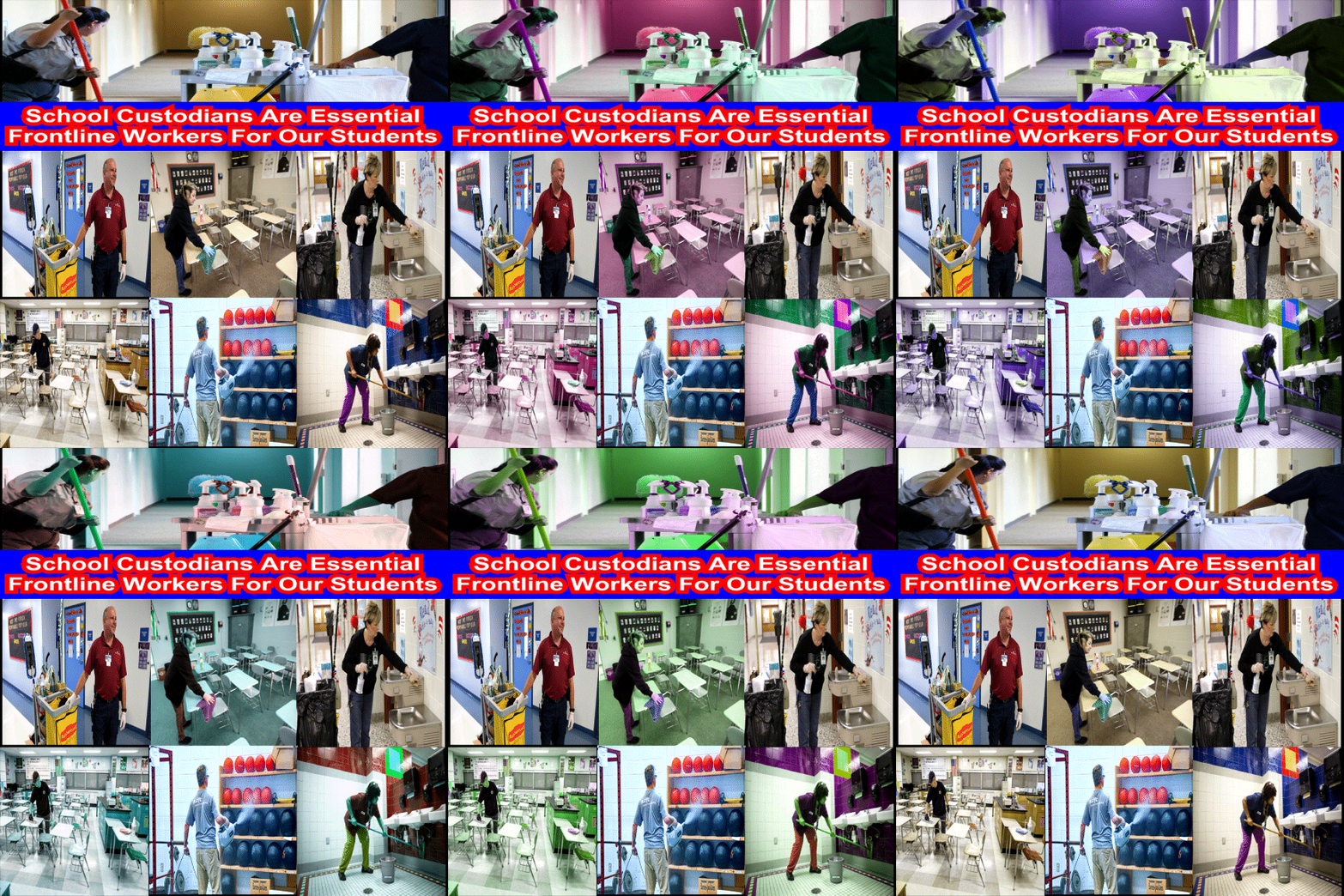
School Custodians Are Essential Frontline Workers For Our Students

School Custodians Are Essential Frontline Workers For Our Students

School Custodians Are Essential Frontline Workers For Our Students


Juan Ramos has been a school custodian and union member for nearly 30 years. His father was a custodian before him, and Ramos spent summers helping his dad starting out when he was just fourteen-year-old. With that much experience under his utility belt, Ramos definitely has the know-how to protect students and educators from coronavirus, but only if he and his colleagues have the equipment and staff-power necessary to fight the deadly virus.
school custodians covid
School custodian Juan Ramos
“Custodians are on the front line of defense at school,” says Ramos, who works at Maple Brook Elementary School in Naperville, Illinois. “We need to make sure our schools are thoroughly cleaned and disinfected throughout the day, after the students leave, and before they come each morning — now more than ever in history.”
It’s not just hand sanitizer, hand washing and social distance that will keep schools safe, he says, but sophisticated cleaning equipment designed to take on the deadly virus.
“Custodians will need electrostatic sprayers to make sure that we hit high touch surfaces with the right chemicals for fighting the virus, we need hospital grade, which is the best there is,” Ramos says.
The sprayers should use a solution that is EPA registered for use against the cause of COVID-19 and should be applied to all touch and hard surfaces, door handles, furniture, floors – everything. The solution takes about 10 minutes to activate so it can’t be rushed and will need to be used in hallways, bathrooms and classrooms CONTINUE READING: School Custodians Are Essential Frontline Workers For Our Students