Latest News and Comment from Education

Wednesday, June 17, 2020

School Field Trip Turns Into a Tour of Our Nation’s Unhealed Scars | gadflyonthewallblog

School Field Trip Turns Into a Tour of Our Nation’s Unhealed Scars | gadflyonthewallblog

School Field Trip Turns Into a Tour of Our Nation’s Unhealed Scars


You’ve got to be a little crazy to take a bunch of teenagers on a field trip – especially overnight and out of town.
But that’s what I did, and – yeah – guilty as charged.
For the second time in my more than 15-year career as a public school teacher, I volunteered along with a group of parents and other teachers to escort my classes of 8th graders to Washington, DC, and surrounding sights.
 
And I never regretted it. Not for a moment.
Not when Jason bombed the bathroom in the back of the bus after eating a burrito for lunch.
Not when Isaac gulped down dairy creamers for dessert and threw up all over himself.
Not when a trio of teenage girls accidentally locked themselves in their hotel room and we needed a crowbar to get them out.
But as I stood in Manassas, Virginia, looking at a statue of Stonewall Jackson, the edge of regret began to creep into my mind.
There he was perched on the horizon, ripped and bulging like an advertisement for CONTINUE READING: School Field Trip Turns Into a Tour of Our Nation’s Unhealed Scars | gadflyonthewallblog

National Education Policy Center Interview of the Month: Yours Truly | Diane Ravitch's blog

National Education Policy Center Interview of the Month: Yours Truly | Diane Ravitch's blog

National Education Policy Center Interview of the Month: Yours Truly


This is a really fun interview with Chris Saldana of NEPC, in which we talk about the important education issues of our time.
I think you will enjoy it.
Tuesday, June 16, 2020
Publication Announcement
NEPC’s June Education Interview of the Month: Teacher Strikes, Philanthropy, and Public Education
KEY TAKEAWAY:
NEPC Education Interview of the Month is a great teaching resource; engaging drive-time listening; and 30 minutes of high-quality policy information for educators, community members, policymakers, and anyone interested in education.
BOULDER, CO (June 16, 2020) – In this month’s NEPC Education Interview of the Month, NEPC Researcher Christopher Saldaña interviews Diane Ravitch, research professor of education at New York University and the co-founder of the Network for Public Education, about her new book, Slaying Goliath: The Passionate Resistance to Privatization and the Fight to Save America’s Public Schools.
In Slaying Goliath, Ravitch argues that the effect of the most recent teacher strikes was to change the narrative about K-12 public education in the United States. She explains that where educational policy had become fixed on the idea of high-stakes accountability and school choice, teacher strikes shifted the policy conversation toward reforms such as smaller classes that center on the needs of children.
Ravitch believes the teacher strikes, along with the COVID-19 pandemic, have highlighted the importance of K-12 public schools and the need for adequate school funding. The importance of schools, Ravitch argues, is evidenced in the role schools and teachers have played both historically and during the pandemic, from CONTINUE READING: National Education Policy Center Interview of the Month: Yours Truly | Diane Ravitch's blog
CONTACT:
William J. Mathis:
(802) 383-0058
wmathis@sover.net
Christopher Saldaña:
(303) 492-2566
christopher.saldana@colorado.edu
TwitterEmail Address

Jersey Jazzman: On Comparing Education Spending Across Time

Jersey Jazzman: On Comparing Education Spending Across Time

On Comparing Education Spending Across Time


I’ve noticed a lot of back-and-forth recently on social media about education spending – specifically, on how spending has changed over the years in the United States.

The usual context is someone complaining about how spending in K-12 schooling has soared over the past few decades, but outcomes haven’t improved. I and others have repeatedly pointed out just how dumb such claims are, so no need to rehash it. Let’s instead set aside outcomes for the moment and focus instead on inputs: how much more has the U.S. spent on schools, across the years?

When I see people sling around the numbers, I find they tend to break down into measures that range from valid and useful to completely worthless (and probably deliberately deceptive). Let’s arrange these from worst to better, with the goal of producing the most reasonable estimation of how much K-12 school spending has changed.

-       Total spending per year. This is simply the total amount spent on schooling in any one year. Anyone who tries to use this measure is either hopelessly inept or a con artist. The most obvious flaw is that the number of students changes in any year; total spending makes no attempt to account for this. Any time you see his measure being used, ignore it.

-       Per pupil spending per year. This is barely an improvement on above, because there is no adjustment for changes in costs over time. The cost of a textbook or a gallon of gas or an hour of a teacher’s work is different in 1970 than it is in 2020. Again, ignore anyone who cites this figure.

-       Per pupil spending per year in “real” dollars. This is probably the figure CONTINUE READING: Jersey Jazzman: On Comparing Education Spending Across Time

University of California Votes to Restore Affirmative Action

University of California Votes to Restore Affirmative Action

University of California Votes to Restore Affirmative Action 24 Years After Its Repeal


In 1996, the state of California passed proposition 209 which prohibited race and gender from being a factor in university admissions. Now, some 24 years later, the University of California voted unanimously to restore affirmative action.
The move was made in the hope of diversifying their student population, according to CNN. The school’s Board of Regents reached an unanimous vote, endorsing the repeal of prop 209. They also voted in favor of Assembly Constitutional Amendment 5 which would formally appeal prop 209. “Proposition 209 has forced California public institutions to try to address racial inequality without factoring in race, even where allowed by federal law. The diversity of our university and higher education institutions across California, should—and must—represent the rich diversity of our state.” U.C. president Janet Napolitano said in a statement.
From CNN:
“There is amazing momentum for righting the wrongs caused by centuries of systemic racism in our country. The UC Board of Regents’ votes to endorse ACA 5 and to repeal Proposition 209 plays a part in that effort,” Board Chair John A. Pérez said in a statement.
“As we continue to explore all the University’s opportunities for action, I am proud UC endorsed giving California voters the chance to erase a stain, support opportunity and equality, and repeal Proposition 209.”
In a news release, the board said Proposition 209 challenged the university’s efforts to create and maintain a student body that “reflects California’s laudable cultural, racial, geographic and socioeconomic diversity.” CONTINUE READING: University of California Votes to Restore Affirmative Action
 

NYC Public School Parents: Talk out of School podcast on charter schools getting PPP funds and how teachers and parents should talk to kids about race and racism

NYC Public School Parents: Talk out of School podcast on charter schools getting PPP funds and how teachers and parents should talk to kids about race and racism

Talk out of School podcast on charter schools getting PPP funds and how teachers and parents should talk to kids about race and racism


This morning on the Talk out of School podcast on WBAI, I spoke to Carol Burris, executive director of the Network for Public Education, about their research on charter schools that applied for funds under the Payroll Protection Program,  meant for struggling small businesses. Then Takiema Bunche-Smith, executive director of Bank Street College's Center on Culture, Race, and Equity, joined us with advice for teachers and parents on how to discuss race and racism with kids.

Please listen and check out the resources below.  You can also subscribe to the podcast here.


Charter schools and the Payroll Protection Program
Carol Burris and Marla Kilfoyle, Did some charter schools double-dip in federal coronavirus relief funding?, Washington Post
Erica Green, Charter Schools, Some With Billionaire Benefactors, Tap Coronavirus Relief, NY Times
Network for Public Education, What do you think? Are charter schools public schools or small businesses?
Email info@networkforpubliceducation.org if you discover that charter schools in your community have applied for or received PPP funds.

Resources about race and racism in schools and the larger society
Center on Culture, Race and Equity:  Equity & Culturally Responsive Resources and Black Lives Matters at Schools Symposium
Imani Perry, Racism is Terrible. Blackness is Not, Atlantic
Howard Zinn,  A People’s History of the United States
Howard Zinn,  A Young People’s History of the United States
Beverly Tatum, Why Are All the Black Kids Sitting Together in the Cafeteria: And Other Conversations About Race
Shawn Ginwright, The Future of Healing: Shifting from Trauma Informed Care to Healing Centered Engagement, Medium
NYC Public School Parents: Talk out of School podcast on charter schools getting PPP funds and how teachers and parents should talk to kids about race and racism

When "Progressive" White People Perfect Progressive Racism And Call It "Allyship" - Philly's 7th Ward

When "Progressive" White People Perfect Progressive Racism And Call It "Allyship" - Philly's 7th Ward

WHEN “PROGRESSIVE” WHITE PEOPLE PERFECT PROGRESSIVE RACISM AND CALL IT “ALLYSHIP”


Good people, it looks like the smoke rising from Minneapolis has inspired so many “allies” to ask: “what can we do to help.” And, as a matter of solidarity, folks have focused intently on defunding or reforming or lightly tapping the Minneapolis Police Department.
That is a fine goal if people are serious (hint: they aren’t).
Even if the over-policing problem in Minneapolis is meaningfully addressed, it won’t fix the racism problem in the Twin Cities because the structural oppression here involves so much more than one department.
In fact, we are home to one of the most finely tuned systems of “progressive” white supremacy in the country. The minds and bodies of nonwhite people are policed by public schools, the DFL political system, the nonprofit industry, and the business community. Taken together these systems offer people two choices: comply or die.
And, atop it all is the paternalism of philanthropy. The funders of Minneapolis are self-satisfied puppeteers who use money to control black minds and bodies, keeping everyone in their place by giving and taking away grants strategically and politically with the effect of creating a network of tokenized POC who are good so long as they say nothing that upsets the CONTINUE READING: When "Progressive" White People Perfect Progressive Racism And Call It "Allyship" - Philly's 7th Ward

How to Be an Anti-racist Teacher - The Atlantic

How to Be an Anti-racist Teacher - The Atlantic

What Anti-racist Teachers Do Differently
They view the success of black students as central to the success of their own teaching.


Editor’s Note: In the next five years, most of America’s most experienced teachers will retire. The Baby Boomers are leaving behind a nation of more novice educators. In 1988, a teacher most commonly had 15 years of experience. Less than three decades later, that number had fallen to just three years leading a classroom. The Atlantic’s “On Teaching” project is crisscrossing the country to talk to veteran educators. This story is the 17th in our series.

Ask black students who their favorite teacher is, and they will joyfully tell you. Ask them what it is about their favorite teacher, and most will say some version of this: They know how to work with me. So much is in that statement. It means that these students want to work, that they see their teachers as partners in the learning process, and that they know the teacher-student relationship is one in which they both have power. In other words, black students know that they bring intellect to the classroom, and they know when they are seen—and not seen.

As the principal of San Francisco’s Mission High School and an anti-racist educator for more than 30 years, I have witnessed countless black students thrive in classrooms where teachers see them accurately and show that they are happy to have them there. In these classes, students choose to sit in the front of the class, take careful notes, shoot their hands up in discussions, and ask unexpected questions that cause the teacher and other classmates to stop and think. Given the chance, they email, text, and call the teachers who believe in them. In short, these students are everything their families and community members have raised and supported them to be.

I have seen some of these very same students walk into another teacher’s classroom, go to the last row of desks, and put their head down. I have seen them sit frozen in their seat, staring at an assignment—when earlier I had heard them make jokes, talk excitedly about the content of their history class, celebrate solving a vexing algebra equation, or shake a test tube with authority, waiting for a result. Their report cards often reveal this disparity in classroom experiences: A’s and B’s in classes where they feel valued and C’s, D’s, or even F’s in classes where they don’t.
When black students’ academic strengths are overlooked, black students are marginalized. They are kept out of advanced courses, given bad grades, and sent to the dean’s office. Over the years, the power that they initially bring to school is siphoned off by educators at every level of the educational system who do not respect, and in some cases do not wish to respect, the intellectual contributions of black students.
Anti-racist teachers take black students seriously. They create a curriculum with black students in mind, and they carefully read students’ work to understand what they are expressing. This might sound fairly standard, but making black students feel valued goes beyond general “good teaching.” It requires educators to view the success of black students as central to the success of their own teaching. This is a paradigm shift: Instead of only asking black students who are not doing well in class to start identifying with school, we also ask teachers whose black students are not doing well in their classes to CONTINUE READING: How to Be an Anti-racist Teacher - The Atlantic

Billionaire Reed Hastings Plans Luxury Resort to Train Teachers to Think Like Him | Diane Ravitch's blog

Billionaire Reed Hastings Plans Luxury Resort to Train Teachers to Think Like Him | Diane Ravitch's blog

Billionaire Reed Hastings Plans Luxury Resort to Train Teachers to Think Like Him


VOX reports on billionaire Reed Hastings’ grandiose plans to build a fabulous resort in Colorado for teachers, where they will learn to love charter schools, high-stakes testing, test-based accountability for teachers, and other failed reform strategies.
Hastings has $5 billion and he doesn’t seem to know what to do with it, even though California has many people who are homeless and many hotbeds of racism and injustice. So, he decided to keep spending on privatization, no doubt gladdening the heart of Betsy DeVos, and high-stakes testing.
Every one of Hastings’s favorite ideas has failed but he plans to convert teachers to follow his path by immersing them in luxurious surroundings.
If only he would read SLAYING GOLIATH, he would realize that he is wasting his money and undermining an essential democratic institution, the American public CONTINUE READING: Billionaire Reed Hastings Plans Luxury Resort to Train Teachers to Think Like Him | Diane Ravitch's blog

Federal CARES Act Public Education Relief Dollars Quietly Flow into the Coffers of Charter Schools and Private Schools | janresseger

Federal CARES Act Public Education Relief Dollars Quietly Flow into the Coffers of Charter Schools and Private Schools | janresseger

Federal CARES Act Public Education Relief Dollars Quietly Flow into the Coffers of Charter Schools and Private Schools


Many charter schools are taking advantage of their public/private status to double dip into more than one stream of federal CARES Act dollars. And Betsy DeVos has also been shifting the rules on distribution of CARES Act education dollars to support private schools at public schools’ expense. Promoters of school privatization are using every opportunity they can find to squeeze the public schools that serve 50 million of our children and undermine especially the public school districts serving our nation’s poorest big cities.
Charter Schools Skim CARES Act Dollars
The NY Times‘ Erica Green reports: “Charter schools, including some with healthy cash balances and billionaire backers like Michael Bloomberg and Bill Gates, have quietly accepted millions of dollars in emergency coronavirus relief from a fund created to help struggling small businesses stay afloat.”
By state law, charter schools must themselves be nonprofits, although, as we know, many are operated by for-profit Charter Management Organizations. Whether they are nonprofit or managed for-profit, they are all private contractors operating schools under a charter from the state. As private contractors providing a public function under state law, they receive per-pupil state aid provided by tax dollars. But charter school promoters like to call themselves “public charter schools” and keep the definition murky. Right now, however, a lot of charter schools are trying to operate as private businesses just to get CARES Act Payroll Protection Program dollars.
Erica Green explains: “Since their inception, charter schools have straddled the line between CONTINUE READING: Federal CARES Act Public Education Relief Dollars Quietly Flow into the Coffers of Charter Schools and Private Schools | janresseger

Stewart Swoons, Eva Evades | Gary Rubinstein's Blog

Stewart Swoons, Eva Evades | Gary Rubinstein's Blog

Stewart Swoons, Eva Evades


I recently listened to two illuminating podcasts about Success Academy.  Hosted by Education Post CEO Chris Stewart on the Citizen Ed podcast, the first interview was with Robert Pondiscio, author of ‘How The Other Half Learns’ and the second was with Success Academy CEO Eva Moskowitz.
The first thing that struck me about these podcasts was that Chris Stewart, when he is not being very immature on Twitter, has it in him to be a thoughtful and humble guy.  Why he acts like he does on Twitter, I guess he thinks it achieves something.  We’ve had some epic Twitter battles over the years — often some TFA supporters join in and gang up on me — I can’t say I look forward to them.  One thing I have earned as result of my sporadic interactions with him is that I have my own ‘tag’ on Education Post.
So to see him interview people who he has long standing relationships is an interesting experience.  It’s like when the curtain is removed and we see the real Wizard of Oz that is voicing the booming avatar.
The first interview was with Pondiscio.  About a year ago he published a tell-all about Success Academy.  Though he set out to give a balanced picture of the good and bad of CONTINUE READING: Stewart Swoons, Eva Evades | Gary Rubinstein's Blog

USDA CNP Nationwide Waiver Revision and Extensions - Nutrition (CA Dept of Education)

USDA CNP Nationwide Waiver Revision and Extensions - Nutrition (CA Dept of Education)

USDA CNP Nationwide Waiver Revision and Extensions


In early June 2020, the U.S. Department of Agriculture (USDA) released several policy memorandums to state agencies and Child Nutrition Programs Operators during the Novel Coronavirus (COVID-19) public health emergency. The policy memos are:
Updates regarding the USDA waivers and additional information for program operators are regularly posted to the California Department of Education COVID-19 School and Child and Adult Day Care Meals web page.
Questions:   Nutrition Services Division | 800-952-5609


USDA CNP Nationwide Waiver Revision and Extensions - Nutrition (CA Dept of Education)

Sanity Through Math | JD2718

Sanity Through Math | JD2718

Sanity Through Math


This has been a tumultuous three months. I have been overwhelmed, frightened, angry, excited.
The world has been horrible. My employer has been heartless. My union has been too often passive. My friends are distant.
And my work has been exhausting. The grading – absurdly slow. Lessons?  Maybe I’ve figured something reasonable out. I’m not certain, not about that. It’s taken me twelve weeks.
But math can be centering. Almost twenty years ago I registered for a too-hard-for-me math class at the Graduate Center (and one not-too-hard-for-me which I loved). This was the fall of 2001, and events in New York City interrupted class for a few weeks. Then we came back, and at the first session, Roman Kossak, the professor, said a few words about what had happened and then “sometimes when the world is falling apart around us, the best thing to do is some math.” Maybe he was right.
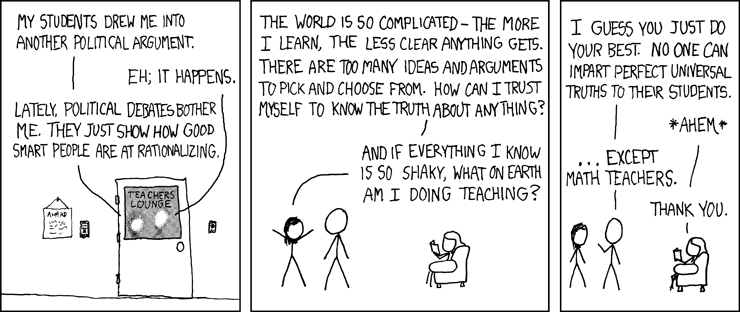
This morning I shared some enrichment work (mostly for my juniors, but optional for my seniors) and I included this cartoon (xkcd, by Randall Munroe):

Certainty

Certainty
Now, if you hover your mouse over it, you’ll get a bonus, some alt-text: I didn’t share all of it with my students.
But I do think there is something comforting about considering problems with right and wrong answers.
And at 1PM today I finished my mini-elective in Axiomatic Arithmetic. Super-hard work. One lunch- CONTINUE READING: Sanity Through Math | JD2718

Tuesday, June 16, 2020

Police Reform and School Reform (Part 1) | Larry Cuban on School Reform and Classroom Practice

Police Reform and School Reform (Part 1) | Larry Cuban on School Reform and Classroom Practice

Police Reform and School Reform (Part 1)


Amid widespread protests against police violence against African Americans, calls for reform from ending neck restraints to “defunding” police departments have monopolized TV newscasts and newspaper headlines. Social media traffic prompted by smartphone videos of incidents between police officers and blacks have gone viral. State and city officials across the nation are generating to-do lists of reforms aimed at solving the problem of police officers using lethal force to arrest minority suspects (see here and here).
White people over the age of 18 might be surprised that such cries for police reform have occurred before. But their grandparents wouldn’t.
The decade between 1965-1975 when urban “riots” (or “rebellions,” depending upon your political stance) occurred in Los Angeles, Chicago, Washington, D.C., Detroit, Newark, and other cities killing both blacks and whites including police officers. President Lyndon Johnson appointed the governor of Illinois, Otto Kerner, to chair a commission to investigate the racial violence. The Kerner Commission’s report (1968) condemned white racism in housing, employment, and criminal justice while offering many recommendations for police reform (see here and here).
Subsequent calls for reforming police departments to reduce excessive force against people of color have occurred after killings of black men such as Eric Garner in New York City and Michael Brown in Ferguson (MO) in 2014. Then consider Minneapolis police officers have shot dead Jamar Clark (2015) and CONTINUE READING: Police Reform and School Reform (Part 1) | Larry Cuban on School Reform and Classroom Practice

Teachers’ Unions Are Demanding Police-Free Schools

Teachers’ Unions Are Demanding Police-Free Schools

Teachers’ Unions Are Demanding Police-Free Schools


A major lesson from the recent teachers’ strike wave was the necessity for unions to bargain for the common good of the entire working class. By joining the nationwide protests against police brutality and demanding police-free schools, teachers’ unions have taken that lesson to heart.

It’s been three weeks since Minneapolis police officer Derek Chauvin killed George Floyd by kneeling on his neck for nearly nine minutes. Protests continue in cities, suburbs, and even small towns all over the United States.

The sheer volume of political activity makes it hard to focus on any particular development. But there’s something important happening right under our noses that has received far too little attention outside of disconnected local media stories. Across the country, teachers’ unions are stepping up to demand police-free schools.
The union-led police-free schools movement represents a welcome development in the labor movement more broadly. For decades, many unionists have argued that it’s critical to connect the bread-and-butter demands of union members to issues affecting other members of the working class. The Red for Ed teachers’ strike wave was the best sign yet that this orientation was gaining renewed popularity in the labor movement.
Now, emboldened by the strike wave and feeling their power, teachers’ unions are broadening their horizons further than at any time in recent history as they take advantage of this moment to dismantle the school-to-prison pipeline.

Bargaining for the Common Good

In February of 2012, the Chicago Teachers Union (CTU) released a forty-six-page white paper called “The Schools Chicago’s Students Deserve.” In it, they proposed a new vision for Chicago public education: better staffing, smaller class sizes, better facilities, a less testing-oriented curriculum, and more nurses and counselors. The paper proposed these reforms be funded through progressive taxation. The first sentence of the paper read: “Every student in CPS deserves to have the same quality education as the children of the wealthy.”
The report provided the backdrop for the 2012 CTU strike, which took place later that year. And it also represented a major development in the politics of teachers’ unions: by negotiating for many of the CONTINUE READING: Teachers’ Unions Are Demanding Police-Free Schools

Police-Free Schools: Lessons on Racial Justice from Minneapolis and the Nation | Schott Foundation for Public Education

Police-Free Schools: Lessons on Racial Justice from Minneapolis and the Nation | Schott Foundation for Public Education

Police-Free Schools: Lessons on Racial Justice from Minneapolis and the Nation


Realizing racial justice in public education is impossible when Black and Brown students are criminalized in their own schools. Students, parents and education justice groups have long known this, and while we've seen some inspiring reforms in school discipline thanks to tireless grassroots organizing efforts, the present moment offers the chance for serious leaps forward. Minneapolis is no different, with education justice organizers calling for structural changes long before the most recent uprising.
In the wake of the police murders of George Floyd in Minneapolis and Breonna Taylor in Louisville and the popular resistance that has erupted, Minneapolis’ school district has ended its contract with the police. School districts across the country are now making similar decisions, often forced by organized residents who are fed up with unjust, racist systems.
Join us for a wide-ranging conversation and call to action. Hear from local and national grassroots leaders in the education justice movement. How and why were police placed in our schools? What new possibilities can we create when we can imagine police-free schools? How do we move funding from police to provide the academic, social, and healing-centered supports that our children require? How does this struggle connect with wider movements for racial and social justice? How can elected officials, advocates, allies, and funders be accountable to Black and Brown communities who are on the front lines of this fight?
Register Today
Speakers include:
    Edgar Villanueva, Schott Foundation for Public Education
    Jonathan Stith, Alliance for Educational Justice
    Marika Pfefferkorn, Twin Cities Innovation Alliance
    Kim Ellison, Minneapolis Board of Education Chair
Co-moderators:
    Leah Austin, Schott Foundation for Public Education
    Marianna Islam, Schott Foundation for Public Education
Police-Free Schools: Lessons on Racial Justice from Minneapolis and the Nation | Schott Foundation for Public Education

American Federation Of Teachers Launches Ad Campaign To Support The HEROES Act

American Federation Of Teachers Launches Ad Campaign To Support The HEROES Act

American Federation Of Teachers Launches Ad Campaign To Support The HEROES Act


The American Federation of Teachers (AFT) has launched an ad campaign telling people to urge their Senators to pass the HEROES Act. The influential teachers’ union is spending $1 million to support the legislation passed by House Democrats.
“We must fund our public schools and community services,” the ad’s narrator says. “We can’t afford to forfeit our future.”
Entitled “Essential,” the ad shows teachers and a food service worker while asking who is considered essential workers in this time. It asks viewers how states can safely reopen without teachers.

The ad will be airing in 30-second and 15-second versions for two weeks on Facebook, CNN, MSNBC, and Fox News. AFT is targeting 10 states—Arizona, Colorado, Florida, Kentucky, Maine, Montana, North Carolina, Ohio, Pennsylvania, and West Virginia—and Washington, DC.
“If the HEROES Act fails to pass, and states and schools don’t get the support they need to reopen safely, then they’ll stay shut and the economy will stall—it’s that simple,” AFT President Randi Weingarten said in a statement. CONTINUE READING: American Federation Of Teachers Launches Ad Campaign To Support The HEROES Act