Latest News and Comment from Education

Saturday, April 18, 2020

Grieving At Home, Kids Face Their Teachers' Deaths | HuffPost

Grieving At Home, Kids Face Their Teachers' Deaths | HuffPost

Grieving At Home, Kids Face Their Teachers’ Deaths
With widespread school closures, children have been left to grieve in isolation, sometimes experiencing the tragedy of death for the first time.


Eighth grader Kiara Dokes in Detroit never knew her father, and she usually has a hard time getting along with adult men, her mom said. But at the beginning of the school year, Kiara met Thomas Fields, the culture facilitator at her school. He became “like another father to me,” Kiara said. 
Hundreds of miles away, in New Jersey, high school senior Que’jon Malawo has spent years turning to case manager Javiera Rodriguez for help. They first met his freshman year, and since then, she’s become his “go-to” person for all things academic and personal, her office a haven of warmth and safety. “She was like a second mother to me,” he said. 
Fields and Rodriguez both passed away in recent weeks, falling victim to the coronavirus. There is no official number on how many teachers and school staff members have passed. The American Federation of Teachers, the nation’s second largest teachers union, has lost at least 65 of its educators and 10 retirees, a spokesperson told HuffPost. In New York City, the American epicenter of the outbreak, at least 50 school staff members have passed away, according to the New York City Department of Education
When teachers and school staff members die, they leave behind friends, family, colleagues. They also leave behind hundreds of children and teenagers whom they see nearly everyday. With widespread school closures, children have been left to grieve in isolation, sometimes experiencing the tragedy of death for the first time. 
Schools have been offering counseling and holding online vigils. But without face-to-face CONTINUE READING: Grieving At Home, Kids Face Their Teachers' Deaths | HuffPost

The Pandemic Is a Crisis for Students With Special Needs - The Atlantic

Special Education Goes Remote in the COVID-19 Pandemic - The Atlantic

The Pandemic Is a Crisis for Students With Special Needs
Some students rely on schools for the personal, hands-on attention of specialists. What do they do now?


Editor’s Note: This story is the 15th in our series “On Teaching,” which aims to collect the wisdom and knowledge of veteran educators. As the coronavirus pandemic has forced the majority of American students to learn at home or remotely, we’re asking some of the country’s most experienced and accomplished teachers to share their advice and identify their students’ most urgent needs.
Lauren Kahn is used to spending her whole day on the floor. She works at the Queens Center for Progress, teaching nonverbal 3- and 4-year-olds with intellectual disabilities and autism spectrum disorder, several of whom have visual impairments as well. The class is hands-on, to say the least—they sing, they play, they practice communicating with body language. Well, they used to.


Instructing her students is an impossible task from afar, so Kahn is trying to teach their parents to teach. On Mondays, Wednesdays, and Fridays, she FaceTimes the parents so that they can put on their children, and on Tuesdays she sends out an email newsletter with exercises for the whole week. The theme of the month is plants; one week, she asked the parents to help their children sort vegetables by color, to see if they can point to the red ones or combine the orange ones.


But the parents aren’t teachers. They have their own jobs to worry about—or worse, are unemployed—and other children to tend to. Much of the time, the parents don’t pick up Kahn’s call, and she’s left to wonder how her students are doing. Sometimes, when she says she’ll call back, she’s told not to bother. She understands—it’s hard on everyone, especially low-income families such as those she typically serves. “They’re burnt out,” she told me. So is she. Kahn tries to sing songs to her students over FaceTime so that she can see how they’re responding, but it’s hard to tell whether they even know she’s there; if she gets a smile, it’s a win so big it’ll have to carry her for days.
For students with special needs—roughly 7 million in the U.S. ages 3 to 21—the coronavirus pandemic, and its attendant school closures, can be especially scary. At school, they get individualized attention from professionals who are trained in, and deeply familiar with, their unique ways of thinking, perceiving, and processing. But no amount of love and care at home can turn the average parent into a special-education teacher overnight. Nor can it enable them to practice occupational, speech, or physical therapy—services that are provided in many schools, but aren’t always covered by insurance and can therefore be otherwise out of reach. “A lot of students have had one-on-one professionals with them in the classroom, along with general-education and special-education teachers supporting them,” Elizabeth Barker, an accessibility researcher with the Northwest Evaluation Association, told me. “Now we’re asking parents to step into all of these roles.”
For many special-education students, the tools that other children are using to make remote education possible—online platforms such as Zoom and Microsoft Teams, printed work packets—just aren’t accessible. Students with disabilities often use assistive technology; for instance, a student with visual impairments might use a screen reader to read aloud the text on a computer screen, or a braille reader to read the text themselves. But a lot of online platforms aren’t compatible with assistive technology—and even CONTINUE READING: Special Education Goes Remote in the COVID-19 Pandemic - The Atlantic

The Betsy DeVos connection to the protests against Covid-19 precautions in Michigan | Eclectablog

The Betsy DeVos connection to the protests against Covid-19 precautions in Michigan | Eclectablog

Another billionaire-approved ‘movement’ is pushing for massive human sacrifice in order to save Trump’s presidency


On April 15, Michigan reported 1,058 new cases of COVID-19 and 153 new deaths. That put the total number of Michiganders who had tested positive for the novel Coronaivirus 28,059 and the number confirmed dead from the virus at 1,921.
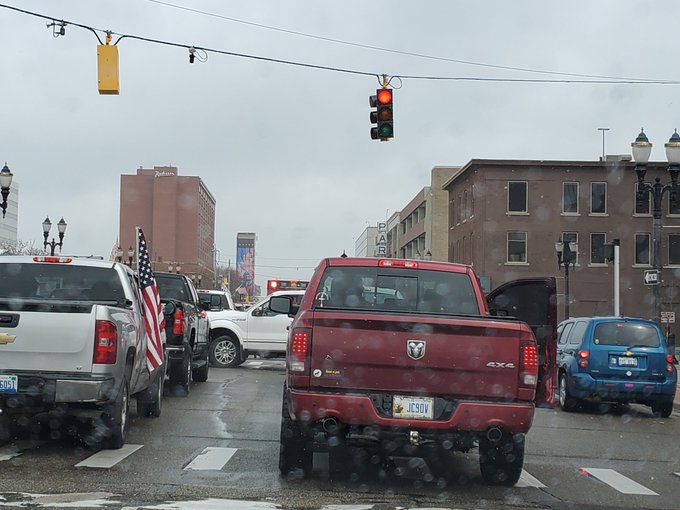
And this is how some right wingers in our state chose to mark the preventable deaths of our neighbors nearing the thousands — by purposely creating a traffic jam near a hospital.
The scene on Grand Ave. in downtown Lansing about 15 minutes ago where conservatives have jammed streets around the Capitol to protest Gov. Whitmer's stay-at-home order. It took about 10 minutes for this ambulance to evade traffic by turning the wrong way down a one-way street. https://twitter.com/ZachGorchow/status/1250452278944899072 

The arguments against the restrictions Governor Whitmer has put into place in an attempt to contain this plague are as flimsy as you might expect. Prohibiting travel to second homes, for instance, was actually requested by some elected officials in Michigan’s Upper Peninsula, where the hospitals could quickly be overrun by a Covid outbreak. And while there is definitely a place for frustration given the Trump administration disastrous response to Covid-19 and the growing economic destruction accompanying this massive failure, this protest mocked the horrendous suffering our state is enduring.
“Under the guise of our American right to assembly, a mob gathered, not only endangering themselves, but jeopardizing thousands of others throughout Michigan,” Jeff Timmer, Former Director Michigan GOP, wrote.


It also stank of the billionaire-sponsored tea party movement that exploited right-wing failures to attack anything the government might do to help workers out of the financial crisis. And like the CONTINUE READING: The Betsy DeVos connection to the protests against Covid-19 precautions in Michigan | Eclectablog

JEFF BRYANT: Homeschoolers want you to believe the pandemic has a silver lining — they’re wrong | Salon.com

Homeschoolers want you to believe the pandemic has a silver lining — they’re wrong | Salon.com

Homeschoolers want you to believe the pandemic has a silver lining — they’re wrong
While the public experiences a health calamity, the homeschooling movement sees a big opportunity


In the early days of the spread of the coronavirus in the U.S., when the number of known cases was barely cresting 1,000, advocates for homeschooling were greeting news of the outbreak as an opportunity to promote their cause.

"While the virus has caused illness and hardship for many, keeping children out of school is not a global calamity," wrote libertarian think tank operative Kerry McDonald in Forbes on March 11, two days before President Trump declared coronavirus a national emergency.
McDonald wasn't the only cheerleader for homeschooling in the face of a pandemic. "Learning can happen anywhere," Secretary of Education Betsy DeVos enthused on Twitter.
School closings were turning parents into "the nation's teachers," according to the Washington Times, a consistent advocate for public school privatization. The article, by Christopher Vondracek, told readers not to think about home-schooling as being "associated with religious reactions to the secularization of public education and the banning of prayer in public schools during the 1960s." Homeschooling, he contended, "looks nothing like that of yesteryear," because now "innovative lessons abound" and new technologies — including video streaming, apps, and social media — have made homeschooling a better option for parents seeking "individualized instruction and safer environments" for their children.
Vondracek pointed readers to the National Home Education Research Institute (NHERI), which "lists a variety of reasons for home-schooling." What Vondracek failed to mention is that NHERI is not an educational organization but is instead part of a network organized by the Home School Legal CONTINUE READING: Homeschoolers want you to believe the pandemic has a silver lining — they’re wrong | Salon.com

CURMUDGUCATION: Why Teach Literature? The Whole Collection

CURMUDGUCATION: Why Teach Literature? The Whole Collection

Why Teach Literature? The Whole Collection


I created a series of posts about the teaching of literature, and they ended up being sprinkled here and there. I thought I would just pump them out one after another but after I got started--squirrel!! So for those of you how enjoyed them, I'm putting this up to collect links to all of them in one place so that you can get to them more easily, should you ever wish to.

I know these aren't as entertainingly crabby as some of my stuff, and appeal to a more narrow audience, but I still like the exercise of thinking about what to teach and why. It's easy to get caught up in the day to day mess. Nice to step back and look at the bigger, more important picture behind the rest. So here they are:

Why Teach Literature Stuff: #1 What Is It?

Let's define our terms before we start.

Why Teach Literature Stuff: #2 Humanity

Because we all want to know what it means to be fully human in the world, and it takes a lifetime to even start to find out.

Why Teach Literature Stuff: #3 Knowing Stuff Is Useful

It's really handy to have a bunch of knowledge stuffed in your head.

Why Teach Literature Stuff: #5 Language Is Power

If you want to control your world, language is Tool #1.

Why Teach Literature Stuff: #6 Not For These Reasons.

There are bad reasons to teach a work of literature.

Why Teach Literature Stuff #7 Everything Is Reading

Because there's nothing to teach that isn't reading.


CURMUDGUCATION: Why Teach Literature? The Whole Collection


When Will You Feel Comfortable Sending Your Children Back to School? | Ed In The Apple

When Will You Feel Comfortable Sending Your Children Back to School? | Ed In The Apple

When Will You Feel Comfortable Sending Your Children Back to School?


It is increasingly looking like the powers that be are taking steps, albeit baby steps, to re-open the economy.
The President, reversing himself, has pushed re-opening decisions to the states; the American Enterprise Institute (AEI) recommends a phased return to normalcy.
State-by-State Reopening in Phase II. Individual states can move to Phase II when they are able to safely diagnose, treat, and isolate COVID-19 cases and their contacts. During this phase, schools and businesses can reopen, and much of normal life can begin to resume in a phased approach. However, some physical distancing measures and limitations on gatherings will still need to be in place to prevent transmission from accelerating again.
Governor Cuomo, issued another Executive Order extending PAUSE until at least May 15th, and, coordinating decisions with a multi-state consortium of states (NY. NJ, Conn, RI, Maryland, Delaware).
Denmark is the first European nation to re-open schools, with social distancing in schools and a NY Times article reports trepidation among parents.
Parents have tough decisions.
Should I send my child to an out-of-town college? Take a gap-year? Transfer to a college near home? Colleges and parents are mulling the options  and colleges are preparing for returning to on campus classes as well as continuing remote CONTINUE READING: When Will You Feel Comfortable Sending Your Children Back to School? | Ed In The Apple

COVID-19 CACFP Meal Delivery - Nutrition (CA Dept of Education)

COVID-19 CACFP Meal Delivery - Nutrition (CA Dept of Education)

COVID-19 CACFP Meal Delivery


The California Department of Education (CDE) Nutrition Services Division (NSD) wishes to clarify guidance on SP 14-2020, CACFP 08-2020, SFSP 07-2020 (SP 14-2020), regarding the home delivery of Child and Adult Care Food Program (CACFP) meals under the optional, nationwide Novel Coronavirus (COVID-19) non-congregate feeding waiver previously issued by the U.S. Department of Agriculture (USDA).
SP 14-2020 is located on the USDA Food and Nutrition Service web pageExternal link opens in new window or tab..


CACFP agencies that wish to deliver meals under the non-congregate feeding waiver must ensure that the privacy and safety of participants is safeguarded. To protect the best interests of both agency and participant, please note the following requirements:
  1. In order to protect the confidentiality of participants, Program Operators must have

    • Written consent (e.g., a letter, consent form, or email) from the participant or his/her guardian before meals can be delivered. The consent must be obtained by the Program Operator or CACFP administrative staff and may not be obtained by a delivery driver or by other CACFP staff unless confidentiality can be assured.
    • A Memorandum of Understanding (MOU). If the Program Operator uses an external organization or non-staff, they must have a MOU between themselves and the person/organization doing the delivery. The MOU must include provisions that protect confidential information, (e.g., what information can be disclosed, how the information may be used, how the information will be protected, and penalties for unauthorized disclosure).
  2. In order to use the waiver for meal pickup or delivery, Program Operators must complete the online COVID-19 waiver application and select the option for non-congregate meals. If Program Operators will offer or deliver meals at times that differ from what has been approved in the Child Nutrition Information and Payment System, they should also select the meal service times waiver option in the same waiver application. The waiver application is on the California Department of Education Nutrition Services Division COVID-19 CACFP Waiver(s) Application web page.
Program Operators that have already received approval for the non-congregate meals and meal service times waivers do not need to complete the waiver application again.
  1. After completing and submitting the waiver application, Program Operators that wish to use meal delivery must request to use that option by getting written approval from their assigned CACFP specialist. A request should be sent to the specialist by email. Program Operators should not begin meal delivery until they receive approval from their specialist.
Important Reminders
Program Operators should keep copies of the confirmation emails they receive after they apply to use the waivers—in addition to the meal delivery approval email from their CACFP specialist—as documentation of approval to serve and claim delivered meals.
Program Operators may provide meals via mail, delivery service, or hand-delivery by CACFP staff, volunteers, community organizations, or others. Please note, the child or adult participant does not have to be present for the meal delivery.
Finally, the CDE reminds Program Operators that they must adhere to all State and local food safety requirements as applicable to meal delivery and provision of off-site meals.
Under the non-congregate waiver, the home delivery flexibility is effective immediately and will remain in effect until June 30, 2020, or until expiration of the federally declared public health emergency, whichever is earlier.
Resources
For updated information, Program Operators are directed to visit the California Department of Education COVID-19 Guidance for K–12 Schools and Child and Adult Day Care Meals web page. This page is updated each Friday with new information.
For information on waivers and communication sent out to Program Operators, please refer to the California Department of Education Nutrition What’s New web page under the Disaster tab.
Contact Information
If you have any questions regarding this subject, please contact your CACFP specialist by email at CACFPWaiver@cde.ca.gov.
Questions:   Nutrition Services Division | 800-952-5609
COVID-19 CACFP Meal Delivery - Nutrition (CA Dept of Education)

Polio Epidemic in 1937 Closed Chicago Schools: Kids Learned at Home from Radio (Michael Hines) | Larry Cuban on School Reform and Classroom Practice

Polio Epidemic in 1937 Closed Chicago Schools: Kids Learned at Home from Radio (Michael Hines) | Larry Cuban on School Reform and Classroom Practice

Polio Epidemic in 1937 Closed Chicago Schools: Kids Learned at Home from Radio (Michael Hines)


An assistant professor at Stanford University’s Graduate School of Education, Michael Hines researches and teaches the history of education in the United States. His articles have appeared in the Journal of the History of Childhood and Youth and History of Education Quarterly; he is writing a book on race, democracy and Chicago’s schools during World War II. This piece appeared in the Washington Post, April 3, 2020.
A rapidly spreading virus with no known cure or vaccine. Chicago-area schools closed. Experiments in remote learning and concerns over access to technology. This has happened before.
While the challenges to education stemming from the novel coronavirus pandemic may seem unprecedented, educators may be surprised to learn that almost 100 years ago Chicago’s schools faced similar circumstances.
In the fall of 1937, an outbreak of poliomyelitis, or polio, a highly infectious disease that can lead to paralysis and death and is especially dangerous to young children, swept through the Chicago area. It forced schools to delay the opening of the academic year and prompted widespread alarm about lost instructional time and students left to their own devices.
Determined to continue instruction for the district’s nearly 325,000 elementary age students, then-Superintendent William H. Johnson and then-Assistant Superintendent Minnie Fallon initiated a massive experiment that brought school lessons directly into the homes of students through the coordinated efforts of public schools, major radio stations, daily newspapers and local libraries.
Although some of the area’s more well-heeled schools had already begun using radio inside the classroom, the technology itself was still fairly new and largely untested in education in the 1930s, and the idea of school-by-radio was highly innovative, prompting excitement and comment from educators around the country.

CATCH UP WITH NEWBLACKMAN (IN EXILE)

NewBlackMan (in Exile)


CATCH UP WITH NEWBLACKMAN (IN EXILE)

TODAY

Is Social Media the Future of Epidemiology?
'News and social media are changing the way we learn about and track the spread of infectious diseases. The Takeaway spoke to Dr. Marjorie Pollack , a physician, medical epidemiologist, and deputy editor of ProMED, about how she used local news reports and social media to alert the international community to what we now know as COVID-19, in late December 2019.'
DJ Dahi Unpacks His Spiritual Samples for Pusha T and Kendrick Lamar
'Spinning records backwards was once condemned as satanic. But when DJ Dahi reverses samples — or alters his voice — to produce hits for the likes of Pusha T , Kendrick Lamar or Childish Gambino, it's a ministry of texture and sound.'
In New Film About Gospel Pioneers The Clark Sisters, The Music Comes First
'Director Christine Swanson 's new film is about the celebrated Detroit gospel group, The Clark Sisters. She talks to host Rachel Martin about being adamant about casting women who could actually sing.'

Black Like Who?

'It's one of the thorniest questions in any theoretical plan for reparations for Black people: Who should get them? On this episode, Code Switch digs into some ideas about which Black people should and shouldn't receive a payout — which Christina Greer , author of the book Black Ethnics: Race, Immigration, And The Pursuit Of The American Dream, estimates would cost at least $10 trillion.'
Artist Billie Zangewa – the Ultimate Act of Resistance is Self-Love

' Artist Billie Zangewa welcomes us at her home in Johannesburg, South Africa. As we tour the city, we learn about what inspires and influences her work. From the love for her son, to her experience of silk as a 'transformative material' – her focus is largely rooted in the home and plays into what she describes as ‘daily feminism’.'
Elizabeth Stordeur Pryor: Why it's so hard to talk about the N-word

'Historian Elizabeth Stordeur Pryor leads a thoughtful and history-backed examination of one of the most divisive words in the English language: the N-word. Drawing from personal experience, she explains how reflecting on our points of encounter with the word can help promote productive discussions and, ultimately, create a framework that reshapes education around the complicated history of racis
Riché D. Richardson: The Hidden Life of Rosa Parks

' Throughout her life, Rosa Parks repeatedly challenged racial violence and the prejudiced systems protecting its perpetrators. Her refusal to move to the back of a segregated bus ignited a boycott that lasted 381 days and helped transform civil rights activism into a national movement. But this work came at an enormous risk— and a personal price. Riché D. Richardson details the life of Rosa Park
Audra McDonald - "Somewhere" | 2019 Kennedy Center Honors

'Broadway star Audra McDonald performs "Somewhere" from West Side Story to honor Michael Tilson Thomas during the 2019 Kennedy Center Honors.
People's Party: Talib Kweli & Gina Yashere Talk Bob Hearts Abishola, UK vs. US Racism

' In this episode of People’s Party , Talib Kweli and Jasmin Leigh sit down with British-born comedian and actor Gina Yashere . The interview spans from Gina's upbringing in London, being raised by Nigerian parents to her path emerging as a globally recognized comedian.'
Sonics & Visuals: Kandace Springs Covers Sade's "Pearls"

Vocalist Kandace Springs offers a thoughtful of Sade 's "Pearls". The song is featured on Springs's The Women Who Raised Me (2020).
Heather C. McGhee: Racism Has a Cost for Everyone

'Racism makes our economy worse -- and not just in ways that harm people of color, says public policy expert Heather C. McGhee . From her research and travels across the US, McGhee shares startling insights into how racism fuels bad policymaking and drains our economic potential -- and offers a crucial rethink on what we can do to create a more prosperous nation for all. "Our fates are linked," s

APR 09

Prisoners Reveal Inhumane Conditions Inside Mississippi Prisons

' Inmates inside Parchman State Penitentiary, Mississippi’s most infamous prison, describe the inhumane conditions that have them fearing for their lives. They’ve shared videos from inside the prison, exposing the hellish surroundings. Overflowing sewage, rats, mold, and threats of violence are all part of their day-to-day reality. It’s a situation that’s been years in the making. Now, it’s reach
Black Thought Of The Roots: Tiny Desk (Home) Concert

'While our culture adjusts to the New Normal, artists are revealing the threads of our common humanity as they find new ways to bring their work to virtual communities. In this installment of Tiny Desk (home) concerts, hip-hop wordsmith Tariq Trotter , aka Black Thought of The Roots crew, took the occasion to premiere three new songs.'
Joking from a Distance: Ziwe Fumudoh on Processing Trauma Through Comedy

' The last time Ziwe Fumudoh , a comedian and writer for Showtime's Desus & Mero , was on The Takeaway , she discussed the relationship between empathy and comedy. For the next installment in our series "Joking from a Distance," The Takeaway checked back in with her to see whether comedy can still be used to build empathy during the coronavirus pandemic.'
People’s Party: Talib Kweli & Chuck D Talk Public Enemy, Flavor Flav, Tupac and Trump

' In this episode of People’s Party , Talib Kweli and Jasmin Leigh sit down with rapper, author, producer, and one of the most influential and respected figures around the world in all of culture. The leader of the iconic group Public Enemy -- "Mista" Chuck D .' -- UPROXX Video
Just Blaze Unpacks His Samples for Beyoncé And Jay-Z

'In the first installment of NPR Music's video series The Formula , producer Just Blaze unpacks the drum-centric samples he created for Jay-Z and Beyoncé . Whether he's tapping out sampled drums or incorporating live drummers in the studio, his ability to harness energy is what makes his sound so dynamic.'
Why Racial Data on Coronavirus Testing and Deaths is Needed

'In some communities, the coronavirus pandemic appears to be disproportionately affecting people of color. African Americans have higher rates of the underlying health issues that can lead to death by the virus. Jericka Duncan speaks with health experts, Dr. Uché Blackstock including about the need to collect data on the race of those who have tested positive or died from coronavirus.' -- CBS Thi
9th Wonder Breaks Down His Beats For Kendrick Lamar's 'Duckworth.'

'Three samples. Three genres. Three generations. Watch 9th Wonder take NPR Music on a sonic journey while breaking down the trio of beats he produced for one Kendrick Lamar classic: "Duckworth".'


TWO DOLLARS AND A DREAM: The True Story of Madam C.J. Walker (dir. Stanley Nelson, 1987)

'TWO DOLLARS AND A DREAM is the biography of Madame C.J. Walker , America's first self-made millionairess. Mrs. Walker's fortune was built on skin and hair care products, parlaying a homemade beauty formula into a 
NewBlackMan (in Exile)