Latest News and Comment from Education

Saturday, March 7, 2020

The Truth Behind Go Public Schools Corporate Connections

The Truth Behind Go Public Schools Corporate Connections

The Truth Behind Go Public Schools Corporate Connections


Public education is no stranger to the corporate forces that rule and orchestrate their control and assault on it. It is not only detrimental to the entire system.
The corporate forces realize this and of course, they are not stupid.
They realize that their procedure of divide and conquer was backfiring at them cohesively.
It was breaking down as the teachers being blamed revolted through unions which brought everything into the right perspective.
The strong alliance created between teachers and parents to fight the system in Chicago – especially in the case of Black and Latino parents overruled the forces.
Similarly, another alliance is being formed in Philadelphia with at least 23 schools being shut down and naturally getting handed over to charter school organizations.
The anger is being directed towards school districts by revolting in the closures itself.
Resources are being denied as funds are being restricted. Everything is being directed at these corporate forces and they understand it. So now they are going to go ahead with the same strategy but fine-tune the material by regrouping and CONTINUE READING: The Truth Behind Go Public Schools Corporate Connections

Betsy DeVos’s problem with numbers - The Washington Post

Betsy DeVos’s problem with numbers - The Washington Post

Betsy DeVos’s problem with numbers


Education Secretary Betsy DeVos has a problem with numbers. As in, she sometimes cites numbers that just aren’t accurate.
DeVos, of course, is hardly the only government official to cite inaccurate numbers to make a point, but that’s no reason not to point it out when she does — and she did during two appearances in the last week before congressional committees when defending the Trump administration’s proposed 2021 budget.

Let’s look at a few examples from her testimony.
One misleading figure that gets repeated, and not just by DeVos, is this: There are 1 million students on waiting lists at charter schools throughout the country. DeVos uses the statistic to show there is enormous demand for charters — which are publicly funded but privately operated — but not enough schools to accept all children who want to go. That, the argument goes, is why charter expansion should be encouraged.
To be sure, some charter schools are indeed in high demand and do have long waiting lists. But on some of the lists, there are duplicates, children who are already in other schools and other issues.
The 1 million figure was first cited in 2013 when the National Alliance for Public Charter Schools first made the claim. That alliance is led by Nina Rees, who worked for former vice president Richard B. Cheney. The alliance quickly revised the number it cited — to a minimum of 520,000 when it acknowledged that students were on duplicate lists.
In 2014, Gary Miron, a professor at Western Michigan University, and Kevin Welner, a professor at the University of Colorado at Boulder and founder of the National Education Policy Center, wrote a policy brief titled “Wait, Wait, Don’t Mislead Me,” which gave nine evidence-based reasons the waiting list numbers from the charter alliance should not be believed. These include no external verification, the CONTINUE READING: Betsy DeVos’s problem with numbers - The Washington Post

Education Votes: Featured Headlines Get the latest education news

Home - Education Votes


Education Votes
 Featured Headlines Get the latest education news


Six reasons we must address our nation’s crumbling school buildings

By Amanda Menas / Photo: NEA President Lily Eskelsen Garcia at the Rayburn Building Too many students and educators across the country learn and work in crumbling schools. In California, one teacher reported that students are instructed to run the water for one minute before drinking to prevent lead contamination. In one Idaho school, educators … The post appeared first on Education Votes .
$100 billion for schools added to infrastructure package

NEA President Lily Eskelsen GarcĆ­a joined Speaker Nancy Pelosi (D-CA), House Education and Labor Committee Chairman Bobby Scott (D-VA), NEA member and former National Teacher of the Year Jahana Hayes (D-CT), Rep. Donald Norcross (D-NJ), and national education leaders for a press event about adding the Rebuild America’s Schools Act (S. 266/H.R. 865) to House … The post appeared first on Education
DeVos forced to backtrack on cuts to rural schools

In the face of a bipartisan outcry, Education Secretary Betsy DeVos retreated from a bookkeeping change that would have caused more than 800 rural, low-income schools to lose critical funding from the Rural Education Achievement Program (REAP). The change entailed how districts report the number of students living in poverty. For the last 17 years, … The post appeared first on Education Votes .


Schools and coronavirus: what you need to know

Congress took quick, bipartisan action to address the public health emergency posed by COVID-19, the disease caused by the coronavirus. An $8.3 billion emergency supplemental appropriations package passed the House 415-2, 
Home - Education Votes


The Virus that Ate My Field Trip | Teacher in a strange land

The Virus that Ate My Field Trip | Teacher in a strange land

The Virus that Ate My Field Trip


For more than a dozen years, I took my 8th grade bands on an extensive field trip, near the end of the school year. The trips were always out-of-state (or out of the country), involving two or three nights in a hotel, plus a symphony performance, cultural experiences like museums, university-based skills clinics, plays and musicals, a formal, white-tablecloth dinner out–and someplace for my students to play a concert.
We selected the destination (Chicago, Cleveland, Toronto, St. Louis, Washington D.C.) in the fall, and raised funds all year. Lots of parents paid to chaperone. The destination became a kind of instructional theme—we studied the blues in our Chicago years, and all-American composers and patriotic music in the D.C. year.
Nothing I’ve done since has ever been a worthier use of instructional time, or a better learning experience, than taking 135, more or less, 13/14-year olds and perhaps 25 parents out in the wider world for a musical adventure. Playing in a Chicago jazz club (at 2:00 p.m., with pitchers of Coke), wandering the Rock and Roll Hall of Fame, putting on a concert for veterans in St. Louis, the Phantom of the Opera in Toronto—all good.
The Band Boosters made sure, financially, that everyone went—and one year, we took a virus along with us.
It was some kind of norovirusaccording to the local health department, which got into the act after we returned, contacted by a worried mother who thought perhaps her child had been poisoned. But no. All 164 people on the trip got to experience the CONTINUE READING: The Virus that Ate My Field Trip | Teacher in a strange land

Jennifer C. Berkshire: Trump’s Education Policy Is an Opportunity for Democrats | The Nation

Trump’s Education Policy Is an Opportunity for Democrats | The Nation

Trump’s Education Policy Is an Opportunity for Democrats
Republicans are running away from Betsy DeVos’s “education freedom” agenda as fast as they can. So why haven’t Democrats noticed?


Keller, Texas—On the same night that President Trump invoked the specter of “failing government schools” in his State of the Union address, Texas Republican Giovanni Capriglione was working hard to establish his public school bona fides. Elected to the Texas House as part of the 2012 Tea Party wave, Capriglione reminded voters here in Keller, an affluent suburb of Fort Worth, that he was a product of public schools, his wife is too, and that his children attend them now. Grade by grade, he named his favorite teachers.
While Trump used his pulpit to make clear his administration’s contempt for public schools, Capriglione wooed the voters he hopes will send him back to the state legislature with calls for more generous school funding, less standardized testing, and more rigorous oversight of charter schools.
Why such disparate messaging?
In a word: elections. In 2018 Texas Democrats flipped 12 formerly Republican legislative seats, half in the fast-growing region around Dallas and Fort Worth known as the Metroplex. While the Texas version of the blue wave was fueled in part by enthusiasm for the Senate candidacy of Beto O’Rourke, Democrats also ran hard against what they characterized as the GOP’s antipathy toward public education. Voters ejected several school voucher advocates, while candidates who ran as supporters of public schools were rewarded. And while Trump is beloved among rural Texans, they are not fans of his signature education issue, “education freedom,” aka sending taxpayer funds to private and religious schools. CONTINUE READING: Trump’s Education Policy Is an Opportunity for Democrats | The Nation

Protect The Tax-Payer’s Revolution – Los Angeles Education Examiner

Protect The Tax-Payer’s Revolution – Los Angeles Education Examiner

Protect The Tax-Payer’s Revolution


Here in L.A., we’ve just finished weighing in on two ballot questions regarding schools funding. Really engaged activists and politicians will argue the initiatives we voted on are unrelated, both the two just addressed and another coming up. But many of us see a set of connected dots in a three-part series:  Measure EE [June 2019], Proposition 13 [2020], Schools And Communities First (SCF).
The three initiatives do share a common objective in funding schools, but their significance shifts according to the context in which each is evaluated.
One year ago during a cold and rainy January, UTLA’s teachers (and allied communities) went on strike for contract concessions above and beyond the typical matter of a paycheck. At issue were systemic questions of management and budget, District resources and their equitable distribution, and the very nature of public service in our modern democracy.
This is a “demand-side” context regarding public resources – basically, that more money is needed. The strike was settled upon acknowledgement of available funds held in reserve. But there was seemingly little disagreement about this:  schools require more general funding.
Given the strike’s widespread public support then, it is bewildering to look through this filter yet experience first one followed by a second, ballot- CONTINUE READING: Protect The Tax-Payer’s Revolution – Los Angeles Education Examiner

Bernie Sanders Would Be the First Jewish President – What That Means to Me | gadflyonthewallblog

Bernie Sanders Would Be the First Jewish President – What That Means to Me | gadflyonthewallblog

Bernie Sanders Would Be the First Jewish President – What That Means to Me

Being Jewish is not something I advertise.
Some of my earliest memories are trying to explain to school friends that no, I didn’t kill Jesus – and, yes, I do eat matzo but it isn’t made with baby’s blood – and would they like to come over to my house and play Legos?
I’ve been called “yid,” “kike,” “heeb,” even just plain “Jew” with the lips curled and the word hurled at me like a knife.
Heck. When I was a kid even the bus driver called me “moneybags,” though my family was far from rich.
So it makes sense to me that Bernie Sanders isn’t running for President as a Jew first.
He’s running on his policies and experience.
But it still hurts when pundits complain that there are now just two white men vying for the democratic nomination.
Um. Okay.

Sanders IS Jewish. You know that, right? If he were elected, it would not be business CONTINUE READING: Bernie Sanders Would Be the First Jewish President – What That Means to Me | gadflyonthewallblog

CURMUDGUCATION: The Complexity of Performance Tasks

CURMUDGUCATION: The Complexity of Performance Tasks

The Complexity of Performance Tasks


It's spring musical season here in NW PA, and I am back in a small way playing in the pit orchestra for a production of Seussical being put as a co-op between my old school and a neighboring high school. This is an annual enterprise I was part of for years. I've been doing school and community theater in a variety of capacities for almost forty years now, and it's still pretty exciting.

There really isn't a much purer version of a performance task than performing arts work. But they're also as reminder of how complex performance tasks really are.


First, there's the actual preparation for the task. Whether we're talking music or theater, there's a wide range that a teacher/director can land on. On one end of the scale, we get very specific preparation for this very specific task. On the other end of the scale, preparing for this task while also noting the larger ideas and principles behind whatever you're doing. For example, you can teach a young actor how to play this one character, or you can teach her about the acting that can be used in this one particular application. You can teach your band how to play "Nobles of the Mystic Shrine" or "Take The A Train," or you can use those pieces to teach them about the stylistic features of playing marches or swing.

It's a challenging choice because sometimes, given the limits of time and aptitude you're working with, you may get a better final product by providing less actual education. You can see this in the world of performance competition, where you will find, for instances, band musicians who can deliver a dynamite precision performance of this year's show-- and nothing else.

But then we get to the performance itself.

A stage musical involves a gazillion moving parts, and every one of those parts effects the other parts.  Folks like to talk about all the magic and mystery of theater, but for magic to happen, a lot of basic nuts-and-bolts mechanics have to be taken care of first. We have to move two set pieces CONTINUE READING: 
CURMUDGUCATION: The Complexity of Performance Tasks

Coronavirus Guidance Update - Letters (CA Dept of Education)

Coronavirus Guidance Update - Letters (CA Dept of Education)


Dear County and District Superintendents, Charter School Administrators, and Principals:

2019 Novel Coronavirus Guidance Update for Schools and School Districts

We understand that some Californians may be concerned about novel coronavirus (COVID-19), as it is a new virus and there are a lot of unknowns. The health risk to the general public in California remains low at this time, however, California state and local health officials are actively monitoring the situation and preparing should the risk of infection to the general public increase. The California Department of Education (CDE) is participating in daily calls with several state agencies, as we learn more about COVID-19, and how best to support our schools and families.
In light of the State of Emergency declared on March 4, 2020, by the Governor, we would like to remind school communities that this was preparation-based, not because an outbreak currently exists. An emergency proclamation is designed to help focus resources and get a government response moving more quickly. Emergency declarations have unfortunately happened a number of times in the past few years, especially during wildfire season, and pertain to only those directly involved with the emergency situation.
We have provided guidance to our schools and districts throughout the state to encourage them to identify plans and protocols in preparation for the possibility of school closures, and for communicating with families due to a public health concern.
Deciding to close a school is a local decision, and one that CDE would not provide the directive on, especially if it is a public health concern. In the case of COVID-19, the decision to close a school would either come from the school and/or district, or ideally from their local county public health officials. We ask that you trust your local district leadership, as well as public health officials, to handle the potential of these situations with professionalism and calmness, and as always, with the safety of students and staff as the utmost priority.
It is important to note that so much of protecting yourself and your family comes from common sense practices, such as washing your hands with soap and water, staying away from work or school if you become sick with typical COVID-19 symptoms, and of course, following guidance from public health officials. We will continue to stay in close contact with public health officials, monitoring the situation with the experts, and as applicable, supporting our schools and districts as needed.
For more information, please visit the California Department of Public Health’s (CDPH) web page at https://www.cdph.ca.gov/Programs/CID/DCDC/Pages/Immunization/nCOV2019.aspx.
Please see the attached document for information on COVID-19 to share with your K–12 schools, districts, and county offices of education.
Sincerely,
Tony Thurmond
State Superintendent of Public Instruction
TT:kb
Coronavirus Guidance Update - Letters (CA Dept of Education)

Our Right to Resources - Public Advocates

Our Right to Resources - Public Advocates

School Districts are Cheating Students to Fund Law Enforcement


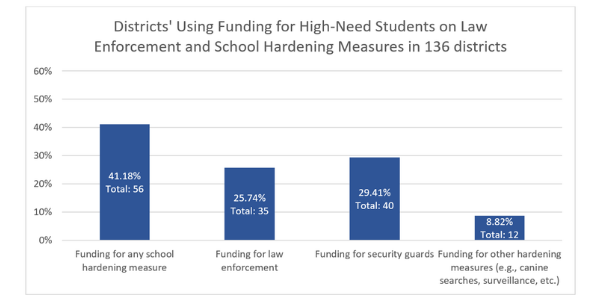
We have uncovered rampant and illegal misspending by school districts on law enforcement throughout Southern California. In a report released on March 5, 2020, titled “Our Right to Resources: School Districts are Cheating Students to Fund Law Enforcement,” 56 districts were found to have illegally diverted money intended for English learners, foster youth, and low-income students towards police, security guards or other hardening measures such as surveillance equipment.
These actions violate the state’s education funding law and only further criminalize high-need students, and students of color, especially Black students. Altogether, more than 40% of the 136 districts examined spent on school police or security, robbing over 1 million high-need students of tens of millions of dollars of services.
The report is co-authored by Public Advocates, the ACLU of California, Gente Organizada, and the Pomona Students Union.

See which Southern California districts are spending illegally on law enforcement


Background

In 2019, youth leaders at Gente Organizada discovered that the Pomona Unified School district was illegally spending funds reserved for foster youth, English learners, and low-income students on school police and security.  Outraged, the students organized and ran a campaign to stop it.  After months of advocacy, they ultimately convinced their district to stop spending those funds on law enforcement and to reinvest them instead in additional counselors.
Concerned about how common such illegal spending might be, Gente Organizada, Public Advocates, and the ACLU of California launched an investigation looking at how all 136 school districts in Los Angeles, San Bernardino, and Riverside Counties were spending their funds.  The study uncovered a disturbing trend: more than 40% of the school districts were illegally spending funds meant for high-need students on law enforcement or other school hardening measures, costing more than a million high-need California students their right to tens of millions of dollars in positive supports and services.


charts
This report examines the true cost of such illegal spending, including the harmful impacts the presence of law enforcement in schools has on high-need students and students of color.  The report also proposes alternative, evidence-based solutions that effectively support high-need students, such as school-based health and mental health resources (e.g., school counselors, school social workers, school psychologists, and school nurses), restorative justice programs, and positive behavior interventions and supports.
For more information, contact dluu@publicadvocates.org or 415-625-8460

Going Off the Grid…but First… | The Merrow Report

Going Off the Grid…but First… | The Merrow Report

Going Off the Grid…but First…

Before I go off the grid for ten days to go kayaking in the Sea of Cortez, I am asking a favor. If you believe that students deserve challenging educational opportunities, and if you believe that the most important question an educator can ask is ‘How Is This Child Intelligent?’ (instead of ‘How smart is this kid?’), then please share these five links with everyone who feels the same way, or who should feel this way.

Part one: Why Project-Based Learning (PBL), plus a project to measure water use in their schools and communities;
Part two:  A project to study air quality that elementary students can do at their school;
Part three:  Projects that get students out in their communities show the general public the good stuff that schools are doing;
Part four: PBL means students are creating knowledge, not merely regurgitating; here are two great examples;
Part five:  This covers the important issue of evaluating project-based learning, plus two more examples of successful PBL.
Basically, these posts are about the significant benefits of PBL.  First of all, students CONTINUE READING: Going Off the Grid…but First… | The Merrow Report