Latest News and Comment from Education

Thursday, March 5, 2020

Keith E. Benson: What Reformers Are Really Doing in Camden and Other Urban Districts | Diane Ravitch's blog

Keith E. Benson: What Reformers Are Really Doing in Camden and Other Urban Districts | Diane Ravitch's blog

Keith E. Benson: What Reformers Are Really Doing in Camden and Other Urban Districts


Keith E. Benson is president of the Camden (New Jersey) Education Association. In his view, the underlying goal of the charter industry is gentrification, and he worries about its long-term implications for his community and its families.
He writes:
Admittedly [my] fight for Camden’s public schools is personal. Both my grandmothers were teachers, numerous aunts, and two of my uncles were employees of the District where I, myself, taught before becoming president of the city’s teacher union in 2017. My daughter goes to school here and has since she was three. My wife went to school here until her freshman year of high school, and she grew up here. We all live here now. Because of such deep and intimate connections I have with this public school district and city, anything that threatens the sustainability is triggering.


 The planned dismantling of our public-school system coupled with a massive redevelopment effort dubbed “Camden Rising”, reduces merely existing here in the future to a tenuous proposition for many working class and poor residents. For generations of Camden’s current residents, and new arrivals here from Latin America, this city is one of the last affordable places in New Jersey CONTINUE READING: Keith E. Benson: What Reformers Are Really Doing in Camden and Other Urban Districts | Diane Ravitch's blog

Dewey Academy in Danger of Displacement: Gentrification and the Oakland Unified School District

Dewey Academy in Danger of Displacement: Gentrification and the Oakland Unified School District

Dewey Academy in Danger of Displacement: Gentrification and the Oakland Unified School District


The Gentrification of Oakland Unified School District & The Precarious Position of Dewey Academy
Gentrification is a long-standing process that targets the lower waged group to displace, dislocate, and disperse in favor of the higher income community. Gentrification has been a reality in the bay area for long. For the past few months, this reality is hitting the students’ community in the OUSD hard.
The Oakland Unified School District’s administration revealed that the gentrifying developers are targetting the Dewey academy, a public continuation high school.

It was known to the masses that the developers were planning to forge a twenty-four story condominium right in front of the Dewey academy, eclipsing it like a tower. But recent developments have put the very existence of this public institution at risk.
What entails is a close view of the reasons and the Causes why the Dewey Academy and the Admin building are under threat of displacement.
Dewey Academy: A Surplus Land?
The duty to ascertain the fate of Dewey academy was entrusted upon the ‘7-11 CONTINUE READING: Dewey Academy in Danger of Displacement: Gentrification and the Oakland Unified School District

The Blame Game: 100 Years of Teacher Bashing – Have You Heard

The Blame Game: 100 Years of Teacher Bashing – Have You Heard

The Blame Game: 100 Years of Teacher Bashing


Blaming teachers for the woes of US public schools and beyond is as old a pastime as public education itself. Historian Diana D’Amico Pawlewicz takes us through 100 years of teacher blaming and the love-hate relationship the US has with its teachers. You’ll laugh! You’ll cry! You’ll want to pre-order her book, Blaming Teachers: Professionalization Policies and the Failure of Reform in American History.
Complete transcript of the episode is available here. And if you appreciate Have You Heard, consider making a small donation via Patreon.com. Thanks for your support!


Louisiana Educator: Almost Everything Recently Done in the Name of Education Reform Has Backfired

Louisiana Educator: Almost Everything Recently Done in the Name of Education Reform Has Backfired

Almost Everything Recently Done in the Name of Education Reform Has Backfired

Here is an article informing us that the reduction of recess time so that children could spend more time being drilled for the almighty standardized tests has actually resulted in lower test performance! How can that be? Why isn't constant drilling on test taking skills at the expense of recess, PE, art, music, vocational education, and other "less important" instruction producing higher test scores? Maybe because the current trend to ignore fundamental child development principle's is harmful in every way, including killing the joy of schooling for both children and teachers! Teachers in Finland, whose students perform at the top of the rankings on international achievement tests, routinely take young children outdoors where they can play, investigate nature and develop normally as they are programmed by their genes to do. Why do American reformers insist on counteracting nature and instead have transformed our education system to motivation killing test drudgery?

Here is another new article challenging the removal of teachers from the decision making process of what kids really need in school. This outrageous trampling on the rights and critical input of the teaching profession in education decisions has actually resulted in the opposite of what our non-educator reformers said they wanted to do. Do you think our government can stop the Corona virus by ignoring the recommendations of the highly trained CONTINUE READING: 
Louisiana Educator: Almost Everything Recently Done in the Name of Education Reform Has Backfired

The Politics of Capitalism in Trumplandia – radical eyes for equity

The Politics of Capitalism in Trumplandia – radical eyes for equity

The Politics of Capitalism in Trumplandia


In the idealism of youth, I came to believe deeply in the power of education to transform not only individuals (as it had done for me) but also society. More than a decade before I discovered my intellectual home, critical pedagogy, I was compelled by John Dewey’s philosophy of education, democracy, and their relationship.
This idealism was tinted with a naive lack of awareness about my own privilege and the corrosive power of systemic inequities driving racism, sexism, classism, and many other social biases. I was raised in a home, community, and region of the country steeped in rugged individualism and bootstrap narratives among working-class (and racist) whites.
Over the course of my first decade-plus of teaching, I certainly could see that I was shaping individual lives, but I grew increasingly skeptical of the revolutionary power of education to transform society.
By the spring of 2005, then, after I had secured my doctorate and moved from K-12 to higher education, I sat in a hotel room in New Orleans watching George Carlin talk about being a non-voter. I recognized that day my skepticism had turned into full-blown cynicism, and I then joined the ranks of non-voters who argued there was little discernible difference between the two major political CONTINUE READING: The Politics of Capitalism in Trumplandia – radical eyes for equity

Election Analysis: Mixed Results and There’s a Lot of Work Ahead – Los Angeles Education Examiner

Election Analysis: Mixed Results and There’s a Lot of Work Ahead – Los Angeles Education Examiner

Election Analysis: Mixed Results and There’s a Lot of Work Ahead


As the election results rolled in last night, much of the media focused on the drama in the Democratic Presidential Primary. But a lot happened in local races as well. The battle over whether or not the Los Angeles Unified School Board is controlled by supporters of public education and the UTLA or “school choice” and unfettered charter school expansion remains up in the air.
But first, let’s discuss Proposition 13 and what its failure means for the Schools and Communities First Ballot Initiative this fall. While the two ballot initiatives are very different, the failure of Proposition 13 doesn’t bode well for supporters of robust funding for public education.
Prop 13 (2020) was a bond measure that wouldn’t actually raise taxes, but was still opposed by the Howard Jarvis Taxpayer’s Association. We understand the Prop. 13 was complicated and that plenty of people reading this likely voted against it. But some of the opposition was based around mis-information that Prop 13 (the 1978 ballot measure that capped property taxes) was under attack.
The Schools and Communities First ballot is anticipated to require “50% -plus-1” voters to pass this fall. But it will more directly affect voter’s CONTINUE READING: Election Analysis: Mixed Results and There’s a Lot of Work Ahead – Los Angeles Education Examiner

CURMUDGUCATION: IN: Child Labor Is Fun

CURMUDGUCATION: IN: Child Labor Is Fun

IN: Child Labor Is Fun


Some legislators in Indiana are boldly taking on one of the great problems of their state-- too many restrictions on child labor.

The bill intends, among other things, to do away with the requirement for student work permits for teens. Because the fact that a teenager is flunking high school should not stand in his way when it comes to serving as a useful meat widget for employers.


Full day of school, full shift of work, then homeworkkkzzzzz
Rep. Randy Lyness (R) is stumping for the bill, which is advancing through the legislature. In civilian life, Lyness is the owner of Randy Lyness Builders, and he thinks that it should be "more attractive" for employers to hire minors, which means, apparently, being able to get plenty of work out of the little buggers. The bill proposes that students be allowed to work forty hours a week during the school year (and, as mentioned above, that the student's performance in school not be a factor). On holidays, students could put in a 48 hour week. Also, it gets rid of mandated CONTINUE READING: CURMUDGUCATION: IN: Child Labor Is Fun


Wednesday, March 4, 2020

CURMUDGUCATION ON A ROLL TODAY

CURMUDGUCATION


CURMUDGUCATION ON A ROLL TODAY


IN: Child Labor Is Fun

Some legislators in Indiana are boldly taking on one of the great problems of their state-- too many restrictions on child labor. The bill intends, among other things, to do away with the requirement for student work permits for teens. Because the fact that a teenager is flunking high school should not stand in his way when it comes to serving as a useful meat widget for employers. Full day of sch
NWEA Offers More Testing Baloney

When a system doesn't work, you have a couple of choices-- you can address the problems that are causing failure, or you can insist that the original system is super-duper and start imposing new rules to try to work around the flaws in your original system. Like the latch that doesn't work properly, but instead of fixing the latch, you just teach everybody to lift and push the door to the side to
Civics and History in the Classroom

The teaching of US history has always been... well, not a hot topic, exactly, but always one that is simmering on a back burner. From the occasional reaction to one brand of civic illiteracy or another (no, that's not an actual power of the President) to the eternal complaint that schools are teaching students to hate America , the civic conversation is always drawn back to the question of how the
How Do We Measure Your Turf?

In which I ponder the various ways in which private money plays in the public sphere, how much we should care about them, and why. Preface/Warning This post is probably going to be long and only sort of related to education. It has an audience of roughly two people-- a guy who periodically kicks at my ass on Twitter, and me. He's unlikely to be moved by anything I have to say, and I'm indulging my


MO: Arresting Librarians

If you haven't already, read this piece from Nancy Bailey that makes two points with crystal clarity and detailed support: * school librarians are an essential part of teaching reading in school (scientifically or otherwise) * school librarian jobs 
CURMUDGUCATION

Mitchell Robinson: Healthcare: A Love/Hate Story… | Eclectablog

Healthcare: A Love/Hate Story… | Eclectablog

Healthcare: A Love/Hate Story…

Amid all the murky and dramatic national conversations about the disaster that is our current healthcare system, one sometimes stumbles upon a moment of potential clarity. This is one of those moments…
At a social event the other night, I met a person who worked for a large regional health insurance company. The conversation, naturally, came around to the topic of what to do about our country’s healthcare system, and I asked her what the folks at her company thought about Medicare For All (M4A).
To my surprise, she laughed and immediately dismissed the possibility of a single-payer system completely, claiming it could “never happen” because private health insurance companies are too strong and important to our economy to “just go away.”
Even more than her dismissive nature regarding M4A, I was struck with the look of absolute confidence and assurance in her eyes. This woman was rock solid in her conviction that private health insurance was too big to fail and, even though every other industrialized country in the world had figured out how to implement single-payer systems, this could just never happen in the US. In her eyes, it was simply inconceivable.
The conversation then unexpectedly pivoted to the recent surgery her husband had just had, and how their health insurance–the health insurance they received through her employer, the private health insurance company–had a very high, $3,000 deductible, and how difficult it was for them to pay for every prescription and medical procedure out of pocket until they reached that number.
The couple also complained that their copays varied depending on the treatment and provider, ranging unpredictably from $35 for a simple office visit to as high as $75 per appointment, and CONTINUE READING: Healthcare: A Love/Hate Story… | Eclectablog

5 Reasons Betsy DeVos is Bad for Public Schools - Education Votes

5 Reasons Betsy DeVos is Bad for Public Schools - Education Votes

5 Reasons Betsy DeVos is Bad for Public Schools


By Amanda Menas
Over the two years since Betsy DeVos was confirmed as President Trump’s secretary of education, she has worked against the best interests of public schools. From proposing funding cuts to promoting privatization to rolling back protections for vulnerable children, she has ignored the voices of educators across the country about what students need. 
DeVos has never worked in a public school. She has never been a teacher, a school administrator, nor served on any public board of education. She didn’t even attend public schools or send her children to public schools. 
As NEA President Lily Eskelsen GarcĆ­a, a former elementary teacher from Utah, says DeVos is “the first secretary of education with zero experience with public schools…. She is out of her league when it comes to knowing and doing what works for public school students.”
Educators knew from the start that DeVos would be a disastrous choice, and she has been. Here are five times she has harmed our students, educators, and public schools.

1. She wants to privatize public schools

 Betsy DeVos has consistently pushed to expand federal vouchers that will take money from public schools to give to private schools. Her voucher bill is a brazen scheme that would take $50 billion from public schools over 10 years. Meanwhile, DeVos and President Trump proposed to cut education spending by $8.5 billion in 2020, eliminating more than two dozen programs that help public schools, including teacher development, academic support and enrichment, and after-school activities.
In the 2020 State of the Union, it was clear she had influenced Trump when he called for a national voucher program. She has also opened the door for private schools and religious organizations to receive a windfall of taxpayer funding. DeVos says the U.S. Department of Education will no longer enforce provisions that require federally funded services be provided only by public employees or contractors independent of private schools and religious organizations. It is an unprecedented move for a federal agency to indicate its intent not to enforce the law as written.

2. She won’t support students with disabilities

Starting off on the wrong foot, Betsy DeVos could not even address fundamental questions about the Individuals with Disabilities Education Act, including whether states and localities have to comply, during her confirmation hearing. Since then, she has stalled efforts to fight racial inequities in special education, causing a judge to rule against the education secretary’s proposal to delay an Obama-era rule that protects minority students in special education. The judge referred to DeVos’ attempted delay as “arbitrary and capricious.”
When DeVos proposed a $7 billion cut to education funding, she included a 26 percent  CONTINUE READING: 5 Reasons Betsy DeVos is Bad for Public Schools - Education Votes

Education Research Report TODAY: Number of Student Data Breaches, Ransomware Attacks Nearly Triple in Last Year

Education Research Report: Number of Student Data Breaches, Ransomware Attacks Nearly Triple in Last Year

Number of Student Data Breaches, Ransomware Attacks Nearly Triple in Last Year
Complete report


There was a sharp rise in the frequency of cyber incidents affecting public school districts across the U.S. in 2019, according to new research conducted by the K-12 Cybersecurity Resource Center.


Arlington, VA, February 27, 2020 – According to a report released today by the K-12 Cybersecurity Resource Center, The State of K-12 Cybersecurity: 2019 Year in Review, public K-12 education agencies across the country experienced a total of 348 cybersecurity incidents during calendar year 2019. This is nearly 3 times as many incidents as were publicly-disclosed during 2018. Many of these incidents were significant, resulting in the theft of millions of taxpayer dollars, stolen identities, and the denial of access to school technology and IT systems for weeks or longer.
Student and educator data breaches were the most commonly experienced type of incident in 2019. Over half of these were due to the actions of insiders to the school community, including edtech vendors and other third-party partners. The next most frequent type of cyber incident experienced by schools during 2019 was ransomware, mirroring the experiences of other local government agencies.
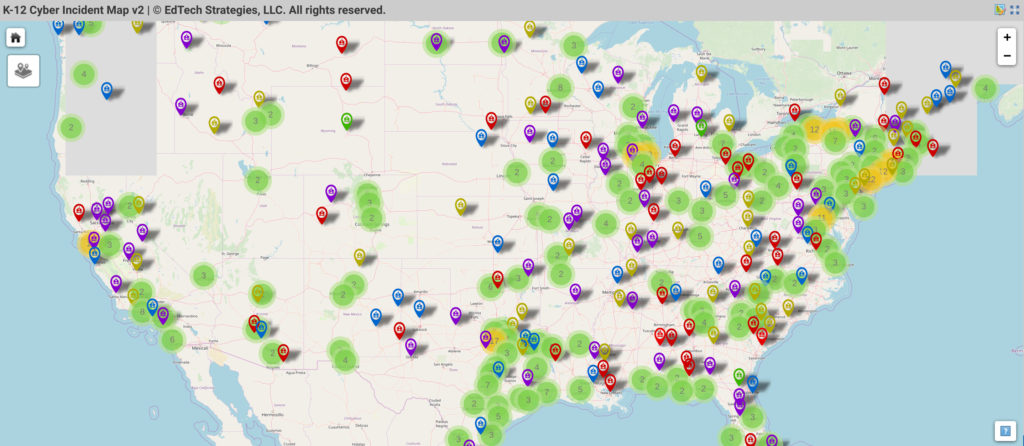
Data for the report is drawn from publicly disclosed incidents cataloged on the K-12 Cyber Incident Map. The map and underlying database capture detailed information about two inter-related issues:
  • publicly disclosed cybersecurity incidents affecting public K-12 schools, districts, charter schools, and other public education agencies (such as regional and state education agencies) in the 50 states and DC, and
  • the characteristics of public school districts (including charter schools) that have experienced one or more publicly disclosed cybersecurity incidents.

The K-12 Cyber Incident Map has identified over 775 school cybersecurity incidents since 2016.

Since 2016, the K-12 Cyber Incident Map has documented over 775 publicly disclosed incidents affecting students and educators across the country and grown to become the definitive source of K-12 cyber incident data.


Special challenges for charter schools, all subject to the same special education obligations under federal law as a traditional school district

Complete report Families with children with disabilities must constantly work to advocate for their children, find the school that provides the best fit, and assess whether educators are providing the right interventions. This can be exhausting and frustrating, especially when it comes on top of the unique demands of parenting a child with a disability. Add to that the reality of living in povert
Completing College National and State Reports - Updated with State-Level Trends​

The national college completion rates continue to rise. The six-year and eight-year college completion rates have reached new highs, 60 percent and 62 percent, respectively. As the eighth in the series, the national report presents both the national six-year completion outcomes for the fall 2013 entering student cohort and the national eight-year results for the fall 2011 beginning student cohort
Bridging digital divides between schools and communities

Schools have historically been the beneficiaries of public and private sector investments in digital infrastructure, programs, and other resources. Funding has been primarily directed at in-school internet connectivity, after school programs and a wide range of related activities, including teacher professional development, e-books, and on-site computer labs. One of the largest sources of technol
Number of Student Data Breaches, Ransomware Attacks Nearly Triple in Last Year

Complete report There was a sharp rise in the frequency of cyber incidents affecting public school districts across the U.S. in 2019, according to new research conducted by the K-12 Cybersecurity Resource Center. Arlington, VA, 
Education Research Report: Number of Student Data Breaches, Ransomware Attacks Nearly Triple in Last Year