Latest News and Comment from Education

Monday, December 30, 2019

The Teacher Strikes: Teachers Speak Out about Their Activism | Diane Ravitch's blog

The Teacher Strikes: Teachers Speak Out about Their Activism | Diane Ravitch's blog

The Teacher Strikes: Teachers Speak Out about Their Activism


California Sunday Magazine published interviews with teachers about their role in striking, walking out, negotiating, bargaining.
It begins:
On February 22, 2018, some 20,000 teachers in West Virginia — many of them wearing red in solidarity — walked out of their classrooms. That April saw strikes in Arizona, Colorado, and Oklahoma, as teachers vented their collective frustration in what became known as the #RedforEd movement. In early 2019, educators picketed in Oakland and Los Angeles, in districts across Washington state and Oregon, and again in Colorado. And this fall, educators in Chicago, the nation’s third- CONTINUE READING: The Teacher Strikes: Teachers Speak Out about Their Activism | Diane Ravitch's blog

CURMUDGUCATION: The Height Of A Dead Salmon

CURMUDGUCATION: The Height Of A Dead Salmon

The Height Of A Dead Salmon

A while back someone sent me an article with a striking lead:

The methodology is straightforward. You take your subject and slide them into an fMRI machine, a humongous sleek, white ring, like a donut designed by Apple. Then you show the subject images of people engaging in social activities — shopping, talking, eating dinner. You flash 48 different photos in front of your subject's eyes, and ask them to figure out what emotions the people in the photos were probably feeling. All in all, it's a pretty basic neuroscience/psychology experiment. With one catch. The "subject" is a mature Atlantic salmon.

And it is dead.

The experiment was run in 2009 and drew a fair amount of attention at the time, perhaps because it allowed editors to write headlines like "fMRI Gets Slap In The Face With A Dead Fish" and "Scanning Dead Salmon in fMRI Machine Highlights Risk Of Red Herrings." The paper, which carried the droll title "Neural correlates of interspecies perspective taking in the post-mortem Atlantic Salmon: An argument for multiple comparisons correction" didn't show that dead salmon have thoughts about human social interactions, and it didn't show that fMRI is junk. It showed, as one writer put it, that "bad statistics lead to bad science."


"Guess what I'm thinking right now!"
To understand why the salmon looked alive, there are two things to get. One is that vast amounts of data invariably include bizarre little outliers, and that if you do not correct for the comparison of the huge amounts of data, junk gets into your system. This matters to us because crunching huge amounts of data is how the Artificial Intelligences using "machine learning" to figure out what a student coulda woulda shoulda completed as a CONTINUE READING: CURMUDGUCATION: The Height Of A Dead Salmon


The Greatness [A Decade In Review] | The Jose Vilson

The Greatness [A Decade In Review] | The Jose Vilson

THE GREATNESS [A DECADE IN REVIEW]

I became a math instructional coach, went back to the classroom a few years later, graduated hundreds of students, achieved National Board certification, received the Math for America Master Teacher Fellowship, spoke at over 100 venues, was the first current classroom teacher to keynote the American Education Research Association annual meeting and the National Council of Teachers in Mathematics conference, wrote a best-selling book This Is Not A Test: A New Narrative on Race, Class, and Education, was the “first” or “only” in a bunch of other places, jumpstarted #EduColor (the name of the movement and the organization), went to the White House and Gracie Mansion on multiple occasions and the United Nations as an invited guest, helped finalize and invested in a Syracuse University scholarship for Latinx students, and either wrote or appeared in most major news publications including The New York Times, ESSENCE, CNN, and The Atlantic. I became a father and husband, got my driver’s license, and a new apartment, too.
I did some things.
At the end of the last decade, I wanted more teachers, especially of color, to sit squarely within their power and visibility without having to leave the profession. In the last ten years, I wrote the blueprint.
In various presentations, when people asked me if I’m a Teacher of the Year for New York or the CONTINUE READING: The Greatness [A Decade In Review] | The Jose Vilson

Sunday, December 29, 2019

CATCH UP WITH CURMUDGUCATION + ICYMI: Almost A New Decade Edition (12/29)

CURMUDGUCATION: ICYMI: Almost A New Decade Edition (12/29)


Almost A New Decade Edition (12/29)
Yep, soon anything from the 1900s will be "a long time ago." But we can meditate on how experience fades into the dim past some other day. Right now we'll just worry about last week. Here's some of the worthwhile reading; it's a short list because holiday time. Remember to amplify the stuff that speaks to you!

How Ibram X. Kendi's Definition of Antiracism Applies to Schools 
If you don't know Kendi's work yet, you should catch up. Here KQED takes a look at how it applies directly to schools. Start thinking about racism before you get back from vacation.

The Stories We Were Told About Education Technology (2019)
Audrey Watters takes a look at the year in ed tech, employing her gift for blowing away the smoke and cutting through the bullshit. This read is a little depressing, but important.

While City Services Suffer, MNPS Plans $45.6 Million For Charter Expansion
Andy Spears looks at one more instance of how Tennessee's charter gravy train keeps running at the expense of the public good.

Reasons Children Have Reading Problems That Corporate Reformers Don't Talk About
Nancy Bailey takes a look at some of the factors that can affect children's reading, even if they aren't part of the reformster playbook.

Massachusetts Nonprofit Receives $57 Million from Arkansas Waltons
The indispensable Mercedes Schneider looks into one more astro-turfy charter-promoting group and finds a big fat pile of Walton money.

The PISA Problem 
The Have You Heard podcast looks at the regular testing chicken littling. And if, like me, you don't really have a chance to listen to podcasts, there's a transcript for us dinosaurs.

Ten Ideas To Save The World In 2020
Looking for ways to have a more positive impact on the planet? Here's some simple starter ideas from a fine blogger who is also my daughter.

CURMUDGUCATION: ICYMI: Almost A New Decade Edition (12/29)

CATCH UP WITH CURMUDGUCATION


Dana Goldstein's Common Core Ten Year Tale, Annotated

Dana Goldstein's NYT ten year retrospective of Common Core has been sitting on my desktop since it was published, making me grumpy. It's yet another example of how the stories we are told about modern disruptive education reform are subtly sugared and carefully crafted to avoid discussing some of the larger issues. I don't know-- after all, Goldstein is a published book author and writes for the A

DEC 27

VA: Ideas About How To Recruit and Retain Teachers

As squawking about the teacher "shortage" many states have developed methods to either take advantage of the situation ("Now we can finally break the teachers union and public education by letting any warm body stand in front of a classroom because, hey, there's a shortage") or try to figure out a way to actually solve the problem. In Virginia, a coalition appears to be t aking a shot at the latte

DEC 26

Big Brother U & The Surveillance State

If you missed this article at Washington Post about on campus surveillance of students-- well, congratulations on having one less troubling thought in your head over the past week. Because the surveillance is continuing its slow, steady advance. Now technology lets colleges monitor their students 24/7. Yay. This particular article focuses on a company called SpotterEDU , and they are creepy as hel

DEC 25

Merry Christmas

To those of you who celebrate the holiday, best wishes. (For those of you who don't, best wishes). Here's the Curmudgucation Institute's annually curated selection of Christmas music that's not just the same damn thing the radio's been playing for weeks. Enjoy. I've taken off a couple of days to spend with board of directors and the rest of the institute stakeholders who are in town. I'll be back

DEC 22

WI: Pre-K Cyberschool Shenanigans

A few Wisconsin legislators have a dumb idea for a law . They'd like to spend $1.5 million on cyberschool -- on line computerized instruction-- for pre-schoolers. This is just layers and layers of dumb. First, cyberschools in general have proven to be lousy. Spectacularly lousy -- and that's in a study run by an organization sympathetic to charters.. Students would be better off spending a year pl
ICYMI: The Nights Before Christmas Edition (12/22)

Down to the wire (or in some cases, past the wire-- my extended family gathered at my folks yesterday for our holiday celebration). But there's still plenty to read from the last week. The Science of Writing "Science is not a hammer." Paul Thomas with some thoughts about the teaching of writing and the science that is (or is not) behind it and science's place in the grander scheme. Whatever Happen

DEC 20

OH: Voucher Crisis Looming

When does a voucher program lose support? When it comes for the wealthy white districts. Ohio has quietly been working to become the Florida of North when it comes to education, with an assortment of school choice programs that 
CURMUDGUCATION - http://curmudgucation.blogspot.com/

Cursive Writing and Coding: Conflicts over School Goals | Larry Cuban on School Reform and Classroom Practice

Cursive Writing and Coding: Conflicts over School Goals | Larry Cuban on School Reform and Classroom Practice

Cursive Writing and Coding: Conflicts over School Goals


I published this post originally on May 18, 2014. Since then the regular media run pieces on the disappearance and revival of cursive writing. I am re-printing this post since again proposals to resusitate cursive writing have appeared. As reported in the New York Times, 24 states now require different forms of cursive writing with seven that have adopted policies since 2013.
Schools as “museums of virtue”* and schools as engines of change have been dominant and conflicting metaphors in the history of school reform. In the mid-19th century, tax-supported public schools pursued Reading, ‘Riting, ‘Rithmetic–the three Rs. Basic literacy–being able to read the Bible, write one’s name, know elementary ciphering, and absorb family and community values–were the primary reasons for creating public schools. In a predominantly rural society, one-room schools sought to preserve the virtues of Protestantism, instill basic literacy, strengthen patriotism, and social custom through the three Rs.
One hundred and fifty years later, public schools are not only expected to instill the traditional three Rs and socialize children into dominant societal values but also expected to be responsible for the “whole child” and change society for the better. There has been an unrelenting expansion of traditional  three Rs to now include a suite of literacies:  scientific , numeracytechnological, and civic. The notion of schools as “museums of virtue” still exists but now competes with the idea that schools were (and are) engines of political, social, and economic CONTINUE READING: Cursive Writing and Coding: Conflicts over School Goals | Larry Cuban on School Reform and Classroom Practice

Reader: I Taught SAT Prep. It’s a Sham. | Diane Ravitch's blog

Reader: I Taught SAT Prep. It’s a Sham. | Diane Ravitch's blog

Reader: I Taught SAT Prep. It’s a Sham.


An anonymous reader left this comment about the SAT.
Once upon a time, 25 years ago, I ‘offered’ SAT tutoring (at a rather high price of $50/hr.) to denizens of a tony private school. I could charge that much because I ‘got results’. But, it was rather easy to improve scores.
First, there was the fact that almost all of my clients had scored ‘too low’ when they first took the test. The probability was, therefore, that if they simply took it again, they would ‘improve’. Secondly, most low performers had a certain level of anxiety when they took the test. Simply being familiar with the format by reviewing former tests helped those students assess the test in a more calm and analytical manner. Thirdly, despite the subtraction of ‘wrong’ answers from the score (at a rate commensurate with the number of answers), the students needed to understand that they actually knew something, if only at the subconscious level, and they needed to ‘guess’ (even randomly) because an inaccurate random guess didn’t really count against the score. They needed to trust their instincts.
The result was often (among ‘median’ scores) a 100 point increase. Were the students any ‘smarter’ after the CONTINUE READING: Reader: I Taught SAT Prep. It’s a Sham. | Diane Ravitch's blog

Listen to This – Nineteen for 2019 | Live Long and Prosper

Listen to This – Nineteen for 2019 | Live Long and Prosper

Listen to This – Nineteen for 2019


Nineteen meaningful comments and quotes from 2019 from my blog and others…
JANUARY
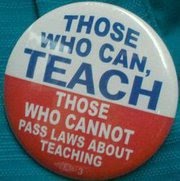
Making Laws About Teaching
Perplexing but not surprising- people who are most judgmental & outspoken about the qualifications necessary to perform a job are typically those people who have never done the job.
Hey Kindergarten, Get Ready for the Children.
…it is not a five year old’s job to be ready for kindergarten– it is kindergarten’s job to be ready for the five year olds. If a test shows that the majority of littles are not “ready” for your kindergarten program, then the littles are not the problem– your kindergarten, or maybe your readiness test, is the problem. The solution is not to declare, “We had better lean on these little slackers a little harder and get them away from their families a little sooner.” Instead, try asking how your kindergarten program could be shifted to meet the needs that your students actually have. 
FEBRUARY
Punishing third graders
Now we are witnessing the other consequences of the Third Grade Threat—pushing inappropriate instruction down to kindergarten, as anxious CONTINUE READING: 
Listen to This – Nineteen for 2019 | Live Long and Prosper

Massachusetts Nonprofit, Building Excellent Schools, Receives $57M from Arkansas Waltons | deutsch29

Massachusetts Nonprofit, Building Excellent Schools, Receives $57M from Arkansas Waltons | deutsch29

Massachusetts Nonprofit, Building Excellent Schools, Receives $57M from Arkansas Waltons
The billionaire Walton family spends millions promoting school choice, including fronting money for charter school start-ups. Moreover, the Walton “paths to public charter school startup” advertises a number of “partners,” including Massachusetts-based Building Excellent Schools (BES).
BES received its tax-exempt status in June 2003; however, BES’s “about” page places its beginnings prior to formation of the BES nonprofit, a a resource center in response to “poor academic performance of Massachusetts’ first charter schools.” The BES mission statement from its tax forms indicates BES’s purpose is “to foster the development and ensure the success of charter schools.”
Once BES became a nonprofit, the Waltons immediately began funding BES. In fact, BES’s first tax filing, spanning July 2003 to June 2004 (FY2003) indicates total revenue of $1,670,374– mostly Walton cash:
In 2003, the Waltons gave BES $1,190,000– which equals 71 percent of the BES revenue reported on its initial return– making Massachusetts-based BES instantly dependent upon the Arkansas-based Walton wealth for most of its revenue.
I was curious what percentage of BES revenue derived from the Waltons across the years, so I examined BES total revenue on its tax forms and compared it to BES’s Walton grants as listed on the Walton Family Foundation.
A continuous, year-by-year comparison is not possible: The Walton grants CONTINUE READING: Massachusetts Nonprofit, Building Excellent Schools, Receives $57M from Arkansas Waltons | deutsch29


Sixteen Gadfly Articles That Made Betsy DeVos Itch in 2019
 | gadflyonthewallblog

Sixteen Gadfly Articles That Made Betsy DeVos Itch in 2019
 | gadflyonthewallblog

Sixteen Gadfly Articles That Made Betsy DeVos Itch in 2019

“Life can only be understood backwards,” wrote SĆøren Kierkegaard, “but it must be lived forwards.”
I remember reading the Danish philosopher’s “Fear and Trembling” in my philosophy of religion class back in college.
To be honest I was never a big fan of his work – I thought if the only way to truth was taking a leap of faith, how many madmen have already reached enlightenment?

But he had a point when he wrote about the backwards order of perspective – that we can only understand the meaning of our lives once those moments have passed. How cruel that we must live our lives without knowing the importance of those moments until later.
The only times I remember knowing – really knowing – that I was living through an CONTINUE READING: Sixteen Gadfly Articles That Made Betsy DeVos Itch in 2019
 | gadflyonthewallblog