Latest News and Comment from Education

Wednesday, August 21, 2019

Can Teachers Afford a Home in the Nation’s Largest Metros? | LendingTree

Can Teachers Afford a Home in the Nation’s Largest Metros? | LendingTree

Can Teachers Afford a Home in the Nation’s Largest Metros?

According to recent statistics from the U.S. Department of Labor, there are around 4.2 million preschool, primary, secondary and special education teachers in the United States, making teaching one of the most popular careers in the country. Teachers are also among the most trusted professionals in the nation, with at least 60% of Americans placing high or very high degrees of trust in both grade and high school teachers.
That makes it no surprise that teacher pay is a hot-button issue for many Americans.
With that in mind, LendingTree, the nation’s largest online loan marketplace, asked whether or not teachers in the nation’s largest metropolitan areas are paid enough to be able to afford a home. What we found is that, assuming they can afford to dedicate around 28% of their income toward housing, most teachers are paid well enough to be able to buy the median-priced home in their area.

Key findings

  • In 46 of the nation’s 50 largest metros, teachers in the nation’s largest metros can afford to buy the median-priced home in their city. Assuming a teacher can afford to spend 28% of their annual salary on a home, then they shouldn’t have too much trouble paying for a house in most of the nation’s largest metros. Our data shows teachers can afford to spend about $431 more on a home than they would need to buy a median priced home.
  • Teachers from the Buffalo, N.Y., Pittsburgh and Detroit areas will likely have the easiest time affording a home. On average, teachers in these areas can afford to spend a little over $1,000 more a month on housing than what would be required to buy a median-valued home.
  • San Jose, Calif., San Francisco and Los Angeles are the metros where home affordability would be hardest for teachers. In these metros, a teacher would need to shell out an average of $985 more than what they could comfortably afford in order to buy a house.
  • While homes in many of the nation’s metros might look affordable to the average teacher, it is important to remember that teachers are often saddled with things like massive student loan debt and other monthly expenses related to their job. For example, those who earned a master’s degree in education graduated with an average loan debt of $50,879 in 2012. This debt load could require hundreds, if not thousands, of dollars in monthly loan payments each month, which can severely limit the amount of money left over for home costs. As a result, many teachers may struggle to allocate 28% of their salary to a home, regardless of what their salary is.

Most affordable metros for teachers CONTINUE READING: Can Teachers Afford a Home in the Nation’s Largest Metros? | LendingTree


CURMUDGUCATION: The Thirteen Presenters Who Will Ruin Your First Day Back

CURMUDGUCATION: The Thirteen Presenters Who Will Ruin Your First Day Back

The Thirteen Presenters Who Will Ruin Your First Day Back


It's been a great summer. You've had a chance to recharge and reflect. You've developed some new ideas, units, and materials, and most importantly, away from the dailiness of the job, you have gotten back in touch with all the reasons you love the work. You cannot wait to get back to it., take a couple of in service days to get fully up to speed, and then-- bring on the students!

Unfortunately, your administration thinks that your very first day(s) back should be spent sitting in some professional development sessions. In some lucky few school districts, these sessions will actually be useful and even  inspiring. But if you are really unfortunate, you'll spend those sessions with one of these soul-crushing people:

The Defense Specialist

"I'm here to remind you that at any moment this year, someone might burst into your room and kill you and your students. I'm going to talk about how you should react when someone is about to shoot you, presenting a variety of scenarios and details of previous shootings that will all be so vivid that for the rest of this week you won't be able to concentrate on teaching material because you're too busy looking for hiding places in the room, peering into your own soul to consider whether or not you are the kind of person who would die for your students, and just generally staring into the abyss of human mortality and brutality."

The Social Issues Specialist

"I'd like to talk to you about some issue that affects your students-- something like hunger or poverty or gang violence or homelessness or whatever drug is currently out of control. I will remind you that many of your students are being slowly crushed by forces outside of your control and you CONTINUE READING: 
CURMUDGUCATION: The Thirteen Presenters Who Will Ruin Your First Day Back


Students speak on DC schools, SBOE roles 8/15/19 – Education Town Hall Forum

Students speak on DC schools, SBOE roles 8/15/19 – Education Town Hall Forum

STUDENTS SPEAK ON DC SCHOOLS, SBOE ROLES 8/15/19

Before DC students head back to school later this month, Education Town Hall was privileged to have in studio three DC public school students serving in a variety of roles both at their schools as well as with the DC State Board of Education (SBOE).
Show begins at 6:20 mark on this recording —

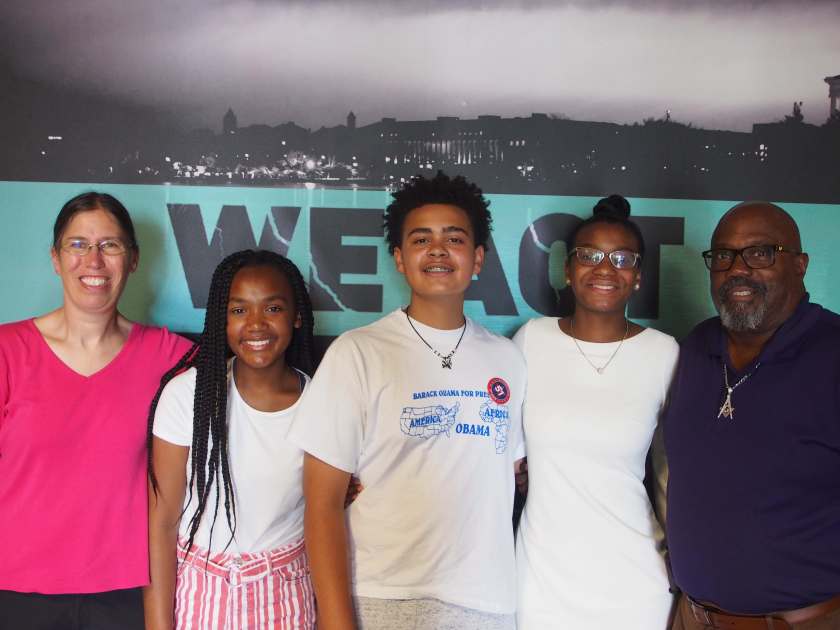
OLYMPUS DIGITAL CAMERA
Valerie, Shayla, Alex, Maya, Thomas

Shayla Dell is a rising sophomore at Duke Ellington School of the Arts, studying vocal music, and has participated in classical singing competitions. As a student advocate, Ms. Dell has served on the student government association at Duke as well as the DCPS chancellor’s student cabinet and is a continuing member of the student advisory committee of the DC SBOE. (The student advisory committee is consulted by the state board on issues of policy before the board.)

Maya Gray is a rising senior at Benjamin Banneker Academic high school and a returning member of the SBOE’s student advisory committee. Having attended both DC public and charter schools, Ms. Gray has worked as a teen aide with DC Public Library, served as a member of the National Building Museum’s teen council, and completed internships with DC government agencies. She is also involved in a variety of sports and looks forward to a career in either architecture or veterinary medicine.
Alex O’Sullivan is a rising sophomore at BASIS DC. He is one of two student representatives CONTINUE READING: Students speak on DC schools, SBOE roles 8/15/19 – Education Town Hall Forum

CARL J. PETERSEN: State of Our Schools: Rudderless

State of Our Schools: Rudderless

State of Our Schools: Rudderless


That’s it?”
– Audience member’s reaction to Austin Beutner’s speech
As parents were making their final preparations to send their children back to school, Los Angeles Unified School District (LAUSD) leadership was gathering downtown last Thursday for the annual “State of Schools” event. After a breakfast in Grand Park provided by the Food Services Division (no, there was none of the Walmart surplus that is said to be part of the Breakfast in the Classroom program), principals, five out of the seven school board (Nick Melvoin and Kelly Gonez were conspicuously absent) and district bureaucrats headed to the Walt Disney Concert Hall for the headline event – a speech by Superintendent Austin Beutner.
Beutner started his speech by looking back at the most significant event of the past year – the strike by the District’s teachers. While acknowledging that many of the concessions won by United Teachers Los Angeles (UTLA) would be beneficial to the students, he did not explain why a work stoppage was necessary to achieve them. Nor did he accept responsibility for his part in creating animosity between the district and its workers that led to the strike.
From here, Beutner segued to the cost of providing the services CONTINUE READING: State of Our Schools: Rudderless

NYC Educator: Long Discredited, Merit Pay Dies in Newark

NYC Educator: Long Discredited, Merit Pay Dies in Newark

Long Discredited, Merit Pay Dies in Newark

I'll leave it to Jersey Jazzman, who's followed this far more closely than I have, to fill you in on chapter and verse. He does mention, though, that only 20% of those with a choice opted into the system, and that highly rated teachers were mostly found in the opt-out pool. I'd argue well-informed, smart people make the best teachers. Diane Ravitch has written extensively on merit pay, and states it's been around for over a hundred years, and has never worked anywhere.

Why on earth does it keep bouncing back? In a world looking for quick fixes and quick answers, it makes sense. If you're good, you should earn more money. The question then becomes how you measure who is good. The answer, usually, is via test scores. When I first started this blog, I assumed that test scores measured something. I've since evolved. I think it was Alfie Kohn who suggested what they actually measured was zip code.

I'm in a funny position. Someone told me recently that my students had very good test scores. Assuming that's true, it has very little to do with me and everything to do with the test. I'm rated on the NYSESLAT, and it appears that everyone is advanced, even if they know little to no English. Can't form present tense? Advanced. Can't write a coherent sentence? Advanced. Can't make basic conversation? Advanced.

So I'm a frigging genius, and all my students will go to the advanced class. Therefore, I deserve merit pay. However, the tests give, and the tests taketh away. Next year, NY State CONTINUE READING: 
NYC Educator: Long Discredited, Merit Pay Dies in Newark


Jeffrey Epstein, Apollo Global Management and IL TRS investments. – Fred Klonsky

Jeffrey Epstein, Apollo Global Management and IL TRS investments. – Fred Klonsky

JEFFREY EPSTEIN, APOLLO GLOBAL MANAGEMENT AND IL TRS INVESTMENTS

Pensions and Investments is reporting this morning:
CalPERS is pressing Apollo Global Management LLC, one of its private equity managers, over co-founder Leon Black’s relationship with registered sex offender Jeffrey Epstein.
“CalPERS takes this issue very seriously. The actions our general partners take, both in professional and private contexts, impact our assessment of which firms we desire as long-term partners,” said Megan White, spokeswoman for the $376 billion California Public Employees’ Retirement System, Sacramento, in an email.
While CalPERS is the largest pension system in the United States, they are not the only ones doing business with the shady Leon Black and Apollo Global Management.
Other retirement systems making commitments to Apollo within the past 18 months include the $152.5 billion Teacher Retirement System of Texas, $80.4 billion Virginia Retirement System, $29 billion Pennsylvania State Employees’ Retirement System, $20.1 billion Teachers’ Retirement System of Louisiana and $2.6 billion Oklahoma Police Pension & Retirement System. Pension fund representatives either
What about the Illinois Teacher Retirement System? CONTINUE READING: Jeffrey Epstein, Apollo Global Management and IL TRS investments. – Fred Klonsky

NYC Public School Parents: High levels of lead in water still at many NYC schools; check to see if your child's school is on the list!

NYC Public School Parents: High levels of lead in water still at many NYC schools; check to see if your child's school is on the list!

High levels of lead in water still at many NYC schools; check to see if your child's school is on the list!

In all the news about peeling lead paint in schools, there has been little attention given to the fact that there were more than 500 NYC public schools and/or preK centers in which lead was found in the water above the “action” level of 15 parts per billion. 
The DOE spreadsheet showing the lead test results of water outlets in 534 schools is posted on this page.  DOE says that “One third of all schools were tested in this round, with the remainder of schools scheduled to be tested in 2019 and 2020.”  Of those 534 schools, more than 80% had at least one outlet with elevated levels of lead.  The detailed DOE spreadsheet is here


We created a new spreadsheet, adding tabs for fixtures found to have lead above the action level of 15 ppb sorted by district and by concentration (with outlets found to have the highest levels at the top).  The new spreadsheet is here.
Some of the schools with the highest levels are listed below, showing outlets with lead at 54 to 873 times the action level, with the most alarming results from a cold water faucet in the 4th floor boys bathroom in Prospect HS.  This outlet emitted water with lead at an incredible 13,100 parts per billion.  In that same school as well, a hallway fountain (or “bubbler”) on the 3rd floor was found to emit water at 3,070 parts per billion. CONTINUE READING: NYC Public School Parents: High levels of lead in water still at many NYC schools; check to see if your child's school is on the list!

Tuesday, August 20, 2019

Hollywood Insiders Battle Over Charter Schools | Hollywood Reporter

Hollywood Insiders Battle Over Charter Schools | Hollywood Reporter

Hollywood Insiders Battle Over Charter Schools

 It's industry creatives vs. Reed Hastings as California bills restricting new options are up for vote: "The people backing charters [are] really problematic." 

When LAUSD board member and charter school advocate Ref Rodriguez pleaded guilty in July 2018 to a felony count of conspiracy, it seemed that Los Angeles' charter school movement had hit a critical low. Rodriguez's unraveling over campaign finance violations tipped the balance of power on the seven-member board that oversees the nation's second-largest school district, weakening its charter school block.
Tensions between proponents of public schools and of charter schools — which are started by parents, teachers or community groups and receive government funding but operate independently of state school systems — were already high. The January teachers' strike won concessions for LAUSD public schools ranging from smaller class sizes to hiring full-time nurses but was marked by heated anti-charter rhetoric. Critics of charters say they continue to drain
much-needed resources from public schools. "If LAUSD were properly funded, then I think the choice that a charter school gives would be a nice one," says writer Audrey Wauchope (Crazy Ex-Girlfriend). "Unfortunately, it often seems that going charter is now just another way for parents to leave behind their neighborhood school."
Public-school proponents contend that charters operate without sufficient oversight (proof of which came in May when California authorities arrested two men for allegedly stealing more than $50 million in state funds via a network of online charter schools). For their part, charter school CONTINUE READING: Hollywood Insiders Battle Over Charter Schools | Hollywood Reporter


Educating Voters About Jessie Ryan's Lack of Transparency - Sacramento City Teachers Association

Educating Voters About Jessie Ryan's Lack of Transparency - Sacramento City Teachers Association
Educating Voters About Jessie Ryan's Lack of Transparency

For the past several weeks, SCTA educators and other community allies have been talking to voters in School Board District, Area 7, currently represented by School Board President Jessie Ryan. The flyer being distributed is below.
Over the weekend, there were some questions raised about including the telephone number used to contact Ms. Ryan.
The number included was the one provided by Ms. Ryan to SCTA representatives on several occasions as her contact number. When this issue came up several months ago, SCTA specifically offered Ms. Ryan that an alternative number would be used if that was her preference. She did not provide an alternative.
School board members received a taxpayer-financed stipend from the District for their cell phone use.


Big Education Ape: District cuts mic on SCTA again in violation of the contract; what Jessie Ryan didn’t want to hear. - https://bigeducationape.blogspot.com/2019/08/district-cuts-mic-on-scta-again-in.html


Educating Voters About Jessie Ryan's Lack of Transparency - Sacramento City Teachers Association

By teaching slavery adequately, we can overcome our history

By teaching slavery adequately, we can overcome our history

Slavery still shapes all of our lives, yet students aren’t taught its history
Glossing over America’s original sin means we can never overcome it

I had been taught, in school, through cultural osmosis, that the flag wasn’t really ours, that our history as a people began with enslavement and that we had contributed little to this great nation.”
Nikole Hannah-Jones wrote those words in her introductory essay to The 1619 Project, a special issue of The New York Times Magazine she edited that commemorates the 400-year anniversary of the arrival of 20 enslaved Africans who were sold into slavery to the shores of Virginia. Often referred to as America’s original sin, slavery is so pervasive that its residual effects can be found in everything from the stock exchange to our prison system. Slavery was instrumental in the formation of the United States. It’s crucial that we understand its inner workings and aftereffects; only then can we create a moral, economic and social roadmap to achieving our democratic ideals.
Under slavery, our ancestors were robbed of our liberty, of opportunity to gain wealth, an education, due process, and basic dignity — and all those thefts bolstered an American economy; it was built on the back of slave labor.


Slavery may have ended 154 years ago, but its vestiges remain in our criminal justice system, in the systematic devaluation of our property, and in the harsh discipline to which we are disproportionately subjected. Even as black students stand and pledge allegiance to the flag, they know their country considers them second-class citizens. It’s past time all students learn why black and white Americans can expect very different life outcomes, so that they can unlearn the myths of America and the black stereotypes that bolstered those falsehoods.
The disconnect between students’ lived experiences and what they are taught in school is reinforced by the failure of our schools to properly teach about the institution of slavery. In a 2018 study, the anti-racist nonprofit the Southern Poverty Law Center surveyed high school seniors and social studies teachers and found that only 8 percent of the students surveyed could identify slavery as a central cause of the Civil War. Less than a quarter could identify how the U.S. Constitution gave advantages to slaveholders. And while most teachers (90 percent) claimed they were comfortable teaching about slavery, 58 percent stated their textbooks were inadequate, and 40 percent believed their respective states offered insufficient support CONTINUE READING: By teaching slavery adequately, we can overcome our history

School’s Open! Cartoons | Larry Cuban on School Reform and Classroom Practice

School’s Open! Cartoons | Larry Cuban on School Reform and Classroom Practice

School’s Open! Cartoons

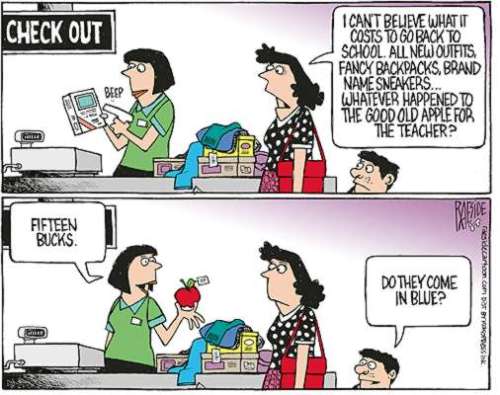
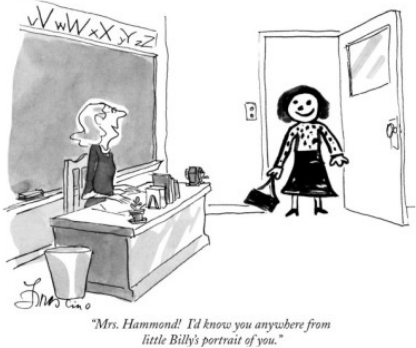
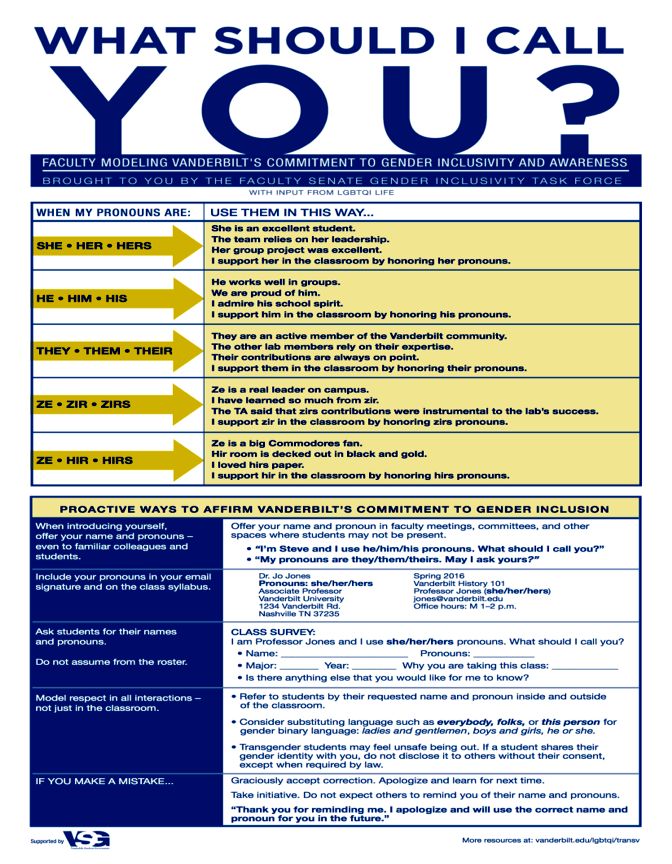
Yep, it’s that time of year for buying school supplies, getting up early, and returning to school. Parents, children, principals, and teachers are preparing for that glorious first day of school. Here are some cartoonists’ jabs at the annual ritual of returning to school. Enjoy!
cache_600_400_0_50_60_16777215_backtoschool.jpg
School-Pictures-2018-HP-500.jpg
1440473323.png
5e9144adf399dd081e808450f43a2096.jpg
8221d03ab75a27cf06f18fbef75c0184--teacher-tips-teacher-humor.jpg

Breaking the Gender Codes of Dress Codes | radical eyes for equity

Breaking the Gender Codes of Dress Codes | radical eyes for equity

Breaking the Gender Codes of Dress Codes

A popular meme in the wake of even more mass shootings makes a powerful, if somewhat hyperbolic, point:
Image result for girls clothing in schools more regulated than guns
DAVID MACK/BUZZFEED NEWS via TeenVogue
With most formal schooling restarting now, the dramatic consequences of gun violence is more likely to overshadow the more subtle negative and disproportionate impact of dress codes, especially on girls and young women as well as black and brown students.
When I raise the topic of dress code early in my foundations of education course, where students are required to tutor in a nearby school once a week, the young women invariably respond in ways that confirms what research has shown about the gender inequity of dress codes and how they are applied.
An early-career high school teacher and I were discussing her school and the new year starting with a different principal; she noted that principal is taking a different approach to the school’s dress code, specifically focusing on applying the existing code uniformly and more strictly.
She is concerned about the strictness, knowing that dress codes and their implementation tend to target girls more harshly than boys and perpetuate slut-shaming culture as well as placing the burden of “proper attire” on those girls instead of addressing toxic masculinity and sexism among the boy students. However, the consistency, she thinks, will be welcomed and much better for the students and the teachers.
Her next comment was important for me since she plans to ask the principal to re-examine the dress code next year, stressing that administrators and teachers need to explore the purposes of that dress CONTINUE READING: Breaking the Gender Codes of Dress Codes | radical eyes for equity


Jersey Jazzman: The Merit Pay Fairy Dies in Newark

Jersey Jazzman: The Merit Pay Fairy Dies in Newark

The Merit Pay Fairy Dies in Newark
Hey, youse bums -- get back to the teachin' already!


One of the long-running characters on this blog is the Merit Pay Fairy.


The Merit Pay Fairy lives in the dreams of right-wing think tanks and labor economists, who are absolutely convinced that our current teacher pay system -- based on seniority and educational attainment -- is keeping teachers from achieving their fullest potential. It matters little that even the most generous readings of the research find practically small effects* of switching to pay-for-performance systems, or that merit pay in other professions is quite rare (especially when it is based on the performance of others; teacher merit pay is, in many contexts, based on student, and not teacher, performance). 

Merit pay advocates also rarely acknowledge that adult developmental theory suggests that rewards later in life, such as higher pay, fulfill a need for older workers, or that messing with pay distributions has the potential to screw up the pool of potential teacher candidates, or that shifting pay from the bottom of the teacher "quality" distribution to the top -- and, really, that's what merit pay does -- still leaves policymakers with the problem of deciding which students get which teachers.

Issues like these, however, are at the core of any merit pay policy. Sure, pay-for-performance sounds great; it comports nicely with key concepts in economic theory. But when it comes time to implement it in an actual, real-world situation, you've got to confront a whole host of realities that theory doesn't address.

Which is what seems to have happened in Newark:
In 2012, Newark teachers agreed to a controversial new contract that linked their pay to student achievement — a stark departure from the way most teachers across the country are paid. 
The idea was to reward teachers for excellent performance, rather CONTINUE READING: Jersey Jazzman: The Merit Pay Fairy Dies in Newark

DeVos-Linked Adoption Agency Exposed Highly Sensitive Children's Medical Data - VICE

DeVos-Linked Adoption Agency Exposed Highly Sensitive Children's Medical Data - VICE

DeVos-Linked Adoption Agency Exposed Highly Sensitive Children's Medical Data
Bethany Christian Services left information about prospective adoptees' "intellectual development" as well as their medical histories and lab results online.

An adoption and foster care non-profit linked to the family of Department of Education Secretary Betsy DeVos exposed highly sensitive personal and medical information of dozens of children, Motherboard has learned.
The charity, called Bethany Christian Services, is one of the nation's largest adoption agencies and helps place children for adoption and foster care. It works with vulnerable children in the U.S. as well as refugees and immigrants.
"Our vision is to find a loving family for every child who needs one—that is where they thrive best," the group says on its website.
The exposed data was stored on PDFs openly available on its website. Some PDFs were called "Children Medical Examination Records" that included the names, dates of birth, the hospital or orphanage they were based in, and extremely sensitive medical information.
This includes a child's HIV status, number of teeth, lab test results, and whether the child has any physical deformities ("Spine: no deformity" "Liver: not palpable under the rib; "Anus: no abnormal findings" are examples of the data contained on the form). Other information exposed includes a "Growth Report" that explains the child's background and "motor skills and intellectual development." One notes that a child arrived "wearing yellow baby clothes and she was placed in a paper box" and that, between the age of 10 and 12 months, "she knows her name, can get biscuits, and feeds herself."
The charity has multiple connections to the DeVos family: Brian DeVos, a cousin of Betsy DeVos' husband, was a senior vice president at the CONTINUE READING: DeVos-Linked Adoption Agency Exposed Highly Sensitive Children's Medical Data - VICE

Q&A Collections: Education Policy Issues - Classroom Q&A With Larry Ferlazzo - Education Week Teacher

Q&A Collections: Education Policy Issues - Classroom Q&A With Larry Ferlazzo - Education Week Teacher

Q&A Collections: Education Policy Issues

During the summer, I will be sharing thematic posts bringing together responses on similar topics from the past eight years. You can see all those collections from the first seven years here.
Here are the ones I've posted so far:
Today's theme is on Education Policy Issues. You can see the list following this excerpt from one ...CONTINUE READING: Q&A Collections: Education Policy Issues - Classroom Q&A With Larry Ferlazzo - Education Week Teacher

Larry Ferlazzo's Websites of the Day... | The latest news and resources in education since 2007 - http://larryferlazzo.edublogs.org/ on @Larryferlazzo