Latest News and Comment from Education

Thursday, August 15, 2019

Ferris HS teacher Mandy Manning says she was denied entrance to immigrant detention center - KXLY

Ferris HS teacher Mandy Manning says she was denied entrance to immigrant detention center - KXLY

Ferris HS teacher Mandy Manning says she was denied entrance to immigrant detention center
Image result for 2018 National Teacher of the Year Mandy Manning
SPOKANE, Wash. - Ferris High School teacher and 2018 National Teacher of the Year Mandy Manning said she was denied entrance to an immigrant detention center in McAllen, Texas on Wednesday. 
In a Facebook post, Manning said she traveled to the center with other members of the American Federation of Teachers to check on the welfare of children. 
Manning was named the National Teacher of the Year in 2018 for her work at Ferris High School's Newcomer Center. She teaches English to refugee and immigrant students and is set to return to Spokane this fall. 

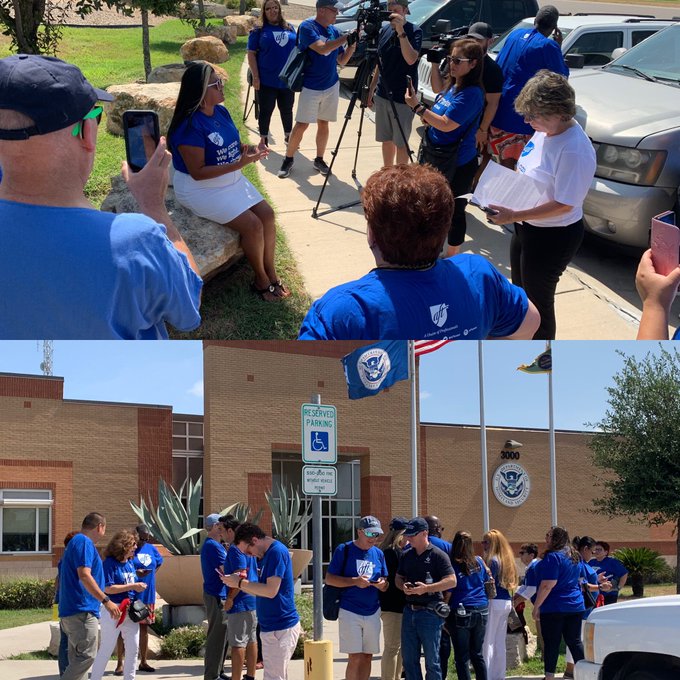
Denied entrance McAllen Immigrant prison. After numerous applications to check on the children, were told “AFT does not have a legitimate mission or business purpose for participating on a visit.” They called the police and attempted to tow our vehicles. @TeachersACD @AFTunion



View image on Twitter


Randi Weingarten, president of the AFT, was among the group of teachers present on Wednesday. In a tweet, she said Border Patrol members threatened to arrest the group for praying for the children’s wellbeing. 

While doing a vigil in McAllen,Tx, in front of the border facility detaining asylum seeking families...the Border Patrol after first denying our application to visit the children, then threatened to arrest us 4 praying 4 the childrens’ well being @MandyRheaWrites @AFTEVPDeJesus

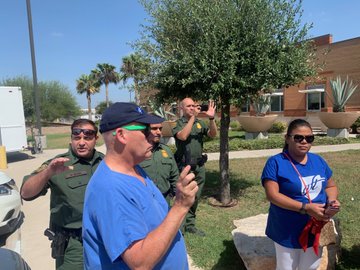
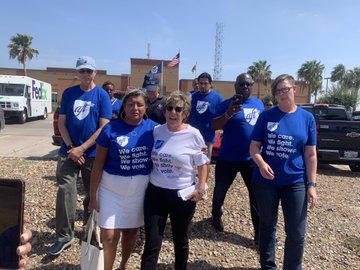
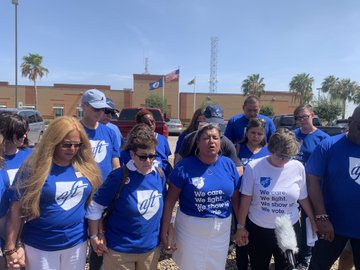
View image on TwitterView image on TwitterView image on Twitter


AFT said the group handed out bags of books, stuffed animals and blankets to migrant children held at the center. 
Weingarten and AFT have been vocal about the Trump administration’s detention of migrant children, saying they should instead be in classrooms. Weingarten was quoted by PJ Media saying illegal immigration makes America’s public school system “stronger” by bringing more diversity. 
4 News Now has reached out to Manning for further comment on the situation. 


Anatomy of a Charter School Fraud – Have You Heard

Anatomy of a Charter School Fraud – Have You Heard

Anatomy of a Charter School Fraud

Step one: become an expert in the regulations governing (and more importantly, not governing) charter schools in your state. Step two: recruit as many students as possible, even students who’ll be attending your schools in name only. Step three: watch the money role in…In the latest episode of Have You Heard we delve into the audacious story of A3 Education and it’s empire of online charter schools. Special guest: Voice of San Diego’s Will Huntsberry. Complete transcript of the episode is here. And if you like our high-quality content, consider supporting us on Patreon – or by making a one-time donation.


Anatomy of a Charter School Fraud – Have You Heard

Mike Klonsky's Blog: Environmental Justice: Water crisis in Newark worse than Flint, on Booker/Christie's watch

Mike Klonsky's Blog: Environmental Justice: Water crisis in Newark worse than Flint, on Booker/Christie's watch

Environmental Justice: Water crisis in Newark worse than Flint, on Booker/Christie's watch

A pallet of bottled water is delivered to a recreation center, Tuesday in Newark. 

Former Newark Mayor and presidential candidate, Sen. Cory Booker is acting like he just discovered that the lead-contaminated water system has been poisoning the children and families of his city for years. The latest figures from federal observers show that children in Newark's Essex County are in fact nearly four times more likely to have elevated blood lead levels than those in Flint.

Now, the U.S. Environmental Protection Agency has issued a dire warning about lead contamination, and New Jersey environmental officials found a problem with “ineffective corrosion treatment” at one of the city’s two water-treatment facilities.


In addition, according testing found that 2 out of 3 filters tested in three Newark homes failed to effectively reduce lead contamination.

In a tweet on Wednesday, Booker called on the federal government to step in.


"Everyone deserves clean, safe water," Booker wrote. "It's shameful that our national crisis of lead-contaminated water disproportionately hits poor black and brown communities like my own."
But where has Booker been up until this past week when the media started shining light on the crisis? He still hasn't taken any responsibility for the problem even though he was Newark's mayor from 2006 to 2013.

Small point...He might have used that $100M he got from Zuckerberg as a start in alleviating CONTINUE READING: 
Mike Klonsky's Blog: Environmental Justice: Water crisis in Newark worse than Flint, on Booker/Christie's watch


CURMUDGUCATION: The Problem With Comparisons In Education

CURMUDGUCATION: The Problem With Comparisons In Education
The Problem With Comparisons In Education
Which is the best movie: GhostbustersSingin' In The RainCasablanca, or Avengers: Endgame?
It depends, of course, on how we choose to compare them. Based on level of romance? On the happiest ending? Best dancing? Most money made? Best use of Sigourney Weaver? Criteria make all the difference. But it's not just the criteria; it's the problems with criteria that naturally emerge from the mandate to compare.
One of the driving features of modern education reform has been the mandate to compare. Fans of free market education want to be able to compare schools; several reform programs targeted schoolsthat ranked in the bottom five percent. The New Teacher Project (TNTP) made a huge splash in 2009 with "The Widget Effect" arguing that we should compare teachers and make staffing and pay decisions based on the results. Ranking schools is as important to U.S. News as swimsuits are to Sports Illustrated.
There are problems applying comparisons to education.
Comparisons are not measurements. Pat may be ranked the tallest or shortest student in class, but either way, knowing Pat's ranking does not tell me how tall Pat actually is. "Most improved" may make good advertising copy, but your enterprise can be "most improved" and still be terrible.
This problem only increases as we deal with more complex systems. The better a measure is for making comparisons, the worse it is for actually describing the thing being measured.
If we want to describe what makes a particular school great, or where it is falling short of CONTINUE READING: CURMUDGUCATION: The Problem With Comparisons In Education

Keeping the Why of Writing Instruction in Mind | radical eyes for equity

Keeping the Why of Writing Instruction in Mind | radical eyes for equity

Keeping the Why of Writing Instruction in Mind

While many, including myself, have focused on Jennie Young’s provocative argument that “that we stop teaching [academic citation] entirely” in first-year writing, Young builds to an important and broader point by the end: “Writing instruction is a messy business, and there are few simple fixes for any aspect of it.”
I certainly agree there are no simple fixes, but here I want to consider a foundational need if we are in fact concerned about writing instruction—the “why.”
Writing in 1946, Lou LaBrant asserted, “There are many ways of writing English, and the teacher of composition must know, before he thinks of means for teaching, what kind of writing he thinks important to teach.”
Here, I think, LaBrant is calling for any teacher of writing to understand both the “what” and the “why” before coming to terms with the “how” of teaching writing.
At the K-12 and higher education levels, I suspect there are far more teachers assigning writing than teaching writing, and far more teachers grading writing than giving substantive feedback on writing.
I also would anticipate that too few teachers have investigated the “what” and “why”—in part because they are teaching in a curriculum that is absent a cohesive writing program, some guiding principles for why any teacher is assigning or teaching writing to students.
In a brief exchange with Young, she noted two points from a post of mine CONTINUE READING: Keeping the Why of Writing Instruction in Mind | radical eyes for equity

Wednesday, August 14, 2019

Let the Children Play! A Book You Should Read | Diane Ravitch's blog

Let the Children Play! A Book You Should Read | Diane Ravitch's blog

Let the Children Play! A Book You Should Read
Image result for Let the Children Play

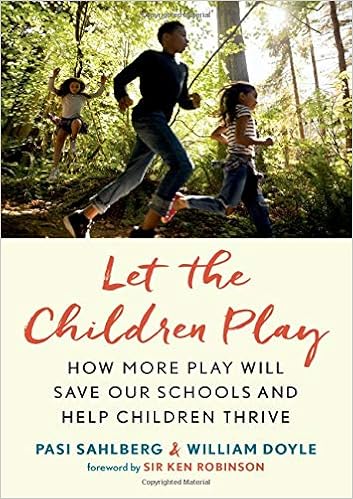
Pasi Sahlberg and William Doyle have written a wonderful new book about the importance of play for children. Play is important for the healthy development of all children, regardless of their socioeconomic status. It’s title is Let the Children Play. 
Since the passage of no Child Left Behind and the implementation of Race to the Top, the federal government and the states have done their best to stamp out play.
Noted conservative Reformer Checker Finn enjoyed the book but thought it smacked too much of Dewey and Rousseau. Play may be fine for our children, he says, but not for poor children, who need to raise their test scores. No play for them! Sahlberg and Doyle do not agree. They argue that children need to run, jump, imagine, sing, dance, and play-act, whatever their circumstances. It’s called childhood, and all children should have one, not just those who are privileged.
Its time to take a stand on behalf of play, fun, joy for all children.

4 new studies bolster the case: More money for schools helps low-income students

4 new studies bolster the case: More money for schools helps low-income students

4 new studies bolster the case: More money for schools helps low-income students

Does money matter in education? The answer is increasingly clear.
A 2018 overview of the research on education spending found that more money consistently meant better outcomes for students — higher test scores, higher graduation rates, and sometimes even higher wages as adults. It was enough for Northwestern economist Kirabo Jackson to say the question was “essentially settled.”
Since then, the research hits have just kept on coming.
Four new studies from different parts of the country have come to similar conclusions. In Texas and in Wisconsin, researchers found that spending more translated to higher test scores and boosted college enrollment. Two other studies — one looking at California and another looking across seven states — found that spending more money didn’t affect test scores in more affluent areas, but did boost test scores in higher-poverty districts.
“All four studies find that increased school spending improves student outcomes,” said Jackson.
The findings come as school spending is on the upswing across the country, with states continuing to rebound from the Great Recession and policymakers respond to pressure from striking teachers to invest more in schools. The new research indicates that students are likely to benefit from those increases, even as notable disparities between states like Mississippi and Massachusetts, and between some neighboring school districts, linger.
The studies don’t provide clear answers on how to best use new resources, though, CONTINUE READING: 4 new studies bolster the case: More money for schools helps low-income students

Today's Education Research Report

Education Research Report


Today's Education Research Report


Undergraduate nonfederal grant and scholarship aid between 2003–04 and 2015–16

Overall, in each selected year, 2003–04 through 2015–16, between 36 and 46 percent of undergraduates received nonfederal grant aid, which includes grants and scholarships from states, institutions, and private organizations. The National Center for Education Statistics released a new set of web tables today (August 14) entitled Trends in Undergraduate Nonfederal Grant and Scholarship Aid by Demog

YESTERDAY

A Case Study of the College Success Report

Unless significant advancements are made in closing existing gaps in educational attainment, America's current employment gaps will worsen as the student population becomes more diverse. Introduced in 2015, Delaware's College Success Report (CSR) enables such advancements by connecting high school course outcomes in math and English to college remediation rates in these same subjects. Delaware's
National report card rates states' safety policies for high school athletes x

In the two years since the Korey Stringer Institute (KSI) first assessed all 50 states and the District of Columbia on key health and safety policies for high school athletes, 31 states have adopted new policies -- 16 this year alone. With more than 7.8 million high school students participating in sanctioned sports each year, the need for comprehensive safety policies and training is critical. A
Launch of standardised tool to assess cognitive and language development in two year olds x

A new paper published in The Lancet Child & Adolescent Health co-authored by a University of Warwick researcher provides standardised scores for The Parent Report of Children's Abilities Revised (PARCA-R) questionnaire. The PARCA-R is recommended for routine use in the UK to screen for cognitive and language developmental delay in children born preterm and can be completed by parents in 10 to 15
'Conversation-based' activities reduce mental illness stigma among college students

College students who participate in fun, peer-directed activities that openly and honestly address mental illness are significantly less likely to stigmatize people with these conditions, according to a new study led by researchers at Indiana University. The work, published online in the Journal of the American Academy of Child and Adolescent Psychiatry , is the first study to systematically surv
Growth mindset intervention boosts confidence, persistence

A low-cost intervention aimed at fostering a growth mindset in students gave the students more confidence in their entrepreneurship abilities and helped them persist when challenges arose. "The finding is valuable because efficacy, or confidence in one's abilities, and perseverance are powerful motivators and are critical for career development in entrepreneurship," says Jeff Pollack, second auth
Without social and emotional support, adolescent students who have recently made the difficult transition to middle sch...

Without social and emotional support, adolescent students who have recently made the difficult transition to middle school experience decreased social belonging, waning academic performance, and increased risk of dropping out. This randomized field trial, conducted at scale across a Midwestern school district, reveals how a psychologically precise intervention for students supported transitioning
Programs and practices in place at schools across the nation

The National Center for Education Statistics released a new report, Characteristics of Public and Private Elementary and Secondary Schools in the United States: Results From the 2017–18 National Teacher and Principal Survey First Look . The report introduces new information about public and private K–12 schools. During the 2017–18 school year, 78 percent of all schools reported that they particip

AUG 12

Public opinion and education spending has become inversely related

Using new estimates of state-level public opinion, this study explores the relationship between support for increased education spending and statewide per-pupil expenditures from 1986 to 2013. In the 1980s, there was a modest, positive relationship between public opinion and actual spending: States with greater support for increased education spending tended to have slightly higher per pupil expe


Do r to teacher evaluation and tenure policies affect teacher retention?

This study examines the effect of Michigan’s 2011 reforms to teacher evaluation and tenure policies on teacher retention. The data are drawn from administrative records containing the population of public school employees