Latest News and Comment from Education

Thursday, April 4, 2019

ANDRE PERRY: To survivors of school shootings: your survival is ultimate form of protest

To survivors of school shootings: your survival is ultimate form of protest

To the survivors of school shootings
Your survival is the ultimate form of protest


Dear survivors of the Parkland school shooting,
I’m thinking of you, unsure of what to say, fearful that I will say the wrong thing. The last three weeks have been hard: Two of your Parkland classmates, maybe your friends, ended their lives. I don’t want to lose you, too. So, I’m reaching out to offer my support, love and attention, and my hope that if you are now considering or have considered suicide, you understand there is help and hope.
I lost a high school friend and running competitor to suicide. Maybe ‘competitor’ is too strong a word: I shouldn’t consider myself a challenger to the man I’ll call Jimmy Sherman, who was a state champion in the mile. I got to know him mostly from afar, back in the pack. He led almost every race I saw him in, setting the pace for everyone else. I don’t know if he knew, but Jimmy was a hero in my mind.
When he took his life in our college years, I really felt the loss of leadership — to me, he had always been a champion in so much more than a race.
This country’s plague of school shootings has made it clear that all parents are connected, as our children’s fates are inextricably linked. As a parent, I can’t help but feel a connection to you, and I humbly reach out as a father who fears that the killer who took the lives of CONTINUE READING: To survivors of school shootings: your survival is ultimate form of protest

Attorneys General Sue Trump Administration Over School Nutrition Rollbacks : The Salt : NPR

Attorneys General Sue Trump Administration Over School Nutrition Rollbacks : The Salt : NPR

Attorneys General Sue Trump Administration Over School Nutrition Rollbacks


A coalition of state attorneys general is suing the Trump administration for weakening the federal nutrition standards for school meals that are fed to about 30 million children across the country.
"Over a million children in New York – especially those in low-income communities and communities of color – depend on the meals served daily by their schools to be healthy, nutritious, and prepare them for learning," New York Attorney General Letitia James said in a statement announcing the lawsuit. Joining James in the lawsuit are the attorneys general of California, the District of Columbia, Illinois, Minnesota, New Mexico and Vermont.
As we've reported, last year the Trump administration gave school lunch administrators more flexibility in serving up refined grains, including white breads, biscuits and white pastas. The move weakened standards set during the Obama administration aimed at serving more nutritious and fiber-dense whole grains, which are a key part of a healthy diet.
In addition, the Trump administration put the brakes on targets to reduce the amount of salt allowed in school meals. At the time, U.S. Department of Agriculture Secretary Sonny Perdue wrote: "If kids are not eating what is being served, they are not benefiting, and food is being wasted."


But public health advocates have cried foul. "The 'flexibilities' the administration is offering [schools] are both unnecessary and undermining," Laura MacCleery, policy director at the Center for Science in the Public Interest, told me.
Her group has also filed a lawsuit in federal court in Maryland. The suit argues that the CONTINUE READING: Attorneys General Sue Trump Administration Over School Nutrition Rollbacks : The Salt : NPR

Congress Approves National Award Program for ESPs - NEA Today

Congress Approves National Award Program for ESPs - NEA Today

Recognition Long Overdue: Congress Approves National Award Program for ESPs


After the U.S. House of Representatives overwhelmingly passed the Recognizing Achievement in Classified School Employees Act (H.R. 276) by a vote of 387-19 in February, the Senate quickly followed suit with its own unanimous approval in March.
“This recognition is way overdue,” said Debby Chandler, president of the National Council for Education Support Professionals (NCESP), which works within the National Education Association (NEA) to represent the interests and issues of education support professionals (ESP).
It has taken more than a decade of seemingly endless meetings between elected officials in Washington, political appointees from two different presidential administrations, and numerous NEA staff, board members, lobbyists, ESPs and other activists for the bill to get this close to becoming law.
“The voices of our board members and activists who contacted Congressional members in the first few months of this year made the difference,” said Marc Egan, NEA director of government relations. “We had worked behind the scenes and knew we had a moment to try to capitalize on.”
Popularly known as the RISE Act, the bill has been sent to the president for review.
“Lobbying for a bill like this is one of those moments where you realize how fortunate you are to work on behalf of educators nationwide,” Egan said. “Over the many years we fought for this bill, I would say to members of Congress, ‘This is as much of a mom-and-apple-pie bill that you can find.’”
“After many years by educators of advocating for such a national award, Congress is right to recognize the unsung and often unseen heroes of the education professions – education support professionals and classified school employees.” – NEA President Lily Eskelsen García.
The legislation provides recognition by the federal government for the outstanding contributions of ESPs to the nation’s public schools and the students they serve. If signed by the president, the legislation will direct the Secretary of Education to establish a national award program recognizing the excellence exhibited by these public school educators in pre-kindergarten through grade 12.
Similar to the National Teacher of the Year award program, governors from each state will work with educators, associations, and other stakeholders on identifying nominees for final selection by the education secretary.
“Schools simply cannot run without us,” said Chandler, who is an NEA board member and a secretary at John R. Rogers High School in Spokane, Wash. “We ignite the love of learning while providing essential services to the whole student.”
There are almost 3 million school support professionals in our nation’s public CONTINUE READING: Congress Approves National Award Program for ESPs - NEA Today

A (Mostly) Brief History Of The SAT And ACT Tests

A (Mostly) Brief History Of The SAT And ACT Tests

A (Mostly) Brief History Of The SAT And ACT Tests

H/T Sonja Luchini

late 1800s
Average Scores

SAT (1952–present)
Data | Graph

ACT (1970–present)
Data | Graph
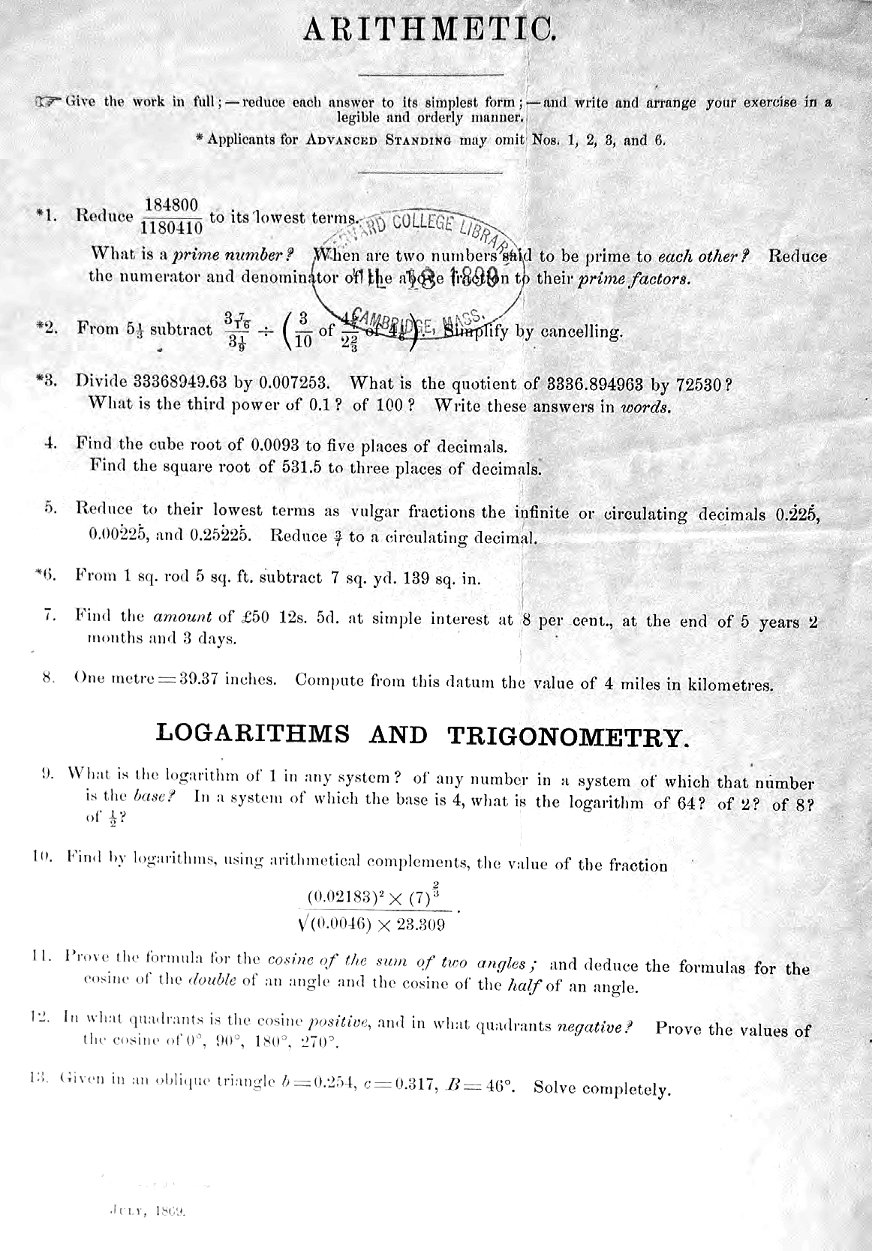
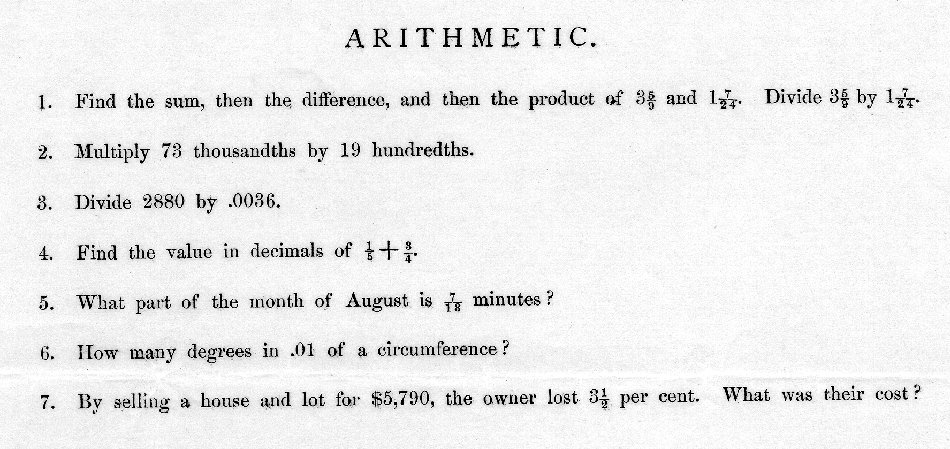
By the end of the 19th century, tests for admission to U.S. colleges are specific to each school. (The arithmetic portion of Harvard's 1869 entrance exam can be seen here. The corresponding portion of MIT's 1869 exam can be seen here. These portions of the two tests are quite different in difficulty.) The content of the tests varies widely and can be highly dependent on the interests of the faculty conducting the exams. It is not unusual for a college to administer exams on campus a week or two before classes begin. As an alternative to testing, many colleges, especially in the midwestern U.S., use "admission by certificate": a high school would be certified by inspectors from the colleges to have an appropriately preparatory curriculum for college work, and students graduated from such a high school would be considered to be adequate without testing. By 1900, however, inspections are infrequent and college faculty are often not present.
1899The College Entrance Examination Board (or "College Board") is founded in December, consisting of a non-profit membership of twelve colleges and universities. The membership is comprised mostly of elite institutions in the northeastern U.S., including Columbia, Cornell, Vassar, Barnard, and New York University. The founders are worried that the lack of uniform admissions testing and the certificate system places too much control of college admissions with the high schools. Also, the certificate system is thought to be conducing students away from the northeastern colleges.

The purpose of the Board is primarily to administer annual examinations in a variety of subjects thought to be important for college-level work. The members of the Board could then use the test scores however they chose. The fee for the test is expected to be $5 (about $136 in 2012 dollars).

At this time, roughly 4% of high school graduates go on to college.
1901The "College Boards" are administered in June for the first time to fewer than 1000 students. Roughly 75% of these students are applicants to Columbia University or Barnard College, hence the practical effect of these tests is to distinguish excellent students from elite students. The essay tests, which require five days to complete, are curriculum-based achievement exams, designed to assess a student's mastery of nine subjects, including Greek, Latin, and physics. For the price of ten cents, an examinee could find out from the College Board, before taking the test, the area of knowledge that each subject test would focus on. (For example, the student could learn that this year's Greek test would cover the first three books of Homer's Iliad.) Scoring is done by hand and consists of five ratings for each subject, from "Excellent" to "Very Poor", with "Doubtful" in the middle.
1917An intelligence test developed by Robert Yerkes and other psychologists is administered to more than 1.5 million U.S. Army recruits. The test, called the Army "Alpha" exam, uses multiple-choice questions (invented two years prior) and is designed to help the Army make rapid placement decisions for prospective soldiers entering World War I.
1919Columbia University begins allowing prospective students to substitute the results of an intelligence test (the Thorndike test for "Mental Alertness") for its regular entrance exams.
1925By this time, about 20,000 prospective freshmen take the College Board's exams each year. However, this figure represents only about 10 percent of the number of students entering college in the U.S. Most colleges continue either to admit by certificate or use their own entrance exams.

In April, the College Board appoints a commission, headed by Carl Brigham, to develop a new test designed to measure general intelligence.
1926The first Scholastic Aptitude Test (or "SAT") is administered on June 23 to 8,040 students, 40% of whom are women. (About 85% of these students are taking the traditional boards as well.) Carl Brigham, a psychologist who helped to develop aptitude tests for the U.S. Army during World War I, is influential in the development of the CONTINUE READING: A (Mostly) Brief History Of The SAT And ACT Tests

“Have You Heard” Interviews Award-Winning Reporter about Arizona Charter School Scandals | Diane Ravitch's blog

“Have You Heard” Interviews Award-Winning Reporter about Arizona Charter School Scandals | Diane Ravitch's blog

“Have You Heard” Interviews Award-Winning Reporter about Arizona Charter School Scandals 


Jennifer Berkshire and Jack Schneider interview Arizona Republic reporter Craig Harris about the charter school scandals in Arizona, the “wild west” of charters.
Harris was a member of the investigative team that won the prestigious George Polk Award for its coverage of charter schools in their state.
You can listen here.
Or, you can read the interview here. 
Here is a small excerpt, where they begin to interview Craig Harris:
Craig Harris​: It started about a year ago on two fronts. One, there was a relatively prominent charter school, a notorious charter school that abruptly closed on the west side of Phoenix in a town called Goodyear. And the reason that school had gained some notoriety is because a few years earlier, one of the students had gone missing and died. And what happened, now we’re finding out later, is that the school was being fraudulent on its attendance in order to keep it running because people had left the school because of the tragedy. And so the school got shut down. And that piqued our interest.
And then I live on the east side of Phoenix in town called Gilbert, which is kind of like ground zero of where charter schools are. They’re very, very popular out in my neck of the woods. And part of the reason is that a lot of the operators that run the charter schools belong to the Church of Jesus Christ of Latter Day Saints. They’re Mormons. And so a lot of them have developed charter schools and they’ve been able to grow because they have pretty good academics, but they also focus on morality and wholesomeness and things like, so that, that gets a lot of parents to enroll their kids at those schools.
Berkshire​: Well, we are obviously here to talk about some of the less wholesome aspects of Arizona’s charter school industry over the last year. You’ve written one unbelievable exposé after another about the CONTINUE READING: “Have You Heard” Interviews Award-Winning Reporter about Arizona Charter School Scandals | Diane Ravitch's blog


High School Doesn’t Have to Be Boring (Jal Mehta and Sarah Fine) | Larry Cuban on School Reform and Classroom Practice

High School Doesn’t Have to Be Boring (Jal Mehta and Sarah Fine) | Larry Cuban on School Reform and Classroom Practice

High School Doesn’t Have to Be Boring (Jal Mehta and Sarah Fine)


This op-ed appeared in the New York Times, March 30, 2019
“The writers spent six years traveling the country studying high schools. Jal Mehta  is an associate professor at the Harvard Graduate School of Education. Sarah Fine runs a teacher preparation program at the High Tech High Graduate School of Education in San Diego. They are the authors of ‘In Search of Deeper Learning: The Quest to Remake the American High School.’ “

When you ask American teenagers to pick a single word to describe how they feel in school, the most common choice is “bored.” The institutions where they spend many of their waking hours, they’ll tell you, are lacking in rigor, relevance, or both.
They aren’t wrong. Studies of American public schools from 1890 to the present suggest that most classrooms lack intellectual challenge. A 2015 Gallup Poll of nearly a million United States students revealed that while 75 percent of fifth-grade students feel engaged by school, only 32 percent of 11th graders feel similarly.
What would it take to transform high schools into more humanizing and intellectually vital places? The answer is right in front of us, if only we knew where to look.
When the two of us — a sociologist and a former English teacher — began our own investigation of this question several years ago, we made two assumptions. Both turned out to be wrong.
The first was that innovative schools would have the answers. We traveled from coast to coast to visit 30 public high schools that had been recommended by leaders in the field. What we saw, however, was disheartening. Boredom was pervasive. Students filled out worksheets, answered factual questions, constructed formulaic paragraphs, followed algorithms and conducted “experiments” for which the results were already known. Covering content CONTINUE READING: High School Doesn’t Have to Be Boring (Jal Mehta and Sarah Fine) | Larry Cuban on School Reform and Classroom Practice


CURMUDGUCATION: College Board's AP Rate Hike Backlash

CURMUDGUCATION: College Board's AP Rate Hike Backlash

College Board's AP Rate Hike Backlash

The College Board, the company behind the dreaded SAT and popular AP courses has made changes to the registration for the AP exams. AP courses and the exams that go with them are supposed to provide students with a leg up on college applications. Though the changes, which amount to an increase in cost, were announced over a month ago, they now add to the conversation the nation is suddenly having about the college admissions process.
The new policy (to be implemented next school year) calls for students to register in November for the AP test. But in November, students are barely one quarter of the way through the AP course; they might not yet be certain they'll take the test in May. Additionally, AP tests are only accepted by certain schools; a sufficiently high score (as determined by the college) may be good for a credit, or simply serve as a placement test. However, AP credits are often not counted in the student's major.All this means that for a high school senior to accurately gauge the utility of an AP test, she needs to know what college she will attend and what her major will be. Many high school seniors will have none of that information in November. Yet under the new policy, the College Board will charge them a $40 late fee if they register after November, and a $40 cancellation fee if they register and then decide not to take the test.
This certainly looks like a financial windfall for the College Board, particularly when one considers that data collected from high school seniors in the fall would be a valuable commodity. And the CONTINUE READING: CURMUDGUCATION: College Board's AP Rate Hike Backlash

Conservative’s White Nationalism Dog Whistle: The Political Lie of School Choice | radical eyes for equity

Conservative’s White Nationalism Dog Whistle: The Political Lie of School Choice | radical eyes for equity

Conservative’s White Nationalism Dog Whistle: The Political Lie of School Choice


A dog whistle is designed so that to unintended audiences (humans), the whistle is silent, but to the intended audience (dogs), the whistle is a sharp alert.
Now here comes the metaphorical portion of this post.
Over only a couple years of the Donald Trump era of Republican politics, we have become gradually accustomed—like a live lobster dropped in a pot of water soon boiled—to the gross and bluntly self-unaware language of his leadership of the Republican party—he of “grab them by the pussy,” no less.
But Trump’s race-baiting and race-appeasing of white nationalism/racism is no less ham-fisted.
In the U.S., we are pretty solid examples of Meursault’s dictum that people can get used to anything, but we also represent how short human memory is. I fear we have forgotten something most of us never even recognized: The good ol’ traditional political lie, often wrapped conveniently in dog whistle language.
Do not fret, though, because here’s a little nudge from former South Carolina Representative and Senator Jim DeMint, who did what many good ol’ Republicans have done, parlay the “damned-government” mantra into, ironically, a political career that leads to a cushy position in the so-called private sector, in DeMint’s case that was becoming president of the [White] Heritage Foundation forming his own conservative think tank.
It’s good work—if you are a white man with the sort of wealth and clout CONTINUE READING: Conservative’s White Nationalism Dog Whistle: The Political Lie of School Choice | radical eyes for equity

Why We're Striking April 11th - Sacramento City Teachers Association

Why We're Striking April 11th - Sacramento City Teachers Association
WHY WE’RE STRIKING APRIL 11TH


Sixteen months ago, educators and the District reached an historic agreement that redirected District priorities away from the Serna Center and into the classroom. 
Since then Superintendent Jorge Aguilar, School Board President Jessie Ryan and the Sac City school board have backtracked on that agreement and engaged in at least 30 unlawful, unfair labor practices.
We are striking for 2 simple reasons:
 Honor the Contract:  SCUSD needs to keep its promises to our students by lowering class sizes and increasing services to students.


Obey the Law:  SCUSD needs to stop acting unlawfully and remedy its illegal actions that hurt students.
Why We're Striking April 11th - Sacramento City Teachers Association


Why We're Striking April 11th - Sacramento City Teachers Association

Wednesday, April 3, 2019

Want More Money for a Federal Program? Get DeVos to Put It on Her Budget Elimination Wish List | deutsch29

Want More Money for a Federal Program? Get DeVos to Put It on Her Budget Elimination Wish List | deutsch29

Want More Money for a Federal Program? Get DeVos to Put It on Her Budget Elimination Wish List


On March 28, 2019, I wrote a post about US ed sec Betsy DeVos’ attempts to eliminate federal funding for Special Olympics from the past three US Department of Education (USDOE) annual proposed budgets (FY2018FY2019, and FY2020).
One interesting finding was that instead of eliminating Special Olympics, Congress actually voted to increase money to the program.
So, I was curious to see what other programs received increased funding despite DeVos’ repeated attempts to eliminate. Sixteen programs fit this description; below is a listing of each program that received increased federal funding at least once, with its budget authority (BA) funding amount (in millions) for FY2017, FY2018, and FY2019, respectively:
  • 21st Century Community Learning Centers: $1,164.5, $1,191.7, $1,221.7
  • Alaska Native Education: $32.4, $32.5, $35.5
  • American History and Civics Academies: $1.8, $3.5, $4.8
  • Arts in Education: $26.9, $27.0, $29.0
  • Comprehensive Literacy Development Grants: $189.6, $190.0, $190.0
  • Federal Supplemental Education Opportunity Grants: $731.7, $733.1, $840.0
  • Full Service Community Schools: $10.0, $10.0, $17.5
  • Impact Aid Payments for Federal Property: $66.7, $68.8, $74.3
  • Innovative Approaches to Literacy: $26.9, $27.0, $27.0
  • Int’l Educ and Foreign Lang Studies Domestic Programs: $65.0, $65.1, $65.1
  • Int’l Educ and Foreign Lang Studies Overseas Programs: $7.0, $7.1, $7.1
  • Native Hawaiian Education: $33.3, $33.4, $36.4
  • Ready to Learn Programming: $25.7, $25.7, $27.7
  • Special Olympics Education Programs: $10.1, $12.6, $17.6
  • Strengthening Institutions: $86.4, $86.5, $99.9
  • Teacher Quality Partnerships: $43.0, $43.1, $43.1
Thus, of the 22 programs listed for elimination in DeVos’ CONTINUE READING: Want More Money for a Federal Program? Get DeVos to Put It on Her Budget Elimination Wish List | deutsch29

Rep. Mark Pocan: Betsy DeVos is unfit to lead the Education Department. It's time for her to resign.

Betsy DeVos is unfit to lead the Education Department. It's time for her to resign.

Rep. Mark Pocan Betsy DeVos is unfit to lead the Education Department. It's time for her to resign.
DeVos' confirmation hearing raised many red flags. Now America's children are dealing with the consequences of her incompetence.


By Rep. Mark Pocan, U.S. Representative

Last week, Secretary of Education Betsy DeVos appeared before the House Appropriations Committee to attempt to justify the Trump administration’s 2020 budget request. During the committee hearing, members of Congress — Democrats and Republicans — had the opportunity to ask her about a number of programs and funding decisions that we found problematic to our students, educators and schools. Her answers only reinforced a truth we have known for two years: Secretary Betsy DeVos is wholly unfit to oversee this vital department and must resign before her actions wreak even more havoc than has already occurred.
We’ve long known that President Donald Trump was proposing dangerous and irresponsible cuts to many critical programs, from Medicaid and Social Security, to special education and medical research. However, during Tuesday’s hearing with DeVos, representatives pressed her on some of her agency’s most devastating cuts, including those to Special Olympics, Gallaudet University and the National Technical Institute for the Deaf. DeVos could not defend cutting or eliminating these programs, instead only claiming, “We had to make some difficult decisions.”
When Trump first nominated Betsy DeVos to lead the Department of Education, there were many red flags that both Congress and the American public noticed. Most alarming was the fact that DeVos — who was never a public school student, teacher, principal, superintendent, or administrator — brings the least amount of public school experience of any secretary in our nation’s history.
During her confirmation hearing, DeVos' lack of background in public education became even more clear when she gave downright CONTINUE READING: Betsy DeVos is unfit to lead the Education Department. It's time for her to resign.

I say enough with the failing schools narrative. Teachers perform miracles every day for our students. - PublicSource

I say enough with the failing schools narrative. Teachers perform miracles every day for our students. - PublicSource | News for a better PittsburghPublicSource | News for a better Pittsburgh

I say enough with the failing schools narrative. Teachers perform miracles every day for our students.


Editor's note: This is a first-person essay in response to recent PublicSource stories on the racial achievement gap in Allegheny County school districts. The author of the essay is a teacher in the Steel Valley School District. Our reporting showed the Steel Valley High School to have the highest racial achievement gap in the county. Steel Valley Middle School, where the author of the essay teaches, also had significant achievement gaps. The high school and middle school are on the state Department of Education's Additional Targeted Support and Improvement List, which requires the district to come up with an action plan to address low test scores from black students. You can read more about racial achievement gaps in the county here.

Compelling personal stories
told by the people living them.
“Mom, I’m going to college.”
“I love you, too.”
“It’s not real.”
I flashed these and other phrases on the screen in my eighth-grade classroom during a February class. I told my students to take notes and try to figure out what all of these phrases had in common.
As I continued showing the phrases, it became more obvious to the students.
“What are you following me for?”
“I can’t breathe.”
“Please don’t let me die.”
Eventually one of my eighth-grade students caught on.
“‘I can’t breathe?’ Wasn’t that Eric Garner?”
And then it all fell into place. These were the last words of African-American men wrongly killed by police.
As a white teacher at Steel Valley Middle School with classes of mostly students of color, I don’t mind talking about race and prejudice in school. In fact, I find it essential to doing the job properly.
The lesson I described led to some deep discussions about the role of law enforcement, rules of engagement and justice.
And it almost didn’t happen because of standardized testing.
I adapted the lesson from the Black Lives Matter at School curriculum that teachers were using across the country during a week of action Feb. 4 to Feb. 8. There were lessons on diversity, restorative justice, black families, women and villages, collective value, queer and transgender affirmation and so much more.
Teachers — especially those serving students of color — were trying to enrich and attest their students’ individuality while engaging them in culturally and developmentally appropriate CONTINUE READING: I say enough with the failing schools narrative. Teachers perform miracles every day for our students. - PublicSource | News for a better PittsburghPublicSource | News for a better Pittsburgh

Jesse Hagopian to Appear on Second Season of HBO’s “Problem Areas” with Wyatt Cenac – I AM AN EDUCATOR

Jesse Hagopian to Appear on Second Season of HBO’s “Problem Areas” with Wyatt Cenac – I AM AN EDUCATOR

Jesse Hagopian to Appear on Second Season of HBO’s “Problem Areas” with Wyatt Cenac


Season 2 of Problem Areas Premieres on HBO Friday, April 5th
The great comedian and writer Wyatt Cenac, formerly a correspondent on The Daily Show, hosts the HBO show Problem Areas.  The first season of the show focused on policing in America, because as he says, “the delicious rise of ramen restaurants was already taken.” The season featured several authors, organizers, and activists throughout the season that commented on different topics related to police brutality and accountability that Wyatt raised as he traveled the country.  The show raised many important issues about the systemic nature of police violence that aren’t often discussed in mainstream media.
Wyatt is focusing on education for the entire second season of Problem Areas.  I will join other authors, activists and educators–many who have stood up against corporate education reform and institutional racism, and fought for fully funded community schools–as a commentator on the program.
The second season of Problem Areas airs on HBO every Friday evening at 9:00pm Pacific, 11:00pm Eastern, beginning on April 5th.  I don’t know what exactly will happen with the final product of the show or what the overall message will be, but I can CONTINUE READING: 

Abandoning public education will be considered unthinkable 50 years from now - Vox

Abandoning public education will be considered unthinkable 50 years from now - Vox

Abandoning public education will be considered unthinkable 50 years from now
Private and charter schools, and public schools in expensive communities, fuel inequality.


Adia Harvey Wingfield is a professor of sociology at Washington University in St. Louis. She is the author of Flatlining: Race, Work, and Health Care in the New Economy.
For many parents, when it comes to their children’s educational opportunities, they want only the best. American parents are often driven by the belief that educational advantages will allow children to accomplish ambitious goals. Thus, parents’ educational decisions are deceptively simple — do whatever it takes to get children into the best school available.
But in 50 years, we’ll look back at how a declining public sector has led to a dizzying array of increasingly out-of-reach options — whether that’s private schools, charter schools, or “good” public schools in inaccessible expensive areas — and consider it unthinkable. We’ll be living in a much more demographically diverse country, likely reconsidering what choosing “the best” looks like and thinking more about how all too often, uncritical definitions of what’s best reproduce racial and economic inequality. In this light, it will be necessary to reinvest in public education so that it becomes more of a democratizing force and less a mechanism for maintaining inequality.
Prior to Brown v. Board of Education, most US students attended local public schools. Of course, these were also strictly racially segregated. It wasn’t until the Supreme Court struck down legal segregation that a demand for private (and eventually charter and religious parochial) schools really began to grow, frequently as a backlash to integrated public institutions. In 2012, for instance, a study done by the Southern Education Foundation showed that in Mississippi, white students comprised 51 percent of all school-age students but an overwhelming 87 percent of all private school students. This pattern holds across Southern states that demonstrated resistance to school integration.
Today, proponents of our current educational system of unfettered school choice argue that diverting local, state, and federal funding to these varied types of schools creates necessary options and gives parents more control over their children’s education. But this narrow, individualized focus maintains the racial and economic disparities that desegregation was supposed to eradicate. School is viewed less as a public good and more and more as something we buy access to, and thus driven by income and wealth.
Those with more money can afford to live in areas with top public schools or pay to send children to private school. Study after study has shown that all children are not exposed to the same educational opportunities, but that those in high-income families have a significantly easier time accessing high-quality education. Additionally, as intergenerational mobility has stalled, higher-income parents have become even more devoted to hoarding educational opportunities for their children. In a changing world with less social mobility, parents often believe that education will give their children elusive tools necessary to CONTINUE READING: Abandoning public education will be considered unthinkable 50 years from now - Vox