Latest News and Comment from Education

Tuesday, February 19, 2019

The good news: Social-emotional learning is hot. The bad news: Some of it is gives cognition a bad name. - The Washington Post

The good news: Social-emotional learning is hot. The bad news: Some of it is gives cognition a bad name. - The Washington Post

The good news: Social-emotional learning is hot. The bad news: Some of it is gives cognition a bad name.


In 2014, I ran a post by veteran educator Larry Ferlazzo about how social and emotional learning (SEL) — and its ancestor, character education — was being manipulated by some in the education world. He wrote then:
I am a big supporter of educators helping students develop many of the qualities highlighted in the concept of Social Emotional Learning (SEL) — perseverance (or “grit”); self-control; personal responsibility, etc.   I apply it regularly in my classroom, write in my blog about practical ideas on implementing SEL lessons in schools, and have even authored two books on the topic (and will have a third one published next year).
At the same time, I am concerned that many proponents of Social Emotional Learning might not be aware of the increasing danger to SEL of being “co-opted” by well-heeled and well-known groups and individuals, ranging from “school reformers” to columnists like The New York Times’ David Brooks,  and converted into a “Let Them Eat Character” strategy.   I fear those “Blame The Victim” efforts may  be used to distract from the importance of supplying needed financial resources to schools, providing  increased support to families by dealing with growing income and wealth inequality, and developing a comprehensive anti-poverty strategy.
“School reformers” in Los Angeles are using SEL terms (they even call their report, True Grit) to justify pushing performance pay for teachers and rewards for students, as well as advocating for an increased emphasis on being data-driven (instead of being data-informed) through the use of  ”dynamic data.”   KIPP schools use the destructive strategy of grading character traits.  And, in a column last month, David Brooks proclaimed that Social Emotional Learning and training “average” parents to become better ones  will take care of everything.
It’s 2019, and as SEL becomes increasingly popular, there are new concerns about the way it is interpreted. The following piece was written by Mike Rose, a highly respected research professor in the University of California at Los Angeles Graduate School of Education and Information Studies. And, interestingly enough, he wrote it after reading a new column by David Brooks of the New York Times about how students learn.
Rose is the author of books that include “The Mind at Work: Valuing the Intelligence of the American Worker,” which demonstrated the heavy cognitive demands of blue-collar and service work and what it takes to do such work well, despite the tendency of many to underestimate and undervalue the intelligence involved in such work. His other books include “Back to School: Why Everyone Deserves a Second Chance at Education,” “Possible Lives: The Promise of Public Education in America” and “Why School? Reclaiming Education for All of Us.”
This post appeared on Rose’s blog, and he gave me permission to publish it.
By Mike Rose
On January 17, 2019, the New York Times, in the person of one of the newspaper’s premier columnists, David Brooks, discovered social and emotional learning. In a column titled “Students Learn from People They Love,” Brooks summarizes some of the research that over the last few decades has gotten us to appreciate the role of emotion in learning and thus the importance of the quality of the relationship between teachers and their students. “We used to have this top-down notion that reason was on a teeter-totter with emotion,” writes Brooks. “If you wanted to be rational and think well, you had to suppress those primitive gremlins, the CONTINUE READING: The good news: Social-emotional learning is hot. The bad news: Some of it is gives cognition a bad name. - The Washington Post


Oakland’s Teachers Will Strike Thursday to Protest Low Salaries, Fiscal Crisis, and School Closures | janresseger l #Unite4OaklandKids #WeAreOEA #WeAreCTA #strikeready #REDFORED

Oakland’s Teachers Will Strike Thursday to Protest Low Salaries, Fiscal Crisis, and School Closures | janresseger

Oakland’s Teachers Will Strike Thursday to Protest Low Salaries, Fiscal Crisis, and School Closures

A predictable and tragic perfect storm is brewing in Oakland, California, where teachers will strike Thursday to protest low salaries and untenable conditions for students. The teachers union also intends its strike to protest the school district’s five year plan to close 24 traditional public schools. Like Los Angeles, Oakland’s financial crisis is related to California’s embrace of charter schools and the school district’s adoption of portfolio school reform, a governance plan by which the district manages traditional public and charter schools as though they are  investments in a stock portfolio. The idea is to launch new schools and close low scoring schools and schools that become under-enrolled. It is imagined that the competition will drive school improvement, but that has not been the result anyplace where this scheme has been launched.

For EdSourceTheresa Harrington describes the district: “About 30 percent of the roughly 50,000 students in Oakland attend charter schools, leaving about 37,000 students enrolled in district schools. That enrollment shift is one of the reasons the district is looking to close 24 of its 86 schools over the next five years. The district has 44 charter schools. The Oakland teachers’ union, the Oakland Education Association, says the district made school closures a bargainable issue by linking its plan to close schools to its ability to meet teachers’ salary demands.  But the district disagrees and does not plan to bargain its closure plan.”
At the end of January, Harrington reported that the school board approved the closure of Roots International Academy, located in East Oakland and serving primarily African American and Latino/Latina students. Oakland’s school superintendent used the same argument to justify the school closures as administrators in Chicago used when that school district closed 50 schools in May of 2013: “Superintendent Kyla Johnson-Trammell and the school board members who voted for the closure said the decision was necessary to ‘right-size the district,’ which has too many schools for the number of students it is currently educating. The district’s enrollment of about 37,000 is expected to continue to drop by 2023.”

The Bay Area News Group‘s Nico Savidge reported last Saturday that Oakland’s teachers have set Thursday, February 21 as a firm strike date: “The Oakland Education Association has been without a contract since July 2017 and is seeking a new one that would deliver a 12 percent pay raise over three years, smaller class sizes and the hiring of additional counselors and CONTINUE READING: Oakland’s Teachers Will Strike Thursday to Protest Low Salaries, Fiscal Crisis, and School Closures | janresseger

For New York City To Love Us Back [Teaching and Living Here] | The Jose Vilson

For New York City To Love Us Back [Teaching and Living Here] | The Jose Vilson

FOR NEW YORK CITY TO LOVE US BACK [TEACHING AND LIVING HERE]
Question of the century: how do we create a profession that we can love and can love us back?
These ideas aren’t diametrically opposed, but they’re worth considering in the largest school district in the nation. The New York City I grew up in has changed in trajectory and culture, but not in its uncanny ability to amplify one’s aspirations. It’s cool to make fun of New York culture now that gentrification and social media have diluted our symbols, but Timberlands and a baseball fitted cap are appropriate uniform for four fierce seasons. And our tongues fire warning shots as barometers for trust.
You can walk 20 blocks in any direction and the empire uncovers a new facet of the body. The same hood glorified in our rap music changes into the architecture that poke its heads to create the preeminent skyline. Citizens discarded the stars for the artificial lights, and the concrete we walk on weathers weather and the economies.
New York City teaches us power lessons at an early age. When I walk through the Upper West Side and Chelsea, I expect their denizens to hold their bags tightly and move swiftly past me. When their sons and daughters run through the Lower East Side and Harlem, I expected rents and condos to rise as well. When I was a teen, I could walk down 14th Street and could see the Twin Towers, the Empire State Building, and Times Square all before heading to school, a scene so normal that I never considered what would happen if any of them fell.
Before the advent of blogs and cell phone cameras, native New Yorkers didn’t gawk much at CONTINUE READING: For New York City To Love Us Back [Teaching and Living Here] | The Jose Vilson

How Little We Know about How Teachers Teach Common Core | Larry Cuban on School Reform and Classroom Practice

How Little We Know about How Teachers Teach Common Core | Larry Cuban on School Reform and Classroom Practice

How Little We Know about How Teachers Teach Common Core
Image result for How Teachers Avoid The Common Core Standards


Peter Greene, a retired teacher in Pennsylvania, had this to say about teaching the Common Core standards:
What happens to a teacher who doesn’t teach to the standards?
Nothing.
Oh, teachers still had (and have) to submit lesson plans that show alignment to standards, based on curriculum that is aligned to the standards. However, the alignment process is simply a piece of bureaucratic paperwork– you can simply write down the lessons and units that your professional judgment considers best, and then just fill in the numbers of various standards in the blanks. Maybe you have an administrator who will hold your feet to the fire (“Mrs. McTeachalot, I believe your use of standard RL.5.2a is not entirely on point”), but mostly, life will go on, your paperwork will be filed, the district’s report to the state will show that teachers are teaching to the standards with fidelity, and you can close your classroom door and do what you know is right. As long as the paperwork is good, reality can take care of itself.
Greene may well be right. For so little is known about how teachers actually teach the Common Core in their daily lessons.
Since 2010, nearly all states have adopted the Common Core standards or a modified version. Surely, those state policymakers and federal officials who championed these standards believed that adopting these reform-driven standards would lead eventually to improved academic performance for all students (see herehere, and here).
In the back-and-forth over the politics of these standards, it was easy for these policymakers to lose the critical, no, essential, connection between adopting a policy and implementing it. Any adopted policy aimed at changing students is put into practice by teachers. And the Common Core standards asked teachers to make major shifts in how they teach. So civic and business leaders and academic experts who pushed such reforms  forgot a simple fact:  teachers are the CONTINUE READING: How Little We Know about How Teachers Teach Common Core | Larry Cuban on School Reform and Classroom Practice

Power and Politics in Education:Who Controls Education Policy? The Left? The Right? or Teachers and Parents? | Ed In The Apple

Power and Politics in Education:Who Controls Education Policy? The Left? The Right? or Teachers and Parents? | Ed In The Apple
Power and Politics in Education:Who Controls Education Policy? The Left? The Right? or Teachers and Parents?


A few months ago I began getting e-messages to join actions sponsored by #BlackLivesMatteratSchools,
  • End Zero Tolerance
  • Mandate Black Studies #ethnicstudies
  • Hire More Black Teachers
  • Fund Counselors Not Cops
Back in October at the Network for Public Education conference I met the teacher from Seattle who was leading the movement. The motion was introduced at the January delegates meeting at the UFT, the NYC teachers union. The motion was overwhelmingly rejected, teachers are, by nature, cautious.
The student behavior code in New York City is spelled out in minute detail, zero tolerance does not exist and suspensions at the school and superintendent level are closely controlled by the overlords. I believe curriculum should be determined, to the extent possible, by teachers at the school level, and, New York State is embarking on a statewide Culturally Relevant Pedagogy initiative. The Men Teacher in Education program, richly funded by the city encourages men of color to enter schools of education in the City University. And, I would change the last “Ask” to “Fund Counselors AND cops.”
Teachers want orderly schools, and have mixed feelings about the #blacklivematteratschool agenda.
A core question: will the asks/demands of #blacklivesmatterinschools lead to better outcomes for student of color or satisfy the philosophies of a small group of activists? Even deeper, who controls educational policies: elected/appointed school boards, educational (de)reformers, Unions, parents, or a power establishment with an agenda to control schools and other social services?
Is the #blacklivesmatterinschools an example of Critical Policy Analysis?
  • Challenging traditional notions of power, politics and governance
  • Examining policy as discourse and political spectacle
  • Centering the perspectives of the marginalized and the oppressed
  • Interrogating the distribution of power and resources
  • Holding those in power accountable for policy outcomes
Janelle Scott (UC Berkeley) Sonya Douglas-Horford (Teacher College) and Gary  CONTINUE READING:Power and Politics in Education:Who Controls Education Policy? The Left? The Right? or Teachers and Parents? | Ed In The Apple

NYC Public School Parents: Update on class size caps, violations & strikes in NYC, LA, Oakland and Florida

NYC Public School Parents: Update on class size caps, violations & strikes in NYC, LA, Oakland and Florida
NYC Public School Parents: Update on class size caps, violations & strikes in NYC, LA, Oakland and Florida 

On Wednesday, the UFT announced the beginning of an expedited process to resolve class size violations in five high schools where violations had been chronic: Benjamin N. Cardozo High School, Francis Lewis High School, and Academy of American Studies, in Queens, and Leon M. Goldstein High School and Secondary School for Journalism, in Brooklyn.  Chalkbeat wrote about this here
This process was negotiated as part of the new UFT contract and is supposed to accelerate the lengthy and often ineffective way that excessive class sizes in schools have been addressed in the past, especially where violations have repeatedly occurred over the years.  The UFT press release  says the grievances will be referred "immediately to arbitration and the arbitrator’s decision must be implemented by the DOE within five days.”
Yet neither Chalkbeat the article nor the UFT press release provides any information about how many other NYC public schools in addition to these five schools still suffer from class sizes over the cap. What the UFT did say about all these other schools was this:
In addition to the expedited process for chronically overcrowded classes, the UFT will be working with district superintendents and the citywide Class Size Labor Management Committee to resolve oversize class complaints in other schools. Any schools where class size issues are not resolved by this process will be eligible for arbitrators' hearings, with the additional requirement that arbitrators' remedies must be implemented within five school days.
The class size caps according to the UFT contract are listed here:
Kindergarten: 25 students contained
Grades 1-6 in elementary schools: 32 students 
JHS/MS: 33 students in non-Title I schools; 30 in Title I schools.
HS: 34 students.


Coincidentally, on Friday, the DOE released the audited Oct. 31 data for class sizes this fall, citywide, by district and by school.   When the law requiring DOE reporting was first passed over a decade ago, in part because of our advocacy, we pushed for two reporting periods, once in the fall and once in the spring, because we knew that high school classes were reconstituted in the second semester and we wanted to have a handle on those class sizes as well and try to provide pressure for them to be lowered as promptly as possible. 
Unfortunately, the DOE interpreted the law another way and after releasing the Oct. 31 data on Nov. 15, uses the Feb. 15 date to release the same basic data from Oct. 31, now just audited, rather than class size data from the  second semester.  The City Council has never challenged them on that interpretation.
Anyway, over the weekend we looked at the just-released audited fall data two ways, one assuming the Title I middle school cap of 30 pertains, and the other way assuming the CONTINUE READING: NYC Public School Parents: Update on class size caps, violations & strikes in NYC, LA, Oakland and Florida

From Portugal, with no Love from the Education Reformers | Cloaking Inequity

From Portugal, with no Love from the Education Reformers | Cloaking Inequity

FROM PORTUGAL, WITH NO LOVE FROM THE EDUCATION REFORMERS


I was invited by Steve Nelson, faculty member at the University of Memphis, to be the discussant for a panel entitled School Choice and Black Communities: Discussing Educational Equity and Educational Racism Beyond Test Scores. The researchers in the panel (go the the third photo in the instagram post above) discussed how market-based school choice has limited self-determination in the African American community. As you might expect there was quite a bit of pushback after the presentation from the audience that included leaders from EdChoice, Cato and other neoliberal supports of education privatization. In fact, the pushback basically came at us throughout the conference— during lunch, in the hallways etc. Pretty much the same experience that I had when I attended AEI education reform workgroups in past years (ask me about being in the room at AEI next time you see me and how I managed to get disinvited from their events— has something to do with Nazis, I am NOT lying).
Here are my remarks that I prepared, but not necessarily as delivered. I’ll follow the text with a YouTube video of the remarks.

The United States has not yet realized the 1954 mandate of Brown v. Board to address segregation and deep-seated education inequity across our nation.
Today, more than 60 years later, schools across the United States are still profoundly separate and unequal based on race and class.
As these papers demonstrate, our failure extends disparities across the spectrum of education including education law, performance, access to school boards, and how school discipline is administered.
It’s a national shame that the state-sanctioned sabotage of human potential is readily apparent in communities in Louisiana, Tennessee, Michigan and other states across the nation.
As these papers demonstrate, these issues are being amplified, in fact, made worse, by the school privatization and private-control movement, which #WeChoose community campaign has called the illusion of school choice
The NAACP and other community-based activists have called upon education reforms to refocus on inequality CONTINUE READING: 
From Portugal, with no Love from the Education Reformers | Cloaking Inequity

CURMUDGUCATION: Wasting Time In School

CURMUDGUCATION: Wasting Time In School
Wasting Time In School


It's tax season, so it's time for this sort of meme--


These are just another version the compliant that teachers hear all the time-- why are we learning this? When am I ever going to use it? Every discipline has its own version. English-- when will I ever need to know subjects and verbs? Math-- when will I ever need to know the quadratic equation? Phys ed-- when will I ever have to do a shuttle run? History-- when will I ever need to know any history at all? (History teachers have it he worst.)


The answer, of course, is that we have no idea. Maybe life will take you to a place where you need to pick apart sentences. Maybe it never will.


When I was teaching, I had three main responses to this general complaint. Here they are-- and you can feel free to use them, because until the Board of Directors and my grandchildren get a little older, I won't be using them for anything.


****


Nobody ever said, "Dammit-- I wish I hadn't learned so much. Being educated totally messed up my life."


****


Most of our athletes spend a ton of time in the weight room, even in the off season. Why do they do that? Has anyone ever been at a football game and the play action totally stopped so that they could bring a bunch of equipment on the field so that the teams could have a bench press competition? Of course not. Operating those weight machines is a skill you will never use doing an CONTINUE READING: CURMUDGUCATION: Wasting Time In School


Monday, February 18, 2019

Mitchell Robinson: Our Public Schools Aren't Failing; We're Failing Our Public Schools | Eclectablog

Our Public Schools Aren't Failing; We're Failing Our Public Schools | Eclectablog

Our Public Schools Aren’t Failing; We’re Failing Our Public Schools


I’ve noticed an uptick lately in the number of folks talking about school choice, charter schools, and competition. I’m guessing this is a by-product of the recent swing in public opinion against charter schools, and the attendant backlash against 2020 presidential candidate and big charter school cheerleader, New Jersey Sen. Cory Booker.
The conversation around charters and choice, however, like so many discussions in the public square, is far too superficial. It lacks nuance and depth, and winds up reducing a complex, complicated issue down to isolated images and simplistic terms. And while everyone is entitled to their own opinion about the schools, they are not entitled to their own facts.

For example, one of the most common “talking points” trotted out in these discussions is that of “failing schools”–here’s an example from a recent Facebook thread…
If a school is failing that also hurts the neighborhoods. Just because it is a traditional public does not mean its acceptable. Its clear parents are opting to other districts and charters for many reasons. All which seem to be ignored. The reason other school keep opening is because others keep failing.
I don’t doubt that this poster believes this rhetoric; I just wish that we’d all dig a little deeper, and be curious as to the reasons that some schools struggle while others are flourishing. Because the reasons that things happen are pretty important, and tell us a lot about what we should believe.

Home Visit Legislation: A Sales Pitch For Family Surveillance? – Wrench in the Gears

Home Visit Legislation: A Sales Pitch For Family Surveillance? – Wrench in the Gears

Home Visit Legislation: A Sales Pitch For Family Surveillance?


I’ve heard rumblings from folks in a number of states about pending legislation to establish home visit programs for expectant families or families with newborns or pre-school age children. So many families are struggling. Poverty is at an all time high. When hearing about such bills, those who have not been faced with the challenge of navigating impersonal bureaucracies, will likely think, “Thank goodness! Our elected officials are recognizing how hard things are and are stepping up to do something for those people.”
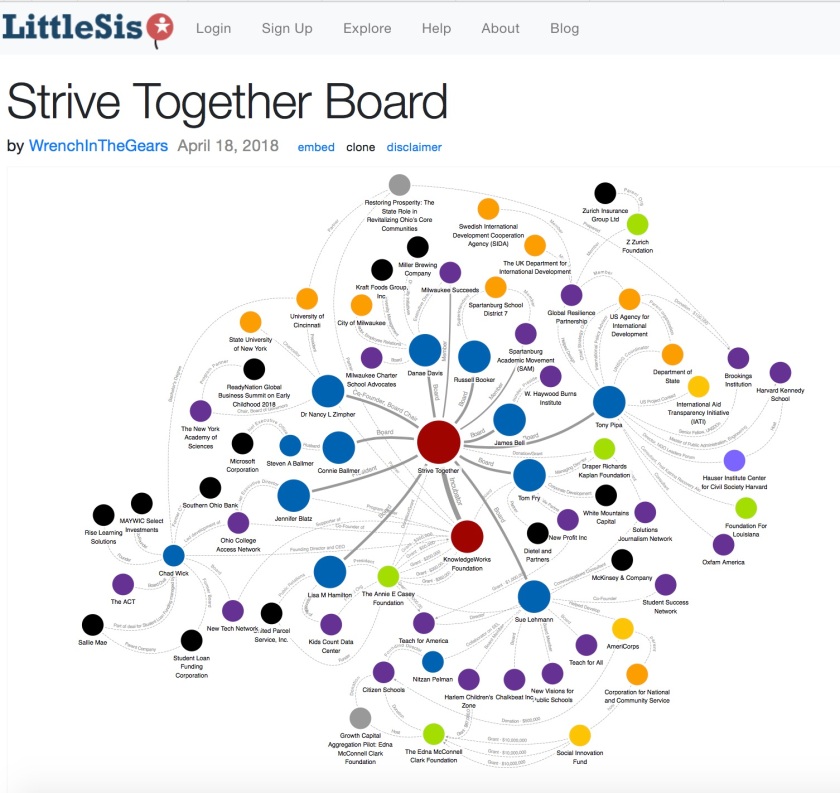
For those who think that, I wish you were right, but the reality is considerably more troubling. I follow money, and it tells a different story. It tells the tale of a sweeping program of “collective impact” cultivated by consultancies like Third Sector Capital PartnersFSG, and the Nonprofit Finance FundStrive Together, a non-profit program incubated in Cincinnati, OH under the wing of Gates Foundation-funded Knowledgeworks (promoter of learning ecosystems), will carry out the program.
Strive Together Board
Interactive map of Strive Together board here.
This initiative has been brought to scale with support from influential banks and foundations led by Living Cities, the United Way, and representatives of the Federal Reserve. Through carefully chosen “backbone organizations” and “conveners,” Strive Together’s pathways are being set up to channel tens of millions of private “impact investments” while harvesting personal data on an almost unimaginably vast scale. Central to this enterprise is the Annie E. Casey Foundation (UPS money) that sought to leverage a treasure trove of “Kids Count” data and trigger an expansive program of impact investing via the creation of Mission Investors Exchange CONTINUE READING: Home Visit Legislation: A Sales Pitch For Family Surveillance? – Wrench in the Gears

Wave of teachers’ strikes pressure states, school boards to change tune | Beatrice News Channel #Unite4OaklandKids #WeAreOEA #WeAreCTA #strikeready #REDFORED

Wave of teachers’ strikes pressure states, school boards to change tune | Beatrice News Channel

Wave of teachers’ strikes pressure states, school boards to change tune


(OAKLAND, Calif.) —  Having seen teachers score victories in Los Angeles, Denver and a string of states in their fights for higher wages and better working conditions, more than 3,000 educators in Oakland, California, have voted to go on strike this week.
“Oakland teachers cannot afford to live in Oakland,” Keith Brown, president of the Oakland Education Association, said during a news conference on Saturday. “One out of five leaves each year. Five-hundred classrooms are left with inexperienced teachers.”
Teachers voted overwhelmingly to walk off their jobs on Thursday, Brown said.
To stem the tide of teachers exiting the Oakland Unified School District, which has more than 37,000 students, the union is asking for a 12 percent raise over three years, smaller class sizes and more support staff.
The school district is offering a 5 percent raise, retroactive to when the union’s contract expired in July 2017.
The union and the school district began bargaining on a new contract in December 2016, but after 30 negotiating sessions encompassing 200 hours of bargaining, an impasse was declared on May 18, 2018. Both sides agreed to mediation, but that failed to break the stalemate.
School District Superintendent Kyla Johnson-Trammell said she is still hopeful that an agreement can be reached to avoid the first teachers’ strike in Oakland in 23 years.
“Despite our challenges, we are prepared with a comprehensive proposal to reach an agreement,” Johnson-Trammell said in a statement over the weekend. “If both sides are committed to settling the contract before a strike occurs — and we are — an agreement can certainly be reached without disrupting the educational experience for students, families and staff.”
Wave of teachers’ strikes
If Oakland teachers walk out of classrooms this week and hit the picket lines, the job action will become the latest in a string of public school teacher strikes that have swept the nation in the past 12 months.
The wave of teachers strikes started in West Virginia, where one year ago this week more than 20,000 teachers across the state walked off the job and formed picket lines for nearly two weeks before Gov. Jim Justice signed a bill granting educators and other state employees a 5 percent pay raise.
Randi Weingarten, president of the American Federation of Teachers, said the West Virginia strike was a game changer that inspired teachers across the nation.
“I don’t like when people say, ‘Well if they can do it in West Virginia, we can do it’ because that is really insulting to West Virginia. But it is a sense that they saw themselves with it. It inspired them and they CONTINUE READING: Wave of teachers’ strikes pressure states, school boards to change tune | Beatrice News Channel

Chicago charter strike settled. – Fred Klonsky

Chicago charter strike settled. – Fred Klonsky

Chicago charter strike settled


There is a tentative agreement in the strike by CTU charter teachers against CICS.
In a statement from the CTU the agreement protects counselors and social workers, limits class sizes, and raises teacher and paraprofessional pay up to CPS standards.
The tentative agreement immediately raises paraprofessional pay to the CPS schedule. Teachers are now placed on a salary schedule with extra pay lanes for advanced degrees. They receive an immediate average raise averaging 8% and will meet or exceed CPS salary rates by the last year of the four-year agreement.
There is now sanctuary language in the contract as well as stronger language on school safety.
The agreement also includes special education language which requires CICS to provide legally mandated services for students. Educators also won guaranteed full-time staffing of teaching assistants in every kindergarten through 2nd grade class, a 7% pension pick-up and more affordable health care coverage for families.
Class size, key sticking point in negotiations, establishes  goals at 28 and barring any classroom from holding more than 30 students.
Educators, some of whom earn barely $30,000/year, will see average pay raises of CONTINUE READING: Chicago charter strike settled. – Fred Klonsky