Latest News and Comment from Education

Saturday, December 8, 2018

CURMUDGUCATION: Inducing ADHD

CURMUDGUCATION: Inducing ADHD

Inducing ADHD


"Maybe you should consider testing him. You know. For ADD."

That was my son's kindergarten teacher. His mother and I were in for yet another conference because he was "a problem." The nature of the problem? Well, because of my schedule, he arrived 15-20 minutes before school officially started. His teacher's expectation was that he would sit at his desk, still and quiet, while she finished getting ready for the day. The rest of his problems were similar, violations of her desire for order in her classroom. He was an active and social five year old boy, a July birthday and so youngest in his class.

It was not a good year, and one of the top regrets of my life was that I did not make more of a fuss on his behalf. I should have demanded a switch to a different teacher, or gone over the head of the one we had, made a fuss, been That Parent. But I didn't want too be That Parent, didn't want to violate professional respect (particularly since this was the same district in which I taught). I only had about a decade in the field. I should have fought harder for my son.

But I did know enough-- and so did my wife at the time-- to know that he was not ADD, that he did not even need to be tested for ADD.

It was a bad year, and at the end of it, my son had learned to things-- that he was a bad student, and that he didn't like school. The better ending to that story was that my district in the following year instituted a Junior First grade, and with a supportive and nurturing teacher, he thrived.


Image result for ADHD

That was twenty-five-ish years ago, and I have often thought back on it, and not just because of my own regrets. What would happen, I wondered, with parents who were younger, in their early twenties instead of mid-thirties? What would happen if someone with a little less education or education profession background heard a teacher say their child should be checked for ADD? And CONTINUE READING: 
CURMUDGUCATION: Inducing ADHD

Image result for ADHD


Privatization is part of the ongoing assault on democracy

Privatization is part of the ongoing assault on democracy

Privatization is part of the ongoing assault on democracy


Itcouldn’t be clearer that the fundamental democratic right to have our voices — and votes — heard is under attack. Just this week, Wisconsin’s Republican-dominated legislature slashed early voting…in the middle of the night…during a lame duck session.
Bottom line: there are politicians, conservative think tanks, and corporate funders who don’t want people to be able to vote.
But we’ve learned through our work that there’s another — and perhaps deeper — threat to democracy spreading nationwide, and that is privatization.
When corporations take control of public goods like water, transit, and schools, we give them the ability to make decisions that should be made democratically by us, the public. Some examples:
Chicago’s infamous parking meter deal with Wall Street investors requires the city to pay those investors back for taking meters out of use for things like road construction, street festivals, and, even, bike and bus lanes.
Private prison corporations slip occupancy guarantees into their contracts — some as high as 100 percent — which makes it harder to reduce prison populations while putting taxpayers on the hook for guaranteeing their profits.
Many “public-private partnerships” take decision-making power away from the public, like Virginia’s Beltway toll lanes contract, which actually requires the government to pay investors if too many people carpool.
Charter schools, which are publicly funded but privately operated, are among the nation’s most segregated schools.
Total alleged and confirmed fraud and waste in California’s charter schools has reached over $149 million, but that’s just the tip of the iceberg. Due to little transparency and oversight, an untold amount of the $6 billion spent CONTINUE READING: Privatization is part of the ongoing assault on democracy


Schooling in the Ownership Society: The 'end of Camelot'? Not quite. Rahm gives crooked company new lease on life.

Schooling in the Ownership Society: The 'end of Camelot'? Not quite. Rahm gives crooked company new lease on life.

The 'end of Camelot'? Not quite. Rahm gives crooked company new lease on life.

Chicago Public Schools officials are digging out from another Barbara Byrd-Bennett scandal, three years after the former CPS CEO departed the district in disgrace.  -- Chicago Tribune
Camelot CEO Andrew Morrison said in a statement. “We are proud of our track record over the past seven years and of the achievements of our students." -- Unsolicited confession
The top line above is from a July 31st Tribune editorial called, "The end of Camelot at CPS". Camelot is a network of privately-run alternative and charter schools that serve "at risk" students. Their owners have fleeced Chicago Public Schools for more than $67M in bid-rigged contracts over the past decade.

Camelot's operators have long been criticized for their brutal, "prison-like" disciplinary policies directed nearly exclusively at African-American children.


But the title of the editorial is misleading. It's definitely not the "end of Camelot" at CPS. Despite the recent findings of illegal bid-rigging schemes by Camelot and now disgraced and imprisoned Byrd-Bennett that go back to 2014, it looks like the company will be given another run in Chicago at the cost to taxpayers of millions more.

Camelot Education, which still runs six schools for about 850 at-risk students, has agreed to pay a $1M fine. But they dodged a permanent ban on doing any business with CPS as the schools Inspector General Nicholas Schuler had recommended in July when he released his report outlining the misconduct.

The excuse for not shutting down Camelot offered by CPS officials is that, "closing 


CONTINUE READING: Schooling in the Ownership Society: The 'end of Camelot'? Not quite. Rahm gives crooked company new lease on life.

Fight for federal right to education takes a new turn

Fight for federal right to education takes a new turn

Fight for federal right to education takes a new turn


A new fight to secure a federal constitutional right to education is spreading across the country. This fight has been a long time coming and is now suddenly at full steam.

In 1973, plaintiffs in San Antonio Independent School District v. Rodriguez argued that school funding inequities violated the right to education. The Supreme Court rejected education as a fundamental right under the federal Constitution, leaving funding inequalities in Texas and elsewhere completely untouched. For more than 40 years, no one even dared to directly challenge Rodriguez’s conclusion in court. Now, in just two years, four different legal teams and plaintiff groups have done just that. But this time, they are shifting their arguments away from just claims about money. They are focusing on educational quality, literacy and learning outcomes.

The boldest claim was filed on Nov. 29 in Rhode Island, arguing for an education that prepares students for citizenship – an argument that draws directly on my own legal research and expertise as a scholar of education law.
When plaintiffs filed the first two cases in Detroit and Connecticut in 2016, the Supreme Court was set to shift significantly to the left. Hillary Clinton was a strong favorite to win the presidency and fill the vacancy created by the death of Justice Antonin Scalia. What looked like perfect timing for plaintiffs in mid-2016 turned awful a few months later when Clinton lost. The questions now are why plaintiffs, including new ones, continue to press forward and whether they have any chance of winning. The answers lie in a strange and tangled confluence of events that include school funding shifts, new legal theories and evolving cultural challenges.

Steep declines in school funding

Schools’ real-world problems are first and foremost driving the litigation. Detroit’s schools, for instance, are among the most segregated, lowest performing and most financially strapped in the country. The net result, plaintiffs allege, are schools where “illiteracy is the norm.” Detroit’s problems, while severe, are not entirely unique. Public schools nationwide are suffering from increasing segregation and a decade of steep CONTINUE READING: Fight for federal right to education takes a new turn


First-Ever Report Details Loss of Revenue to Public Ed Due to Corporate Tax Breaks | deutsch29

First-Ever Report Details Loss of Revenue to Public Ed Due to Corporate Tax Breaks | deutsch29

First-Ever Report Details Loss of Revenue to Public Ed Due to Corporate Tax Breaks


Corporate tax breaks divert public support for a state’s infrastructure into the corporate coffers.  It is a way to give away tax money without ever collecting it.
One of the lines of defense for the corporate tax break is that the tax break does not constitute giving away tax money since the money was never collected.
Nice try. However, the diverting of tax money into corporate tax breaks results in fewer dollars directly available for otherwise tax-funded entities, including public schools.
A second justification for corporate tax breaks is that the tax break will result in the indirect benefit of the corporation’s greater economic contribution, which more than offsets the tax break.
Maybe, maybe not. But how is one to know?
Answer: Track and publicize the dollar amounts of state and local corporate tax breaks in order to see exactly how much revenue is being forfeited so that one might evaluate whether the corporate tax break can be economically justified.
In 2013, the Government Accounting Standards Board (GASB) formally took up the issue of tax abatement disclosure; its Statement 77, “Tax Abatement Disclosures,” formally took effect in December 2015. According to GASB,
GASB Statement No. 77, Tax Abatement Disclosures, requires state and local governments to disclose key information about their tax abatement agreements that has not been consistently or comprehensively available before. …
Many state and local governments have tax abatement programs in place. These programs can have a substantial effect on the governments’ ability to generate revenue and their overall financial health. Without providing the kind of disclosures the GASB guidance will require, it can be difficult to determine the extent and nature of the abatements.
In December 2018, the Washington, DC-based, national policy resource CONTINUE READING:  First-Ever Report Details Loss of Revenue to Public Ed Due to Corporate Tax Breaks | deutsch29

Charter School Lobby Silent as Charter Teachers Continue Strike | gadflyonthewallblog

Charter School Lobby Silent as Charter Teachers Continue Strike | gadflyonthewallblog

Charter School Lobby Silent as Charter Teachers Continue Strike


Charter school teachers in Chicago are in their fourth day of a strike.
Yet I wonder why the leaders of the charter movement are quiet.

Not a word from Campbell Brown or Michelle Rhee?

Not a peep from Betsy DeVos or Donald Trump?

This is a historic moment. Teachers at various charter schools have unionized before, but it has never come to an outright strike – not once since the federal charter school law was established in 1994.
You’d think the charter cheerleaders – the folks who lobby for this type of school  CONTINUE READING: Charter School Lobby Silent as Charter Teachers Continue Strike | gadflyonthewallblog


Friday, December 7, 2018

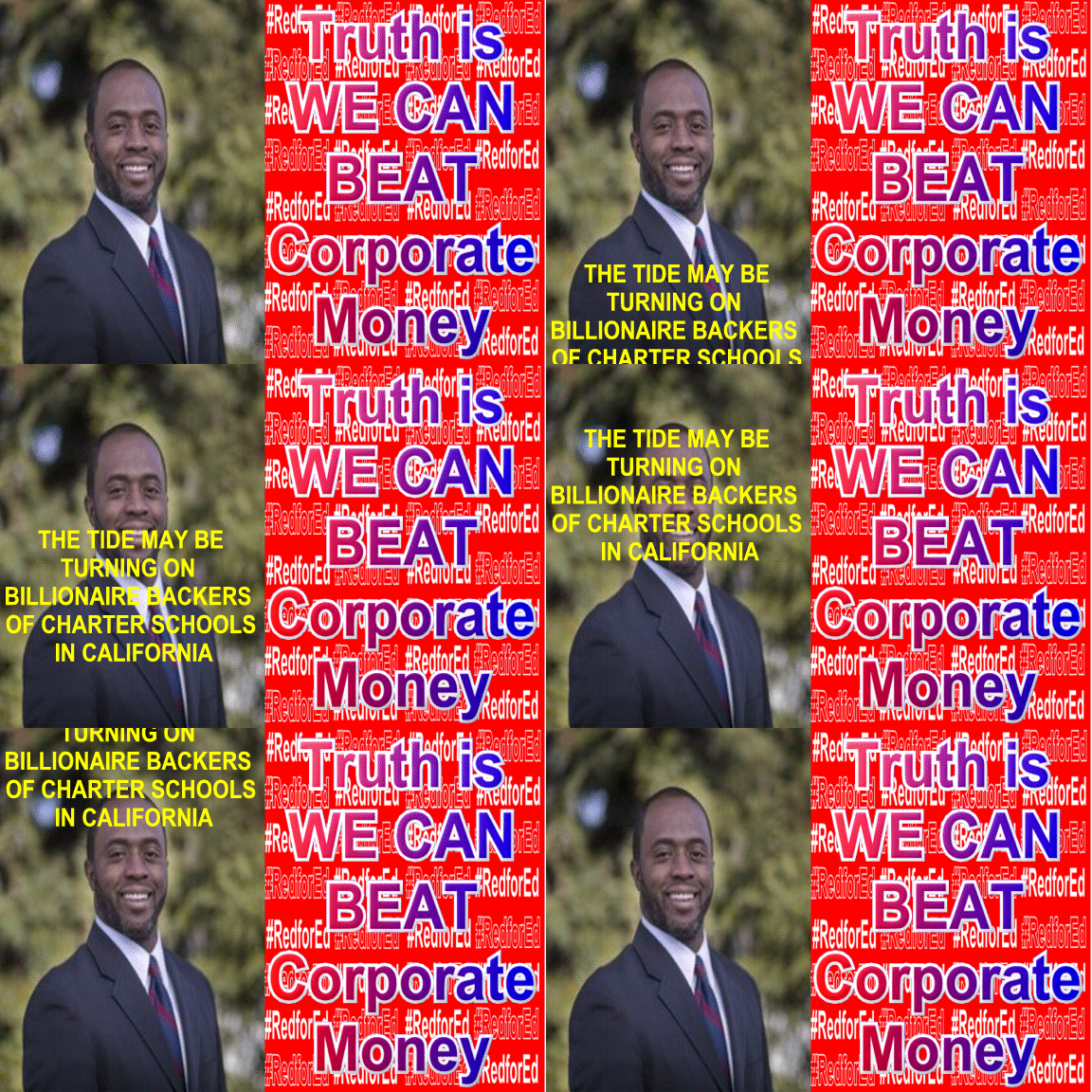
The Tide May Be Turning on Billionaire Backers of Charter Schools in California | Cloaking Inequity

The Tide May Be Turning on Billionaire Backers of Charter Schools in California | Cloaking Inequity

THE TIDE MAY BE TURNING ON BILLIONAIRE BACKERS OF CHARTER SCHOOLS IN CALIFORNIA

For years, billionaires have donated millions to promote pro-privatization, school choice candidates in political races ranging from local school board, to state houses, to Washington, D.C. An avalanche of political donations from deep-pocketed national advocates for private-management of education—such as entrepreneur Eli Broad, the Walton family (heirs to the Walmart fortune), co-founder of the Gap retail chain Doris Fisher, and other wealthy ideologues—has elected politicians and promoted district leaders who have enacted school choice policies focused on private management. California has perhaps been the state most impacted by this surge of cash, although enrollment growth is slowing, the Golden State has more students attending privately managed charter schools than any other state.


According to a chapter in the forthcoming second edition of the Handbook of Research on School Choice, campaign filings from the City of Oakland and the Alameda County Office of Education show more than a million dollars was spent in the past two school board elections in Oakland California, most of it to promote charter school friendly candidates (full disclosure: I was part of the team that conducted this analysis). In Los Angeles, charter school political support groups spent over $9 million in the 2017 school board elections. Hoping to tip the scales in the 2018 Democratic gubernatorial primary, the billionaires spent $23 million in support of Antonio Villaraigosa. Of these examples, only Villaraigosa failed to win, while school leaders in Oakland and Los Angeles continue to enact school choice policies focused on charter schools.

But the results of the 2018 midterm elections in California show the tide may have turned on the billionaires, and the fortunes of the progressive movement that seeks community-based education reform solutions may be trending upward.
School choice advocates experienced a big loss when they broke spending records and contributed nearly $40 million to Marshall Tuck, a former charter school operator, to try to defeat Assemblyman Tony Thurmond in a race for superintendent of California schools. Thurmond came from behind to win and overcame an election night deficit once all of the votes were counted.
Soon after winning the election, Thurmond called for a temporary ban on any new K-12 charter schools in the state, saying California has reached a “tipping point” with too many charters that have financially harmed public school districts and that California “shouldn’t open new schools without providing the resources for those schools… It is time to have perhaps a pause on the opening of new schools until we get clear about how we will fund any new schools.”
In San Francisco, where charters schools were recently approved by the California Board of Education, even when the CONTINUE READING: The Tide May Be Turning on Billionaire Backers of Charter Schools in California | Cloaking Inequity


Big Education Ape: Doris Fisher: Down the Dark Money Rabbit Hole | Capital & Main #UTLAStrong #StrikeReady #kidsdeserveit #marchforpubliced #WeAreCTA @WeAreCTA - http://bigeducationape.blogspot.com/2018/12/doris-fisher-down-dark-money-rabbit.html

An open letter to Betsy DeVos and the Department of Education - Lily's Blackboard

An open letter to Betsy DeVos and the Department of Education - Lily's Blackboard

An open letter to Betsy DeVos and the Department of Education


The National Education Association stands firmly with the millions of people in the United States, including our students and educators, who identify as transgender, gender non-binary, gender expansive and/or intersex.
We are alarmed by recent news reports that indicate that the Administration is contemplating policy to erase transgender protections through reinterpretation of existing laws and regulations. The NEA strongly opposes such damaging and dangerous policy efforts. 
We oppose any policy or regulation that violates the privacy rights of those that identify as transgender, gender non-binary, gender expansive/non-conforming or who are intersex. NEA logo
We oppose any attempts to eliminate federal recognition of the estimated 1.4 million Americans who identify as a gender other than the one they were assigned at birth.
We view any attempts to narrowly define gender as a deliberate attack on the fundamental equality of LGBTQ individuals and part of a deliberate strategy to eliminate or undo federal protections for LGBTQ people on the part of the current administration.
Transgender, gender non-binary, gender-expansive/non-conforming and intersex individuals are our students, our colleagues, our members and our families.
We call for equality in policy-making and equality under the law for transgender, gender non-binary, gender-expansive/non-conforming and intersex individuals.
Lily Eskelsen GarcĆ­a 
An open letter to Betsy DeVos and the Department of Education - Lily's Blackboard


CARL J. PETERSEN: Dismantling Our Public Schools

Dismantling Our Public Schools

Dismantling Our Public Schools

– Cheryl Ortega
Under what circumstances should the police be called on a five-year-old child? According to parents at Mayberry Elementary School in the Silver Lake/Echo Park area of Los Angeles, the principal has called the Los Angeles Police Department about students under her charge on six different occasions. In one incident, a kindergarten student was questioned by police after he “pulled his pants down to a playmate”. When the boy’s mother, Britney Ingram, attempted to find out what was happening, she was told by the officers that the matter was a “confidential problem”, that she could not “be present while they questioned her son” and “that if her son did not testify they would take him to the police station.” Another parent who attempted to record the events was removed from the school at the direction of the principal despite the fact that she “was a registered [school] visitor at the time this happened”.
If Ingram lived in one of the six Board Districts that currently has an elected representative on the School Board, she could have sought assistance from this Board Member. Unfortunately for her, she lives in Los Angeles Unified School District (LAUSD) Board District 5, the area CONTINUE READING: Dismantling Our Public Schools

CURMUDGUCATION: The Disordered Order of Competencies

CURMUDGUCATION: The Disordered Order of Competencies

The Disordered Order of Competencies

Competency Based Education (or Proficiency Based Learning, or Outcome Based Education, or Mastery Learning, or whatever new name appears next week) is the up-and-coming flavor of the week in education, even though it is neither new nor well-defined by the people who promote it (or the people who are implementing it in name only). But the basic principle is simple and, really, fairly common sensical. It offers a different solution to the age-old tension at the heart of education: students should definitely learn a certain core group of competencies, and they have to learn them in 180 days.
Traditionally, we resolve the tension by siding with the 180 days, and so some students are pushed through even though they don't necessarily fully master the material. But what if we flipped that? What if we said that every student must fully master one skill or unit of content knowledge before she moved on to the next one, regardless of how much or little time it took her to do it.
There's an obvious challenge here. What if Chris only takes 30 days to complete the full list of competencies? Worse, what if Pat needs 400 days to master the same full list? But there's another, less obvious issue here.
CBE is often presented with math lessons as the examples. That's handy, because CONTINUE READING: CURMUDGUCATION: The Disordered Order of Competencies

Chicago's Charter-School Strike Is the Nation's First - The Atlantic

Chicago's Charter-School Strike Is the Nation's First - The Atlantic

The Charter-School Teachers’ Strike in Chicago Was ‘Inevitable’
The move could signal a shift in the long, contentious relationship between teachers’ unions and these privately run schools.


Teachers’ strikes have been a constant across the country in 2018, popping up in six states, from West Virginia to Oklahoma. But so far, the wave of activism has been limited to educators at traditional public schools. That is, until earlier this week, when unionized teachers from one of Chicago’s largest charter-school networks, Acero Schools, took to the picket line. The strike is the first of its kind in U.S. history; although other charter-school teachers have unionized—collective bargaining is a requirement for charters in Hawaii and Maryland—these teachers are the first in the country to actually stage a walkout.
Teachers from all 15 Acero schools—which range from elementary to high school—resorted to a strike after failing to arrive at an agreement with Acero on Monday night over the terms of a new contract, in which they had requested higher salaries and smaller class sizes.
While teachers’ unions such as the American Federation of Teachers (AFT) had been gearing up for a possible strike for weeks, this decision to walk out is unprecedented: For decades, charter schools have championed themselves as a radical experiment in education that eschews the constraints of unions and traditional-public-school bureaucracy in favor of the flexibility to innovate. Now, at least in Chicago, the mentality seems to be shifting—and charter-school advocates fear it’s a sign that teachers’ unions, in a desperate effort to retain their clout, are co-opting charters for their own political reasons. Concurrently, the head of Chicago Public Schools, Janice Jackson, recommended on Monday that the city stop accepting proposals for new charter schools, a moratorium also supported by J. B. Pritzker, the governor-elect of Illinois.

“Ten years ago, that would have been a pretty unimaginable stance to be taken in this city,” says Elizabeth Todd-Breland, a historian at the University of Illinois at Chicago who studies education reform in the city. However, as a close watcher of Chicago charter schools, she long considered a strike like this to be “inevitable.” For several years, charter-school teachers have been joining the Chicago Alliance of Charter Teachers and Staff union, which recently merged with the Chicago Teachers Union (CTU)—an organization that is affiliated with the AFT and has historically opposed including charter-school teachers, Todd-Breland says. “I think after a number of conversations [among charter-school and traditional-public-school teachers’ unions], they came to the Continue reading: Chicago's Charter-School Strike Is the Nation's First - The Atlantic

7 questions educators are asking about their rights to speak out, protest, and engage in activism - Education Votes

7 questions educators are asking about their rights to speak out, protest, and engage in activism - Education Votes

7 questions educators are asking about their rights to speak out, protest, and engage in activism
Image result for educators  rights to speak out, protest, and engage in activism


With the number of students and educators participating in actions growing each week, many educators have questions about their rights when they engage in activism and protest on social justice issues.
In a national call with NEA members earlier this year, attorneys with NEA’s Office of General Counsel addressed many of these issues, answering the questions we are hearing most often about legal and free speech protections for educators who participate in actions in support of gun safety, DACA, Black Lives Matter@School, and more.
Below are a number of the key questions they addressed:

1. Do educators have First Amendment rights to speak up at school? What about outside of school?

The First Amendment enshrines the right to speak out, to assemble, and to speak without being punished.  But this right is not absolute, and public employees, like public educators, have limited First Amendment rights.
Before speaking out or participating in an action, it is always good to ask yourself two questions: 1) Which hat will you be wearing when you speak – an educator’s or private citizen’s?  And 2) What are you speaking about? Is it a topic of general public concern, or a personal grievance?
Generally, a public educator has the greatest free speech rights when speaking as a private citizen (outside of school and not to students or parents) about issues of public concern. You may have no First Amendment protections at all when speaking as an employee (in school or to students or parents) or about workplace or personal issues outside of school.
Before speaking out or participating in an action, it is always good to ask yourself two questions: 1) Which hat will you be wearing when you speak – an educator’s or private citizen’s?  And 2) What are you speaking about? Is it a topic of general public concern, or a personal grievance?
So, for example, an educator who speaks out about a hot-button political matter such as gun control outside of the school will be protected by the First Amendment. But speaking in class about the same issue would not be protected. Educator speech about personal issues or specific workplace complaints would also not be protected.

2. What other laws might protect educators?  

It’s always a good idea to check with your local or state NEA affiliate about which other laws may apply. Many, but not all, states have teacher tenure laws. Under these laws, your employer has to show cause to discipline or terminate a tenured teacher. Newer teachers and other educators often don’t have these rights, so they may want to act a little more cautiously.
Collective bargaining laws may also protect you when speaking out about issues that relate to the terms and conditions of your employment. So if you work in a state that permits public education collective bargaining, you may have stronger protections to speak out about specific issues in your school or district.
Anti-discrimination laws may also provide additional protection against discipline or termination that is imposed because of your gender, race, ethnicity, religion or other protected characteristic.
All of these protections are typically strongest when educators are speaking on non- Continue reading: 7 questions educators are asking about their rights to speak out, protest, and engage in activism - Education Votes

The best — and worst — education news of 2018 - The Washington Post

The best — and worst — education news of 2018 - The Washington Post

The best — and worst — education news of 2018


Every December veteran educator Larry Ferlazzo looks at the year in education news and makes his list of what he thinks the best — and the worst — of it was.
Of course it is subjective, and if you disagree with him, tell him (nicely) in the comments.
Ferlazzo is a teacher of English and social studies at Luther Burbank High School in Sacramento He has written numerous books on education, writes a teacher advice blog for Education Week Teacher and has his own popular resource-sharing blog.
See whether you agree with his assessment. You can find links to his lists from past years at the bottom of this post.
By Larry Ferlazzo
As usual, I don’t presume to say this compilation all-encompassing, so I hope you’ll take time to share your own choices. I’ll list the ones I think are the best first, followed by the worst. It’s too hard to rank them within those categories, so I’m not listing them in any order.
The Best Education News Of 2018
* The November elections brought lots of good news:
It wasn’t all good news, and some school funding measures lost, but — overall — it was a Continue reading: The best — and worst — education news of 2018 - The Washington Post