Latest News and Comment from Education

Wednesday, December 5, 2018

George H. W. Bush: A Tribute and a Happy Memory of My Time in D.C. | Diane Ravitch's blog

George H. W. Bush: A Tribute and a Happy Memory of My Time in D.C. | Diane Ravitch's blog

George H. W. Bush: A Tribute and a Happy Memory of My Time in D.C.


I’m in an airplane, flying from NYC to L.A., where I will attend the annual dinner of LAANE, the Los Angeles Alliance for a New Economy. This group fought for and won a battle to raise the minimum wage. I believe and hope they will join the struggle to support public schools and save them from the clutches of the billionaires.
As I fly, I’m watching the state funeral of President George H.W. Bush. The services are very moving. People speak of his decency, his sense of honor, his humility, his dignity, his loyalty to friends and family, his patriotism, his sense of duty and courage (he volunteered for combat duty in World War II right out of high school). Trump is sitting in the front row, scowling and looking uncomfortable. It’s not about him.
The former Prime Minister of Canada spoke about Bush’s devotion to improving the environment, assuring that we have clean air to breathe and clean water to drink. Others spoke of his support for the Americans with Disabilities Act. Still others referred to his steady hand as the Soviet Union dissolved and the Cold war ended. I broke down and cried when his son George W. said that he takes comfort in knowing that his dad is now hugging Robin (the daughter who died of leukemia at age 3) and holding Barbara’s hand. Because I hope sometime I’ll meet Steven, who died of the same disease at age 2.
I won’t pretend that I saw a lot of him when I worked in his administration. I did not.
When I was Assistant Secretary of Education for the Office of Research and Improvement during the administration of President George H.W. Bush, I made only one trip to the Oval Office.
Image result for Secretary Lamar Alexander and Deputy Secretary David Kearns diane ravitch
I was invited to join Secretary Lamar Alexander and Deputy Secretary Continue reading: George H. W. Bush: A Tribute and a Happy Memory of My Time in D.C. | Diane Ravitch's blog

Ravitch Goals 2000 | User Clip | C-SPAN.org - https://www.c-span.org/video/?c4469542/ravitch-goals-2000

CURMUDGUCATION: Real Stupid Artificial Intelligence (Personalized Learning's Missing Link)

CURMUDGUCATION: Real Stupid Artificial Intelligence (Personalized Learning's Missing Link)

Real Stupid Artificial Intelligence (Personalized Learning's Missing Link)


Good lord in heaven.


Intel would like a piece of the hot new world of Personalized [sic] Learning, and they think they have an awesome AI to help. And they have concocted a deliberately misleading video to promote it.

In the video, we see a live human teacher in a classroom full of live humans, all of whom are being monitored by some machine algorithms "that detect student emotions and behaviors" and they do it in real time. Now teachers may reply, "Well, yes, I've been doing that for years, using a technique called Using My Eyeballs, My Ears, and My Brain." But apparently teachers should not waste time looking at students when they can instead monitor a screen. And then intervene in "real time," because of course most teachers take hours to figure out that Chris looked confused by the classwork and a few days to respond to that confusion.

Oh, the stupid. It hurts.

First, of course, the machine algorithm (copywriters will be damned if they're going to write anything like "students will be monitored by computers") cannot detect student emotions. They absolutely cannot. They are programmed to use certain observable behaviors as proxies for emotions and engagement. How will Intel measure such things? We'll get there in a second. But we've already seen one version of this sort of mind-reading from NWEA, the MAP test folks, who now Continue reading: CURMUDGUCATION: Real Stupid Artificial Intelligence (Personalized Learning's Missing Link)


Why School Choice Ends Up Creating Injustice and Inequality | janresseger

Why School Choice Ends Up Creating Injustice and Inequality | janresseger

Why School Choice Ends Up Creating Injustice and Inequality


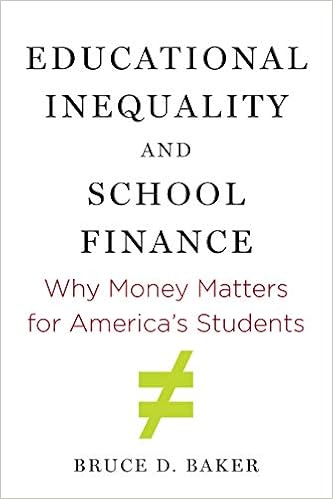
In his new book, Educational Inequality and School Finance: Why Money Matters for America’s Students, school funding expert, Bruce Baker critiques the rapid expansion of charter schools for siphoning off dollars from state and local public school budgets.  Baker also addresses the philosophical contention frequently offered to justify the rapid expansion of school choice—that justice can be defined by offering more choices for those who have few.
Our society now accepts the essential promise of liberty defined as freedom from enslavement and domination. We also would like to believe that our society provides freedom from want, and many argue that school choice offers opportunity to those who have been disempowered by poverty.  The wealthy can pay for whatever kind of education they want to choose for their children.  So… what about helping poorer people with freedom of choice—at public expense—in an education marketplace? Won’t that result in what the “portfolio school reform” think tank, the Center on Reinventing Public Education, promises: “a great school for every child in every neighborhood”?
Baker argues that more choice will not necessarily result in equal access to quality schooling.  Instead, equal opportunity can be better protected systemically: “Liberty and equality are desirable policy outcomes. Thus, it would be convenient if policies simultaneously advanced both.  But it’s never that simple.  A large body of literature on political theory explains that liberty and equality are preferences that most often operate in tension with one another. While not mutually exclusive, they are certainly not one and the same. Preferences for and expansion of liberties often lead to greater inequality and division among members of society, whereas preferences for equality moderate those divisions. The only way expanded liberty can lead to greater equality is if available choices are substantively equal, conforming to a Continue reading: Why School Choice Ends Up Creating Injustice and Inequality | janresseger
Educational Inequality and School Finance: Why Money Matters for America's Students: Bruce D. Baker: 9781682532423: Amazon.com: Books - https://www.amazon.com/Educational-Inequality-School-Finance-Americas/dp/1682532429


CURMUDGUCATION: Education, Bad Leadership, and Harvard

CURMUDGUCATION: Education, Bad Leadership, and Harvard

Education, Bad Leadership, and Harvard


We have a problem with bad management, pretending to be leadership, in this country. And it has infected education.

Even in a small area like mine, the symptoms have been plain to see. A major local oil business was put under the leadership of a man who had previously run a soap company and a toy company. He was not good for the company. In my town, the mining machinery company that employed both my father and my brother passed through the hands of several management organizations who installed top brass who knew nothing about the mining industry. It did not end well. In both cases, major employers for the area were gutted, jobs lost, local economy damaged.


I think I left some leadership over by the tea pots.
It was the smaller scale version of what we've seen with retailers like Sears and Toys R Us-- companies that lost their flexibility and edge because they were run by dopes who didn't know the business-- just how to extract value.

All indications are that our tech giants are just as terribly run, with Facebook repeatedly in the hot seat for a morally tone deaf mistake-plagued string of bad behaviors. Duff McDonald took a look at the woman taking the heat, Sheryl Sandberg (she of Lean In fame), and in particular the kind of leadenly education she got from the Harvard Business School, which McDonald marks as ground zero in this bad leadership pandemic.

The truth is, Harvard Business School, like much of the M.B.A. universe in which Sandberg was reared, has always cared less about moral leadership than career advancement and financial performance. 

It is an education, McDonald says, that stresses that there are no right answers, and, he suggests, no moral dimension to making this choices. The article includes a story about Jeff Skilling, a product of Harvard Business School and McKinsey's Uber-consulting firm, operated in the same style.

One of Skilling’s H.B.S. classmates, John LeBoutillier, who went on to be a U.S. congressman, later recalled a case discussion in which the students were debating what the C.E.O. should do if he  Continue reading: 
CURMUDGUCATION: Education, Bad Leadership, and Harvard


Mike Klonsky's Blog: Rahm and his schools CEO try and sell their discredited reforms in D.C.

Mike Klonsky's Blog: Rahm and his schools CEO try and sell their discredited reforms in D.C.

Rahm and his schools CEO try and sell their discredited reforms in D.C.


Mayor Rahm Emanuel is so discredited on his education and policing policies that he's been forced out of a re-election bid. But that didn't stop him and his ever-faithful schools CEO Janice Jackson from putting in an appearance in D.C. on WaPo's Education in Americaforum recently to spread the good news about all things terrific going on in Chicago's public schools.

Jackson offered a few comments when she could get a word in, but it was obvious that Rahm had her there as window dressing.

Was there any discussion of the regime's continuing disastrous mass school-closings policy mostly in underserved black communities, or the dramatic plunge in CPS enrollment during Rahm's tenure? Glad you asked. No.

District officials report a loss of 10,000 students since the last school year, one of the largest single-year declines in more than a decade. In the last three years, 31,000 students have ghosted CPS classrooms. But the Post's Jonathan Capehart never asked about that.

But he did ask Rahm about his closed-door meeting with Ed Secretary Betsy DeVos. At first, Rahm and Jackson giggled as if trying to distance themselves from the right-wing buffoon who currently occupies the D.O.E. That was followed by a seemingly unending speed rap about all the great ed initiatives flowing out of the 5th floor at City Hall; i.e. longer school days, not Continue reading: Mike Klonsky's Blog: Rahm and his schools CEO try and sell their discredited reforms in D.C.

Tuesday, December 4, 2018

College dropout named next FL House education chair - YouTube

College dropout named next FL House education chair - YouTube

College dropout named next FL House education chair


This week incoming Florida House Speaker Jose Oliva announced that Mount Dora Tea Party darling Jennifer Sullivan will the new chair of the House Education Committee. Sullivan, who was home-schooled, has zero experience as an educator, has never studied or written about education policy. And about those college credits she claimed to have earned when she was first elected in 2014? Not true, says the evangelical Christian college in question.
Oliva called Sullivan “a leader of the utmost integrity and fairness,” who, of course, continues lying about her own education, because she knows that’s essential to being an education leader.
Apparently, she apparently can’t even answer questions from the press on her own. The speaker’s communications director claims Sullivan’s “goals are to create a system that is student centered by putting what’s best for those same students first. That starts by giving parents choice in the education of their children.”
Translation: she plans on expanding the policy that hands over public assets to greedy corporations with little to no accountability and — while they’re at it — crushing the teachers unions.
“Parents always have had the choice of homeschooling or enrolling their children in any private school they desire — they still do. No one is taking it away. The issue is whether taxpayers should ante up for what usually is religious education.”
https://www.orlandosentinel.com/news/...
Sullivan says “she hopes to expand funding for students who want to go to charter and voucher schools,” which means cutting even more funding to the schools the most vulnerable children attend, “reward the best teachers with better pay,” which means limiting teacher pay to bonuses and other gimmicks that clearly are not working to recruit or retain the most qualified teachers, “and look for ways to reduce administrative overhead in local districts.” Keep in mind, administrative costs in Florida school districts average around six percent.
None of these talking points is new. This is exactly the same agenda that has left Florida 45th nationally in per pupil spending, dead last in percentage of students funded at the state average, and put the state at the epicenter of the movement dismantling public education, brick by brick.
And by the sound of it, they’ve only just begun.


enrique baloyra

College dropout named next FL House education chair - YouTube

Matt Barnum: “Reformers” on Local School Boards Create New Organization to Promote Portfolio Model | Diane Ravitch's blog

Matt Barnum: “Reformers” on Local School Boards Create New Organization to Promote Portfolio Model | Diane Ravitch's blog

Matt Barnum: “Reformers” on Local School Boards Create New Organization to Promote Portfolio Model


Matt Barnum reports that school board members in several cities have formed a new organization to consult with one another. They claim they don’t have an agenda but they are funded by Education Cities, the organization that was created to promote the “portfolio model” that favors charters.
If all that was wanted was an organization where school board members could communicate, such organizations exist. Every state has a state school boards association. There is also the National School Boards Association. Clearly, something else is intended here, and you don’t need a big imagination to figure it out. These are school boards members who are part of the “Reformer” agenda, and they are impatient to disrupt their district’s schools.
This is yet another organization trying to pump life into the moribund charter movement, which has failed to close the achievement gap anywhere or to introduce any innovation other than strict discipline (a return to the late 19th century) and which lobbies to avoid accountability and transparency.
The charter lobby is doubling down and pumping out more organizations as existing charters close or fail to produce results, kind of like buying more of a sinking stock. If the stock doesn’t rebound, you lose it all.

Barnum writes:
School board members are elected to make the most local decisions about school policy. But a new group is trying to get them to join forces to form a network of school board members in at least 10 cities.


School Board Partners says it wants to create a “national community” of  Continue reading:Matt Barnum: “Reformers” on Local School Boards Create New Organization to Promote Portfolio Model | Diane Ravitch's blog


Education Research Report: Debunking Grit, Free and Reduced-Price Lunch: A Valid Measure of Educational Disadvantage, Within-Year Teacher Turnover And More

Education Research Report

Education Research Report

TODAY

Fine motor skills, executive functions, and basic numerical skills in kindergarten
Research Findings : This study examined the interrelations between fine motor skills, executive functions, and basic numerical skills in kindergarten as well as their predictive value for mathematics achievement in 2nd grade in a sample of 136 children. Structural equation modeling techniques were used to uncover the unique predictive value and mediation of 4 predictors. The results indicated tha
Focused Early Childhood Curriculum Can Enhance Social-Emotional Competence in Low-Income Children
Research Findings : This meta-analysis examined 29 (quasi-)experimental studies that involved low-income children ages 3 to 5 who might be subject to risks of academic failure and other negative outcomes. Compared to the controls, children who learned with social-emotional learning (SEL) curricula demonstrated significantly improved social-emotional competence, with an effect size or standardized
Teaching and Learning in Pre-K through 2nd Grade - Lessons from Boston
This report explains the work that has taken place over the last decade in Boston to not only improve pre-K, but to build on the successes of pre-K through reform of classroom environments, instructional practices, and curricula in pre-K, kindergarten, and, more recently, in first and second grade. It is a story of reforming from the bottom up, of realizing that the work of increasing student ach
Postsecondary Graduation Rates, Outcome Measures, Student Financial Aid, and Admissions
About 19 percent of first-time full-time students who enrolled in 2-year institutions in 2013 graduated within two years (100 percent of normal time), according to new postsecondary data. However, that rate jumped to 37 percent when the time for graduation was extended to four years (200 percent of normal time). The National Center for Education Statistics released a First Look repor t today (Dec
Teacher Sorting is a Global Phenomenon
Although substantial evidence from the United States suggests that more qualified teachers are disproportionately concentrated in the schools and classrooms of academically and socioeconomically advantaged children, it is not clear whether the problem of teacher sorting is global in scope. This study uses data from the 2013 Teaching and Learning International Survey to examine whether and how sch
Debunking Grit
Grit is a construct that is widely studied by educational researchers and that has generally been enthusiastically received by educational practitioners. This essay highlights that many of the core claims about grit have either been unexamined or are directly contradicted by the accumulated empirical evidence. Specifically, there appears to be no reason to accept the combination of perseverance a
Within-Year Teacher Turnover
Teacher turnover occurs during and at the end of the school year, although documentation of within-year turnover currently rests on anecdotal evidence. On average, over 4.6% of teachers turn over during the school year, which amounts to 25% of total annual turnover. Teachers transfer within districts at higher rates at the beginning of the school year and leave teaching at higher rates at the beg
Free and Reduced-Price Lunch: A Valid Measure of Educational Disadvantage
Students in the United States whose household income is less than 130% of the poverty line qualify for free lunch, and students whose household income is between 130% and 185% of the poverty line qualify for reduced-price lunch. Education researchers and policymakers often use free and reduced-price lunch (FRPL) status to measure socioeconomic disadvantage. But how valid is this measure? Linking
New Report on Teacher Evaluation Lacks Coherence
A new report from the National Council on Teacher Quality (NCTQ) highlights six teacher evaluation systems purportedly “yielding substantial benefits.” This comes at the end of a decade when reformed teacher evaluation systems that link teacher performance to measures of student growth have been at the center of educational debate. Amy Farley and Leah Chamberlain of the University of Cincinnati r

YESTERDAY

Learning to read comes at a cost
The early focus on larger units may have positive effects, and explain why young children are so good at learning certain areas of grammar, say scientists from the PSL University of Paris, the Max Planck Institute for Psycholinguistics and the Hebrew University of Jerusalem. They found that preliterate 6-year-olds were better at learning grammatical relations between words than at learning novel
Children perform better when parents are involved in school life
A family's involvement in a child's education acts as a source of social mobility, according to a study by experts from the HSE Centre of Social and Economic School Development, Mikhail Goshin and Tatyana Mertsalova http://doi. org/ 10. 17323/ 1814-9545-2018-3-68-90 . Lower income parents who actively participate in their children's school life open up more opportunities for their children. The r
Students who meet 8-hour sleep challenge do better on finals
Students given extra points if they met "The 8-hour Challenge" -- averaging eight hours of sleep for five nights during final exams week -- did better than those who snubbed (or flubbed) the incentive, according to Baylor University research. "Better sleep helped rather than harmed final exam performance, which is contrary to most college students' perceptions that they have to sacrifice either s
Boys with social difficulties most susceptible to early substance use
Boys who enter sixth-grade with co-occurring social skills, anxiety, learning and conduct problems are at the greatest risk of developing aggressive behavior and using tobacco, alcohol and marijuana by the end of eighth grade, a new study found. "While substance use among all boys in the study population increased over time, it increased the fastest among boys who had the greatest social skills n
despie soaring job growth, only 64,405 students received computer science degrees
ACM, the Association for Computing Machinery, has released the highly anticipated report "Retention in Computer Science Undergraduate Programs in the U.S.: Data Challenges and Promising Interventions." Among its key recommendations, the report calls for additional research to provide a more nuanced understanding of the dynamics of attrition and retention, and encourages higher education instituti
Why Are STEM Doctoral Completion Rates Lower for Women?
Women entering PhD programs in which they have no female peers are 12 percentage points less likely to graduate than men entering the same program. More than half of all doctoral graduates in the United States in 2016 were women, but women accounted for just 23 percent of engineering and 26 percent of mathematics graduates. In Nevertheless She Persisted? Gender Peer Effects in Doctoral STEM Progr
Public Service Loan Forgiveness Denials
Complete article The hardest thing in higher education isn’t getting into an elite college; it’s getting approved for Public Service Loan Forgiveness (PSLF). So far, the U.S. Department of Education has only approved 1 percent of all applications for PSLF —a federal loan program that forgives debts of borrowers who make 120 qualifying payments while working in public service jobs such as teaching
High-Stakes Testing, Stress, and Performance
Chronic stress – due to neighborhood violence, poverty, or family instability – can affect how individuals’ bodies respond to stressors in general, including the stress of standardized testing. This, in turn, can affect whether performance on standardized tests is a valid measure of students’ actual ability. This study collected data on students’ stress responses using cortisol samples provided b
How attending an elite college affects later-life outcomes
This paper revisits the question of how attending an elite college affects later-life outcomes. For men, the findings echo those in Dale and Krueger (2002): controlling for selection eliminates the positive relationship between college selectivity and earnings. There are also no significant effects on men's educational or family outcomes. The results are quite different for women: the authors fin
Later High School Start Times and Student Academic Outcomes
This study uses statewide student-level data from North Carolina to estimate start time effects for all students and for traditionally disadvantaged students. The authors found that urban high schools were likely to start very early or late. Later start times were associated with positive student engagement outcomes (reduced suspensions, higher course grades), especially for disadvantaged student