Latest News and Comment from Education

Tuesday, October 23, 2018

'There's no paper in the classroom': why Los Angeles teachers are moving toward a strike | US news | The Guardian

'There's no paper in the classroom': why Los Angeles teachers are moving toward a strike | US news | The Guardian

'There's no paper in the classroom': why Los Angeles teachers are moving toward a strike
Following high-profile teacher walkouts across the country, LA teachers voted to strike over school funding, wages and class sizes

At the start of the 2018-19 school year, members of the Los Angeles teachers’ union overwhelmingly voted to authorize a strike, granting the union board the authority to approve a walkout as the union and school district continue to negotiate a new contract. The strike authorization provides the union with a possible tactic to leverage a variety of demands over the second largestschool district in the nation.
This year, teachers have gone on strike in Arizona, West Virginia and Oklahoma with varying degrees of success. Arizona teachers received a 19% pay raise after a five-day walkout in May. West Virginia teachers ended their nine-day strike after receiving a 5% pay raise in March. Oklahoma teachers’ nine-day strike pushed their state legislature to pass an annual $6,100 pay increase and devote $500m to education funding.
The United Teachers of Los Angeles, the union of the city’s public school teachers, are demanding the school district increase education investment, hold charter schools accountable, take efforts to reduce class sizes, improve school safety and reduce the quantity of mandated standardized tests in addition to increasing wages by 6.5% for teachers.

“It seems clear talking to over 1,000 teachers in the district that the big issue for teachers in the Los Angeles unified school district is class size, easily at the top of the list. It’s gotten out of hand,” said Elgin Scott, a teacher at Los Angeles’ Taper Avenue elementary school, in an interview. According to Scott and other teachers the Guardian spoke with, it’s not uncommon for Continue reading: 'There's no paper in the classroom': why Los Angeles teachers are moving toward a strike | US news | The Guardian


Diane Ravitch’s Network for Public Education Conference: A Report and Reflections | Ed In The Apple

Diane Ravitch’s Network for Public Education Conference: A Report and Reflections | Ed In The Apple

Diane Ravitch’s Network for Public Education Conference: A Report and Reflections


I spent the weekend in Indianapolis at the fifth annual Network for Public Education Conference, both uplifting and disturbing.
Hundreds of teachers, parents, activists, elected officials, all dedicated supporters of public education sharing stories, both uplifting stories of how small groups of dedicated, caring sophisticated teams of teacher unions, parents and community activists can make a difference and begin to turn the tide, and, in other locations, how the forces of privatization, charter schools, “portfolio” models are unrelenting in their assault on public education.
The weekend alternated between speakers and workshops.
Pasi Stahlberg, a Finnish educator described the worldwide attack on public education, Pasi has dubbed the movement GERM – the Global Education Reform Movement. Watch his presentation here.
Finland should be a model for our nation, at least for states within our nation. The education system in Finland: no standardized tests, local autonomy, well-paid teachers and students at the top of the list on international lists. Yes, Finland is small, 5.5 million in a nation the size of Montana, very few immigrants, income equality, teachers selected from the top 10% of college Continue reading: Diane Ravitch’s Network for Public Education Conference: A Report and Reflections | Ed In The Apple


Will Teachers Be Accountable to Make “Happy” Students?

Will Teachers Be Accountable to Make “Happy” Students?

Will Teachers Be Accountable to Make “Happy” Students?


Here comes VAM for social-emotional learning!
Controversy erupted years ago over holding teachers accountable for academic test scores. VAM (Value Added Measurement) was supposed to have been put to rest, but it never really left. Move over VAM, now teachers will be responsible for student behavior too!
Back in June, Peter Greene, writing for Forbes noted:
Few systems have been debunked more often then VAM systems, and yet somehow this failed system is still the primary tool for evaluating teachers across the country. Why?
Now reformers are giddy about adding more assessment in the form of student noncognitive soft skills to the mix. They want teachers to create perfectly behaved children in a world that is far from perfect.
Professor C. Kirabo Jackson, a professor of human development and social policy at Northwestern University, authored the study. An overall point to be made is that academics and positive behavior go together. Students who feel better about themselves will likely do better academically.
But Jackson seems to be advocating for a social-emotional learning VAM, to combine academic and social-emotional learning for a fuller teacher evaluation program.
…this study provides evidence that measuring teacher effects on test scores captures Continue reading: Will Teachers Be Accountable to Make “Happy” Students?

The Days of Charter Schools and Vouchers Are Numbered - Education Law Prof Blog

Education Law Prof Blog

The Days of Charter Schools and Vouchers Are Numbered


If you were trying to make a buck on the side and were pretty sure that some new or improved technology would drastically undercut the market for cell phones within five years, would you invest in Apple stock or look for other opportunities?  Well, that is the type of information I have for the Koch Brothers and Devos families of the world.  Invest your money elsewhere.  Vacate the Secretary of Education’s office.  The days of charter and voucher growth are numbered.  And regulation is coming to those charters and vouchers already in place.
Why am I suddenly confident, rather than nervous, about charters and vouchers?  I got the chance to meet and listen to teachers from across the country at the Network for Public Education’s annual conference in Indianapolis this past weekend.  For the first time in my professional career, I had a firm sense of public education’s future.  I have litigated and participated in several civil rights and school funding cases, dealt with lots of different advocates, and watched closely as the teacher protests unfolded this spring.  In Indianapolis, I saw something special—something I had never seen before.
I saw a broad based education movement led not by elites, scholars, or politicians, but everyday people.  Those everyday people were teachers who were not just from big cities, small cities, suburbs, or the countryside, but from all of those places and as diverse as America’s fifty states and ten thousand school districts.  The teachers weren’t Continue reading: Education Law Prof Blog

Related image

Before assigning homework, ensure that students have a home

Before assigning homework, ensure that students have a home

Before assigning homework, ensure that students have a home
Fixing the achievement gap comes second to meeting kids’ basic needs


We had to wake up at 5 o’clock in the morning because our school was far away. Sometimes we had to go to school late, because we had to wait for the bathroom. But since it wasn’t our house, they could use the bathroom first,” Kimberly, 12, told the child advocacy organization Children’s Defense Fund for their The State of America’s Children 2014 report. But at school, she was labeled truant. “I could not go to recess because of this.”
One out of every ten New York City public school students lived in temporary housing in 2017, according to a sobering October 15 article by The New York Times. That amounts to 114,659 students sleeping in hotels, motels, others’ couches, temporary shelters and the unsheltered streets of New York City. The article showed that the total number of homeless students was more than the entire population of Albany, the state capital. Put closing the achievement gap bombast to bed till students have one to sleep in.
Rhetoric around the need to close the achievement gap feeds into a warped notion of individualism — that students need to pick themselves up by their academic bootstraps — and misses the real needs that kids have, which should be supported through policy. Students and their families need secure, affordable homes in safe neighborhoods and a living wage, which can be addressed through policy. Student homelessness of this magnitude is not an individual failure — it’s a failure of policy to address families’ basic needs and made worse by the systemic problems of unaffordable housing and Continue reading: Before assigning homework, ensure that students have a home


A Billionaire Stops Funding Charters and TFA, Starts Funding Public Schools! | Diane Ravitch's blog

A Billionaire Stops Funding Charters and TFA, Starts Funding Public Schools! | Diane Ravitch's blog

A Billionaire Stops Funding Charters and TFA, Starts Funding Public Schools!


She fell in love with public education.
She fell in love with the schools that take everyone, even the least of them, the children that the charters reject.
She got woke.
In the past three years alone, the foundation, which Barbara co-founded with her husband, has donated $50 million to public education programs in Connecticut.
“I never thought I would get into education because it’s not my background, so I am learning as I go along,” she said. “I love it. I don’t play golf or tennis. This is my passion.”
Connecticut Adds Two More Billionaires To The Forbes 400 List. Here’s A Look At All Nine Members.
Dalio, 70, who is universally described as humble and hands-on, said in an interview last week that her shift toward traditional public school districts came about as she learned more about education and became concerned about the achievement gap and students who are disengaged from school.
Dalio said she observed that the kids who go to public charter schools have parents who are often more involved and have the initiative to seek out an alternative for their child.
But many parents, she said, don’t have the time to do that.


“It’s not that they don’t care about the kids,” Dalio said of those parents. “It’s that they are burdened in many instances with just one parent having Continue reading: A Billionaire Stops Funding Charters and TFA, Starts Funding Public Schools! | Diane Ravitch's blog


A Moment When Grassroots Mobilization for Public Education Is Making a Difference—Part 1 | janresseger

A Moment When Grassroots Mobilization for Public Education Is Making a Difference—Part 1 | janresseger

A Moment When Grassroots Mobilization for Public Education Is Making a Difference—Part 1


I was privileged to participate in the 5th Annual Conference of the Network for Public Education (NPE) in Indianapolis this past weekend.  In the next few days, I’ll post some reflections on what I heard and learned at this important meeting.
One of the highlights of the Conference were presentations on excellent community organizing that is finally making a difference. Today’s post and tomorrow’s will describe two very different and encouraging initiatives.
What if city parents were supported in ignoring the glitzy brochures, radio ads, and even incentive gifts encouraging them to escape public schools and experiment with charter schools? What if, instead. parents were encouraged and supported to demand public schools designed to meet the needs of their families and children?  I found hope this past weekend in a workshop where the Journey4Justice Alliance (J4J) told the story of mobilizing Black and Brown parents to demand the kind of stable, quality public schools middle class children take for granted: no more experiments with state takeover, privatization, and school closure at the expense of their children. The #WeChoose Campaign is national—connecting and organizing parents across America’s big cities. For years, there has been a sense of confusion and despair as corporate reformers with big money swept in to seize governance and policy in big city school districts. Finally a moment of clarity and empowerment is being created.
Related image
At last weekend’s NPE Conference we listened as national organizers from the Journey4Justice Alliance and local leaders of their multi-city partners—Chicago’s Kenwood Oakland Community Organization; New York City’s Alliance for Quality Education and Coalition for Educational Justice; Camden Parents Union and Camden Student Union; Newark’s Parents Unified for Local School Education; Pittsburgh’s Education Rights Network and One Pennsylvania; and the Detroit L.I.F.E. Coalition—explained how their communities are proclaiming #We Choose Public Schools: “We choose educational equity in public schools, not the illusion of school choice.”
The Journey4Justice Alliance (J4J) launched its #WeChoose campaign in February, 2017 with plans in at least 25 cities for press events, policy forums, meetings with elected officials, and direct actions along with a coordinated social media campaign. Jitu Brown, executive director of  J4J describes the campaign’s message which organized parents are proclaiming to Continue reading: A Moment When Grassroots Mobilization for Public Education Is Making a Difference—Part 1 | janresseger
Related image


A Little Piece of Something - A film about a public Montessori school in Memphis says everything about who we are, who we were, & who we aspire to be – Sam Chaltain

This film about a public Montessori school in Memphis says everything about who we are, who we were, & who we aspire to be – Sam Chaltain

THIS FILM ABOUT A PUBLIC MONTESSORI SCHOOL IN MEMPHIS SAYS EVERYTHING ABOUT WHO WE ARE, WHO WE WERE, & WHO WE ASPIRE TO BE


I am so proud of our newest film for 180 Studio.
At its most literal, A Little Piece of Something is a story about a public Montessori school in Memphis that is changing the way people think — about their community, about public education, and about the best way(s) to foster a healthy identity in young children.


At its core, however, it’s a story of how we come to understand who we are and why we matter. It interweaves three different narrative threads: the inextricable relationship between the health of a community and the health of its schools; the impact of structural racism on our individual and collective sense of identity; and the mission of public Montessori programs, which offer a radically different model of healthy child development than the conventional “reform” approach (i.e., KIPP, Success Academy, etc.) to educating low-income children of color.
I hope you’ll watch and share — and if you do, we hope you’ll join me in considering some larger questions worth wrestling with:
What assumptions have we made in America about children living in poverty that this school is directly challenging?
In what ways has structural racism impacted the ways we see public education, child development, and one another?
And finally, what have we become as a country, and what do we wish to become?


This film about a public Montessori school in Memphis says everything about who we are, who we were, & who we aspire to be – Sam Chaltain

Pennsylvania’s Keystone Exam – the Monster We Refuse to Let Die | gadflyonthewallblog

Pennsylvania’s Keystone Exam – the Monster We Refuse to Let Die | gadflyonthewallblog

Pennsylvania’s Keystone Exam – the Monster We Refuse to Let Die

Let’s say there was a monster loose in Pennsylvania and you caught it.
Its days of wandering loose causing chaos and destruction were over.
But what would you do with such a beast now?
Would you kill it outright? Stop it from ever hurting anyone ever again?
Or would you simply neutralize it – place it perhaps in the center of a labyrinth, continue feeding it, and in fact create a whole religion based on worshipping it?
In the keystone state, we have just such a creature, and we’re going with the second option – the maze, nourishment and a cult.
And, heck, it would just make more sense to stop doing something that isn’t working, wastes money and causes legitimate problems for students.
But this is Pennsylvania! We’re not going to admit we made a mistake. Better to bury Continue reading: Pennsylvania’s Keystone Exam – the Monster We Refuse to Let Die | gadflyonthewallblog


Monday, October 22, 2018

John Thompson: The Negative Effects of Corporate Reform and Disinvestment in Education | Diane Ravitch's blog

John Thompson: The Negative Effects of Corporate Reform and Disinvestment in Education | Diane Ravitch's blog

John Thompson: The Negative Effects of Corporate Reform and Disinvestment in Education
John Thompson, historian and teacher, lives in Oklahoma.


The Oklahoma press is focusing on the state’s low level of college readiness as measured by the ACT test, 16 percent, in comparison to the national rate of 27 percent. The state known for dramatic cuts in education funding is ranked 19th in the nation with an average composite score of 19.3. But it is missing the big picture.
The average ACT composite for my old school, Centennial, is 14.8, which is above average for the high-poverty neighborhood schools in Oklahoma City and Tulsa. Even when we were ranked last in the state, our ACT scores were significantly higher. Since I retired, Centennial received a $5 million School Improvement Grant. I believe that its ACT decline is just one example of evidence explaining how and why tens of billions of dollars of corporate school reform drove meaningful learning out of many inner city schools.
The important question is what caused the national decline. Retired PBS education reporter John Merrow argues these ACT-takers “have had 12 or 13 years of test-centric education, and the kids coming up behind them have also endured what the ‘school reformers’ designed.” He also asks, “How much more evidence do we need of the folly of ‘No Child Left Behind’ and Education Secretary Arne Duncan’s ‘Race to the Top’ before we take back our schools?”
Since reformers sought to improve low-performing schools, it is significant that Merrow cites the ACT report on recent outcomes:
A higher percentage of students this year than in recent years fell to the bottom of the preparedness scale, showing little or no readiness for college coursework. Thirty-five percent of 2018 graduates met none of the ACT College Readiness Benchmarks, up from 31% in 2014 and from 33% last year.


All types of researchers are contributing to the autopsies being performed on data-driven, competition-driven reform. And many of us are especially intrigued by the analyses of corporate school reformers on why test-driven accountability, the expansion of charter schools, and the quest to “build a Continue reading: John Thompson: The Negative Effects of Corporate Reform and Disinvestment in Education | Diane Ravitch's blog


ISTA: Lying Down With Dogs – Live Long and Prosper

ISTA: Lying Down With Dogs – Live Long and Prosper

ISTA: Lying Down With Dogs


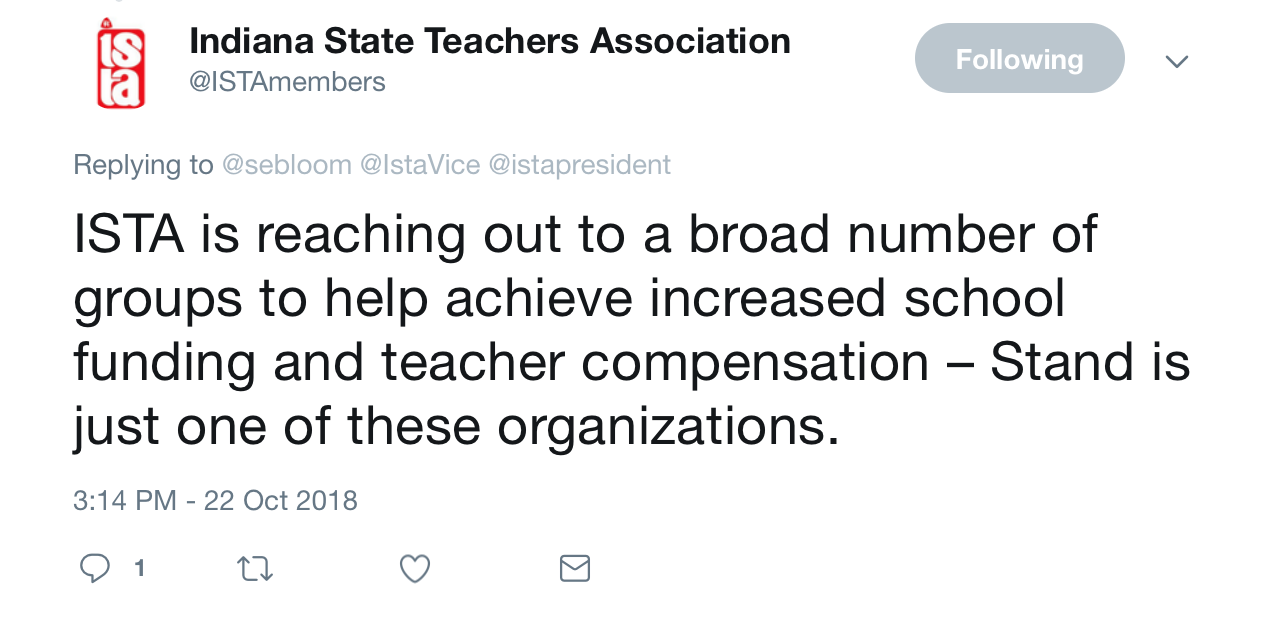
The Indiana State Teachers Association is joining with Stand for Children. Why would ISTA join with an ed-reform group?

In case you don’t know, Stand for Children is a pro-ed-reform group deeply involved with the privatization of Indianapolis Public Schools (IPS).
With the arrival of Oregon-based Stand For Children, Indianapolis school board elections started to take on a decidedly different tenor. Until 2010, a few thousand dollars was all that was needed to win a seat. That all changed when Stand For Children, an education reform 501(c)(4), started pouring tens of thousands of dollars into the 2012 elections. Stand’s tax return that year reported that the election of three Indianapolis school board members was a top accomplishment for the organization.
The result of this is that Indianapolis has seen school closures and disruptions led by the district superintendent…appointed by the school board purchased by Stand for Children.
Stand for Children also spent $473,172 lobbying Indiana lawmakers on Public Law 1321, which was passed in 2014. Public Law 1321 was based on a 2013 model policy drafted by the American Legislative Exchange Council (ALEC), the Koch-funded member organization of corporate lobbyists and conservative state legislators who craft “model legislation” on issues important Continue reading: ISTA: Lying Down With Dogs – Live Long and Prosper


Investigation of Clayton Valley Charter High School extended, referred to DA

Clayton Valley investigation will continue, county votes

Investigation of Clayton Valley Charter High School extended, referred to DA


PLEASANT HILL — After a contentious discussion that lasted roughly two hours, the Contra Costa County Board of Education decided Wednesday night to continue investigating the possible misuse of funds at and alleged mismanagement of Clayton Valley Charter High School in Concord.
A recent audit by the county found that the married former top leaders of the school made almost $850,000 in less than two years before leaving in the spring, secretly hired people and created positions without the school board’s approval.
Among the staff recommendations at the county office of education was to refer some issues — including the salaries of former executive director David Linzey and his wife, Eileen Linzey, the former chief program officer — to the district attorney’s office to potentially evaluate whether any use of funds violated the law.
“The individual and combined salary of the (executive director) and his wife appear to represent the potential for the substantially improper use of charter school funds for the personal benefit of any officer,” a staff memo to the board said.
David Linzey’s salary totaled $312,212 annually for managing the school — a salary that county education staff said exceeded the pay of most superintendents in Contra Costa County who oversee more students, schools and staff than Clayton Valley. Eileen Linzey, who was hired to fill the other top job at the school in early 2017, was paid a yearly salary of $223,392 — also more than what most of the county’s superintendents make.
The audit also found that Eileen Linzey was hired without the school posting the job internally and externally and noted that she reported to the executive director, her husband. However, Clayton Valley’s board members have disputed that, saying she reported directly to them.
An amendment to David Linzey’s contract added health benefit payments and a car allowance to his base salary, prompting county staff to recommend submitting a compensation summary to the California State Teachers’ Retirement System to determine if benefit “spiking” — using benefit payments to boost the overall salary base in an effort to  Continue reading: Clayton Valley investigation will continue, county votes


Big Education Ape: Audit finds steep salaries, misuse of funds at Clayton Valley charter school - https://bigeducationape.blogspot.com/2018/09/audit-finds-steep-salaries-misuse-of.html

Video of Teaching for Black Lives Book Launch: “It really touched my heart more than you will ever know.” – I AM AN EDUCATOR

Video of Teaching for Black Lives Book Launch: “It really touched my heart more than you will ever know.” – I AM AN EDUCATOR
Video of Teaching for Black Lives Book Launch: “It really touched my heart more than you will ever know.”

Video of Teaching for Black Lives Book Launch: “It really touched my heart more than you will ever know.”


Town Hall Seattle recently sponsored the Seattle book launch event for the new Rethinking Schools book, “Teaching for Black Lives,” at the Langston Hughes Performing Arts Center.

It was a sold out forum and turned out to be a wonderful celebration of Blackness, resistance, and pedagogy. It was a special night for all of us editors of Teaching for Black Lives–Dyan Watson, Wayne Au, and myself–who got to come together in celebration of the work we had done to create this book. But the highlight of the evening was the Garfield High School students who opened the event. Their poignant descriptions of institutional racist schooling, coupled with their appreciation for the transformative power of the lessons in Teaching for Black Lives, was truly moving for me.
Janelle Gary, in what I would consider the best praise the book has ever gotten, ended her speech to the assembled audience saying:
There’s this quote on page 10 of Teaching for Black Lives: “Teaching for Black lives also means considering the loneliness of learning about one’s history when you might be one of the few students in class or few teachers in school that this history represents.” And that stuck out to me the most because…I felt alone and I felt like none of my teachers were going to be able to relate to me. And just reading that in the book really lets me know that I wasn’t crazy.
So I just wanted to thank Mr. Hagopian, and I want to thank everybody who’s here. This book is amazing…if you haven’t read it yet, please read it. And if you have, read it again and suggest it to someone because it really touched my heart in a way more than you will ever know. Thank you.
Below is the video of the Town Hall event–featuring the wonderful speeches of Garfield student leaders from New Generation Janelle Gary, Chardonnay Beaver, Ke’von Avery–followed by an edited transcript of the Janelle’s presentation. I hope this book event inspires you to work to dismantle institutional racism in education and teach for Black lives! Continue reading: Video of Teaching for Black Lives Book Launch: “It really touched my heart more than you will ever know.” – I AM AN EDUCATOR


Public schools for private gain: The declining American commitment to serving the public good  - kappanonline

Public schools for private gain: The declining American commitment to serving the public good  - kappanonline.org

Public schools for private gain: The declining American commitment to serving the public good 
When schooling comes to be viewed mainly as a source of private benefit, both schools and society suffer grave consequences. 

We Americans tend to talk about public schooling as though we know what that term means. But in the complex educational landscape of the 21st century — where charter schools, private schools, and religious schools compete with traditional public schools for resources and support — it’s becoming less and less obvious what makes a school “public” at all. 
A school is public, one might argue, if it meets certain formal criteria: It is funded by the public, governed by the public, and openly accessible to the public. But in that case, what should we make of charter schools, which are broadly understood to be public schools even though many are governed by private organizations? And how should we categorize private schools that enroll students using public vouchers or tax credits, or public schools that use exams to restrict access? For that matter, don’t private schools often serve public interests, and don’t public schools often promote students’ private interests?  
In short, our efforts to distinguish between public and nonpublic schools often oversimplify the ways in which today’s schools operate and the complex roles they play in our society. And such distinctions matter because they shape our thinking about education policy. After all, if we’re unclear which schools deserve what kinds of funding and support, then how do we justify a system of elementary, secondary, and higher education that consumes more than $800 billion in taxes every year and consumes 10 to 20 or more years of every person’s life?  
To clarify what we mean by public schooling, it’s helpful to broaden the discussion by considering not just the formal features of schools (their funding, governance, and admissions criteria) but also their aims. That is, to what extent do they pursue the public good, and to what extent do they serve private interests? 
A public good is one that benefits all members of the community, whether or not they contribute to its upkeep or make use of it personally. In contrast, private goods benefit individuals, serving only those Continue reading: Public schools for private gain: The declining American commitment to serving the public good  - kappanonline.org


Image result for Public loss private gain

Education May Propel the Blue Wave in DeVos Country

Education May Propel the Blue Wave in DeVos Country

Education May Propel the Blue Wave in DeVos Country
Should Democrats retake the Rust Belt, it may not only snuff out the DeVos legacy but also change the course of education policy in the nation


It’s increasingly clear that if the November midterm elections are to produce a “Blue Wave” for the Democratic Party, then many of the wins will need to come in Midwestern states that Trump carried in the 2016 presidential election. But what’s less well understood is that an issue helping Democratic candidates compete in the region is education. In the stomping ground of U.S. Secretary Betsy DeVos—including her home state of Michigan as well as the surrounding states of Ohio, Wisconsin, Illinois, and nearby Minnesota—Democratic candidates are getting an edge by sharply opposing the DeVos agenda of privatizing public schools.
Up and down the ballots in state contests in the Midwest, Democratic candidates call for an end to school voucher programs that use public taxpayer funds to pay for tuitions at private schools, they propose tougher regulations of privately managed charter schools funded by the public, and they pledge to direct public money for education to public schools. Should Democrats retake the Rust Belt, it may not only snuff out the DeVos legacy but also change the course of education policy in the nation.

Why the Midwest Matters


The need for Democrats to prevail in the Midwest is acute. Trump won Indiana, Iowa, Michigan, Ohio, and Wisconsin in 2016 and came close in Minnesota. But a perhaps more important trend in these states is the Republican dominance down ballot where Republicans control both chambers of the state legislature and governors and most of the U.S. House seats in Michigan, Wisconsin, Iowa, Indiana, and Ohio.
So far, most Democratic candidates running in state governor races in these states are well ahead or very competitive, and at least 35 seats in state legislatures in Michigan, Minnesota, and Wisconsin are considered “flippable” by party advocates. Republican candidates are in danger of losing governor elections in Michigan, Wisconsin, Illinois, and Iowa, and elections could give Democrats the upper hand in state legislatures previously controlled by Republicans in Iowa, Minnesota, Michigan, and Wisconsin.
According to Politico, “Democrats are poised to chip away at Republican statehouse dominance in next month’s midterm elections, with wins appearing likely in some of the biggest states in the industrial Midwest.”

‘Making Education Central’

Even before the primaries were over, the Democratic National Committee declared that education would be “on the ballot” in the midterm elections, according to Education Week. The EdWeek reporter quotes a DNC source saying that Democratic candidates are “running and winning by making education central to their campaigns.” Subsequent Continue reading: Education May Propel the Blue Wave in DeVos Country