Latest News and Comment from Education

Thursday, October 11, 2018

Save The Date: BLM At School National Week of Action, 2019, Feb 4th-8th – Black Lives Matter At School

Save The Date: BLM At School National Week of Action, 2019, Feb 4th-8th – Black Lives Matter At School

Save The Date: BLM At School National Week of Action, 2019, Feb 4th-8th

Image result for Black Lives Matter At School
Mark your calendar! The Black Lives Matter at School action this school-year will be held from February 4-8th, 2019.
Black Lives Matter At School is a national committee educators organizing for racial justice in education.  We encourage all educators, parents, students, unions, and community organizations to join our annual week of action during the first week of February each year.
If you or your organization would like to support or endorse the week of action, please email us at: BlackLivesMatterAtSchool2@gmail.com.   
BLMschool_Background.jpgDuring the 2017-2018 school year, from February 5 to 9, thousands of educators around the U.S. wore Black Lives Matter shirts to school and taught lessons about structural racism, intersectional black identities, black history, and anti-racist movements for the nationally organized Black Lives Matter at School week of action. Educators in over 20 cities participated in this national uprising to affirm the lives of Black students, teachers, and families including, Seattle, Philadelphia, Los Angeles, Chicago, Detroit, Boston, New York City, Baltimore, Washington, D.C., and beyond.
BLM at School started nationally with these three demands:
1) End “zero tolerance” discipline, and implement restorative justice
2) Hire more black teachers
3) Mandate black history and ethnic studies in K-12 curriculum
The lessons that educators teach during the week of action corresponded to the thirteen guiding principles of Black Lives Matter:
Monday: Restorative Justice, Empathy and Loving Engagement
Tuesday: Diversity and Globalism
Wednesday: Trans-Affirming, Queer Affirming and Collective Value
Thursday: Intergenerational, Black Families and Black Villages
Friday: Black Women and Unapologetically Black
With your help, this year’s BLM at School week of action can be even bigger and have more of an impact.  Let us know what you are planning for BLM at School week this school year or ask us how to get involved with the action by emailing us at: BlackLivesMatterAtSchool2@gmail.com.
Save The Date: BLM At School National Week of Action, 2019, Feb 4th-8th – Black Lives Matter At School


Charter Schools: When 'School Choice' Means the Opposite - Bloomberg

Charter Schools: When 'School Choice' Means the Opposite - Bloomberg

When ‘School Choice’ Means the Opposite
The U.S. charter-school movement was meant to stimulate innovation. Instead, it’s enforcing uniformity.


When Albert Shanker, the legendary teachers’ union leader, promoted the idea of charter schools 30 years ago, he was hoping to create flexibility from the constraints of education bureaucracies and union contracts so teachers and communities could experiment and innovate.
In the years since the first charter-school law was passed in Minnesota, in 1991, the charter movement has strayed far from Shanker’s original vision. Instead of community-based, educator-driven innovation, charters have grown into an industry dominated by like-minded management organizations that sometimes control hundreds of schools — some nationwide.

These charter organizations have proliferated with the help of deep-pocketed philanthropists and businesspeople who have sought to transform the public-education system so that both charters and traditional public schools operate like companies competing in an economic market. Schools survive by producing the greatest gains, usually measured by test scores. The rest lose students as families choose the highest-performing schools or have their charters revoked by state-designated organizations that authorize charters.  
Now the charter industry is reaching an inflection point. Business backers are pushing to expand charter schools at an unprecedented rate, doubling down on the idea that free markets are the best approach to improving K-12 education. At the same time, critics — some from within the charter movement — are shining a Continue reading: Charter Schools: When 'School Choice' Means the Opposite - Bloomberg

Michael Bloomberg Switches to Democratic Party Ahead of Possible 2020 Presidential Campaign

Michael Bloomberg Switches to Democratic Party Ahead of Possible 2020 Presidential Campaign

The Democrat turned Republican turned Independent re-registers as a Democrat with 2020 on his mind.


Former New York City mayor Michael Bloomberg announced in an Instagram post on Wednesday morning that he was changing his party affiliation for the third time this century.

“Today, I have re-registered as a Democrat,” part of the post read, “because we need Democrats to provide the checks and balance our nation so badly needs.”

Also, perhaps, because it’s the only way he can achieve his on-again, off-again aspirations of winning the White House. Speaking to the New York Times a few weeks ago about a possible candidacy in 2020, he conceded that winning as a Democrat was his only realistic option—as well as the only tasteful one. “It’s impossible to conceive that I could run as a Republican—things like choice, so many of the issues, I’m just way away from where the Republican party is today,” he said.

Yes, about that—he was “way away” from it well before yesterday, too. In October 2000, he switched his registration from Democrat to Republican, despite having donated $5,000 to NARAL in the recent past and telling the Washington Post just 12 months prior that he was “probably more of a liberal Democrat than most of [Bloomberg L.P.’s] customers.” But the 2001 mayoral race was a year off, and Bloomberg wanted no part of the four-way Democratic primary.
Despite rarely discussing his plans on the record in the lead-up to his campaign launch in June, it was openly acknowledged that his jump to the GOP was only for electoral convenience. A Daily News profile in March even claimed, unattributed, that “[h]e has said his reasons are purely strategic, aimed at separating himself from a crowded Continue reading: Michael Bloomberg Switches to Democratic Party Ahead of Possible 2020 Presidential Campaign


Marshall Tuck’s Financial Support of Convicted Felon Ref Rodriguez

Marshall Tuck’s Financial Support of Convicted Felon Ref Rodriguez

Marshall Tuck’s Financial Support of Convicted Felon Ref Rodriguez

Image result for Rodriguez’s misdeeds…made a mockery of the laws governing elections.”
– LA Times Editorial Board
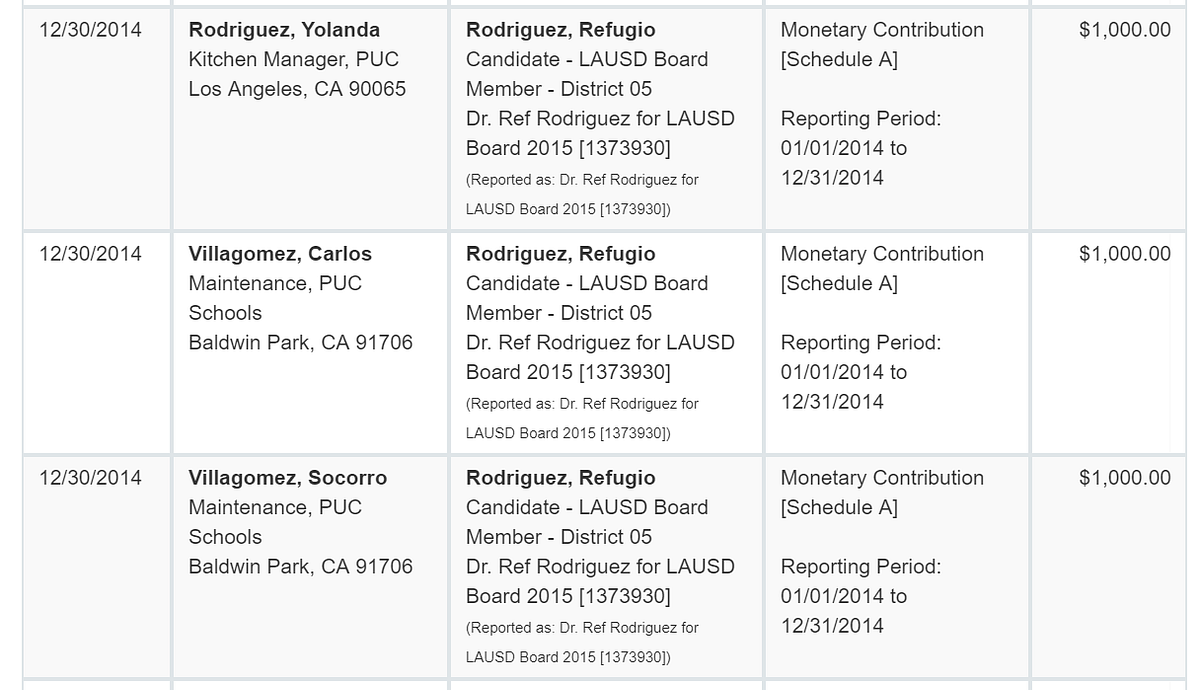
By the time the last vote was counted in the 2015 LAUSD School Board election, it was the most expensive school board race in the history of the country. The impending cost to run for the Board District 5 seat was clear from the beginning when challenger Andrew Thomas loaned his campaign $51,000 during the filing period ending September 30, 2014.  In order to show that he was competitive, charter industry candidate Ref Rodriguez knew that he had to prove that he was also capable of filling his campaign coffers. He ended 2014 showing that he had raised $50,001. The choices that he made in reaching this achievement would eventually lead to him pleading guilty to felony charges and resigning his Board seat in disgrace.
State Superintendent of Education candidate Marshall Tuck made his first donation to the Rodriguez campaign during the December 2014, push. However, his $500 donation was dwarfed by the “$21,000 in campaign donations from employees of his charter school network, Partnerships to Uplift Communities” that were also made in  Continue reading: Marshall Tuck’s Financial Support of Convicted Felon Ref Rodriguez
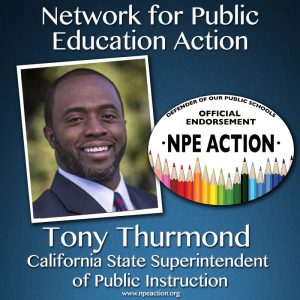
Image result for Tony Thurmond as Superintendent of Public Instruction

A Plan to Improve California's Public Schools

Tony Thurmond for State Superintendent of Public Instruction -https://www.tonythurmond.com/


Stunning New Book Contextualizes Tragedy of 2013 School Closures in Chicago’s Hyper-Segregated History | janresseger

Stunning New Book Contextualizes Tragedy of 2013 School Closures in Chicago’s Hyper-Segregated History | janresseger

Stunning New Book Contextualizes Tragedy of 2013 School Closures in Chicago’s Hyper-Segregated History

Eve Ewing’s new book, Ghosts in the Schoolyard: Racism and School Closings on Chicago’s South Side, explores the blindness, deafness, and heartlessness of technocratic, “portfolio school reform”* as it played out in 50 school closings in Chicago at the end of the school year in 2013. After months of hearings, the Chicago Public Schools didn’t even send formal letters to the teachers, parents and students in the schools finally chosen for closure.  People learned which schools had finally been shut down when the list was announced on television.

Eve Ewing, a professor in the University of Chicago School of Social Service Administration and a former teacher in one of the closed schools, brings her training as a sociologist to explore this question: “But why do people care about these failing schools?” (p. 13)  In four separate chapters, Ewing examines the question from different perspectives: (1) the meaning for the community of the closure of Dyett High School and the hunger strike that reopened the school; (2) the history of segregation in Chicago as part of the Great Migration, followed by the intensification of segregation in thousands of public housing units built and later demolished in the Bronzeville neighborhood; (3) the narratives of community members, teachers, parents and students about the meaning of their now-closed schools in contrast to the narrative of the portfolio school planners at Chicago Public Schools; and (4) the mourning that follows when important community institutions are destroyed.
We hear an English teacher describing the now-closed school where she had taught: “I never considered us as a failing school or failing teachers or failing students. I felt like pretty much everyone in that building was working really hard for those kids…. Trying to push them forward as far as they could go.” (p. 135)
And we hear Rayven Patrick, an eighth grader speaking about the importance of Mayo elementary school at the public hearing which preceded the school’s closure: “Most of my  Continue reading: Stunning New Book Contextualizes Tragedy of 2013 School Closures in Chicago’s Hyper-Segregated History | janresseger


New Jersey: Charter School Situation Under Review, Pro-Charter Folks Wary | deutsch29

New Jersey: Charter School Situation Under Review, Pro-Charter Folks Wary | deutsch29

New Jersey: Charter School Situation Under Review, Pro-Charter Folks Wary


New Jersey education commissioner, Lamont Repollet, is in the process of reviewing the state of New Jersey’s education system. In the meantime, noticeably fewer charter schools are being approved or expanded.
Repollet is trying to assure stakeholders that he is neutral concerning charter schools and that he simply wants “quality schools.” And even though Repollet says that charters in New Jersey are under no “deliberate moratorium,” still, it seems that the NJ charter slowdown has charter advocates on edge.
John Mooney of the NJ Spotlight offers the following summary of the NJ-school-review situation, excerpts of which I offer here:
State Education Commissioner Lamont Repollet is embarking on a review of the state’s burgeoning charter school movement, with an eye on addressing both performance and budget issues in the schools and their host districts. …
In the latest cycle of applications, the administration this month rejected the last of the bids for new charter schools opening next year, after also rejecting five expansions last spring. One new school is opening under a previous cycle of applications, but it is a clear slowdown from former Gov. Chris Christie’s tenure and the state’s explosive growth of charters.

Repollet, at last week’s State Board of Education meeting, sought to assuage questions about the administration’s stance on the controversial schools, specifically saying there was no deliberate moratorium on approvals and the review was only part of a system-wide assessment.
“Before we do anything, we are going to assess the landscape and get feedback from everybody,” the commissioner said. “We are not going to get it  Continue reading: 
New Jersey: Charter School Situation Under Review, Pro-Charter Folks Wary | deutsch29


Wednesday, October 10, 2018

Lack Of Charter School Accountability Was Baked Into the System From the Start | The Range: The Tucson Weekly's Daily Dispatch

Lack Of Charter School Accountability Was Baked Into the System From the Start | The Range: The Tucson Weekly's Daily Dispatch

Lack Of Charter School Accountability Was Baked Into the System From the Start


Note [of exasperation]: I'm beginning to think the Star has a policy: "Never write the words, 'According to an article by Craig Harris in the Republic . . .'" Harris has written a groundbreaking series of articles on charter school corruption and profiteering which has statewide relevance, but to my recollection, the Star hasn't mentioned any of them, nor has it done similar investigations on its own.

Craig Harris has a new article in The Republic that takes another look at the lack of charter school regulation and accountability. Not only does the State Board for Charter Schools conduct minimal charter school oversight, it doesn't acknowledge public complaints about charters on its website. 


For the past three years, each charter school's profile on the site displayed the message: "This charter has no complaints."
According to Harris, the board received 91 complaints during the 2017-18 school year. Two months into this school year, it has already received 141 complaints.

The board's motto: See no evil. Hear no evil. Post no evil.

According to Harris, the website has addressed the problem, though the board has yet to release complaints, which are public records, to the paper.

None of this is recent, or accidental. It's part of a pattern that goes back to charter school beginnings in Arizona. The state charter board has always been more a promoter of charters than a regulator. Here's some historical background.

Lisa Graham Keegan was the state senator who shepherded Arizona's charter school law through the legislature in 1994. She became education superintendent in 1995. While charter schools were sprouting up all over the state, she was cutting the size of the department of education. The staffing went from over 450 employees to 350 in her first year.

The cuts were part of Keegan's overall educational philosophy: cut regulations and accountability for public schools, and keep charters as regulation-free as possible. In an article titled The Continue reading: 
Lack Of Charter School Accountability Was Baked Into the System From the Start | The Range: The Tucson Weekly's Daily Dispatch


Democratic Senators Call For Investigation Into Virtual Charter Schools | HuffPost

Democratic Senators Call For Investigation Into Virtual Charter Schools | HuffPost

Democratic Senators Call For Investigation Into Virtual Charter Schools
Senators say they have questions about student performance and fiscal transparency in the online school systems.


Two Democratic senators asked Wednesday for the Government Accountability Office to launch an investigation into the practices and policies of virtual charter schools. The request comes on the same day the Center for American Progress released a report outlining stark academic shortcomings at these schools and a disproportionate focus on profit over quality.
The virtual charter schools have come under scrutiny in states including California and Ohio. But now Democratic Sens. Patty Murray (Wash.) and Sherrod Brown (Ohio) are calling for a more comprehensive look at how these schools work in the 27 states that house them. About 300,000 students attend these online public schools of choice. The enrollment has been steadily increasing over the years.
“There is almost no research on whether virtual charter schools meet student needs, especially for students who require specific accommodations, including English learners and students with disabilities,” says the letter from the senators.
Brown and Murray are asking the GAO to shed light on issues surrounding student outcomes, school funding and spending, rigor of academic courses, recruitment tactics and the relationship between enrollment growth and student performance. 
The new report from the liberal Center for American Progress is providing a critical look at these schools. It looked at both for-profit virtual charter schools and virtual charter schools that are managed by for-profit companies, focusing on companies like K-12 Inc. and Connections Education. K-12 Inc. has strong ties to Education Secretary Betsy DeVos, who had invested in the company and has championed its brand of school choice. But Continue reading: Democratic Senators Call For Investigation Into Virtual Charter Schools | HuffPost


Tell your legislators to reject online pre-school and support real universal pre-school instead.

Tell your legislators to reject online pre-school and support real universal pre-school instead.

Tell your legislators to reject online pre-school and support real universal pre-school instead.

Click Here To Tell your legislators to reject online pre-school and support real universal pre-school instead.

The profiteers have come up with one more scam to grab public tax dollars--online pre-schools. Tell your legislators that young children need pre-school classrooms with caring teachers and peers.

Click Here To Tell your legislators to reject online pre-school and support real universal pre-school instead.


Network for Public Education Action
Click Here To Tell your legislators to reject online pre-school and support real universal pre-school instead.

LeMya Vaughn completes an activity on her kindergarten readiness program, UPSTART.
Experts call for an end to online preschool programs - https://hechingerreport.org/?p=44036 via @hechingerreport


Our Public Schools, Our Democracy: Our Fight for the Future - https://events.bizzabo.com/NPE18INDY on @Bizzabo

Fifty Years Ago, 35,000 Chicago Students Walked Out Of Their Classrooms In Protest. They Changed CPS Forever. | PopularResistance.Org

Fifty Years Ago, 35,000 Chicago Students Walked Out Of Their Classrooms In Protest. They Changed CPS Forever. | PopularResistance.Org

FIFTY YEARS AGO, 35,000 CHICAGO STUDENTS WALKED OUT OF THEIR CLASSROOMS IN PROTEST. THEY CHANGED CPS FOREVER.

Among Their Demands: Black And Latino Teachers And Administrators, Ethnic Studies Classes And Clubs, And Bilingual Education


It’s 1968 and 18-year-old Pemon Rami, a recent graduate of Wendell Phillips Academy High School, stands in front of the Umoja Black Student Center in Bronzeville. He stares off into the distance, quiet, determined. Behind him, a poster with an illustration of Malcolm X preaches unstinting devotion to radical change, challenging viewers: “He was ready! Are you?”
It’s 2018, and 68-year-old Rami stands before a photo of his younger self. Plenty has changed in those intervening years. A half century has softened his features and grayed his short-cut hair, but his presence remains self-assured. Though his own revolutionary moment has long since passed, he still believes that revolution belongs in the hands of the young. It’s why, after a long career as a playwright and producer and as the director of educational services and public programs at the DuSable Museum of African American History, he now consults with groups such as Peace Warriors of North Lawndale College Prep High School and Fearless Leading by the Youth, hoping to pass along hard-earned lessons to those young people fighting today.
“You get to that point where you’re no longer capable of having the kind of battles that you had when you’re younger,” he explains. “I think it’s important that young people understand that it is their responsibility to be involved. It’s not something you can bargain with.”
But the bonds of solidarity that inspired Rami and his friends to launch a series of student walkouts to protest Chicago Public School’s racist policies—a protest movement that eventually included 35,000 students—live on in every student strike today.
The past five years have seen a wellspring of student activism in Chicago and beyond, actions that hearken back to the unrest that transformed society 50 years ago. In Chicago, it was Mayor Rahm Emanuel’s proposed closing of more than 200 schools in 2012—intended to save $43 million annually—that first sparked resistance among teachers, parents, and students, an energy that carried forward into the Chicago Teachers Union’s successful 2013 strike. In the end, 50 schools, not 200, were closed. (A 2018 study at the University of Chicago found that the closures had had no educational benefits, and CPS has not commented about whether the move did, indeed, save the district money.) In the last year, Englewood students have protested the proposed closure of four neighborhood high schools.
Everything changes, and everything stays the same. As Rami and others look back on their youthful accomplishments, organized actions that resulted in massive concessions from a school system that systematically denied Chicago’s black and Latino youth the resources they needed, they’re all too happy to help today’s youth see the connections that remain between past and present. They’ve been aided in their efforts by CPS educators. Together, they offer a potent reminder of what young people can accomplish.
The 1968 high school walkouts were an expression of growing dissent among the city’s black and Latino student population, and a reflection of a wider climate of protest that permeated society at large. Years of disinvestment by Chicago Public Schools in the education of nonwhite students had created significant barriers for these students: there were few bilingual teachers, and the curriculum didn’t represent their experiences. In 1968 they went on strike, pushing beyond the adult-led actions of previous years and defining their own Continue reading: Fifty Years Ago, 35,000 Chicago Students Walked Out Of Their Classrooms In Protest. They Changed CPS Forever. | PopularResistance.Org

An Analysis of the Performance and Financial Practices of For-Profit, Virtual Charter Schools

Profit Before Kids - Center for American Progress

Profit Before Kids
An Analysis of the Performance and Financial Practices of For-Profit, Virtual Charter Schools


Introduction and summary

California Virtual Academies (CAVA) oversees nine virtual charter schools across the state of California. Virtual charter schools are public schools that provide online instruction. Students complete assignments individually rather than attending a brick-and-mortar school. State tax records and the schools’ charters specify that CAVA schools are independent nonprofit charitable organizations, but these schools are moneymakers for K12 Inc., a publicly traded company and the largest for-profit virtual school provider in the United States. CAVA is a subsidiary of K12 Inc. and its schools run in lockstep with their parent company’s deceptive and harmful business practices.1
K12 Inc. receives substantial scrutiny from the media and advocates given its market share and listing on the New York Stock Exchange. But a growing body of research and national media reports show that, on average, fully virtual schools perform much worse than brick-and-mortar schools serving similar populations.2 For instance, students at CAVA schools significantly underperform the state average. In the 2015-16 school year, the CAVA schools @ Los Angeles’ graduation rate was 66 percent, far below the Los Angeles School District’s average of 92 percent and the state’s average of 84 percent.3
In 2016, then-California Attorney General Kamala Harris announced a court-approved settlement in which K12 Inc. would repay California $8.5 million—$2.5 million for inflated attendance figures and $6 million for costs ensured by the attorney general’s office—regarding aggressive marketing campaigns and inadequate instructional supports. This settlement included no admission of fault, but Harris’s office alleged that K12 Inc. and CAVA used misleading advertising to recruit students even if they were unlikely to be successful in a virtual program.4 Once enrolled, many students did not receive adequate instruction. CAVA instructed teachers to mark a child in attendance if they logged in for at least one minute a day in order to maximize the public dollars allocated to each school.5


These types of concerning outcomes among for-profit virtual charter schools are not unique to California. Schools managed by K12 Inc. nationwide struggle to match student outcomes at other public schools, even as the company’s executives receive multimillion-dollar compensation packages.6 Alex Molnar and others, “Virtual Schools in the U.S. 2017” (Boulder, CO: National Education Policy Center, 2017), available at http://nepc.colorado.edu/files/publications/RB%20Virtual%20Schools%202017_0.pdf.] Rather than address these challenges and rework instructional strategies to improve outcomes, K12 Inc. has misrepresented student performance—leading to shareholders filing multiple lawsuits.7 They have also defended their outcomes, stating that policymakers use “broken” accountability measures to evaluate school performance and their schools serve struggling students.8
Virtual instruction takes many forms: virtual courses supplementing what is available at traditional brick-and-mortar schools, blended schools where students receive substantial instruction online while also having access to face-to-face teacher support, and fully virtual schools with no in-person instruction. The prevalence of all of these types has grown steadily.9

Limited online coursework can fill an important need in public education, especially within secondary schools. For example, 24 states develop their own virtual education content or partner with an outside entity that provides virtual material, in order to offer students greater flexibility to take additional credits.10 These courses can help students make up credits or expand course options in districts or schools where there are not enough students or available staff to teach full classes on specific subjects, such as some languages. In fact, the enrollments in language courses have grown more significantly than any other subject offered among state virtual schools and now account for about 12 percent of all state virtual enrollments.11
Coursework in fully virtual schools usually entails students completing their work alone, at their own pace. Students in fully virtual charter schools interact in real time with a teacher for fewer hours in one week than students in brick-and-mortar schools do in one day.12 Overwhelmingly, research shows that fully virtual schools underperform blended or brick-and-mortar schools.13 Molnar and others, “Virtual Schools in the U.S. 2017”; Miron, Shank, and Davidson, “Full-Time Virtual and Blended Schools.”] Yet the number of students enrolled in fully virtual schools continues to grow. In the 2016-17 school year, virtual schools enrolled an estimated 295,518 students nationwide.14 Of those students, 76 percent—or 223,634—enrolled in fully virtual charter schools.15 Fully virtual public schools and fully virtual charter schools are both public, but virtual charter schools are operated by companies or nonprofits rather than public school districts or the state.

While K12 Inc. is well known as a for-profit company and their schools do not hide their affiliation, many independent virtual charter schools bury their connections to for-profit companies. Many states bar for-profit companies from receiving public education funding, so many of these schools establish nonprofit boards to accept the funds but contract operations Continue reading: Profit Before Kids - Center for American Progress