Latest News and Comment from Education

Friday, June 22, 2018

WATCH: Dem lawmaker plays audio of crying immigrant kids -- as Republican tries to shut him down

WATCH: Dem lawmaker plays audio of crying immigrant kids -- as Republican tries to shut him down

WATCH: Dem lawmaker plays audio of crying immigrant kids — as Republican tries to shut him down


ep. Ted Lieu (D-CA) on Friday took to the floor of the House of Representatives and tried to force his colleagues to listen to audio of wailing immigrant children who had been separated from their parents.
As Lieu took the floor, he brought up a large photo of immigrant children who had been taken from their parents and placed into a detention facility — and he proceeded to tear apart President Donald Trump’s immigration policies.
“If the Statue of Liberty could cry, she would be crying today,” he said. “As I stand here there are 2,300 kids that have been ripped away from their parents by our government.”
Lieu then asked his colleagues to imagine how they would feel if they had their children taken from them without even telling them where they were being held — and then he started to play leaked audio of a child immigrant detention facility obtained by Pro Publica earlier this week.
Rep. Karen Handel (R-GA) then tried to shut Lieu down by information that the rules prohibit “the use of an electronic device to make sounds in the chamber.”
Lieu, however, kept playing the recording, despite her objections, until its completion.
Watch the video below.

Thursday, June 21, 2018

As unions await a key Supreme Court decision, a simple plea: ‘Educators want their voices heard’ - The Washington Post

As unions await a key Supreme Court decision, a simple plea: ‘Educators want their voices heard’ - The Washington Post

As unions await a key Supreme Court decision, a simple plea: ‘Educators want their voices heard’


Across the country, frustrated and fed-up teachers have staged school walkouts to demand fair pay and adequate resources for public schools. One common denominator of these public actions: They occurred in states with laws that weaken unions and their ability to collectively bargain for better wages, benefits and working conditions — which, when it comes to public education, are teaching and learning conditions.
No student should attend schools with overcrowded classrooms that lack desks for every student, that function with textbooks as old as their parents and where the teachers’ salaries do not cover living expenses, forcing them to take second jobs.
Collective bargaining allows employers and employees to forge agreements on the basis of shared interests that address both parties’ priorities and concerns. Without bargaining rights, educators are left with few options to have their voices heard and are forced to take more public actions, such as protesting to lawmakers, to have their priorities addressed.
Any day now, the Supreme Court is expected to release its decision in Janus v. AFSCME Council 31. That ruling could eliminate requirements that workers represented by and benefiting from a union contribute to it financially through “fair-share fees,” depriving unions of funds they need to advocate on behalf of their members, thus weakening unions’ ability to advocate for better teaching and learning conditions.
Our organizations do not see eye-to-eye on all education issues, but we agree that teachers and students lose when teachers don’t have a collective voice to advocate for their profession and their students. Teacher unions give educators voice and ways to influence important issues and policies that directly benefit students, from protecting education funding to supporting teacher development and improving school climate. Education Week’s 2018 Quality Counts data showed that the top 10 states in educational performance have high union density, whereas the bottom 10 states have low density. Data clearly show that students perform better where teachers are more fairly compensated, because higher salaries attract more-qualified people to the profession and help keep them in the classroom.
And while some groups are dedicating millions of dollars to weakening public employee unions, these efforts are out of step with Americans, particularly teachers. A recent Associated Press poll of Americans found that nearly two-thirds approve of national teacher unions. Educators for Excellence recently released the initial findings of a survey of educators from across the country showing that a vast majority of teachers believe teacher unions are essential. The survey found that 85 percent of teachers regard unions as Continue reading: As unions await a key Supreme Court decision, a simple plea: ‘Educators want their voices heard’ - The Washington Post

NPE and Schott Issue a 50 State Report Card on School Privatization - Network For Public Education

NPE and Schott Issue a 50 State Report Card on School Privatization - Network For Public Education

NPE and Schott Issue a 50 State Report Card on School Privatization


This morning the Network for Public Education and the Schott Foundation released  Grading the States: A Report Card on Our Nation’s Commitment to Public Schools, a report that evaluates the extent to which the 50 states and the District of Columbia are funneling public money away from community public schools to privately run charter and voucher schools. The report also measures the consequences of school privatization on students’ civil rights and taxpayers’ rights to know how their dollars are spent.
You can find the report and see where your state stands here.
Grading the States is the first in-depth nonpartisan report card to measure each state’s commitment to democratically governed public schools. It also includes state by state measurement of whether each state’s charter schools and voucher-funded private schools protect student civil rights and guard taxpayers from fraud and the misuse of public funds.
If you scroll down the page you find here you will also see our interactive map.
We need you to help us get this important report out to the public.
Below are some “clickable” tweets that are easy to send.


And here are some memes you can download and use on Facebook or with your Tweets.

Please share this page on social media and let others know about this very important report.
NPE and Schott Issue a 50 State Report Card on School Privatization - Network For Public Education

WATCH: “Things That Make White People Uncomfortable”–Super Bowl champion Michael Bennett in conversation with Jesse Hagopian – I AM AN EDUCATOR

WATCH: “Things That Make White People Uncomfortable”–Super Bowl champion Michael Bennett in conversation with Jesse Hagopian – I AM AN EDUCATOR

WATCH: “Things That Make White People Uncomfortable”–Super Bowl champion Michael Bennett in conversation with Jesse Hagopian

Image result for Super Bowl champion Michael Bennett


Of course we are supposed to score the touchdowns…but at the same time we also are supposed to speak for the people who don’t have a voice.
–Michael Bennett
Last night was one of the more meaningful and and enjoyable evenings of my life.
I had the great honor of joining Super Bowl champion, three time pro bowler, proud feminist, and my good friend Michael Bennett in conversation at a sold out Town Hall Seattle event. In this wide ranging conversation, we talked about the the outspoken players on the Seahawks, Michael reconnecting with his birth mother, his commitment to feminism and intersectionality, his decision to not go on a state sponsored trip to Israel to play in front of Trump and Netanyahu, the N-word, food justice, why he sits for the national anthem, the movement for Black lives, the Las Vegas Police threatening his life, his commitment to education and supporting youth programs, the spiritual awakening he had during his recent trip to Africa, and so much more.
What made this conversation so meaning for me, is that I got to tell him, in front of hundreds of people, how much I’ve learned about leadership, empathy, dedication, and friendship from him.  What made this experience so riveting for everyone there was how raw, vulnerable, wise, and uproariously funny Michael Bennett is.

I Voted for Jill Stein. Was I Wrong? | gadflyonthewallblog

I Voted for Jill Stein. Was I Wrong? | gadflyonthewallblog

I Voted for Jill Stein. Was I Wrong?


On November 8, 2016, I had a heart attack.
That’s not a metaphor.
I went to vote. I went to the doctor. I was sent to the hospital.
How much of that was a result of the Presidential election? I will never know.
But whenever I think back on that day, I am filled with a sense of bone-deep sadness.
After only a little more than a year in office, Donald Trump is already the worst President of my lifetime – and that’s saying something after the disaster that was George W. Bush.
I wish there is something I could do to go back in time and change the results of that day. I wish there was something I could do to stop Donald Trump from being elected President. And though I did not vote for her, I would do anything to have Hillary Clinton defeat him.
On that day, though, I voted for Jill Stein.
jill-stein-green-placard
There’s nothing I can do about that now.
I imagine going back in time and telling myself not to do it. “Go vote for Hillary,” I imagine Future Me telling Continue Reading: I Voted for Jill Stein. Was I Wrong? | gadflyonthewallblog


Wednesday, June 20, 2018

Betsy DeVos’ Deputy Privately Admitted Trump Administration's Idea Could Hurt Kids | HuffPost

Betsy DeVos’ Deputy Privately Admitted Trump Administration's Idea Could Hurt Kids | HuffPost

Betsy DeVos’ Deputy Privately Admitted Trump Administration’s Idea Could Hurt Kids
Candice Jackson indicated she was against rescinding the Obama-era school discipline guidance that protects brown and black children.

One of the Department of Education’s top civil rights appointees said in a private meeting that it isn’t necessary for the Trump administration to rescind school discipline guidance designed to protect black and brown children. 
The appointee, Candice Jackson, also acknowledged that such a move could harm vulnerable kids, according to a document obtained by HuffPost. Still, the guidance remains on the administration’s chopping block.
The Obama-era guidance is supposed to help prevent schools from disproportionately punishing black and brown students. However, in recent months, it has come under fire from the Trump administration and has become a target for rescission.
Jackson, who now serves as second in command at the Department of Education’s Office for Civil Rights, made these comments during a phone conversation in March with representatives from the Southern Poverty Law Center, a civil rights advocacy group. At the time, Jackson was temporarily serving as the highest official in the Office for Civil Rights, an agency that enforces federal civil rights laws in schools. 
In the call with the SPLC, Jackson said much of the opposition to the guidance is based Continue reading: Betsy DeVos’ Deputy Privately Admitted Trump Administration's Idea Could Hurt Kids | HuffPost

UPDATE: Teacher And Civil Rights Groups File Complaint Over Family Separation | HuffPost

Teacher And Civil Rights Groups File Complaint Over Family Separation | HuffPost

Teacher And Civil Rights Groups File Complaint Over Family Separation
“We believe in helping children thrive, not in confining them to heinous, abusive situations,” said the president of the American Federation of Teachers.


Teachers unions and civil rights groups filed a human rights complaint at the United Nations Wednesday morning over the Trump administration’s policy of separating families caught illegally crossing the border. 
The zero tolerance policy designed to deter illegal border-crossing puts parents in jail while their children are placed in detention centers. It resulted in nearly 2,000 children being separated from their parents from mid-April through May. 
Education and civil rights groups have decried the policy as inhumane. In filing a formal complaint with the U.N. Human Rights Council, the nation’s two teachers unions, as well as civil rights groups like the NAACP and the Hispanic Federation, are claiming that the policy violates international treaties such as the International Covenant on Civil and Political Rights and the Convention Relating to the Status of Refugees. Notably, U.S. Ambassador to the United Nations Nikki Haley announced Tuesday that the U.S. was leaving the Human Rights Council, saying that the body has failed to hold abusers of human rights accountable.
“The trauma caused by family separation is heinous under any circumstances, particularly in a civil society centered on family values,” the groups say in the complaint. “It is intolerable and unlawful to separate families who have sacrificed everything to escape the toxic circumstances of their home countries.” 
Randi Weingarten, president of the American Federation of Teachers, told HuffPost that this issue especially resonates with the teachers she represents.
We love children. These kids should actually be in schools and with their parents and with their families, not separated from them,” Weingarten said. “We believe in helping children thrive, not in confining them to heinous, abusive situations.” Read more: Teacher And Civil Rights Groups File Complaint Over Family Separation | HuffPost
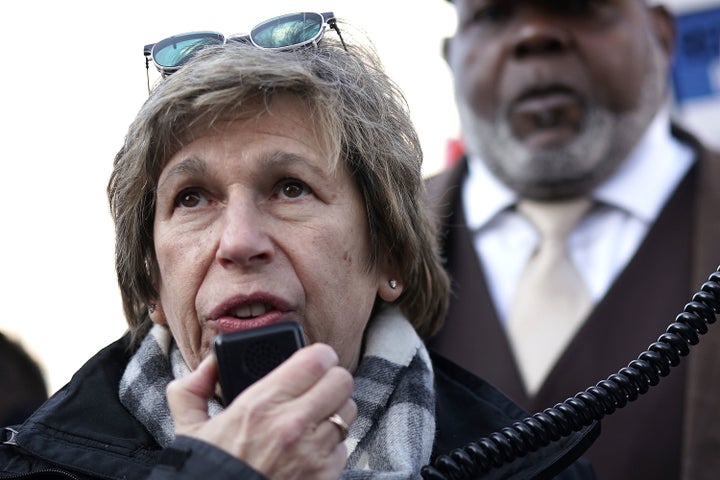
Randi Weingarten serves as president of the American Federation of Teachers, one of the groups that filed a human r
ALEX WONG/GETTY IMAGES Randi Weingarten serves as president of the American Federation of Teachers, one of the groups that filed a human rights complaint at the United Nations over the Trump administration’s policy of separating families at the border.

AFT President Randi Weingarten Responds to Trump Executive Order
American Federation of Teachers - https://www.aft.org/node/12598


WASHINGTON—Statement of AFT President Randi Weingarten responding to President Trump’s executive order following universal condemnation of his policy of ripping children from their families:
“Thank God President Trump caved under the universal public condemnation and outrage over his administration's unconscionable policy of ripping children from families and caging them. To be real, the first step is not tweeting, but reuniting these children who have suffered irreparable harm and trauma along with their parents.
“This struggle for basic humanity is not over—family unification cannot be traded for indefinite family internment or imprisonment. The families seeking asylum are not criminals, they are fleeing near-certain death in their own country and seeking refuge and compassion from our nation.
“The complaint we delivered to the United Nations this morning still stands. These actions still violate basic human rights and have caused deep and traumatic harm. The nations of the world must take action against these immoral and hateful acts by this administration. It has been heartening to see that while Donald Trump’s government may be motivated by a polarizing and dehumanizing ideology, the American people—through their condemnations and outrage—spoke out in ways that could not be ignored. We must continue to speak out and act to protect the values and principles of this nation of immigrants and on which our nation was founded.”

# # # #
The AFT represents 1.7 million pre-K through 12th-grade teachers; paraprofessionals and other school-related personnel; higher education faculty and professional staff; federal, state and local government employees; nurses and healthcare workers; and early childhood educators.
American Federation of Teachers - https://www.aft.org/node/12598

Tuesday, June 19, 2018

Disaster Capitalism Strikes Puerto Rico’s Schools - In These Times

Disaster Capitalism Strikes Puerto Rico’s Schools - In These Times

Disaster Capitalism Strikes Puerto Rico’s Schools
The government’s plan to close 179 public schools and open charters has residents alarmed.


SAN JUAN, PUERTO RICO—It’s Valentine’s Day at Eleanor Roosevelt elementary, and chocolate goodies and Krispy Kreme donuts sit in the back of Axamara PĆ©rez’s classroom. Her first-graders are eager to finish their assignment so they can start the party.
Since Hurricane Maria hit in September 2017, “to get them excited about something, you really have to do a lot,” says PĆ©rez.
It’s almost impossible to forget realities on the island, which include hurricane recovery, a 12-year financial crisis and devastating austerity measures. The island owes bondholders $75 billion, a result of mismanagement and a century under a colonial superpower. To save money, 179 schools have been shuttered, and Puerto Rico Education Secretary Julia Keleher announced in April that a quarter of the 1,100 remaining schools will close this summer.
Morale is low in the Eleanor Roosevelt community, where some students still live without electricity. Letters to parents receive no response, requests for parent-teacher meetings are ignored, homework goes unfinished and teachers feel pressure to keep the school from closing.
“Even though we are trying to get back to normal—emotionally, we are not back to normal,” PĆ©rez says. She has worked at Eleanor Roosevelt for 19 years and is one of the dedicated staff members who have helped keep the school off the closings list. Puerto Rico’s public schools lost 8 percent of their students in the post-hurricane exodus. But Eleanor Roosevelt still has 279 students, well above the threshold of 150 that Keleher suggested could trigger a closure.
Keleher saw in Hurricane Maria what she calls “a real opportunity to press the reset button.” In a sweeping “education reform” plan unveiled by Gov. Ricardo Rosselló on March 29, Puerto Rico is simultaneously opening charter schools. Critics worry the plan will replicate what happened to New Orleans after Hurricane Katrina: With the charterization of that school system, thousands of AfricanAmerican teachers were fired to make way for a predominantly white and inexperienced workforce. Keleher has promised not to lay off permanent teachers, but about a sixth of Puerto Rico’s teachers are on year-to-year contracts. Others worry that their job descriptions will change or they will face long commutes over mountainous roads.
“We are not like books that you move from this school to another school because they need them in another library,” says Noralis Medina, who was transferred when her Continue reading: Disaster Capitalism Strikes Puerto Rico’s Schools - In These Times


If Dems are the party of the people, let's act like it - CNN

If Dems are the party of the people, let's act like it - CNN

If Democrats are the party of the people, let's act like it


(CNN)As leaders of two of the largest unions in the country, we represent more than three million public service workers -- including teachers, nurses and corrections officers, just to name a few. These folks belong to unions to fight for the kitchen table issues that matter to all Americans, union and non-union alike: a living wage, quality health care, public education, a secure retirement and a just and vibrant democracy in the workplace and in America. In other words, our members are part of the fight for the American Dream and a better life for themselves, their families and their communities.
Traditionally, the Democratic Party has supported these issues, and has supported them for everyone -- not just the few at the top.
As at-large members of the Democratic National Committee, we have automatic delegate status (commonly known as superdelegate status) when it comes to picking the party's presidential nominee. In other words, under the current rules, we can pledge our support to any presidential candidate at the Democratic National Convention.
It's a system that the Democratic Party developed over time to ensure that, in the event of a closely divided primary, automatic delegates could step in to make sure the candidate who received the most primary and caucus support would reach the margin of victory, and the party would always emerge from our convention with a clear nominee. It's a system that the Democratic Party developed over time to ensure that members of Congress and other Continue reading: If Dems are the party of the people, let's act like it - CNN

Sunday, June 17, 2018

Nearly 750 charter schools are whiter than nearby district schools

Nearly 750 charter schools are whiter than nearby district schools

Nearly 750 charter schools are whiter than the nearby district schools
Loose laws let scores of charters create policies that favor white students


GREENSBORO, Ga. — This was clearly no ordinary public school.

Parents of prospective students converged on Lake Oconee Academy for an open house on a bright but unseasonably cold March afternoon for northern Georgia. A driveway circling a landscaped pond led them to the school’s main hall. The tan building had the same luxury-lodge feel as the nearby Ritz-Carlton resort. Parents oohed and aahed as Jody Worth, the upper school director, ushered them through the campus. Nestled among gated communities, golf courses and country clubs, the school felt like an oasis of opportunity in a county of haves and have-nots, where nearly half of all children live in poverty while others live in multimillion-dollar lakeside houses.

The school’s halls and classrooms are bright and airy, with high ceilings and oversize windows looking out across the lush landscape. There is even a terrace on which students can work on warm days. After a guide pointed out several science labs, the tour paused at the “piano lab.” The room holds 25 pianos, 10 of them donated by residents of the nearby exclusive communities. The guide also noted that starting in elementary school, all students take Spanish, art and music classes. The high school, which enrolls less than 200 students, has been able to offer as many as 17 Advanced Placement courses.

Stunned, one mother, who was considering moving her family from suburban Atlanta to the area, asked how the school could afford it all. Lake Oconee’s amenities are virtually unheard of in rural Georgia; and because it is a public school, they are all available at the unbeatable price of free.

“It’s where districts and schools decide to spend their money,” Worth, a veteran educator who has also taught in Greene County’s traditional public schools, explained. “Some schools spend their money on overhead. We spend it on students.”

Conspicuously absent from the open house were African-American parents. Of the dozen or so prospective families in attendance, all were white except for one South Asian couple.

At Lake Oconee Academy, 73 percent of students are white. Down the road at Greene County’s other public schools, 12 percent of students Continue reading: Nearly 750 charter schools are whiter than nearby district schools


Walmart Pay to Play: Walton heirs' groups deny role in Georgia governor's race

Walmart heirs' groups deny role in Georgia governor's race

Walmart Pay to Play:  Walton heirs' groups deny role in Georgia governor's race


Representatives of the Walmart company heirs deny any involvement in the Georgia governor’s race after a candidate was secretly recorded saying he backed a school choice law because campaign money from the family’s non-profit foundation was at stake.

Republican Lt. Gov. Casey Cagle admits making the remarks that surfaced in the past week. His campaign issued a statement Friday calling it “old news” that stemmed from a “purely political conversation” Cagle had in his campaign office. Cagle is heard saying he supported a bill in the recent legislative session expanding tax credit vouchers for private schools because millions of dollars in Walton foundation money were at stake in the gubernatorial race.

“The words that Casey used in that secret recording do not reflect his feelings about the legislation that passed. He was a strong supporter and led to pass it,” said Scott Binkley, his campaign manager.

Cagle faces Georgia Secretary of State Brian Kemp in a July 24 runoff vote for the Republican nomination for governor. Both Republican and Democrat officials in the state who support Cagle’s rivals have called for an investigation. State campaign finance reports show Cagle hasn’t received money from Walton family members for his gubernatorial campaign.

The Walton family — through personal campaign contributions, their non-profit private foundation and a political affiliate group — are leading supporters of the charter school movement in America. Charter schools are run privately but get public dollars to educate students whose families choose to enroll them there instead of traditional neighborhood schools. The Waltons are also prominent supporters of giving scholarship vouchers funded by tax credits to students going to private schools.

The foundation is a private non-profit that is legally forbidden from wading into partisan politics because it does its work using tax-exempted dollars. Foundation spokeswoman Daphne Moore said in a statement: “As is the case with any other  Continue Reading:Walmart heirs' groups deny role in Georgia governor's race


Saturday, June 16, 2018

Separating families at the border: Trump sees it as negotiating tactic. #KeepFamiliesTogether #WhereAreTheChildren

Separating families at the border: Trump sees it as negotiating tactic.

Trump Reportedly Ripping Children Away From Parents at Border as Negotiating Tactic


President Donald Trump has claimed to hate the policy that separates families at the border even as some of his top officials say it’s a way to deter immigrants from crossing into the United States. But turns out the commander in chief is moving forward with the practice that the American Academy of Pediatrics describes as causing children “irreparable harm” because it is a good negotiating tactic to give him the upper hand with Democrats, reports theWashington Post. “The president has told folks that in lieu of the laws being fixed, he wants to use the enforcement mechanisms that we have,” a White House official said. “The thinking in the building is to force people to the table.”
Publicly, Trump has pushed the message that Democrats are the ones who have the power to change the policy. “I hate the children being taken away,” Trump said Friday. But, as the Postnotes, using young immigrants as bait to get Democrats to agree to other demands isn’t new for the president. Previously he had tried to use protections for immigrants who were brought to the United States as children to try to get Democrats to agree to his immigration demands Continue reading: Separating families at the border: Trump sees it as negotiating tactic.


Why is Sacramento failing its black students? - Sacramento News & Review - Video 13 CBS Sacramento

Sacramento News & Review - Why is Sacramento failing its black students? - Feature Story - Local Stories - June 14, 2018

Why is Sacramento failing its black students?
Study reveals that Sacramento City Unified School District has suspended more black boys than any other district in the state


Levi Beckwith is too young to remember much about the first time he was kicked out of a classroom. It happened four years ago when he was in preschool at Woodlake Elementary School in the Twin Rivers Unified School District. Now 8, Levi recalls being removed from class a second time that year, though he can’t say why.

His mother, Tyffani Beckwith, remembers both suspensions vividly.
“It was after [Levi] telling his teacher several times that he was being teased and bullied,” Tyffani said.

Levi’s teacher didn’t intervene, his mother says, and Levi resorted to punching his classmate. He was sent home for several days. Later that year, Levi was suspended again, this time for being disruptive, something Tyffani says could’ve been avoided had the school called her.

“He’s in the second grade now,” Tyffani said, looking at her son sitting quietly next to her. “This is the first year of school that he has not gotten suspended—not once.”

Suspensions are frequent in Sacramento County school districts, especially for black boys like Levi.

According to researchers from San Diego State University and University of California, Los Angeles, Sacramento schools disproportionately suspend black boys. The researchers’ new study, “The Capitol of Suspensions: Examining the Racial Exclusion of Black Males in Sacramento County,” revealed that the schools with the worst record are right here in the state capital: The Sacramento City Unified School District has suspended more black boys than any other district in the state—including Los Angeles’ much larger one. Three other local districts are in the undesirable top 20 for disproportionate suspensions.

While the research brief didn’t examine what behavior preceded the suspensions, other studies have shown that black boys are disciplined more harshly than classmates of other races or ethnicities for the same minor transgressions.

“What we find as a pattern is that when black boys do things that are normal, it’s viewed as criminal,” said San Diego State education professor J. Luke Wood, one of the authors of the new report. “When white children do things that are normal, it’s viewed as just that—normal.”

Maybe you’ve heard of the school-to-prison pipeline? This is how it gets built, Wood says: on the backs of little black boys who are told from an early age that they are unfit for society. According to the figures, that message is loudest in Sacramento County classrooms.

Sacramento schools by the numbers
Black boys in the county’s four largest districts—Sacramento City Unified, Elk Grove Unified, Twin Rivers Continue Reading: Sacramento News & Review - Why is Sacramento failing its black students? - Feature Story - Local Stories - June 14, 2018


More Coverage 
Report: Black Male Students Suspended At Highest Rate In Sacramento Schools
CBS Sacramento


Elk Grove Parents Say School Officers Using Excessive Force
This comes at a time when the district is facing a number of issues dealing with race and discrimination against its black student population.