Latest News and Comment from Education

Tuesday, June 13, 2017

Torlakson Announces Statewide Summer Meals Program - Year 2017 (CA Dept of Education)

Torlakson Announces Statewide Summer Meals Program - Year 2017 (CA Dept of Education):

State Schools Chief Tom Torlakson Announces Statewide Summer Meals Program

Image result for big education ape Tom t Torlakson Announces Statewide Summer Meals Program

SACRAMENTO—State Superintendent of Public Instruction Tom Torlakson encourages parents, caregivers, child care organizations, and community groups to take advantage of the Summer Meals Program that provides free meals to children eighteen or younger at local community sites.
“Nutritious meals help a child thrive both physically and mentally,” Torlakson said. “The Summer Meals Program helps to keep kids well-nourished during the summer months so they can return to the classroom prepared and ready to learn.”
The Summer Meals Program begins when school districts end their school year. For a complete list of participating sites, visit the California Department of Education Summer Meals Service Sites Web page.
Summer Meals is part of the Summer Food Service Program, which is a federally funded and state-administered program that operates when schools are closed for at least 15 continuous school days or when year-round schools are off track. The program provide meals to children who qualify for free or reduced-price meals during the school year or who live in areas where at least 50 percent of students are eligible to receive those meals.  
“This program will help feed children in communities where food insecurity is a real issue,” Torlakson said. “Students who live in those areas can receive meals without paperwork. No child is turned away.”
Community celebrations around the state mark the start of the Summer Meals Program. The Sacramento Summer Meals Program kick-off event is Thursday (June 15, 2017) at 11:15 a.m. at the Central YMCA, 2021 W Street, Sacramento, 95818. For details, visit Healthyeating.org.
Image result for big education ape Tom t Torlakson kiss the cook
Tom Torlakson — State Superintendent of Public Instruction
Communications Division, Room 5602, 916-319-0818, Fax 916-319-0100
Torlakson Announces Statewide Summer Meals Program - Year 2017 (CA Dept of Education):

Updated Recommended Literature List Unveiled - Year 2017 (CA Dept of Education)

Updated Recommended Literature List Unveiled - Year 2017 (CA Dept of Education):

State Schools Chief Tom Torlakson Unveils Updated Recommended Literature List

Image result for big education ape Tom t dr seuss

SACRAMENTO—State Superintendent of Public Instruction Tom Torlakson today unveiled an addition of 285 award-wining titles to the Recommended Literature: Prekindergarten Through Grade Twelve list.
“The books our students read help broaden their perspectives, enhance their knowledge, and fire their imaginations,” Torlakson said. “The addition of these award-winning titles represents the state’s continued commitment to the interests and engagement of California’s young readers.”
The Recommended Literature: Prekindergarten Through Grade Twelve list is a collection of more than 8,000 titles of recommended reading for children and adolescents. Reflecting contemporary and classic titles, including California authors, this online list provides an exciting range of literature that students should be reading at school and for pleasure.  Works include fiction, nonfiction, poetry, and drama to provide for a variety of tastes, interests, and abilities.
The additional titles in the Recommended Literature: Prekindergarten Through Grade Twelve list offers an increase in the stories of diverse peoples and lifestyles, giving California’s students the opportunity to engage with works that represent both themselves and others and encourages 21st century literacy that prepares students for career, college and the world beyond high school.
The recent additions also include multilingual authors, which offer students in California more opportunities to celebrate multilingualism and see the contributions of those who speak and write in multiple languages..
Visitors may search the interactive database by author, title, annotation, illustrator, translator, subject, grade span, and language. Local school officials and teachers are encouraged to use this list as a resource in designing standards-based instructional programs.
The Recommended Literature: Prekindergarten Through Grade Twelve list is coordinated by the California Department of Education (CDE) and developed with the assistance of teachers, library consultants from school and public libraries, administrators, curriculum planners, and college professors. For more information about the literature list, visit the CDE Recommended Literature List web page.
Updated Recommended Literature List Unveiled - Year 2017 (CA Dept of Education):

Ravitch: Why is PBS running this education documentary? - The Washington Post

Ravitch: Why is PBS running this education documentary? - The Washington Post:

Ravitch: Why is PBS running this education documentary?


If you go to the website of the Cato Institute, a libertarian think tank in Washington that believes in privatizing the public education system, you will learn about a three-part documentary called “School Inc.,” which is narrated by the late director of the organization’s Center for Educational Freedom. The documentary has been called the magnum opus of Andrew Coulson, who was a researcher and author who promoted the idea that free markets and the profit motive would improve education in the United States. Coulson called traditional public schools “government-run” and was a strong proponent of school tax credit programs that use public money to fund private education.
It is no surprise, then, that School Inc. — whose primary funders have the same educational beliefs as Coulson — would extol the virtues of privatized education and attack public education. What is surprising to some public education activists, however, is that the documentary is being shown on publicly funded PBS stations.
Diane Ravitch, the education historian and former assistant secretary of education who became the titular head of the movement fighting corporate school reform and the privatization of the public education system, watched the documentary and wrote in the following piece that viewers will not get anything close to a balanced view of the education reform debate in the country and around the world.
A PBS spokesman said in an email (you can see the full response below) that the network stations “offer programs that reflect diverse viewpoints and promote civic dialogue” and that School Inc. is “an independent production that reflects the personal viewpoint of series creator Andrew Coulson.”


It also said that PBS has “high editorial standards” that ensure “that the creative and Ravitch: Why is PBS running this education documentary? - The Washington Post:


What the NEA probably wouldn’t want you to know about “personalized” learning in Boone County, KY. – Wrench in the Gears

What the NEA probably wouldn’t want you to know about “personalized” learning in Boone County, KY. – Wrench in the Gears:

What the NEA probably wouldn’t want you to know about “personalized” learning in Boone County, KY.


Just weeks before the 2017 Annual Meeting opens in Boston, an article from NEA TodayAs More Schools Look to Personalized Learning, Teaching May Be About to Change, makes it clear NEA’s top leadership prioritizes digital curriculum over the right of a student to be educated without data mining and to have unconditional, full time access to a human teacher. For those familiar with NEA’s and AFT’s partnership with Ed Reform 2.0 interests on the Education Reimagined initiative this comes as no surprise, though seeing the propaganda in print is still jarring. If you’re NOT aware of this partnership, stop and read Emily Talmage’s Anatomy of a Betrayal now. Oh, and later check out the NEA’s 2011 Policy Brief in support of blended learning. Here Tom Vander Ark notes the content of the brief is largely drawn from the work of Clayton Christensen’s reformy Innosight Institute.
The general rule for ed-activists is to never, ever read the comments, though I encourage you to make an exception in this case. Over fifty heartfelt statements against digital curriculum have been logged thus far, though you should be aware that at least four other comments were posted and subsequently removed by the site administrator. One was from Emily Talmage and included a link to Anatomy of a Betrayal. Another was from a former NEA member and midwestern teacher “NEA’s motto-destroying public education from within.” A Connecticut teacher and NEA member wrote “What a deceptive article – shame on NEA Today.” And the fourth was submitted by Massachusetts Teachers Association member Mary Porter.
Mary’s comment included the full text of New Business Item 6, MTA Opposes the MAPLE / LearnLaunch Partnership with Massachusetts DESE. The NBI was approved at the state meeting of the Massachusetts Teachers Association on May 20, 2017, and as far as I am aware it is the first What the NEA probably wouldn’t want you to know about “personalized” learning in Boone County, KY. – Wrench in the Gears:

Where is Claudia Rueda? - Lily's Blackboard

Where is Claudia Rueda? - Lily's Blackboard:

Where is Claudia Rueda?


For more than two weeks last month, she was not in her classroom at Cal State Los Angeles. She was not at the UCLA Labor Center, where she has been awarded a prestigious summer fellowship. And she was not volunteering, as per usual, with on-campus community groups like the Immigrant Youth Coalition.
Instead, this promising student, this young woman who has filled her heart with love for her community, sat inside Otay Mesa Detention Center in San Diego, while her teachers and classmates protested outside.
Tell me. What good does is it do for our country to deny Claudia the opportunity to learn? Are we safer when she’s removed from the classroom? Should we sleep better at night because her voice is silenced?
Claudia is 22, and she has lived in this country since the age of 4. She qualifies for DACA (Deferred Action for Childhood Arrivals) and would have the protection from deportation that it offers, except that she couldn’t afford the application. Her mother’s wages from her bakery job barely cover Claudia’s college tuition.
(Side note: It was not that long ago that tuition to the California State University was free. Those were years when the state invested in the future of its students because leaders saw the public good in providing a higher education to everybody who wanted it. It is no coincidence, as my sisters in the California Faculty Association have pointed out, that state funding has declined and tuition has been raised, as the student population has grown more diverse.)
Today, I am struck by the timing of Claudia’s detention. This week marks the 35th anniversary of Plyler vs. Doe, the Where is Claudia Rueda? - Lily's Blackboard:

What Is Personalized Learning? | Truth in American Education

What Is Personalized Learning? | Truth in American Education:

What Is Personalized Learning?


I had a conversation today about personalized learning with an education reporter. It is not something we’ve focused on here, but it is part of the next wave of education reform, so it is something that I know I need to keep my eye on. Some initial thoughts….
My first thought is that it sounds good because who would not want to tailor education to the particular learning style of a student. That is what my wife and I (mainly my wife) do as homeschooling parents.
Second, what does it mean? Here we have another catchphrase bandied about where the true meaning is not what most people think of. Remember “rigor” and “college-and-career-ready” these sound good, but what is meant? We’ve discovered that “rigor” is a meaningless term as applied to Common Core, and “college-and-career-ready” is a catchphrase for the workforce development shift in public education that has moved us further away from classical education.
Third, who benefits the most from this change in education? Students or curriculum developers?
Fourth, is this something that can realistically be accomplished within public education? What are the consequences?
Underground Parent has a primer on personalized learning that I think is helpful.
They bring up some concerns that we should consider like its current dependence on technology:
Big data demands, adaptive learning software use, the move to mobile device use, and embedded assessments all come into play with Personalized Learning, requiring and 
What Is Personalized Learning? | Truth in American Education:


Children Express Fears of Deportation in Comics

Children Express Fears of Deportation in Comics:

Children Express Fear of Deportation in Hand-Drawn Comics


The hardline stance on immigration has struck fear and anxiety in students and their families across the U.S. They hear about “the wall” on the news or from other kids. They are told what to do if their parents don’t come home from work and who to call for help. They are aware that when someone knocks on the door they are not to answer, and they are afraid.
These fears were revealed in a recent Philadelphia workshop by a group of about 30 children of Mexican descent. They expressed their feelings in comics – a medium that the kids were already fans of and that offered a way in.
The workshop is part of an ongoing writing program of Mighty Writers, a Pennsylvania nonprofit whose mission is to help kids think and write clearly. Run by Mexican artist, writer and activist Nora Litz, the workshop was called “Illustrated Migration Stories” and the kids’ assignment, completed over seven recent Saturdays, was to tell their family’s story. Most of them focused on their immigration status and their fears about what it meant for their future.
“What’s happening with immigration right now is pretty stressful for anyone, let alone kids,” says Mighty Writers founder Tim Whitaker. “We wanted to use art to allow the kids to tell us what’s on their mind. Right away we noticed how relieved they were to verbalize this stuff. We saw them from being afraid to being more confident about who they are and how they feel about themselves and their situation. They were empowered by the process.”
Some of the comics are pictured below. If you want to participate in a workshop or Children Express Fears of Deportation in Comics:

John Thompson: Sexual assault in schools: Report praises Norman - NonDoc

Sexual assault in schools: Report praises Norman - NonDoc:

Sexual assault in schools: Report praises Norman


We Oklahomans need to take the time to look at ourselves the way that the rest of the nation does. Recent high-profile stories in the New York Times, the Washington Post, the Associated Press and National Public Radio reveal the worst and the best of our state.
The latest special report by the AP and NPR’s Reveal focused on an important success. Even better, it was Oklahoma students who drove the effort to right a wrong that has long been ignored.
Schoolhouse Sex Assault, the Associated Press’ year-long special investigation of state and federal records, found “roughly 17,000 official reports of sex assaults by students … from fall 2011 to spring 2015.” This figure undoubtedly underestimates the “hidden horror” of sexual abuse.
Oklahoma was cited in the concluding NPR report, which described what works in protecting kids. It recalled the 2014 case at Norman High School where:
Three girls said that after they reported being assaulted, they were 
Sexual assault in schools: Report praises Norman - NonDoc:

Proficiency-Based Learning: Focused on Skills While Missing the Big Picture

Proficiency-Based Learning: Focused on Skills While Missing the Big Picture:

Proficiency-Based Learning: Focused on Skills While Missing the Big Picture

Image result for can't see the forest for the trees
…tests are now broken down into specific sets of skills so teachers can identify how well students understand each task. When students get less than a proficient score, they must go back and study the skill they missed. They are then given a chance to retake the relevant portions of the test until they earn a satisfactory score.
English department head Elizabeth Vigue was quick to point to the biggest change her team had to make: giving up nearly every novel on their syllabus.
Teaching skills isn’t a new phenomenon.
Proficiency-based learning is sweeping schools in the State of Maine and the rest of the country. Blazing a trail? Teachers have always taught skills—even on the computer.
Years ago, I periodically took my high school students to the Plato lab to work on skills. Before computers, teachers reviewed skills with worksheets. Remember dittos and the old mimeograph machines?
In his 1999 The Schools Our Children Deserve: Moving Beyond Traditional Proficiency-Based Learning: Focused on Skills While Missing the Big Picture

Diane Ravitch: PBS Runs A Three-Hour Series Glorifying The DeVos Education Agenda | HuffPost

PBS Runs A Three-Hour Series Glorifying The DeVos Education Agenda | HuffPost:

PBS Runs A Three-Hour Series Glorifying The DeVos Education Agenda

Funded by conservative foundations devoted to privatization, this program is the definition of paid propaganda.


Public education today faces an existential crisis. Over the past two decades, the movement to transfer public money to private organizations has expanded rapidly. The George W. Bush administration first wrote into federal law the proposal that privately managed charter schools were a remedy for low-scoring public schools, even though no such evidence existed. The Obama administration provided hundreds of millions each year to charter schools, under the control of private boards. Now, the Trump administration, under the leadership of Secretary of Education Betsy DeVos, wants to expand privatization to include vouchers, virtual schools, cyberschools, homeschooling, and every other possible alternative to public education. DeVos has said that public education is a “dead end,” and that “government sucks.”
DeVos’s agenda finds a ready audience in the majority of states now controlled by Republican governors and legislatures. Most states already have some form of voucher program that allow students to use public money to enroll in private and religious schools, even when their own state constitution prohibits it. The Republicans have skirted their own constitutions by asserting that the public money goes to the family, not the private or religious school. The longstanding tradition of separating church and state in K-12 education is crumbling. And Betsy DeVos can testify with a straight face that she will enforce federal law to “schools that receive federal funding,” because voucher schools allegedly do not receive the money, just the family that chooses religious schools.
Advocates of the privatization movement like DeVos claim that nonpublic schools will “save poor children from failing public schools,” but independent researchers have recently concurred that vouchers actually have had a negative effect on students in the District of Columbia, Indiana, Louisiana, and Ohio. Charters, at best, have a mixed record, PBS Runs A Three-Hour Series Glorifying The DeVos Education Agenda | HuffPost:
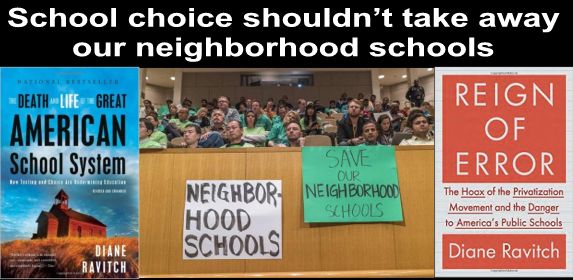
Image result for big education ape diane reign of error life and death

Good news: There is an answer to the shortage of black and brown teachers - The Hechinger Report

Good news: There is an answer to the shortage of black and brown teachers - The Hechinger Report:

Good news: There is an answer to the shortage of black and brown teachers
If you could only see them, right under your noses

Ysupposed teacher shortage crisis is really an inability to cultivate black and brown talent that’s right in front of us in local classrooms.
ou reap what you sow when it comes to developing teachers. And overrepresentation of white teachers in public schools should make clear what current teacher preparation programs are built to yield. The 
The majority of students in public schools are minority but only 18 percent of teachers are people of color. That’s not by choice: In urban school districts, just like in suburban and rural ones, communities have students who aspire to be teachers. Call it what you will — racism, unconscious bias or color blindness — but understand that black and brown local students aren’t seen as potential teachers and that teachers of color work in conditions that discount them.
As a response to a lack of community representation in local schools, educators are looking to grow-your-own (GYO) programs — the latest jargon relating to recruiting and retaining local teachers — which attempt to address the failure to recruit and retain local teachers, who are in plain sight. Some programs are connected to universities, like Pathways2Teaching with the University of Colorado Denver. Others such as GYO Illinois are nonprofits that have university affiliations but are much more connected to the communities they serve.
GYO programs make educational, political and economic sense. Study after study has shown that students are likelier to learn from someone who looks like them, a neighbor rather than a stranger. A pale male teaching biology in a broad Boston accent may not inspire a black kid with a New Orleans drawl to follow in his footsteps. While there are certainly black teachers and leaders who have negative views of black children, research consistently shows that black teachers have higher expectations of them, which is a kind of a buffer for injustice. Teachers are also important members of the middle class and have influence in local politics, both pressing needs in Good news: There is an answer to the shortage of black and brown teachers - The Hechinger Report:

Gov. Brown agrees not to hold back money from California schools next year | EdSource

Gov. Brown agrees not to hold back money from California schools next year | EdSource:

Gov. Brown agrees not to hold back money from California schools next year


California school districts won’t have to wait an extra year to get nearly $1 billion in one-time funding, as Gov. Jerry Brown proposed last month. And after-school and summer program providers will see their first funding increase in more than a decade, under the terms of the 2017-18 state budget that legislative leaders and the Brown administration negotiated last week.
The Legislature must pass the proposed $126 billion state budget by Thursday to meet a constitutional deadline. Schools and community colleges will get a sizable share of the funding increase. Funding under Proposition 98, the formula that determines K-12 and community colleges’ share of state revenue, will rise $3.1 billion – 4.4 percent – to $74.5 billion. School districts’ share of the increase will be $2.8 billion.
In his revised May budget, Brown proposed giving schools about $600 million more than the minimum funding that Prop. 98 required, but he called for withholding $1 billion in one-time funding until May 2019 to make sure that revenue projected for next year actually comes in. Brown, who has long warned a recession is imminent, said it would be better to wait than to retroactively cut school funding in the middle of the year.
But Assembly and Senate budget negotiators didn’t like that idea any more than education groups, which said thatGov. Brown agrees not to hold back money from California schools next year | EdSource:

Celebrate Tuesday with Diane Ravitch's blog | A site to discuss better education for all

Diane Ravitch's blog | A site to discuss better education for all:

Celebrate Tuesday with Diane Ravitch's blog 
A site to discuss better education for all


Image result for big education ape Diane


Steven Singer: Did the NEA Just Endorse Depersonalized Learning?

Steven Singer, like many other teachers, was stunned to see an article published by NEA that lauds the rise of technologies that replace teachers. This is what is known on this blog as “depersonalized learning.” When I wrote “The Death and 

Gary Rubinstein: Teach for America Is Training Recruits at a “Failing School” in Houston

Gary Rubinstein was a member of Teach for America who has become an articulate critic of the organization. He objects to the use of the term “failing school,” because he has worked in schools with dedicated staff that were labeled “failing” based on test scores alone. He notes that TFA has benefitted by the use of this term because it sets up for closure, allowing charter schools and TFA to ride
PBS Runs Three-Hour Special Promoting the DeVos-Trump Privatization Agenda

I wish that everyone who sees the PBS program “School Inc.”–which airs nationally this month–knew who was funding this error-ridden attack on public education. Please watch my 10-minute interview with New York City’s PBS affiliate, WNET, where I gave a concise response to this meretricious three-hour program. It airs locally, not nationally. Public education today faces an existential crisis. Ove
DeVos Taps School Choice Advocate for Crucial Position in ED Department

Betsy DeVos has chosen Jim Blew, who is a veteran of the privatization movement, for one of the most important positions in the Department of Education. From Education Week: “Jim Blew, the director of Student Success California, a 50CAN affiliate, is a top contender to lead the office of planning, evaluation, and policy analysis at the U.S. Department of Education, multiple sources say. “Blew dec
The 96 Billionaires Who Decided to Buy Local School Board Elections

In this latest episode of the “Have You Heard” podcast, Jennifer Berkshire and education historian Jack Schneider interview Michigan professor Rebecca Jacobsen about the role of big money in school board elections . Jacobsen has studied this relatively new phenomenon and identified 96 super-rich individuals who have decided that buying local school boards is fun. Others would call it the corrupti
Virginia: NPE Action Fund Endorses Northam for Democratic Candidate for Governor

After careful deliberation, the Network for Public Education Action Fund endorses Lt. Governor Ralph Northam in the Democratic Party run-off for Governor of Virginia. We were impressed by his strong support for public schools.

YESTERDAY

Success Academy, Known for Harsh Discipline and Skimming Students, Wins Broad Prize

Eva Moskowitz’s Success Academy charter chain, known for its harsh discipline and cherryocking students, won the Broad Prize for Charter Schools. http://mobile.edweek.org/c.jsp?cid=25920011&item=http%3A%2F%2Fapi.edweek.org%2Fv1%2Fblog%2F129%2F%3Fuuid%3D72531 In the past year, the New York Times ran stories about a “got to go” list, identifying students who were supposed to be pushed out because o
How Jared Kushner’s Daddy Bought Him a Spot at Harvard

In 2006, reporter Daniel Golden wrote a book called “The Price of Admission” about how uber-rich families buy places for their children at elite colleges. In this article published in ProPublica , Goldren says that the Kushner story was included in his book. He never dreamed that the Jared Kushner story would one day be a big deal. He writes: “My book exposed a grubby secret of American higher ed
Tom Ultican: Credit Recovery and the Farce of Rising Graduation Rates

Tom Ultican left the private sector to teach physics and mathematics in a California public school. He writes here about how setting targets for graduation rates has produced the same corruption as NCLB’s mythical target of 100% proficiency on tests. It is the inexorable workings of what is known as Campbell’s Law in social science: “The more any quantitative social indicator is used for social d
Kipp Dawson: Our Fight for Public Schools is a Fight for Social Justice

In my travels these past few years, one of the most remarkable people I met was Kipp Dawson in Pittsburgh. She is a middle school teacher who is dedicated to her work and her students. She is a warrior for social and economic justice. Before she became a teacher, she spent ten years as a coal miner. I knew about her before I met her and expected to meet an Amazon. But Kipp is diminutive in size w
William Mathis: Trump’s Budget is a Model of Doublespeak and Indifference to Children

William Mathis describes Trump’s education budget as a demonstration of Doublespea k, meant to mask its indifference to children. He writes: “In 1965, the federal government, driven by the obligation to provide equal opportunities to the least fortunate of our citizens, passed the Elementary and Secondary Education Act. It was intended to lift the nation by strengthening our poorest children and


Teacher Reports on Child Abuse in Kindergarten in Ohio

A comment by a teacher: “Young students in kindergarten are now labeled as having specific learning disabilities if they do not receive a certain score on district universal screeners(STAR, iReady, MAP), which are taken on computers. 
Diane Ravitch's blog | A site to discuss better education for all: