Latest News and Comment from Education

Monday, June 12, 2017

CURMUDGUCATION: NEA Whiffs Again

CURMUDGUCATION: NEA Whiffs Again:

NEA Whiffs Again


Back in the day, NEA leadership should have picked up a clue that they'd backed the wrong horse when they published this article in 2013. "10 Things You Should Know About the Common Core" included such notable observations as "Most NEA Members Support the Common Core," and while you might get a chuckle out of the rest of the list, the real harbinger is in the long, blistering comments section. The average NEA Today article does not exactly draw large or lively response, but this piece drew 325 rather angry comments asking what, exactly, that author was smoking. NEA was either ignorant of or deliberately trying to rope in the large number of anti-Core members.

The author was Tim Walker, and last week he offered a look at personalized learning, and once again NEA either doesn't get it or is trying to stick it to members.


As with NEA support for the Core, Walker starts the article by implicitly accepting that current schools (you know-- the ones where NEA members work) pretty much suck. Too many students sitting in regimented rows memorizing things and listening to teacher lecture. It's a simplistic and reality-impaired view of what's actually going on in classrooms, and it raises more questions than it addresses (e.g. If the classrooms are too full, why aren't we calling for smaller classrooms? Also, if Common Core was going to fix exactly these problems, why aren't they fixed?) He visits a happy personalizing school at East Pennsboro Area Middle School in Enola, PA. 

Best of all, the lifeless classroom setups are gone, and learning spaces have been reconfigured with moveable furniture and walls so that when classroom subjects overlap, teachers can combine 
CURMUDGUCATION: NEA Whiffs Again:

Where do Virginia’s Democratic gubernatorial candidates stand on school choice and other education issues? - The Washington Post

Where do Virginia’s Democratic gubernatorial candidates stand on school choice and other education issues? - The Washington Post:

Where do Virginia’s Democratic gubernatorial candidates stand on school choice and other education issues?


Governors have a great deal to say about public education in the states they run, but voters don’t often cast their ballots with education as a prime issue. In Virginia, however, there are plenty of people interested in the education views of the two candidates in Virginia’s Democratic primary for governor — Ralph Northam, the lieutenant governor of the state, and Tom Perriello, a former one-term congressman and diplomat in President Barack Obama’s administration.
On a number of issues, the two have similar if not identical views. Both say they want to:
— focus their education policy efforts on improving traditional local school districts.
— implement state-funded universal prekindergarten programs.
— raise teacher salaries in a state where educators on average make less than the national average.
— improve the Standards of Learning, the state’s standards and series of standardized tests used for accountability purposes. Virginia is one of the handful of states that did not adopt the Common Core State Standards even when the Obama administration was dangling federal funds to persuade state authorities to do so.


— break the “school to prison” pipeline, given that one 2015 report showed Virginia leading Where do Virginia’s Democratic gubernatorial candidates stand on school choice and other education issues? - The Washington Post:
 Image result for big education ape dfer

Related image

Nothing abstract about the lessons of play By Wendy Lecker - Wait What?

Nothing abstract about the lessons of play By Wendy Lecker - Wait What?:

Nothing abstract about the lessons of play By Wendy Lecker

Image result for big education ape teacher in the box virtual preschool

Last week, The New York Times unwittingly provided an example of how bad education policy is made. A front-page article trumpeted “Free play or flashcards? A new study nods to more rigorous preschools.”
The study the article featured purportedly proved that frequent, direct instruction of “academic” content in preschool yielded more “cognitive gains” than play-based preschool. The study even contended that preschools that do not engage in enough direct academic instruction “may be doing their young charges a disservice.” The study’s author, Bruce Fuller, denigrated play, declaring that “(s)imply dressing up like a firefighter or building an exquisite Lego edifice may not be enough.”
However, Fuller’s study did not prove that “academically oriented” preschools help children learn better.
The study showed simply that children who were exposed to instruction regarding phonics, simple writing and counting manipulatives frequently in preschool, and then were tested on these discrete skills near the beginning of kindergarten, did better on those tests than children who were not exposed at all or as frequently to this instruction.
Of course if one instructs a child on something and tests her on it soon Nothing abstract about the lessons of play By Wendy Lecker - Wait What?:
Image result for Free play

Seattle Schools Community Forum: On "Red-shirting" Kindergarteners

Seattle Schools Community Forum: On "Red-shirting" Kindergarteners:

On "Red-shirting" Kindergarteners

Image result for On "Redshirting" Kindergarteners

Several readers had some thoughts on this practice of holding back a child to enter kindergarten much later than at age five. 

I came across a couple of good articles on this topic I wanted to pass along.

From the Bright blog, Everything You Need to Know about "Redshirting"


Kindergarten’s role as “the new first grade” was further cemented when — beginning in the mid-1970s — many states began to raise their cutoff dates, resulting in a consistently older pool of students, and consequently raising teachers’ expectations for behavior and learning skills.

Is redshirting effective?

Researchers have found varied results. While some studies assert that younger students are more likely to underperform on standardized tests, and that older students may fare better academically or take on more leadership roles, a number of other studies have demonstrated the opposite. In 2006, one comprehensive study noted that adult students who had been 
Seattle Schools Community Forum: On "Red-shirting" Kindergarteners:

Nonprofit sues Education Dept. for release of information on campus sex-assault investigations - The Washington Post

Nonprofit sues Education Dept. for release of information on campus sex-assault investigations - The Washington Post:

Nonprofit sues Education Dept. for release of information on campus sex-assault investigations


The National Women’s Law Center filed suit Monday against the Education Department in an effort to force the release of information about federal enforcement of Title IX, a law that governs how schools handle campus sexual harassment and assault.
In a complaint filed in the U.S. District Court for the District of Columbia, the D.C.-based nonprofit group alleges the department has wrongfully failed to release public records that should have been released by now under the Freedom of Information Act (FOIA).
The Law Center argues that the information is important for understanding how the Trump administration is approaching Title IX enforcement — especially given that Education Secretary Betsy DeVos has declined to say whether she intends to uphold or withdraw controversial guidance to schools and colleges on sexual harassment and sexual violence issued during the administration of President Barack Obama.
“Without the release of these documents, students, families, and advocates are kept in the dark about whether the department is enforcing legal protections for student survivors of Nonprofit sues Education Dept. for release of information on campus sex-assault investigations - The Washington Post:

Success Academy, Known for Harsh Discipline and Skimming Students, Wins Broad Prize | Diane Ravitch's blog

Success Academy, Known for Harsh Discipline and Skimming Students, Wins Broad Prize | Diane Ravitch's blog:

Success Academy, Known for Harsh Discipline and Skimming Students, Wins Broad Prize

Eva Moskowitz’s Success Academy charter chain, known for its harsh discipline and cherrypicking students, won the Broad Prize for Charter Schools.
In the past year, the New York Times ran stories about a “got to go” list, identifying students who were supposed to be pushed out because of their behavior or test scores.
Image result for big education ape eva moskowitz  “got to go” list,
There was also a prominent page-one story about a leaked video showing a teacher at SA humiliating a first-grade child and ripping her paper up in front of the class.
According to the press release, former Secretary of Education John King, a member of the selection committee for Broad, landed the choice and said that Success Academy proved it was possible to give high-quality to “every child.” He meant “every child” except those with disabilities, English language learners, nonconformists, and others who can’t or won’t produce high test scores.
“Success Academy is intentional about delivering quality instruction and offering well-rounded, hands-on learning experiences to every child,” said former Education Secretary John B. King Jr., who’s now president of the nonprofit, The Education Trust, and a member of the Broad Prize’s review board.
“These charter schools understand the benefit of a diverse educational community, with children of different socioeconomic status, race, and background all learning together,” he said.”Success Academy, Known for Harsh Discipline and Skimming Students, Wins Broad Prize | Diane Ravitch's blog:
Image result for big education ape eva moskowitz  “got to go” list,

Why giving grades destroys education--Aleteia

Standardized testing and education--Aleteia:

Why giving grades destroys education

Kids deserve better than to have their education turned into a contest.

Image result for Kids deserve better than to have their education turned into a contest.


 chool’s out for summer, which means I can finally be honest about something that’s been bugging me all year long: grades.

Grades are terrible for children. They’re terrible for all children, whether they struggle in math like my oldest or they excel in spelling like my youngest. They’re terrible for a million reasons, but the primary one is because they turn education into a contest.
Scary Mommy had a post up recently that expressed the unease around grading that’s beginning to circulate among parents. Author Meredith Ethington, herself a former honor roll student, said:
“It’s not that I don’t care about the grade. I do. But I think sometimes the emphasis we are putting on our kids getting straight A’s is setting them up for lofty expectations that just aren’t realistic for some kids. Not everyone excels in all areas. We all have our strengths and weaknesses. Not everyone is meant to be an honor roll student. I firmly believe that.”
This is true, but it’s just the tip of the iceberg. Grades are an utterly terrible way to monitor what a child has or hasn’t learned. I get that they’re convenient and simple, but like all convenient and simple things, they cause more harm than good.
Grades measure performance. Like standardized tests, grades reflect how well a student was able to perform — on tests, mostly, but also projects, homework, even class conversation.
What they don’t measure is how much a student understands. In high school, I spent countless afternoons in private tutoring for trig and pre-calculus. I did not care about those subjects — I used (and still use) my Standardized testing and education--Aleteia:

Key facts about race and marriage in the U.S. | Pew Research Center

Key facts about race and marriage in the U.S. | Pew Research Center:

Key facts about race and marriage, 50 years after Loving v. Virginia


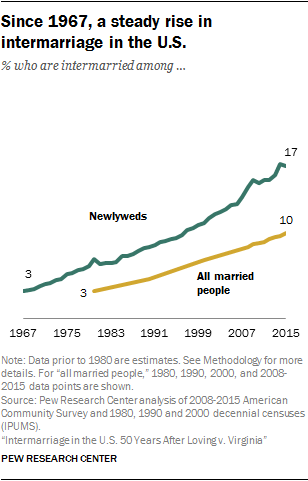
In 1967, the U.S. Supreme Court ruled in the Loving v. Virginia case that marriage across racial lines was legal throughout the country. Intermarriage has increased steadily since then: One-in-six U.S. newlyweds (17%) were married to a person of a different race or ethnicity in 2015, a more than fivefold increase from 3% in 1967. Among all married people in 2015 (not just those who recently wed), 10% are now intermarried – 11 million in total.
Here are more key findings from Pew Research Center about interracial and interethnic marriage and families on the 50th anniversary of the landmark Supreme Court decision.
1A growing share of adults say interracial marriage is generally a good thing for American society. Nearly four-in-ten adults (39%) say the growing number of people marrying someone of a different race is good for society, up from 24% in 2010. Adults younger than 30, those with at least a bachelor’s degree and those who identify as a Democrat or lean Democratic are especially likely to say this.
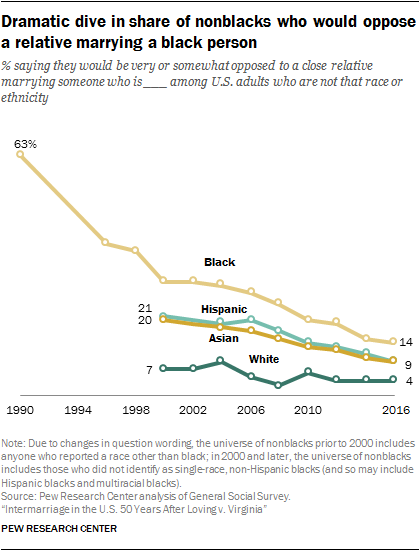
Americans today also are less likely to oppose a close relative marrying someone of a different race or ethnicity. Now, 10% say they would oppose such a marriage in their family, down from 31% in 2000. The biggest decline has occurred among nonblacks: Today, 14% of nonblacks say they would oppose a close relative marrying a black person, down from 63% in 1990.
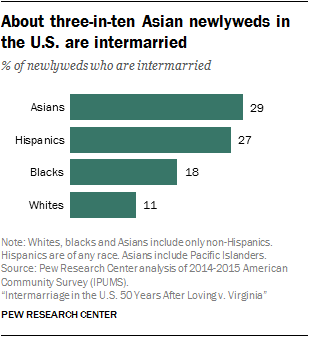
2Asian and Hispanic newlyweds are the most likely to be intermarried. Nearly three-in-ten Asian newlyweds (29%) were married to someone of a different race or ethnicity in 2015, as were 27% of Hispanic newlyweds. Intermarriage for these groups was especially prevalent among the U.S. born: 39% of U.S.-born Hispanics and almost half (46%) of U.S.-born Asian newlyweds were intermarried in 2015.
Although Asian and Hispanic newlyweds are most likely to be intermarried, overall increases in intermarriage have been driven in part by rising intermarriage rates among black and white newlyweds. The most dramatic increase has occurred among black newlyweds, whose intermarriage rate more Key facts about race and marriage in the U.S. | Pew Research Center:

Black Girls Matter: Pushed-Out, Overpoliced and Underprotected | Schott Foundation for Public Education

Black Girls Matter: Pushed-Out, Overpoliced and Underprotected | Schott Foundation for Public Education:

Black Girls Matter: Pushed-Out, Overpoliced and Underprotected

Image result for Black Girls Matter: Pushed-Out, Overpoliced and Underprotected
An important new report from the African American Policy Forum is a must-read for anyone committed to understanding how both race and gender impact educational opportunity in our country. Black Girls Matter: Pushed-Out, Overpoliced and Underprotected combines national data on school discipline with interviews with young women of color to paint a picture of their experiences in school and in their communities and to offer suggestions for how we can better support them.
 Download here (2.14 MB)


 Black Girls Matter: Pushed-Out, Overpoliced and Underprotected | Schott Foundation for Public Education:

Related image

Black Girls Matter:
Pushed Out, Overpoliced, and Underprotected

February 4, 2015—Girls of color face much harsher school discipline than their white peers but are excluded from current efforts to address the school-to-prison pipeline, according to a new report issued today by the African American Policy Forum and Columbia Law School’s Center for Intersectionality and Social Policy Studies. 
The report, Black Girls Matter: Pushed Out, Overpoliced and Underprotected, is based on a new review of national data and personal interviews with young women in Boston and New York. Read a copy of that report here.
“As public concern mounts for the needs of men and boys of color through initiatives like the White House’s My Brother’s Keeper, we must challenge the assumption that the lives of girls and women—who are often left out of the national conversation—are not also at risk,” said Kimberlé Crenshaw, the report’s lead author.
 Crenshaw, a leading authority in how law and society are shaped by race and gender, argues that an intersectional approach encompassing how related identity categories such as race, gender, and class overlap to create inequality on multiple levels is necessary to address the issue of school discipline and the school-to-prison pipeline.
The study cites several examples of excessive disciplinary actions against young black girls, including the controversial 2014 case of a 12-year-old in Georgia who faced expulsion and criminal charges for writing the word “hi” on a locker room wall.  A white female classmate who was also involved faced a much less severe punishment.  
According to the most recent data from the U.S. Department of Education cited in the report, nationally black girls were suspended six times more than white girls, while black boys were suspended three times as often as white boys.
Data specific to New York and Boston demonstrates that the relative risk for disciplinary action is higher for Black girls when compared to white girls than it is for Black boys when compared to white boys.
      In New York, the number of disciplinary cases involving black girls was more than 10 times more than those involving their white counterparts and the number of cases involving black boys was six times the number of those involving white boys, despite there being only twice as many black students as white students.
      In Boston, the number of disciplinary cases involving black girls was more than 11 times more than those involving their white counterparts while the number of cases involving black boys was approximately eight times those involving white boys, despite there being less than three times as many black students as white students.
      Rates of expulsion were even more strikingly disproportionate between black and white students, especially among girls.
The report recommends policies and interventions to address challenges facing girls of color, including revising policies that funnel girls into juvenile supervision facilities; developing programs that identify signs of sexual victimization and assist girls in addressing traumatic experiences; advancing programs that support girls who are pregnant, parenting, or otherwise assuming significant familial responsibilities; and improving data collection to better track discipline and achievement by race/ethnicity and gender for all groups.
Click on the images below to access to the report, the executive summary, and a Black Girls Matter: Social Media Guide, which provides images, tweets, and key messages for you to use in promoting the basic point that Black Girls Matter. 
Black Girls Matter: Pushed Out, Overpoliced and Underprotected — AAPF - http://www.aapf.org/recent/2014/12/coming-soon-blackgirlsmatter-pushed-out-overpoliced-and-underprotected

Lily Eskelsen García: He wanted to interview me, but then I learned about him.

He wanted to interview me, but then I learned about him.:

He wanted to interview me, but then I learned about him…

I get many inquiries from reporters who want my take on an issue. Recently, I received an unusual query. It was from a student at Orange County Community College (OCCC) in Newburgh, NY who writes for the campus paper.
The student, Samir Thomas, sent me some of his articles from the Community College Campus News and asked for my answers to two questions for a series he’s writing to help special education students adjust to college. What Samir asked me and what he wrote were so moving that I wanted to share it.
First, let me tell you a little about this remarkable student.
Samir lives with his mom and brother in Newburgh.  When he and his younger brother were very young, they ingested lead-based paint chips from the walls of their old apartment in the Bronx. Lead poisoning, which can result short- and long-term learning difficulties and damage a developing brain, was the result. 
From kindergarten through 12th grade, Samir and his brother were in special education in the Newburgh Enlarged City School District. Last August, Samir graduated from high school. He enrolled in community college through TRIO, the federal outreach programs that assist students who are low-income or have special needs.
Those programs are a lifeline—but at this moment they’re in danger.  They would suffer under the budget-cutting agenda of Donald Trump and Betsy DeVos, a dangerous duo that wants to take an ax to funding for public schools and higher education.
The Individuals with Disabilities Education Act (IDEA), which helps level the educational playing field but has never been fully funded by Congress, is at risk, as are many other programs designed to help vulnerable K-12 and college students. But it doesn’t have to be this way. Take a minute to send an email to DeVos and tell her how harmful her plans are.
Samir gives me even more motivation to fight for all our students—so that each and every one of them has the resources and support to discover their passions, follow their hearts, and live out their dreams.
Samir’s goal is to graduate with an associate’s degree and then attend a four-year college to study engineering science. And he’s well on his way. In his articles, he shares tips and lessons learned from his first year at OCCC. Here are a few:
  • “Thinking about going to college made me extremely nervous. I didn’t believe I would understand what my teachers, a.k.a. professors, said, or the classwork. I had a fear of the big words they would use or not knowing He wanted to interview me, but then I learned about him.:

Confederate Statues Down In New Orleans, But Structural Racism Still Stands Tall In Our Schools | PopularResistance.Org

Confederate Statues Down In New Orleans, But Structural Racism Still Stands Tall In Our Schools | PopularResistance.Org:

Confederate Statues Down In New Orleans, But Structural Racism Still Stands Tall In Our Schools

Image result for New Orleans, But Structural Racism Still Stands Tall In Our Schools

Above Photo: Ashana Bigard. Two students embrace outside a New Orleans Center for the Creative Arts graduation ceremony that many protested because of the high numbers of fellow students being expelled for minor, arbitrary infractions, and not allowed to graduate.
Many New Orleanians celebrated at the removal of confederate monuments around the city in recent weeks. But on the same day that Robert E. Lee’s bronzed image came down from Lee Circle, two black boys (like hundreds of boys throughout the city and state of Louisiana) were not allowed to graduate for arbitrary, punitive, and potentially illegal reasons.
The monuments may be gone, but structural racism continues to create barriers for students of color in New Orleans schools.
Take the cases of Rahsaan Ison and Rashaad Brown, both enrolled at the New Orleans Center for the Creative Arts. They had requested a tutor in Spanish, and one was provided to them under state and federal law protecting students with disabilities. But the tutor turned out to be so unprofessional that their school claimed he had cheated on a test by answering questions for them, and refused to accept any of their work, making it impossible for them to achieve their graduation requirements.
I acted as a student advocate for the boys, and I asked for an accommodation on the 504 plan so they could graduate with the rest of the class. Both Ison and Brown worked hard and had completed more than 621 assignments, and, according to computer records, they had passing grades. On the day of the graduation ceremony at 9:00am, they were told by their principal that they had another 1700 assignments to do that he had yet to “unlock.”
I son, who suffers with panic attacks, couldn’t breathe when he heard the news.
“Why?” he asked. “What kind of ugly set up is this? How can we do assignments if you didn’t even unlock them? Every hoop you gave us to jump through, we jumped and jumped and now you’re telling me I still can’t graduate with my class. Why?”
And if that is not enough to get your blood boiling, Ison was even featured in Teen Vogue, after NOCCA expelled him in his ninth grade year because he had crossed train tracks (which he didn’t know was forbidden) in order to save time and not be late forConfederate Statues Down In New Orleans, But Structural Racism Still Stands Tall In Our Schools | PopularResistance.Org:

K–12 Cyber Incidents Have Been Increasing in 2017 -- THE Journal

K–12 Cyber Incidents Have Been Increasing in 2017 -- THE Journal:

K–12 Cyber Incidents Have Been Increasing in 2017

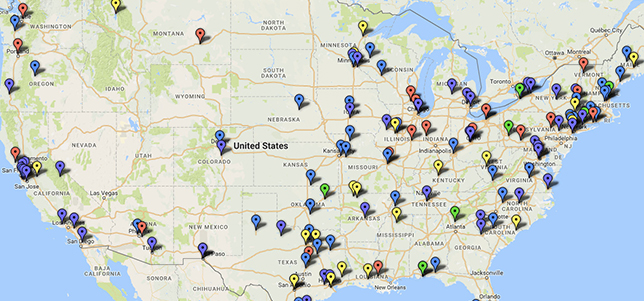
The creator of a national K–12 Cyber Incident Map warns that schools should act now, not later, to bolster their security.

map
Ed Tech Strategies' K–12 Cyber Incident Map. Courtesy of Doug Levin.


The founder and operator of a K–12 Cyber Incident Map is sharing some lessons he has learned after collecting data over the past 17 months on cyber incidents at United States schools.
Doug Levin, president of Ed Tech Strategies, a Virginia-based research and counsel consultancy, says that as K–12 schools increase their use and reliance on digital tools and services, the number of cyber incidents has also been on the rise — exponentially so.
Since Jan. 1, 2016, 141 U.S. K–12 schools and districts experienced one or more publicly disclosed cyber incidents. Sixty-seven incidents were reported during 2016, and 74 have been reported during the first five months of 2017. If the pace continues at the current rate, that will represent a more than 100 percent increase in 2017, compared to last year.
“Incidents and disruptions have been on the rise,” Levin said in an interview. “We have had more incidents in 2017 than all of 2016. We’ve seen more than double the number of incidents in schools.”
Levin attributed this rise to a few different factors: more awareness of nefarious cyber activities; more schools using more hackable technologies; more schools going 1-to-1 and relying on digital tools; and bad actors who continue to look for soft targets, such as students and school staff.
“They’re looking for vulnerable targets,” Levin said. “My sense is that as schools increase reliance on technology, [cybercriminals] are finding that schools are softer targets.”
Levin has been tracking the publicly disclosed K–12 incidents on a color-coded K–12 Cyber Incidents Have Been Increasing in 2017 -- THE Journal:

Chicago’s public teacher union and charter teacher union merge. Hear about it on this coming Hitting Left with the Klonsky brothers minus one brother. | Fred Klonsky

Chicago’s public teacher union and charter teacher union merge. Hear about it on this coming Hitting Left with the Klonsky brothers minus one brother. | Fred Klonsky:

Chicago’s public teacher union and charter teacher union merge. Hear about it on this coming Hitting Left with the Klonsky brothers minus one brother.


The Chicago Teachers Union legislative director Stacy Davis Gates and Chris Baehrend, head of ChiACTS, the Chicago charter teacher union (with Chuy Garcia).
I will be in Brooklyn this coming weekend to celebrate my granddaughter’s graduation from middle school to high school.
Which means I will miss my co-hosting job on Friday’s Hitting Left with the Klonsky Brothers at 11AM on 105.5 FM, streaming live on http://www.lumpenradio.com and podcasted at Hittingleft.libsyn.com
I will be sorry to miss the conversation my brother will be having with the Chicago Teachers Union’s Political and Legislative Director Stacy Davis Gates and Chris Baehrend of ChiACTS, the charter teachers union.
Both groups, currently separate affiliates of the American Federation of Teachers, have agreed to merge.
Even the charter organizers have described Chicago as the epicenter of charter union organizing.
Chicago’s public teacher union and charter teacher union merge. Hear about it on this coming Hitting Left with the Klonsky brothers minus one brother. | Fred Klonsky:


Image result for hitting left with the klonsky brothers

The big problem with what Trump just said about religion in schools - The Washington Post

The big problem with what Trump just said about religion in schools - The Washington Post:

The big problem with what Trump just said about religion in schools


On the day that Washington was riveted by the testimony on Capitol Hill of former FBI director James Comey, President Trump made a speech to a group of religious conservatives during which raised the issue of religion and schools. Here is what he said on June 8, according to a White House transcript:
So we want our pastors speaking out. We want their voices in our public discourse. And we want our children to know the blessings of God. (Applause.) Schools should not be a place that drive out faith and religion, but that should welcome faith and religion with wide, open, beautiful arms. (Applause.) Faith inspires us to be better, to be stronger, to be more caring and giving, and more determined to act in selfless and courageous defense of what is good and what is right. It is time to put a stop to the attacks on religion. (Applause.) Thank you.
It’s no surprise that Trump would say this to the Faith and Freedom Coalition; 80 percent of white evangelicals who voted in the November 2016 selected supported him, and polls show that most of them approve the job he is doing as president.
But a First Amendment scholar has some issues with what Trump said. The following is the reaction from Charles Haynes, the vice president of the Newseum Institute in Washington D.C. and founding director of the Religious Freedom Center of the Newseum Institute:
I have no problems with the part where the president calls on schools to “welcome faith and religion” — only, of course, if he means that they welcome religion throughout the First Amendment door. If Trump is saying that public schools should treat students of all faiths with fairness and respect, then he is only re-stating what the law requires under the First Amendment.
Unfortunately, however, the president frames his remarks in culture-war language about schools being places that “drive out faith” and ends his remarks with a call to “put a stop to attacks on religion.” This is a false narrative about most public schools today, a narrative that stirs anger by reinforcing culture-war myths about public schools as places hostile to religion.
I very much doubt that President Trump has visited very many public schools 
The big problem with what Trump just said about religion in schools - The Washington Post:


 FFRF_NYTAd_Pence_11x21_sm

DeVos is Questioned About Campaign to Influence Climate Change Education | FRONTLINE | PBS

DeVos is Questioned About Campaign to Influence Climate Change Education | FRONTLINE | PBS:

DeVos is Questioned About Campaign to Influence Climate Change Education

Image result for DeVos  Climate Change Education
Four Democratic senators are sharply criticizing a conservative think tank’s efforts to bring climate change skepticism into the nation’s public schools as “industry funded” and “possibly fraudulent” and demanding to know whether federal education officials have been in contact with the group.
The Heartland Institute has been sending books, DVDs and pamphlets to science teachers across the country promoting its stance that climate change is caused by natural phenomena rather than human activities — a view rejected by nearly all climate scientists. Heartland’s campaign to influence how climate science is taught in public schools was first reported by FRONTLINE and The GroundTruth Project in March.
The Illinois-based non-profit vows to continue its efforts, saying it has already sent more than 300,000 packages to K-12 and college-level science teachers since the launch of the campaign earlier this year. Mailings have wrapped up for the summer break, according to Heartland spokesman Jim Lakely. He added, however, “This is not the end of Heartland’s efforts to bring balance to the climate debate in our schools, but just the beginning.”
In a letter sent to Education Secretary Betsy DeVos on Wednesday, Sens. Sheldon Whitehouse (D-R.I.), Brian Schatz (D-Hawaii), Edward Markey (D-Mass.) and Elizabeth Warren (D-Mass.) — all of whom have been outspoken on climate change issues — described the campaign as an effort “to disseminate fossil-fuel industry talking points as curriculum for science teachers.”
The senators asked DeVos whether any Education Department officials have had contact with individuals associated with the Heartland Institute “on climate, science, or science education issues,” and whether any informational resources put out by the department have been created in collaboration with Heartland.
The senators also asked DeVos whether she was aware of any discussions between the White House staff and Heartland. In March, the group’s president and CEO, Joseph Bast, told FRONTLINE and GroundTruth, “We’re getting a lot of requests for expert opinion from the White House … That’s very new.”
Heartland was founded in 1984 and has a history of promoting causes that align with the interests of industry. In the 1990s, for instance, the organization lobbied against smoking bans, for which it was rewardedwith donations from tobacco company Philip Morris. Today, the group DeVos is Questioned About Campaign to Influence Climate Change Education | FRONTLINE | PBS:
Related image
Image result for DeVos  Climate Change Education

Jessica Tang quietly makes history with Boston Teachers Union election - The Boston Globe

Jessica Tang quietly makes history with Boston Teachers Union election - The Boston Globe:

Jessica Tang quietly makes history with Boston Teachers Union election

Jessica Tang has been elected the Boston Teachers Union’s new president.

The most remarkable thing about Jessica Tang’s ascension as head of the Boston Teachers Union might be just how unremarkable it feels.
Tang’s election last week as president of one of the city’s most important unions was anticlimactic: She was unopposed. She’s the first person of color to head the union, the first member of the LGBT community, and the first woman in more than three decades. Since 1983, in fact, only two people, Edward Doherty and the retiring Richard Stutman, have led the city’s teachers. 
But Tang, 35, is a brilliant and passionate advocate for public schools and their teachers.She has learned the art of fiercely defending positions without sparking personal animusand her rise through the union ranks has been so seamless that she was elected to the presidency unopposed. 


She takes office at a challenging time for the union, which is locked in a contentious contract negotiation with the city. This is also a watershed moment for teachers unions in general, facing fire Jessica Tang quietly makes history with Boston Teachers Union election - The Boston Globe: