Saturday, May 20, 2017

Catch up with CURMUDGUCATION

CURMUDGUCATION:

Catch up with CURMUDGUCATION


My 16 Rules
Today I turn sixty, so it's time form one of those posts. These are the rules. Mind you, they are not a sign of any particular wisdom or smartitude on my part-- I have learned about these rules in the same way a somewhat dim cow learns about an electric fence. About 59 years ago. My typing skills have not improved 1. Don't be a dick. There is no excuse for being mean on purpose. Life will provide

YESTERDAY

PA: Cyber School Court-Ordered Crowded Clown Car
Pennsylvania has been a big, fat profitable garden of cyber schools, taking an early lead over even California in letting virtual education take root. And there are so many aspects of cyber-schooling in Pennsylvania that we could discuss. As always, I'll preface this by saying that there are students fro whom cyber-schooling is a useful option. But the modern cyber charter industry is not aimed at

MAY 18

So Now Failure Is Okay, Apparently
" Fail better ," says Michael Q. McShane (Show-Me Institute, AEI) in a piece at US News, arguing to reformsters for the virtue of admitting failure and building upon it. Part of his point is vaid, part is hugely self-serving and part of it is just plain annoying. Policy ideas like charter schools, teacher evaluation and high standards first exist in the abstract. When they are actually implemented

MAY 17

The Geography of Reform
It's an oft-repeated reformster refrain. Students trapped by zip code in failed school s. Paul Ryan offering a lifeline for trapped students . And here's Betsy DeVos at a recent speech, explaining some of the fundamental flaws of our terrible awful no good very bad public education system: The system assigns your child to a school based solely upon the street on which you live. We get these repeat
Petrilli Pokes Personalized Processing
Mike Petrilli, head honcho of the ever-reformy Thomas B. Fordham Institute, has taken a look at the future of Personalized Learning , and he has some concerns. He's read the PR, and he knows about the appeal of super-flexible differentiation, the varied student-customized pathways to excellence. However: Hooray for all that. But after seeing a version of personalized learning in action recently, I
Rutgers Prof Beats NJ Charter Attack
I'm happy to provide a good news follow up to an old story. Two years ago, Rutgers University professor Julia Sass Rubin found herself under attack by the New Jersey Charter School Association. She had published research that contradicted the rosy charter picture in NJ, showing that, much to nobody's surprise, that charters enroll fewer very poor students, fewer non-English speaking students, and

MAY 16

The Takeover Lie
One of the techniques in the reformster arsenal has been the school takeover, in which some august body declares a public school a failure, and that school is marked for Takeover. That failure can be certified by specious Big Standardized Test results (yay, PAARC and SBA) or by the more cynical method of refusing to fuly fund a district and then certifying them, as financially distressed. This par

MAY 14

Artificial Stupidity
Facebook absolutely insist on showing me "top stories." Every time I open the Facebook page, I have to manually switch back to "most recent," because even though the Facebook Artificial Smartitude Software thinks it knows what I most want to see, it can't figure out that I want to see the "most recent" feed. Mostly because the Facebook software is consistently wrong about what I will consider Top
ICYMI: Mother's Day Edition (5/14)
Time for another batch of reading. I know I sound like a broken record, but when you read something you like, share it, pass it along, help add to its reach. How Google Took Over the Classroom The New York Times takes a close look at how Google took over the classroom-- and what price we all may be paying. Don't Put Efficiency in School Ahead of Other Goals Andy Smarick in US News once again apply

MAY 13

Progressive: The Trouble with Ranking Schools
For a while now I've been a "Progressive Fellow in Education" (which is different from being, say, a charming fellow in the low brass section) and I write regularly for them as part of a group of twelve education writers. If you aren't reading the Fellows regularly, you should be. Anyway, I'm going to try to entice you over there by offering the lead to my latest piece, because I think it's impor
(Not) A New Conversation
Phyllis Lockett took to Huffington Post last week to call for a New Conversation , which-- okay, can we stop calling for new conversations? Because they're hardly ever new and often they are barely conversations, and we have had many of these calls and maybe we should just finish one of our old conversations instead of dropping them to start new ones like an easily-distracted party guest. Lockett
CURMUDGUCATION:


Jersey Jazzman: U-Ark Screws Up A Charter School Revenue Study, AGAIN: Part II

Jersey Jazzman: U-Ark Screws Up A Charter School Revenue Study, AGAIN: Part II:

U-Ark Screws Up A Charter School Revenue Study, AGAIN: Part II

Image result for U-Ark Screws Up A Charter School Revenue Study, AGAIN

Here's Part I of this series.


If this is true, it's really disturbing:

Colorado’s General Assembly on Wednesday passed a bill giving charter schools the same access to a local tax funding stream as district schools have, The Denver Post reported.
The bipartisan compromise measure, which supporters say is the first of its kind in the nation, would address an estimated $34 million inequity in local tax increases. It came a day after the University of Arkansas released a study that found charter schools receive $5,721 less per pupil on average than their district counterparts — a 29 percent funding gap. [emphasis mine]
It is, of course, standard operating procedure for outfits like the U-Ark Department of Education Reform to claim their work led to particular changes in policy; that's how they justify themselves to their reformy funders.  Maybe the connection between the report and the Colorado legislation (which is really awful -- more in a bit) is overblown...

But if the U-Ark report did sway the debate, that's a big problem. Because the report is just flat out wrong. 

As I explained in Part I, the claim that Camden, NJ, has a huge revenue gap between charters and public district schools seems to be based on an utterly phony comparison: all of the revenue, both charter and district, is linked to only the CCPS students -- not the charter students. Because the data source documentation in the report is so bad, I can't exactly replicate U-Ark's figures, so I invited Patrick Wolf and his colleagues to contact me and explain exactly how they got the figures they did.

So far, they remain silent.

But that isn't surprising. When U-Ark related its first report in 2014, Bruce Baker tore it to shreds in a brief published by the National Education Policy Center. The latest U-Ark report cites Baker's brief, so they must have read it -- but they never bothered to answer Jersey Jazzman: U-Ark Screws Up A Charter School Revenue Study, AGAIN: Part II:


New National Map Shows That Education Privatizers Have Burrowed into Almost All 50 States | Alternet

New National Map Shows That Education Privatizers Have Burrowed into Almost All 50 States | Alternet:

New National Map Shows That Education Privatizers Have Burrowed into Almost All 50 States

Charter schools, voucher programs, private school tax subsidies and more.


Only three states do not have some form of privatized K-12 education in their public schools, a new nationwide map and accompanying analysis has found, showing how much the charter school and school choice movement has grown in recent years.
Those states are North Dakota, Nebraska and West Virginia, the only states given an “A” grade by the Network for Public Education, a non-profit that opposes privatization, loss of local control, over-testing of students, and other non-governmental efforts that seek to commoditize public schools.       
All the other states and the District of Columbia have some mix of charter schools, charter authorizing authority outside local school districts, online charter school, voucher programs where taxpayers pay for private schools, tax credits for sending children to private schools or educational savings accounts, which is another form of a voucher program, according to the NPE State Report Card 2017.
“Our goal for the School Privatization Explained project was to arm public school advocates with the facts,” said Carol Burris, executive director of the Network for Public Education (NPE) and a former high school principal from New York. “Those who wish to turn our public education system into a private education system have been quite clever in disguising their intent. Our one-page fact sheets ‘rip off the mask.’”
The Network for Public Education was co-founded by Diane Ravitch and Anthony Cody, both longtime educators and advocates of traditional public schools. The group supports numerous policies that would improve public schools but is opposed to private sector efforts to infiltrate K-12 schools via various corporate management and marketing schemes.
“You know what we oppose,” Ravitch says on the website. “High-stakes testing; privatization of public education; mass school closures to save money or to facilitate privatization; demonization of teachers; lowering of standards for the education profession; for-profit management of schools.”
“We want advocates to have facts at their fingertips,” Burris said. “We want them New National Map Shows That Education Privatizers Have Burrowed into Almost All 50 States | Alternet:
 

Big Education Ape: Defend Your Public School from the Trump/DeVos Budget Debacle - Network For Public Education - http://bigeducationape.blogspot.com/2017/05/defend-your-public-school-from.html

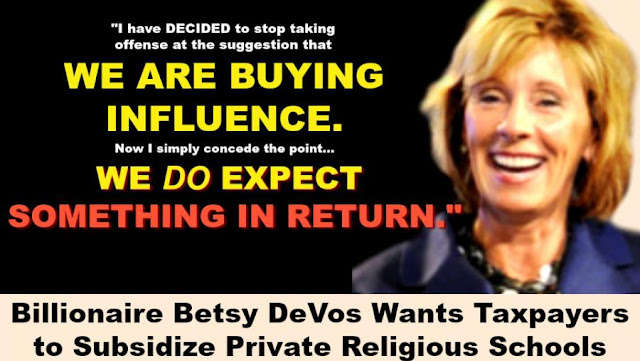
Democrats Look To Close Conflict-Of-Interest Loophole Linked To Betsy DeVos | HuffPost

Democrats Look To Close Conflict-Of-Interest Loophole Linked To Betsy DeVos | HuffPost:

Democrats Look To Close Conflict-Of-Interest Loophole Linked To Betsy DeVos

New bill would require nominees to disclose “dark money” they’ve donated or solicited.


Image result for big education ape devos dark money
WASHINGTON ― Democrats introduced legislation on Wednesday to close a conflict-of-interest loophole spotlighted after President Donald Trump nominated Republican megadonor Betsy DeVos to be Secretary of Education and Scott Pruitt to be head of the Environmental Protection Agency.
At the time of her confirmation, DeVos and her wealthy family were known to have made around $20 million in publicly reported contributions to support Republican candidates. What remained unknown was how much she and her family donated to non-disclosing “dark money” nonprofits that helped elect senators who would vote on her nomination. For Pruitt, the lack of disclosure went the other way, as he had solicited contributions from donors for a dark money nonprofit during his time as Oklahoma’s attorney general.
The legislation, sponsored by Sen. Sheldon Whitehouse (D-R.I.) and Rep. Ted Deutch (D-Fla.), would require executive branch nominees to disclose whether they solicited or contributed money to political candidates, political parties, political action committees and, most importantly, nondisclosing nonprofits active in elections. Additionally, nominees would be required to enter into agreements with the Office of Government Ethics that would explain how they would avoid conflicts of interest after confirmation.
Whitehouse and Deutch cite the Supreme Court’s 2010 Citizens United decision as the main reason why this new conflict-of-interest disclosure is needed. That decision gave corporations the right to spend unlimited amounts of money on elections so long as their spending was independent of the candidates they supported.
A side effect of the decision was that nonprofits that do not disclose their donors were suddenly empowered to spend on direct electoral appeals. This led to a rapid increase in dark money spent to elect congressmen, senators, governors and presidents.
“Citizens United unleashed a tsunami of corporate spending in our politics, threatening to drown out the voices of individual citizens.  It’s time to update our ethics rules to prevent that spending from hatching serious conflicts of interest at the top levels of our government,” Whitehouse said in a statement.
“We ask high-level appointees to disclose their financial relationships, which may have a serious influence on the work they do if confirmed.  We also need to ask about fundraising relationships, which can be just as thorny.  That will help us avoid potentially serious conflicts of interest and the scandal that would follow,” he said.
Deutch said, “Under current law, billionaires can anonymously flood our elections with unlimited amounts of money one day and become heads of an agencies the next. We can’t let the failures in our campaign finance laws be compounded by failures in our ethics laws.”
Sens. Tom Udall (D-N.M.), Chris Van Hollen (D-Md.), Al Franken (D-Minn.) and Tom Carper (D-Del.) cosponsored the Senate bill. Reps. John Sarbanes (D-Md.), Zoe Lofgren (D-Calif.), Mark Pocan (D-Wisc.), David Cicilline (D-R.I.) and Jan Schakowsky (D-Ill.) cosponsored the House bill.