Latest News and Comment from Education

Monday, March 13, 2017

Will Randi Weingerten Thwart Trump’s Plan? - Fast Forward – Forward.com

Will Randi Weingerten Thwart Trump’s Plan? - Fast Forward – Forward.com:

Will Teacher’s Union Head Randi Weingerten Thwart Trump’s Infrastructure Plan?


Teachers union leader Randi Weingarten is shaping up to be one of President Trump’s toughest opponents, especially when it comes to implementing his ambitious $1 trillion infrastructure plan.
Axios reports that Weingerten’s clout goes way beyond the 1.6 million member American Federation of Teachers which she heads. According to the report, the Jewish Democratic union leader may hold the key to allowing Trump to go ahead with his plan, which requires reaching deals with national organized labor groups.
Weingerten may have no direct influence on infrastructure workers, but she’s close to the Building Traders union and is a major stakeholder at the AFL-CIO, meaning it will be hard to pull off a deal without her consent.
Furthermore, the infrastructure plan is expected to rely on private equity, making the teacher’s pension funds valuable for financing the program, which will also give Weingerten and the AFT a say in the process.
Will Weingerten play along with the administration’s plans?
So far she has been highly critical of Trump’s Education Secretary Betsy DeVos and has positioned herself as the president’s major union rival. So collaboration over infrastructure does not seem to be in the cards.
Contact Nathan Guttman at guttman@forward.com or on Twitter @nathanguttman

Name Calling in the Time of Trump - Living in Dialogue

Name Calling in the Time of Trump - Living in Dialogue:

Name Calling in the Time of Trump 


By Michelle Strater Gunderson.
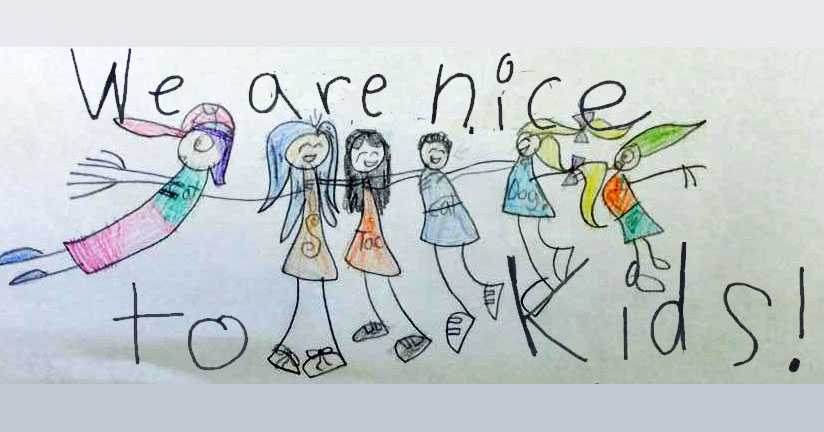
Last week a group of my first grade girls was taking an unusually long time in the bathroom. When you teach little ones you get a sixth sense for when something is going on. I knocked on the door and said, “Dear ones, whatever can be keeping you?” The ring leader answered me with her cute front toothless diction, “We are talking about Trump because we know you won’t let us in the classroom. We can’t stand him.”
Now, before you jump straight to the comments section and make ungodly statements about my ban on political speech and intolerance of differences, you need to hear me out.
I teach in a Chicago Public School in a neighborhood that is traditionally LGBTQ. Many of our students have two moms or two dads, and it is fair to say that most of our families are politically liberal with many who consider themselves progressive. Yet, in this context, there are families who still support Trump.
During the month before the election, one of my students made it very clear that his family supported Donald Trump, and he talked about it often. The children started teasing him on the playground. In fact, the taunting game became “nanny nanny boo boo, you vote for Trump” as children tag one another (much like the game of cooties you might remember from childhood).
After recess that day girl came running into the classroom crying uncontrollably. “Why would they say I like Trump? I am a good person. I don’t say bad things.”
We held a class meeting to try to work this out, but the crying kept up, and the hurt feelings were incredibly deep. Now, I ask you, reader, how have these conversations been going for you about Donald Trump with the adults in your lives? How many relatives or friends have you lost on Facebook? Put yourself in the children’s shoes. Can you imagine how confusing and how hard it is to navigate this space for first graders?
Usually during class meetings we make a group decision about how we are going to proceed in working with one another, but there just seemed to be no end to it. I finally said, “These are arguments that adults are having, and it is very hard right now for us to understand one another.” I decided that we would not talk about the election in our classroom any more. I needed to protect the children whose families supported Trump and stop the harmful teasing before it went any further.
This is my thirtieth year of teaching, and I have always taught about the elections and current events no matter what grade I teach. But this was more than we could approach in our class. Many of our families consider Trump’s presidency as an existential threat and the anxiety and pressure has filtered down to the children. And when children feel anxiety and pressure, they misbehave.
The other day, an eruption happened during lunch in the cafeteria. One of my students decided to go around the room calling the others “losers.” You are probably saying to yourself that first graders have been calling Name Calling in the Time of Trump - Living in Dialogue:


CURMUDGUCATION: MI: A Blueprint for Education?

CURMUDGUCATION: MI: A Blueprint for Education?:

MI: A Blueprint for Education? 


First announced in Governor Rick Snyder's January 2016 State of the State address, the 21st Century Commission has been working diligently at an educational blueprint for Michigan. The final report on charting the edu-journey for Betsy Devos's home state, and it is a hefty 146 pages. I've read it so that you don't have to. Buckle up, boys and girls.

Who Created This Thing?


The commission was headed up by Dr. Thomas Haas, President of Grand Valley University. Members included some folks from industry and business, some school superintendents (including the Grand Rapids super), some charter school folks, some state board of education members, representatives from AFT Michigan and the Michigan Education Association, and some assorted bureaucrats. Oh, and one lone classroom teacher (Matt Oney from Escanaba Area Public Schools).
Part of the process was, apparently, a listening tour. The breakdown of that is not encouraging; the thank you section mentions thirteen hosts from Northern Michigan, six hosts from the Upper Peninsula, eleven hosts from West Michigan, and from Southeast Michigan, a single stop on the "tour"-- a virtual visit to Voyageur Academy, a charter school in Detroit. (That visit was virtual, says the notes, "due to weather, so I guess Detroit has been socked in for the last year).

Introduction and Call To Action

The introduction hits several familiar notes. The economy has changed (and now it's hard to get work). Education improves opportunity (education and employment correlate, ad we'll lazily accept causation there). Education is a public good (Michigan would probably work better with educated 
CURMUDGUCATION: MI: A Blueprint for Education?:


Navigating the Scylla and Charybdis of Research in Education | radical eyes for equity

Navigating the Scylla and Charybdis of Research in Education | radical eyes for equity:

Navigating the Scylla and Charybdis of Research in Education

Image result for Research in Education


Teaching children according to their individual ‘learning style’ does not achieve better results,” reports Sally Weale, “and should be ditched by schools in favour of evidence-based practice, according to leading scientists.”
Narrowly about learning styles, but more broadly about the decade’s long tension over what research counts, this argument plays out incessantly in education. Notably in the U.S., calls for scientific teaching, research-based practices, and evidence-based policy have their roots in John Dewey’s progressivism, and then have been intensified throughout the accountability era begun in the 1980s and codified in No Child Left Behind (NCLB) in 2001.
For about a century, education has simultaneously claimed to be driven by science and research while also being criticized for failing to use our research base and being trapped in fads.
This debunking of learning styles, then, is old hat; consider Lou LaBrant lamenting in 1947: “A brief consideration will indicate reasons for the considerable gap between the research currently available and the utilization of that research in school programs and methods.”
And the problem rests with the Scylla and Charybdis of research: on one side, educators must resist the tyranny of a narrow definition of what counts as evidence (the so-called hard view grounded in experimental and quasi-experimental studies), and on the other, educators must resist the trendy and often reductive (lazy) extrapolations of research (within which we may place learning styles).
Let me offer here two powerful examples that I believe address this tension: the poverty materials of Ruby Payne and the “word gap” narrative.
In the wake of federal mandates in NCLB that required public schools to identify and then address the so-called achievement gap, Ruby Payne capitalized on an opportunity to provide schools with manageable workbooks and workshops.
However, after many schools and districts across the U.S. purchased Payne’s materials and seminars, scholars on social class and race began to unmask that Payne was peddling stereotypes, not providing evidence-based claims about children and families in poverty (scholarship debunking Payne as well as the Teachers College Record exchange can be found here).
The Payne phenomenon (one that continues despite her poverty characterizations being thoroughly discredited) reveals several problems with calling for education to be research-based.
First, and possibly most significantly, educational practices are far too influenced by the marketing of materials and the incessant training and re-training of teachers in the field. That market influence and dynamic is made robust since K-12 education is far more bureaucratic than scholarly.
The market influence necessarily creates the need for “new” and manageable, characteristics that often supersede the validity of those materials.
Payne’s success has been built on her self-promotion, not her expertise in Navigating the Scylla and Charybdis of Research in Education | radical eyes for equity:

SKrashen: WEBINAR, Tuesday evening, March 14 - S. Krashen Has Some Priorities For Betsy Devos

SKrashen: WEBINAR, Tuesday evening, March 14 - S. Krashen:

SKrashen: WEBINAR, Tuesday evening, March 14 
S. Krashen Has Some Priorities For Betsy Devos


WEBINAR: Stephen Krashen
Tuesday evening
Tuesday, March 14th from 7-8pm MST
Link to zoom conference call:
https://zoom.us/j/161756919
 
Join Uniting4Kids for our next video conversation featuring educational researcher, linguist and political activist Stephen Krashen, as he suggests priorities for the new Department of Education;  The current focus on poor teaching and low standards has failed to improve education.  Dr. Krashen is nationally recognized leader in education. A professor emeritus at the University of Southern California, he has authored numerous books and dozens of articles including this latest editorial published in the Wall Street Journal:
 
http://skrashen.blogspot.com/2017/01/response-to-whos-afraid-of-betsy-devos.html


Upcoming Debate: Charters and Vouchers are the Answer – Cloaking Inequity

Upcoming Debate: Charters and Vouchers are the Answer – Cloaking Inequity:

Upcoming Debate: Charters and Vouchers are the Answer


Chris Stewart is Director of Outreach and External Affairs for Education Post, a nonprofit publication covering public schools. Additionally, Chris publishes Citizen Ed, a weekly education reader that highlights grassroots voices that often go unheard.
Before that, Chris was Executive Director of the African American Leadership Forum (AALF), a cross-sector network of black leaders working to develop and implement an urban policy agenda in five northwest states. In 2007 Chris was elected to the Minneapolis Public Schools Board of Education where he created the Equity and Achievement Committee, authored a board-level “Covenant with the African American Community,” and advocated safe, orderly, and rigorous schools that prepare students for high-wage, high-growth occupations.
Julian Vasquez Heilig is an award-winning teacher, researcher, and blogger. He is currently a Professor of Educational Leadership and Policy Studies and the Director of the Doctorate in Educational Leadership at California State University Sacramento.
In addition to educational accomplishments, Julian Vasquez Heilig has held a variety of practitioner, research, and leadership positions in organizations from Boston to Beijing. These experiences have provided formative professional perspectives to bridge research, theory, and practice.
His current research includes quantitatively and qualitatively examining how high-stakes testing and accountability-based reforms and market reforms impact urban minority students. Julian’s research interests also include issues of access, diversity, and equity in higher education.


Expanded View of the ELA/ELD Framework Resources - Curriculum Frameworks (CA Dept of Education)

Expanded View of the ELA/ELD Framework Resources - Curriculum Frameworks (CA Dept of Education):

Expanded View of the ELA/ELD Framework Resources
A Collection of Resources That Support the Implementation of the English Language Arts/English Language Development Framework.
Image result for English Language Arts/English Language Development Framework.

The California Department of Education (CDE) continues to develop and collect resources critical to implementing the California content standards and increasing student achievement. This select collection of resources connects the content in the ELA/ELD Framework with other resources from the CDE, as well as other reputable sources that address the five key instructional themes: meaning making, effective expression, language development, content knowledge, and foundational skills. The intent of this collection is to provide educators additional resources they can use to expand the scope of the guidance in the ELA/ELD Framework and to inform professional development and instructional decisions at all schools and districts.  
The resources included here are structured around the five key themes in the ELA/ELD Framework. The resources are further organized by grade level and area of focus. The selection of resources begins with exemplars from the ELA/ELD Framework. These are supported by a selection of resources from the CDE Web site or originate from other sources, including national entities or local educational agencies in California. All resources included in this document have been reviewed by CDE staff to ensure, to the extent possible, that they
  • were created or recommended by a reliable source;
  • have been used in classrooms, schools, or districts;
  • demonstrate evidence of positive impact or evidence of usefulness for an intended audience (e.g., students, teachers, administrators, schools, districts);
  • are timely, given current educational priorities and policy developments;
  • reference research; and
  • are aligned to current standards.
Note: Additional resources may be added as they become available.
Questions:   Curriculum Frameworks and Instructional Resources Division | CFIRD@cde.ca.gov | 916-319-0881
 Expanded View of the ELA/ELD Framework Resources - Curriculum Frameworks (CA Dept of Education):