Latest News and Comment from Education

Monday, February 20, 2017

#FAKEPRESIDENTSDAY 2017 | Reclaim Reform

#FAKEPRESIDENTSDAY 2017 | Reclaim Reform:

#FAKEPRESIDENTSDAY 2017


fakepresidentsday-010-copy

CURMUDGUCATION: Barber: Let It All Burn

CURMUDGUCATION: Barber: Let It All Burn:

Barber: Let It All Burn


On Valentine's Day, Sir Michael Barber (the head education honcho at Pearson) took to the74 to offer a rather odd and ultimately confused metaphor for education reform by walking us through the story of St. Paul's Cathedral. It's the test from his speech at the 2016 Global Google Education Symposium. Yikes.

The problem, he asserts, began with the construction of the original St. Paul's, a classic Gothic construction whose spire had been shattered by a lightning strike in the 1560s, a mess that was never repaired. A century later, royal surveyors recommended patch and repair, but fortunately, just a few years later, the Great Fire of London leveled the city, St. Paul's included. Christopher Wren got to build a new cathedral.

Does this historic example of disaster-based opportunity remind you of Katrina-socked New Orleans? Well, it does Barber. And it represents for him a choice that he will repeat throughout the piece--- patch and mend, or transformation?

He proceeds with a litany of ills-- blacks men sent to prison, poor students not admitted to Oxford, Greece's huge levels of youth unemployment, illiterate Ugandan teachers, jobs at risk for automation.

Patch and mend, or transformation?

He's talking now about the education system. And he will now call out the reasons he think transformation isn't happening.

Cost-- it's easy to let short term concerns "override long-term aspirations." Kind of like poor people could save money over time by buying a Tesla with the $80,000 they don't have.

Entrenched status quovians-- Oh, those damn teachers' unions. They advocate for crazy things like 
CURMUDGUCATION: Barber: Let It All Burn:


Finland’s School Reforms are Troubling: 4 Reasons Why

Finland’s School Reforms are Troubling: 4 Reasons Why:

Finland’s School Reforms are Troubling: 4 Reasons Why


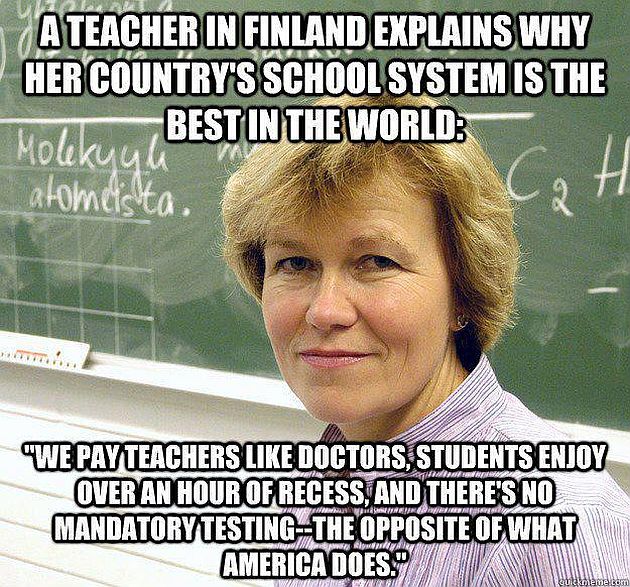
Finland’s new curriculum means that schoolchildren will no longer need to sit down quietly in classrooms, since they will instead be able to choose where and how they study. In future there will not necessarily be any traditional enclosed classrooms.
Finland’s schools have been admired for years. Americans and others from around the world have visited and marveled at their success. Scores on the Programme for International Student Assessment (PISA) have consistently been high.
I list several sources below describing the past beauty of Finnish schools and how they have done much that is right when it comes to teaching.
The United States has never imitated Finland’s winning practices. That’s because the goal here has been to privatize public schools.
But wait! Now schools in Finland are changing to mirror America’s reforms! What’s Finland’s School Reforms are Troubling: 4 Reasons Why:
 Image result for Finland’s School

Two Thirds of Californians Disapprove of Trump’s Job Performance (PPIC Press Release)

A Third of Californians Approve of Trump’s Job Performance (PPIC Press Release):

Two Thirds of Californians Disapprove of Trump’s Job Performance 
Image result for Trump’s Job Performance sucks

Views on Immigration, Health Care, Climate Change, Abortion at Odds with President

SAN FRANCISCO, February 9, 2017—Just a third of Californians approve of the way President Trump is doing his job, according to a statewide survey released today by the Public Policy Institute of California (PPIC), with funding from the James Irvine Foundation.
In the survey, taken January 22–31, the president’s job approval rating is 30 percent among California adults and 34 percent among likely voters. Majorities in both groups disapprove (58% all adults, 55% likely voters). There’s a strong partisan divide among Californians on this question: 72 percent of Republicans and 10 percent of Democrats approve of the president’s job performance. Approval is low across regions of the state. There are differences across racial/ethnic groups, with whites (39%) and Asian Americans (37%) twice as likely as Latinos (17%) and African Americans (15%) to approve. Californians overall are less likely to approve of President Trump than are adults nationwide (45% approve), according to a Gallup tracking poll from January 23–29.
Trump’s favorability rating is 33 percent among adults and 37 percent among likely voters. Most have an unfavorable opinion (60% adults, 59% likely voters), and about half in each group have a strongly unfavorable one. Slightly less than a third of Californians have confidence (15% great deal, 13% good amount) that the president will make the right decisions for the country’s future (26% just some confidence, 45% none at all).
"The California public’s early reviews of President Trump are generally negative,” said Mark Baldassare, PPIC president and CEO. "Yet they also demonstrate that the state’s voters have deep partisan divisions that are very much in line with national politics.”
Most Support State, Local Action on Immigration
As California leaders consider their responses to Trump’s early action on immigration, the survey asked whether state and local governments should make their own policies and take actions—separate from the federal government—to protect the legal rights of undocumented immigrants in California. A solid majority of adults (65%) and 58 percent of likely voters favor state and local action. Opinion differs widely across political parties: 80 percent of Democrats favor state and local government action, while 69 percent of Republicans oppose it. Majorities across regions and racial/ethnic groups are in favor.
Consistent with PPIC surveys over the past year, an overwhelming majority of Californians (85%) say there should be a way for undocumented immigrants to stay in the US legally if certain requirements are met. Strong majorities across parties hold this view (93% Democrats, 84% independents, 65% Republicans). Of those who say they voted for Trump, 61 percent say undocumented immigrants should be allowed to stay and 34 percent say they should not.
When Californians are asked to name the one issue facing the state that is most important for the governor and legislature to work on, immigration is tied with jobs and the economy as the top issue (14% adults, 13% likely voters). Last January, Californians said water and drought (17% adults, 18% likely voters) and jobs and the economy (16% adults, 19% likely voters) were most important.
A Slight Majority Oppose ACA Repeal
In the wake of Trump’s pledge to repeal the Affordable Care Act (ACA), the survey asked Californians for their opinions of the 2010 health care law. Half (51% adults, 53% likely voters) view the law favorably (39% adults, 40% likely voters view it unfavorably). Californians are somewhat more likely to have favorable opinions of the law than were adults nationwide in a December Kaiser Family Foundation survey (43% favorable, 46% unfavorable). There are stark partisan differences: 77 percent of Democrats view the law favorably and 74 percent of Republicans view it unfavorably. Independents are more evenly divided but are more likely to view the law favorably (50%) than unfavorably (40%).
A slight majority of Californians (53%) oppose repealing the ACA. About a quarter (26%) say Congress should wait to repeal it until details of a replacement plan are announced, while 16 percent favor an immediate repeal. Across political parties, most Democrats (78%) and independents (57%) oppose repealing the ACA, while Republicans (80%) overwhelmingly favor it.
Strong Majority See Climate Change as Major Threat
The Trump administration’s approach to federal climate change policy appears likely to diverge from California’s. A strong majority of Californians (65%) say global climate change is a major threat to the well-being of the US (20% minor threat, 12% not a threat). Adults nationwide were much less likely to see climate change as a major threat in a January Pew Research Center survey (52% major, 32% minor, 14% not a threat). In the PPIC survey, Democrats (82%) are far more likely than independents (62%) and Republicans (27%) to say climate change is a major threat. A solid majority of Californians (63%) say they favor the state government making its own policies—separate from the federal government—to address global warming. Partisans are split: 77 percent of Democrats, 64 percent of independents, and just 30 percent of Republicans favor the state making its own policies. Republican support has dropped 19 points since last July.
Most across Parties Support Abortion Access
As Congress considers Trump’s Supreme Court nominee, abortion policy is an important issue in the debate. Most Californians (71%) say the government should not interfere with a woman’s access to abortion, while 27 percent say the government should pass more laws to restrict the availability of abortion. Since PPIC first asked this question in 2000, solid majorities of Californians have said the government should not interfere with access. Today, this view is held across parties (87% Democrats, 75% independents, 60% Republicans). Majorities of men and women and majorities across racial/ethnic, age, education, and income groups concur. Asked about the Roe v. Wade decision establishing a woman’s constitutional right to an abortion, 71 percent of Californians say they do not want to see the decision completely overturned. In PPIC surveys since 2005, at least 65 percent of Californians expressed this view.
"Californians’ policy preferences are deeply at odds with the new federal direction on abortion access, climate change, health insurance, and undocumented immigrants,” Baldassare said.
Most Approve of Supreme Court’s Job Performance
Most adults (57%) approve of the way the Supreme Court is handling its job. Independents (61%) are the most likely to approve, followed by Democrats (54%) and Republicans (49%). Asked about the ideology of the court, 20 percent say it is too liberal, 24 percent say it is too conservative, and 47 percent say it is just about right. Across parties, 48 percent of Republicans say it is too liberal, while 47 percent of Democrats and 37 percent of independents say it is just about right.
Approval Ratings for Congress Are Similar to Trump’s
Californians’ job approval ratings for Congress are similar to their ratings for Trump. Just a third of adults (33%) and a quarter of likely voters (25%) approve of the way Congress is doing its job. Democrats (19%) are much less likely than independents (35%) and Republicans (39%) to approve.
Although Republicans control the executive and legislative branches of the federal government, only about half of Californians (50% adults, 55% likely voters) say the president and Congress will be able to work together and accomplish a lot in the next year. An overwhelming majority of Republicans (85%) and a majority of independents (56%) expect productive collaboration, compared to 34 percent of Democrats. The belief that the president and Congress will be able to accomplish a lot is down sharply from January 2009, when there was a Democratic president and Democratic-controlled Congress. Then, 81 percent of Californians—including 66 percent of Republicans—held this view.
Half of Californians (52%) think the nation will have good times financially in the next year. When they are asked about the direction of the nation, just 36 percent of adults and 37 percent of likely voters say the US is headed in the right direction.
Governor Brown, California Legislature Get High Ratings
When asked about state leaders, California adults and likely voters each give Governor Brown 62 percent job approval rating—a record high in PPIC Statewide Surveys. The legislature’s approval ratings—57 percent among all adults and 50 percent among likely voters—are the highest since 2001. A record-high 66 percent of adults and 64 percent of likely voters say the governor and legislature will be able to work together and accomplish a lot in the next year. About half of Californians (53% adults, 51% likely voters) say the state will have good times financially in the year ahead. Most (58% adults, 58% likely voters) say things in California are generally going in the right direction.
"Californians give much higher approval ratings to the governor and legislature than to the president and Congress today,” Baldassare said. "With starkly different views of the direction of the state and the nation, many Californians have hopes that the governor and legislature will be able to work together and keep the state on its current track.”
Fewer Than Half Support Brown’s Budget
When Brown proposed his 2017–18 budget, he estimated a $1.6 billion deficit for the state. Yet just 37 percent of Californians see the budget situation as a big problem—a record low since PPIC first asked the question in 2006. Brown’s plan includes modest spending increases in K–14 and higher education, health and human services, and prisons and corrections. It also calls for slowing spending growth in K–14 education and other areas, and putting $1.1 billion in the state rainy day fund. When read a short description of the plan, just under half of California adults (47%) and 43 percent of likely voters favor it.
Brown has proposed about $43 billion in additional spending over the next ten years to address a multibillion-dollar shortfall in funding for infrastructure improvements. Funding would come from a $65 fee on all vehicles, increased state gas and diesel taxes, and cap-and-trade funds. When they are read a short description of this proposal, 41 percent of adults and 43 percent of likely voters are in favor.
For more survey findings on transportation, read "Californians and Transportation.”
"The public strongly believes that transportation spending should be a high priority for the state government,” Baldassare said. "Yet with most saying that we also have to spend what we have more wisely, state bonds are much more popular than fees and taxes for funding much-needed improvements.”
About the Survey
The PPIC Statewide Survey was conducted with funding from the James Irvine Foundation and the PPIC Donor Circle. Findings are based on a telephone survey of 1,702 California adult residents, including 681 interviewed on landline telephones and 1,021 interviewed on cell phones. Interviews took place from January 22–31, 2017. Interviews were conducted in English or Spanish, according to respondents’ preferences.
The sampling error, taking design effects from weighting into consideration, is ±3.3 percent for all adults, ±3.6 percent for the 1,428 registered voters, and ±4.1 percent for the 1,107 likely voters. For more information on methodology, see page 23.
Mark Baldassare is president and CEO of PPIC, where he holds the Arjay and Frances Fearing Miller Chair in Public Policy. He is founder of the PPIC Statewide Survey, which he has directed since 1998.
The Public Policy Institute of California is dedicated to informing and improving public policy in California through independent, objective, nonpartisan research. We are a public charity. We do not take or support positions on any ballot measure or on any local, state, or federal legislation, nor do we endorse, support, or oppose any political parties or candidates for public office. Research publications reflect the views of the authors and do not necessarily reflect the views of our funders or of the staff, officers, advisory councils, or board of directors of the Public Policy Institute of California.A Third of Californians Approve of Trump’s Job Performance (PPIC Press Release):

PPIC Statewide Survey: Californians and Their Government
Mark Baldassare, Dean Bonner, David Kordus, and Lunna Lopes
A strong majority of Californians disapprove of President Trump’s job performance—but opinion varies widely across parties. Majorities differ with the president in their views on immigration, health care, climate change, and abortion. A solid majority approve of Governor Brown’s performance, but fewer than half favor his proposed budget.

 Crosstabs:
All Adults [PDF]
Likely Voters [PDF]
 Time Trends:
All Adults [PDF]
Likely Voters [PDF]
This research was supported with funding from the James Irvine Foundation and the PPIC Donor Circle.

The Japanese education system may solve the problems of US public education | TheHill

The Japanese education system may solve the problems of US public education | TheHill:

The Japanese education system may solve the problems of US public education

Image result for Japanese education system

The uproar over the new Secretary of Education’s first days in the cabinet and the state of American public education K through 12 ignores the challenge of how we might actually improve teaching. And it can be a relatively simple fix.  
Blocked by protesters from visiting a Washington, D.C. school recently, newly confirmed Education Secretary Betsy DeVos, an avid support of privatization, met with public school officials eventually.
Yes, DeVos had faced a historically close vote — the first ever cabinet confirmation when a vice president cast the tie-breaking vote.
Opponents of DeVos cited her lack of experience, the poor performanceof the Michigan Charter schools and her financial contributions to many of the senators voting for her confirmation. 
Secretary DeVos revealed alarming misunderstandings about education policy and resisted calls to maintain funding for public education or to hold private schools and charter schools to the same standards as public schools. She remains a supporter of privatization.  


However, as Diane Ravitch argues in her 2013 book “Reign of Error: The Hoax of the Privatization Movement and the Danger to America’s Public Schools,” there is scant evidence privatization works.
If privatization approaches, such as vouchers, charter schools, merit pay and abolishing tenure haven’t provided the magic bullet to improving education, it is because they don’t directly address how we improve teaching.
What may solve the problems of American public education is what already works in Japan.
In researching the K-12 Japanese educational system, typically compared favorably to ours, Catherine Lewis, senior research scientist at Mills College, asked Japanese teachers how they learned problem-solving approaches to teaching mathematics. Reportedly Lewis reacted in disbelief when they told her that were developed by American researchers.
Elizabeth Green, author of Building a Better Teacher: How Teaching Works (and how to Teach it to Everyone) found a similar pattern when she interviewed Akahiko Takashi, once one of Japan’s leading teachers and now Associate Professor of Elementary Math Teacher Education at DePaul University.
As Green describes in her book, Takashi came to Chicago to observe classrooms using the innovative teaching approaches of John Dewey, George Polya and the National Council of Teachers of Mathematics. The Japanese education system may solve the problems of US public education | TheHill:
Related imageImage result for Japanese education system

Happy (Not My) Presidents Day!

Happy (Not My) Presidents Day!


Anti-Trump protesters come out for ‘Not My Presidents Day’ rallies

A broad range of activists opposed to the month-old Trump administration were using Monday's President's Day holiday to hold “Not My Presidents Day” rallies nationwide.
With most government workers, school employees and students enjoying a day off due to the federal holiday, events were underway in New York, Chicago, Los Angeles, and as many as two dozen other communities, organizers said. In Atlanta, more than 600 protesters were expected at an “ImPEACH Now” march — the group's Facebook page featured an image of a cut peach with Trump's face in place of the pit.
In Los Angeles, about 4,300 people were expected to rally at noon at City Hall, according to the group's Facebook page. Protests were also taking place in nearby Pasadena and near Disneyland in Anaheim, Calif.
In Philadelphia, protesters were marching in a "Counter the Executive Orders" rally, according to the group's Facebook page.
In Ann Arbor, Mich., about 600 marchers were expected to attend a "Bad Hombres and Nasty Women" event Monday night, featuring "uncensored performances" and benefiting Planned Parenthood.
“While we acknowledge that Donald Trump holds the current title, the policies he’s trying to put in place are not the beliefs shared by the majority of the people,” said Nova Calise, a television production manager and one of the organizers of New York event, which was expected to draw about 15,000 people to Trump International Hotel near Manhattan’s Central Park, according to a Facebook group. Expected speakers included Manhattan Borough President Gale Brewer and Sonia Ossorio, who runs the New York City chapter of the National Organization for Women.
Monday's rallies come days after several weekend events in New York, Dallas and Los Angeles that called for the establishment of "sanctuary cities" in order to end immigration raids, NBC News reported. In Boston, hundreds of scientists marched to urge Trump to recognize climate change and tackle environmental issues. The rally coincided with the annual conference of the American Association for the Advancement of Science.
On Sunday in New York, more than 1,000 people rallied in New York City in support of Muslim Americans. The "I Am A Muslim Too" rally was organized by, among others, hip-Hop mogul Russell Simmons, who said last week, "We are living in a time when unity will make America great. This is a special moment for all Americans of goodwill to band together to promote the kind of compassion and equality for others that we want for ourselves."
Rabbi Marc Schneier, FFEU's president, co-organized the first "Today, I Am A Muslim Too" in 2010, ABC reported.
In a statement, Rabbi Schneier said: "We must join together at the most famous crossroads in the world to make a collective statement that, 'Whenever my Muslim brothers and sisters are demonized and vilified, discriminated against or victimized by hate crimes and violence, 'Today, I am a Muslim too.'"
One of the organizers of Monday's Chicago rally, business professor Laura Hartman, said the event has an overarching theme of unity. Hartman said Trump’s early moves — from attacking journalists to imposing limits on immigration — could splinter the public.
“We don’t want to pick an issue,” said Hartman, who also attended the massive Women’s March in Washington last month. “By embracing a broad umbrella, we can show this administration that the numbers against it are broad."
Contributing: Fredreka Schouten; Follow Greg Toppo on Twitter: @gtoppo


Keep DeVos Away From Our Public Schools! - Action Network

Keep DeVos Away From Our Public Schools! - Action Network:

Keep DeVos Away From Our Public Schools!

16508745_2208616122696372_4463910818552693619_n


 Tell the National School Boards Association, The School Superintendents Association, and The National PTA to keep DeVos out of our public schools! Her goal has been, and always will be, to liquidate our public school system.  BATs will deliver this petition to the NSBA, SSA, and Nat. PTA on March 20th! Let's get a million or  more on this petition!Keep DeVos Away From Our Public Schools! - Action Network:

Betsy DeVos Had an Awfully Difficult First Week on the Job | Diane Ravitch's blog

Betsy DeVos Had an Awfully Difficult First Week on the Job | Diane Ravitch's blog:

Betsy DeVos Had an Awfully Difficult First Week on the Job

Image result for Betsy DeVos  First Week

Teachers who teach children with multiple disabilities and children who are homeless may think that they have a tough job, but consider what a very hard time Betsy DeVos had in her first week as Secretary of Education, very likely the first paying job she has ever held. She visited a public middle school in D.C., where protestors harassed her and tried to keep her out. When she eventually entered the school, she said nice things to the staff, but after she left she insulted them as being in a “receive” mode. She gave a few interviews and said she hoped to launch more charter schools, more vouchers, more cybercharters, and presumably shrink the number of public schools as she opens up opportunities for students to go anywhere other than public schools.
In one interview, she told syndicated conservative columnist Cal Thomas that she did not think the protests against her were spontaneous. The implication was that those evil teachers’ unions had plotted against her. The other implication was that parents and teachers would welcome her noble presence in their public school, even though she was unimpressed with what she saw. Someone, she said, was trying to make her life “a living hell.” No matter what the plotters do, she pledged she would not be deterred from her mission of “helping kids in this country,” by enabling them to leave public schools for privatized alternatives.
She suggested to Thomas that it might be a good idea to bring tens of thousands of children to the Capitol to demonstrate for charters and vouchers. She said it had worked in Florida. Of course, this is now a standard part of the privatization script, using children as political pawns to demand more public funding for private choices, thus disabling public schools by diminishing their resources.
She pledged to support alternatives to public schools, without citing a scintilla of evidence that these choices would help kids and without acknowledging that the proliferation of choices harms the great majority of children who don’t choose to leave public schools. Her mindset is purely ideological. She did not offer any suggestions about how to help the vast majority of children who attend public schools. She has one idea, and she is sticking to it: choice. The absence of evidence for that one idea from her home state never comes up. Michigan has tumbled in national rankings as choice has expanded.
When Cal Thomas asked what could be done for children who had an Betsy DeVos Had an Awfully Difficult First Week on the Job | Diane Ravitch's blog:
Image result for Betsy DeVos  First Week
Related image

Activist, politician Tom Hayden is remembered at UCLA memorial - LA Times

Activist, politician Tom Hayden is remembered at UCLA memorial - LA Times:

Activist, politician Tom Hayden is remembered at UCLA memorial


tomhayden.com - The Democracy Journal - http://tomhayden.com/
When Robert Kennedy was assassinated in 1968, the senator’s family picked Tom Hayden to be an honorary pallbearer at the funeral because the young antiwar activist embodied “the great hope that my father had in the future of our country,” Robert Kennedy Jr. recalled Sunday night at a memorial for Hayden.
Hayden, who died in October at the age of 76, had been one of the first white students from northern states to join blacks in Freedom Ride protests against segregation in the South. He’d gotten beat up by police in Mississippi and “gone to jail for his beliefs in Georgia,” Kennedy told the audience at UCLA’s Royce Hall.
Now, he said, Hayden had joined those in heaven “who spent their lifetime fighting for justice, fighting for the poor.”
“He’s there with my father, and with Martin Luther King, and they are right now exhorting that when we leave this hall, we go out into the streets, and onto the barricades, and we fight to reclaim our country from these very, very bad people,” Kennedy said to a round of applause.
Hayden died just over two weeks before Donald Trump was elected president. But none of the roughly 1,000 people who gathered to remember him doubted how vigorously he would have fought Trump’s administration.
The service opened with one civil rights march song, “Keep Your Eyes on the Prize,” and closed with another, “Ain’t Nobody Going to Turn Me Around.” Joining a four-person choir in the final number were singers Bonnie Raitt, Holly Near and Barbara Williams, Hayden’s wife, along with the couple’s son, Liam Hayden, and Hayden’s ex-wife, Jane Fonda.
Hayden was in the vanguard of the 1960s counterculture movement, a radical who led civil rights and antiwar protests and later became a prolific author and member of of the California Legislature.  
Hayden was the lead author of the Port Huron Statement, a 1962 student manifesto that served as a foundation for protests against the Vietnam War.


President Nixon’s Justice Department prosecuted Hayden in the raucous “Chicago 7” trial after violent clashes between police and protesters at the 1968 Democratic National Convention. (Two of his codefendants, Rennie Davis and John Froines, attended the service.)
Hayden and Fonda were a major force in California politics in the 1970s and ’80s, and Hayden went on to represent the liberal Westside in the state Assembly and Senate for 18 years.
“Tom was our friend, and boy, could we use his voice right now,” said Father Greg Boyle, the Homeboy Industries founder who worked with Hayden on efforts to rehabilitate gang members.
One former gang member, Alex Sanchez, paid tribute to Hayden for leading him away from a life of crime and violence.
“He believed in me,” Sanchez told the audience as tears rolled down his cheeks. “He believed in change. He didn’t see my tattoos. He didn’t see that I was from the most infamous gang. He saw the real me.”
Hayden’s critics — and there were many — were given voice in a couple of video snippets, including one that focused on his three years of community organizing in poor black sections of Newark in the mid-’60s.
“He was a bum,” Hayden critic Anthony Imperiale of the Newark Citizens Committee was shown saying to a burst of laughter and applause in Royce Hall. “He was a troublemaker, and to this day he’s a troublemaker.”
Troy Garity, the son of Hayden and Fonda, told the crowd it was “slightly difficult being the son of a communist radical and Hanoi Jane, and having our house lit on fire — well, not really, but almost.”
He choked up about video  footage showing cops beating up his father and paid tribute to “everybody in the movement who lost somebody.”
“Don’t mourn,” he said. “Organize.”
Fonda recalled meeting Hayden at one of her slide presentations against the Vietnam War. Activist, politician Tom Hayden is remembered at UCLA memorial - LA Times:

The Importance of Asking the Right Policy Question: Technology in Schools | Larry Cuban on School Reform and Classroom Practice

The Importance of Asking the Right Policy Question: Technology in Schools | Larry Cuban on School Reform and Classroom Practice:

The Importance of Asking the Right Policy Question: Technology in Schools


About a century ago, electronic technologies entered the classroom. Initially  as the film (1920s), radio (1930s), and instructional television (1960s), these devices derived from the entertainment business. The hype surrounding each promised that teachers would have access to the world beyond the classroom and the library. Teachers would have engaging tools that turn on students to what had to be learned. And students would be able to learn more, faster, and better.
The policy question driving these entertainment-oriented devices was: How can these new media help teachers do better what they ordinarily do in conveying to students new knowledge and skills?
Both teacher and student access to these electronic devices, however, was limited by costs of film projectors, classroom radio sets, and television wiring and equipment. Districts parceled out equipment to schools and established audiovisual departments. Consider further that finding the best film for a unit took much time as teachers scoured public libraries and district audiovisual departments. Teachers competed for the projectors, available films,radio sets, and television monitors so classroom use was seldom regular but occasional or none at all. Limited access for teachers and students–say once a month–kept this question front and center.
Now enter the desktop computer in the early 1980s. The hoopla surrounding its launching in schools (who recalls the TRS-80, and Apple II?) when teachers would get one computer for their classrooms and the school would have a set of devices for a lab.
As competitors entered the education market and the price of these desktops fell, what became clear was that these devices were far more powerful in teaching the young about both academic subjects and the world than earlier generations of film, radio, and instructional TV. These devices were interactive, drawing students into responding to what was on the screen. The entry of these devices and subsequent generations of more powerful and sophisticated hardware and software occurred simultaneous with the push by  federal and state officials to The Importance of Asking the Right Policy Question: Technology in Schools | Larry Cuban on School Reform and Classroom Practice:


Experience Matters | EdCentrist

Experience Matters | EdCentrist:

Experience Matters


The new Secretary of Education, Betsy Devos, is receiving quite a bit of slack for this recent interview. Although the interview covers a variety of education-related topics, I want to focus solely on the question and answer regarding her visit to Jefferson Academy Middle School, in Washington, D.C. Full disclosure, I have the privilege of working at this school and alongside a talented group of school leaders and teachers. Now, as much as I can take offense to her unfounded critiques of my colleagues, I rather focus my attention on the question and response, itself, through the lens of a five-year, public middle school teacher.
Before I analyze her response, I want to first evaluate and unpack the interviewer’s question.
Question: “There have been many programs to improve public education through Democrat and Republican administrations. And yet American students continue to lag behind in areas like math and science. Why haven’t those programs worked? What has been the missing piece in these noble and sometimes very expensive efforts?”
This question is dependent on the following assumption: there is a single missing piece or simple solution to “fix” the American public education system. Unfortunately, the interviewer is not the only person who suffers from this logical fallacy. In my professional opinion, both political parties fall victim to the silver bullet narrative in education reform. For liberal leaning education reformers, this assumption is often promoted by the “teacher as savior or superhero” narrative, where we (wrongly) celebrate the teacher who works 100 hours a week or until they “burn out” and leave the profession, altogether.
For conservative leaning education reformers, this fallacy is used to promote the idea and policy of school vouchers and/or school choice. Even though this policy makes for great campaign rhetoric and talking points, school vouchers and/or choice, albeit a parent’s right, is not a strategy for “improving” public education. Think of this policy “solution” as more of an “out,” than a evidenced-based approach to improving a “failing” public school. In fact, this Experience Matters | EdCentrist:


The problem with special education in Illinois is not over-funding or over-identification of students with special needs. Amend HB 2808. | Fred Klonsky

The problem with special education in Illinois is not over-funding or over-identification of students with special needs. Amend HB 2808. | Fred Klonsky:

The problem with special education in Illinois is not over-funding or over-identification of students with special needs. Amend HB 2808.

ep-141118612-1

State Senator Andy Manar told the Gov. Rauner’s School Funding Reform Commission on January 17 that there was “drastic over-identification.”
-By Bev Johns
On the surface Illinois is engaged in a debate on how to fund Illinois schools. But Illinois House Bill 2808 includes a completely different system for special education.
Is our vision IDEA, the Federal special education law, or House Bill 2808?
Special education or RTI (MTSS)?
Disability or (temporary) differences?
Special Educators or General Educators that do it all?
Continuum of Alternative Placements or full inclusion?
Differing outcomes as individual as an IEP or one outcome for all?
Dedicated funding or funding based on general education?
Special educators or interventionists?
Under-identification or over-identification?
There are some saying students are over-identified for special education in Illinois. State Senator Andy Manar told the Gov. Rauner’s School Funding Reform Commission on January 17 that there was “drastic over-identification”. 
NO STUDY confirms that.
Parents, teachers and disability rights advocates say new oversight protocols keep kids from getting services they need, while BGA analysis raises questions about Chicago Public Schools’ claims that minority students are over-identified for special ed.
HB 2808 assumes the problem is over-identification, and offers two solutions:
(1) Special ed funding based on a fixed number of GENERAL education students.
(2) Funds for Interventionists (RTI or MTSS: Response to Intervention or Multi-TieredSystem of Support).