Latest News and Comment from Education

Sunday, February 19, 2017

NYC Public School Parents: Update on Lead - what's going on?

NYC Public School Parents: Update on Lead - what's going on?:

Update on Lead - what's going on?

Image result for get Lead out of schools

On Thursday night, I gave a presentation on the capital plan to District 6 CEC.  Since many of the   parents in the district at the meeting were  understandably concerned about the high levels of lead reported in the water of some of their schools -- including a finding of 6,620 parts per billion (ppb) and 493 ppb at the building shared by Muscota and Amistad, as well as elevated levels at P.S. 98, I.S. 52  and Washington Heights Academy, I also provided an update on this critical issue.
As I pointed out in this DNAinfo article, DOE officials had dragged their feet ever since the lead scandal erupted in Flint Michigan, which drew attention to this issue for the first time in years.   In its first round of testing last year, DOE refused to follow the recommended protocol and instead flushed out the water from pipes first before gathering samples which tends to diminish lead levels. This discredited method was also used by the government officials in Flint to minimize the problem of lead and also violated recommended EPA guidelines. Initially,  DOE also refused to test the water in schools built after 1986-- even though most experts advised all schools should be tested.  As Marc Edwards, the Virginia Tech expert who brought national attention to the crisis in Flint said, The results should be thrown into the garbage, and the city should start over."
Then in June 2016, the NY legislature passed a new law requiring that lead at all schools be tested with the “first draw” of water to more accurately assess the dangers, as recommended by experts and the EPA.  Outlets found to have water with lead more than 15 parts per billion would have to be shut off and the sources of lead identified and remediated until levels fell below this limit. 
Though Governor Cuomo didn't sign the legislation until September, many districts started retesting the water over the summer in expectation that the law would take effect soon.  The NYS Department of Health released an memo in late August to school districts, informing them of the urgency of this issue; and emergency regs were issued Sept. 6.  calling for a deadline for retesting the water in all schools by October 31, 2016.  (You can check out the DOH documents here.)

Parents and others were supposed to be informed of the results within six weeks of testing, and districts mandated to report all results to the state no later than November 11, 2016.
Even after law passed, DOE refused to adopt the new protocols and insisted on testing lead as previously.  Inexplicably, NYC officials didn't even NYC Public School Parents: Update on Lead - what's going on?:
Image result for get Lead out of schools

On 2/19/17, the 75th Anniversary of the Japanese Internment Order | Bill Ayers

On 2/19/17, the 75th Anniversary of the Japanese Internment Order | Bill Ayers:

On 2/19/17, the 75th Anniversary of the Japanese Internment Order


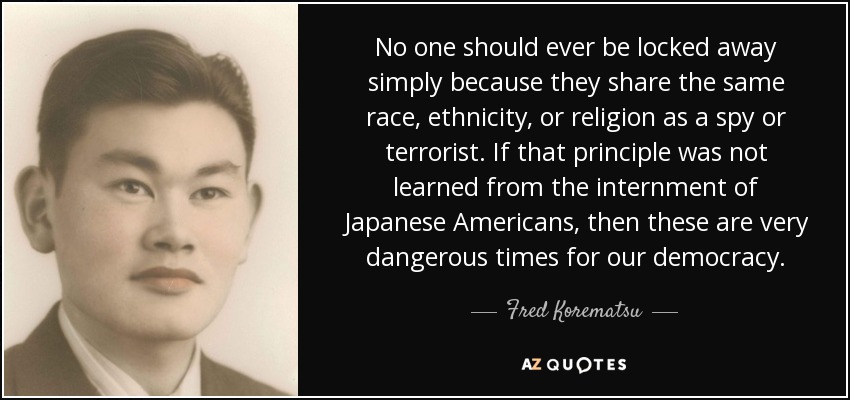
Image result for Fred Korematsu


Remember that the US Supreme Court upheld the internment orders in Korematsu v. US., convicting US citizen Fred Korematsu for refusing to comply with the order.  The Korematsu decision has long been viewed as one of the “ante-canon” landmarks of constitutional law, along with Dred Scott and Plessy v Ferguson.  But it has never been overruled by the Supreme Court, so in a sense it lies in wait…

Korematsu’s conviction was finally overturned in 1998 by a California federal court that found that the Supreme Court decision was based on a fraudulent military report, and Clinton gave him a presidential medal of honor.  The dissent of Robert Jackson (former chief US prosecutor in Nuremberg) in Korematsu is worth revisiting today:

“But once a judicial opinion rationalizes such an order to show that it conforms to the Constitution, or rather rationalizes the Constitution to show that the Constitution sanctions such an order, the Court for all time has validated the principle of racial discrimination in criminal procedure and of transplanting American citizens. The principle then lies about like a loaded weapon, ready for the hand of any authority that can bring forward a plausible claim of an urgent need. Every repetition imbeds that principle more deeply in our law and thinking and expands it to new purposes. All who observe the work of courts are familiar with what Judge Cardozo described as “the tendency of a principle to expand itself to the limit of its logic.” [*] A military commander may overstep the bounds of constitutionality, and it is an incident. But if we review and approve, that passing incident becomes the doctrine of the Constitution. There it has a generative power of its own, and all that it creates will be in its own image. Nothing better illustrates this danger than does the Court’s opinion in this case.”On 2/19/17, the 75th Anniversary of the Japanese Internment Order | Bill Ayers:


Decaying Buildings and the Rise of Digital Education – Wrench in the Gears

Decaying Buildings and the Rise of Digital Education – Wrench in the Gears:

Decaying Buildings and the Rise of Digital Education

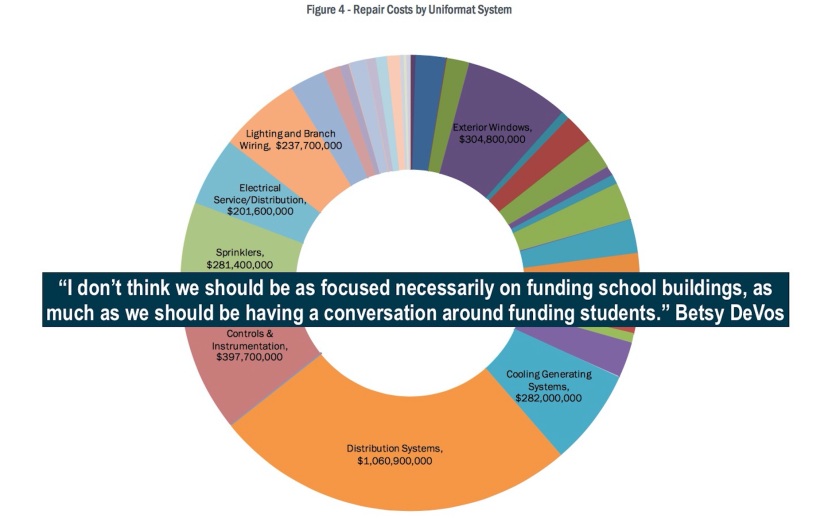
devos-repairs-2

“DeVos doesn’t think we should be funding school buildings as much as students.” The line caught my eye as I scrolled through social media this weekend. How could it not? I’ve been working hard over the past year to try and convince other education activists that the true endgame of the reform movement is to make school buildings obsolete. So I listened to the video of DeVos speaking to attendees of the Magnet Schools of America National Policy Training Conference in Washington, and there it was at timestamp 11:40: “I don’t think we should be as focused necessarily on funding school buildings, as much as we should be having a conversation around funding students.”
DeVos, being from Michigan, surely knows the deplorable conditions students in Detroit face daily trying to access a free and appropriate public education. And Detroit is not alone. Parsons completed a Facility Condition Assessment for the School District of Philadelphia last month identifying $4.5 billion in deferred maintenance. Over $1 billion of that total involves life safety, code compliance, health hazards, accessibility, and security issues. Think about that. We are asking vulnerable children and school staff to enter buildings that are not safe five days a week, while at the same time the Secretary of the US Department of Education is proclaiming we should not be funding school buildings.
This week I also came across a legislative forecast for Educational Savings Accounts (vouchers) prepared by Jeb Bush’s group Excellence in Education. The info-graphic accompanying the report indicated that my home state of Pennsylvania was one of 13 states identified as having a 75+% chance of implementing ESA legislation in the coming year. Our schools are already in an incredibly precarious financial position after Decaying Buildings and the Rise of Digital Education – Wrench in the Gears:

CURMUDGUCATION: Toomey Doesn't Get It

CURMUDGUCATION: Toomey Doesn't Get It:

Toomey Doesn't Get It

Pennsylvania Senator Pat Toomey's office was one that was bombarded with phone calls, faxes, texts, tweets, emails, and messages strapped to the backs of delivery hamsters during the run up to the Betsy DeVos confirmation. At one point he was targeted as one of the GOP senators who might change his mind, which struck me as odd because I've met Toomey and heard him talk about school choice and I don't think he'll be abandoning that drum any time soon. That's okay-- it couldn't have hurt for him (or at least some member of his staff) to hear from actual constituents.


That may be why Toomey (or at least some member of his staff) took the time to write a Betsy DeVos mash note that appeared at PennLive this week. It doesn't make his support of DeVos any more palatable, but it does at least show in brief, painful detail why Toomey is not a supporter of public education.

Toomey opens with what is one of my least favorite pro-charter-choice lines:

No child should be forced to stay in a failing school.

Can anybody, anywhere, find me the person who wants to force a child to stay in a failing school? Nobody anywhere disagrees with this statement. There's considerable disagreement about the definition of a failing school, but let's let that slide for a moment and accept that pretty much everyone believes that there are some schools failing to get the job done. The disagreement starts immediately after that period at the end of this statement. 

For modern charter-choice advocates, the next sentence is "That's why we're going to allow maybe five percent of those students to leave that school for some other school that may or may not be any 
CURMUDGUCATION: Toomey Doesn't Get It:


BustED Pencils Trending News: Resistance! | BustED Pencils

BustED Pencils Trending News: Resistance! | BustED Pencils:

BustED Pencils Trending News: Resistance!


 Stark.  Bleak. Depressing. etc. Have you used any of these words to describe your sense of the world lately?  Hey it’s hard not to.  But let’s not forget that the solutions we seek and the remedy for this malaise is within each of us.

So in that spirit here are three stories of resistance—with endings that prove that we (teachers, students, parents, supporters of public education) can be the “hope for the hopeless and the light in the dark.”
  1. Got Fascism? The 1942 Norwegian Teachers’ Nonviolent Resistance to Nazis Has Answers
  2. Costa Rican women teachers defend schools, help bring down a dictator, 1919
  3. Chicago parents stage occupation to acquire a library for local school, 2010
Check out Rivera Sun—author of Got Fascism.  She will be a feature guest on the radio show in the near future.

Michigan students sliding fast toward the bottom

Michigan students sliding fast toward the bottom:

Michigan students sliding fast toward the bottom


Michigan, already sliding toward the bottom nationally for fourth-grade reading performance on a rigorous national exam, is projected to fall to 48th place by 2030 if the state does nothing to improve education.
That finding is included in a report out today from Education Trust-Midwest, a nonpartisan education research and policy organization based in Royal Oak. The organization analyzed more than a decade's worth of results from the National Assessment of Educational Progress — or NAEP, a tough exam given to a representative sample of students in each state.
In 2003, Michigan ranked 28th in fourth-grade reading. In 2015, the state was ranked 41st.
"We're certainly not on track to become a top 10 state any time soon," said Amber Arellano, executive director of the organization. "It's totally unacceptable for the economy, for business and especially for kids themselves."
Among the 2015 NAEP results highlighted in the report:
• Michigan ranked 41st in fourth-grade reading, down from 28th in 2003.
• The state ranked 42nd in fourth-grade math, down from 27 in 2003.
• It ranked 31st in eighth-grade reading, down from 27th in 2003.
• It ranked 38th in eight-grade math, down from 34th.
The report is focused on the fourth-grade reading results because of how crucial it is for students to be able to read well by the end of third grade. But students have also struggled in math.
The achievement problem crosses demographic lines. Consider how various demographic groups in Michigan compared with similar demographic groups Michigan students sliding fast toward the bottom:

KJ's No Accountability Charter School Chickens Coming Home to Roost? | The Sacramento Bee

Del Paso Heights adult charter school under investigation for overcharging state | The Sacramento Bee:
Del Paso Heights adult charter school under investigation for allegedly overcharging state

Highlands Community Charter School is under investigation for allegedly enrolling adult students in primary grades, double-charging the state and claiming a full year of funding for students who attended for a shorter period of time.
The Sacramento County Office of Education began investigating the Del Paso Heights school after the California Department of Education raised red flags about Highlands’ reimbursement practices.
The adult charter school serves about 1,500 students from a variety of backgrounds, according to Executive Director Murdock Smith. Highlands offers high school completion, English classes, citizenship courses and vocational training. The school opened in 2014 to initially focus on ex-offenders.
The county’s investigation became public after Sacramento County schools chief David Gordon distributed a memo to local school districts recommending the audit.
Gordon said he hired the state’s Fiscal Crisis Management and Assistance Team because of its experience with audits. “They have done hundreds of them and have access to an audit-type staff,” he said. “We don’t have an audit staff in-house.”
Smith was adamant that his school’s business practices were above board. “Ninety-nine percent of the memo is just crazy,” he said.
He confirmed that his school sought state reimbursement at transitional kindergarten through high school levels for adult students. But he defended that practice.
“How can an 80-year-old be a kindergartener?” Students at the school are put into grade levels based on ability, he said.
“Nowhere in the Ed Code links age to grade level,” he added.
State reimbursement for students in K-12 is higher than the money available for adult education programs, which are now funded by regional consortium programs, Gordon said.
The state Education Code allows schools to receive a K-12 level of reimbursement for adults who have not been continuously enrolled in school, said Natasha Collins, a senior fiscal and policy analyst at the Legislative Analyst’s Office. To qualify, schools need to work with Workforce Innovation and Opportunity Act agencies and other federal programs geared toward educating adults.
Highlands Community Charter School has partnerships with the Sacramento Employment and Training Agency, which is authorized by the Workforce Innovation and Opportunity Act.
More than a dozen adult charter schools enroll their students in K-12 grades and receive state funding for those grade levels, said Laura Kerr, managing regional director of the California Charter Schools Association, which advocates for charter schools.
The Sacramento County Office of Education launched its investigation after reviewing a 2015 school audit, the Highlands website and recruitment materials, according to a memo written by SCOE Assistant Superintendent Tamara Sanchez.
The county office is responsible for providing oversight of school finances and took action after the state Department of Education inquired about potential improprieties. State officialsDel Paso Heights adult charter school under investigation for overcharging state | The Sacramento Bee:

Civil Rights Project: Charters Worsen Segregation in D.C. - The Atlantic

Civil Rights Project: Charters Worsen Segregation in D.C. - The Atlantic:

What Could Reverse D.C'.s Intense School Segregation?

Not more charter schools

Charter Schools - Dividing Communities since 1991


Last week, a group of Washington, D.C., parents and teachers stopped Betsy DeVos, the new secretary of education, from entering a D.C. middle school. Several conservative pundits compared DeVos, an outspoken school-choice advocate, to Vivian Malone and James Hood, the black students blocked from entering the University of Alabama by segregationists in 1963. The parallel, however, is somewhat problematic, since one of the things the D.C. parents were rallying against was segregation: The protester Betsy Wolf told NBC Washington she was there to ensure that DeVos “not do things to further the inequity and school segregation that already exists.”
As a new report from UCLA’s Civil Rights Project—a prominent critic of school choice—suggests, the protesters may have cause for concern. D.C.’s school district, despite being a darling of the school-choice movement, is intensely divided by both race and class, and the report’s authors, Gary Orfield and Jongyeon Ee, conclude that charter schools and vouchers may only be exacerbating the issue.
The researchers found that D.C. charter schools, which serve over 40 percent of the city’s student population, are more segregated than D.C.’s other public schools. In 2012, over two-thirds of charter schools, Orfield and Ee note, were “apartheid schools” (defined as having less than 1 percent white enrollment), whereas only 50 percent of public schools had such completely segregated populations. Voucher schools, another model that DeVos favors, often heightened this problem, according to the report, concentrating in affluent, white communities and underserving black families, who could often not afford to pay fees required beyond the vouchers themselves.
D.C.’s embrace of school choice began in earnest in the 1990s, but the city’s schools were segregated long before that. Underlying this is extreme housing segregation (and the hyper-racialized wealth inequality that feeds it). To better understand the scope of the issue, CityLab, a partner of The Atlantic, talked to Civil Rights Project: Charters Worsen Segregation in D.C. - The Atlantic:

US: Remembering Japanese internment camps 75 years on

FDR Called Them Concentration Camps: Why Terminology Matters:

Image result for those that do not remember the past


FDR CALLED THEM CONCENTRATION CAMPS: WHY TERMINOLOGY MATTERS


 Boys Behind Barbed Wire (Norito Takamoto, Albert Masaichi, and Hisashi Sansui), 1944, Manzanar concentration camp (Photo Credit: Toyo Miyatake)

As we approach February 19th, the 75th anniversary of the signing of Executive Order 9066, now referred to as the Day of Remembrance, you'll see a lot of media talking about the Incarceration of Japanese Americans. However, you'll notice that sometimes the terminology isn't consistent. Why do some people say "internment" or "relocation", while others say "incarceration" and "forced removal"?

Here are some of the most common points of confusion, and explanations of why many in the Japanese American community use and avoid specific terminology when talking about our history.


1. "Internment" vs. "Incarceration"

What most people don't realize is that the term "internment" has a very specific meaning. It only refers to the confinement or impounding of "enemy aliens" during a time of war. "Internment" does not refer to the imprisonment of our own citizens. Of the 120,000 who were imprisoned, about 80,000 were indeed American citizens by birthright, while the other roughly 40,000 were barred from citizenship until the law changed in 1952.

"Incarceration" correctly refers to the imprisonment of all 120,000 Japanese Americans who were affected by Executive Order 9066. This correctly acknowledges that these people were mostly citizens, and does not portray them as "enemy aliens."

2. "Relocation" or "Evacuation" vs. "Forced Removal" or "Exclusion"

As you might remember, a public school teacher wrote a horrible op-ed titled "Was the Relocation of West Coast Japanese Racist?" (Yes, it was.) The first problem I noted with his writing was the term "relocation" in the title.

First of all, by definition, neither "relocation" nor "evacuation" include the continued imprisonment of Japanese Americans. "Relocation" is used when talking about a longer term plan to move a population, usually to protect them from some kind of harm. "Evacuation," on the other hand, suggests a short-term removal of persons from an area for their own safety (typically from a natural disaster).

The government knew there was no threat to the West Coast from Japanese Americans, but suppressed the evidence and forced thousands of citizens and legal residents to abandon their homes and their land without due process. That's why in this case, "forced removal" or "exclusion" are appropriate terms that reflect the compulsory nature of the order, and reject that it was "for our own good." They were indeed excluded from the West Coast, and would have been arrested for trying to return.

3. "Internment Camps" vs. "Concentration Camps"

The term "internment camp" is problematic for the same reasons as "internment" above. Critics will complain that the term "concentration camps" is an exaggeration that recalls Nazi camps during the Holocaust. However, the level of brutality does not change the fact that these meet the definition of a concentration camp, for example as seen in the 2013 Merriam-Webster English Language Learner's Dictionary:


Concentration Camp: A type of prison where large numbers of people who are not soldiers are forced to live during a time of war, usually in very bad conditions.

Indeed, the conditions were inhumane for many of those incarcerated. The facilities were surrounded by barbed wire, with guards pointing their guns inwards. Many families were forced to live in horse stables, and many still remember the inescapable stench. You can read Mine Okubo's description of the Tanforan Assembly Center in San Bruno:


"We walked in and dropped our things inside the entrance. The place was in semidarkness; light barely came through the dirty window on the other side of the entrance.... The rear room had housed the horse and the front room the fodder. Both rooms showed signs of a hurried whitewashing. Spider webs, horse hair, and hay had been whitewashed with the walls. Huge spikes and nails stuck out all over the walls. A two-inch layer of dust covered the floor.... We heard someone crying in the next stall."

Let's also talk about another little known part of this history - the Lordsburg detention facility.

Lordsburg was home to some of the most disturbing mistreatment of Japanese Americans. Colonel Clyde Lundy ordered many Issei (first generation Japanese Americans, immigrants barred from citizenship) to build military facilities and perform other types of slave labor in inhumane conditions, a clear violation of the Geneva Convention.

Possibly even more disturbing were the killings of multiple older Japanese American men incarcerated at Lordsburg who were accused of trying to escape. Toshio Kobata and Hirota Isomura, both described as physically disabled and incapable of running, were both shot in the back and killed by a guard, who was found not guilty by an army court-martial board. Article 54 of the Geneva Convention said that attempted escape could not be punishable by death. Sadly, these men may have been targeted for protesting the inhumane treatment.

In case you're still not convinced, read the following quote by Franklin D. Roosevelt himself in a note to the military Joint Board on August 10, 1936: (emphasis is mine)


What arrangements and plans have been made relative to concentration camps in the Hawaiian Islands for dangerous or undesirable aliens or citizens in the event of national emergency?

Yes, FDR himself used the term when discussing the issue, and records show that so did most government authorities and congressional officials. "Internment camp" and "relocation center" are unacceptable euphemisms that ignore the reality of American concentration camps, where the U.S. imprisoned its own loyal citizens and denied them their civil rights.

4. "Japanese" vs. "Japanese Americans"

When discussing the Incarceration of Japanese Americans, these two terms are often used quite interchangeable, and often times without any malice intended, but they have important implications for how we view this historical event.

The most problematic result of the term "Japanese" is obscuring the fact that about 2/3 of the 120,000 who were incarcerated were indeed American citizens. They were the Nisei, second generation Japanese Americans, many of whom had little familiarity with Japan. The other 1/3 were the Issei, the first generation immigrants who were barred from citizenship and even owning land in many places because of discriminatory laws at the time.

Many today also say "the Japanese" to refer interchangeably to both Japanese Americans and the soldiers of the Imperial Japanese military. People try justify the Incarceration by mentioning the crimes of "the Japanese" against POWs, or the attack on Pearl Harbor. People are not understanding that we should never punish our own citizens and their families for the actions of a foreign nation's military. And yet despite this mistreatment, around 33,000 Japanese Americans enlisted and fought for the U.S. during and immediately after World War II.

Looking further back, Japanese Americans had already been residing and raising families in the U.S. for decades, and they had to cope with a grower discriminatory backlash. The 1908 "Gentleman's Agreement" between the U.S. and Japan meant that no more male laborers could immigrate to the U.S., and the 1924 Immigration Act ended Japanese immigration to the U.S. altogether. My great grandfather, for example, came with his family in 1907 to serve as a pastor at a church he founded for Japanese American Episcopalians. His daughter (my grandmother) and other second generation kids grew up almost like any other American child. However, unlike many of her childhood friends, she had to receive her high school diploma while in an American concentration camp.

Is it inappropriate or offensive to use historical euphemisms at all? Yes and no, depending on the context provided. We should remember to critically analyze the euphemisms the government employed to describe the Incarceration of Japanese Americans, and also challenge that language, so that we do not obscure or distort our history. This piece only shows the basics of why these terms are so problematic, but it can serve as a reminder for people to think about how we frame our history. Look for similar ways that euphemistic or propagandist language is applied to how we discuss American Muslims and Muslims around the world, and catch warning signs when it seems that history may repeat itself.
FDR Called Them Concentration Camps: Why Terminology Matters:


An Open Letter from Vietnamese Americans to our Japanese American Brothers and Sisters - http://blog.angryasianman.com/2017/02/an-open-letter-from-vietnamese.html via @angryasianman
 
US: Remembering Japanese internment camps 75 years on - http://www.rawstory.com/?p=989271

A chilling moment to mark the 75th anniversary of the executive order that led to Japanese American internment - LA Times - http://www.latimes.com/local/education/la-me-japanese-executive-order-20170219-story.html on @latimes

75 years later, looking back at The Times' shameful response to the Japanese internment

75 years later, looking back at The Times' shameful response to the Japanese internment - LA Times - http://www.latimes.com/opinion/editorials/la-ed-internment-anniversary-20170219-story.html on @latimes

A History Of The United States’ Fear Of Immigrants | Larry Ferlazzo’s Websites of the Day… - http://larryferlazzo.edublogs.org/?p=74594 on @Larryferlazzo


Trump administration to expand groups of immigrants to be deported: documents - http://www.rawstory.com/?p=989197


Ed Notes Online: DeVos to Tour Schools With Randi - Marshals Doubled to Protect Randi From Union Members' Outrage

Ed Notes Online: DeVos to Tour Schools With Randi - Marshals Doubled to Protect Randi From Union Members' Outrage:

DeVos to Tour Schools With Randi - Marshals Doubled to Protect Randi From Union Members' Outrage


With Betsy DeVos mocked throughout the nation and  on the run, Randi Weingarten has legitimized, or normalized, her by arranging to go visit public schools with her. Some people are speechless. For long-time Randi observers this is totally in line with her modus operendi. Thanks to Abby in Newark for the story.

https://origin-nyi.thehill.com/homenews/administration/320004-devos-to-tour-schools-with-teachers-union-head


DeVos faced a storm of criticism before her confirmation vote, with critics arguing she lacked public school experience.
Protesters then tried impeding DeVos’s entrance into Washington, D.C.’s Jefferson Middle School during a Feb. 10 visit after she was sworn in.

DeVos ultimately entered the school, and Weingarten condemned those attempting to stop the visit, which was organized by the Washington Teacher’s Union, a group which also opposed DeVos’s confirmation.

“Just heard a protester blocked & almost knocked Secy @BetsyDeVos down at Jefferson,” she tweeted Feb. 10. "We don’t condone such acts. We want her to go to pub schls."
Ed Notes Online: DeVos to Tour Schools With Randi - Marshals Doubled to Protect Randi From Union Members' Outrage:

CURMUDGUCATION: ICYMI: Extra Homework Edition + Catch up with CURMUDGUCATION

CURMUDGUCATION: ICYMI: Extra Homework Edition (2/19):

ICYMI: Extra Homework Edition (2/19)


It's a big list this week. As always, remember to share, pass on, and amplify what speaks to you and provide that writer with a wider audience.  

Betsy DeVos Broke the Ed Reform Coalition-- For Now

Daniel Katz with a good historical overview of how we ended up where we are in the ed debates, and what a DeVos ed department means to reformsters.

Stop Learning To Read

From Blue Cereal Education, a reflection on the innate stupidity of certain Lear To Read Or Else policies.

Massachusetts Students Are Increasingly Diverse, but Their Teacher Are Not

Remember when just everyone was concerned about this issue for about five minutes? Here's a reminder from the Boston Globe that it has not gone away, with some actual facts and some acknowledgement that bashing teachers (as the Globe often does) is not helpful.

Detroit Parents Steered To Better Schools That Don't Actually Take Detroit Kids

Detroit continues to be on the forefront of screwing over poor children and their families. Here's how the whole "Once we close your school, you can go to a better one" plan actually works.

They Ruined It

Teacher Tom in Seattle, on the vagueries of playground design.

How I Was Schooled at The NAACP Charter Hearings


Karen Wolfe went to one of the NAACP hearings on charter schools. What she hears, said, and learned there.

DeVos's Stumbles at the Start Are Nothing To Laugh About

Jeff Bryant looks at Betsy DeVos's initial blunders and reminds us that we have no reason to just sit back and laugh

Investigation: Charter school leaders, founders linked to controversial Turkish cleric


This piece looks at New Jersey, but it's a good explanation of how the Turkish-linked Gulen schools, and why they remain one of the very worst abuses of charter school laws in the US

5 Ways Teachers Are Fighting Fake News

There are plenty of these "fake news" stories for classroom teachers, with plenty of minilessons and tips. This is just one.

Online Charter Legislation for This Year

A look at what's up in some states this year as far as regulating the failing cyber charter industry. Plus, a handy chart showing just how much money one of the major players is spending to lobby in state legislatures.
CURMUDGUCATION: ICYMI: Extra Homework Edition (2/19):


Catch up with CURMUDGUCATION


Big Education Ape: Catch up with CURMUDGUCATION: PA Senate Ed Chair Wants To Trash Education - http://bigeducationape.blogspot.com/2017/02/catch-up-with-curmudgucation-pa-senate.html

In Annual Newsletter, Gates Goes Silent on Education | deutsch29

In Annual Newsletter, Gates Goes Silent on Education | deutsch29:

In Annual Newsletter, Gates Goes Silent on Education


Each year, the Gates Foundation issues an annual newsletter touting what it perceives as the gains make by its spending.
In 2015, the education focus of the newsletter was, “Better software will revolutionize learning.” The 2015 Gates ed celebration includes the following comment:
Our foundation gives more money to education than to any other cause in the United States because it’s the best lever we’ve seen for giving every child in America a chance to make the most of their lives.
Gates acknowledges that it gives more money to education than to any other US cause. Therefore, it is strange that there is no mention of the Common Core, which Gates has spent hundreds of millions to fund (see here, as well).
Gates also does not mention that it can pull its financial support if and when it likes, which is what happened in 2015 to Hillsborough County Schools’ “Empowering Effective Teachers” grant from Gates. Hillsborough was left holding the bag to the tune of 20 million “late in the process.”
Thus, teacher evaluation was another Gates-funded flop (see here for cautions about its test-score center), as was its “small schools” effort– more than $2 billion according to Gates in 2009– as the Washington Post’s Valerie Strauss notes in 2014. Chopping larger schools into smaller ones mostly didn’t work, and what Gates glosses over is how chaotic it can be to the school system to alter itself on a billionaire’s whim and then be shrugged off by the billionaire. (More about Gates’ small schools bail in this post.)
Note that Gates offered no funding to systems to reinstate the system it had in place prior to participating in Gates’ failed “small schools” push.
Gates offers no insurance, and by 2015, “small schools” is a term surely not In Annual Newsletter, Gates Goes Silent on Education | deutsch29:


Resistance Sunday. | Fred Klonsky

Resistance Sunday. | Fred Klonsky:

Resistance Sunday.

screen-shot-2017-02-19-at-6-37-31-am-1

In neighborhoods across Chicago with large immigrant populations, people are banding together to form rapid response networks to support their neighbors in the event of expected deportation raids by President Donald Trump’s administration.

In the 35th Ward on the city’s Northwest Side, Ald. Carlos Ramirez-Rosa has started what he calls the Community Defense Committee.
In Rogers Park, home to an extremely diverse immigrant population, volunteer organizers have chosen to dub their effort Protect RP.
In Little Village, the Mexican capital of the Midwest, they have picked the name La Villita Se Defiende, which translates to Little Village Defends Itself.
As with the different names, each group seems to be charting its own tactical approach, but the overarching goal is the same: to protect undocumented immigrants by resisting efforts to deport them.
Resistance eventually could take the form of actually interfering with federal agents in the performance of their duties, something not to be taken lightly Resistance Sunday. | Fred Klonsky:


Schools Matter: Let's Slow Down the Faster Future

Schools Matter: Let's Slow Down the Faster Future:

Let's Slow Down the Faster Future

Image result for train illusion

Whiplash: How to Survive Our Faster Future, Joi Ito, Director, MIT Media Lab & Jeff Howe
Grand Central Publishing 2016

Kirkus calls this book “exhilarating and authoritative,” two cybergurus offering a “user’s manual to the twenty-first century.”  As a longtime teacher, I find the manual to be flawed. I was interested in the authors’ observation that the failure of Microsoft’s  professionally designed Encarta encyclopedia contrasted with the success of Wikipedia’s amateur-led platform as examples of  push-pull consumerism, with suppliers “pushing” goods toward consumers and consumers “pulling” goods according to their needs, with  Encarta being push and Wikipedia pull. Similarly, AOL, with its traditional push approach originally faltered and Twitter’s pull flourished.

Certainly it’s not surprising that the director  and visiting scholar at the MIT Media Lab would be cheerleaders for technology, but I guess I’m too old to embrace  Moore’s law, which the authors explain thusly: “everything digital gets faster, cheaper, and smaller at an exponential rate,” and this results in “wearable computers. Robots building robots.” We are told that we live in exponential times and “Change doesn’t care if you’re ready.”


 One assertions strikes me as particularly whacky. The authors  insist that compasses are way more useful than maps. “A map implies a detailed knowledge of the terrain, and the existence of an optimum route; the compass is a far more flexible tool and requires the user to employ creativity and autonomy in discovering his or her own path…..a good compass…will always take you were you need to go.” I’d say it depends on where you are and where you want to go. I’m comfortable watching the compass when my hand is on the tiller only  because of my husband’s careful study of  the charts that have given him  detailed knowledge of  the shallows and hazards of Lake Champlain.

It seems astounding that authors who have extolled compasses over maps can be so enthusiastic about KIPP schools, gushing,“KIPP schools have achieved admirable results in communities saddled with failing public schools. They focus on discipline, longer school days, and a steady diet of math, reading, writing, and homework.” The authors choose to ignore devastating research by scholars such as Professor Jim Horn whose Work Hard, Be Hard: Journeys Through “No Excuses”documents what it’s like to teach and be taught in KIPP with its straightjacket classroom conditions. No  compasses here, only strict schedules that must be obeyed. With breathtaking and heartbreaking examples, Horn shows that teacher behavior becomes reminiscent of subjects in Stanley Milgram’s infamous experiments—all to produce a corps of Blacks who obey orders. 


The authors intone about the importance of maintaining “a culture of creative disobedience,” emphasizing that human systems are most resilient at their most diverse. 
In promoting the assertion that all kids should learn coding, the authors nod toward research Schools Matter: Let's Slow Down the Faster Future:


Get 20% Off w/code: RLEGEN16