Latest News and Comment from Education

Thursday, December 22, 2016

Carol Burris: Under Trump, will the marketplace be the only regulator of school ‘choice’? - The Washington Post

Under Trump, will the marketplace be the only regulator of school ‘choice’? - The Washington Post:

Under Trump, will the marketplace be the only regulator of school ‘choice’?
Image result for market forces

The “school choice” movement in the United States is bound to get a huge boost from President-elect Donald Trump’s selection of Betsy DeVos, a Michigan billionaire and choice advocate, as his secretary of education. If she is approved by the Senate, as expected, DeVos will push to expand a range of choice programs that use public funds for schools not part of traditional public systems.
DeVos has called the public education system in the country — which many see as America’s most important civic institution — as a “dead end” and a goverment-run “monopoly.” That’s why public education advocates are worried about her impending leadership at the U.S. Education Department.
One of the pieces in DeVos’s constellation of choice programs are charter schools, which are publicly funded but operated independently from traditional systems, sometimes by nonprofits and somethings by for-profit companies. Nationwide the charter school sector has grown over the past few decades amid a debate about its virtues and drawbacks — and even whether the publicly funded schools are public or private entities. Some charters are excellent. But as the sector has grown, so have problems that have gone unaddressed.
Ohio and Utah have troubled charter sectors, as does Arizona, where there are no laws against conflicts of interest and where for-profit charters do not have to open their books to the public. In Michigan, 80 percent of the charters are operated entirely or substantially by for-profit entities. Pennsylvania Auditor General Eugene DePasquale recently declared his state’s charter school law the “worst” in the nation. California has more charter schools and charter school students than any other state in the nation.
This fall I published a four-part series on California’s charter schools, often called the “Wild West” of the charter sector. Why? Here’s an example:
*One charter school closed in 2014 after state auditors found a number of issues, including indications that administrators funneled millions of dollars in state funds to the schools’ operator and her family and friends. As the Los Angeles Times reported, some of the allegations against the school operator were downright “bizarre.” Auditors questioned the use of school funds to pay a more than $500,000 settlement to a former teacher who sued, claiming she had been wrongly terminated after she was ordered by the school director to travel to Nigeria and marry the director’s brother-in-law so he could become a U.S. citizen. The operator’s penalty? She paid “a $16,000 fine for misconduct that includes using public education funds to lease her own buildings,” the Times said.
That series was written by former award-winning high school principal Carol Burris, who is now executive director of the nonprofit Network for Public Education advocacy group. She chronicled many of the glaring problems with the charter school law in California. Here is a new post by Burris about charter schools and the “choice movement.”
By Carol Burris
The drive to privatize the public education system under the guise of “choice” is well under way — and can be expected to pick up steam when Donald Trump becomes president. He chose as his education secretary a Michigan billionaire named Betsy DeVos, who is an ardent supporter of school choice who has said the public education system is a “dead end.”
During the past 60 years, public education has been the frog in the pot of water, as school privatizers and “education reformers” have slowly turned up the heat. Over 1 million students Under Trump, will the marketplace be the only regulator of school ‘choice’? - The Washington Post:


The Modern Purpose of Public Education Is to Grade Teachers. Or So It Seems. | deutsch29

The Modern Purpose of Public Education Is to Grade Teachers. Or So It Seems. | deutsch29:

The Modern Purpose of Public Education Is to Grade Teachers. Or So It Seems.


I teach public school in southern Louisiana, and I am on my second day of Christmas break.
Before I began my holidays, I had to reckon with the New Reality for public school teachers across the country:  I had to tabulate my value based upon test scores of my students, scores that exist for the sole purpose of rating me.
It wasn’t pretty. The outcome indicated that my value is very low and that my students would have done better had I not shown up at all.
The above determination of my worth in the classroom is a numeric determination made by my entering test scores and student class averages into a “calculator” created by my district. The result is one of two numbers that will be averaged to account for 50 percent of my annual teacher evaluation.
Such comprises the 50 percent of my evaluation that must be quantitative.  (Feel free to read about that here.)
On the surface, it seems like grading teachers using student test scores should work without a hitch. And it would, if I assumed an unethical, unhealthy control over those testing outcomes, including but not limited to somehow shaping the student population whom I serve, or giving students grades for work not completed, or removing/altering grades/falsifying my reporting, or drilling students into a narrowed perfection on the test used to grade me, or even blatantly feeding students the correct answers on the test used to grade me.
Given the flat weight I felt at having to officially report my own low value as part of The Modern Purpose of Public Education Is to Grade Teachers. Or So It Seems. | deutsch29:

Happy Holidays! A Look Back at 2016 | Schott Foundation for Public Education

Happy Holidays! A Look Back at 2016 | Schott Foundation for Public Education:

Happy Holidays! A Look Back at 2016

Happy Holidays from the Schott Foundation!
While 2016 was a tough year on many fronts, we accomplished so much this year, and nothing we did was possible without the hard work of grantees and partners like you.
Here are just a few incredible things we're grateful to you and our many exceptional partners for making possible in 2016:
  1. We had the largest grantmaking year in our history, providing nearly $3 million in grants to grassroots and policy organization - and we leveraged millions more for our grantees from local and national donors.  We co-launched a new fund support gender justice, the NYC Fund for Girls and Young Women of Color.
  2. The National Opportunity to Learn Network added over 2,500 new members, growing the network to over 27,000 members fighting for education justice.
  3. We launched our Grassroots Education Webinar series, engaging more than 3,000 participates in education and policy discussions across the country.
  4. Our local and state partners led key education policy and movement building victories in Massachusetts, California, Pennsylvania, Arkansas, New York, New Orleans, Chicago and Mississippi.
  5. Communication Tools & Resources: We produced 7 policy infographics and 126 blog posts highlighting key policy solutions.
  6. Race and Gender Research: We partnered with four major research institutions to support implicit bias research, including the Center for Policing Equity who is conducting one of the largest school-to-prison pipeline studies in the nation.
  7. We launched our 25th Anniversary celebration with a public forum in Boston: Addressing Racism: Strategies for Systemic Change.
Here’s a brief recap of some of our most popular resources in 2016.Happy Holidays! A Look Back at 2016 | Schott Foundation for Public Education:


CURMUDGUCATION: DeVos's Inconvenient Truths

CURMUDGUCATION: DeVos's Inconvenient Truths:

DeVos's Inconvenient Truths


Valerie Strauss of the Washington Post turned up a 2015 speech from billionaire heiress and Education Secretary Designee Betsy DeVos in which Devos lays out her six "inconvenient truths," the guiding principles by which her vision of American education is powered. Ed Patru, a self-identified spokesperson for Friends of Betsy DeVos (so I guess that's a thing-- damn), indicates that the speech is a fair measure of DeVos's animating philosophy, so we'd probably better take a look at these six pillars of super-duper governance that's headed our way like a over-loaded semi with a brick on the gas pedal.

Inconvenient Truth No. 1-- Our education system in America is antiquated and it is quite frankly embarrassing.

DeVos compares public education system to the Model T, and talks about how Detroit totally innovated to do a better job of producing automobiles, so I'm a little confused-- she wants to send American children to Mexico and Canada to be educated under less safe conditions by underpaid workers?


This truth is where we get to bring up the criticism of DeVos that she has never in her life spent any time in an actual public school. She didn't attend one; her children didn't attend one. This is not a mean, personal attack-- it's an explanation for why she doesn't appear to know what the hell she's talking about.

This is what I call Reformster Timewarp Syndrome, in which reformsters criticize public schools based on the assumption that these schools are exactly the way they were fifty years ago (when some reformsters attended them as students). This is like criticizing the military for still fighting on horseback.

Is there room for improvement, growth and new creativity in public schools? Absolutely. And there's no question that like many institutions, public education is at root conservative. But on this point of antiquation and embarrassment, DeVos is just spouting vague, baseless baloney.

Inconvenient Truth No. 2-- American education has been losing ground to other countries for at least half a century.

DeVos says the facts here are "unarguable," and follows up that piercing argument with "it's really a 
CURMUDGUCATION: DeVos's Inconvenient Truths:


Read Me, Please! My favorites from 2016 - Lily's Blackboard

Read Me, Please! My favorites from 2016 - Lily's Blackboard:

Read Me, Please! My favorites from 2016

It’s been a busy year, and if you’re anything like me, you have a growing list of articles you flagged and promised yourself that you’ll get to…eventually. Over the years, I’ve found that the holiday break allows a great opportunity for us to dig in and make a dent into that reading list. Last year I started the “in-case-you-missed-it must reads” list of NEA Today’s award-winning journalism, and I’m excited to share with you some of my favorites.

From closing the achievement gaps and charter schools to inspiring educators and social justice, plus everything in between, these articles should not be missed. So whether you’re going over the river and through the woods to grandmother’s house or staying put for the holidays, make sure to read the amazing stories from the past year.
Achievement Gaps
String rehearsal with violins, viola, cellos, and basses.
The opportunity ESSA presents isn’t a question of interpretation or misplaced hope that things will just be different. It’s right there in the text of the law. Gone are references to “core academic subjects,” highlighted repeatedly in NCLB. In its place is language calling for a “well-rounded education” for all students. (The term appears 24 times in the law.) Everything from arts, physical education, science, civics and government, music and foreign languages is named, making them eligible for federal funding under ESSA.
Empty playground swing with children playing in the background concept for child protection, abduction or loneliness
In recent years, mandatory-recess legislation has been introduced in at least four states, including Florida, Illinois, New Jersey, and Rhode Island. Meanwhile, one Texas school has jacked up its daily allotment of recess to four times a day. Recess supporters point to the health benefits of exercise and movement, the way that physical activity supports cognitive development, plus the critical social and emotional learning that takes place when children have unstructured, free time to play.
 Charter Schools
charter_waste_1
Many people support the idea behind charter schools, but how many are aware of the mounting troubles the charter industry has experienced lately? Probably not enough. Proponents work very, very hard to maintain a facade of Read Me, Please! My favorites from 2016 - Lily's Blackboard:


Education Civil Rights Advocates Fear "Horror Show" Under Trump - BuzzFeed News

Education Civil Rights Advocates Fear "Horror Show" Under Trump - BuzzFeed News:

Education Civil Rights Advocates Fear “Horror Show” Under Trump

The Department of Education’s Office of Civil Rights is bracing for change under the president-elect, who’s previously talked about cutting the office. Many conservatives believe the agency has gone too far in pushing a progressive federal agenda on local community schools


 Over the past eight years, officials in the federal Department of Education’s Office for Civil Rights have pushed to transform their little-known agency into a force for social change on the nation’s schools and college campuses.

The office launched a data-driven campaign to prevent school districts from meting out harsher discipline to black and Latino students than to their white counterparts. It took on campus sexual assault as a federal civil rights issue, forcing colleges to more closely track rapes and sexual assaults and revamp their legal procedures for addressing them. It instructed public schools to treat transgender students consistent with their identity. And it waged battle after battle in individual school districts, such as one that resulted in a settlement this August that forced the San Bernardino County Superintendent of Schools to improve the education in its alternative schools.
But now, with the election of Donald J. Trump and his Secretary of Education nominee Betsy DeVos, many officials in the office fear much of what they see as progress could come to a halt.
Trump has publicly said that he would either dismantle or cut the Department of Education by “a lot.” Many conservatives believe the agency has gone too far in pushing a progressive federal agenda on local community schools. At least one Trump surrogate has suggested the Office of Civil Rights is no longer needed, calling it “self-perpetuating absolute nonsense.”
Earlier this month at an event meant as a celebration of its accomplishments over the past eight years, many speakers couldn’t help but make ominous — and repeated — remarks about the recent presidential election.
“We’ve got some tough times ahead but we are up to it,” said Marian Wright Edelman, founder and president of the Children’s Defense Fund, during opening remarks. Edelman was once a mentor and boss to Democratic presidential candidate Education Civil Rights Advocates Fear "Horror Show" Under Trump - BuzzFeed News:

Fethullah Gulen linked to Cincy charter school rejects blame in envoy's killing

Cleric linked to Cincy charter school rejects blame in envoy's killing:

Cleric linked to Cincy charter school rejects blame in envoy's killing


MOSCOW — A U.S.-based Muslim cleric on Thursday condemned the killing of Russia's envoy to Turkey and rejected accusations that his movement was behind the attack.
Ambassador Andrei Karlov was shot dead by an off-duty policeman in front of stunned onlookers at a photo exhibition in Ankara earlier this week. Turkish President Recep Tayyip Erdogan has implicated Fethullah Gulen in the killing, saying the policeman had links to his movement.
In a video address made available to The Associated Press, Gulen accused the Turkish government of blaming and defaming his movement and suggested the government would facilitate other assassinations and blame them on his followers.
Gulen said "it is not possible for them to convince the world of such accusations."
In October, a report from an international law firm hired by the Turkish government stated Gulen’s worldwide network includes the Horizon Science Academy in Bond Hill, which is under state and federal scrutiny.
The network also includes 16 other charter schools in Ohio, according to the law firm Amsterdam & Partners.
The firm accused the Gulen schools of a real-estate scam that had resulted in a profit of $18.8 million on the backs of Ohio taxpayers.
Russia flew a team of 18 investigators and foreign ministry officials to Turkey to participateCleric linked to Cincy charter school rejects blame in envoy's killing:

The complicated history of America's first 'union-backed' charter school authorizer | MinnPost

The complicated history of America's first 'union-backed' charter school authorizer | MinnPost:

MinnPost's education reporting is made possible by a grant from the Bush Foundation.

The complicated history of America's first 'union-backed' charter school authorizer

 The National Association of Charter School Authorizers discourages authorizers from taking over low-performing charters, as there’s very little evidence to suggest that new authorizers can turn them around


Despite its name, the Community School of Excellence in St. Paul has not distinguished itself with excellence. Instead, the Hmong-focused charter has become one of Minnesota’s most scandal-ridden schools. Battles between teachers and the administration have been common, with educators repeatedly reporting threats and retaliatory behavior. And since 2012, the school has been found not only to have suppressed multiple reports of suspected child abuse at the urging of its controversial superintendent, but also to have misdirected federal funds for subsidized student lunches — even after receiving a hefty fine for the practice.
Nor has the Community School of Excellence excelled academically. Since its inception, the school has produced poor test score results. In 2016, just a third of its students met state reading standards.
Yet these troubles have not prevented the school’s rapid expansion. When it opened in 2007, the CSE had 176 students; today, it’s one of the largest charter schools in Minnesota, with nearly 1,000 kids enrolled.
After a state investigation and reams of bad publicity — within just a few years the school had been investigated by the FBI, the Minnesota Department of Education, the federal Department of Education, the Department of Agriculture, local law enforcement, and the National Labor Relations Board — the powers-that-be had had enough. When efforts to jettison the school's superintendent failed, the school's legal backer abandoned it altogether, a move that could have effectively shuttered the flailing charter.
Instead, something else happened. The Community School of Excellence was bailed out — just hours before it would have been closed permanently — by an unlikely savior: The Minnesota Guild of Public Charter Schools, a nonprofit created by the local teachers union and funded in part by its national parent, the American Federation of Teachers.

A unique law

To understand what a union-backed group was doing rescuing a notorious charter school — and why that was so unusual — you have to dive into the little-noticed world of charter authorizing.
Charters aren’t unregulated, of course, but their monitoring system isn’t well understood, either. Across the country, charter schools are generally overseen by another organization: most often a public school district, but it could also be anything from a university to a state commission. This third party — called an authorizer — grants a charter the right to exist, and in turn, takes over much of the work of ensuring that the school complies with relevant laws and regulations. Authorizers are also tasked with monitoring schools’ academic performance. In theory, if a charter strays too far from the straight and narrow, authorizers are expected to shut it down.
Minnesota, long regarded as a leader in education reform, virtually invented the authorizer system when it opened up the nation’s very first charter school 25 years ago. By the early aughts, however, state officials recognized that they had accumulated an awfully high number of charter authorizers (then referred to as “sponsors”) that were not taking their oversight responsibilities very seriously, a situation that enabled some charter leaders to seek out especially lax authorizers. 
In response, in 2009, legislators decided to increase the responsibilities assigned to Minnesota authorizers. When all was said and done, the reforms reduced the number of authorizers in the state from 51 to 13, and education reform advocates took the dramatic The complicated history of America's first 'union-backed' charter school authorizer | MinnPost:

Webinar: #ReclaimOurSchools! | Schott Foundation for Public Education

Webinar: #ReclaimOurSchools! | Schott Foundation for Public Education:

Webinar: #ReclaimOurSchools!


Image result for Alliance to Reclaim Our Schools
Dozens of cities are gearing up for a demonstration of support for their public schools and the fight for the schools all our children deserve. On May 4, parents, students and educators will gather outside of their schools before the bell to hold a rally and march. Then they will walk into their schools together in a show of solidarity.
This is the second national walk-in event organized by the Alliance to Reclaim Our Schools — and the movement is growing! Earlier this year, 33 cities participated in the first national walk-in on February 17.
Tune in for an exclusive webinar on the issues facing public education and the organizing we can do to make sure all children have an opportunity to learn in a safe and well-funded public school. Learn about walk-ins happening near you on May 4 and how you can get involved.
Speakers include:
  • Keron Blair, National Director, Alliance to Reclaim Our Schools
  • Nate Gunderson, Organizer, National Education Association
  • Edgar Villanueva, Vice President of Programs and Advocacy, Schott Foundation for Public Education


Webinar: Beyond the First Look: Turning Local Data Into Action

Thu, 2016-07-07
The Schott Foundation a webinar featuring our partner Dignity in Schools Campaign where participants:
- Explored the U.S. Department of Education Office for Civil Rights First Look Data
- Prepared advocates for upcoming release of the U.S. Department of Education Office for Civil Rights district level data
- Shared potential strategies for how to use the data in organizing efforts at the local, state and federal level
- Described limitations of the data and places where those challenges are being discussed

Webinar: Addressing Classroom Bias to Improve Learning

Thu, 2016-09-01
The school-to-prison pipeline has been prominent in the education debate for the past several years, and youth, parents, teachers, and communities across the country have put questions of school discipline, restorative justice and implicit bias at the heart of their organizing work.

Webinar: Strategies for Lifting All Children Up

Thu, 2016-07-28
What will it take to ensure that all children have an opportunity to learn, regardless of their background or which school they attend?
The work of the National Education Policy Center at the University of Colorado has long pointed out that the problems of inequity in public education aren’t just contained within our public schools, but also stem from larger structural issues in the community like unemployment, poverty, and disinvestment of public resources. These structural problems weigh down students and their schools in ways that more affluent communities rarely have to deal with — so what can we do to lift them up?

Webinar: Protecting an Opportunity to Learn Through ESSA State Accountability Plans

Wed, 2016-10-05
With the passage of the Every Student Succeeds Act (ESSA) last year, an unprecedented level of autonomy and control has been given to states and districts in crafting education policy. Many organizations and advocates see a real opportunity to advance an equity agenda through ESSA's implementation: the law supports the planning and implementation of community schools with wraparound supports and pushes states to look beyond mere test scores when assessing student achievement.

Webinar: Bursting the Bubbles: Is There a Link Between Standardized Tests and Improved Learning?

Fri, 2016-12-09
High-stakes tests became a centerpiece of education reform under No Child Left Behind: countless fill-in-the-bubble sheets that could impact everything from a student's academic placement and a teacher’s employment to school climate and whether their school will be closed. But what’s the origin of standardized testing? What does the research show? What can standardized tests truly measure, and how are policymakers (mis)using them?


Webinar: #ReclaimOurSchools! | Schott Foundation for Public Education:

California appeals federal decision on state science testing | EdSource

California appeals federal decision on state science testing | EdSource:

California appeals federal decision on state science testing

Image result for big education ape science testing

lifornia education officials have appealed the U.S. Department of Education’s decision to reject the state’s request to begin phasing in tests this spring based on new science standards, rather than administer current tests based on standards in place since 1998.
In a letter sent Tuesday to federal education leaders, State Superintendent of Public Instruction Tom Torlakson and State Board of Education President Michael Kirst wrote that they are seeking an administrative hearing in Washington, D.C., to make their case before Ann Whalen, a senior adviser to U.S. Secretary of Education John King Jr.
Existing federal education law requires that the U.S. Department of Education hold a hearing by Dec. 29, but Torlakson and Kirst requested that the hearing be postponed until after the Jan. 2 holiday to allow state education staff time to prepare for the hearing.
“Given the upcoming holiday season, we believe that conducting a hearing prior to this date (Dec. 29) will be burdensome for both parties,” Torlakson and Kirst wrote.
“We hope to honor our respective staffs’ family obligations, and recognize the difficulty and expense of booking last-minute travel during the holiday season,” they wrote. “This suggestion does not represent a waiver of our right to a hearing; instead, it indicates our willingness to waive the statutory time limit within which that hearing should be conducted.”
The U.S. Department of Education did not immediately respond to a request for California appeals federal decision on state science testing | EdSource:

Big Education Ape: Federal Denial of Science Testing Waiver Request - Year 2016 (CA Dept of Education) - http://bigeducationape.blogspot.com/2016/12/federal-denial-of-science-testing.html

12/22/2016 – Girding For The Education Fight Ahead

12/22/2016 – Girding For The Education Fight Ahead:

Girding For The Education Fight Ahead


THIS WEEK: DeVos’ Donor Advantage … More Private Choice Coming … Obama’s Edu-Legacy … Online Charters Love Trump … Computer Conundrum

TOP STORY

Girding For The Education Fight Ahead

By Jeff Bryant

“If you want to get an idea of what kind of education policies to expect from a Donald Trump administration, Wall St. has a clue for you … Online charter schools are ‘gearing up for a boom during the Trump administration, judging by where investors are placing their bets’… A burning question is, ‘Where are the Democrats?'”
Read more …

NEWS AND VIEWS

DeVos Heads Into Confirmation With A Megadonor’s Advantage

Politico

“Billionaire Betsy DeVos has been unabashed about using her wealth to advance her own agenda. ‘We expect a return on our investment,’ she once wrote … After giving millions of dollars to politicians over the past two decades, she now heads into her Senate confirmation hearing for education secretary with a clear advantage: DeVos and her husband, Dick, have donated to the campaigns of 17 senators who will consider her nomination – four of whom sit on the Senate education committee that oversees the process … Over the past two and half decades, the couple donated more than $7.7 million to Republican candidates and parties across the country.”
Read more …

Beyond Vouchers: How Trump Could Boost Private School Choice

Education Week

“What other avenues are there for Trump, DeVos, and Congress to expand private school choice?… Tax-credit scholarships allow individuals and corporations to claim a tax credit of some kind, in exchange for a donation to an organization that provides scholarships to children… Congress could find some way to … create a new education savings account applicable to K-12 … [Or] an annual $250 million federal grant program to promote private school choice.”
Read more …

The Education Of Barack Obama

The Nation

Dana Goldstein writes, “When it came to K–12 policy, [Obma’s] first six years were defined by an aggressive reform agenda that left the traditional camp, especially the teachers unions, playing defense. Only since 2014 has there been a détente … Grassroots activism from the Black Lives Matter movement, as well as from tens of thousands of parents who opted their children out of standardized testing, helped shift the terms of the debate. We now talk almost as much about school discipline, unequal school funding, and school segregation as we do about low test scores and teacher tenure. It’s a profound change in rhetoric … The expansion of the charter-school sector seems likely to be the most lasting of Obama’s education reforms.”
Read more …

Online Charter Schools Prepare For A Trump-Era Boom

BuzzFeed

“Online charter schools are widely regarded as among the country’s worst-performing, plagued by abysmal test scores and sky-high student turnover rates. They’re also gearing up for a boom during the Trump administration … K12 Inc., the online charter school industry’s largest and most controversial player, has risen in value by more than 50% since November 8 … Betsy DeVos … is married to an early investor in K12 … Vice President Mike Pence has worked closely with groups tied to the company. ”
Read more …

Giving Children Computers Basically Does The Opposite Of What You Expect

The Washington Post

“The benefits of having a computer at home are subtle and somewhat counterintuitive … Researchers … in California looking for students in grades six through 10 who didn’t have access to a computer at home … divided [stuents] into two groups. One group received free desktop machines …The other group got nothing … In the end, none of this had a measurable [academic] effect … The children who saw the most benefit were the ones who didn’t have a social-network account at the beginning of the experiment. They became more likely to chat with friends and to meet with friends face-to-face.”
Read more …
12/22/2016 – Girding For The Education Fight Ahead:

LEONIE HAIMSON: Meet Trump’s Public Ed Wrecking Ball | The Indypendent

Meet Trump’s Public Ed Wrecking Ball | The Indypendent:

Meet Trump’s Public Ed Wrecking Ball

Billionaire Betsy DeVos is radical privatizer with no prior experience as public school parent or educator.


Donald Trump’s nomination of Betsy DeVos as Secretary of Education could be a devastating blow for American public schools.
“DeVos’s agenda is to break the public education system, not educate kids, and replace it with a for-profit model,” John Austin, president of the Michigan State Board of Education, told the Detroit Free Press after her appointment was announced Nov. 23. 23. “It’s like putting the fox in charge of the henhouse, and hand-feeding it schoolchildren.”
DeVos is the daughter of a wealthy auto-parts manufacturer who funded Christian-right causes, and her brother Erik Prince founded the mercenary company Blackwater. She married Dick DeVos, the billionaire heir to the Amway fortune. The two, based in Grand Rapids, Mich., have used their personal wealth to encourage the expansion of charter schools, to prevent any government oversight of their use of public funds or regulation of the quality of education they provide and to aggressively promote the use of vouchers to let taxpayer funds pay for private and parochial schools.
She would be the first Secretary of Education who never attended a public school or sent her own children to one. She has never worked as a teacher, served on a school board, or held any position in government. 
DeVos is an even more radical privatizer than either Arne Duncan or John King, President Barack Obama’s education secretaries. Both Duncan and King favored expanding the charter sector, offering these publicly funded, privately run schools more than $1.5 billion in federal grants between 2010 and 2015. The Department of Education’s Race to the Top program offered states the chance of winning millions more if they let the number of charter schools expand. Many states, including New York, then raised their charter caps.
The DeVos family is among the leading donors to the Republican Party. According to an analysis by ­OpenSecrets.org, they have given at least $20.2 million to GOP candidates, party committees, PACs, and super PACs. They also finance far-right groups that promote climate-change denial, oppose marriage equality, and want to cripple labor unions, such as Michigan’s Mackinac Center for Public Policy. Another group they support, the Acton Institute, argues for the abolition of child-labor laws.
“I have decided to stop taking offense at the suggestion that we are buying Meet Trump’s Public Ed Wrecking Ball | The Indypendent:


Argentina's tough truths for improving schools - BBC News

Argentina's tough truths for improving schools - BBC News:

Argentina's tough truths for improving schools

"We don't want to accept that we're doing badly at anything," says Argentina's education minister, Esteban Bullrich.
Whether it is admitting to levels of poverty, the inflation rate or weaknesses in the education system, Mr Bullrich says Argentina has been ill-served by a political culture which has not wanted to face up to uncomfortable truths.
Improving the quality of schools is the task facing the minister and he says the first point is to admit to the extent of the difficulties.
This is an education system where most schools are only open for four hours a day and he says that despite previous claims to the contrary - only about half of young people actually successfully complete their secondary education.

Left behind

The results of the latest international Pisa results, published by the OECD this month, seem emblematic of the challenge.


congressImage copyrightISTOCK
Image captionIn the 1970s, Argentina was much better off than South Korea - now the positions are reversed

Argentina was not included in the results after confusion over the sample of schools taking the tests - so it remains uncertain where the country stands in such international rankings.
The problems with the test pre-dated Mr Bullrich's time as education minister, but he is now picking up the pieces.
Another awkward question is why Latin American countries have been left standing by the rising Asian star performers, such as Singapore, South Korea and Vietnam, who are building their economies on investment in education.

More stories from the BBC's Global education series looking at education from an international perspective, and how to get in touch.
You can join the debate at the BBC's Family & Education News Facebook page.

Mr Bullrich says that in the 1970s, Argentina had a GDP per capita that was five times greater than South Korea - now it is three times smaller.
Argentina has failed to keep up and economies such as South Korea and Singapore are reaping the rewards.
Even though South Korea started from a long way behind, the world is watching Samsung televisions rather than any technology built in Argentina.

Long-term planning

The challenge for Mr Bullrich is how to begin to catch up - and he dismisses the self-serving argument that Pisa tests are really for European and Asian systems and not applicable elsewhere.
He says education has to be taken seriously - on an international as well as a national stage.
So when Argentina hosts the G20 summit in 2018, he says an education section will be introduced for the first time.
Mr Bullrich has an ambitious set of reforms - but speaking in London, he says it will mean long-term investment rather than relying on "magic answers" from "messianic leaders".


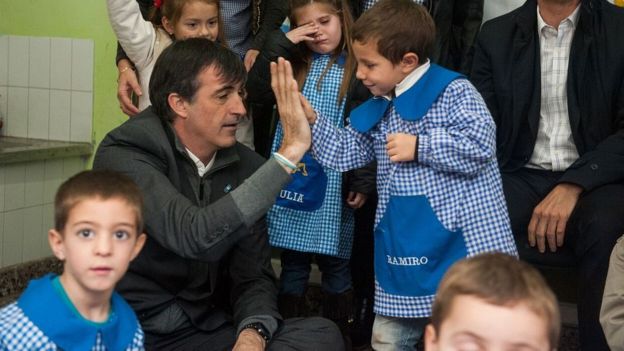
Bullrich in school
Image captionMr Bullrich wants to import some of the best ideas being used in top education systems

It will take until 2030 to turn around his country's school system, says Mr Bullrich, which will mean any political benefits will come long after his time in office.
He wants to extend the school day to six hours - and for teachers to have an eight-hour day, including time for lesson preparation.
That will mean extra cost - but he says the challenge in Argentina is not about funding, but how efficiently the money is targeted.
At present, he says Argentina spends about the same proportion of GDP on schools as Finland and adds: "But we're not spending it wisely."

Importing ideas

Mr Bullrich wants to take ideas from the most successful education systems.
He wants to learn from the "exemplary" teacher training approach in Finland and is copying some of the recruitment incentives used in Singapore to get the best graduates into teaching.


Argentina cycleImage copyrightISTOCK
Image captionArgentina has been overtaken by international education competitors such as Vietnam

Ideas for improving vocational training and skills are being borrowed from Australia, he says.
There are plans for building 400 to 500 new schools, equipped with up-to-date Argentina's tough truths for improving schools - BBC News: