Latest News and Comment from Education

Friday, December 2, 2016

A School Assignment System for 2016 or the 1960s? - SF Public School Mom

A School Assignment System for 2016 or the 1960s? - SF Public School MomSF Public School Mom:

A School Assignment System for 2016 or the 1960s?

shamannsaquote


Guest post Julie Roberts-Phung

[Julie Roberts-Phung is a founding member of the San Francisco Families Union. This is a report back from the SFUSD Ad Hoc Student Assignment System Committee meeting November 29, 2016.]
At a moment when President-Elect Trump is talking about “making America great again” there’s a surprising way that San Francisco is closer to the 1960s than 2016. Our schools are as segregated now as they were in 1968, before the NAACP won a series of desegregation orders. The order was lifted in 2005, and in ten short years we’re back at civil rights era levels of segregation. Weird and a little shocking, for San Francisco, right?
Last night’s Ad Hoc Committee on Student Assignment meeting could be a part of undoing the systemic racism that leads to segregation in our schools. It started out on a frustrating path, but turned in a hopeful direction. What happens next will determine if San Francisco takes the position you would expect of a progressive city, or whether we maintain our little piece of the 1960s in our schools.
The presentation ran models of what diversity would look like under neighborhood schools.
Spoiler alert – neighborhood schools won’t create integrated schools, though our current “choice” system is even more segregating.
As Commissioner Walton pointed out, “choice is fundamentally inequitably distributed.”
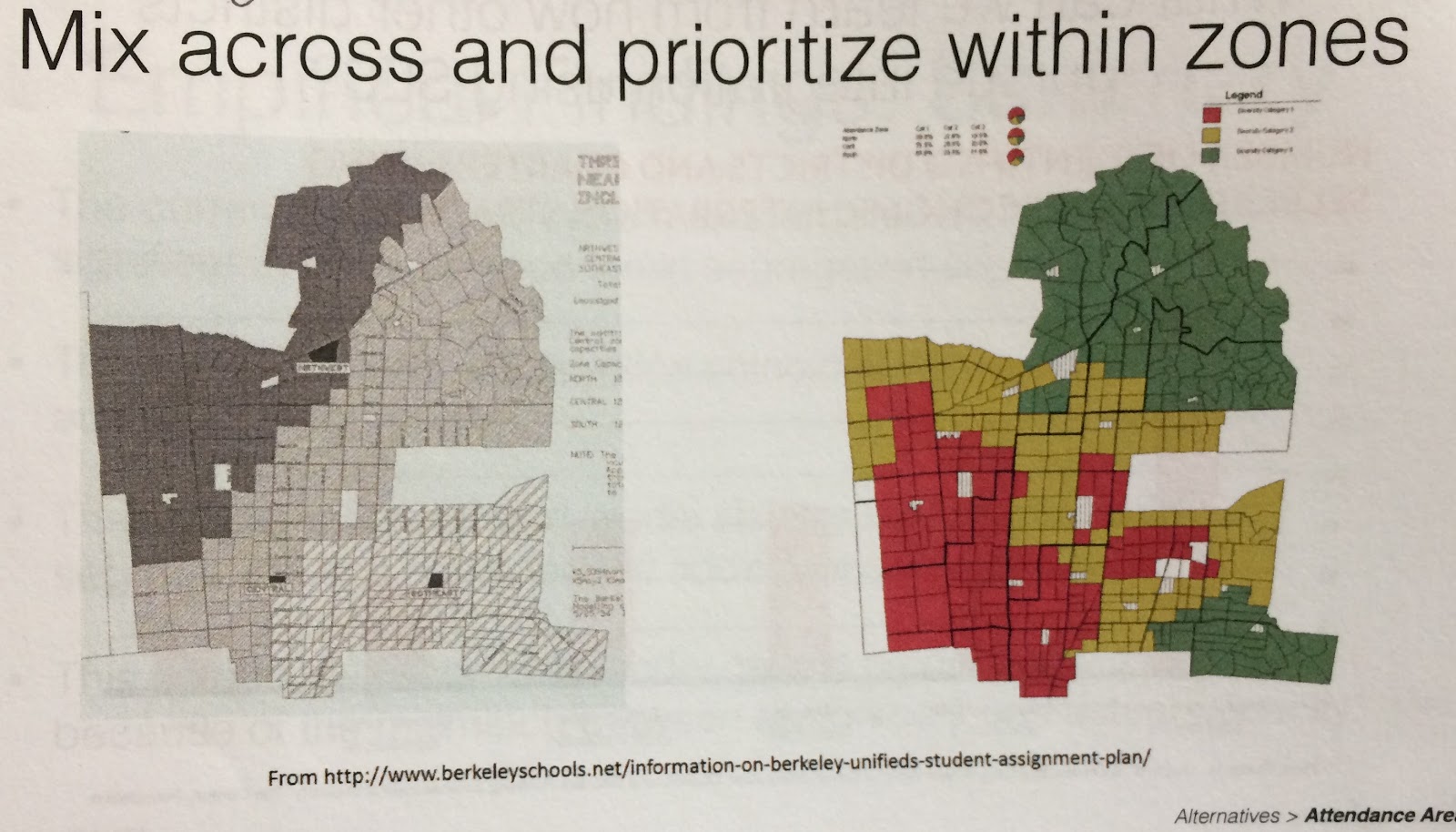
The second half of the presentation focused on other approaches districts take to integrate their schools, including a look at Berkeley’s zone model.
FullSizeRender (6).jpg
A really positive moment came when staff noted that schools and districts which have achieved integration set specific goals and targets.

Will SFUSD do the same?

There was limited parent participation, maybe partly because as one parent testified, the meetings and materials and recordings have not been posted publicaly, despite several requests. However, all the parents who testified called on the district to use the SAS process to integrate schools, which seemed to have a powerful impact!
Commissioners were really responsive to feedback and asked staff to follow-up on getting information online, getting a promise that materials would be up on the website the next day. Commissioner Norton and others articulated that they are not making a proposal that SFUSD move to a neighborhood school assignment system. Commissioner Haney said current levels of segregation are completely unacceptable and that we have a moral imperative to reduce racial isolation. Commissioner Walton turned this sentiment into action by asking staff what it would take to run models of different strategies with a goal of integration, and asking if we could bring in outside partners to help.

Will we do it?

It will take real leadership and consistent work to change from a system with 1960s levels of segregation to an integrated school district. Any changes made this year, or even next year would take 5+ years to roll out, since enrollment for families currently A School Assignment System for 2016 or the 1960s? - SF Public School MomSF Public School Mom


Mike Pence's Voucher Program in Indiana Was a Windfall for Religious Schools | Mother Jones

Mike Pence's Voucher Program in Indiana Was a Windfall for Religious Schools | Mother Jones:

Mike Pence's Voucher Program in Indiana Was a Windfall for Religious Schools
Creationists, Catholics and a madrasa all received taxpayer funding.


One of Vice President-elect Mike Pence's pet projects as governor of Indiana was expanding school choice vouchers, which allow public money to pay for private school tuition. President-elect Donald Trump has said he'd like to expand such vouchers in the rest of the country, but what happened in Indiana should serve as a cautionary tale for Trump and his administration.
Pence's voucher program ballooned into a $135 million annual bonanza almost exclusively benefiting private religious schools—ranging from those teaching the Koran to Christian schools teaching creationism and the Bible as literal truth—at the expense of regular and usually better-performing public schools. Indeed, one of the schools was a madrasa, an Islamic religious school, briefly attended by a young man arrested this summer for trying to join ISIS—just the kind of place Trump's coalition would find abhorrent.
In Indiana, Pence created one of the largest publicly funded voucher programs in the country. Initially launched in 2011 under Republican Gov. Mitch Daniels, it was sold as a way to give poor, minority children trapped in bad public schools a way out. "Social justice has come to Indiana education," Daniels declared after the voucher legislation passed. It was supposed to be a small program, initially capped at 7,500 vouchers. Full vouchers, worth 90 percent of the per-pupil spending in a school district, were reserved for families with incomes up to 100 percent of the cutoff for free or reduced-price school lunch, about $45,000 a year for a family of four.
But in 2013, Pence and the state's GOP-controlled Legislature raised the income limits on the program so that a family of four with up to $90,000 in annual income became eligible for vouchers covering half their private school tuition. They also removed most requirements that students come from a public school to access the vouchers, making families already attending private school eligible for tuition subsidies, thus removing any pretense that the vouchers were a tool to help poor Mike Pence's Voucher Program in Indiana Was a Windfall for Religious Schools | Mother Jones:


Dana Goldstein: How Much Damage Could Trump Do to Public Education?

How Much Damage Could Trump Do to Public Education?:

Will Trump Overhaul Public Education?

From privatization to civil rights, his Department of Education could transform the American system.

ast week, President-elect Donald Trump announced a strongly ideological pick for secretary of education: Michigan philanthropist Betsy DeVos. Unlike the current secretary, John King, or the previous one, Arne Duncan, DeVos has never led a state education department or school district. As an advocate and donor, she has been  committed to the concept of school choice, not necessarily as a driver of improved student achievement—she has supported for-profit and virtual charter schools, as well as private school vouchers, all of which have disappointing academic track records—but to choice as a good in and of itself. DeVos is also a social conservative. She and her husband, Amway heir Dick DeVos, have funded anti–gay marriage and anti–affirmative action efforts. If she is confirmed, which is likely, she will inherit a department that spends $68 billion per year.
As I wrote last week, DeVos will certainly try to direct federal education dollars toward vouchers that parents could use at any school, private or public. However, the work of the Department of Education is much broader than that, encompassing a number of areas, from school discipline to campus sexual assault to pre-K, where DeVos has essentially no record. Trump will have the opportunity to appoint at least seven other high-level officials to the Department of Education, who in turn will hire dozens of political appointees. What could happen to President Obama’s legacy on education, which emphasized civil rights and school accountability? What can the Trump administration do on its own, and what would require action from Congress? The most radical outcome would be a federal government that vastly increases profit-making opportunities in public education while declining to investigate discrimination in schools. But what is actually likely to happen?
To game out the possibilities, I spoke to two experts with deep knowledge of how federal education policy is crafted. Mike Petrilli is president of the Thomas B. Fordham Institute, a center-right education think tank, and from 2001 to 2005 he worked for the Department of Education under President George W. Bush. Andrew Rotherham is the founder of Bellwether Education Partners, a nonprofit consulting firm, and worked for President Bill Clinton from 1999 to 2000 as a special assistant for domestic policy. They both said that many of Obama’s education priorities could be easily reversed, since they were accomplished through executive regulation and letters of guidance, not legislation. And even if Trump and DeVos don’t take decisiveHow Much Damage Could Trump Do to Public Education?:


Did a California Charter School Group Fund an Effort to Overthrow the Turkish Government? | L.A. Weekly

Did a California Charter School Group Fund an Effort to Overthrow the Turkish Government? | L.A. Weekly:
Did a California Charter School Group Fund an Effort to Overthrow the Turkish Government?


More than a dozen times in a single year, Yunus Avcu, a 31-year-old man from Turkey, boarded a commercial flight to John Wayne Airport in Santa Ana carrying a laptop case loaded with cash — between $5,000 and $10,000, he claims. The story of how the money ended up in the bag is complicated, but Avcu says his role in it was simple. At the time, in 2013, Avcu worked as the business manager for the Lotus School for Excellence, a charter school in Aurora, Colorado, with an academic focus on science, math and technology. He says he booked the flights on the school's credit card and flew to Orange County about once a month, to drive the money to an office park in Westminster, which was the West Coast headquarters of what he refers to as simply "the organization."
The name on the lease at the office park was the Accord Institute for Education Research, a nonprofit that advertises itself as a provider of management and education services to charter schools throughout the Western United States.
Avcu says going to the organization was like going home. Turkish men occupied every seat in the conference room. The seats were filled by executives from the Accord Institute, as well as superintendents, principals and business managers from the charter schools that contracted Accord's services. Representatives from the various charters' boards had pooled together to found the Accord Institute, to build on and improve the academic model the charters had developed.
The schools paid hundreds of thousands of taxpayer dollars to Accord for curriculum development and training, as well as administrative services, such as accounting, fiscal planning and grants management.
Avcu says that the executives and officers at the Accord Institute weren't exactly forthcoming with him about what the money he dropped off was for. But he says that, at the meetings, Turkey always seemed to him the overriding concern — trips to Turkey for American dignitaries, Turkish cultural dinners for local officials, and the guarantee that Turkish majorities on the charter schools' boards would hire Turkish principals, who would in turn sponsor the H1B visas for Turkish teachers to come to the United States to work — and, according to Avcu, to make the all-important donations from their salaries to the organization.
According to Avcu, that was the source of the cash he carried. He says that the 11 Turkish teachers and administrators at the Lotus school were obliged to hand it over to him the first week of every month.
Avcu says these payments weren't voluntary; he says the organization also obligated him to return about 40 percent of his own salary every month. He says Accord executives made an Excel spreadsheet at the start of the school year with the salary of every Turkish employee at every school in one column and the amount of money each would owe in another. Avcu says executives determined the amount each Turkish teacher had to return to the organization, based on the employee's seniority, education level, marital status and number of children. "The organization was taking the money from the people," Avcu says. "If you don't pay this money, they don't employ you. If you reject or refuse to pay Did a California Charter School Group Fund an Effort to Overthrow the Turkish Government? | L.A. Weekly:


Reading Betsy DeVos: All About Children? | educarenow

Reading Betsy DeVos: All About Children? | educarenow:

Reading Betsy DeVos: All About Children?


Now that Betsy DeVos has been named the national Secretary of Education, We’re going to have to get used to articles like this“Betsy DeVos is All About Children,” from Ingrid Jacques of the Detroit News.
But that doesn’t mean we have to believe anything about them.
Let me start with my shock that someone like Betsy DeVos could ever be named Secretary of Education. Much has been written about DeVos (see this for one of the best pieces) so I won’t go into it all other than to express my disdain. Really, it seems like getting a position in the Trump administration is like joining a golf club- just do what DeVos has done- pay your fee. Your ability or actual experience are irrelevant if you can afford the position.
As for the Jacques piece, it leaves me a bit flabbergasted. She begins by writing, “… DeVos embodies the principle that the education establishment fears most: school choice.” There’s much truth in that statement. I am scared sh*tless of school choice. (More to follow.) What’s notable here is her use of the phrase, “educational establishment.” This phrase works to bring up echoes of the same kind of intentional language from the right that devalues anything that we all hold in common, language such as “government schools”, and “status quo.” The argument implied by “reformers” like DeVos (and Jacques) is that public education is an institution that has little to do with the needs or learning of children, but rather is about the protection of adult careers. Yes. That is aimed directly at you, dear educator. The implication in the use of the phrase “education establishment” is that you do not care about children, and certainly not as much as Betsy DeVos. That you do not care about learning. That you only care about your big fat pay check, your pension and your summers off. You lazy S.O.B’s. So when you read “education establishment,” replace that with “lazy S.O.B.’s” and you will have an accurate reflection of how you are thought of by Reading Betsy DeVos: All About Children? | educarenow:

Feds: South Carolina law compounds 'school-to-prison pipeline' problem | News | aikenstandard.com

Feds: South Carolina law compounds 'school-to-prison pipeline' problem | News | aikenstandard.com:

Feds: South Carolina law compounds 'school-to-prison pipeline' problem

Image result for 'school-to-prison pipeline'

COLUMBIA — Federal authorities have weighed in on a lawsuit challenging South Carolina's "disturbing schools" law, arguing that the vague statute ends up disproportionately landing minority students and those with disabilities in juvenile jails.
The filing in federal court this week is connected to a controversial 2015 cellphone video of a South Carolina high school student being snatched from her desk by a sheriff's deputy, flipped backward and tossed across a classroom. The images prompted the deputy's firing, sparked national outrage over the use of force on students, and led to a debate on deputies' roles in the classroom.
Earlier this week, the U.S. Justice Department filed what's called a statement of interest in the American Civil Liberties Union's challenge of the law. In a statement announcing the filing, Civil Rights Division chief Vanita Gupta wrote that the arbitrary enforcement of such vague statutes contributes to the "school-to-prison pipeline," which unfairly affects minorities and students with disabilities.
"The criminalization of everyday and ordinary childhood behavior under imprecise statutes can have disastrous and discriminatory consequences," Gupta said. "Laws must provide officers with sufficient guidance to distinguish between innocent and delinquent conduct and ensure that all children receive the full protections of our Constitution."
The ACLU filed its lawsuit in August on behalf of students including Niya Kenny, who in October 2015 videotaped Richland County Deputy Ben Fields flipping another Spring Valley High School student out of her chair and tossing her across a classroom after she refused to surrender her cellphone.
Kenny told the deputy what he was doing was wrong, and she and the other student were arrested and charged with disturbing schools.
Richland County Sheriff Leon Lott swiftly fired Fields, saying the deputy's actions made him want to "throw up" but that the officer shouldn't have ever been called in the first place, saying it is up to educators to manage their classrooms. Local prosecutors ultimately found no probable cause to charge Fields with a crime.
As the ACLU filed its lawsuit, Lott's department reached a settlement with the Justice Department to do its part in ending the "school-to-prison pipeline" by providing intensive annual training for deputies who work in more than 60 schools on how to de-escalate situations, avoid bias and interact properly with disabled students.
The agreement also required the creation of an advisory group including students and parents and the hiring of outside consultants approved by the DOJ to assist with compliance. It settled a civil rights review that began five months before the cellphone video incident went viral.
For his part, Lott has called the "disturbing schools" law "terrible" and "misused and abused." In a statement issued Wednesday, the sheriff called on South Carolina lawmakers to make revising the "disturbing schools" law a priority when they reconvene next year.

Julie Vassilatos: Betsy DeVos and the Zombie Apocalypse | Diane Ravitch's blog

Julie Vassilatos: Betsy DeVos and the Zombie Apocalypse | Diane Ravitch's blog:

Julie Vassilatos: Betsy DeVos and the Zombie Apocalypse


Julie Vassilatos, an activist parent of children in the Chicago public schools, writes here about Betsy DeVos.
She begins by offering a round up of some of the best posts about DeVos. We all must get up to speed on who she is.
In addition to being a fervent advocate for vouchers and charters, she has given generously to anti-gay organizations and organizations that promote creationism. I am trying to imagine what the U.S. Department of Education will do under her leadership backwards.
Julie points out that Arne Duncan paved the way for DeVos. Duncan and his Department made school choice a priority, leaving an opening for the next step, which is vouchers.
She would not have been able to accomplish what she did in Michigan without the federal government’s encouragement of privatization efforts for the past 8 years. She would not now be poised to bring full privatization to the nation if the field had not been tilled for this for the past 8 years. Duncan’s Department of Ed absolutely created the conditions for Betsy DeVos. She may be different in emphasis, but not in kind from Arne Duncan. She touts charters, choice, and competition; Duncan’s Department of Ed touted charters, choice, and competition. She likes vouchers; the Department of Ed never definitively closed the door on vouchers. She has given millions to unregulated charters; so did the Department of Ed. Federal visa policy and the New Market Tax Credit created the conditions to make charters very big–global–business.
All that was settled years ago. Now corporate ed control is poised to succeed in a totalizing way; all that was needed was a billionaire secretary of education who knows absolutely nothing about public education, is purely ideology-driven, and is well-practiced at controlling legislators with her cash.
Don’t fool yourselves–DeVos isn’t the sudden end of the world for public education, like a bomb being dropped. She’s more like the result of a slow-traveling virus or a zombie invasion. Our schools have been in peril for years. Now I think we will be able to see it more clearly. It’s time to get to work.


Mike Klonsky's SmallTalk Blog: The bailout of Exelon nukes comes right out of the schools

Mike Klonsky's SmallTalk Blog: The bailout of Exelon nukes comes right out of the schools:

The bailout of Exelon nukes comes right out of the schools


Jobs creators -- 30 years after the nuclear meltdown, the Great Arch at Chernobyl is finally completed.

Natasha Korecki in this morning's IL Playbook: 

It’s probably fitting that the Legislative veto session concluded Thursday with just about everyone going nuclear. Gov. Bruce Rauner dropped the first bomb by vetoing a Chicago Public Schools bill that blows a $215 million hole into the school’s budget... Then there were the actual nukes. A bitterly divisive Legislature came together to pass a massive bailout of two unprofitable nuclear plants...
Almost the exact amount...

The measure provides Exelon with $235 million a year as a reward for the carbon-free energy its nuclear reactors produce — a prize Exelon argued it was just as entitled to as the "clean" energy producing wind and solar industries. Without the money — financed by an increase in electric rates — the company threatened to close nuclear plants in Clinton and the Quad Cities.
Yes, "carbon-free." Tell it to the people of Fukushima, Chernobyl, or Three Mile Island.  Yes, a taxpayer bailout for nuclear giant Exelon, who raked in $29.45B in revenue last year. Yes, another assault on teacher pension funds.


CPS Board Pres. Frank Clark.
So there you have it. An even swap. Nukes for schools. A win-win for former Exelon CEO Frank Clark who now is president of Chicago's Board of Education and even has a privately-run Noble charter school named after him, as does current Exelon CEO, John Rowe, and Rauner himself.

I'm sure Democrats in the Legislature and environmental Mike Klonsky's SmallTalk Blog: The bailout of Exelon nukes comes right out of the schools:

School District of Philadelphia District-Wide Surveys

SDP District-Wide Surveys:
School District of Philadelphia District-Wide Surveys


NEW! 2015-2016 Data Available


 ABOUT the DISTRICT-WIDE SURVEYS

The results available on this site are from surveys designed to capture feedback from The School District of Philadelphia community on five key topics related to school improvement. Because this feedback provides a more complete picture of Philadelphia schools than relying solely on traditional measures of school success, it can help identify what is working well along with areas that need to be improved.


Why does the School District of Philadelphia have surveys?

The surveys were designed to capture feedback from the school community on five key topics related to school improvement—climate, instruction, leadership, professional capacity, and parent/guardian-community ties. With an eye toward the Action Plan 3.0 goal of creating an equitable system of schools, this feedback provides a more complete picture of Philadelphia schools than relying solely on traditional measures of school success. By considering the perspectives of different groups in a school, this feedback can help pinpoint what is working well in a school along with areas that need to be improved.

What do the surveys measure?

The surveys measure five key topics related to school improvement—climate, instruction, leadership, professional capacity, and parent/guardian-community ties. The surveys were developed using research on effective schools and school reform, particularly the extensive work done by Anthony Bryk and his colleagues (2010) at The University of Chicago Consortium on School Research.
Different groups were asked to provide feedback on different questions across the five topics. Within each topic, the questions were organized by subtopic.

How were these surveys designed?
These surveys were developed by The School District of Philadelphia (SDP) Office of Research and Evaluation (ORE) in collaboration with the University of Pennsylvania Graduate School of Education (Penn GSE), as part of Shared Solutions, the first formal researcher–practitioner partnership between SDP and Penn GSE. Through multiple rounds of focus groups, item testing, and cognitive interviews, stakeholders played a critical role in determining the questions included in the survey, the language used, and the methods of distribution.

Who takes the surveys?

Surveys are made available to students in grades 3-12 attending District public and charter schools, their parents and guardians, teachers, and principals. The surveys are available each year from April through June.

How can people take the survey?

The District administers these surveys each spring. More information on the District’s survey schedule and access to the surveys can be found at http://webgui.phila.k12.pa.us/offices/r/res-eval/district-wide-surveys.

How do you keep results private?

Data privacy is of the utmost importance to our survey efforts. All survey administration and analysis follows The School District of Philadelphia’s Survey Code of Ethics, which is available on the Office of Research and Evaluation’s Survey Website: http://webgui.phila.k12.pa.us/offices/r/res-eval/district-wide-surveys.
The surveys are primarily administered through SurveyMonkey, a company that uses some of the most advanced technology for Internet security that is commercially available (https://www.surveymonkey.com/mp/policy/privacy-policy/). This ensures that user data in transit is safe, secure, and available only to intended recipients. Surveys provided in other formats (e.g., paper copies) are administered according to strict guidelines to ensure confidentiality as well.
To further protect confidentiality, all survey data is combined and aggregated at the school level. Principal survey results are aggregated at a more broad level (i.e., school type, region, etc.).

Where are my school’s results?

Data is only available for schools that meet minimum response thresholds. For student surveys, the minimum number of responses per school is 25 percent of students or 50 students, whichever is greater. For parent/guardian surveys, the threshold is whichever is greater, 5 percent of total enrollment or 25 parents/guardians for the 2014-2015 school year and 10 percent for the 2015-2016 school year. For teacher surveys, a minimum of 20 teachers or 25 percent of total teachers per school must have responded. Principal survey results are only presented in aggregate.SDP District-Wide Surveys:

Not On Survey


Sen. Sessions once linked special education law to ‘decline in civility’ in classrooms - The Washington Post

Sen. Sessions once linked special education law to ‘decline in civility’ in classrooms - The Washington Post:

Sen. Sessions once linked special education law to ‘decline in civility’ in classrooms


Sen. Jeff Session, the Alabama Republican whom President-elect Donald Trump has tapped to be the next attorney general of the United States, once trashed a federal law that was passed to ensure students with disabilities have a free and appropriate public education.
Sessions, who had served as a U.S. attorney and as Alabama’s attorney general, attacked the Individuals With Disabilities in Education Act, known as IDEA, saying, “In fact, it may be the single most irritating problem for teachers throughout America today,” he said in a 2000 speech on the floor of the Senate (see full text below). He read parts of letters he said he had received from teachers and said:
We have created a complex system of federal regulations and laws that have created lawsuit after lawsuit, special treatment for certain children, and that are a big factor in accelerating the decline in civility and discipline in classrooms all over America. I say that very sincerely.
Queries by email and phone about the senator’s current thoughts about IDEA were not answered. Sessions said in the speech that he did not want to end IDEA and noted that he had once taught — he was a Sunday school teacher at his family’s church in Mobile. But he also said:
There is no telling how many instructional hours are lost by teachers in dealing with behavior problems. In times of an increasingly competitive global society it is no wonder American students fall short. Certain children are allowed to remain in the classroom robbing the other children of hours that can never be replaced.
IDEA — first passed in 1990 and reauthorized in 1997 and 2004 — has a handful of central ideas in which students with disabilities are to be provided with:
  • Individual Education Programs (IEP) tailored to their needs.
  • A free and appropriate education.
  • An education in the least restrictive environment, meaning students who can attend mainstream classes with assistance should be enrolled in them.
  • Appropriate evaluation of children to determine their educational needs and associated services.
The law also calls for participation by parents and teachers in the individual students’ education plans, and it spells out a set of procedural safeguards that ensure families can review their Sen. Sessions once linked special education law to ‘decline in civility’ in classrooms - The Washington Post:
Big Education Ape: Historian Assesses Attorney General Nominee, Jeff Sessions’ Civil Rights Legacy | janresseger - http://bigeducationape.blogspot.com/2016/11/historian-assesses-attorney-general.html

Experts Discuss Office for Civil Rights Future Under Trump - The Atlantic

Experts Discuss Office for Civil Rights Future Under Trump - The Atlantic:

What Is the Future of the Office for Civil Rights?
Experts with varying opinions weigh in on what the arm of the Department of Education could look like under Donald Trump and Betsy DeVos.


In the days after the presidential election, news outlets and thousands of educators reported increases in harassment, bullying, and intimidation of students based on race, ethnicity, religion, and gender identity. While schools and colleges are on the frontline in confronting these incidents, one mechanism that for more than 35 years has served to curtail such actions is the Office for Civil Rights (OCR) within the U.S. Department of Education.

The federal agency’s mission is “to ensure equal access to education,” and it’s charged with enforcing laws that prohibit discrimination against marginalized populations—including students of color, religious and gender minorities, and students with disabilities. In recent years OCR has issued guidance to states and local school districts on their legal obligation to meet the educational needs of transgender studentsstudents with ADHD, and youth in juvenile justice facilities; the civil-rights unit also tracks how well public schools and districts nationwide measure up on equity in learning opportunities.


As one president wraps up his term and another takes the reigns, some have speculated on what a Donald Trump administration and Education Secretary-nominee Betsy DeVos foretell for the civil-rights branch given indications that they plan to downsize the department. With many unknowns still in play, The Atlantic invited voices in education representing divergent viewpoints to offer their outlook and prognosis on the Education Department’s civil-rights arm. The responses, via email, have been edited for clarity and length.

Melinda D. Anderson: It would seem that the fundamental work of current OCR—whether focused on sexual harassment and violence, racial bullying, transgender discrimination, or other efforts—is providing equitable learning environments. Could this work look different in the new administration and a DeVos-led Department of Education? If so, how?

Thomas J. Gentzelthe executive director of the National School Boards Association

[Though] the fundamental work of OCR is enforcing civil-rights laws in education, it is the job of school districts to provide equitable learning environments and, ultimately, to balance all of the competing interests so that all students have safe environments in which to learn. NSBA has been concerned Experts Discuss Office for Civil Rights Future Under Trump - The Atlantic:


Ed Notes Online: Buying the So-called Ed Press: Bill and Melinda Drop a Half Million on Chalkbeat

Ed Notes Online: Buying the So-called Ed Press: Bill and Melinda Drop a Half Million on Chalkbeat:

Buying the So-called Ed Press: Bill and Melinda Drop a Half Million on Chalkbeat

Image result for big education news Gates
to inform low-income parents and parents of color in Newark, Detroit, and New York about K-12 education 

$525,042

Sure -- to really "inform" low-income parents of color or to propagandize for ed deform policies of Bill Gates?

I remember back when I used to go to Gotham/Chalkbeat events when we raised questions about their donors the response was that Randi also gives them money and even that I had given them $50. Trying to equivocate what Randi and I might give with Gates alone makes the reporting more than suspect.

I think it important to understand and analyze what biased coverage is and Chalkbeat must be looked at as much as what they don't cover as what they do and how they do or don't do it. We know Gates is against opt out so watch CB coverage of that issue - it will be subtle how they lean in to Gates' issues. And you will never see a word of criticism about all the Gates failures in ed policy. We know Gates is not pro-Trump so we might see a more aggressive crit of Betsy DeVos than we saw about Duncan and King -- even though when you shake those trees a lot of the same crap comes out of the leaves.


Gates Foundation: How We Work

Grant


CHALKBEAT, INC.


October 2016 
to inform low-income parents and parents of color in Newark, Detroit, and New York about K-12 education 
$525,042 
18 
Global Policy & Advocacy 
United States 
New York, New York 
http://www.chalkbeat.org 
http://www.gatesfoundation.org/How-We-Work/Quick-Links/Grants-Database/Grants/2016/10/OPP1159098


 Ed Notes Online: Buying the So-called Ed Press: Bill and Melinda Drop a Half Million on Chalkbeat: