Latest News and Comment from Education

Saturday, November 26, 2016

Yes, Betsy DeVos Can Privatize Large Numbers of Public Schools, with the Help of Red States | Diane Ravitch's blog

Yes, Betsy DeVos Can Privatize Large Numbers of Public Schools, with the Help of Red States | Diane Ravitch's blog:

Yes, Betsy DeVos Can Privatize Large Numbers of Public Schools, with the Help of Red States


Kevin Carey of the New America Foundation wrote an opinion piece in the New York Times, attempting to assuage fears that Betsy DeVos would privatize American schools. If she tries to promote privatization, she is likely to face “disappointment and frustration,” as Carey put it. He believes that the decentralization of American public education will prevent her from imposing privatization. I disagree with Carey, because we have seen state after state, district after district, where “reformers” have passed legislation for charters and vouchers, intended to undermine public schools without the consent of the governed. Massachusetts and Georgia, the only states that voted on whether to have more charters, decisively voted NO. The point of Carey’s article seems to be to persuade readers that charters are swell and vouchers will never happen, that DeVos can’t change much, so relax, privatization is not a threat. Can’t happen. Won’t happen. Trust me.
The New America Foundation, Carey’s employer, has received nearly $10 million from the Gates Foundation since 2009. Not surprisingly, it regularly defends charter schools and the Common Core standards. It  has even urged colleges to adopt the standards now.
Carey previously worked at Education Sector and Education Trust, both Gates-funded and charter-friendly. He tells us that “charter schools are public schools, open to all, accountable in varying degrees to public authorities, and usually run by nonprofit organizations.” Savvy readers of this blog know that charter schools declare that they are private organizations whenever they are sued or when their teachers try to form a union, but they are “public” when it is time to collect government money. They choose their students. They exclude children with severe disabilities and English-language-learners. They kick out troublesome students. In many states, charters are deregulated, unsupervised, and non-accountable. Carey has written favorably about the for-profit Alt-School chain of technology-based private schools (which would be eligible for Trump’s vouchers). Carey joined Eli Broad and every national “reform” group (including TFA, 50CAN, DFER, etc.) to endorse the Obama administration’s plan for “reforming” teacher education. After the 2008 election, he called on Democrats to embrace such “progressive” reforms as charter schools and test-based accountability.*
Carey says not to worry about DeVos’ passion for privatization because most states won’t be able to afford the cost of a universal voucher system. Trump says he will free up $20 billion from existing federal programs, but expects states to chip in another $110 billion. That won’t happen, Carey says, because “states don’t have that kind of money lying around.” Local school districts will resist the diversion of their property taxes. And besides, Betsy DeVos’ state laboratory of free-market reform–Michigan–is hardly a success. 80% of the charters there operate for profit, and Detroit is still a mess, despite a Wild West of charters and competition. Nor have vouchers proved to be a success.
Larded throughout the article is subtle praise for charters. He points out that expansion of charters was voted down in Massachusetts “despite strong evidence that the state’s well-supervised charters produce superior results for low-income and minority schoolchildren.” No mention of the reason that liberal Massachusetts rejected charters: the districts with charters did not want to sacrifice their public schools to the growth of charters, and the districts without charters wanted to protect their public schools. Organized groups of parents rang doorbells and told their friends and neighbors to support their public schools. The defenders of public education were outspent 2-1 by out-of-state billionaires like the Waltons and Michael Bloomberg, but they defeated the charter question by a vote of 68-32%.
Carey exemplifies the new line of “reformers”: charters run by private corporations and private boards are “public” but vouchers are a bad idea. The problem with this logic is that once you start down the road of school choice, it is hard to know when or how to stop. The Obama administration’s advocacy for charter schools greased the wheels for vouchers, some form of which now exist in about half the states.
Yes, we do have to worry about DeVos and Trump’s privatization agenda. If the state is a deep red state, with a Republican governor and a Tea Party legislature, like Indiana and many more, the state may grab whatever the feds offer and supply vouchers to anyone who wants them to use for any purpose, including home schooling and low-quality religious schools. DeVos may open the floodgates to unregulated, for-profit charters, allowing anyone to open a charter who wants to, regardless of their experience or qualifications (like Florida, Michigan, and Nevada). School choice does not have a record of success; charters get mixed results, at best, and vouchers have a record of failure. Even when they produce higher graduation rates, they simultaneously have astonishingly high attrition rates.
Join with the Network for Public Education to fight the DeVos nomination.Democrats, Republicans, and independents must stand together in opposition to this raid on public money. Separation of church and state is part of our heritage as Americans. Public schools that enroll all children–not just those they want–are part of our democracy.
When the federal government turns against public education, as the Trump administration promises to do, that is unprecedented. We don’t need to be soothed and promised that its threats to public education are not real. They are real. They build on the opening to school choice created by the Gates Foundation, the Broad Foundation, the Walton Foundation and the think tanks that they have underwritten as part of their “policy advocacy.”
Parents and educators and concerned citizens must mobilize to oppose the Trump privatization agenda.
*I had my own unfortunate brush with Carey in 2011; I didn’t realize he was a key player in the “reform” movement, and I agreed to an interview. He published a mean-spirited screed about me, taking pot shots at my scholarly works and claiming that I changed my philosophy of education because Joel Klein did not give my partner a job. At the time, I was closeted, and Carey managed to “out” me. My partner already had a high-level job at the Board of Education when Klein arrived and was not in need of a job. So long as she worked at the Board, I was constrained from criticizing Klein or Bloomberg, whose policies of disruption did little to improve education. Once she retired, I was free to write and speak my mind. Yes, they helped me to see the deep flaws of corporate reform, of putting non-educators in charge of schools, of intimidating experienced educators, of trying to run schools like a business, of making test scores the basis for all decisions, but not for the reason Carey and Klein asserted.Yes, Betsy DeVos Can Privatize Large Numbers of Public Schools, with the Help of Red States | Diane Ravitch's blog:


Meet Our New Public Education Personnel: Just Like the Old Ones (Only More So) | educationdc

Meet Our New Public Education Personnel: Just Like the Old Ones (Only More So) | educationdc:

Meet Our New Public Education Personnel: Just Like the Old Ones (Only More So)


Like shifting tides creating debris pools, the changing political winds of this election year have revealed common underpinnings of our public education system.
Let us start with Antwan Wilson, who has been offered the position of DCPS chancellor (albeit without the review of the DCPS Rising Leadership Committee—oops, so much for public engagement required by law).
The city council will hold three public roundtable hearings about Wilson:
Wednesday, November 30, 5 pm, Brookland Middle School, 1150 Michigan Ave NE
Monday, December 5, 5 pm, Benning Neighborhood Library, 3935 Benning Road NE
Thursday, December 8, 10 am, Wilson Building, 1350 Pennsylvania Avenue NW
Sign up for the roundtables is here.
Wilson himself embodies the path of many DC schoolchildren, having grown up with a single mother and attending 10 different (presumably public) schools. As the cross sector task force has examined, students with such high mobility are much more likely to do worse in school.
Wilson served as the head of public schools in Oakland, California, for about 2 years. His resume indicates that he has had many similarly short education stints elsewhere. Wilson’s longest employment appears to be as an administrator in Denver public schools, under the guidance of Denver superintendent Tom Boasberg, himself a proponent of charter schools and school closures—as well as a product of the elite DC private school St. Albans.
Perhaps not coincidentally, Wilson is also the beneficiary of training provided by a billionaire financier of education reform, Eli Broad, whose deep-pocketed foundation has funded a variety of pro-charter and school privatization interests.
Wilson is apparently leaving the Oakland schools mid-year, after making more than $400,000 a year in compensation.
So why take a pay cut to come to DC mid-year? And why the rush, such that the Meet Our New Public Education Personnel: Just Like the Old Ones (Only More So) | educationdc:


What's the worst that could happen under New Ed Secretary Betsy DeVos? Some Scenarios - The Hechinger Report

What's the worst that could happen under New Ed Secretary Betsy DeVos? Some Scenarios - The Hechinger Report:

What’s the worst that could happen under New Ed Secretary Betsy DeVos? Some Scenarios


New York—Thanksgiving is, of course, about giving thanks, while being mindful of an America that has not always treated people fairly. This year, there is a lot to take stock of, as President-elect Donald Trump, in the midst of populating his cabinet, selected Elisabeth (Betsy) DeVos to be his Secretary of Education.
I’ve been joking that Ben Carson – Trump’s pick to be Secretary of Housing and Urban Development – primary qualification is that he grew up in a house. But Betsy DeVos attended private schools and sent her children to them.
Her qualification to be Secretary of Education? She doesn’t even have that going for her.
So what’s the worst that could happen? This question has two distinct connotations. On the one hand, asking “What’s the worst that could happen?” may be a way of sidestepping catastrophic thinking, a common feature of psychological anxiety in which people systematically and irrationally overstate the likelihood of a negative event.
Psychologists treating individuals with this kind of negative thought distortion will help them to challenge the distortions, and to substitute an alternative, rational thought. In this context, asking “What’s the worst that could happen?” is a way of sensitizing people to the fact that the worst-case scenario hasn’t happened to others they know, and is extremely unlikely to happen to them, too.
That’s why I decided to take a hard look at two distinctly possible scenarios of “What’s the worst that could happen?” under a federal Department of Education led by Betsy DeVos.
Scenario #1: DeVos moves quickly to implement President-Elect Trump’s plan to use $20 billion of federal funds for block grants to states to support vouchers for poor children to attend private schools. With support from the Republican majority in Congress, she zeroes out the $15 billion currently allocated to Title I, the federal program devoted to providing equal access to primary and secondary education, particularly for children in poverty. The new initiative has incentives for states to treat the block grants solely as a funding stream and to provide minimal oversight of the schools that students attend with the voucher funds.
As he did on the campaign trail, President-elect Trump calls on states to buttress this $20 billion with $110 billion from their own coffers. His powers of persuasion are great; early successes in the administration give states the confidence that this is a good investment, and they reallocate their budgets to create this larger pool of $130 billion to provide a voucher of approximately $12,000 for every school-aged child in poverty in the U.S. At the state level, funds that were targeted for local education agencies are diverted to vouchers for individual children, a sharp loss in the funding that states historically have provided to school districts.
Money is siphoned from traditional public schools and towards a diverse array of unregulated for-profit and private providers. School quality takes a back seat to marketing, as the only measure of success is a school’s ability to attract students who bring public dollars with them. Schools rely on ridiculous marketing ploys, advertising “themes” and practices designed to draw students.
For example, a private or charter school might advertise its behavioral practices. “The handshake represents the quintessential spirit of [our school],” one might read on a school’s website. “It’s the attribute that leaves an indelible impression upon the business leaders, dignitaries and visitors we’re privileged to host almost daily. But we don’t encourage our students to shake hands just to impress—it goes beyond the first impression to instill an attitude of respect when meeting. Giving students the opportunity to practice this important American cultural norm gives our students the edge in college and in life. In addition, showing respect to our guests models our core values and the more we practice it, the more ingrained into our nature it becomes.”
(This quote, by the way, is taken from the website of the West Michigan Aviation Academy, a charter school founded by Betsy DeVos’ husband Dick. Unlike many charter schools in Michigan, its students are doing pretty well academically.)
Across the country, millions of children enroll in schools whose primary mission is to sustain a flow of dollars, not provide an What's the worst that could happen under New Ed Secretary Betsy DeVos? Some Scenarios - The Hechinger Report:


Privatization and School Buses? Thoughts, Please, Betsy DeVos?

Privatization and School Buses? Thoughts, Please, Betsy DeVos?:

Privatization and School Buses? Thoughts, Please, Betsy DeVos?


The private company that owned the bus involved in Monday’s wreck in Chattanooga that killed five [six] elementary school students has had 142 crashes with injuries and three fatalities in the past 24 months, according to federal records. Here
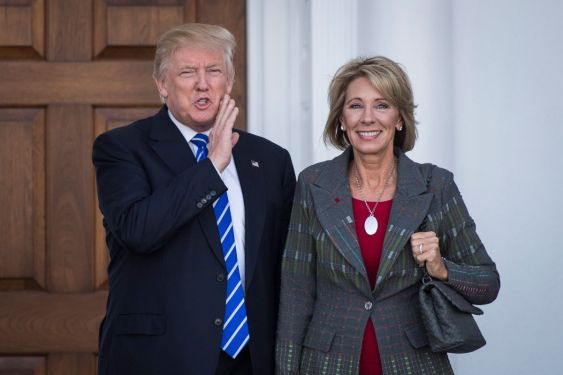
I’m thinking of the pictures this past week of Donald Trump and Betsy DeVos beaming about school choice–vouchers and charters. Do they see any analogy with privatized school bus services?
Both boast they will “go after the status quo” or they will “break the monopoly.” Those are favorite catch phrases having to do with privatization.
This involves loosening rules and regulations in the name of profit and free market–so-called competition. Costs are cut at the bottom so that those at the top can make a profit.
For many years we have watched privatization sneak into schools in various forms. One is privatizing school services. Many school districts now hire outside school bus companies to transport children.
Durham is one of those companies.
The National Education Association (NEA) is a union the privatization enthusiasts Privatization and School Buses? Thoughts, Please, Betsy DeVos?:
The stop sign on a public school bus.

What To Know About Betsy DeVos, Trump’s Education Secretary Pick  | PopularResistance.Org

What To Know About Betsy DeVos, Trump’s Education Secretary Pick  | PopularResistance.Org:

What To Know About Betsy DeVos, Trump’s Education Secretary Pick 

Image result for big education ape devos

President-elect Donald Trump has reportedly tapped Michigan philanthropist Betsy DeVos to be his education secretary.
“I am honored to work with the President-elect on his vision to make American education great again,” DeVos tweeted Wednesday. “The status quo in ed is not acceptable.”
DeVos, an advocate for school vouchers, has chaired the Michigan Republican party and played a key role in some major education policy decisions there in recent years. But unlike former D.C. schools chief Michelle Rhee and charter-school leader Eva Moskowitz, two others Trump considered for the education secretary position, DeVos has kept a relatively low national profile. She has neither worked in public education nor chosen public schools for her own children, who attended private Christian schools.
Earlier this week, Chalkbeat compiled a few things we could reasonably surmise from a DeVos pick:

1. Trump intends to go through with his sweeping voucher plan.

On the campaign trail, Trump vowed to use federal funds to encourage states to make school choice available to all poor students, including through vouchers that allow families to take public funding to private schools.
That’s exactly what DeVos has zealously worked to make happen on a state-by-state basis for decades. In 2000, she helped get a ballot measure before Michigan voters that would have enshrined a right to vouchers in the state’s Constitution. After the measure failed, she and her husband formed a political action committee to support pro-voucher candidates nationally. Less than a decade later, the group counted a 121–60 win-loss record.
One recipient of its support: former Indiana Gov. Mitch Daniels, who created the voucher program that Trump’s vice president-elect, Mike Pence, later expanded. Indeed, DeVos’s vision puts her more in line with Pence, who has supported private school vouchers for both low- and middle-income families, than with Trump, whose plan extends only to poor families.
Trump also vowed to promote publicly funded but privately managed charter schools. But DeVos, whose husband founded an aviation-themed charter school in their hometown of Grand Rapids, Michigan, has expressed reservations about them.
“Charter schools take a while to start up and get operating,” she told Philanthropy Roundtable in 2013. “Meanwhile, there are very good non-public schools, hanging on by a shoestring, that can begin taking students today.”

2. School oversight might not be the education department’s top concern.

DeVos and her husband played a role in getting Michigan’s charter school law passed in 1993, and ever since have worked to protect charters from additional regulation. When Michigan lawmakers this year were considering a measure that would have added oversight for charter schools in Detroit, members of the DeVos family poured $1.45 million into legislators’ campaign coffers — an average of $25,000 a day for seven weeks. Oversight was not included in the final legislation.
The DeVos influence is one reason that Michigan’s charter sector is among the least regulated in the country. Roughly 80 percent of charters in Michigan are run by private companies, far more than in any other state. And state authorities have done little up to now to ensure that charter schools are effectively serving students, eliciting concern from current federal authorities.
“There are a lot of schools that are doing poorly and charter authorizers do not seem to be taking the necessary actions to either improve performance or close those underperforming charters,” current U.S. Secretary of Education John King told Chalkbeat about Michigan last month.
Chalkbeat is an independent nonprofit news organization telling the story of education in America. Support us with a tax-deductible donation today!

3. The Common Core would remain a question mark.

DeVos hasn’t been outspoken about the Common Core, the shared learning standards adopted by most states in recent years. But some of her ties would suggest that she supports the effort to raise and standardize expectations of what students should learn in each grade. She’s on the board of Foundation for Excellence in Education, the group that former Florida Gov. Jeb Bush founded to promote school choice and the Common Core.
On the campaign trail, Trump routinely denounced the standards — despite his having no authority to “repeal” them — in statements that won applause from conservatives and liberal parents and teachers alike. But his transition team said the meeting with DeVos “focused on the Common Core mission, and setting higher national standards and promoting the growth of school choice across the nation.”
The statement suggests a possible effort to achieve the standards’ goals without promoting the Common Core brand — exactly the middle path that many states have chosen as they revise the standards, often only lightly, and rename them.

4. The education secretary won’t be a counterweight to Republican officials.

Trump’s consideration of Moskowitz and Rhee, both self-identified Democrats, raised the hopes of some that the federal education department’s leader could counterbalance some more hard-right administration officials. (It also prompted one prominent education lobbying group to issue a statement calling on Democrats not to take a position in Trump’s administration.)
That hope would evaporate if DeVos is the choice, though there is some evidence that she is less extreme than some of the voices gaining prominence in Trump’s administration so far. For one, she did not support Trump even once he became the presumptive Republican nominee, throwing her vote as a party delegate instead behind Ohio Gov. John Kasich. Two years ago, she also publicly called for a Republican leader in Michigan to step down after he made anti-gay and anti-Muslim comments on social media.
But she is a dyed-in-the-wool Republican party leader who has been more conservative on education issues than some of her colleagues. In fact, DeVos stepped down as chair of Michigan’s Republican party in 2000 after the Republican governor declined to support vouchers. (She later took the position back.)
Outside of education, her family gave heavily to efforts to ban same sex-marriage in Michigan.

5. DeVos will have to operate outside of most of the world she has known.

Many of DeVos’ successes have resulted from using her family’s considerable financial resources. DeVos family foundations reported lifetime charitable giving of more than $1.2 billion earlier this year to institutions ranging from hospitals to arts organizations. Political donations — to oppose gay marriage, support vouchers, and sway lawmakers from increasing oversight to charter schools — came on top of that. As education secretary, she would not be able to rely on her personal wealth and approach to get things done.
Instead, she would have to operate within a complicated web of interests and priorities, including with education officials in states that did not support Trump. Her work up to now has been largely within the Republican Party, but she has expressed confidence in the past about being able to cross party lines.
“What we’ve tried to do is engage with Democrats, to make it politically safe for them to do what they know in their heart of hearts is the right thing,” DeVos said in 2013. “Education should be non-partisan.”What To Know About Betsy DeVos, Trump’s Education Secretary Pick  | PopularResistance.Org:

Secretary of Privatization | Daniel Katz, Ph.D.

Secretary of Privatization | Daniel Katz, Ph.D.:

Secretary of Privatization

For almost 16 years, across two administrations of different parties, America’s teachers have watched federal education officials embrace destructive policies.  President George W. Bush ushered in the era of test and punishment based accountability under the No Child Left Behind Act.  President Barack Obama entered office with promises of relief from unrealistic expectations and punitive incentives – only to double down on testing’s importance by favoring value-added teacher evaluations and to promote privatization through favoritism for the charter school sector which has increasingly placed portions of our educational commons into hands that avoid public oversight.  With a Secretary of Education under President Obama who declared that Hurricane Katrina was the “best thing” to happen to New Orleans schools because the recovery turned the entire city over to privately managed charters, teachers could be forgiven for wondering how anything could get worse regardless of who won the election this month.
it-could-be-worse
god-help-us
its-worse
After floating a raft of names – from former rival and now designated Secretary of Housing and Urban Development Dr. Ben Carson to New York City charter magnate Eva Moskowitz to former Washington D.C. School Chancellor and Patron Saint of Firing Teachers  Michelle Rhee to actually qualified school choice advocate and Hoover Institute Fellow Dr. Williamson Evers – Donald Trump has settled upon Michigan billionaire and school privatization zealot Betsy DeVos as his nominee for Secretary of Education.  Friends have asked me directly what I think about this pick, and I have frankly responded that if Ms. DeVos can accomplish for the nation’s schools what she has manage to do in Michigan by leveraging her fortune to buy her desired results, then we are well and truly Secretary of Privatization | Daniel Katz, Ph.D.:


Pearson Awarded Vendor Status For Delaware Social Studies State Assessment – Exceptional Delaware

Pearson Awarded Vendor Status For Delaware Social Studies State Assessment – Exceptional Delaware:

Pearson Awarded Vendor Status For Delaware Social Studies State Assessment


Pearson has officially entered the world of Delaware standardized tests.  On November 10th, NCS Pearson officially signed a contract with the Delaware Department of Education for a five-year contract worth $6 million to create and deliver the Social Studies state assessment.  This contract will expire on December 31st, 2021.  You won’t find any official news release from the Delaware DOE on this.  I imagine many history teachers across the state will not be too happy to see this news.  The Delaware DOE has used Pearson in the past as a vendor, but never for an official state assessment.  With American Institutes for Research as the Smarter Balanced Assessment vendor for English Language Arts and Math, along with WestEd as the recent awarded vendor for Science, Pearson joins the Delaware state assessment crew.
The Social Studies state assessment will be given to students in 4th, 7th, and presumably 10th grade.  This would follow the former Social Studies DCAS testing delivery method.  Upon reading the contract, it looks like the field tests would begin next year with full implementation in those grades by the 2018-2019 school year.
I was not able to determine whether this test will be a once a year test or a “stealth test” based on the below contract.  Delaware Secretary of Education Godowsky did mention the possibility of this assessment being a “stealth test”.  Those kind of tests are delivered throughout the year in competency-based education environments.  Until a student is considered to “master” the content, they do not move on until they do.
There has been recent talk in Delaware concerning the future of the Smarter Balanced Assessment.  Sources have indicated newly elected Governor John Carney may want to move away from the Smarter Balanced standardized test and may want to engage NWEA for the assessment provider for ELA and Math.  But no matter who the vendor is or what kind of test it is, it would still be based on the Common Core State Standards.  The Every Student Succeeds Act gives states the flexibility to choose their own standards for education, but the Delaware DOE already decided (without any input from stakeholders whatsoever) that Common Core is the way to go.
Pearson beat out American Institutes for Research, Measured Progress Inc., and Strategic Measurement and Evaluation, Inc. to win this contract. Pearson Awarded Vendor Status For Delaware Social Studies State Assessment – Exceptional Delaware:

CURMUDGUCATION: Opposing DeVos

CURMUDGUCATION: Opposing DeVos:

Opposing DeVos


The edubloggochatosphere have pretty much itself up over the designation of Betsy DeVos to the position of Secretary of Education. Oppositions runs across the spectrum, from progressives who are upset by a super-privatizer taking over responsibility for public education to conservatives who thought they were promised an outsidey, drained-swamp, Common Core smasher and instead are looking at an old-swamp, Bush-buddy, Common Core apologist (for what it's worth, I don't see DeVos making any real attempt to defend the Core).

So, how do you like me now?


So what can you do?

First, you can remember that this appointment is not a done deal and is, in fact, subject to the approval of Congress, that other branch of government that is not run by the President.

Second, you can take some easy options. For instance, here's a link to the Network for Public Education, which has once again provided a simple and handy form for contacting your Congressional representative and saying, "Please don't!" The form will provide you with a perfectly swell text, but if you want to add complaints of your own, consider any of the following:

* DeVos is the very model of an establishment big-money Republican-- exactly the sort of people that Trump claimed would NOT be running this administration.

* DeVos has spent her entire adult life tearing down public education. Putting her in charge of public education makes no more sense than putting a draft dodger in charge of the Department of Defense.

* DeVos's ideas about education have been tried, extensively, in Michigan, particularly in Detroit, and they have been disastrous, helping to create one of the worst education messes in the nation with failing and churning charters and grossly undersupported public schools.

* DeVos favors little or not oversight of charter schools, providing the taxpayers with no accountability for how their tax dollars are spent.

* DeVos has no experience working in education or in government. She has literally nothing in her background that would suggest that she could succeed in this job. 

If you're a teacher, you can throw in this one

* I know that this administration is unlikely to choose a secretary that I will whole-heartedly approve, but DeVos is beyond the pale. Her history makes her likely to not just mismanage public education, but to burn it down.

Third, if you'd like to work a little harder at this-- call. There are several resources that will help you find your Congressmen, including this one and this one and this one. (Just to be clear, it's your Senator that will decide the appointment, but it's fair game to let your Representative know so that he can tell your Senator about all the fuss he's hearing). A phone call to the office (short, sweet, to the point, and not ranting like a crazy person) will make more of an impression than an email.

Make no mistake-- Donald Trump is not going to nominate someone for the office that we will all (or even mostly) find a great choice. Face it-- nobody has made a good choice for the office in pretty much ever, and Trump is clearly not the man to break that streak. But there is misguidedly ineffective, and there is aggressively destructive. You will have to make your own call on this-- for me, Betsy DeVos is a far-worse-than-average choice for the office, and I am willing to kick a little to let my elected representatives know it. I have no reason to think we can win on this, but I know two things-- you miss 100% of the shots you don't take, and the loser in the argument always wins the right to say "I told you so" later when they turn out to have been correct all along. 
CURMUDGUCATION: Opposing DeVos:


Jersey Jazzman: What Can We Learn About Betsy DeVos From Her Husband's Charter School?

Jersey Jazzman: What Can We Learn About Betsy DeVos From Her Husband's Charter School?:

What Can We Learn About Betsy DeVos From Her Husband's Charter School?

Image result for airplane movie animated gif autopilot

And so it begins:

It is hard to find anyone more passionate about the idea of steering public dollars away from traditional public schools than Betsy DeVos, Donald J. Trump’s pick as the cabinet secretary overseeing the nation’s education system. 
For nearly 30 years, as a philanthropist, activist and Republican fund-raiser, she has pushed to give families taxpayer money in the form of vouchers to attend private and parochial schools, pressed to expand publicly funded but privately run charter schools, and tried to strip teacher unions of their influence. 
A daughter of privilege, she also married into it; her husband, Dick, who ran unsuccessfully for governor of Michigan a decade ago, is heir to the Amway fortune. Like many education philanthropists, she argues that children’s ZIP codes should not confine them to failing schools. 
But Ms. DeVos’s efforts to expand educational opportunity in her home state of Michigan and across the country have focused little on existing public schools, and almost entirely on establishing newer, more entrepreneurial models to compete with traditional schools for students and money. Her donations and advocacy go almost entirely toward groups seeking to move students and money away from what Mr. Trump calls “failing government schools.”
Yes, elections do have consequences, and while I am much more fearful about what is going to happen to our foreign relations, our economy, and our planet under President Trump (can't get used to saying that...), DeVos's nomination makes clear that public Jersey Jazzman: What Can We Learn About Betsy DeVos From Her Husband's Charter School?: